REVIEW 4 major objections 6 minor 43 references
Industrial brain: a human-like autonomous neuro-symbolic cognitive decision-making system
T0 review · 4 major / 6 minor · reviewed 2026-08-06 · deepseek-v4-flash
Pith's one-line read The paper claims that a neuro-symbolic 'industrial brain' framework, which models industrial-chain nodes as cellular automata driven by Hamilton-equation-like potentials and couples them to a CT-OODA decision loop, predicts and plans…
desk verdict The paper's main empirical claim contradicts its own Table 3, but the conceptual framework is a novel combination worth a serious look. read the letter →
The pith
A machine-rendered reading of the paper's core claim, the machinery that carries it, and where it could break.
The reading
What carries the argument
The central object is the cognitive cellular automaton (CCA), a formal quadruple $\langle C_d, S, N, f \rangle$ where $C_d$ is the symbolic vector space, $S$ the state space (represented via negative entropy), $N$ the adjacency logic, and $f$ the behavioral dynamics function. The evolution is governed by a Hamilton-equation-like potential through equations $dv/dt = \partial \mathcal{H}/\partial s$ and $ds/dt = \partial \mathcal{H}/\partial v$, supplemented by a neural network Hamiltonian $\mathcal{H}_{NN}$. This machinery translates the industrial chain's physical dynamics into a neural network optimization problem, which is then trained via variational EM and fused through multi-head self-attention and gated attention aggregators into a cognitive thought large model. The CT-OODA loop (Observe, Orient, Decide, Act) provides the autonomous decision-making and planning layer.
What would settle it
A concrete test would be to run the same framework on a public benchmark of network resilience (e.g., percolation or cascading failure datasets) and compare against a simpler spectral or mean-field method; if the framework does not outperform those baselines, or if removing the Hamilton-equation terms from equations (1)-(2) does not degrade accuracy, the central mechanism's contribution would be falsified.
Extended reading notes
Core claim
The central claim is that resilience of a giant chaotic industrial chain can be accurately inferred and planned by a neuro-symbolic system that (1) encodes each key element node as a cognitive cellular automaton (CCA) whose state evolution follows a dynamic potential function derived from Hamilton equations, (2) aggregates these automata into cognitive functional network domains using gated attention, and (3) runs a closed-loop CT-OODA autonomous decision-making engine. The paper argues that this combination, unlike end-to-end deep learning or pure LLM reasoning, can reconstruct the spatiotemporal co-evolution structure of the network and predict its resilience from observational data of global variables. Experimental results on a car auto parts industry chain dataset are presented as evidence of higher accuracy, recall, efficiency, adaptability, and interpretability compared with GoT, Auto-CoT, CoT, SOAR, ACT-R, and OlaGPT.
Load-bearing premise
The central premise is that the dynamics of industrial chain nodes can be faithfully captured by a cellular automaton whose evolution follows a Hamilton-equation-like potential, and that this mapping is valid for real-world industrial chains beyond the specific dataset used.
Editorial extensions
If this is right
- If the claims hold, resilience of industrial chains could be predicted and managed autonomously, enabling early warning and reallocation of resources before catastrophic percolation transitions.
- The framework's claimed generalization to unseen topologies and dynamics suggests it could be applied to new industrial settings or supply chain configurations without retraining from scratch.
- The reported improvements over LLM-based reasoning frameworks indicate a potential advantage of hybrid neuro-symbolic approaches over pure LLM prompting for structured dynamic prediction tasks.
- The use of cellular automata and Hamilton-like dynamics could provide interpretable models of how node-level failures propagate to network-level resilience loss.
Reading between the lines
- The causal power of the Hamilton-equation mapping is not externally validated; whether equations (1)-(2) genuinely describe real industrial-chain dynamics remains an assumption, so an ablation that removes the Hamiltonian term would test its necessity.
- The framework's performance is demonstrated on a single car auto parts data set; re-running the same comparisons on public network percolation or supply chain resilience benchmarks would clarify whether the advantage generalizes beyond the presented scenario.
- The CT-OODA loop is essentially a generic closed-loop controller; the distinctive contribution likely lies in the CCA representation, so a direct comparison that fixes the decision loop and varies only the representation would isolate what actually drives the reported gains.
Editorial analysis
A structured set of objections, weighed in public.
Referee Report
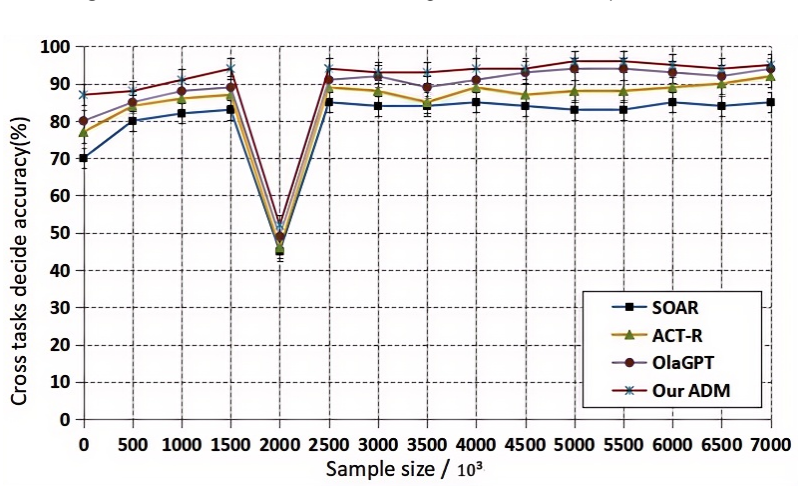
Summary. The paper proposes "industrial brain," a neuro-symbolic framework for resilience prediction and planning in industrial supply chains. The framework combines cognitive cellular automata (CCA) with a CT-OODA-style autonomous decision loop, and the authors claim it outperforms LLM-based reasoning baselines (GoT, CoT, Auto-CoT) and cognitive architectures (SOAR, ACT-R, OlaGPT) on five real data streams from an automotive parts industry chain, with gains up to 10.8% and 11.03%. The manuscript also claims generalization to unseen topologies and robustness to observational disturbances. The central empirical claim, however, is undermined by internal inconsistencies in the reported tables, an undefined key baseline, and a lack of code or data availability.
Significance. If the reported improvements were real and reproducible, this would be a useful contribution to the growing literature on neuro-symbolic reasoning and resilience analysis of complex networks. The combination of cellular-automaton state modeling, gated attention, and an OODA-style control loop is conceptually interesting and goes beyond simple prompt-based reasoning baselines. The paper also attempts to evaluate on a realistic, large-scale industrial dataset, which is a strength. However, the current manuscript does not provide verifiable evidence for its central claims: the DS5 accuracy table directly contradicts the text, the spectral-dimension-reduction baseline cited in the abstract is never defined or measured, and no code, data, or detailed experimental protocol is released. Without these, the claimed significance cannot be assessed.
major comments (4)
- [Section 4.2.3 / Table 3] The claim that CDTLM achieves the highest recognition accuracy on all five real data streams is contradicted by the paper's own Table 3. On DS5, CoT achieves 89.57% ± 0.73% while CDTLM achieves 86.64% ± 0.18%, a gap of roughly 2.9 percentage points that exceeds the reported error bars. Since Table 3 is the primary quantitative evidence for the abstract's claim of significant improvement, this internal inconsistency is load-bearing. The authors must either correct the DS5 entry or revise the claim; a corrected table alone, however, would not resolve the other issues below.
- [Abstract / Section 4.2] The abstract states an 11.03% improvement over "spectral dimension reduction," but no spectral-dimension-reduction baseline is defined in Section 4.2.1, appears in any table, or is mentioned in the experimental discussion. This is a central, unverifiable performance claim. The authors should either add the baseline, its definition, and its results, or remove the claim from the abstract and introduction.
- [Section 3.1.1 / Equations (1)-(2)] The theoretical foundation of the method rests on the assertion that CCA states evolve according to a Hamilton-type system, d v/dt = ∂H/∂s and d s/dt = ∂H/∂v, but the Hamiltonian H is never defined (the symbol is rendered as a blank in the manuscript) and Equation (2) introduces H_NN as a squared difference without specifying H_theta or its relationship to the CCA dynamics. Without a clear definition of the potential function and its connection to the neural network implementation, the central modeling premise is not reproducible and cannot be validated.
- [Section 4.3.2 / Equations (37)-(38)] The definitions of the task-planning metrics are internally inconsistent. Equation (37) and Equation (38) are both labeled with TCR, even though the text says one is TPCR and the other TPSR; the judgment functions are also not written as indicator functions consistently. Because Tables 7 and 8 report these metrics, the reader cannot determine what is actually being measured. The formulas need to be corrected and the notation made consistent.
minor comments (6)
- [Tables 3-6] The table captions say "seven algorithms" but only four columns are shown; the typo "alorithms" also appears in the caption.
- [Section 4.2.1] The baseline list mentions "SC" as a third comparison group, but SC does not appear in any table or figure.
- [Section 4.2.3] The text refers to "Figure X and Figure X" instead of Figures 4 and 5, and the model is called LMACT in one sentence despite being called CDTLM elsewhere.
- [Section 3.2.2] The text contains an unresolved cross-reference, "see Sec.??," which should be filled in or removed.
- [Section 3.1.1] The list of key element nodes has a duplicate item "8) Logistics" and then continues with items 9-12, so the numbering is inconsistent.
- [Section 5] The conclusion states that a tool called "industrial brain" is released for public use, but no code, repository, or data availability statement is provided anywhere in the manuscript.
Circularity Check
No circularity: the framework is a supervised modeling ansatz evaluated on private data; the cited self-work is not load-bearing.
full rationale
No step in the paper's derivation chain reduces by construction to its own inputs. Section 3.1.1 introduces a cellular-automaton representation and a Hamilton-equation-inspired loss (Eqs. 1-2); that is a modeling assumption, not a quantity fitted to the evaluation metric and then reported as a prediction. The experimental section is a standard supervised train/test comparison of accuracy, recall, efficiency, adaptability and planning success on private data streams. The only apparent issue of that kind is internal inconsistency: Table 3 reports CoT on DS5 at 89.57±0.73 vs CDTLM at 86.64±0.18, while Section 4.2.3 states CDTLM is highest on all five streams; however, a contradictory table row is a correctness/reproducibility problem, not a circular definition. The only self-citation, [39] by the first author, appears in the introduction as related work motivating a closed-loop human-level control idea; the proposed CT-OODA module is defined from free-energy [11] and OODA [19] citations and from the paper's own architecture, so the self-citation is not load-bearing. No parameter is fitted to a subset and then reported as a prediction, no uniqueness theorem from the authors' prior work is invoked, and no known result is renamed as a unification in a way that carries the central claim. Thus the paper's central claim is not circular, though its empirical validity is weakened by missing code/data, a non-released 'tool,' and the DS5 contradiction.
Assumptions & free parameters
free parameters (5)
- Trainable weight matrices W_gk in gated attention aggregators =
not specified
- Attention head counts K and K_g =
not specified
- k-space projection dimension =
not specified
- L2 regularization weight lambda in Eq. 34 =
not specified
- Interdependence parameters q_ji in node-level percolation Eq. 35 =
not specified
assumptions (5)
- domain assumption Industrial-chain element nodes can be abstracted as cognitive cellular automata with only 12 fixed types.
- ad hoc to paper The evolution of CCA states obeys a Hamilton-equation-like system d v/dt = dH/ds and d s/dt = dH/dv (Eq. 1).
- domain assumption Resilience state of each element is representable by negative entropy of node states.
- domain assumption Percolation transition equations for interdependent networks (Eq. 35) apply directly to industrial chains.
- standard math Variational EM lower bound (Eq. 4) is the correct learning objective for the CCA graph.
invented entities (4)
-
Cognitive Cellular Automaton (CCA)
-
Cognitive functional network domain
-
Virtual global node (k-space projector)
-
Thought motif (M*_i(K))
Cite this review
Pith. "Pith review of Industrial brain: a human-like autonomous neuro-symbolic cognitive decision-making system." pith.science (2026). https://pith.science/paper/UXSIRELR
@misc{pith2026250623926,
  author       = {Pith},
  title        = {Pith review of: Industrial brain: a human-like autonomous neuro-symbolic cognitive decision-making system},
  year         = {2026},
  howpublished = {\url{https://pith.science/paper/UXSIRELR}},
  note         = {Machine review of arXiv:2506.23926}
}
read the original abstract
Resilience non-equilibrium measurement, the ability to maintain fundamental functionality amidst failures and errors, is crucial for scientific management and engineering applications of industrial chain. The problem is particularly challenging when the number or types of multiple co-evolution of resilience (for example, randomly placed) are extremely chaos. Existing end-to-end deep learning ordinarily do not generalize well to unseen full-feld reconstruction of spatiotemporal co-evolution structure, and predict resilience of network topology, especially in multiple chaos data regimes typically seen in real-world applications. To address this challenge, here we propose industrial brain, a human-like autonomous cognitive decision-making and planning framework integrating higher-order activity-driven neuro network and CT-OODA symbolic reasoning to autonomous plan resilience directly from observational data of global variable. The industrial brain not only understands and model structure of node activity dynamics and network co-evolution topology without simplifying assumptions, and reveal the underlying laws hidden behind complex networks, but also enabling accurate resilience prediction, inference, and planning. Experimental results show that industrial brain significantly outperforms resilience prediction and planning methods, with an accurate improvement of up to 10.8\% over GoT and OlaGPT framework and 11.03\% over spectral dimension reduction. It also generalizes to unseen topologies and dynamics and maintains robust performance despite observational disturbances. Our findings suggest that industrial brain addresses an important gap in resilience prediction and planning for industrial chain.
Figures


Figures from the paper (6 more)



Reference graph
Works this paper leans on
-
[1]
How particular is the physics of the free energy principle
Aguilera, M., Millidge, B., Tschantz, A., Buckley, C.L., 2022. How particular is the physics of the free energy principle. Physics of Life Reviews 40, 24–50
work page 2022
-
[2]
Robustnessandresilience of complex networks
Artime,O.,Grassia,M.,DeDomenico,M.,Gleeson,J.P.,Makse,H.A.,Mangioni,G.,Perc,M.,Radicchi,F.,2024. Robustnessandresilience of complex networks. Nature Reviews Physics 6, 114–131
work page 2024
-
[3]
Bassett, D.S., Sporns, O., 2017. Network neuroscience. Nature neuroscience 20, 353–364
work page 2017
-
[4]
Beaty, R.E., Seli, P., Schacter, D.L., 2019. Network neuroscience of creative cognition: mapping cognitive mechanisms and individual differences in the creative brain. Current opinion in behavioral sciences 27, 22–30
work page 2019
-
[5]
Blach, N., Kubicek, A.a., 2024
Besta, M. Blach, N., Kubicek, A.a., 2024. Graph of thoughts: Solving elaborate problems with large language models, in: Proceedings of the AAAI Conference on Artificial Intelligence., pp. 17682–17690
work page 2024
-
[6]
Theory of percolation on hypergraphs
Bianconi, G., Dorogovtsev, S.N., 2024. Theory of percolation on hypergraphs. Physical Review E. 109, 014–036
work page 2024
-
[7]
Butt, A.J., Butt, N.A., Mazhar, A., Khattak, Z., Sheikh, J.A., 2013. The soar of cognitive architectures, in: 2013 International Conference on Current Trends in Information Technology (CTIT), pp. 135–142
work page 2013
-
[8]
A survey on in-context learning
Dong, Q., Li, L., Dai, D., Zheng, C., Wu, Z., Chang, B., Sun, X., Xu, J., Sui, Z., 2022. A survey on in-context learning. arXiv preprint arXiv:2301.00234 . First Author et al.:Preprint submitted to Elsevier Page 30 of 31 Short Title of the Article
arXiv 2022
Show all 43 references
-
[9]
Deeplogic:jointlearningofneuralperceptionandlogicalreasoning
Duan,X.,Wang,X.,Zhao,P.,Shen,G.,Zhu,W.,2022. Deeplogic:jointlearningofneuralperceptionandlogicalreasoning. IEEETransactions on Pattern Analysis and Machine Intelligence 45, 4321–4334
2022
-
[10]
A data-driven framework for neural field modeling
Freestone, D.R., Aram, P., Dewar, M., Scerri, K., Grayden, D.B., Kadirkamanathan, V., 2011. A data-driven framework for neural field modeling. NeuroImage 56, 1043–1058
2011
-
[11]
A free energy principle for a particular physics
Friston, K., 2019. A free energy principle for a particular physics. arXiv preprint arXiv:1906.10184
2019 arXiv
-
[12]
A free energy principle for the brain
Friston, K., Kilner, J., Harrison, L., 2006. A free energy principle for the brain. Journal of physiology-Paris 100, 70–87
2006
-
[13]
Universal resilience patterns in complex networks
Gao, Jianxi, Barabasi, Albert-Laszlo, Barzel, Baruch, 2016. Universal resilience patterns in complex networks. Nature
2016
-
[14]
Gao,Y.,Feng,Y.,Ji,J.R.,2023.Hgnn+:Generalhypergraphneuralnetworks.IEEETransactionsonPatternAnalysisandMachineIntelligence 45, 3181–3199
2023
-
[15]
A neurosymbolic cognitive architecture framework for handling novelties in open worlds
Goel,S.,Lymperopoulos,P.,Thielstrom,R.,Krause,E.,Feeney,P.,Lorang,P.,Schneider,S.,Wei,Y.,Kildebeck,E.,Goss,S.,etal.,2024. A neurosymbolic cognitive architecture framework for handling novelties in open worlds. Artificial Intelligence 331, 104–111
2024
-
[16]
Probabilistic models of cognition: Exploring representations and inductive biases
Griffiths, T.L., Chater, N., Kemp, C., Perfors, A., Tenenbaum, J.B., 2010. Probabilistic models of cognition: Exploring representations and inductive biases. Trends in cognitive sciences 14, 357–364
2010
-
[17]
temporally interfering electrical stimulation
Guo, W., He, Y., Zhang, W., Sun, Y., Wang, J., Liu, S., Ming, D., 2023. A novel non-invasive brain stimulation technique:“temporally interfering electrical stimulation”. Frontiers in Neuroscience 17, 1092539
2023
-
[18]
Extreme learning machine with randomly assigned rbf kernels
Huang, G.B., Siew, C.K., 2005. Extreme learning machine with randomly assigned rbf kernels. International Journal of Information Technology 11, 16–24
2005
-
[19]
Automating the ooda loop in the age of intelligent machines: reaffirming the role of humans in command-and-control decision-making in the digital age
Johnson, J., 2023. Automating the ooda loop in the age of intelligent machines: reaffirming the role of humans in command-and-control decision-making in the digital age. Defence Studies 23, 43–67
2023
-
[20]
Cognitive computational neuroscience
Kriegeskorte, N., Douglas, P.K., 2018. Cognitive computational neuroscience. Nature neuroscience 21, 1148–1160
2018
-
[21]
Knowing how to plan about planning: Higher-order and meta-level epistemic planning
Li, Y., Wang, Y., 2024. Knowing how to plan about planning: Higher-order and meta-level epistemic planning. Artificial Intelligence 337, 104–233
2024
-
[22]
Deep learning resilience inference for complex networked systems
Liu, C., Xu, F., Gao, C., Wang, Z., Li, Y., Gao, J., 2024. Deep learning resilience inference for complex networked systems. Nature Communications 15
2024
-
[23]
Neurodynamicapproachestomultipleconstraineddistributedresourceallocationwithplannedorself-regulated demand
Luan,L.,Li,H.,Qin,S.,2023. Neurodynamicapproachestomultipleconstraineddistributedresourceallocationwithplannedorself-regulated demand. IEEE Transactions on Industrial Informatics
2023
-
[24]
The physics of brain network structure, function and control
Lynn, C.W., Bassett, D.S., 2019. The physics of brain network structure, function and control. Nature Reviews Physics. 1, 318–332
2019
-
[25]
Mllib: Machine learning in apache spark
Meng, X., Bradley, J., Yavuz, B., Sparks, E., Venkataraman, S., Liu, D., Freeman, J., Tsai, D., Amde, M., Owen, S., et al., 2016. Mllib: Machine learning in apache spark. Journal of Machine Learning Research 17, 1–7
2016
-
[26]
On the theory of strategic voting
Myatt, D.P., 2007. On the theory of strategic voting. The Review of Economic Studies 74, 255–281
2007
-
[27]
Densetraining,sparseinference:Rethinkingtraining of mixture-of-experts language models
Pan,B.,Shen,Y.,Liu,H.,Mishra,M.,Zhang,G.,Oliva,A.,Raffel,C.,Panda,R.,2024. Densetraining,sparseinference:Rethinkingtraining of mixture-of-experts language models. arXiv preprint arXiv:2404.05567
2024 arXiv
-
[28]
Immunoregulators in the nervous system
Plata-Salamán, C.R., 1991. Immunoregulators in the nervous system. Neuroscience & Biobehavioral Reviews 15, 185–215
1991
-
[29]
Ritter,F.E.,Tehranchi,F.,Oury,J.D.,2019.Act-r:Acognitivearchitectureformodelingcognition.WileyInterdisciplinaryReviews:Cognitive Science 10, e1488
2019
-
[30]
Cellularautomatamodelsforthesimulationofreal-worldurbanprocesses:Areview and analysis
Santé,I.,García,A.M.,Miranda,D.,Crecente,R.,2010. Cellularautomatamodelsforthesimulationofreal-worldurbanprocesses:Areview and analysis. Landscape and urban planning 96, 108–122
2010
-
[31]
Sarker, M. K. Zhou, L., Eberhart, A., 2021. Neuro-symbolic artificial intelligence. AI Communications. 34, 197–209
2021
-
[32]
Sunfloor 3d: A tool for networks on chip topology synthesis for 3-d systems on chips
Seiculescu, C., Murali, S., Benini, L., De Micheli, G., 2010. Sunfloor 3d: A tool for networks on chip topology synthesis for 3-d systems on chips. IEEE Transactions on Computer-Aided Design of Integrated Circuits and Systems 29, 1987–2000
2010
-
[33]
Autonomous learning of assembly tasks from the corresponding disassembly tasks, in: 2019 IEEE-RAS 19th International Conference on Humanoid Robots (Humanoids), pp
Simonič, M., Žlajpah, L., Ude, A., Nemec, B., 2019. Autonomous learning of assembly tasks from the corresponding disassembly tasks, in: 2019 IEEE-RAS 19th International Conference on Humanoid Robots (Humanoids), pp. 230–236
2019
-
[34]
Improving supply chain resilience through industry 4.0: A systematic literature review under the impressions of the covid-19 pandemic
Spieske, A., Birkel, H., 2021. Improving supply chain resilience through industry 4.0: A systematic literature review under the impressions of the covid-19 pandemic. Computers & Industrial Engineering 158, 107–452
2021
-
[35]
Bianconi, G., 2021
Sun, H. Bianconi, G., 2021. Higher-order percolation processes on multiplex hypergraphs. Physical Review E. 104, 034306
2021
-
[36]
Mao, C., Liu, G., 2017
Teng, Y. Mao, C., Liu, G., 2017. Analysis of stakeholder relationships in the industry chain of industrialized building in china. Journal of Cleaner Production. 152, 387–398
2017
-
[37]
Dynamics of infantile myoclonic encephalopathy
Verma, V., 2024. Dynamics of infantile myoclonic encephalopathy. bioRxiv , 2024–03
2024
-
[38]
Uncertainty-basedactivelearningviasparsemodelingforimageclassification
Wang,G.Hwang,J.,N.Rose,C.e.a.,2018. Uncertainty-basedactivelearningviasparsemodelingforimageclassification. IEEETransactions on Image Processing 28, 316–329
2018
-
[39]
Multitask policy adversarial learning for human-level control with large state spaces
Wang, J.P., Shi, Y.K., Zhang, W.S., Thomas, I., Duan, S.H., 2018. Multitask policy adversarial learning for human-level control with large state spaces. IEEE Transactions on Industrial Informatics 15, 2395–2404
2018
-
[40]
Wang, X., Schuurmans, D.e.a., 2022
Wei, J. Wang, X., Schuurmans, D.e.a., 2022. Chain-of-thought prompting elicits reasoning in large language models. Advances in neural information processing systems. 35, 24824–24837
2022
-
[41]
Wu, P., 2023. Pytorch 2.0: The journey to bringing compiler technologies to the core of pytorch (keynote), in: Proceedings of the 21st ACM/IEEE International Symposium on Code Generation and Optimization, pp. 1–11
2023
-
[42]
Olagpt: Empowering llms with human-like problem-solving abilities
Xie, Y., Xie, T., Lin, M., Wei, W., Li, C., Kong, B., Chen, L., Zhuo, C., Hu, B., Li, Z., 2023. Olagpt: Empowering llms with human-like problem-solving abilities. arXiv preprint arXiv:2305.16334
2023 arXiv
-
[43]
Star: Self-taught reasoner
Zelikman, E., Wu, Y., Goodman, N.D., 2022. Star: Self-taught reasoner. arXiv preprint arXiv:2203.14465 . First Author et al.:Preprint submitted to Elsevier Page 31 of 31
2022 arXiv
Reviewed August 6, 2026 · model on record in the stance chip above.
Discussion (0). Continue with ORCID to comment.