REVIEW 2 major objections 5 minor 52 references
A Small-Throat Boundary Condition for the Tunneling Wave Function of the Universe
T0 review · 2 major / 5 minor · reviewed 2026-07-13 · grok-4.5
Pith's one-line read The tunneling wave function of the universe is recovered as the limit of tunneling from an arbitrarily small finite throat, not by a boundary condition at vanishing geometry.
desk verdict Solid minisuperspace construction that recovers the tunneling wave function as a controlled small-throat limit; the math holds, the modeling gap is acknowledged and not fatal. read the letter →
The pith
A machine-rendered reading of the paper's core claim, the machinery that carries it, and where it could break.
The reading
What carries the argument
The small-throat cycle D_ε: a relative one-cycle in the punctured disk 0 < |qi| < R_ε = √(ε)/H that forces the Neumann condition q̇(0)=0, selects the Riemann sheet of the inner-to-outer branch cut, and excludes the unsuppressed outer turning-point saddle before the saddle-point approximation is performed.
What would settle it
Construct an explicit two-sided wormhole or parent-universe path integral whose throat is supported by radiation or charge; show that the induced integration cycle for the remaining half-geometry is not the relative cycle inside 0 < |qi| < √(ε)/H, or that its ε o 0 limit fails to recover the standard tunneling exponent 4π^{2}/H^{2}.
Extended reading notes
Core claim
After a finite-ε radiation model is equipped with the Neumann condition q̇(0)=0 and with the initial size restricted to the relative cycle inside the punctured disk 0 < |qi| < √(ε)/H that contains the inner turning point, the subsequent limit ε → 0 collapses that domain to qi o 0 and reduces the saddle action to the standard pure-de-Sitter tunneling wave function exp(-4π^{2}/H^{2} - i Φ).
Load-bearing premise
That a homogeneous radiation term of strength ε together with the postulated small relative cycle around the origin is a faithful model of a throat pinching off from a parent universe, so that the ε o 0 limit after the finite problem is defined really yields the correct creation-from-nothing wave function.
Signed reviews
Editorial analysis
A structured set of objections, weighed in public.
Referee Report
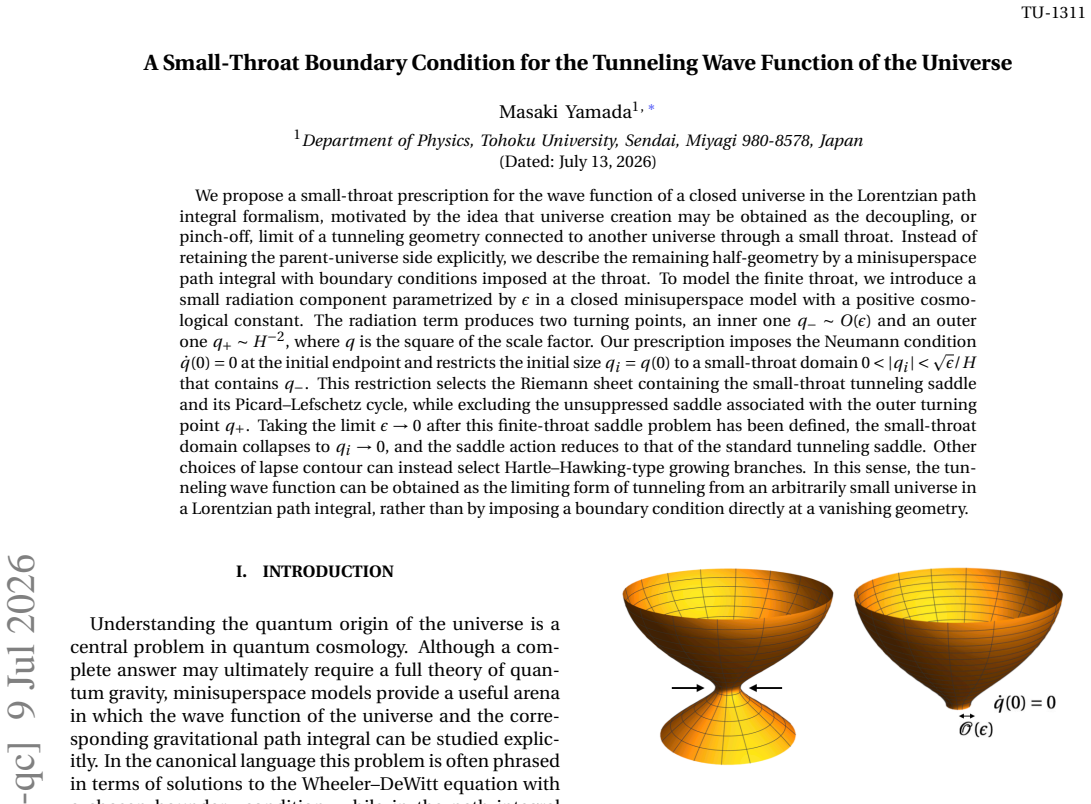
Summary. The paper proposes a small-throat prescription for the tunneling wave function of a closed universe in the Lorentzian path integral. Motivated by pinch-off of a throat connecting to a parent spacetime, it models a finite throat by a small radiation component ε in closed de Sitter minisuperspace (variable q=a^{2}). This produces turning points q_-∼O(ε) and q_+∼H^{-2}. The prescription integrates the initial size q_i over a relative cycle D_ε in the punctured disk 0<|q_i|<R_ε=√(ε)/H (containing q_- but not q_+), which induces the Neumann condition q̇(0)=0 and selects the Riemann sheet of the small-throat tunneling saddle while excluding the unsuppressed outer saddle. After the finite-ε problem is defined, the limit ε o0 collapses D_ε to q_i o0 and recovers the standard pure-de-Sitter tunneling exponent B=4π^{2}/H^{2} plus the usual Lorentzian WKB phase. Analytic on-shell actions (via elliptic integrals) and numerical Picard–Lefschetz maps of the multi-valued map q_i o N support the construction; other lapse contours can select Hartle–Hawking-type branches.
Significance. If the construction is accepted as a legitimate effective description, it supplies a concrete Lorentzian path-integral realization of the tunneling wave function as a decoupling limit of tunneling from a small but finite universe, rather than as a boundary condition imposed directly at a vanishing geometry. The analytic reduction of B_ε and Φ_ε to the pure-de-Sitter values (Eqs. 63–65) is parameter-free once the finite-ε saddle problem is set, and the numerical sampling of the complex-N plane (Figs. 3–4) gives concrete evidence that the small-disk restriction selects the desired sheet and excludes the outer unsuppressed saddle. The discussion of inverse-Gaussian perturbations (Sec. VI) is a potentially useful byproduct: at finite ε the background is an ordinary finite-throat tunneling problem, so regular boundary conditions for fluctuations may avoid the singular zero-size branch. The work is limited to homogeneous minisuperspace and does not derive D_ε from a two-sided geometry, but within that scope it is a clear, self-contained contribution to the contour/saddle literature on Lorentzian quantum cosmology.
major comments (2)
- Sec. II.B and Sec. VI: the relative cycle D_ε in 0<|q_i|<R_ε is postulated rather than derived from a two-sided wormhole or parent-universe path integral. The paper is explicit that this is an effective half-geometry model, so there is no internal inconsistency, but the central physical claim (that the ε o0 limit after defining the finite-throat problem yields the correct creation-from-nothing wave function) rests on this modeling assumption. A short additional argument or toy two-sided calculation showing that the inversion scale R_ε=√(q_-q_+) and the relative cycle arise naturally would substantially strengthen the claim; without it the result remains a consistent effective prescription rather than a derivation from a parent geometry.
- Sec. VI (final paragraphs): the suggestion that the prescription resolves the unsuppressed/inverse-Gaussian perturbation problem is plausible but not demonstrated. At finite ε the background is regular, yet no fluctuation analysis or mode boundary conditions are given. Either a brief one-loop sketch (or a clear statement that the claim is only heuristic and deferred) is needed so that the reader can judge whether the expectation is supported or merely hoped for.
minor comments (5)
- Eqs. (35)–(37) and Fig. 2: the branch conventions for (s,η) and the detour around q=0 for Re[q_i]≤0 are clear in principle but dense; a short explicit statement of which combination yields the tunneling saddle (s=η=1) earlier in Sec. III would help the reader track the multi-valued map.
- Figs. 3–4: the dense labeling (D_i, A_i, L_i, R_{1+}, R_{2+}, etc.) is hard to parse at a glance. A short legend or a sentence in the caption listing which curves are the Picard–Lefschetz thimbles for the tunneling saddle would improve readability.
- Footnote 2 and the surrounding text: the distinction between the minisuperspace Neumann condition q̇(0)=0 and covariant Neumann/Robin prescriptions is important and well taken; a single clarifying sentence in the main text (not only the footnote) would prevent misreading by readers familiar with the no-boundary Neumann literature.
- Sec. IV.D, Eq. (81): the pure-de-Sitter initial derivative for the outgoing branch is quoted for contrast; stating the convention for the square-root branch of √(H^{2}q_1-1) would make the comparison fully self-contained.
- References: the recent Euclidean wormhole/throat papers (e.g. Lavrelashvili–Lehners) are cited; a brief remark on whether any of those geometries already exhibit an inversion scale analogous to R_ε would connect the effective model more tightly to the motivating literature.
Circularity Check
No significant circularity: the finite-ε Neumann+small-disk construction is an auxiliary regulator whose ε o0 limit recovers the known pure-de-Sitter tunneling exponent by direct evaluation, not by fitting or self-definition of the target.
full rationale
The paper's central claim is a proposed boundary prescription (Neumann ṋq(0)=0 plus relative cycle D_ε inside the punctured disk 0<|q_i|<R_ε=√(ε)/H that contains the radiation-induced inner turning point q_-) whose on-shell action, after the finite-ε saddle problem is defined, reduces analytically in the limit ε o0 to the standard tunneling exponent B=4π^{2}/H^{2} plus the usual Lorentzian WKB phase (Eqs. 52–65). This is a self-contained minisuperspace calculation: the first integral, branch structure, elliptic-integral expressions for B_ε and Φ_ε, and the collapse of D_ε o{0} are derived from the action (5)–(7) without external data fits. Self-citations (e.g. to Vilenkin–Yamada tunneling papers and the author's prior regularization work) supply background motivation and a remark on fluctuations, but are not load-bearing for the saddle selection or the limit; the Picard–Lefschetz numerics (Figs. 3–4) independently confirm exclusion of the outer unsuppressed saddle. The construction is intentionally engineered to select the desired sheet, which is ordinary for a boundary-condition proposal rather than a circular derivation of a new quantitative prediction. Score 1 only for the minor presence of author-overlapping citations that do not force the result.
Assumptions & free parameters
free parameters (1)
- ε (radiation strength)
assumptions (4)
- domain assumption Closed FLRW minisuperspace with metric ds^{2}=-N^{2}/q dt^{2} + q dΩ_{3}^{2} and action (5) is sufficient to capture the essential saddle structure of the tunneling wave function.
- domain assumption Picard–Lefschetz theory correctly selects the relevant complex-lapse contours for the oscillatory Lorentzian path integral.
- ad hoc to paper A homogeneous radiation component parametrized by ε models a finite throat whose pinch-off limit yields universe creation.
- ad hoc to paper The relative cycle D_ε in the punctured disk 0<|qi|<R_ε is the correct integration domain that selects the small-throat tunneling sheet.
invented entities (2)
-
small-throat relative cycle D_ε
-
radiation-induced finite throat (inner turning point q_-)
Cite this review
Pith. "Pith review of A Small-Throat Boundary Condition for the Tunneling Wave Function of the Universe." pith.science (2026). https://pith.science/paper/UZ253CB6
@misc{pith2026260708815,
  author       = {Pith},
  title        = {Pith review of: A Small-Throat Boundary Condition for the Tunneling Wave Function of the Universe},
  year         = {2026},
  howpublished = {\url{https://pith.science/paper/UZ253CB6}},
  note         = {Machine review of arXiv:2607.08815}
}
abstract
We propose a small-throat prescription for the wave function of a closed universe in the Lorentzian path integral formalism, motivated by the idea that universe creation may be obtained as the decoupling, or pinch-off, limit of a tunneling geometry connected to another universe through a small throat. Instead of retaining the parent-universe side explicitly, we describe the remaining half-geometry by a minisuperspace path integral with boundary conditions imposed at the throat. To model the finite throat, we introduce a small radiation component parametrized by $\epsilon$ in a closed minisuperspace model with a positive cosmological constant. The radiation term produces two turning points, an inner one $q_-\sim O(\epsilon)$ and an outer one $q_+\sim H^{-2}$, where $q$ is the square of the scale factor. Our prescription imposes the Neumann condition $\dot q(0)=0$ at the initial endpoint and restricts the initial size $q_i=q(0)$ to a small-throat domain $0<|q_i|<\sqrt{\epsilon}/H$ that contains $q_-$. This restriction selects the Riemann sheet containing the small-throat tunneling saddle and its Picard--Lefschetz cycle, while excluding the unsuppressed saddle associated with the outer turning point $q_+$. Taking the limit $\epsilon\to0$ after this finite-throat saddle problem has been defined, the small-throat domain collapses to $q_i \to 0$, and the saddle action reduces to that of the standard tunneling saddle. Other choices of lapse contour can instead select Hartle--Hawking-type growing branches. In this sense, the tunneling wave function can be obtained as the limiting form of tunneling from an arbitrarily small universe in a Lorentzian path integral, rather than by imposing a boundary condition directly at a vanishing geometry.
Figures


Figures from the paper (1 more)

Reference graph
Works this paper leans on
-
[1]
B. S. DeWitt,Quantum Theory of Gravity. 1. The Canonical Theory,Phys. Rev.160(1967) 1113
1967
-
[2]
J. B. Hartle and S. W . Hawking,Wave Function of the Universe, Phys. Rev. D28(1983) 2960
1983
-
[3]
Vilenkin,The Birth of Inflationary Universes,Phys
A. Vilenkin,The Birth of Inflationary Universes,Phys. Rev. D 27(1983) 2848
1983
-
[4]
Vilenkin,Quantum Creation of Universes,Phys
A. Vilenkin,Quantum Creation of Universes,Phys. Rev. D30 (1984) 509
1984
-
[5]
A. D. Linde,Quantum Creation of the Inflationary Universe, Lett. Nuovo Cim.39(1984) 401
1984
-
[6]
V . A. Rubakov,Quantum Mechanics in the Tunneling Universe,Phys. Lett. B148(1984) 280
1984
-
[7]
Y. B. Zeldovich and A. A. Starobinsky,Quantum creation of a universe in a nontrivial topology,Sov. Astron. Lett.10(1984) 135
1984
-
[8]
Vilenkin,Boundary Conditions in Quantum Cosmology, Phys
A. Vilenkin,Boundary Conditions in Quantum Cosmology, Phys. Rev. D33(1986) 3560
1986
Show all 52 references
-
[9]
Vilenkin,Quantum Cosmology and the Initial State of the Universe,Phys
A. Vilenkin,Quantum Cosmology and the Initial State of the Universe,Phys. Rev. D37(1988) 888
1988
-
[10]
Vilenkin,Approaches to quantum cosmology,Phys
A. Vilenkin,Approaches to quantum cosmology,Phys. Rev. D 50(1994) 2581 [gr-qc/9403010]
1994 arXiv
-
[11]
Louko,Propagation Amplitude in Homogeneous Quantum Cosmology,Class
J. Louko,Propagation Amplitude in Homogeneous Quantum Cosmology,Class. Quant. Grav.4(1987) 581
1987
-
[12]
J. J. Halliwell and J. Louko,Steepest Descent Contours in the Path Integral Approach to Quantum Cosmology. 1. The De Sitter Minisuperspace Model,Phys. Rev. D39(1989) 2206
1989
-
[13]
J. J. Halliwell and J. B. Hartle,Integration Contours for the No Boundary Wave Function of the Universe,Phys. Rev. D41 (1990) 1815
1990
-
[14]
J. D. Brown and E. A. Martinez,Lorentzian Path Integral for Minisuperspace Cosmology,Phys. Rev. D42(1990) 1931
1990
-
[15]
Feldbrugge, J.-L
J. Feldbrugge, J.-L. Lehners and N. Turok,Lorentzian Quantum Cosmology,Phys. Rev. D95(2017) 103508 [1703.02076]
2017 arXiv
-
[16]
G. W . Gibbons, S. W . Hawking and M. J. Perry,Path Integrals and the Indefiniteness of the Gravitational Action,Nucl. Phys. 10 B138(1978) 141
1978
-
[17]
Honda, H
M. Honda, H. Matsui, K. Okabayashi and T . Terada, Resurgence in Lorentzian quantum cosmology: No-boundary saddles and resummation of quantum gravity corrections around tunneling saddle points,Phys. Rev. D110(2024) 083508 [2402.09981]
2024 arXiv
-
[18]
Chou and J
C.-Y. Chou and J. Nishimura,Monte Carlo studies of quantum cosmology by the generalized Lefschetz thimble method,JHEP 05(2025) 142 [2407.17724]
2025 arXiv
-
[19]
Diaz Dorronsoro, J
J. Diaz Dorronsoro, J. J. Halliwell, J. B. Hartle, T . Hertog and O. Janssen,Real no-boundary wave function in Lorentzian quantum cosmology,Phys. Rev. D96(2017) 043505 [1705.05340]
2017 arXiv
-
[20]
Diaz Dorronsoro, J
J. Diaz Dorronsoro, J. J. Halliwell, J. B. Hartle, T . Hertog, O. Janssen and Y. Vreys,Damped perturbations in the no-boundary state,Phys. Rev. Lett.121(2018) 081302 [1804.01102]
2018 arXiv
-
[21]
Janssen, J
O. Janssen, J. J. Halliwell and T . Hertog,No-boundary proposal in biaxial Bianchi IX minisuperspace,Phys. Rev. D 99(2019) 123531 [1904.11602]
2019 arXiv
-
[22]
J.-y. Hong, A. Vilenkin and S. Winitzki,Creation of massive particles in a tunneling universe,Phys. Rev. D68(2003) 023521 [gr-qc/0305025]
2003 arXiv
-
[23]
Vilenkin and M
A. Vilenkin and M. Yamada,Tunneling wave function of the universe,Phys. Rev. D98(2018) 066003 [1808.02032]
2018 arXiv
-
[24]
Lavrelashvili and J.-L
G. Lavrelashvili and J.-L. Lehners,Nucleating an Inflationary Universe: Euclidean Wormholes and their No-Boundary Limit,2603.11003
-
[25]
Lavrelashvili and J.-L
G. Lavrelashvili and J.-L. Lehners,Birth of Inflationary Universes via Wineglass Wormholes and their No-Boundary Relatives,2605.10548
-
[26]
S. B. Giddings and A. Strominger,Axion Induced Topology Change in Quantum Gravity and String Theory,Nucl. Phys. B 306(1988) 890
1988
-
[27]
G. V . Lavrelashvili, V . A. Rubakov and P . G. Tinyakov,Loss of Quantum Coherence Due to Topological Changes: A Toy Model,Mod. Phys. Lett. A3(1988) 1231
1988
-
[28]
V . A. Rubakov and P . G. Tinyakov,Gravitational Instantons and Creation of Expanding Universes,Phys. Lett. B214(1988) 334
1988
-
[29]
Jonas, G
C. Jonas, G. Lavrelashvili and J.-L. Lehners,Zoo of axionic wormholes,Phys. Rev. D108(2023) 066012 [2306.11129]
2023 arXiv
-
[30]
Betzios and O
P . Betzios and O. Papadoulaki,Inflationary Cosmology from Anti-de Sitter Wormholes,Phys. Rev. Lett.133(2024) 021501 [2403.17046]
2024 arXiv
-
[31]
Lan and Y.-S
Q.-Y. Lan and Y.-S. Piao,Prepare inflationary universe via the Euclidean charged wormhole,2411.13844
-
[32]
Betzios, I
P . Betzios, I. D. Gialamas and O. Papadoulaki,Magnetic anti–de Sitter wormholes as seeds for Higgs inflation,Phys. Rev. D111(2025) 123542 [2412.03639]
2025 arXiv
-
[33]
Betzios, P
P . Betzios, P . Ghiringhelli, I. D. Gialamas and O. Papadoulaki, A Menagerie of Wormholes and Cosmologies in the Gravitational Path Integral,2602.23432
-
[34]
Di Tucci and J.-L
A. Di Tucci and J.-L. Lehners,No-Boundary Proposal as a Path Integral with Robin Boundary Conditions,Phys. Rev. Lett.122(2019) 201302 [1903.06757]
2019 arXiv
-
[35]
Di Tucci, J.-L
A. Di Tucci, J.-L. Lehners and L. Sberna,No-boundary prescriptions in Lorentzian quantum cosmology,Phys. Rev. D 100(2019) 123543 [1911.06701]
2019 arXiv
-
[36]
Di Tucci, M
A. Di Tucci, M. P . Heller and J.-L. Lehners,Lessons for quantum cosmology from anti–de Sitter black holes,Phys. Rev. D102(2020) 086011 [2007.04872]
2020 arXiv
-
[37]
Krishnan and A
C. Krishnan and A. Raju,A Neumann Boundary Term for Gravity,Mod. Phys. Lett. A32(2017) 1750077 [1605.01603]
2017 arXiv
-
[38]
Yamada,New regularization scheme for the wave function of the Universe in the Lorentzian path integral,Phys
M. Yamada,New regularization scheme for the wave function of the Universe in the Lorentzian path integral,Phys. Rev. D 113(2026) 063547 [2511.09621]
2026
-
[39]
Lehners,Wave function of simple universes analytically continued from negative to positive potentials,Phys
J.-L. Lehners,Wave function of simple universes analytically continued from negative to positive potentials,Phys. Rev. D 104(2021) 063527 [2105.12075]
2021 arXiv
-
[40]
Feldbrugge, J.-L
J. Feldbrugge, J.-L. Lehners and N. Turok,No smooth beginning for spacetime,Phys. Rev. Lett.119(2017) 171301 [1705.00192]
2017 arXiv
-
[41]
Feldbrugge, J.-L
J. Feldbrugge, J.-L. Lehners and N. Turok,No rescue for the no boundary proposal: Pointers to the future of quantum cosmology,Phys. Rev. D97(2018) 023509 [1708.05104]
2018 arXiv
-
[42]
Feldbrugge, J.-L
J. Feldbrugge, J.-L. Lehners and N. Turok,Inconsistencies of the New No-Boundary Proposal,Universe4(2018) 100 [1805.01609]
2018 arXiv
-
[43]
Bojowald and S
M. Bojowald and S. Brahma,Loops rescue the no-boundary proposal,Phys. Rev. Lett.121(2018) 201301 [1810.09871]
2018 arXiv
-
[44]
S.-J. Wang, M. Yamada and A. Vilenkin,Constraints on non-minimal coupling from quantum cosmology,JCAP08 (2019) 025 [1903.11736]
2019 arXiv
-
[45]
Bojowald and S
M. Bojowald and S. Brahma,Loop quantum gravity, signature change, and the no-boundary proposal,Phys. Rev. D102 (2020) 106023 [2011.02884]
2020 arXiv
-
[46]
Matsui, S
H. Matsui, S. Mukohyama and A. Naruko,No smooth spacetime in Lorentzian quantum cosmology and trans-Planckian physics,Phys. Rev. D107(2023) 043511 [2211.05306]
2023 arXiv
-
[47]
Matsui,No smooth spacetime: Exploring primordial perturbations in Lorentzian quantum cosmology,Phys
H. Matsui,No smooth spacetime: Exploring primordial perturbations in Lorentzian quantum cosmology,Phys. Rev. D 110(2024) 023503 [2404.18609]
2024 arXiv
-
[48]
Vilenkin and M
A. Vilenkin and M. Yamada,Tunneling wave function of the universe II: the backreaction problem,Phys. Rev. D99(2019) 066010 [1812.08084]
2019 arXiv
-
[49]
Ailiga, S
M. Ailiga, S. Mallik and G. Narain,Lorentzian Robin Universe, JHEP01(2024) 124 [2308.01310]
2024 arXiv
-
[50]
Ailiga, S
M. Ailiga, S. Mallik and G. Narain,Lorentzian Robin Universe of Gauss-Bonnet Gravity,Gen. Rel. Grav.57(2025) 29 [2407.16692]
2025 arXiv
-
[51]
Ailiga, S
M. Ailiga, S. Mallik and G. Narain,Boundary choices and one-loop complex gravitational path integral,Phys. Rev. D 111(2025) 123538 [2410.19724]
2025 arXiv
-
[52]
Mallik and G
S. Mallik and G. Narain,IR behaviour of one-loop complex R×S 3 saddles,2604.21736
Reviewed July 13, 2026 · model on record in the stance chip above.
Discussion (0). Continue with ORCID to comment.