REVIEW 2 major objections 6 minor 6 cited by
Self-interacting and solitonic scalar potentials can produce radially stable, asymptotically flat boson stars in five and six spacetime dimensions, with nonlinear evolutions confirming the linear stability predictions.
Reviewed by Pith at T0; open to challenge. T0 means a machine referee read the full paper against a public rubric. the ladder, T0–T4 →
T0 review · deepseek-v4-flash
2026-08-04 09:37 UTC pith:UZ4VM2MT
load-bearing objection Solid, genuinely new numerical and perturbative evidence for stable higher-dimensional boson stars, with a caveat about the unproven self-adjointness claim behind the linear-stability criterion. the 2 major comments →
Boson Stars in D ge 4 Dimensions: Stability, Oscillation Frequencies, and Dynamical Evolutions
The pith
A machine-rendered reading of the paper's core claim, the machinery that carries it, and where it could break.
Core claim
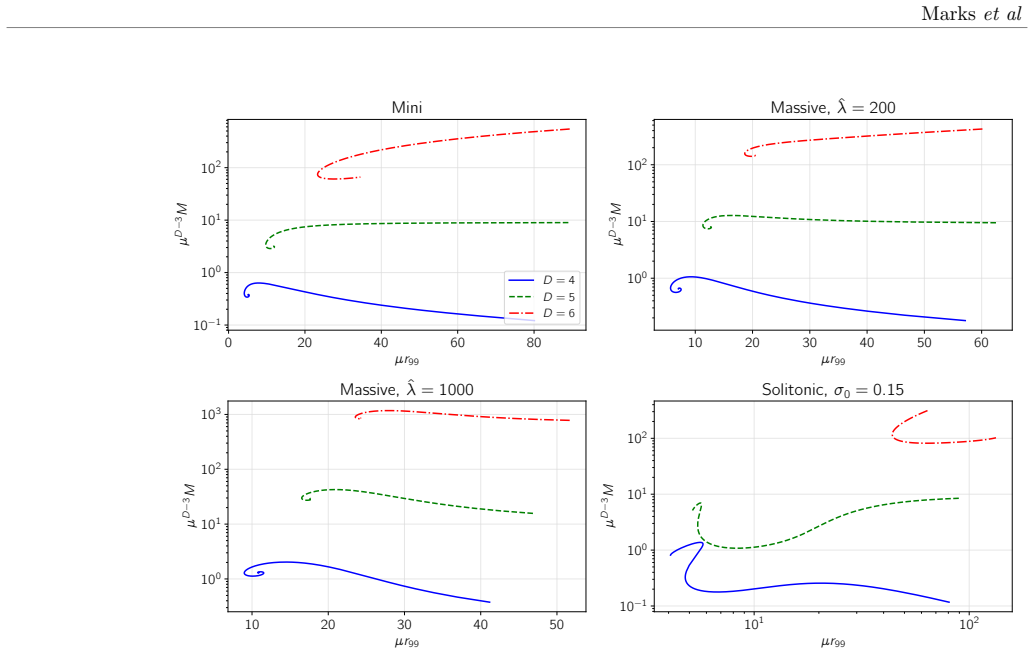
The paper claims that the radial instability of higher-dimensional mini (non-self-interacting) boson stars is not fundamental: self-interactions can cure it. A quartic potential yields radially stable branches in D=5 once λ/μ²>63.4 and in D=6 once λ/μ²>416; a solitonic (two-vacuum) potential yields a stable branch in D=5 when σ0<0.236, while no D=6 solitonic branch is stable. Two complementary tools establish this: generalized pulsation equations valid for any dimension and potential, and nonlinear spherical evolutions—including explicit charge-conserving perturbations—whose outcomes match the linear classification in every tested case.
What carries the argument
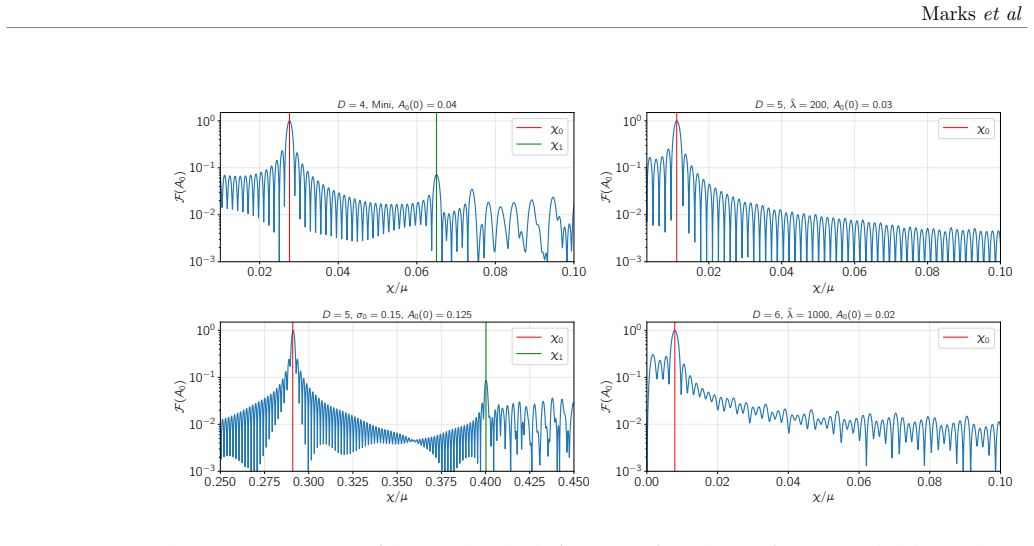
The central object is a generalized set of pulsation equations for radial boson-star perturbations, valid in any spacetime dimension and for any scalar potential. They reduce radial stability to the sign of the lowest eigenvalue: χ₀²>0 means linearly radially stable, χ₀²<0 an unstable breathing mode. The paper solves the system by shooting for the frequency and a second parameter, using the conserved Noether-charge perturbation as a constraint, and confirms the resulting frequencies against power spectra from long unperturbed evolutions. Those evolutions use a dimensional reduction of a standard numerical-relativity formulation, preserving gauge freedom and allowing D=4,5,6 to be evolved wit
Load-bearing premise
The load-bearing premise is that radial stability and stability under spherically symmetric nonlinear evolutions certify physical stability; the paper's evolutions enforce spherical symmetry, so any instability driven by a non-spherical mode lies outside what is tested—a limitation the paper explicitly acknowledges by pointing to four-dimensional rotating and excited boson stars that are radially stable yet nonlinearly unstable.
What would settle it
Recompute the lowest radial eigenvalue for a model on a claimed-stable branch—say the D=5 massive star with λ/μ²=200 and central amplitude 0.03—using an independent integration of the pulsation equations; a negative χ₀² would directly falsify the linear-stability claim. Independently, a spherical nonlinear evolution of that same model that collapses or disperses rather than oscillating indefinitely would falsify the dynamical-stability claim.
If this is right
- Higher-dimensional asymptotically flat boson stars can be radially stable, so the weaker gravitational binding in D≥5 does not by itself doom self-gravitating scalar clumps.
- In D=6, massive stars with fixed quartic coupling never reach arbitrarily low compactness on the stable branch, but increasing λ/μ² shrinks the inaccessible range; D=5 stable branches do reach arbitrarily low compactness.
- The sign of the binding energy is neither necessary nor sufficient for radial stability—stable stars with positive binding energy and unstable stars with negative binding energy both occur—though it does correlate with what an unstable star does next (migrate, disperse, or collapse).
- Solitonic boson stars in D=6 are all radially unstable, and for small σ0 their solution families diverge at finite central amplitude, so this potential does not stabilize six dimensions.
- Mini boson stars in D=5 and D=6 have exactly one unstable radial mode on the first branch of their solution family, a precise extension of the known higher-dimensional instability.
Where Pith is reading between the lines
- A natural extension not pursued here is to relax the spherical symmetry in the evolutions: since the paper's simulations enforce spherical symmetry by construction, a growing non-spherical mode on one of the claimed-stable branches would directly limit the result; the paper itself warns that radially stable rotating and excited stars in D=4 can still be nonlinearly unstable.
- The critical couplings appear to grow steeply with dimension (λ/μ²≈63.4 in D=5, ≈416 in D=6); extrapolating that trend suggests even larger critical values in D≥7 and raises the question of whether a stable window exists at arbitrarily high dimension.
- The stable models with positive binding energy are plausible candidates for metastability in formation: even if they are stable once assembled, generic gravitational collapse of scalar clouds in D=5 or D=6 may rarely produce them, which is a testable question.
- The same generalized pulsation formalism could be used to check whether other self-gravitating solitons in D>4—for example vector-field or spinor-field stars—acquire stable branches once self-interactions are included.
Editorial analysis
A structured set of objections, weighed in public.
Referee Report
Summary. The paper constructs spherically symmetric boson star solutions in D=4,5,6 spacetime dimensions for the mini, massive (quartic self-interaction), and solitonic potentials. It derives a general set of radial pulsation equations for arbitrary dimension and potential, computes the fundamental and first overtone oscillation frequencies, and identifies parameter regions with χ_0^2>0, which it interprets as linear radial stability: massive families in D=5,6 above critical λ̂ (63.4 and 416, respectively) and solitonic families in D=5 below critical σ_0 (0.236). These predictions are then compared with nonlinear dynamical evolutions in spherical symmetry, performed with a modified-cartoon dimensional reduction of BSSN and CCZ4, and the paper reports agreement in all tested cases, including explicit perturbed evolutions. The central claim is that self-interacting or solitonic potentials can stabilize higher-dimensional boson stars against spherical dynamics.
Significance. If the central claims hold, the paper provides the first convincing examples of asymptotically flat, radially stable boson stars in D>4, a question left open by previous work on higher-dimensional mini boson stars. The manuscript includes several strengths: a general form of the pulsation equations, a released numerical code (SBSE), convergence tests at third–fourth order, BSSN/CCZ4 comparisons, and an independent check of the linear frequencies against power spectra from nonlinear evolutions. The stability statements are carefully scoped to radial/spherical dynamics, and the nonradial limitation is explicitly acknowledged. The principal risk is the unproven self-adjointness assertion underlying the linear stability criterion.
major comments (2)
- [Sec. 3.1, after Eq. (25)] The statement that 'the resulting two equations form a self-adjoint system' is the sole basis for the spectral conclusions used in Sec. 3.2: real discrete χ^2, node ordering, and χ_0^2>0 ⇒ radial stability. No inner product, domain, or boundary conditions are specified, and Eqs. (26)–(27) are singular at r=0 and contain derivative couplings after elimination of δα and δψ2. Formal symmetry does not by itself guarantee the Sturm–Liouville theorem; complex eigenvalues or continuous-spectrum contributions cannot be excluded. Please provide a proof or a precise reference for the self-adjoint structure of the two-field system, or state the χ_0^2 criterion as a numerical conjecture. Agreement with D=4 results and the M(A_0) extremum checks are supportive but not a substitute.
- [Sec. 4.1/4.2 and Appendix C] Appendix C reports that BSSN evolutions generically show long-lasting linear growth in the Hamiltonian constraint and warns this could lead to faulty conclusions about dynamical stability. The main text does not state which formulation (BSSN or CCZ4) was used for the runs in Figs. 8–10 and Tables 2–3. If BSSN was used, justify why the growing constraint violation does not affect the stability classification or the quoted instability timescales; if CCZ4 was used, state so explicitly. As written, the nonlinear confirmation is not fully reproducible.
minor comments (6)
- [Sec. 4.2, Eq. (30)] The Gaussian perturbation profile is written as δφ = a exp((r−r0)^2/k^2); the exponent should presumably be −(r−r0)^2/k^2.
- [Table 2 and Fig. 10] The label D5MBIM appears twice in Table 2 for the two perturbation types; the second should likely be D5MBII. Also, Fig. 10 refers to run 'D5BSI' while Table 2 lists 'D5SBI'.
- [Eq. (27)] In the coefficient of g′ the term '3X′_b/X_0' appears; this is presumably X_b rather than X_0.
- [Eq. (28)] The displayed expression for a appears garbled, especially the term involving γ and A_0; please check the typesetting and confirm the correct coefficient.
- [Sec. 3.1] The elimination of δα and δψ2 leading from Eqs. (22)–(25) to Eqs. (26)–(27) is only sketched. Including the intermediate algebra in an appendix would aid verification of the central pulsation equations.
- [Abstract and Introduction] Minor typos: 'D \in {5,6}' should be 'D=5,6'; in the Introduction, 'it it not necessarily sufficient' should be 'it is not necessarily sufficient'.
Circularity Check
No significant circularity: pulsation frequencies are derived from the field equations and independently checked by nonlinear evolutions; self-citations are not load-bearing.
full rationale
The paper's central stability claim is not circular. The background configurations are obtained by shooting the ODEs (5)-(7), and the pulsation system (26)-(27) is derived by linearizing the EKG system (2) and eliminating the metric and phase perturbations, with the eigenvalue chi^2 determined by regularity and asymptotic flatness; no fitted parameter is renamed as a prediction. The nonlinear evolutions use a separate code (SBSE, [63]) and are compared to the computed frequencies as power-spectrum peaks (Fig. 8) and to the stable/unstable classification (Fig. 9, Tables 2-3), which is a genuine cross-check. The self-citations ([30], [41], [63]) are contextual: a D=4 consistency comparison, a prior solitonic-stability observation, and the code repository; they do not carry the D>4 result. The main caveats are a rigor gap, not circularity: Sec. 3.1 asserts without proof that 'the resulting two equations form a self-adjoint system' (after Eq. 25), which is needed for the node-counting and chi_0^2>0 stability interpretation; and the evolutions enforce SO(D-1) symmetry, so nonradial instabilities are excluded, as the paper explicitly acknowledges. These affect confidence but do not reduce a derived quantity to an input.
Axiom & Free-Parameter Ledger
free parameters (4)
- central amplitude A0 =
0.0–0.45 (scan)
- scalar frequency omega =
adjusted per A0 to obtain asymptotically flat solutions
- lambda_hat (quartic coupling) =
0, 200, 1000 (critical 63.4, 416)
- sigma_0 (solitonic parameter) =
0.06-0.3 (critical 0.322, 0.236)
axioms (5)
- domain assumption Spherical symmetry (SO(D-1)) is an isometry of the spacetime, so the metric ansatz Eq. (3) is valid for the background and perturbations.
- domain assumption The harmonic ansatz phi = A(r) e^{i omega t} captures the ground state; excited states are excluded.
- standard math The scalar field perturbation decomposition (Eq. 21) and the resulting pulsation system (Eqs. 26-27) is self-adjoint, implying ordering of eigenvalues and zero-crossing counting.
- domain assumption Existence of asymptotically flat solutions and the shooting method convergence.
- domain assumption Effective radius r99 and compactness definitions are adequate proxies for BS properties.
invented entities (1)
-
stable higher-dimensional boson star solutions
independent evidence
read the original abstract
We construct spherically symmetric boson star solutions in $D \in \{4,5,6\}$ spacetime dimensions, considering the effects of both a quartic self-interaction term and a solitonic potential. We then perform a perturbative analysis, generalizing the pulsation equations to arbitrary dimension and potential and hence demonstrating the existence of radially stable higher-dimensional boson star solutions. In particular, we find stable solutions for $D \in {5, 6}$ with a quartic self-interaction term and for $D = 5$ with a solitonic potential We supplement these linear results with perturbed and unperturbed nonlinear dynamical evolutions in spherical symmetry, obtained using a dimensional reduction that allows us to evolve spacetimes with any number of background dimensions using the same numerical framework, while preserving the full gauge freedom of standard approaches to numerical relativity. The results of these evolutions indicate that the solutions we identify as perturbatively stable are indeed generally stable to nonlinear spherical dynamics.
Figures




Forward citations
Cited by 6 Pith papers
-
Timing-Window Mechanism for Chain-Like Transients in Collisions of Radially Excited Boson Stars
Chain-like transients in boson star collisions are governed by a timing window set by the binary collision time relative to isolated breathing clocks rather than excitation level alone.
-
Massive boson stars: Stability and GW emission in head-on mergers
Quartically self-interacting massive boson stars are stable only up to the first mass maximum; their head-on mergers yield a boson-star remnant, a black hole at contact, or two black holes formed before contact, with ...
-
Timing-Window Mechanism for Chain-Like Transients in Collisions of Radially Excited Boson Stars
Chain-like transients in boson star collisions are controlled by a timing window set by matching binary collision time to the isolated breathing clock rather than excitation level alone.
-
Black Hole-Boson Star Binaries: Gravitational Wave Signals and Tidal Disruption
Numerical simulations of black hole-boson star binaries show that scalar self-interactions can suppress tidal disruption while radiative efficiency depends on the chosen potential.
-
Massive boson stars: Stability and GW emission in head-on mergers
Numerical evolutions of quartically self-interacting boson stars reveal three merger outcomes and a non-monotonic gravitational-wave energy pattern driven by the competition between compactness and tidal deformability.
-
Massive boson stars: Waveform-based branch diagnosis with neural reconstruction
Using an existing numerical-relativity catalogue, the paper builds a branch-conditioned neural reconstruction model that infers boson-star merger outcomes from waveform morphology by comparing reconstruction quality a...
Reference graph
Works this paper leans on
-
[1]
Liebling S L and Palenzuela C 2023Living Reviews in Relativity26ISSN 1433-8351 URL http://dx.doi.org/10.1007/s41114-023-00043-4
-
[2]
Rev.172(5) 1331–1342 URLhttps://link.aps.org/doi/10.1103/ PhysRev.172.1331
Kaup D J 1968Phys. Rev.172(5) 1331–1342 URLhttps://link.aps.org/doi/10.1103/ PhysRev.172.1331
-
[3]
Rev.1871767–1783
Ruffini R and Bonazzola S 1969Phys. Rev.1871767–1783
-
[4]
Palenzuela C, Pani P, Bezares M, Cardoso V, Lehner L and Liebling S 2017Physical Review D 96ISSN 2470-0029 URLhttp://dx.doi.org/10.1103/PhysRevD.96.104058
-
[5]
Bezares M, Boˇ skovi´ c M, Liebling S, Palenzuela C, Pani P and Barausse E 2022Physical Review D105ISSN 2470-0029 URLhttp://dx.doi.org/10.1103/PhysRevD.105.064067
-
[6]
Helfer T, Sperhake U, Croft R, Radia M, Ge B X and Lim E A 2022Classical and Quantum Gravity39074001 ISSN 1361-6382 URLhttp://dx.doi.org/10.1088/1361-6382/ac53b7
-
[8]
Evstafyeva T, Sperhake U, Helfer T, Croft R, Radia M, Ge B X and Lim E A 2023Classical and Quantum Gravity40085009 ISSN 1361-6382 URLhttp://dx.doi.org/10.1088/1361-6382/ acc2a8
-
[9]
Ge B X, Lim E A, Sperhake U, Evstafyeva T, Cors D, de Jong E, Croft R and Helfer T 2024 (Preprint2410.23839)
arXiv 2024
-
[10]
Cardoso V, Ikeda T, Zhong Z and Zilh˜ ao M 2022Physical Review D106ISSN 2470-0029 URL http://dx.doi.org/10.1103/PhysRevD.106.044030
-
[11]
Zhong Z, Cardoso V, Ikeda T and Zilh˜ ao M 2023Physical Review D108ISSN 2470-0029 URL http://dx.doi.org/10.1103/PhysRevD.108.084051
-
[12]
Evstafyeva T, Sperhake U, Romero-Shaw I and Agathos M 2024Phys. Rev. Lett.133131401 arXiv:2406.02715 [gr-qc] (Preprint2406.02715)
-
[13]
Sennett N, Hinderer T, Steinhoff J, Buonanno A and Ossokine S 2017Physical Review D96 ISSN 2470-0029 URLhttp://dx.doi.org/10.1103/PhysRevD.96.024002
-
[14]
Bustillo J C, Sanchis-Gual N, Torres-Forn´ e A, Font J A, Vajpeyi A, Smith R, Herdeiro C, Radu E and Leong S H 2021Physical Review Letters126ISSN 1079-7114 URLhttp://dx.doi.org/ 10.1103/PhysRevLett.126.081101
-
[15]
1103/PhysRevD.50.3650
Sin S J 1994Physical Review D503650–3654 ISSN 0556-2821 URLhttp://dx.doi.org/10. 1103/PhysRevD.50.3650
-
[16]
Schive H Y, Chiueh T and Broadhurst T 2014Nature Physics10496–499 ISSN 1745-2481 URL http://dx.doi.org/10.1038/nphys2996
-
[17]
Synge J L 1966Mon. Not. Roy. Astron. Soc.131463–466
-
[18]
Cardoso V, Miranda A S, Berti E, Witek H and Zanchin V T 2009Phys. Rev. D79064016 arXiv:0812.1806 [hep-th]
-
[19]
Koga Y, Asaka N, Kimura M and Okabayashi K 2022Phys. Rev. D105104040 (Preprint 2202.00201)
-
[20]
V¨ olkel S H, Franchini N, Barausse E and Berti E 2022Phys. Rev. D106124036 (Preprint 2209.10564)
-
[21]
Torres D F, Capozziello S and Lambiase G 2000Phys. Rev. D62104012 (Preprintastro-ph/ 0004064)
-
[22]
Guzman F S 2006Phys. Rev. D73021501 (Preprintgr-qc/0512081) 20 REFERENCES Markset al
-
[23]
Amaro-Seoane P, Barranco J, Bernal A and Rezzolla L 2010Journal of Cosmology and Astropar- ticle Physics2010002–002 ISSN 1475-7516 URLhttp://dx.doi.org/10.1088/1475-7516/ 2010/11/002
-
[24]
Olivares H, Younsi Z, Fromm C M, Laurentis M D, Porth O, Mizuno Y, Falcke H, Kramer M and Rezzolla L 2020Monthly Notices of the Royal Astronomical Society497521–535 ISSN 0035-8711, 1365-2966 arXiv:1809.08682 [gr-qc]
-
[25]
sciencedirect.com/science/article/pii/0550321389903659
Lee T and Pang Y 1989Nuclear Physics B315477–516 ISSN 0550-3213 URLhttps://www. sciencedirect.com/science/article/pii/0550321389903659
-
[26]
Cunha P V P, Berti E and Herdeiro C A R 2017Phys. Rev. Lett.119251102 (PreprintarXiv: 1708.04211[gr-qc])
-
[27]
Cunha P V P and Herdeiro C A R 2020Phys. Rev. Lett.124181101 (Preprint2003.06445)
-
[28]
Keir J 2016Class. Quant. Grav.33135009 (Preprint1404.7036)
-
[29]
Cunha P V P, Herdeiro C, Radu E and Sanchis-Gual N 2023Phys. Rev. Lett.130061401 (Preprint2207.13713)
-
[30]
Marks G A, Staelens S J, Evstafyeva T and Sperhake U 2025 Long-term stable nonlinear evolu- tions of ultracompact black-hole mimickers (Preprint2504.17775) URLhttps://arxiv.org/ abs/2504.17775
arXiv 2025
-
[31]
Evstafyeva T, Siemonsen N and East W E 2025 (Preprint2508.11527)
arXiv 2025
-
[32]
Lai C W and Choptuik M W 2007 Final fate of subcritical evolutions of boson stars (Preprint 0709.0324) URLhttps://arxiv.org/abs/0709.0324
Pith/arXiv arXiv 2007
-
[33]
Lai C W 2004 A numerical study of boson stars (Preprintgr-qc/0410040) URLhttps:// arxiv.org/abs/gr-qc/0410040
arXiv 2004
-
[34]
Choptuik M W and Pretorius F 2010Physical Review Letters104ISSN 1079-7114 URLhttp: //dx.doi.org/10.1103/PhysRevLett.104.111101
-
[35]
Bizo´ n P, Chmaj T and Schmidt B G 2005Physical Review Letters95ISSN 1079-7114 URL http://dx.doi.org/10.1103/PhysRevLett.95.071102
-
[36]
Porto Veronese B and Gundlach C 2022Physical Review D106ISSN 2470-0029 URLhttp: //dx.doi.org/10.1103/PhysRevD.106.104044
-
[37]
Yoo C M, Nakao K i and Ida D 2005Phys. Rev. D71104014 (Preprintgr-qc/0503008)
-
[38]
Mujtaba A and Pope C 2013Physics Letters B719454–457 ISSN 0370-2693 URLhttp: //dx.doi.org/10.1016/j.physletb.2013.01.046
-
[39]
Bl´ azquez-Salcedo J L, Knoll C and Radu E 2019Phys. Lett. B793161–168 (Preprint1902. 05851)
-
[40]
Brihaye Y and Hartmann B 2016Classical and Quantum Gravity33065002 ISSN 1361-6382 URLhttp://dx.doi.org/10.1088/0264-9381/33/6/065002
-
[41]
Marks G A 2025 Perturbations of solitonic boson stars: Nonlinear radial stability and binding energy (Preprint2508.11757) URLhttps://arxiv.org/abs/2508.11757
arXiv 2025
-
[42]
org/10.1007/s10714-024-03287-9
Franzin E 2024General Relativity and Gravitation56ISSN 1572-9532 URLhttp://dx.doi. org/10.1007/s10714-024-03287-9
-
[43]
Astefanesei D and Radu E 2003Nuclear Physics B665594–622 ISSN 0550-3213 URLhttp: //dx.doi.org/10.1016/S0550-3213(03)00482-6
-
[44]
Di Giovanni F, Sanchis-Gual N, Cerd´ a-Dur´ an P, Zilh˜ ao M, Herdeiro C, Font J A and Radu E 2020Physical Review D102ISSN 2470-0029 URLhttp://dx.doi.org/10.1103/PhysRevD. 102.124009
-
[45]
Brito M, Herdeiro C, Radu E, Sanchis-Gual N and Zilh˜ ao M 2025 Stability and collisions of excited spherical boson stars: glimpses of chains and rings (Preprint2506.06442) URLhttps: //arxiv.org/abs/2506.06442 21 REFERENCES Markset al
arXiv 2025
-
[46]
Gabler M, Sperhake U and Andersson N 2009Phys. Rev. D80(6) 064012 URLhttps://link. aps.org/doi/10.1103/PhysRevD.80.064012
-
[47]
Pretorius F 2005Classical and Quantum Gravity22425–451 ISSN 0264-9381, 1361-6382 arXiv:gr-qc/0407110
-
[48]
Baumgarte T W and Shapiro S L 1998Phys. Rev. D59024007 gr-qc/9810065
-
[49]
Shibata M and Nakamura T 1995Phys. Rev. D525428–5444
-
[50]
Alic D, Bona-Casas C, Bona C, Rezzolla L and Palenzuela C 2012Phys. Rev. D85064040 arXiv:1106.2254 [gr-qc]
-
[51]
Lee T D 1987Phys. Rev. D35(12) 3637–3639 URLhttps://link.aps.org/doi/10.1103/ PhysRevD.35.3637
-
[52]
Collodel L G and Doneva D D 2022Phys. Rev. D106084057 (Preprint2203.08203)
-
[53]
Evstafyeva T, Rosca-Mead R, Sperhake U and Bruegmann B 2023Phys. Rev. D108104064 (Preprint2310.05200)
-
[54]
Cardoso V, Macedo C F B, Maeda K i and Okawa H 2022Classical and Quantum Gravity39 034001 ISSN 1361-6382 URLhttp://dx.doi.org/10.1088/1361-6382/ac41e7
-
[55]
Gleiser M and Watkins R 1989Nucl. Phys. B319733–746
-
[56]
Gleiser M 1988Phys. Rev. D382376 [Erratum: Phys.Rev.D 39, 1257 (1989)]
1989
-
[57]
Hawley S H and Choptuik M W 2000Physical Review D62ISSN 1089-4918 URLhttp: //dx.doi.org/10.1103/PhysRevD.62.104024
-
[58]
Kain B 2021Phys. Rev. D103123003 (Preprint2106.01740)
-
[59]
Santos N M, Benone C L and Herdeiro C A R 2024JCAP06068 (Preprint2404.07257)
-
[60]
Kusmartsev F V, Mielke E W and Schunck F E 1991Phys. Rev. D433895–3901 (Preprint 0810.0696)
-
[61]
doi.org/10.1103/PhysRevD.103.044022
Siemonsen N and East W E 2021Physical Review D103ISSN 2470-0029 URLhttp://dx. doi.org/10.1103/PhysRevD.103.044022
-
[62]
Sanchis-Gual N, Herdeiro C and Radu E 2022Classical and Quantum Gravity39064001 ISSN 1361-6382 URLhttp://dx.doi.org/10.1088/1361-6382/ac4b9b
-
[63]
Marks G A 2025 Spherical bs evolverhttps://github.com/GarethAMarks/Spherical_BS_ Evolver/tree/masteraccessed: 2025-10-09
2025
-
[64]
Seidel E and Suen W M 1990Physical Review D42384–403 ISSN 0556-2821
-
[65]
Balakrishna J, Seidel E and Suen W M 1998Physical Review D58ISSN 1089-4918 URL http://dx.doi.org/10.1103/PhysRevD.58.104004
-
[66]
Guzm´ an F S 2009Rev. Mex. Fis.55321–326 (Preprint1907.08193)
-
[67]
Guzman F S 2004Physical Review D70044033
-
[68]
Alcubierre M, Barranco J, Bernal A, Degollado J C, Diez-Tejedor A, Megevand M, N´ u˜ nez D and Sarbach O 2019Classical and Quantum Gravity36215013 ISSN 1361-6382 URLhttp: //dx.doi.org/10.1088/1361-6382/ab4726
-
[69]
Cook W G, Sperhake U, Berti E and Cardoso V 2017Physical Review D96ISSN 2470-0029 URLhttp://dx.doi.org/10.1103/PhysRevD.96.124006
-
[70]
Liang C, Herdeiro C A R and Radu E 2025Journal of High Energy Physics2025ISSN 1029- 8479 URLhttp://dx.doi.org/10.1007/JHEP03(2025)119
-
[71]
Brito R, Cardoso V, Herdeiro C A and Radu E 2016Physics Letters B752291–295 ISSN 0370-2693 URLhttp://dx.doi.org/10.1016/j.physletb.2015.11.051 22 REFERENCES Markset al
-
[72]
Emparan R, Suzuki R and Tanabe K 2013Journal of High Energy Physics2013ISSN 1029-8479 URLhttp://dx.doi.org/10.1007/JHEP06(2013)009
-
[73]
Cook W G, Figueras P, Kunesch M, Sperhake U and Tunyasuvunakool S 2016Int. J. Mod. Phys. D251641013 arXiv:1603.00362 [gr-qc]
-
[74]
Bona C, Mass´ o J, Seidel E and Stela J 1995Physical Review Letters75600–603 ISSN 1079-7114 URLhttp://dx.doi.org/10.1103/PhysRevLett.75.600
-
[75]
Alcubierre M 1997Physical Review D555981–5991 ISSN 1089-4918 URLhttp://dx.doi. org/10.1103/PhysRevD.55.5981
-
[76]
Radia M, Sperhake U, Drew A, Clough K, Figueras P, Lim E A, Ripley J L, Aurrekoetxea J C, Fran¸ ca T and Helfer T 2022Class. Quant. Grav.39135006 (Preprint2112.10567)
-
[77]
Alic D, Kastaun W and Rezzolla L 2013Phys. Rev. D88064049 (PreprintarXiv:1307. 7391[gr-qc]) 23
discussion (0)
Sign in with ORCID, Apple, or X to comment. Anyone can read and Pith papers without signing in.