REVIEW 2 major objections 4 minor 52 references
Detachment of fluid membrane from substrate and vesiculation
T0 review · 2 major / 4 minor · reviewed 2026-08-14 · deepseek-v4-flash
Pith's one-line read Isotropic spontaneous curvature cannot roll a long membrane strip; the strip's edge undulates into an unduloid and vesiculates.
desk verdict A solid simulation study showing that isotropic spontaneous curvature makes long membrane strips vesiculate rather than roll, but the exact 2π/C0 threshold is asserted on thin evidence. read the letter →
The pith
A machine-rendered reading of the paper's core claim, the machinery that carries it, and where it could break.
The reading
What carries the argument
The central object is the unduloid: a periodic surface of revolution with constant mean curvature into which a cylinder of radius $1/C_0$ can be deformed without changing its mean curvature. The transformation from cylinder to unduloid sets in at wavelength $\lambda_{\rm und}=2\pi/C_0$, so strips shorter than this length keep an almost cylindrical roll, while longer strips destabilize into bumps that bud off as vesicles. The simulations use a self-assembled particle membrane with bending, tilt, attraction, and substrate adhesion potentials; the isotropic spontaneous curvature is controlled by a single parameter $C_{\rm bd}$.
What would settle it
A simulation or experiment in which a long membrane strip with only isotropic spontaneous curvature is observed to roll into a stable tube of diameter $2/C_0$ and persist well beyond the time when undulations should grow would refute the central claim.
Extended reading notes
Core claim
On its own terms, the paper's claim is that isotropic spontaneous curvature does not produce a rolling instability for a long membrane strip on a substrate; instead the strip edge undulates into a shape of constant mean curvature, an unduloid, and vesiculates. Rolling into a tube is observed only for strips shorter than $2\pi/C_0$. The detachment boundary itself is set by competition between bending energy $\kappa C_0^2/2$ and adhesion energy per area $w_{\rm ad}=\varepsilon_{\rm ad}/a_0$ under strong adhesion, while thermal undulation lowers the threshold under weak adhesion. Pinning a small fraction of membrane particles slows detachment and creates the straight or concave edges seen in experiments. Reading these results against the annexin experiments, the paper infers that the observed rolling must come from an anisotropic spontaneous curvature or membrane solidification, not from an isotropic one.
Load-bearing premise
The argument rests on representing the annexin-induced deformation as a homogeneous isotropic spontaneous curvature on a single fluid membrane; if annexins bend the membrane anisotropically, bind adjacent membranes, or effectively solidify the patch, the simulated no-rolling result for long strips need not apply to the experiments.
Editorial extensions
If this is right
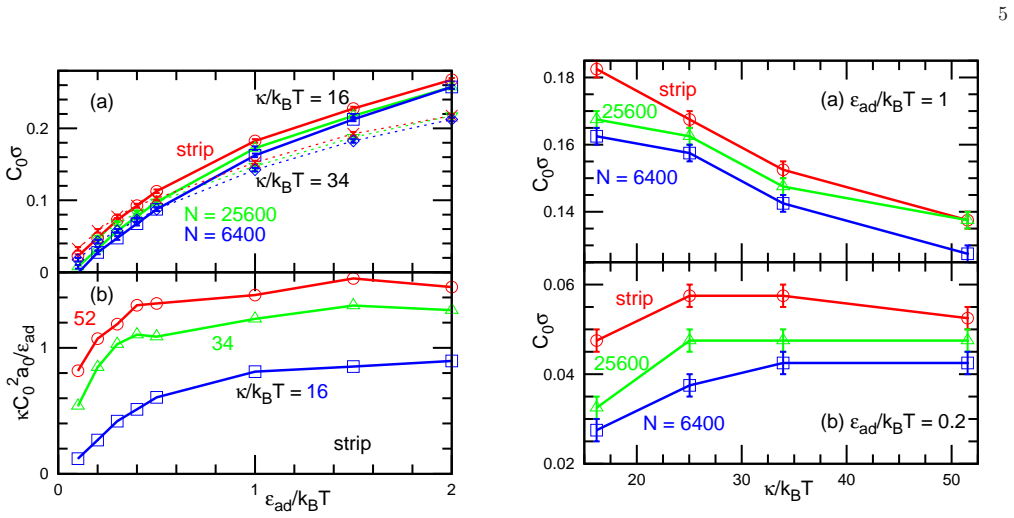
- The minimum spontaneous curvature for detachment scales as $\sqrt{w_{\rm ad}/\kappa}$ under strong adhesion, so tuning adhesion strength directly sets the curvature threshold.
- Under weak adhesion, thermal undulation initiates detachment at curvatures below the energetic threshold, making detachment stochastic.
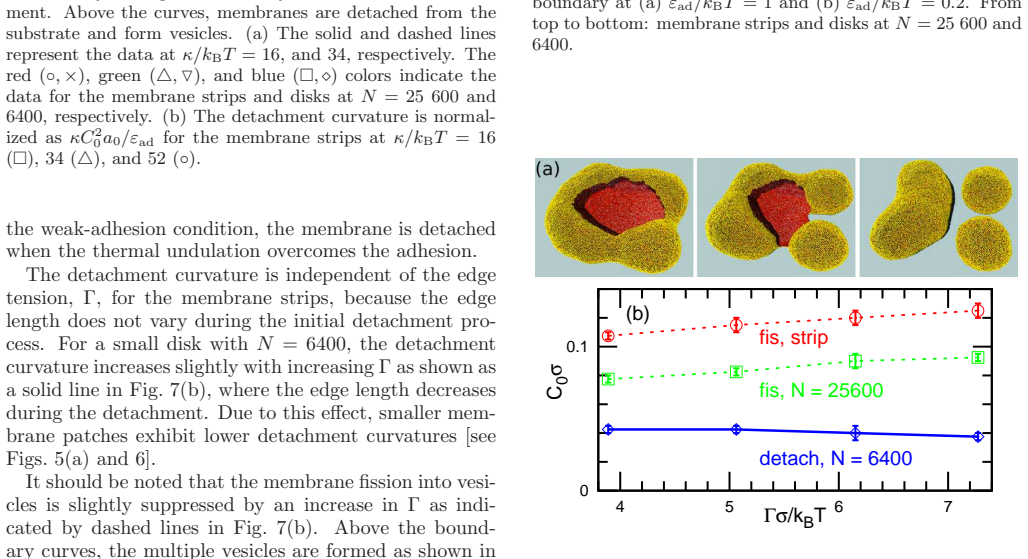
- Pinning even less than 1% of membrane particles can substantially suppress detachment and reshape the remaining patch into straight or concave edges.
- Edge tension does not affect the detachment curvature for strips, but it controls whether the patch closes into one vesicle or fissions into many.
- Long strips vesiculate rather than roll; only sub-wavelength strips roll, so isotropic-curvature-driven rolling is naturally limited to short patches.
Reading between the lines
- The unduloid wavelength $\lambda_{\rm und}=2\pi/C_0$ gives a testable geometric criterion for any isotropic-curvature system: tubes should form only on patches shorter than this length, with longer patches vesiculating.
- If annexins induce anisotropic curvature, the paper's pinning results suggest that pinned sites act as defects that organize the roll, which could explain why rolls in cells tend to start at membrane damage edges.
- The opposite dependence of vesicle size on edge tension for detachment versus self-assembly implies a kinetic control mechanism: cells could regulate vesicle size by locally adjusting edge tension rather than by curvature alone.
Signed reviews
Editorial analysis
A structured set of objections, weighed in public.
Referee Report
Summary. This paper uses meshless membrane simulations to study the detachment of a fluid membrane with isotropic spontaneous curvature from a flat substrate. The author maps out detachment phase boundaries for disks and periodic strips, showing that strong adhesion sets a bending-energy versus adhesion-energy threshold while weak adhesion is assisted by thermal fluctuations. Pinning particles locally arrests detachment and produces straight or concave edges. The central dynamical result is that long membrane strips undulate along their free edge and vesiculate, while a strip shorter than the unduloid wavelength lund = 2π/C0 rolls into a tube. From this, the paper concludes that the rolling observed for annexins A3, A4, A5, and A13 is unlikely to be caused by isotropic spontaneous curvature and presumably arises from anisotropic curvature or membrane binding/solidification.
Significance. If the rolling-threshold result holds, the paper delivers a clear, parameter-light mechanistic statement: an isotropic spontaneous curvature cannot produce persistent rolling of a long membrane strip because the free edge is unstable to unduloid formation at wavelengths beyond 2π/C0. This provides a useful negative constraint for interpreting the annexin experiments of Boye et al. and connects a classical geometric property of constant-mean-curvature surfaces to a nonequilibrium membrane process. The simulation work is careful in its use of multiple independent runs, error bars on phase boundaries and cluster sizes, and a well-characterized meshless membrane model; the unduloid wavelength is a parameter-free geometric input. The main value is the falsifiable prediction and the phase-boundary data, which should be reproducible once the detachment criterion is stated.
major comments (2)
- [Section III, Fig. 2] The central rolling criterion Lx < 2π/C0 is not directly tested. At C0σ = 0.1, the unduloid wavelength is lund ≈ 63σ, and the reported evidence consists of rolling at Lx/σ = 40 and vesiculation at Lx/σ = 160, with a statement that Lx/σ ≥ 80 also yields vesiculation. This brackets the predicted threshold but does not resolve it; no systematic variation of Lx at fixed C0 or of C0 at fixed Lx is shown. In addition, the wavelength argument is derived for an isolated cylinder of radius 1/C0, whereas the simulated strip is partially adhered, has a finite width, and contains two free edges; the substrate and contact line are absent from the unduloid analysis. The text says the threshold length 'agrees with the simulation results', but the agreement is only bracketed, not established. Please add a scan of Lx around lund (for example Lx/σ ≈ 50, 60, 70, 90) at C0σ = 0.1 and at least one additional value of C0 to test the predicted scaling.
- [Section III, Figs. 5–7] The criterion for classifying a membrane as 'detached' is not defined. The phase-boundary plots in Figs. 5–7 necessarily rely on a rule (for example, whether the maximum cluster size drops below some threshold, whether a vesicle detaches, or whether the membrane center height exceeds a fixed value within a maximum simulation time), but the manuscript only states that the boundaries are estimated from 3 independent runs and does not report the time limit or the quantitative indicator. Without this information, the central phase diagrams cannot be reproduced or compared with future studies. Please specify the detachment criterion and the simulation duration used for the phase boundary.
minor comments (4)
- [Abstract and Section V] The phrase 'results from by the anisotropic spontaneous curvature' contains a doubled preposition and appears twice; it should read 'results from the anisotropic spontaneous curvature' or 'is due to the anisotropic spontaneous curvature'.
- [Section V] In the paragraph discussing the experiments, 'Boyes’ experiments' should be 'Boye et al.'s experiments'; the reference list itself is correct.
- [Caption of Fig. 7(a)] The time values 't/τ = 14 000, 17 4000, and 22 000' appear to contain a typographic error in the middle value; it should likely be '17 000' or '17 400'.
- [Abstract and Section V] The conclusion that annexin rolling 'results from' anisotropic spontaneous curvature is stronger than the evidence: the simulations exclude one isotropic mechanism but do not directly test anisotropic bending by annexins. The discussion in Section V already hedges with 'presumably'; the abstract and summary should be softened to match that level of caution.
Circularity Check
No significant circularity: the rolling threshold comes from independent unduloid geometry and simulation dynamics, not from fitted inputs or self-citation.
full rationale
The paper's central claim is that a fluid membrane with isotropic spontaneous curvature rolls only for strips shorter than the unduloid wavelength lund = 2π/C0, and therefore annexin-induced rolling is likely due to anisotropic spontaneous curvature. This claim is not circular. The simulation model is parameterized by standard membrane properties, with model parameters taken from prior work and calibrated against experimental edge tension values; the rolling/vesiculation phase behavior is an emergent output of the meshless membrane simulations, not an input. The threshold lund = 2π/C0 is a classical result for constant-mean-curvature unduloids, cited to Kenmotsu and Naito et al., and is applied to interpret the simulation results; it is not derived from the simulation data and not fitted to the annexin experiments. The comparison of Lx = 40σ and Lx = 160σ at C0σ = 0.1 is consistent with lund ≈ 60σ, and although the boundary is not mapped exhaustively, this under-support is a correctness concern, not circularity. The conclusion about annexins is an inference from the absence of long-strip rolling in the isotropic model, combined with the experimental observation of rolling; it does not reduce to a fitted parameter or to a self-citation. The paper contains many self-citations for the meshless membrane model and prior related studies, but these are not load-bearing for the central rolling criterion, which rests on the simulation dynamics and classical unduloid theory. No equation is shown to be equivalent to its input by construction, and no fitted parameter is renamed as a prediction.
Assumptions & free parameters
assumptions (4)
- domain assumption The meshless membrane model (self-assembled one-layer particle sheet with potentials Urep, Uatt, Ubend, Utilt) faithfully represents fluid lipid membrane mechanics including bending rigidity and edge tension.
- ad hoc to paper Annexin-induced membrane deformation can be represented as an isotropic spontaneous curvature, neglecting protein anisotropy, membrane binding, and solidification.
- standard math Cylindrical membranes of radius 1/C0 can continuously transform into unduloids at wavelength lund = 2π/C0, and this instability threshold applies to finite strips.
- domain assumption Hydrodynamic interactions are negligible for the detachment dynamics.
Cite this review
Pith. "Pith review of Detachment of fluid membrane from substrate and vesiculation." pith.science (2026). https://pith.science/paper/UZEDWWGB
@misc{pith2026190804944,
  author       = {Pith},
  title        = {Pith review of: Detachment of fluid membrane from substrate and vesiculation},
  year         = {2026},
  howpublished = {\url{https://pith.science/paper/UZEDWWGB}},
  note         = {Machine review of arXiv:1908.04944}
}
abstract
The detachment dynamics of a fluid membrane with an isotropic spontaneous curvature from a flat substrate are studied by using meshless membrane simulations. The membrane is detached from an open edge leading to vesicle formation. With strong adhesion, the competition between the bending and adhesion energies determines the minimum value of the spontaneous curvature for the detachment. In contrast, with weak adhesion, a detachment occurs at smaller spontaneous curvatures due to the membrane thermal undulation. When parts of the membrane are pinned on the substrate, the detachment becomes slower and a remained membrane patch forms straight or concave membrane edges. The edge undulation induces vesiculation of long strips and disk-shaped patches. Therefore, membrane rolling is obtained only for membrane strips shorter than the wavelength for deformation into unduloid. This suggests that the rolling observed for Ca$^{2+}$-dependent membrane-binding proteins, annexins A3, A4, A5, and A13, results from by the anisotropic spontaneous curvature induced by the proteins.
Figures


Figures from the paper (5 more)



Reference graph
Works this paper leans on
-
[1]
1, κ/k BT = 34, and εad/k BT = 0 . 1. (a) Lx/σ = 160 and N = 25 600. (b) Lx/σ = 40 and N = 12 800. The side view is also presented at t/τ = 300 000. length increases temporally [see the middle-left snapshot in Fig. 1(a)]. This differs from the cup-to-vesicle transi- tion, in which the edge length decreases monotonically. The time evolution of the clusters ...
work page 2000
-
[2]
The dashed lines indicate the data at C0σ = 0
5. The dashed lines indicate the data at C0σ = 0 . 06, 0 . 08, and 0 . 1 from the bottom to top for εad/k BT = 1. The error bars are indicated for several data points at C0σ = 0 . 08 and εad/k BT = 0. 5. It is noted that the height profile at y /greaterorsimilaryed can be significantly modified by the selection of the averaging methods. At y /greaterorsimila...
-
[3]
001, 0 . 002, 0 . 0039, and 0 . 0078. branes. As the pin density, φpin, increases, larger membrane patches remain on the substrate [see Fig. 9]. At the low densities of φpin = 0 .001 and 0 .002, the remaining membrane area varies significantly: the entire membrane is detached in 7 out of 20 runs at φpin = 0 .001. At φpin ≥ 0.0039, more than half of the mem...
- [4]
-
[5]
E. T. Castellana and P. S. Cremer, Surf. Sci. Rep. 61, 429 (2006)
work page 2006
-
[6]
A. S. Achalkumar, R. J. Bushby, and S. D. Evans, Soft Matter 6, 6036 (2010)
work page 2010
- [7]
-
[8]
J. van Weerd, M. Karperien, and P. Jonkheijm, Adv. Healthcare Mater. 4, 2743 (2015)
work page 2015
Show all 52 references
-
[9]
J. M. Johnson, T. Ha, S. Chu, and S. G. Boxer, Biophys. J. 8, 3371 (2002)
2002
-
[10]
T. W. Cha, A. Guo, and X.-Y. Zhu, Biophys. J. 90, 1270 (2006)
2006
-
[11]
N. Hain, M. Gallego, and I. Reviakine, Langmuir 29, 2282 (2003)
2003
-
[12]
Mapar, S
M. Mapar, S. J˜ oemetsa, H. Pace, V. P. Zhdanov, B. Ag- narsson, and F. H¨ o¨ ok, J. Phys. Chem. Lett. 9, 5143 (2018)
2018
-
[13]
Fuhrmans and M
M. Fuhrmans and M. M¨ uller, Langmuir 29, 4335 (2013)
2013
-
[14]
X. Kong, D. Lu, J. Wu, and Z. Liu, Langmuir 32, 3785 (2016)
2016
-
[15]
C. Wen, M. Wan, X. Li, Q. He, L. Gao, and W. Fang, ACS Omega 2, 910 (2017)
2017
-
[16]
Kolahdouzan, J
K. Kolahdouzan, J. A. Jackman, B. K. Yoon, M. C. Kim, M. S. Johal, and N.-J. Cho, Langmuir 33, 5052 (2017)
2017
-
[17]
N. L. Yamada, M. Sferrazza, and S. Fujinami, Physica B 551, 222 (2018)
2018
-
[18]
T. L. Boye, K. Maeda, W. Pezeshkian, S. L. Sønder, S. C. Haeger, V. Gerke, A. C. Simonsen, and J. Nylandsted, Nature Comm. 8, 1623 (2017)
2017
-
[19]
T. L. Boye, J. C. Jeppesen, K. Maeda, W. Pezeshkian, V. Solovyeva, J. Nylandsted, and A. C. Simonsen, Sci. Rep. 8, 10309 (2018)
2018
-
[20]
Gerke, C
V. Gerke, C. E. Creutz, and S. E. Moss, Nature Rev. Mol. Cell Biol. 6, 449 (2005)
2005
-
[21]
Bouter, R
A. Bouter, R. Carmeille, C. Gounou, F. Bouvet, S. A. D. amd D. Evain-Brion, and A. R. Brisson, Placenta 36, S43 (2015)
2015
-
[22]
A. D. Blazek, B. J. Paleo, and N. Weisleder, Physiol. 30, 438 (2015)
2015
-
[23]
Bouter, C
A. Bouter, C. Gounou, R. B´ erat, S. Tan, B. Gallois, T. Granier, B. L. dEstaintot, E. P¨ oschl, B. Brachvogel, and A. R. Brisson, Nature Comm. 2, 270 (2011)
2011
-
[24]
H. T. McMahon and J. L. Gallop, Nature 438, 590 (2005)
2005
-
[25]
Suetsugu, S
S. Suetsugu, S. Kurisu, and T. Takenawa, Physiol. Rev. 94, 1219 (2014)
2014
-
[26]
Simunovic, G
M. Simunovic, G. A. Voth, A. Callan-Jones, and P. Bassereau, Trends Cell Biol. 25, 780 (2015)
2015
-
[27]
Johannes, R
L. Johannes, R. G. Parton, P. Bassereau, and S. Mayor, Nat. Rev. Mol. Cell. Biol. 16, 311 (2015)
2015
-
[28]
Phillips, T
R. Phillips, T. Ursell, P. Wiggins, and P. Sens, Nature 459, 379 (2009)
2009
-
[29]
Lipowsky, Faraday Discuss
R. Lipowsky, Faraday Discuss. 161, 305 (2013)
2013
-
[30]
Dasgupta, T
S. Dasgupta, T. Auth, and G. Gompper, J. Phys.: Co- dens. Matter 29, 373003 (2017)
2017
-
[31]
M¨ uller, K
M. M¨ uller, K. Katsov, and M. Schick, Phys. Rep. 434, 113 (2006)
2006
-
[32]
Venturoli, M
M. Venturoli, M. M. Sperotto, M. Kranenburg, and B. Smit, Phys. Rep. 437, 1 (2006)
2006
-
[33]
Noguchi, J
H. Noguchi, J. Phys. Soc. Jpn. 78, 041007 (2009)
2009
-
[34]
Shiba and H
H. Shiba and H. Noguchi, Phys. Rev. E 84, 031926 (2011)
2011
-
[35]
Noguchi, Phys
H. Noguchi, Phys. Rev. E 93, 052404 (2016)
2016
-
[36]
Noguchi, J
H. Noguchi, J. Chem. Phys. 151, 094903 (2019)
2019
-
[37]
Noguchi, EPL 108, 48001 (2014)
H. Noguchi, EPL 108, 48001 (2014)
2014
-
[38]
Noguchi, Sci
H. Noguchi, Sci. Rep. 6, 20935 (2016)
2016
-
[39]
Noguchi and J.-B
H. Noguchi and J.-B. Fournier, Soft Matter 13, 4099 (2017)
2017
-
[40]
Noguchi, Sci
H. Noguchi, Sci. Rep. 9, 11721 (2019)
2019
-
[41]
Noguchi, Soft Matter 13, 7771 (2017)
H. Noguchi, Soft Matter 13, 7771 (2017)
2017
-
[42]
D. V. Zhelev and D. Needham, Biochim. Biophys. Acta 1147, 89 (1993)
1993
-
[43]
Karatekin, O
E. Karatekin, O. Sandre, H. Guitouni, N. Borghi, P. H. Puech, and F. Brochard-Wyart, Biophys. J. 84, 1734 (2003)
2003
-
[44]
Portet and R
T. Portet and R. Dimova, Biophys. J. 99, 3264 (2010)
2010
-
[45]
Noguchi, J
H. Noguchi, J. Chem. Phys. 134, 055101 (2011)
2011
-
[46]
Noguchi and G
H. Noguchi and G. Gompper, J. Chem. Phys. 125, 164908 (2006)
2006
-
[47]
Kenmotsu, Surfaces with constant mean curva- ture (American Mathematical Society, Providence, R.I., 2003)
K. Kenmotsu, Surfaces with constant mean curva- ture (American Mathematical Society, Providence, R.I., 2003)
2003
-
[48]
Naito, M
H. Naito, M. Okuda, and O.-Y. Zhong-can, Phys. Rev. Lett. 74, 4345 (1995)
1995
-
[49]
Tsafrir, D
I. Tsafrir, D. Sagi, T. Arzi, M.-A. Guedeau-Boudeville , V. Frette, D. Kandel, and J. Stavans, Phys. Rev. Lett. 86, 1138 (2001)
2001
-
[50]
J. P. Reeves and R. M. Dowben, J. Cell. Physiol. 73, 49 (1969)
1969
-
[51]
N. L. Yamada, M. Hishida, H. Seto, K. Tsumoto, and T. Yoshimura, EPL 80, 48002 (2007)
2007
-
[52]
K. M. Nakagawa and H. Noguchi, Soft Matter 14, 1397 (2018)
2018
Reviewed August 14, 2026 · model on record in the stance chip above.
Discussion (0). Continue with ORCID to comment.