REVIEW 4 major objections 6 minor 1 cited by
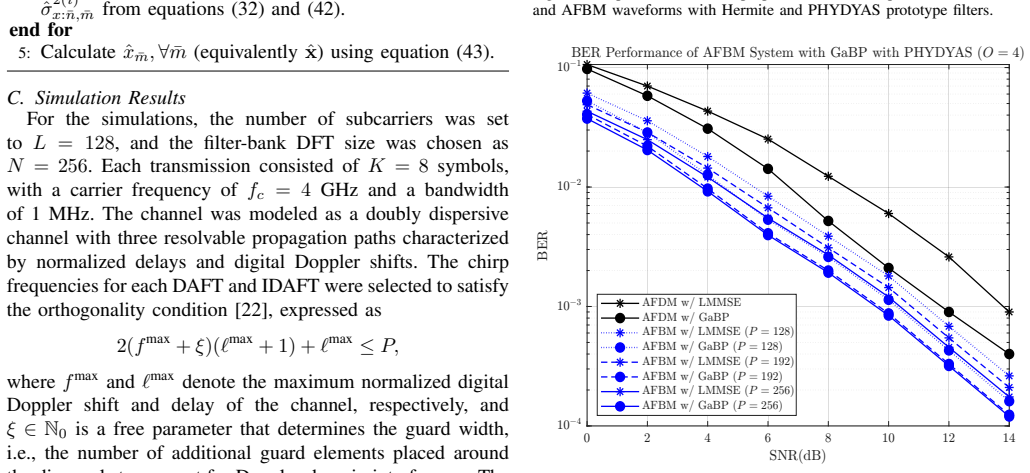
AFBM, an affine chirp-precoded filter-bank waveform for 6G ISAC, is claimed to jointly deliver low PAPR, low out-of-band emission, and delay-Doppler resilience, with about 2 dB BER gain over AFDM at 10^-3.
Reviewed by Pith at T0; open to challenge. T0 means a machine referee read the full paper against a public rubric. the ladder, T0–T4 →
T0 review · deepseek-v4-flash
2026-08-05 05:14 UTC pith:UZIOGN47
load-bearing objection A novel AFDM/FBMC hybrid worth a serious referee, but the headline BER/RMSE gains rest on a visually-supported Gram-matrix diagonal claim and an O=4 vs O<=1.5 tension that need real evidence. the 4 major comments →
Affine Filter Bank Modulation (AFBM): A Novel 6G ISAC Waveform with Low PAPR and OOBE
The pith
A machine-rendered reading of the paper's core claim, the machinery that carries it, and where it could break.
Core claim
AFBM replaces the rectangle-windowed chirp subcarriers of AFDM with chirp-filtered subcarriers: data are placed only in the outer quarters of the time-frequency grid, multiplied by a diagonal compensation stage that cancels intrinsic filter interference and restores complex orthogonality, spread by a pruned DAFT whose chirp parameters set the diagonal spreading of the delay-Doppler channel, and convolved with a localized prototype filter (Hermite or PHYDYAS, with tunable overlap factor O). The paper argues that the payoffs follow from this single construction: an ambiguity function nearly identical to AFDM's, PAPR about 2 dB lower, and spectral sidelobes at FBMC levels, so no cited predecess
What carries the argument
The central construction is the AFBM modulator chain s = G (I_K ⊗ Q_P C_f) Ξ x: a placement map Ξ that reserves the middle half of the band as guard space, a diagonal compensation filter C_f (chosen so the cascade C_f^H Q_P^H G^T G Q_P C_f is a unit diagonal, cancelling intrinsic interference for overlap O ≤ 1.5), a pruned IDAFT Q_P that spreads channel diagonals in delay-Doppler, and a block-Toeplitz prototype-filter matrix G that supplies spectral localization. The receiver-supporting mechanism is the hybrid filtered time-domain Gram matrix Ḡ_FTD = H̄^H H̄ of equation (27b), which the paper claims approaches a diagonal form in high-dimensional AFBM systems; near-diagonality is what lets G
Load-bearing premise
Both low-complexity receivers assume the Gram matrix of AFBM's hybrid filtered time-domain channel is nearly diagonal in practice; the paper supports this with a single visual inspection and then builds the GaBP and EM-PDA estimators on it, so if diagonality weakens at realistic dimensions the reported BER and RMSE gains lose their stated support.
What would settle it
Compute the squared off-diagonal mass of Ḡ_FTD = H̄^H H̄ from equation (27b) relative to its diagonal for the Figure 9-11 settings (L=128, N=256, K=8, three paths, ℓmax=16, fmax=2) over many random channel draws; if the ratio does not shrink with system size, run the GaBP detector with the true (non-diagonal) Gram matrix and check whether its error floor moves well above the 10^-4 regime, which would contradict the claimed ~2 dB edge over AFDM at 10^-3.
If this is right
- One AFBM transceiver could carry both the data and radar functions of a 6G ISAC node: the ambiguity function tracks AFDM's for sensing while the low PAPR relaxes power-amplifier back-off and the low OOBE permits fragmented-spectrum operation.
- The reported ~2 dB BER advantage at 10^-3 transposes into lower transmit power or longer range for equal reliability, delivered by a detector whose per-iteration cost is element-wise scalar operations rather than a cubic matrix inversion.
- The sensing receiver's O(N^3) cost is independent of the delay-Doppler grid size, so target range and velocity resolution can be refined without increasing the dominant algorithmic cost.
- The filter-compensation design shows the classical FBMC orthogonality toolkit (guarded subcarriers, O ≤ 1.5 overlap, compensation coefficients) survives transplantation into chirp-domain modulation, making the pattern available to the wider DAFT waveform family.
Where Pith is reading between the lines
- My read: the near-diagonality of Ḡ_FTD is the hinge of the paper, yet it is supported by visual inspection of one Gram-matrix figure; a quantitative scan of the off-diagonal-to-diagonal energy ratio across L, N, K and many channel realizations would show whether the claimed property is generic or specific to the displayed parameters.
- My read: the reported PAPR advantage is fragile with respect to the chirp parameter c2, since it vanishes as c2,L grows from 1/πL² to 50/πL²; a joint optimization of chirp parameters, prototype filter, and the IDAFT length P (currently chosen heuristically) is the obvious next lever for widening the low-PAPR operating region.
- My read: because the same pruned-DAFT-plus-compensation recipe could be grafted onto DAFT-s-AFDM or zero-padded chirp modulations, the cleanest test of the paper's thesis is whether the 2 dB gain is a property of the AFBM construction specifically or of giving any chirp waveform a filter-bank front end.
- My read: reserving half the subcarriers as guard space and demanding P > L carries a spectral-efficiency cost the paper does not quantify; a net spectral-efficiency comparison against OFDM and AFDM would sharpen the tradeoff the waveform actually offers.
Editorial analysis
A structured set of objections, weighed in public.
Referee Report
Summary. The paper proposes affine filter bank modulation (AFBM), a waveform that inserts a pruned DAFT precoder and an FBMC-type filter bank into the AFDM framework. The authors claim that AFBM simultaneously achieves low PAPR, low OOBE, and quasi-orthogonality in doubly-dispersive channels, and they develop two receivers: a GaBP-based data detector and an EM-PDA-based sensing/radar parameter estimator. Numerical results report an approximately 2 dB BER gain over conventional AFDM at BER 10^{-3} and sensing RMSE comparable to AFDM. The transmitter algebra (compensation, pruned DAFT, filtering) is presented in detail, and the GaBP/PDA update structures are standard. However, the load-bearing premises—especially the approximate diagonality of the filtered time-domain Gram matrix and the validity of the compensation stage for the simulated overlap factors—are not established quantitatively, and there is a dimension inconsistency in the channel model at Eq. (19).
Significance. If the claims are substantiated, AFBM would address a real gap in the ISAC waveform literature: no cited waveform simultaneously provides robustness to doubly-dispersive channels, intrinsically low PAPR, and good spectral containment. The paper gives a concrete transmitter structure, a clear receiver architecture, and reproducible-looking algorithms; these are useful contributions. The significance is conditional, however: the central performance claims rest on a visually demonstrated Gram-diagonality assumption and on hand-picked chirp parameters, so the results as presented are not yet at the standard of a definitive waveform proposal.
major comments (4)
- [Section II-B, Eq. (19)-(25)] There is a serious dimension inconsistency. The channel matrix is defined as H = I_{K-1} ⊗ \check H ∈ C^{(K-1)M × (K-1)M}, while G ∈ C^{M × NK}. For K > 2, the product H G in (19) and G^H H G in (24) are not defined. Consequently \bar H in (25), the I/O relation (29), and the receiver derivations in Sections V and VI are based on an undefined object as printed. This must be corrected; if a block-channel structure is intended, it should be specified explicitly and all dimensions rechecked.
- [Section III-B, Fig. 4] The claim that the hybrid filtered time-domain Gram matrix \bar G_FTD approaches a diagonal form is load-bearing for the GaBP receiver (Section V) and the PDA sensing receiver (Section VI), but it is supported only by visual inspection of one figure with a single parameter set. No diagonal-dominance metric, no dimension sweep, and no statistics over channel realizations are given. Since \bar H = G^H H G(I⊗Q_P C_f)Ξ is a structured product of Toeplitz/diagonal/sparse matrices and not an i.i.d. random matrix, the asserted concentration is not self-evident. The authors should provide a quantitative measure (e.g., normalized off-diagonal energy) as a function of L,N,K and over channel realizations before the BER/RMSE results can be attributed to well-conditioned matched-filter processing.
- [Section II-A1 and Figs. 6, 9, 10] Section II-A1 states that correct compensation via (7)-(9) is guaranteed only when the overlap factor satisfies O ≤ 1.5, and that for larger O the off-diagonal interference reduces the signal-to-interference ratio. However, the OOBE and BER simulations with the PHYDYAS filter use O = 4. The paper never quantifies the resulting SIR loss or explains why the compensation and the Gram analysis remain valid at O = 4. This is an internal inconsistency that affects the generality of the OOBE and BER claims; it should be addressed explicitly.
- [Section IV-A, Fig. 5] The low-PAPR claim is demonstrated only for the specific choice c_{2,L} = 1/(πL^2). The text itself notes that raising c_{2,L} to 50/(πL^2) makes AFBM's PAPR higher than that of AFDM. Since c_2 is a free design parameter and the paper provides no optimization or feasible-region analysis over the AFDM orthogonality constraint, the claimed 'remarkably low PAPR' is not established as a robust property of AFBM. A systematic characterization of PAPR versus admissible chirp parameters, or a constrained optimization, is needed to support the headline claim.
minor comments (6)
- [Figures 7 and 8] The captions read 'AbuguityFunction' — should be 'Ambiguity Function'.
- [Equation (7)] The matrix \tilde G appears in (7) before G is defined in (17); please define \tilde G (presumably the per-symbol filtering matrix) at first use.
- [Section II-C] The complexity discussion mentions K-point (I)DFTs and assumes K log K multiplications, but the displayed complexity expression does not include a K log K term. Align the text with the equation or explain the omission.
- [Figure 4] Please specify the parameters used in each panel of Figure 4 (L, N, K, P, O, filter type) and add a quantitative color scale; the visual claim would also benefit from a numerical off-diagonal energy caption.
- [Section IV-C] The AF parameters 'c_{2,\bar M}=3e100' should be clarified: this appears to be a garbled scientific notation. Also, the heuristic selection of ambiguity-function parameters is stated but not justified; a short explanation of the chosen values would improve reproducibility.
- [Section II-A] The paper reserves half the subcarriers as guard bands and transmits at twice the rate. Please state explicitly how the spectral efficiency compares with the AFDM/OFDM benchmarks in the BER and OOBE simulations, so that the comparisons are not inadvertently affected by different occupied bandwidths.
Circularity Check
No load-bearing circularity; the Gram-diagonal premise is weakly supported and some benchmarks use hand-picked chirp parameters or self-cited implementations, but no derivation reduces to its own inputs.
full rationale
The AFBM transmit chain (equations (1)-(24)) is a closed-form construction: the compensation filter is defined via (8) so that (7) holds, and the quasi-orthogonality in the noiseless case follows from that definition. This is a design property, not a prediction obtained from the thing it is supposed to predict. The GaBP and PDA receivers are derived from the linear model (29) with standard message-passing equations; they do not fit a parameter and then report that parameter as a result. The diagonal-Gram premise in Section III-B is a support gap: it is justified only by visual inspection of Figure 4 and an appeal to 'increased randomness,' with no quantitative diagonal-dominance metric or dimension sweep. This is a correctness/evidence weakness, not circularity, because the BER and RMSE simulations would fail if the premise were false. Similarly, the PAPR and AF comparisons use explicitly disclosed chirp-parameter choices (Section IV-C: 'heuristic values were selected for each waveform to ensure the best performance'), and Section IV-A shows the PAPR advantage reverses at other c_2 values; this makes the claims conditional, not circular. The paper cites the authors' own prior work (AFBM in [41], AFDM baseline in [16], filter-bank designs in [38]-[40]), but those citations supply a construction and a benchmark, not a uniqueness theorem or an unverified ansatz that forces the present conclusions. The internal tension between the O<=1.5 compensation condition (Section II-A1) and the PHYDYAS O=4 simulations is a consistency concern, not a circular reduction. Overall, no equation or fitted parameter is renamed as a prediction; the central claims still depend on independent simulations and standard derivations.
Axiom & Free-Parameter Ledger
free parameters (5)
- Chirp parameter c2 (c2,L, c2,P, c2,N) =
c2,L=1/(pi L^2), c2,P=1/(pi P^2), c2,N=1/(pi N^2) for PAPR plots; c2,L=pi/L^2, c2,P=0, c2,N=0 for AF plots
- Guard width xi (free integer in chirp orthogonality condition) =
not specified in the text
- Damping factors beta_x and beta_h =
beta_x = 0.5; beta_h not specified numerically
- Number of targets/paths P for the sensing prior =
R = 3 in simulations (Figure 11)
- AF baseline chirp values for DAFT-s-AFDM =
c2,Mbar = 3e100 and c2,Dbar = 0 as printed
axioms (6)
- domain assumption The doubly-dispersive channel is represented by the circular affine convolution matrix H = sum_r h_r Phi_r Z^{f_r} Pi^{l_r} from [22], applied directly to the prefix-free overlapped filter-bank signal.
- domain assumption The doubly-dispersive channel remains constant over the K time slots.
- ad hoc to paper The Gram matrix of the hybrid filtered TD channel is approximately diagonal in high-dimensional AFBM systems.
- domain assumption Scalar Gaussian (SGA) and vector Gaussian (VGA/CLT) approximations with independence of estimation errors hold for the message-passing receivers.
- standard math Interference during compensation is limited to a single filter coefficient, which requires overlap factor O <= 1.5.
- domain assumption Prototype filter coefficients are known at both transmitter and receiver.
Cite this review
Pith. "Pith review of Affine Filter Bank Modulation (AFBM): A Novel 6G ISAC Waveform with Low PAPR and OOBE." pith.science (2026). https://pith.science/paper/UZIOGN47
@misc{pith2026250905683,
  author       = {Pith},
  title        = {Pith review of: Affine Filter Bank Modulation (AFBM): A Novel 6G ISAC Waveform with Low PAPR and OOBE},
  year         = {2026},
  howpublished = {\url{https://pith.science/paper/UZIOGN47}},
  note         = {Machine review of arXiv:2509.05683}
}
read the original abstract
We propose the affine filter bank modulation (AFBM) waveform for enhanced integrated sensing and communications (ISAC) in sixth generation (6G), designed by drawing on concepts from classical filter bank multicarrier modulation (FBMC) theory and recent advances in chirp-domain waveforms, particularly affine frequency division multiplexing (AFDM). Specifically, AFBM exhibits several desirable properties, with emphasis on its remarkably low peak-to-average power ratio (PAPR) and reduced out-of-band emission (OOBE) when benchmarked against the conventional AFDM waveform under doubly-dispersive (DD) channel conditions. In the communications setting, reliable symbol detection is achieved using a tailored low-complexity Gaussian belief propagation (GaBP)-based algorithm, while in the sensing setting, a range and velocity estimation approach is developed that integrates an expectation maximization (EM)-assisted probabilistic data association (PDA) framework to accurately identify surrounding targets. The highlighted performance and benefits of AFBM are validated through analytical and numerical evaluations, including conventional metrics such as ambiguity function (AF), bit error rate (BER), and root mean square error (RMSE), consolidating its position as a promising waveform for next-generation wireless systems.
Figures



Forward citations
Cited by 1 Pith paper
-
AFDM: Evolving OFDM Towards 6G+
AFDM is presented as an OFDM-backward-compatible 6G+ waveform whose added transceiver cost is two O(N) chirp rotations, supported by a generalized pulse-shaped FDFD channel formulation.
Reference graph
Works this paper leans on
-
[1]
Low- complexity receiver design for affine filter bank modulation,
K. R. R. Ranasinghe, B. S. Chang, and G. T. F. de Abreu, “Low- complexity receiver design for affine filter bank modulation,” inIEEE 10th International Workshop on Computational Advances in Multi- Sensor Adaptive Processing (CAMSAP), 2025
work page 2025
-
[2]
Terahertz communications and sensing for 6g and beyond: A comprehensive review,
W. Jiang, Q. Zhou, J. He, M. A. Habibi, S. Melnyk, M. El-Absi, B. Han, M. D. Renzo, H. D. Schotten, F.-L. Luo, T. S. El-Bawab, M. Juntti, M. Debbah, and V . C. M. Leung, “Terahertz communications and sensing for 6g and beyond: A comprehensive review,”IEEE Communications Surveys & Tutorials, vol. 26, no. 4, pp. 2326–2381, 2024
work page 2024
-
[3]
Cellular wireless networks in the upper mid-band,
S. Kang, M. Mezzavilla, S. Rangan, A. Madanayake, S. B. Venkatakrish- nan, G. Hellbourg, M. Ghosh, H. Rahmani, and A. Dhananjay, “Cellular wireless networks in the upper mid-band,”IEEE Open Journal of the Communications Society, vol. 5, pp. 2058–2075, 2024
2058
-
[4]
A survey on high mobility wireless communications: Challenges, opportunities and solutions,
J. Wu and P. Fan, “A survey on high mobility wireless communications: Challenges, opportunities and solutions,”IEEE Access, vol. 4, pp. 450– 476, 2016
work page 2016
-
[5]
Enabling data-driven otfs modulation for 6g hyper reliable high-mobility commu- nications,
J. Xue, T. Jiang, H. Huang, Z. Zhang, H. Zhou, and X. Shen, “Enabling data-driven otfs modulation for 6g hyper reliable high-mobility commu- nications,”IEEE Wireless Communications, vol. 32, no. 3, pp. 196–203, 2025
work page 2025
-
[6]
H. Zhang, X. Wang, J. Tan, J. Wang, Z. Yang, and B. Ai, “Closer twins model: Consistent design of modem scheme and channel esti- mation under high-mobility scenarios,”IEEE Transactions on Wireless Communications, vol. 24, no. 6, pp. 4564–4580, 2025
work page 2025
-
[7]
Slepian function-based windowed ofdm systems with high mobility,
H. Mu, J. Wang, M. Jiang, and Q. Zhang, “Slepian function-based windowed ofdm systems with high mobility,”IEEE Wireless Communi- cations Letters, vol. 14, no. 6, pp. 1643–1647, 2025
work page 2025
-
[8]
Flexible delay-doppler domain multiple access for massive connectivity with high mobility,
X. Wang, H. Zhang, J. Wang, Z. Yang, H. Lin, and J. Song, “Flexible delay-doppler domain multiple access for massive connectivity with high mobility,”IEEE Transactions on Wireless Communications, vol. 24, no. 6, pp. 5050–5065, 2025
work page 2025
-
[9]
From theory to reality: A design framework for integrated communication and computing receivers,
K. R. Rayan Ranasinghe, K. Ando, and G. T. Freitas de Abreu, “From theory to reality: A design framework for integrated communication and computing receivers,” in2025 International Conference on Computing, Networking and Communications (ICNC), 2025, pp. 865–870
2025
-
[10]
A flexible design framework for integrated communication and computing receivers,
K. R. R. Ranasinghe, K. Ando, H. S. Rou, G. T. F. de Abreu, T. Takahashi, M. D. Renzo, and D. G. G, “A flexible design framework for integrated communication and computing receivers,” 2025. [Online]. Available: https://arxiv.org/abs/2506.05944
Pith/arXiv arXiv 2025
-
[11]
Beamforming design for active ris-aided over-the-air computation,
D. Zhang, M. Xiao, C. Shi, M. Skoglund, Y . Li, and H. Vincent Poor, “Beamforming design for active ris-aided over-the-air computation,” IEEE Transactions on Communications, pp. 1–1, 2025. 13
work page 2025
-
[12]
Remac: Digital multiple access computing by repeated transmissions,
X. Yan, S. Razavikia, and C. Fischione, “Remac: Digital multiple access computing by repeated transmissions,”IEEE Transactions on Communications, pp. 1–1, 2025
work page 2025
-
[13]
Digital over-the-air computation: Achieving high reliability via bit-slicing,
J. Liu, Y . Gong, and K. Huang, “Digital over-the-air computation: Achieving high reliability via bit-slicing,”IEEE Transactions on Wire- less Communications, vol. 24, no. 5, pp. 4101–4114, 2025
work page 2025
-
[14]
Integrated sensing and communication signals toward 5G-A and 6G: A survey,
Z. Wei, H. Qu, Y . Wang, X. Yuan, H. Wu, Y . Du, K. Han, N. Zhang, and Z. Feng, “Integrated sensing and communication signals toward 5G-A and 6G: A survey,”IEEE Internet of Things Journal, vol. 10, no. 13, pp. 11 068–11 092, 2023
2023
-
[15]
The integrated sensing and communication revolution for 6G: Vision, techniques, and applications,
N. Gonz ´alez-Prelcic, M. Furkan Keskin, O. Kaltiokallio, M. Valkama, D. Dardari, X. Shen, Y . Shen, M. Bayraktar, and H. Wymeersch, “The integrated sensing and communication revolution for 6G: Vision, techniques, and applications,”Proceedings of the IEEE, vol. 112, no. 7, pp. 676–723, 2024
2024
-
[16]
Joint channel, data, and radar parameter estimation for afdm systems in doubly-dispersive channels,
K. R. R. Ranasinghe, H. Seok Rou, G. Thadeu Freitas de Abreu, T. Taka- hashi, and K. Ito, “Joint channel, data, and radar parameter estimation for afdm systems in doubly-dispersive channels,”IEEE Transactions on Wireless Communications, vol. 24, no. 2, pp. 1602–1619, 2025
2025
-
[17]
R. Zhang, W. Wu, X. Chen, Z. Gao, and Y . Cai, “Terahertz integrated sensing and communication-empowered uavs in 6g: A transceiver design perspective,”IEEE V ehicular Technology Magazine, pp. 2–11, 2025
work page 2025
-
[18]
Emerging trends in radar: Otfs-based radar for integrated sensing and communications systems,
A. Correas-Serrano, N. Petrov, M. Gonzalez-Huici, and A. Yarovoy, “Emerging trends in radar: Otfs-based radar for integrated sensing and communications systems,”IEEE Aerospace and Electronic Systems Magazine, vol. 40, no. 6, pp. 102–107, 2025
work page 2025
-
[19]
Integrated sensing and communication enabled multiple base stations cooperative sensing towards 6g,
Z. Wei, W. Jiang, Z. Feng, H. Wu, N. Zhang, K. Han, R. Xu, and P. Zhang, “Integrated sensing and communication enabled multiple base stations cooperative sensing towards 6g,”IEEE Network, vol. 38, no. 4, pp. 207–215, 2024
work page 2024
-
[20]
Comparison of CP-OFDM and OFDM/OQAM in doubly dispersive channels,
J. Du and S. Signell, “Comparison of CP-OFDM and OFDM/OQAM in doubly dispersive channels,” inFuture Generation Communication and Networking (FGCN 2007), vol. 2, 2007, pp. 207–211
work page 2007
-
[21]
Ofdm-rsma: Robust transmission under inter-carrier interference,
M. M. S ¸ahin, O. Dizdar, B. Clerckx, and H. Arslan, “Ofdm-rsma: Robust transmission under inter-carrier interference,”IEEE Transactions on Communications, vol. 73, no. 7, pp. 4602–4615, 2025
work page 2025
-
[22]
H. S. Rou, G. T. F. de Abreu, J. Choi, D. Gonz ´alez G., M. Kountouris, Y . L. Guan, and O. Gonsa, “From orthogonal time–frequency space to affine frequency-division multiplexing: A comparative study of next- generation waveforms for integrated sensing and communications in doubly dispersive channels,”IEEE Signal Process. Mag., vol. 41, no. 5, pp. 71–86, 2024
work page 2024
-
[23]
Orthogonal time frequency space modu- lation,
R. Hadani, S. Rakib, M. Tsatsanis, A. Monk, A. J. Goldsmith, A. F. Molisch, and R. Calderbank, “Orthogonal time frequency space modu- lation,” in2017 IEEE Wireless Communications and Networking Con- ference (WCNC), 2017, pp. 1–6
work page 2017
-
[24]
On the effective- ness of otfs for joint radar parameter estimation and communication,
L. Gaudio, M. Kobayashi, G. Caire, and G. Colavolpe, “On the effective- ness of otfs for joint radar parameter estimation and communication,” IEEE Transactions on Wireless Communications, vol. 19, no. 9, pp. 5951–5965, 2020
work page 2020
-
[25]
On the diversity of uncoded otfs modulation in doubly-dispersive channels,
G. D. Surabhi, R. M. Augustine, and A. Chockalingam, “On the diversity of uncoded otfs modulation in doubly-dispersive channels,” IEEE Transactions on Wireless Communications, vol. 18, no. 6, pp. 3049–3063, 2019
work page 2019
-
[26]
Affine frequency division multiplexing (afdm) for 6g: Properties, features, and challenges,
H. S. Rou, K. R. R. Ranasinghe, V . Savaux, G. T. F. de Abreu, C. Ma- souroset al., “Affine frequency division multiplexing (afdm) for 6g: Properties, features, and challenges,”arXiv preprint arXiv:2507.21704, 2025
-
[27]
Orthogonal delay-doppler division multiplexing (oddm) over general physical channels,
J. Tong, J. Yuan, H. Lin, and J. Xi, “Orthogonal delay-doppler division multiplexing (oddm) over general physical channels,”IEEE Transactions on Communications, vol. 72, no. 12, pp. 7938–7953, 2024
work page 2024
-
[28]
Affine frequency division multiplexing for next generation wireless communications,
A. Bemani, N. Ksairi, and M. Kountouris, “Affine frequency division multiplexing for next generation wireless communications,”IEEE Trans- actions on Wireless Communications, vol. 22, no. 11, pp. 8214–8229, 2023
2023
-
[29]
Y . Tao, M. Wen, Y . Ge, J. Li, E. Basar, and N. Al-Dhahir, “Affine frequency division multiplexing with index modulation: Full diversity condition, performance analysis, and low-complexity detection,”IEEE Journal on Selected Areas in Communications, vol. 43, no. 4, pp. 1041– 1055, 2025
work page 2025
-
[30]
Q. Li, J. Li, M. Wen, X. Dang, H. Arslan, and N. Al-Dhahir, “Affine frequency division multiplexing for 6g networks: Fundamentals, oppor- tunities, and challenges,”IEEE Network, pp. 1–1, 2025
work page 2025
-
[31]
DAFT-spread affine frequency division multiple access for downlink transmission,
Y . Tao, M. Wen, Y . Ge, T. Mao, L. Xiao, and J. Li, “DAFT-spread affine frequency division multiple access for downlink transmission,” in GLOBECOM 2024 - 2024 IEEE Global Communications Conference, 2024, pp. 2991–2996
work page 2024
-
[32]
Spectrum design for orthogonal chirp division multiplexing transmissions,
M. S. Omar and X. Ma, “Spectrum design for orthogonal chirp division multiplexing transmissions,”IEEE Wireless Communications Letters, vol. 9, no. 11, pp. 1990–1994, 2020
work page 1990
-
[33]
Special cases of DFT-based modulation and demodulation for affine frequency division multiplexing,
V . Savaux, “Special cases of DFT-based modulation and demodulation for affine frequency division multiplexing,”IEEE Transactions on Com- munications, vol. 72, no. 12, pp. 7627–7638, 2024
work page 2024
-
[34]
Spectrum efficient, localized, orthogonal waveforms: Closing the gap with the balian-low theorem,
C. W. Korevaar, A. B. J. Kokkeler, P.-T. d. Boer, and G. J. M. Smit, “Spectrum efficient, localized, orthogonal waveforms: Closing the gap with the balian-low theorem,”IEEE Transactions on Communications, vol. 64, no. 5, pp. 2155–2165, 2016
work page 2016
-
[35]
R. Zakaria and D. Le Ruyet, “A novel filter-bank multicarrier scheme to mitigate the intrinsic interference: Application to mimo systems,”IEEE Transactions on Wireless Communications, vol. 11, no. 3, pp. 1112– 1123, 2012
work page 2012
-
[36]
Pruned DFT-spread FBMC: Low PAPR, low la- tency, high spectral efficiency,
R. Nissel and M. Rupp, “Pruned DFT-spread FBMC: Low PAPR, low la- tency, high spectral efficiency,”IEEE Transactions on Communications, vol. 66, no. 10, pp. 4811–4825, 2018
work page 2018
-
[37]
A novel DFT precoded filter bank system with iterative equalization,
R. P. Junior, C. A. F. d. Rocha, B. S. Chang, and D. Le Ruyet, “A novel DFT precoded filter bank system with iterative equalization,”IEEE Wireless Communications Letters, vol. 10, no. 3, pp. 478–482, 2021
work page 2021
-
[38]
A generalized DFT precoded filter bank system,
——, “A generalized DFT precoded filter bank system,”IEEE Wireless Communications Letters, vol. 11, no. 6, pp. 1176–1180, 2022
work page 2022
-
[39]
A two-dimensional FFT precoded filter bank scheme,
R. P. Junior, C. A. F. da Rocha, B. S. Chang, and D. Le Ruyet, “A two-dimensional FFT precoded filter bank scheme,”IEEE Transactions on Wireless Communications, vol. 22, no. 11, pp. 8366–8377, 2023
work page 2023
-
[40]
R. P. Junior, C. A. F. Da Rocha, B. S. Chang, and D. Le Ruyet, “A generalized two-dimensional fft precoded filter bank scheme with low complexity equalizers in time-frequency domain,”IEEE Access, vol. 11, pp. 112 414–112 428, 2023
work page 2023
-
[41]
Affine filter bank modulation: A new waveform for high mobility communications,
H. L. Senger, G. P. Gonc ¸alves, B. S. Chang, H. S. Rou, K. R. R. Ranasinghe, G. T. F. de Abreu, and D. L. Ruyet, “Affine filter bank modulation: A new waveform for high mobility communications,”
-
[42]
Joint channel estimation and data detection for afdm receivers with oversampling,
K. R. Rayan Ranasinghe, Y . Ge, G. T. Freitas de Abreu, and Y . Liang Guan, “Joint channel estimation and data detection for afdm receivers with oversampling,” in2025 International Conference on Computing, Networking and Communications (ICNC), 2025, pp. 823– 828
work page 2025
-
[43]
Low-complexity large mimo detection via layered belief propagation in beam domain,
T. Takahashi, A. T ¨olli, S. Ibi, and S. Sampei, “Low-complexity large mimo detection via layered belief propagation in beam domain,”IEEE Transactions on Wireless Communications, vol. 21, no. 1, pp. 234–249, 2022
work page 2022
-
[44]
Design of adaptively scaled belief in multi-dimensional signal detection for higher-order modulation,
T. Takahashi, S. Ibi, and S. Sampei, “Design of adaptively scaled belief in multi-dimensional signal detection for higher-order modulation,” IEEE Transactions on Communications, vol. 67, no. 3, pp. 1986–2001, 2019
1986
-
[45]
On convergence conditions of gaussian belief propagation,
Q. Su and Y .-C. Wu, “On convergence conditions of gaussian belief propagation,”IEEE Transactions on Signal Processing, vol. 63, no. 5, pp. 1144–1155, 2015
work page 2015
-
[46]
A. Mehrotra, S. Srivastava, A. K. Jagannatham, and L. Hanzo, “Data- Aided CSI Estimation Using Affine-Precoded Superimposed Pilots in Orthogonal Time Frequency Space Modulated MIMO Systems,”IEEE Transactions on Communications, vol. 71, no. 8, pp. 4482–4498, 2023
work page 2023
-
[47]
Bayesian Joint Channel and Data Estimation for Correlated Large MIMO with Non-orthogonal Pi- lots,
K. Ito, T. Takahashi, S. Ibi, and S. Sampei, “Bayesian Joint Channel and Data Estimation for Correlated Large MIMO with Non-orthogonal Pi- lots,” inICC 2021 - IEEE International Conference on Communications, 2021, pp. 1–6
work page 2021
-
[48]
Bilinear Generalized Ap- proximate Message Passing—Part I: Derivation,
J. T. Parker, P. Schniter, and V . Cevher, “Bilinear Generalized Ap- proximate Message Passing—Part I: Derivation,”IEEE Transactions on Signal Processing, vol. 62, no. 22, pp. 5839–5853, 2014
work page 2014
-
[49]
Expectation-maximization gaussian-mixture approximate message passing,
J. P. Vila and P. Schniter, “Expectation-maximization gaussian-mixture approximate message passing,”IEEE Transactions on Signal Processing, vol. 61, no. 19, pp. 4658–4672, 2013
work page 2013
-
[50]
C. M. Bishop,Pattern Recognition and Machine Learning (Information Science and Statistics). Berlin, Heidelberg: Springer-Verlag, 2006
2006
-
[51]
Fast and Efficient Sequential Radar Parameter Estimation in MIMO-OTFS Systems,
K. R. R. Ranasinghe, H. S. Rou, and G. T. F. de Abreu, “Fast and Efficient Sequential Radar Parameter Estimation in MIMO-OTFS Systems,” inICASSP 2024 - 2024 IEEE International Conference on Acoustics, Speech and Signal Processing (ICASSP), 2024, pp. 8661– 8665
work page 2024
-
[2025]
Affine Filter Bank Modulation: A New Waveform for High Mobility Communications
[Online]. Available: https://arxiv.org/abs/2505.03589
work page internal anchor Pith review Pith/arXiv arXiv
discussion (0)
Sign in with ORCID, Apple, or X to comment. Anyone can read and Pith papers without signing in.