REVIEW 2 major objections 6 minor 1 cited by
Pixel3DMM: Versatile Screen-Space Priors for Single-Image 3D Face Reconstruction
T0 review · 2 major / 6 minor · reviewed 2026-08-16 · deepseek-v4-flash
Pith's one-line read Per-pixel normals and UV maps cut posed face reconstruction error by over 15 percent.
desk verdict Solid empirical paper with a credible central claim; the unvalidated FLAME registrations for training data are the main thing I'd like to see addressed. read the letter →
The pith
A machine-rendered reading of the paper's core claim, the machinery that carries it, and where it could break.
The reading
What carries the argument
The load-bearing object is the pair of per-pixel prior networks plus the 2D vertex loss that translates UV predictions into geometry constraints. For each FLAME vertex with template UV coordinate $T^{uv}_v$, the method finds the image pixel whose predicted UV is nearest, then penalizes the distance between that pixel and the projected current mesh vertex; an indicator masks out vertices with no close UV match. The normal loss compares a rendered normal map of the current FLAME mesh with the predicted normal map. Together these terms give the optimizer a dense, smooth objective with a wide basin of attraction, which the paper argues is why it beats landmark-only or photometric fitting on strongly posed faces.
What would settle it
Take a small set of faces with independently measured high-precision 3D geometry (for example structured-light scans), register them with the same pipeline, and also obtain manually corrected registrations; retrain the two heads on the corrected data alone and compare posed Chamfer error on the new benchmark. If the performance gap over the strongest baseline shrinks or vanishes, the reported result is driven by registration bias rather than by the per-pixel prior formulation.
Extended reading notes
Core claim
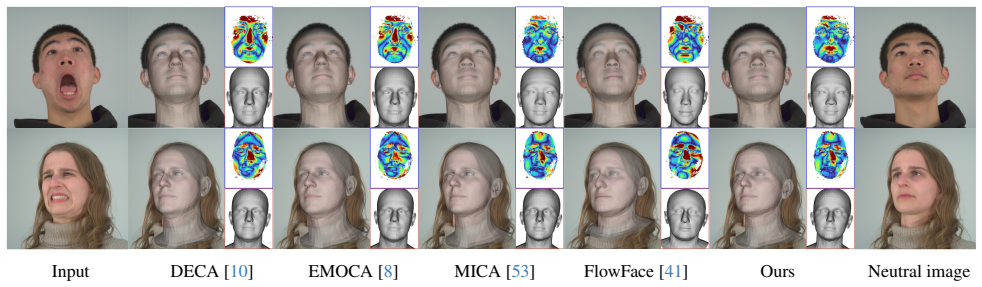
The central claim is that pixel-aligned geometric predictions are powerful constraints for 3DMM fitting. The paper constructs two networks, one mapping an image to per-pixel surface normals and one to per-pixel UV coordinates, both built by fine-tuning a DINOv2 backbone with four transformer blocks and up-convolutions. Training data comes from registering NPHM, FaceScape, and Ava256 into FLAME topology, yielding 976K images; Ava256 contributes only UV supervision. At inference, the UV map is converted into 2D vertex targets by a nearest-neighbor lookup for each FLAME vertex, and the normal map is compared with a rendered normal image; the combined loss, with MICA's identity prediction as a regularizer, drives the optimization. On a new NeRSemble-based benchmark of 21 identities and 20 expressions, this outperforms DECA, EMOCA, MICA, MetricalTracker, TokenFace, and FlowFace, improving L2 Chamfer by over 15% for posed geometry while matching or slightly improving neutral reconstruction. The paper also shows the normal head alone beats existing normal estimators on face data, and extends the same objective to monocular video tracking.
Load-bearing premise
The load-bearing premise is that the non-rigid registration pipeline accurately produces FLAME-topology meshes for all training datasets; every normal and UV target inherits whatever bias or error those registrations contain.
Editorial extensions
If this is right
- If the per-pixel priors are accurate, the same constraints transfer directly to monocular video tracking, where identity, focal length, and principal point are shared across frames and per-frame expressions are regularized by a smoothness term.
- The method can be extended to multi-view fitting by adding the same normal and UV losses from additional views, since the optimization energy is already view-based.
- The new benchmark's dual posed/neutral evaluation makes identity-versus-expression disentanglement measurable; results suggest that improving posed fidelity does not automatically improve neutral reconstruction.
- The UV network can act as a dense correspondence module independent of FLAME, since it maps the image to a shared UV atlas.
- The normal predictor can be used as a standalone high-accuracy face normal estimator for downstream tasks such as relighting or image editing.
Reading between the lines
- Because the training targets are produced by a single non-rigid registration pipeline, the method's ceiling is tied to that pipeline; a natural next experiment is to measure how reconstruction accuracy changes when a subset of registrations is manually corrected.
- The UV-to-vertex lookup is a generic dense-correspondence mechanism; if it works for faces, it could be applied to other objects with a fixed atlas, provided a registered training set exists.
- The ablation replacing the custom normal head with Sapiens normals suggests that normal accuracy alone is not enough; calibration and alignment of the prediction to the face region may matter more, so a future predictor should be evaluated by downstream fitting error rather than pixel-wise normal error.
- Distilling these per-pixel priors into a feed-forward regressor could combine wide-basin optimization quality with real-time speed, since the expensive part is the optimization against the priors.
Signed reviews
Editorial analysis
A structured set of objections, weighed in public.
Referee Report
Summary. The paper proposes Pixel3DMM, a pair of vision transformers that predict per-pixel surface normals and UV coordinates from a single RGB image, built on top of a frozen DINOv2 backbone with a lightweight prediction head. The networks are trained on over 1,000 identities and 976K images from NPHM, FaceScape, and Ava256, all brought into FLAME topology via the NPHM non-rigid registration procedure. At test time, the predicted normals and UV coordinates are used as dense constraints in a FLAME fitting optimization, together with a MICA identity prior. The paper also introduces a new benchmark derived from NeRSemble that separately evaluates posed and neutral geometry, and reports experiments on NoW and FaceScape. The central claim is that the method outperforms the most competitive baselines by over 15% in geometric accuracy for posed facial expressions, supported by results on the proposed benchmark and on FaceScape.
Significance. If the results hold, this is a solid contribution to single-image 3D face reconstruction. The key idea of using dense, learned screen-space geometric priors (normals and UV coordinates) as optimization constraints is well motivated and is shown to outperform sparse landmarks and photometric terms in careful ablations. The new benchmark addresses a real gap in the literature by jointly evaluating posed and neutral geometry with diverse expressions. The paper also demonstrates state-of-the-art surface normal estimation among the compared methods. The experiments are extensive, with external validation on FaceScape and NoW, and the planned release of code, models, and benchmark data would be valuable to the community. The main risks lie in the unvalidated registration pipeline for training supervision and in potential train/test overlap with the FaceScape benchmark identities.
major comments (2)
- [Section 3.1.2] The training supervision for both prior networks consists of rendered normals and UV coordinates of FLAME-topology meshes obtained by 'follow[ing] the non-rigid registration procedure from NPHM' for FaceScape and Ava256. The manuscript provides no quantitative validation of this registration step and no details on how the procedure was adapted to these datasets. Any systematic error in the registrations, especially error that correlates with expression magnitude, is directly learned by the prior networks and will propagate into the final reconstructions. Please report registration accuracy (e.g., scan-to-mesh distance) on a held-out subset of subjects, stratify the error by expression intensity, and specify the exact NPHM registration configuration used, so that readers can assess the risk of expression-correlated bias.
- [Section 5.4, Table 3] The paper does not state whether the 10 FaceScape benchmark identities are excluded from the 350 FaceScape subjects used to train the prior networks. Since the training set is drawn from the same FaceScape dataset, an overlap would make the Table 3 results a test of identity familiarity rather than generalization. Please clarify the exclusion of these subjects from training. If they are not excluded, the FaceScape results should be recomputed on a disjoint held-out set, or the generalization claim should be based on the NoW and NeRSemble evaluations.
minor comments (6)
- [Section 4] The proposed benchmark uses COLMAP reconstructions as ground truth, but the paper does not validate COLMAP's accuracy for the NeRSemble captures (e.g., against high-fidelity scans if available, or against scans for a subset of frames). A brief quantitative or qualitative assessment of the COLMAP point cloud quality would strengthen the benchmark contribution.
- [Section 5.1] The optimization hyperparameters (lambda_uv = 2000, lambda_n = 200, lambda_id = 0.15, lambda_ex = 0.01, delta_uv, number of steps) are given without a sensitivity analysis. A small study varying these values would help establish that the reported results are not brittle to hyperparameter choices.
- [Tables 2, 3, 5] The tables report single scalar metrics without standard deviations or confidence intervals. Given that the benchmark has only 21 identities for the new benchmark and 10 for FaceScape, error bars or per-identity variance would support the significance of the claimed improvements.
- [Abstract and Section 3.1.2] There are minor typos: 'opitmization' in the Abstract should be 'optimization', and 'Addtionally' in Section 3.1.2 should be 'Additionally'.
- [Section 5.6] The statement that the method 'outperforms all available normal estimators' is stronger than what is demonstrated, since Table 4 compares against only three baselines (Metric3D, Sapiens-2B, Diff-E2E). Please reword to 'outperforms the compared normal estimators' or add more baselines.
- [Section 5.3] The sentence 'We encourage the reviewers to watch our supplementary material' is addressed to reviewers; for the published version it should be rephrased to address readers.
Circularity Check
No significant circularity: the central reconstruction claim is tested against independent COLMAP ground truth, not against the training targets.
full rationale
The paper's derivation chain is: (1) register NPHM, FaceScape, and Ava256 into FLAME topology; (2) render per-pixel normals and UV coordinates from these registrations; (3) train two ViT networks to predict these cues via Eq. (3); (4) at test time, optimize FLAME parameters against the predicted cues using Eq. (8). This pipeline is superficially self-referential because the supervision signal and the fitting target both stem from FLAME registrations. However, the paper's central quantitative claims are not evaluated against those training targets. The proposed benchmark uses COLMAP point clouds from NeRSemble as ground truth, and Section 5.1 states that 'we exclude all the subjects from our benchmark from the training set.' Thus the reported >15% posed-reconstruction improvement over baselines is measured against independent geometry, not against the rendered normals/UV used for training. The same holds for the external NoW and FaceScape benchmarks in Table 3. The reliance on the NPHM non-rigid registration procedure is a same-lab citation, but it is a data-production tool, not the target result, and no equation in the paper reduces the evaluation to that registration. The normal-estimation comparison (Table 4) also uses COLMAP normals as reference and compares against external estimators, so the improvement is not forced by construction. The weaknesses noted by the skeptic—unvalidated registrations and possible expression-correlated bias—are legitimate correctness or generalization risks, but they are not circularity: the evaluation would still be independent even if the registrations were biased. Consequently, no specific circular step can be exhibited, and the appropriate finding is no significant circularity.
Assumptions & free parameters
free parameters (6)
- lambda_uv =
2000
- lambda_n =
200
- lambda_id =
0.15
- lambda_ex =
0.01
- delta_uv =
not specified
- optimization steps =
500
assumptions (5)
- domain assumption FLAME is a sufficiently expressive and accurate parametric model of face shape and expression.
- domain assumption DINOv2 features contain useful geometric information for fine-tuning dense face predictions.
- domain assumption The non-rigid registration from NPHM yields accurate FLAME meshes for FaceScape and Ava256.
- domain assumption The nearest-neighbor UV lookup in Eq. (6) finds correct 2D correspondences when the predicted UV map is locally accurate.
- domain assumption COLMAP reconstructions from NeRSemble images are suitable ground truth for face geometry evaluation.
Cite this review
Pith. "Pith review of Pixel3DMM: Versatile Screen-Space Priors for Single-Image 3D Face Reconstruction." pith.science (2026). https://pith.science/paper/UZWI2T4D
@misc{pith2026250500615,
  author       = {Pith},
  title        = {Pith review of: Pixel3DMM: Versatile Screen-Space Priors for Single-Image 3D Face Reconstruction},
  year         = {2026},
  howpublished = {\url{https://pith.science/paper/UZWI2T4D}},
  note         = {Machine review of arXiv:2505.00615}
}
read the original abstract
We address the 3D reconstruction of human faces from a single RGB image. To this end, we propose Pixel3DMM, a set of highly-generalized vision transformers which predict per-pixel geometric cues in order to constrain the optimization of a 3D morphable face model (3DMM). We exploit the latent features of the DINO foundation model, and introduce a tailored surface normal and uv-coordinate prediction head. We train our model by registering three high-quality 3D face datasets against the FLAME mesh topology, which results in a total of over 1,000 identities and 976K images. For 3D face reconstruction, we propose a FLAME fitting opitmization that solves for the 3DMM parameters from the uv-coordinate and normal estimates. To evaluate our method, we introduce a new benchmark for single-image face reconstruction, which features high diversity facial expressions, viewing angles, and ethnicities. Crucially, our benchmark is the first to evaluate both posed and neutral facial geometry. Ultimately, our method outperforms the most competitive baselines by over 15% in terms of geometric accuracy for posed facial expressions.
Figures


Figures from the paper (2 more)

Forward citations
Cited by 1 Pith paper
-
GRAPE: Graduated Routing for Articulated Portrait mesh Estimation
A torso-rooted FLAME+SMPL-X portrait model plus coarse-to-fine graduated routing improves monocular mesh recovery and jaw–expression disentanglement over face-only and body-only baselines.
Reference graph
Works this paper leans on
-
[1]
Valentin Bazarevsky, Yury Kartynnik, Andrey Vakunov, Karthik Raveendran, and Matthias Grundmann. Blazeface: Sub-millisecond neural face detection on mobile gpus.arXiv preprint arXiv:1907.05047, 2019. 2
arXiv 1907
-
[2]
A morphable model for the synthesis of 3d faces
V olker Blanz and Thomas Vetter. A morphable model for the synthesis of 3d faces. InProceedings of the 26th an- nual conference on Computer graphics and interactive tech- niques, pages 187–194, 1999. 2
work page 1999
-
[3]
A morphable model for the synthesis of 3d faces
V olker Blanz and Thomas Vetter. A morphable model for the synthesis of 3d faces. InSeminal Graphics Papers: Pushing the Boundaries, Volume 2, pages 157–164. 2023. 2
work page 2023
-
[4]
Adrian Bulat and Georgios Tzimiropoulos. How far are we from solving the 2d & 3d face alignment problem?(and a dataset of 230,000 3d facial landmarks). InProceedings of the IEEE international conference on computer vision, pages 1021–1030, 2017. 2, 6
work page 2017
-
[5]
Chen Cao, Yanlin Weng, Stephen Lin, and Kun Zhou. 3d shape regression for real-time facial animation.ACM Trans- actions on Graphics (TOG), 32(4):1–10, 2013. 2, 6
work page 2013
-
[6]
Realy: Rethinking the evaluation of 3d face reconstruction
Zenghao Chai, Haoxian Zhang, Jing Ren, Di Kang, Zhengzhuo Xu, Xuefei Zhe, Chun Yuan, and Linchao Bao. Realy: Rethinking the evaluation of 3d face reconstruction. InProceedings of the European Conference on Computer Vi- sion (ECCV), 2022. 2, 3, 5
work page 2022
-
[7]
Timothy F. Cootes, Gareth J. Edwards, and Christopher J Taylor. Active appearance models.IEEE Transactions on pattern analysis and machine intelligence, 23(6):681–685,
-
[8]
Emoca: Emotion driven monocular face capture and animation
Radek Dan ˇeˇcek, Michael J Black, and Timo Bolkart. Emoca: Emotion driven monocular face capture and animation. In Proceedings of the IEEE/CVF Conference on Computer Vi- sion and Pattern Recognition, pages 20311–20322, 2022. 2, 5, 6, 7
work page 2022
Show all 53 references
-
[9]
An image is worth 16x16 words: Trans- formers for image recognition at scale.arXiv preprint arXiv:2010.11929, 2020
Alexey Dosovitskiy, Lucas Beyer, Alexander Kolesnikov, Dirk Weissenborn, Xiaohua Zhai, Thomas Unterthiner, Mostafa Dehghani, Matthias Minderer, Georg Heigold, Syl- vain Gelly, et al. An image is worth 16x16 words: Trans- formers for image recognition at scale.arXiv preprint ar...
2010 arXiv
-
[10]
Learning an animatable detailed 3d face model from in-the- wild images.ACM Transactions on Graphics (ToG), 40(4): 1–13, 2021
Yao Feng, Haiwen Feng, Michael J Black, and Timo Bolkart. Learning an animatable detailed 3d face model from in-the- wild images.ACM Transactions on Graphics (ToG), 40(4): 1–13, 2021. 2, 6, 7
2021
-
[11]
Evaluation of dense 3d reconstruction from 2d face images in the wild
Zhen-Hua Feng, Patrik Huber, Josef Kittler, Peter Han- cock, Xiao-Jun Wu, Qijun Zhao, Paul Koppen, and Matthias R¨atsch. Evaluation of dense 3d reconstruction from 2d face images in the wild. In2018 13th IEEE International Confer- ence on Automatic Face & Gesture Recognition (...
2018
-
[12]
Filntisis, George Retsinas, Foivos Paraperas- Papantoniou, Athanasios Katsamanis, Anastasios Roussos, and Petros Maragos
Panagiotis P. Filntisis, George Retsinas, Foivos Paraperas- Papantoniou, Athanasios Katsamanis, Anastasios Roussos, and Petros Maragos. Visual speech-aware perceptual 3d fa- cial expression reconstruction from videos, 2022. 2
2022
-
[13]
Learning neural parametric head models
Simon Giebenhain, Tobias Kirschstein, Markos Georgopou- los, Martin R ¨unz, Lourdes Agapito, and Matthias Nießner. Learning neural parametric head models. InProceedings of the IEEE/CVF Conference on Computer Vision and Pattern Recognition, pages 21003–21012, 2023. 2, 3
2023
-
[14]
Mononphm: Dynamic head reconstruction from monocular videos
Simon Giebenhain, Tobias Kirschstein, Markos Georgopou- los, Martin R ¨unz, Lourdes Agapito, and Matthias Nießner. Mononphm: Dynamic head reconstruction from monocular videos. InProc. IEEE Conf. on Computer Vision and Pattern Recognition (CVPR), 2024. 2
2024
-
[15]
Attention mesh: High-fidelity face mesh prediction in real-time.arXiv preprint arXiv:2006.10962, 2020
Ivan Grishchenko, Artsiom Ablavatski, Yury Kartynnik, Karthik Raveendran, and Matthias Grundmann. Attention mesh: High-fidelity face mesh prediction in real-time.arXiv preprint arXiv:2006.10962, 2020. 2 9
2006 arXiv
-
[16]
Towards fast, accurate and stable 3d dense face alignment
Jianzhu Guo, Xiangyu Zhu, Yang Yang, Fan Yang, Zhen Lei, and Stan Z Li. Towards fast, accurate and stable 3d dense face alignment. InEuropean Conference on Computer Vi- sion, pages 152–168. Springer, 2020. 7
2020
-
[17]
Mobilenets: Efficient convolu- tional neural networks for mobile vision applications.arXiv preprint arXiv:1704.04861, 2017
Andrew G Howard, Menglong Zhu, Bo Chen, Dmitry Kalenichenko, Weijun Wang, Tobias Weyand, Marco An- dreetto, and Hartwig Adam. Mobilenets: Efficient convolu- tional neural networks for mobile vision applications.arXiv preprint arXiv:1704.04861, 2017. 2
2017 arXiv
-
[18]
Hu, Yelong Shen, Phillip Wallis, Zeyuan Allen- Zhu, Yuanzhi Li, Shean Wang, Lu Wang, and Weizhu Chen
Edward J. Hu, Yelong Shen, Phillip Wallis, Zeyuan Allen- Zhu, Yuanzhi Li, Shean Wang, Lu Wang, and Weizhu Chen. Lora: Low-rank adaptation of large language models. In ICLR. OpenReview.net, 2022. 3
2022
-
[19]
Mu Hu, Wei Yin, Chi Zhang, Zhipeng Cai, Xiaoxiao Long, Hao Chen, Kaixuan Wang, Gang Yu, Chunhua Shen, and Shaojie Shen. Metric3d v2: A versatile monocular geomet- ric foundation model for zero-shot metric depth and surface normal estimation.IEEE Transactions on Pattern Analysi...
2024
-
[20]
A style-based generator architecture for generative adversarial networks
Tero Karras, Samuli Laine, and Timo Aila. A style-based generator architecture for generative adversarial networks. InProceedings of the IEEE/CVF conference on computer vi- sion and pattern recognition, pages 4401–4410, 2019. 1
2019
-
[21]
Video depth without video models.arXiv preprint arXiv:2411.19189, 2024
Bingxin Ke, Dominik Narnhofer, Shengyu Huang, Lei Ke, Torben Peters, Katerina Fragkiadaki, Anton Obukhov, and Konrad Schindler. Video depth without video models.arXiv preprint arXiv:2411.19189, 2024. 9
2024 arXiv
-
[22]
Sapiens: Foundation for human vision mod- els
Rawal Khirodkar, Timur Bagautdinov, Julieta Martinez, Su Zhaoen, Austin James, Peter Selednik, Stuart Anderson, and Shunsuke Saito. Sapiens: Foundation for human vision mod- els. InEuropean Conference on Computer Vision, pages 206–228. Springer, 2024. 4, 6, 8
2024
-
[23]
Kingma and Jimmy Ba
Diederik P. Kingma and Jimmy Ba. Adam: A method for stochastic optimization, 2014. cite arxiv:1412.6980Comment: Published as a conference paper at the 3rd International Conference for Learning Representations, San Diego, 2015. 6
2014 arXiv
-
[24]
Nersemble: Multi-view radi- ance field reconstruction of human heads.ACM Transactions on Graphics (TOG), 42(4):1–14, 2023
Tobias Kirschstein, Shenhan Qian, Simon Giebenhain, Tim Walter, and Matthias Nießner. Nersemble: Multi-view radi- ance field reconstruction of human heads.ACM Transactions on Graphics (TOG), 42(4):1–14, 2023. 2, 3, 5
2023
-
[25]
Diffusionavatars: Deferred diffusion for high- fidelity 3d head avatars
Tobias Kirschstein, Simon Giebenhain, and Matthias Nießner. Diffusionavatars: Deferred diffusion for high- fidelity 3d head avatars. InProceedings of the IEEE/CVF Conference on Computer Vision and Pattern Recognition, pages 5481–5492, 2024. 9
2024
-
[26]
Tianye Li, Timo Bolkart, Michael. J. Black, Hao Li, and Javier Romero. Learning a model of facial shape and ex- pression from 4D scans.ACM Transactions on Graphics, (Proc. SIGGRAPH Asia), 36(6):194:1–194:17, 2017. 2, 3, 4
2017
-
[27]
Single-shot implicit morphable faces with con- sistent texture parameterization
Connor Lin, Koki Nagano, Jan Kautz, Eric Chan, Umar Iqbal, Leonidas Guibas, Gordon Wetzstein, and Sameh Khamis. Single-shot implicit morphable faces with con- sistent texture parameterization. InACM SIGGRAPH 2023 Conference Proceedings, pages 1–12, 2023. 2
2023
-
[28]
Fine-tuning image-conditional diffusion models is easier than you think
Gonzalo Martin Garcia, Karim Abou Zeid, Christian Schmidt, Daan de Geus, Alexander Hermans, and Bastian Leibe. Fine-tuning image-conditional diffusion models is easier than you think. InProceedings of the IEEE/CVF Win- ter Conference on Applications of Computer Vision (WACV),
-
[29]
Codec avatar studio: Paired human captures for complete, drive- able, and generalizable avatars.Advances in Neural Infor- mation Processing Systems, 37:83008–83023, 2024
Julieta Martinez, Emily Kim, Javier Romero, Timur Bagaut- dinov, Shunsuke Saito, Shoou-I Yu, Stuart Anderson, Michael Zollh ¨ofer, Te-Li Wang, Shaojie Bai, et al. Codec avatar studio: Paired human captures for complete, drive- able, and generalizable avatars.Advances in Neural...
2024
-
[30]
Dinov2: Learning robust visual features without supervision
Maxime Oquab, Timoth ´ee Darcet, Th ´eo Moutakanni, Huy V o, Marc Szafraniec, Vasil Khalidov, Pierre Fernandez, Daniel Haziza, Francisco Massa, Alaaeldin El-Nouby, et al. Dinov2: Learning robust visual features without supervision. arXiv preprint arXiv:2304.07193, 2023. 3
2023 arXiv
-
[31]
A 3d face model for pose and illumination invariant face recognition
Pascal Paysan, Reinhard Knothe, Brian Amberg, Sami Romdhani, and Thomas Vetter. A 3d face model for pose and illumination invariant face recognition. In2009 sixth IEEE international conference on advanced video and sig- nal based surveillance, pages 296–301. Ieee, 2009. 2
2009
-
[32]
Joker: Conditional 3d head synthesis with extreme facial expressions.arXiv preprint arXiv:2410.16395, 2024
Malte Prinzler, Egor Zakharov, Vanessa Sklyarova, Berna Kabadayi, and Justus Thies. Joker: Conditional 3d head synthesis with extreme facial expressions.arXiv preprint arXiv:2410.16395, 2024. 9
2024 arXiv
-
[33]
Vi- sion transformers for dense prediction
Ren ´e Ranftl, Alexey Bochkovskiy, and Vladlen Koltun. Vi- sion transformers for dense prediction. InProceedings of the IEEE/CVF international conference on computer vision, pages 12179–12188, 2021. 6
2021
-
[34]
Filntisis, Radek Danecek, Victoria F
George Retsinas, Panagiotis P. Filntisis, Radek Danecek, Victoria F. Abrevaya, Anastasios Roussos, Timo Bolkart, and Petros Maragos. 3d facial expressions through analysis- by-neural-synthesis. InConference on Computer Vision and Pattern Recognition (CVPR), 2024. 2
2024
-
[35]
High-resolution image synthesis with latent diffusion models
Robin Rombach, Andreas Blattmann, Dominik Lorenz, Patrick Esser, and Bj ¨orn Ommer. High-resolution image synthesis with latent diffusion models. InProceedings of the IEEE/CVF conference on computer vision and pattern recognition, pages 10684–10695, 2022. 4
2022
-
[36]
Dreambooth: Fine tuning text-to-image diffusion models for subject-driven generation
Nataniel Ruiz, Yuanzhen Li, Varun Jampani, Yael Pritch, Michael Rubinstein, and Kfir Aberman. Dreambooth: Fine tuning text-to-image diffusion models for subject-driven generation. InProceedings of the IEEE/CVF conference on computer vision and pattern recognition, pages 22500–...
2023
-
[37]
300 faces in-the-wild challenge: the first facial landmark localization challenge, 2013
Christos Sagonas, Georgios Tzimiropoulos, Stefanos Zafeiriou, and Maja Pantic. 300 faces in-the-wild challenge: the first facial landmark localization challenge, 2013. 2
2013
-
[38]
Learning to regress 3D face shape and expression from an image without 3D supervision
Soubhik Sanyal, Timo Bolkart, Haiwen Feng, and Michael Black. Learning to regress 3D face shape and expression from an image without 3D supervision. InProceedings IEEE Conf. on Computer Vision and Pattern Recognition (CVPR), pages 7763–7772, 2019. 2, 3, 5, 7
2019
-
[39]
Structure-from-motion revisited
Johannes Lutz Sch ¨onberger and Jan-Michael Frahm. Structure-from-motion revisited. InConference on Com- puter Vision and Pattern Recognition (CVPR), 2016. 5, 8
2016
-
[40]
Next3d: Gener- ative neural texture rasterization for 3d-aware head avatars
Jingxiang Sun, Xuan Wang, Lizhen Wang, Xiaoyu Li, Yong Zhang, Hongwen Zhang, and Yebin Liu. Next3d: Gener- ative neural texture rasterization for 3d-aware head avatars. 10 InProceedings of the IEEE/CVF conference on computer vi- sion and pattern recognition, pages 20991–21002, 2023. 9
2023
-
[41]
3D face tracking from 2D video through iterative dense UV to image flow
Felix Taubner, Prashant Raina, Mathieu Tuli, Eu Wern Teh, Chul Lee, and Jinmiao Huang. 3D face tracking from 2D video through iterative dense UV to image flow. InProceed- ings of the IEEE/CVF Conference on Computer Vision and Pattern Recognition (CVPR), pages 1227–1237, 2024. 2, 6, 7
2024
-
[42]
Cap4d: Creating animatable 4d portrait avatars with morphable multi-view diffusion models.arXiv preprint arXiv:2412.12093, 2024
Felix Taubner, Ruihang Zhang, Mathieu Tuli, and David B Lindell. Cap4d: Creating animatable 4d portrait avatars with morphable multi-view diffusion models.arXiv preprint arXiv:2412.12093, 2024. 9
2024 arXiv
-
[43]
Face2face: Real-time face capture and reenactment of rgb videos
Justus Thies, Michael Zollhofer, Marc Stamminger, Chris- tian Theobalt, and Matthias Nießner. Face2face: Real-time face capture and reenactment of rgb videos. InProceed- ings of the IEEE conference on computer vision and pattern recognition, pages 2387–2395, 2016. 2
2016
-
[44]
Dust3r: Geometric 3d vi- sion made easy
Shuzhe Wang, Vincent Leroy, Yohann Cabon, Boris Chidlovskii, and Jerome Revaud. Dust3r: Geometric 3d vi- sion made easy. InProceedings of the IEEE/CVF Conference on Computer Vision and Pattern Recognition, pages 20697– 20709, 2024. 9
2024
-
[45]
Prnet: Self-supervised learning for partial-to-partial registration.Advances in neu- ral information processing systems, 32, 2019
Yue Wang and Justin M Solomon. Prnet: Self-supervised learning for partial-to-partial registration.Advances in neu- ral information processing systems, 32, 2019. 7
2019
-
[46]
Fake it till you make it: face analysis in the wild using synthetic data alone
Erroll Wood, Tadas Baltru ˇsaitis, Charlie Hewitt, Sebastian Dziadzio, Thomas J Cashman, and Jamie Shotton. Fake it till you make it: face analysis in the wild using synthetic data alone. InProceedings of the IEEE/CVF international conference on computer vision, pages 3681–369...
2021
-
[47]
3d face reconstruction with dense landmarks
Erroll Wood, Tadas Baltru ˇsaitis, Charlie Hewitt, Matthew Johnson, Jingjing Shen, Nikola Milosavljevi´c, Daniel Wilde, Stephan Garbin, Toby Sharp, Ivan Stojiljkovi´c, et al. 3d face reconstruction with dense landmarks. InEuropean Confer- ence on Computer Vision, pages 160–177...
2022
-
[48]
Look at boundary: A boundary-aware face alignment algorithm
Wayne Wu, Chen Qian, Shuo Yang, Quan Wang, Yici Cai, and Qiang Zhou. Look at boundary: A boundary-aware face alignment algorithm. InCVPR, 2018. 2
2018
-
[49]
Scal- ing in-the-wild training for diffusion-based illumination har- monization and editing by imposing consistent light trans- port
Lvmin Zhang, Anyi Rao, and Maneesh Agrawala. Scal- ing in-the-wild training for diffusion-based illumination har- monization and editing by imposing consistent light trans- port. InThe Thirteenth International Conference on Learn- ing Representations, 2025. 4
2025
-
[50]
Accurate 3d face recon- struction with facial component tokens
Tianke Zhang, Xuangeng Chu, Yunfei Liu, Lijian Lin, Zhendong Yang, Zhengzhuo Xu, Chengkun Cao, Fei Yu, Changyin Zhou, Chun Yuan, et al. Accurate 3d face recon- struction with facial component tokens. InProceedings of the IEEE/CVF international conference on computer vision, pa...
2023
-
[51]
General facial representation learn- ing in a visual-linguistic manner
Yinglin Zheng, Hao Yang, Ting Zhang, Jianmin Bao, Dong- dong Chen, Yangyu Huang, Lu Yuan, Dong Chen, Ming Zeng, and Fang Wen. General facial representation learn- ing in a visual-linguistic manner. InProceedings of the IEEE/CVF Conference on Computer Vision and Pattern Recogni...
2022
-
[52]
Facescape: 3d facial dataset and bench- mark for single-view 3d face reconstruction.IEEE Transac- tions on Pattern Analysis and Machine Intelligence (TPAMI),
Hao Zhu, Haotian Yang, Longwei Guo, Yidi Zhang, Yanru Wang, Mingkai Huang, Menghua Wu, Qiu Shen, Ruigang Yang, and Xun Cao. Facescape: 3d facial dataset and bench- mark for single-view 3d face reconstruction.IEEE Transac- tions on Pattern Analysis and Machine Intelligence (TPAMI),
-
[53]
Towards metrical reconstruction of human faces
Wojciech Zielonka, Timo Bolkart, and Justus Thies. Towards metrical reconstruction of human faces. InEuropean confer- ence on computer vision, pages 250–269. Springer, 2022. 2, 4, 6, 7 11
2022
Reviewed August 16, 2026 · model on record in the stance chip above.
Discussion (0). Continue with ORCID to comment.