REVIEW 4 major objections 6 minor 81 references
Underwater Monocular Metric Depth Estimation: Real-World Benchmarks and Synthetic Fine-Tuning with Vision Foundation Models
T0 review · 4 major / 6 minor · reviewed 2026-08-06 · deepseek-v4-flash
Pith's one-line read Fine-tuning a depth foundation model on physics-simulated underwater images improves metric accuracy on real underwater benchmarks.
desk verdict A genuinely useful underwater depth benchmark whose headline fine-tuning claim needs a same-recipe control before it can be trusted. read the letter →
The pith
A machine-rendered reading of the paper's core claim, the machinery that carries it, and where it could break.
The reading
What carries the argument
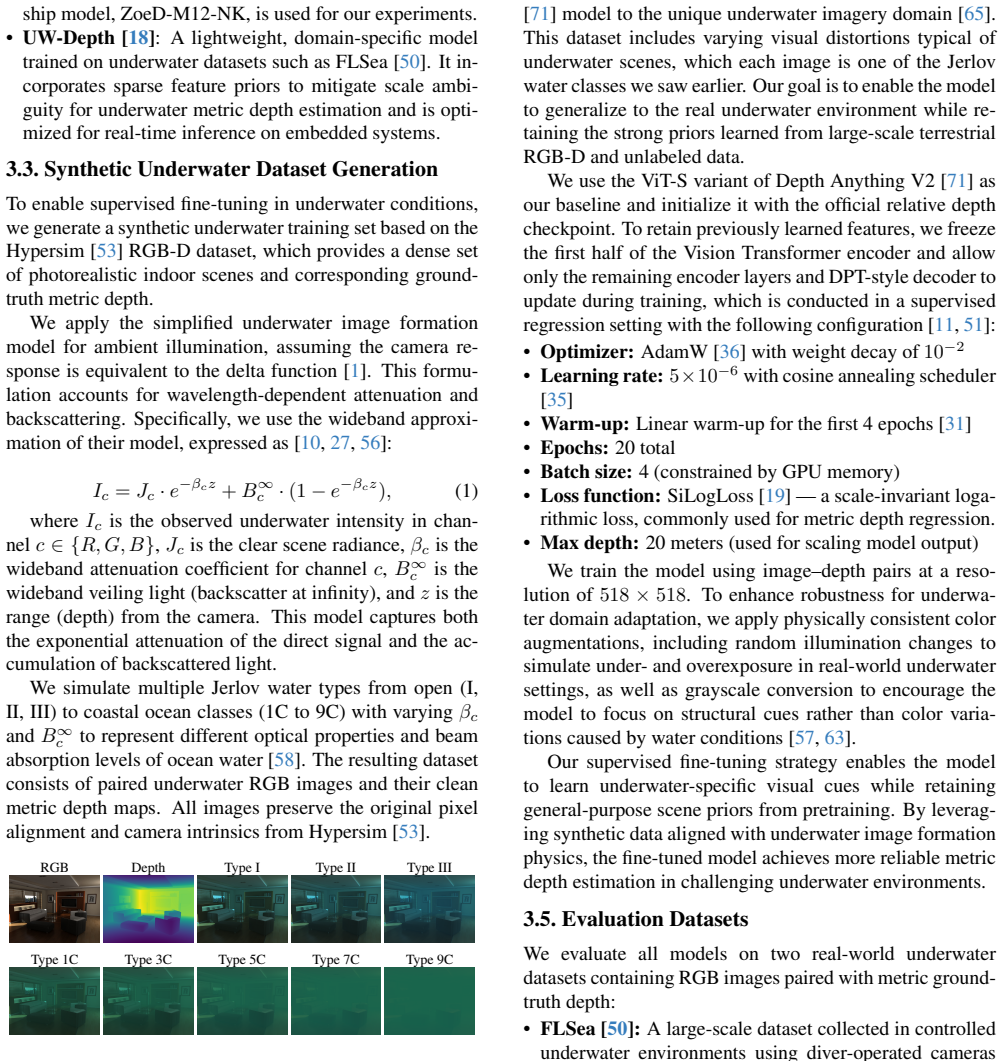
The load-bearing object is the synthetic underwater image formation model: for each channel $c$, the observed intensity is $I_c = J_c \cdot e^{-\beta_c z} + B^\infty_c \cdot (1 - e^{-\beta_c z})$, where $J_c$ is the clear scene radiance, $\beta_c$ the wideband attenuation coefficient, $B^\infty_c$ the veiling light at infinity, and $z$ the per-pixel depth from Hypersim. Applying this to indoor Hypersim RGB-D images, with coefficients drawn from Jerlov open-ocean and coastal water classes, yields paired turbid-looking RGB images and unchanged metric depth maps. The fine-tuning recipe then freezes the first half of the ViT-S encoder and updates the remaining encoder layers and the DPT decoder with SiLog loss at a 20-meter depth scale, with color augmentations, so the model keeps its terrestrial scene priors while learning underwater-specific appearance cues.
What would settle it
Train the same fine-tuning recipe on a synthetic underwater dataset whose attenuation and backscatter coefficients are drawn from a different distribution, or whose scenes are outdoor rather than indoor, and test on FLSea and SQUID: if the $\delta_1$ improvement disappears or reverses, the gain is tied to Hypersim's geometry or to the particular parameter choice rather than to the physics-based underwater image formation model.
Extended reading notes
Core claim
The paper's central claim is that forward domain adaptation with physics-simulated underwater images transfers to real underwater scenes: fine-tuning Depth Anything V2 (ViT-S) on underwater-rendered Hypersim, rather than on clean in-air Hypersim, reduces AbsRel and raises $\delta_1$ on real-world benchmarks, improving $\delta_1$ on all three groups (FLSea-Canyon, FLSea-Red Sea, SQUID) and AbsRel on two of the three. The mechanism is the wideband underwater image formation model $I_c = J_c e^{-\beta_c z} + B^\infty_c (1 - e^{-\beta_c z})$, applied per RGB channel with Jerlov water-type coefficients, which produces paired underwater RGB images and clean metric depth while preserving pixel alignment. The paper also benchmarks six zero-shot models and finds that while UniDepth V2 (ViT-L) leads on clear-water FLSea, performance drops sharply in turbid SQUID, and that the underwater-specific UW-Depth model outperforms much larger general-purpose models on SQUID despite a compact backbone.
Load-bearing premise
The load-bearing premise is that the simplified wideband underwater image formation model, applied to indoor Hypersim scenes, produces degradations similar enough to real underwater light transport that a model fine-tuned on those synthetic images transfers to real FLSea and SQUID photos; the paper does not report the exact $\beta_c$ and $B^\infty_c$ values used and does not quantitatively measure this synthetic-to-real gap.
Editorial extensions
If this is right
- Fine-tuning on synthetic underwater Hypersim improves $\delta_1$ accuracy on all three real benchmark groups: FLSea-Canyon from 0.4463 to 0.4683, FLSea-Red Sea from 0.4722 to 0.6170, and SQUID from 0.2054 to 0.3204.
- The same physics-based degradation can be layered onto any in-air RGB-D dataset, so synthetic underwater supervision is not limited to Hypersim's indoor geometry.
- The synthetic-to-real gain is largest on SQUID, the more turbid and longer-range benchmark, indicating the approach specifically helps where veiling light and attenuation dominate.
- A compact underwater-specific model trained on real data outperforms much larger zero-shot foundation models on SQUID, showing that domain-specific training can matter more than model scale in degraded conditions.
Reading between the lines
- If the transfer holds, the same degradation recipe could be applied to other metric depth foundation models, such as UniDepth V2, or to other dense prediction tasks like surface normal estimation, because the image formation model is task-agnostic.
- The reported gain pattern suggests the fine-tuning mainly teaches the model to discount backscatter and attenuation rather than to improve geometric reasoning; a testable prediction is that improvements concentrate in high-backscatter, low-contrast regions.
- Because the exact $\beta_c$ and $B^\infty_c$ values per Jerlov class are not reported, the recipe is not fully reproducible; publishing these coefficients and validating on tank imagery with measured water properties would isolate whether the gain comes from the physics model or from generic color augmentation.
Editorial analysis
A structured set of objections, weighed in public.
Referee Report
Summary. This paper studies monocular metric depth estimation for underwater images. The authors benchmark six models (Depth Anything V2, Metric3D V2, UniDepth V2, ZoeDepth, Depth Pro, and UW-Depth) in a zero-shot setting on the FLSea and SQUID real-world underwater datasets, construct a synthetic underwater dataset by applying the wideband underwater image formation model of Eq. (1) to Hypersim, and fine-tune Depth Anything V2 (ViT-S) on that synthetic dataset. They report that fine-tuning improves delta1 on all three benchmark groups and AbsRel on two of the three, with qualitative improvements shown in Fig. 3. The paper claims consistent improvement across all benchmarks and proposes synthetic underwater fine-tuning as an effective domain-adaptation strategy.
Significance. The paper addresses a practically important problem and makes a useful empirical contribution by quantifying the zero-shot performance of several metric-depth foundation models on real underwater data. The test data are external to the synthetic training set, so the evaluation is not circular. The synthetic data pipeline is simple and potentially scalable, and the qualitative comparisons are informative. However, the central causal claim—that underwater simulation, rather than supervised fine-tuning on Hypersim in general, drives the observed gains—is not yet supported because the baseline is not a same-recipe clean-Hypersim fine-tune. The overstatement in the abstract and the lack of variance estimates further weaken the current presentation. With a proper control and corrected claims, the work would be a solid contribution.
major comments (4)
- [§4.4, Table 2; §3.4] The central claim that synthetic underwater fine-tuning causes the observed gains is not identified by the reported comparison. Table 2 compares the authors' fine-tuned model, which is initialized from the official relative-depth checkpoint and trained for 20 epochs with the recipe in §3.4 (AdamW, SiLogLoss, color augmentations, frozen first half of the encoder), against a baseline that is the official Depth Anything V2 Hypersim metric-depth checkpoint described in §3.2, whose training details are not controlled by the authors. Any improvement could therefore come from supervised metric fine-tuning on Hypersim itself or from the augmentations, rather than from the underwater simulation. Please add a same-recipe control trained on clean in-air Hypersim with identical initialization, epochs, augmentations, loss, and depth range, and report its numbers alongside Table 2.
- [Abstract; Table 2; §5.2] The abstract and contributions state that fine-tuning 'consistently improves performance across all benchmarks,' but Table 2 shows FLSea-Canyon AbsRel worsening from 0.3576 to 0.3620, and §5.2 itself only claims improvements on 'most FLSea subsets.' The wording should be corrected to match the data, and the Canyon result should be discussed explicitly rather than glossed over. In addition, no error bars, multiple seeds, or significance tests are provided, so it is unclear whether the reported gains (e.g., Red Sea delta1 from 0.4722 to 0.6170) exceed run-to-run variability; please add variance estimates or per-scene scores, especially given the small size of SQUID (57 stereo pairs).
- [§3.3, Eq. (1)] The synthetic data generation is not reproducible as described. The paper lists Jerlov water types but never gives the numeric values of beta_c and B_inf_c used in Eq. (1), nor the sampling distribution over water types, nor whether each image is assigned a single water type or a blend. Without these values, readers cannot regenerate the dataset or assess how much of the simulated attenuation range is covered. Please report the full parameter table and sampling procedure, and ideally include a quantitative analysis of the synthetic-to-real domain gap using real underwater attenuation or color statistics from FLSea and SQUID.
- [Table 1; §4.3; §5.3] The benchmark coverage is overstated relative to what is reported: Metric3D V2 (ViT-L) appears only in qualitative comparisons because its quantitative results are excluded due to hardware constraints, and UW-Depth is omitted on FLSea because of training-set overlap. The paper should either supply the missing quantitative results for these cases or explicitly restrict the 'comprehensive benchmark' claim to the models and splits for which metrics are actually reported.
minor comments (6)
- [§3.4] The sentence 'which each image is one of the Jerlov water classes' should read 'where each image is assigned one of the Jerlov water classes.'
- [Figure 1 caption] The caption 'RGB Depth Type I Type II...' is unclear; please separate the panel labels (e.g., 'RGB, Depth, Type I, Type II, ...') so that each image is identified.
- [Table 2] The abbreviation 'DA V2' is used in the table but not defined there; please define it at first use in the table or in the surrounding text.
- [§5.3] The statement that the fine-tuned Depth Anything V2 model 'ranks just behind UniDepth V2' is not supported by Table 2, where the fine-tuned ViT-S is substantially worse than UniDepth V2 ViT-L on every reported metric; please qualify this as a qualitative observation or compare against a matching backbone size.
- [§4.5 and Fig. 3] Figure 3 is described as showing 'much sharper depth boundaries and a more accurate metric depth scale,' but the quantitative gains in Table 2 are modest and inconsistent on FLSea-Canyon; please temper the qualitative language or tie it to a per-scene quantitative analysis.
- [General] The paper does not state whether code, the synthetic dataset, or fine-tuned checkpoints will be released; for a domain-adaptation study whose main value is the benchmark and the training recipe, releasing these artifacts would greatly improve reproducibility.
Circularity Check
No significant circularity: the paper's claims are empirical comparisons against external real-world benchmarks, not derivations reducible to their inputs.
full rationale
The paper's central contribution is an empirical benchmark plus a domain-adaptation experiment: it fine-tunes Depth Anything V2 (ViT-S) on a synthetic underwater version of Hypersim and measures accuracy on real FLSea and SQUID test images (Section 4.4, Table 2). The evaluation data are external to the training pipeline and are not used to fit any parameter of the synthetic generation model. Equation (1) is a standard wideband underwater image formation model imported from external prior work [1, 10, 27, 56], and the Jerlov water-type coefficients are presented as established optical classifications [58]; no quantity in the model is fitted to the benchmark outputs, so there is no self-definitional or fitted-input-called-prediction structure. No uniqueness theorem, ansatz, or load-bearing self-citation is invoked to force the method choice; the citations to [1] and [71] are background support for the forward model and the pretrained weights, respectively, and neither reduces the measured test improvement to an input by construction. The absence of a same-recipe clean-Hypersim control and the FLSea-Canyon AbsRel regression (0.3576 to 0.3620) are legitimate experimental and reporting concerns about causal attribution, but they are confounds, not circularity: the comparison still evaluates the model against real, external ground truth rather than against the training data or a quantity defined in terms of the prediction. Accordingly, no circular steps are identified and the circularity score is 0.
Assumptions & free parameters
free parameters (1)
- Wideband attenuation coefficients beta_c and veiling light B_inf_c per Jerlov water type =
not specified in paper; taken from Jerlov water type literature [58]
assumptions (4)
- domain assumption Akkaynak-Treibitz wideband underwater image formation model (Eq. 1) is an adequate forward model for generating training images that transfer to real underwater photography.
- domain assumption Jerlov water type optical properties cover the range of real FLSea and SQUID water conditions.
- domain assumption FLSea SfM and SQUID stereo ground-truth depths are accurate enough to serve as metric benchmarks.
- domain assumption Hypersim indoor scene geometry is a sufficient training distribution for underwater depth cues.
Cite this review
Pith. "Pith review of Underwater Monocular Metric Depth Estimation: Real-World Benchmarks and Synthetic Fine-Tuning with Vision Foundation Models." pith.science (2026). https://pith.science/paper/V2TAIUSZ
@misc{pith2026250702148,
  author       = {Pith},
  title        = {Pith review of: Underwater Monocular Metric Depth Estimation: Real-World Benchmarks and Synthetic Fine-Tuning with Vision Foundation Models},
  year         = {2026},
  howpublished = {\url{https://pith.science/paper/V2TAIUSZ}},
  note         = {Machine review of arXiv:2507.02148}
}
read the original abstract
Monocular depth estimation has recently progressed beyond ordinal depth to provide metric depth predictions. However, its reliability in underwater environments remains limited due to light attenuation and scattering, color distortion, turbidity, and the lack of high-quality metric ground truth data. In this paper, we present a comprehensive benchmark of zero-shot and fine-tuned monocular metric depth estimation models on real-world underwater datasets with metric depth annotations, including FLSea and SQUID. We evaluated a diverse set of state-of-the-art Vision Foundation Models across a range of underwater conditions and depth ranges. Our results show that large-scale models trained on terrestrial data (real or synthetic) are effective in in-air settings, but perform poorly underwater due to significant domain shifts. To address this, we fine-tune Depth Anything V2 with a ViT-S backbone encoder on a synthetic underwater variant of the Hypersim dataset, which we simulated using a physically based underwater image formation model. Our fine-tuned model consistently improves performance across all benchmarks and outperforms baselines trained only on the clean in-air Hypersim dataset. This study presents a detailed evaluation and visualization of monocular metric depth estimation in underwater scenes, emphasizing the importance of domain adaptation and scale-aware supervision for achieving robust and generalizable metric depth predictions using foundation models in challenging environments.
Figures


Reference graph
Works this paper leans on
-
[1]
A revised underwater image formation model
Derya Akkaynak and Tali Treibitz. A revised underwater image formation model. In2018 IEEE/CVF Conference on Computer Vision and Pattern Recognition, pages 6723– 6732, 2018. 1, 2, 3, 4, 8
2018
-
[2]
Sea-thru: A method for removing water from underwater images
Derya Akkaynak and Tali Treibitz. Sea-thru: A method for removing water from underwater images. InProceedings of the IEEE/CVF Conference on Computer Vision and Pattern Recognition (CVPR), 2019. 2
work page 2019
-
[3]
Unav-sim: A visually realistic underwater robotics simulator and synthetic data-generation framework
Abdelhakim Amer, Olaya ´Alvarez Tu ˜n´on, Halil ˙Ibrahim U˘gurlu, Jonas Le Fevre Sejersen, Yury Brodskiy, and Erdal Kayacan. Unav-sim: A visually realistic underwater robotics simulator and synthetic data-generation framework. In 2023 21st International Conference on Advanced Robotics (ICAR), pages 570–576, 2023. 3
work page 2023
-
[4]
Foundation models defining a new era in vision: A survey and outlook
Muhammad Awais, Muzammal Naseer, Salman Khan, Rao Muhammad Anwer, Hisham Cholakkal, Mubarak Shah, Ming-Hsuan Yang, and Fahad Shahbaz Khan. Foundation models defining a new era in vision: A survey and outlook. IEEE Transactions on Pattern Analysis and Machine Intelli- gence, 47(4):2245–2264, 2025. 2
work page 2025
-
[5]
Underwater single image color restoration using haze-lines and a new quantitative dataset, 2018
Dana Berman, Deborah Levy, Shai Avidan, and Tali Treibitz. Underwater single image color restoration using haze-lines and a new quantitative dataset, 2018. 1, 2, 3, 5, 6, 8
work page 2018
-
[6]
Zoedepth: Zero-shot transfer by com- bining relative and metric depth, 2023
Shariq Farooq Bhat, Reiner Birkl, Diana Wofk, Peter Wonka, and Matthias M ¨uller. Zoedepth: Zero-shot transfer by com- bining relative and metric depth, 2023. 2, 3, 5, 6, 7, 8
work page 2023
-
[7]
Aleksei Bochkovskii, Ama ¨el Delaunoy, Hugo Germain, Marcel Santos, Yichao Zhou, Stephan R. Richter, and Vladlen Koltun. Depth pro: Sharp monocular metric depth in less than a second, 2025. 1, 2, 3, 5, 6, 7
work page 2025
-
[8]
Pyramid stereo matching network
Jia-Ren Chang and Yong-Sheng Chen. Pyramid stereo matching network. InProceedings of the IEEE conference on computer vision and pattern recognition, pages 5410–5418,
Show all 81 references
-
[9]
When vision transformers outperform resnets without pre- training or strong data augmentations.arXiv preprint arXiv:2106.01548, 2021
Xiangning Chen, Cho-Jui Hsieh, and Boqing Gong. When vision transformers outperform resnets without pre- training or strong data augmentations.arXiv preprint arXiv:2106.01548, 2021. 2
2021 arXiv
-
[10]
Chiang and Ying-Ching Chen
John Y . Chiang and Ying-Ching Chen. Underwater im- age enhancement by wavelength compensation and dehaz- ing.IEEE Transactions on Image Processing, 21(4):1756– 1769, 2012. 4
2012
-
[11]
Best practices for fine-tuning vi- sual classifiers to new domains
Brian Chu, Vashisht Madhavan, Oscar Beijbom, Judy Hoff- man, and Trevor Darrell. Best practices for fine-tuning vi- sual classifiers to new domains. InComputer Vision – ECCV 2016 Workshops, pages 435–442, Cham, 2016. Springer In- ternational Publishing. 4
2016
-
[12]
Indoor semantic segmentation using depth in- formation.arXiv preprint arXiv:1301.3572, 2013
Camille Couprie, Cl ´ement Farabet, Laurent Najman, and Yann LeCun. Indoor semantic segmentation using depth in- formation.arXiv preprint arXiv:1301.3572, 2013. 1, 2, 5
2013 arXiv
-
[13]
Diffusion models in vision: A survey
Florinel-Alin Croitoru, Vlad Hondru, Radu Tudor Ionescu, and Mubarak Shah. Diffusion models in vision: A survey. IEEE Transactions on Pattern Analysis and Machine Intelli- gence, 45(9):10850–10869, 2023. 3
2023
-
[14]
Davis, R
J. Davis, R. Ramamoorthi, and S. Rusinkiewicz. Spacetime stereo: a unifying framework for depth from triangulation. In2003 IEEE Computer Society Conference on Computer Vision and Pattern Recognition, 2003. Proceedings., pages II–359, 2003. 5
2003
-
[15]
CRC Press, 2017
Pinliang Dong and Qi Chen.LiDAR remote sensing and ap- plications. CRC Press, 2017. 1
2017
-
[16]
An image is worth 16x16 words: Trans- formers for image recognition at scale.arXiv preprint arXiv:2010.11929, 2020
Alexey Dosovitskiy, Lucas Beyer, Alexander Kolesnikov, Dirk Weissenborn, Xiaohua Zhai, Thomas Unterthiner, Mostafa Dehghani, Matthias Minderer, Georg Heigold, Syl- vain Gelly, et al. An image is worth 16x16 words: Trans- formers for image recognition at scale.arXiv preprint ar...
2010 arXiv
-
[17]
Simultaneous local- ization and mapping: part i.IEEE robotics & automation magazine, 13(2):99–110, 2006
Hugh Durrant-Whyte and Tim Bailey. Simultaneous local- ization and mapping: part i.IEEE robotics & automation magazine, 13(2):99–110, 2006. 1
2006
-
[18]
Metri- cally scaled monocular depth estimation through sparse pri- ors for underwater robots, 2023
Luca Ebner, Gideon Billings, and Stefan Williams. Metri- cally scaled monocular depth estimation through sparse pri- ors for underwater robots, 2023. 2, 4, 5, 6, 7
2023
-
[19]
Depth map prediction from a single image using a multi-scale deep net- work, 2014
David Eigen, Christian Puhrsch, and Rob Fergus. Depth map prediction from a single image using a multi-scale deep net- work, 2014. 2, 4, 5
2014
-
[20]
3-d mapping with an rgb-d camera
Felix Endres, J ¨urgen Hess, J ¨urgen Sturm, Daniel Cremers, and Wolfram Burgard. 3-d mapping with an rgb-d camera. IEEE transactions on robotics, 30(1):177–187, 2013. 1
2013
-
[21]
Relocating underwater features au- tonomously using sonar-based slam.IEEE Journal of Oceanic Engineering, 38(3):500–513, 2013
Maurice F Fallon, John Folkesson, Hunter McClelland, and John J Leonard. Relocating underwater features au- tonomously using sonar-based slam.IEEE Journal of Oceanic Engineering, 38(3):500–513, 2013. 1
2013
-
[22]
Underwa- ter object detection: architectures and algorithms–a compre- hensive review.Multimedia Tools and Applications, 81(15): 20871–20916, 2022
Sheezan Fayaz, Shabir A Parah, and GJ Qureshi. Underwa- ter object detection: architectures and algorithms–a compre- hensive review.Multimedia Tools and Applications, 81(15): 20871–20916, 2022. 1
2022
-
[23]
Vision meets robotics: The kitti dataset.The in- ternational journal of robotics research, 32(11):1231–1237,
Andreas Geiger, Philip Lenz, Christoph Stiller, and Raquel Urtasun. Vision meets robotics: The kitti dataset.The in- ternational journal of robotics research, 32(11):1231–1237,
-
[24]
Digging into self-supervised monocular depth estimation
Cl ´ement Godard, Oisin Mac Aodha, Michael Firman, and Gabriel J Brostow. Digging into self-supervised monocular depth estimation. InProceedings of the IEEE/CVF inter- national conference on computer vision, pages 3828–3838,
-
[25]
Gonz ´alez-Sabbagh and Antonio Robles-Kelly
Salma P. Gonz ´alez-Sabbagh and Antonio Robles-Kelly. A survey on underwater computer vision.ACM Comput. Surv., 55(13s), 2023. 2, 3
2023
-
[26]
Uw-gan: Single-image depth estimation and image enhancement for underwater images.IEEE Transactions on Instrumentation and Measurement, 70:1–12, 2021
Praful Hambarde, Subrahmanyam Murala, and Abhinav Dhall. Uw-gan: Single-image depth estimation and image enhancement for underwater images.IEEE Transactions on Instrumentation and Measurement, 70:1–12, 2021. 3, 6
2021
-
[27]
Single image haze removal using dark channel prior.IEEE Transactions on Pat- tern Analysis and Machine Intelligence, 33(12):2341–2353,
Kaiming He, Jian Sun, and Xiaoou Tang. Single image haze removal using dark channel prior.IEEE Transactions on Pat- tern Analysis and Machine Intelligence, 33(12):2341–2353,
-
[28]
Distill any depth: Distillation creates a stronger monocular depth estimator, 2025
Xiankang He, Dongyan Guo, Hongji Li, Ruibo Li, Ying Cui, and Chi Zhang. Distill any depth: Distillation creates a stronger monocular depth estimator, 2025. 2, 5
2025
-
[29]
Teacher-student architecture for knowl- edge distillation: A survey, 2023
Chengming Hu, Xuan Li, Dan Liu, Haolun Wu, Xi Chen, Ju Wang, and Xue Liu. Teacher-student architecture for knowl- edge distillation: A survey, 2023. 2 9
2023
-
[30]
Mu Hu, Wei Yin, Chi Zhang, Zhipeng Cai, Xiaoxiao Long, Hao Chen, Kaixuan Wang, Gang Yu, Chunhua Shen, and Shaojie Shen. Metric3d v2: A versatile monocular geomet- ric foundation model for zero-shot metric depth and surface normal estimation.IEEE Transactions on Pattern Analysi...
2024
-
[31]
Why warmup the learning rate? underlying mechanisms and improvements,
Dayal Singh Kalra and Maissam Barkeshli. Why warmup the learning rate? underlying mechanisms and improvements,
-
[32]
Underwater optical-sonar image fusion systems.Sensors, 22(21):8445,
Hong-Gi Kim, Jungmin Seo, and Soo Mee Kim. Underwater optical-sonar image fusion systems.Sensors, 22(21):8445,
-
[33]
Fine-tuning can distort pretrained fea- tures and underperform out-of-distribution, 2022
Ananya Kumar, Aditi Raghunathan, Robbie Jones, Tengyu Ma, and Percy Liang. Fine-tuning can distort pretrained fea- tures and underperform out-of-distribution, 2022. 3
2022
-
[34]
An underwater image enhancement benchmark dataset and beyond.IEEE transac- tions on image processing, 29:4376–4389, 2019
Chongyi Li, Chunle Guo, Wenqi Ren, Runmin Cong, Junhui Hou, Sam Kwong, and Dacheng Tao. An underwater image enhancement benchmark dataset and beyond.IEEE transac- tions on image processing, 29:4376–4389, 2019. 1
2019
-
[35]
Sgdr: Stochastic gradient descent with warm restarts, 2017
Ilya Loshchilov and Frank Hutter. Sgdr: Stochastic gradient descent with warm restarts, 2017. 4
2017
-
[36]
Decoupled weight decay regularization, 2019
Ilya Loshchilov and Frank Hutter. Decoupled weight decay regularization, 2019. 4
2019
-
[37]
A survey on vision-based uav navigation.Geo- spatial information science, 21(1):21–32, 2018
Yuncheng Lu, Zhucun Xue, Gui-Song Xia, and Liangpei Zhang. A survey on vision-based uav navigation.Geo- spatial information science, 21(1):21–32, 2018. 1
2018
-
[38]
John McCormac, Ankur Handa, Stefan Leutenegger, and Andrew J. Davison. Scenenet rgb-d: Can 5m synthetic im- ages beat generic imagenet pre-training on indoor segmenta- tion? InProceedings of the IEEE International Conference on Computer Vision (ICCV), 2017. 2
2017
-
[39]
Autonomous inspection using an underwater 3d lidar
Dan McLeod, John Jacobson, Mark Hardy, and Carl Em- bry. Autonomous inspection using an underwater 3d lidar. In2013 OCEANS-San Diego, pages 1–8. IEEE, 2013. 1
2013
-
[40]
Mobilevit: Light- weight, general-purpose, and mobile-friendly vision trans- former, 2022
Sachin Mehta and Mohammad Rastegari. Mobilevit: Light- weight, general-purpose, and mobile-friendly vision trans- former, 2022. 2
2022
-
[41]
Deep learning for monocular depth estimation: A review.Neuro- computing, 438:14–33, 2021
Yue Ming, Xuyang Meng, Chunxiao Fan, and Hui Yu. Deep learning for monocular depth estimation: A review.Neuro- computing, 438:14–33, 2021. 1
2021
-
[42]
Adjeroh, and Gi- anfranco Doretto
Saeid Motiian, Marco Piccirilli, Donald A. Adjeroh, and Gi- anfranco Doretto. Unified deep supervised domain adapta- tion and generalization. InProceedings of the IEEE Interna- tional Conference on Computer Vision (ICCV), 2017. 3
2017
-
[43]
Springer, 2021
Sergey I Nikolenko et al.Synthetic data for deep learning. Springer, 2021. 1
2021
-
[44]
A survey of structure from motion, 2017
Onur Ozyesil, Vladislav V oroninski, Ronen Basri, and Amit Singer. A survey of structure from motion, 2017. 4
2017
-
[45]
Autonomous mapping of underwater 3-d structures: From view planning to execution.IEEE Robotics and Au- tomation Letters, 3(3):1965–1971, 2018
Narc ´ıs Palomeras, Natalia Hurt ´os, Marc Carreras, and Pere Ridao. Autonomous mapping of underwater 3-d structures: From view planning to execution.IEEE Robotics and Au- tomation Letters, 3(3):1965–1971, 2018. 1
1965
-
[46]
Visual domain adaptation: A survey of recent advances.IEEE Signal Processing Magazine, 32(3):53–69,
Vishal M Patel, Raghuraman Gopalan, Ruonan Li, and Rama Chellappa. Visual domain adaptation: A survey of recent advances.IEEE Signal Processing Magazine, 32(3):53–69,
-
[47]
Unidepthv2: Universal monocular metric depth estimation made simpler, 2025
Luigi Piccinelli, Christos Sakaridis, Yung-Hsu Yang, Mat- tia Segu, Siyuan Li, Wim Abbeloos, and Luc Van Gool. Unidepthv2: Universal monocular metric depth estimation made simpler, 2025. 2, 3, 5, 6, 7, 8
2025
-
[48]
Z-splat: Z-axis gaussian splatting for camera-sonar fusion.IEEE Transactions on Pat- tern Analysis and Machine Intelligence, 2024
Ziyuan Qu, Omkar Vengurlekar, Mohamad Qadri, Kevin Zhang, Michael Kaess, Christopher Metzler, Suren Jaya- suriya, and Adithya Pediredla. Z-splat: Z-axis gaussian splatting for camera-sonar fusion.IEEE Transactions on Pat- tern Analysis and Machine Intelligence, 2024. 1, 2
2024
-
[49]
Svin2: An underwater slam system using sonar, visual, inertial, and depth sensor
Sharmin Rahman, Alberto Quattrini Li, and Ioannis Rek- leitis. Svin2: An underwater slam system using sonar, visual, inertial, and depth sensor. In2019 IEEE/RSJ International Conference on Intelligent Robots and Systems (IROS), pages 1861–1868. IEEE, 2019. 1
2019
-
[50]
PhD thesis, ProQuest Dissertations Publishing,
Yelena Randall and Tali Treibitz.FLSea: Under- water Visual-Inertial and Stereo-Vision Forward-Looking Datasets. PhD thesis, ProQuest Dissertations Publishing,
-
[51]
Vi- sion transformers for dense prediction
Ren ´e Ranftl, Alexey Bochkovskiy, and Vladlen Koltun. Vi- sion transformers for dense prediction. InProceedings of the IEEE/CVF international conference on computer vision, pages 12179–12188, 2021. 1, 2, 3, 4
2021
-
[52]
Underwater image enhancement: a comprehensive re- view, recent trends, challenges and applications.Artificial Intelligence Review, 54:5413–5467, 2021
Smitha Raveendran, Mukesh D Patil, and Gajanan K Biraj- dar. Underwater image enhancement: a comprehensive re- view, recent trends, challenges and applications.Artificial Intelligence Review, 54:5413–5467, 2021. 1, 6
2021
-
[53]
Susskind
Mike Roberts, Jason Ramapuram, Anurag Ranjan, Atulit Kumar, Miguel Angel Bautista, Nathan Paczan, Russ Webb, and Joshua M. Susskind. Hypersim: A photorealistic syn- thetic dataset for holistic indoor scene understanding. In International Conference on Computer Vision (ICCV) 2021,
2021
-
[54]
Mobilenetv2: Inverted residuals and linear bottlenecks, 2019
Mark Sandler, Andrew Howard, Menglong Zhu, Andrey Zh- moginov, and Liang-Chieh Chen. Mobilenetv2: Inverted residuals and linear bottlenecks, 2019. 5, 6
2019
-
[55]
Ashutosh Saxena, Jamie Schulte, and Andrew Y . Ng. Depth estimation using monocular and stereo cues. InProceedings of the 20th International Joint Conference on Artifical Intel- ligence, page 2197–2203, San Francisco, CA, USA, 2007. Morgan Kaufmann Publishers Inc. 1
2007
-
[56]
Schechner and N
Y .Y . Schechner and N. Karpel. Clear underwater vision. In Proceedings of the 2004 IEEE Computer Society Conference on Computer Vision and Pattern Recognition, 2004. CVPR 2004., pages I–I, 2004. 4
2004
-
[57]
Unsupervised low-light image enhancement by extracting structural similarity and color consistency.IEEE Signal Pro- cessing Letters, 29:997–1001, 2022
Yangming Shi, Binquan Wang, Xiaopo Wu, and Ming Zhu. Unsupervised low-light image enhancement by extracting structural similarity and color consistency.IEEE Signal Pro- cessing Letters, 29:997–1001, 2022. 4
2022
-
[58]
Solonenko and Curtis D
Michael G. Solonenko and Curtis D. Mobley. Inherent op- tical properties of jerlov water types.Appl. Opt., 54(17): 5392–5401, 2015. 4, 8
2015
-
[59]
How to train your vit? data, augmentation, and regularization in vision transformers.arXiv preprint arXiv:2106.10270, 2021
Andreas Steiner, Alexander Kolesnikov, , Xiaohua Zhai, Ross Wightman, Jakob Uszkoreit, and Lucas Beyer. How to train your vit? data, augmentation, and regularization in vision transformers.arXiv preprint arXiv:2106.10270, 2021. 2 10
2021 arXiv
-
[60]
Review of underwa- ter sensing technologies and applications.Sensors, 21(23): 7849, 2021
Kai Sun, Weicheng Cui, and Chi Chen. Review of underwa- ter sensing technologies and applications.Sensors, 21(23): 7849, 2021. 1
2021
-
[61]
Vi- sual slam algorithms: A survey from 2010 to 2016.IPSJ transactions on computer vision and applications, 9(1):16,
Takafumi Taketomi, Hideaki Uchiyama, and Sei Ikeda. Vi- sual slam algorithms: A survey from 2010 to 2016.IPSJ transactions on computer vision and applications, 9(1):16,
2010
-
[62]
Gomez, Lukasz Kaiser, and Illia Polosukhin
Ashish Vaswani, Noam Shazeer, Niki Parmar, Jakob Uszko- reit, Llion Jones, Aidan N. Gomez, Lukasz Kaiser, and Illia Polosukhin. Attention is all you need.CoRR, abs/1706.03762, 2017. 2
2017 arXiv
-
[63]
Wagner, Nadieh Khalili, Raghav Sharma, Melanie Boxberg, Carsten Marr, Walter de Back, and Tingying Peng
Sophia J. Wagner, Nadieh Khalili, Raghav Sharma, Melanie Boxberg, Carsten Marr, Walter de Back, and Tingying Peng. Structure-preserving multi-domain stain color augmentation using style-transfer with disentangled representations. In Medical Image Computing and Computer Assiste...
2021
-
[64]
Underwa- ter localization and 3d mapping of submerged structures with a single-beam scanning sonar
Jinkun Wang, Shi Bai, and Brendan Englot. Underwa- ter localization and 3d mapping of submerged structures with a single-beam scanning sonar. In2017 IEEE Inter- national Conference on Robotics and Automation (ICRA), pages 4898–4905. IEEE, 2017. 1
2017
-
[65]
Domain adaptation for underwater im- age enhancement.IEEE Transactions on Image Processing, 32:1442–1457, 2023
Zhengyong Wang, Liquan Shen, Mai Xu, Mei Yu, Kun Wang, and Yufei Lin. Domain adaptation for underwater im- age enhancement.IEEE Transactions on Image Processing, 32:1442–1457, 2023. 1, 3, 4, 5, 6
2023
-
[66]
Junjie Wen, Jinqiang Cui, Zhenjun Zhao, Ruixin Yan, Zhi Gao, Lihua Dou, and Ben M. Chen. Syreanet: A physi- cally guided underwater image enhancement framework in- tegrating synthetic and real images. In2023 IEEE Inter- national Conference on Robotics and Automation (ICRA), pa...
2023
-
[67]
Con- vnext v2: Co-designing and scaling convnets with masked autoencoders
Sanghyun Woo, Shoubhik Debnath, Ronghang Hu, Xinlei Chen, Zhuang Liu, In So Kweon, and Saining Xie. Con- vnext v2: Co-designing and scaling convnets with masked autoencoders. InProceedings of the IEEE/CVF Conference on Computer Vision and Pattern Recognition (CVPR), pages 1613...
2023
-
[68]
O’Kane, and Ioannis Rekleitis
Marios Xanthidis, Nare Karapetyan, Hunter Damron, Sharmin Rahman, James Johnson, Allison O’Connell, Ja- son M. O’Kane, and Ioannis Rekleitis. Navigation in the presence of obstacles for an agile autonomous underwater vehicle.arXiv preprint arXiv:1903.11750, 2020. 1
1903 arXiv
-
[69]
A systematic review and analysis of deep learning-based underwater object detection.Neurocomput- ing, 527:204–232, 2023
Shubo Xu, Minghua Zhang, Wei Song, Haibin Mei, Qi He, and Antonio Liotta. A systematic review and analysis of deep learning-based underwater object detection.Neurocomput- ing, 527:204–232, 2023. 1
2023
-
[70]
Depth anything: Unleashing the power of large-scale unlabeled data
Lihe Yang, Bingyi Kang, Zilong Huang, Xiaogang Xu, Jiashi Feng, and Hengshuang Zhao. Depth anything: Unleashing the power of large-scale unlabeled data. InProceedings of the IEEE/CVF Conference on Computer Vision and Pattern Recognition, pages 10371–10381, 2024. 1
2024
-
[71]
Depth any- thing v2.Advances in Neural Information Processing Sys- tems, 37:21875–21911, 2024
Lihe Yang, Bingyi Kang, Zilong Huang, Zhen Zhao, Xiao- gang Xu, Jiashi Feng, and Hengshuang Zhao. Depth any- thing v2.Advances in Neural Information Processing Sys- tems, 37:21875–21911, 2024. 1, 2, 3, 4, 5, 6, 7, 8
2024
-
[72]
Udepth: Fast monocular depth estimation for visually-guided underwater robots
Boxiao Yu, Jiayi Wu, and Md Jahidul Islam. Udepth: Fast monocular depth estimation for visually-guided underwater robots. In2023 IEEE International Conference on Robotics and Automation (ICRA), pages 3116–3123, 2023. 1, 2
2023
-
[73]
Atlantis: En- abling underwater depth estimation with stable diffusion
Fan Zhang, Shaodi You, Yu Li, and Ying Fu. Atlantis: En- abling underwater depth estimation with stable diffusion. In Proceedings of the IEEE/CVF Conference on Computer Vi- sion and Pattern Recognition (CVPR), pages 11852–11861,
-
[74]
Survey on monocular metric depth estima- tion, 2025
Jiuling Zhang. Survey on monocular metric depth estima- tion, 2025. 1
2025
-
[75]
Adding conditional control to text-to-image diffusion models, 2023
Lvmin Zhang, Anyi Rao, and Maneesh Agrawala. Adding conditional control to text-to-image diffusion models, 2023. 3
2023
-
[76]
An open-source, fiducial-based, un- derwater stereo visual-inertial localization method with re- fraction correction
Pengfei Zhang, Zhengxing Wu, Jian Wang, Shihan Kong, Min Tan, and Junzhi Yu. An open-source, fiducial-based, un- derwater stereo visual-inertial localization method with re- fraction correction. InProceedings of the 2021 IEEE/RSJ International Conference on Intelligent Robots ...
2021
-
[77]
Overview of underwater trans- mission characteristics of oceanic lidar.IEEE Journal of Selected Topics in Applied Earth Observations and Remote Sensing, 14:8144–8159, 2021
Guoqing Zhou, Chenyang Li, Dianjun Zhang, Dequan Liu, Xiang Zhou, and Jie Zhan. Overview of underwater trans- mission characteristics of oceanic lidar.IEEE Journal of Selected Topics in Applied Earth Observations and Remote Sensing, 14:8144–8159, 2021. 1
2021
-
[78]
Jun-Yan Zhu, Taesung Park, Phillip Isola, and Alexei A. Efros. Unpaired image-to-image translation using cycle- consistent adversarial networks.CoRR, abs/1703.10593,
-
[79]
Surrogate gap minimization improves sharpness-aware training.ICLR, 2022
Juntang Zhuang, Boqing Gong, Liangzhe Yuan, Yin Cui, Hartwig Adam, Nicha Dvornek, Sekhar Tatikonda, James Duncan, and Ting Liu. Surrogate gap minimization improves sharpness-aware training.ICLR, 2022. 2
2022
-
[80]
Underwater rgb- d camera based on binocular stereo vision.Acta Photonica Sin, 51:0404003, 2022
SF Zhuang, Y Ji, DW Tu, and X Zhang. Underwater rgb- d camera based on binocular stereo vision.Acta Photonica Sin, 51:0404003, 2022. 1 11
2022
-
[2023]
1, 2, 3, 4, 5, 6, 8
PQDT - Global, ISBN: 9798379478926. 1, 2, 3, 4, 5, 6, 8
Reviewed August 6, 2026 · model on record in the stance chip above.
Discussion (0). Sign in to comment.