REVIEW 4 major objections 7 minor 1 cited by
SSLR: A Semi-Supervised Learning Method for Isolated Sign Language Recognition
T0 review · 4 major / 7 minor · reviewed 2026-08-16 · deepseek-v4-flash
Pith's one-line read This paper proposes SSLR, a semi-supervised sign language recognition method that pseudo-labels unlabeled pose clips with a Transformer, and reports it matching or beating fully supervised training on WLASL-100 across most labeled-data…
desk verdict A reasonable pseudo-labeling baseline for pose-based sign language recognition whose reported gains don't support the 'significantly outperforms' claim; worth a careful referee, not a desk reject. read the letter →
The pith
A machine-rendered reading of the paper's core claim, the machinery that carries it, and where it could break.
The reading
What carries the argument
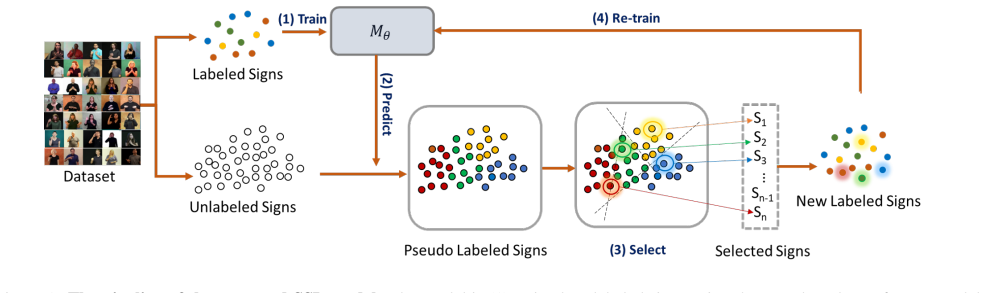
The engine is an iterative pseudo-labeling loop wrapped around a pose Transformer. The backbone, taken from SPOTER, encodes 54 body-joint landmarks per frame as a 108-dimensional vector, adds positional encoding, and uses six encoder and six decoder blocks with nine-head self-attention; a single learned "class query" is decoded and passed through softmax to produce the sign label. Pseudo-labeling is the learning mechanism: after each round, the model labels unlabeled clips and the highest-confidence predictions are moved into the labeled set and used to retrain, repeating until all clips are consumed. The supporting machinery is pose preprocessing: normalizing joint coordinates into the signing space and applying Gaussian noise, in-plane and arm-level rotation, and shearing, which the ablation credits with the largest portion of the accuracy gain.
What would settle it
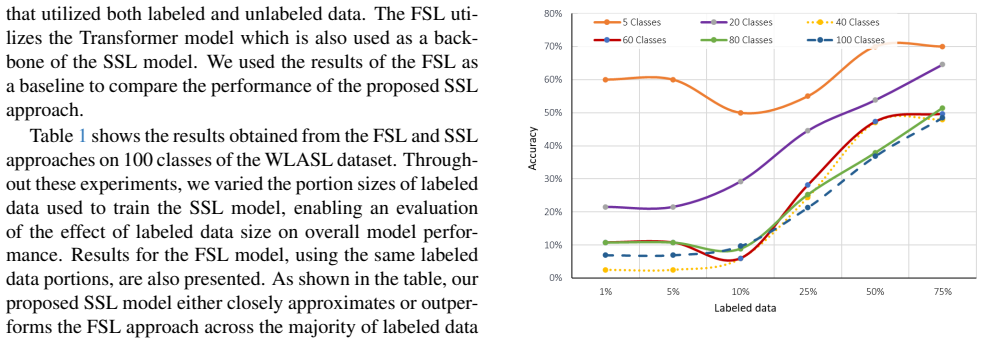
In the 5-class, 10%-labeled row of Table 2, SSL drops from 60% at 5% labeled to 50% at 10% while FSL rises from 25% to 65%; re-running that single cell with several random labeled subsets and logging the true labels of each added pseudo-label would show whether the loop is injecting systematically wrong examples. The claim also fails if an audit of the training loop shows that Algorithm 1's single global maximum, not Section 3.3's one-per-class selection, is what is actually executed and that this choice changes which clips are added.
Extended reading notes
Core claim
SSLR's central claim is that self-training with pseudo-labels turns the same pose Transformer into a better recognizer than supervised training on the same labeled set. The loop starts from labeled clips L, trains the Transformer, predicts softmax scores for unlabeled clips U, moves high-confidence predictions into L, retrains, and repeats until U is empty. On WLASL-100 the authors report SSL accuracies of 7.0, 7.0, 9.7, 21.3, 36.8, and 48.4 for 1%, 5%, 10%, 25%, 50%, and 75% labeled data, against FSL's 7.0, 7.0, 8.1, 22.5, 35.3, and 48.1; SSL wins at 10%, 50%, and 75% and matches at the floor. The authors state the contribution as SSLR significantly outperforming fully supervised methods even with the same amount of labeled data.
Load-bearing premise
The load-bearing premise is that the model's highest-confidence predictions on unlabeled clips are usually correct, and that the initial labeled subset is representative enough that the first model has something reliable to teach.
Editorial extensions
If this is right
- At 100 classes, SSLR surpasses FSL with 10%, 50%, and 75% labeled data (9.7 vs 8.1, 36.8 vs 35.3, and 48.4 vs 48.1), so the pseudo-label loop gains advantage exactly where labeled data is moderately scarce.
- Across 5, 20, 40, 60, 80, and 100 classes at 75% labeled data, SSL matches or exceeds FSL at every class count and opens its largest gap at 40 classes (47.9 vs 42.9).
- On 5 classes, SSL reaches 60% accuracy from just 1% and 5% labeled data while FSL stays at 25%, indicating the loop can bootstrap in very low label regimes.
- The ablation attributes a jump from 46.2% to 63.1% test accuracy to normalization with signing-space projection plus augmentation, so the pseudo-labeling claim depends on those preprocessing steps.
Reading between the lines
- If the strong version holds, the same confidence-selection loop is a plausible recipe for other pose-based action recognition tasks where a large unlabeled archive exists alongside a small labeled seed; a fair comparison with standard self-training and confidence-threshold baselines on the same backbone would place the gain, and the paper does not report such baselines.
- The paper describes two different selection rules: Section 3.3 says the highest-confidence sample is chosen per class, while Algorithm 1 selects a single global maximum; fixing this ambiguity matters because per-class selection preserves rare signs, whereas global selection would bias the added pseudo-labels toward frequent classes.
- A direct test of the mechanism is to log whether early-round pseudo-labels are correct; the 5-class, 10%-labeled drop (SSL 50 vs FSL 65) is exactly the signature of injected wrong labels, so re-running that cell with random labeled subsets would reveal whether the drop is real or a selection artifact.
Signed reviews
Editorial analysis
A structured set of objections, weighed in public.
Referee Report
Summary. The paper proposes SSLR, a semi-supervised pseudo-labeling method for isolated sign language recognition. Skeletal pose keypoints from the WLASL-100 dataset are fed into a SPOTER-style Transformer, which is first trained on a small labeled subset, then used to assign pseudo-labels to unlabeled samples; the highest-confidence pseudo-labeled samples are iteratively added to the training set. The authors compare this method against a fully supervised baseline trained on the same amount of labeled data, varying both the percentage of labeled data and the number of sign classes, and report accuracy tables, an ablation study of normalization and augmentation, and a figure showing the effect of training cycles. The abstract claims that SSL outperforms supervised learning with less labeled data in many cases, while the contribution list makes the stronger claim that SSLR significantly outperforms fully supervised methods even with the same amount of labeled data.
Significance. If the strong claim were substantiated, the paper would be practically useful for low-resource sign language recognition, because pseudo-labeling with a pose Transformer that beats supervised training from the same labeled set would directly address annotation scarcity. The evaluation on a held-out test set is a genuine strength and avoids the circularity of evaluating on the pseudo-labeled data itself. However, the claimed advantage is not established: the contribution bullet is contradicted by several rows of the paper's own tables, there are no error bars or significance tests, the pseudo-label selection rule is ambiguous between the text and Algorithm 1, and the reported tables contain duplicated rows that prevent verification. The method is a standard application of pseudo-labeling to pose-based SLR rather than a new algorithmic idea, so the contribution rests entirely on the empirical evidence, which is currently not reliable enough to support the headline claim.
major comments (4)
- [Section 3.3 / Algorithm 1] The pseudo-label selection rule is described inconsistently. Section 3.3 states that "for each class, the pseudo-labeled sample with the highest confidence is selected," while Algorithm 1 line 5 performs a single global maximum over all classes. These are different policies: global maximum selection tends to repeatedly select easy samples from the most confident classes, creating imbalanced pseudo-labels, whereas per-class selection spreads labels across classes. The authors must state which policy generated Tables 1 and 2, and justify the choice; without this clarification the reported accuracies cannot be interpreted.
- [Table 2 / Section 4] The rows labeled 1% and 5% in Table 2 are identical for every class count (5, 20, 40, 60, 80, 100), and the same duplication appears for 100 classes in Table 1. This is either a copy-and-paste error or an unexplained coincidence, and it makes the table unreliable as evidence. Additionally, no error bars, repeated-seed results, or significance tests are reported, so the word "significantly" in the contribution list is not supported by the data. The authors should correct the table and provide either confidence intervals or a clear statement of the number of runs and their variance.
- [Section 1 / Tables 1 and 2] The contribution bullet claims that "SSLR significantly outperforms fully supervised methods, even with the same amount of labeled data," but the paper's own results contradict this. For example, with 100 classes at 25% labeled data FSL achieves 22.5% while SSL achieves 21.3%; with 5 classes at 10% labeled data FSL achieves 65.0% while SSL achieves 50.0%; and with 20 classes at 50% labeled data FSL achieves 60.0% while SSL achieves 53.8%. Across Table 2, SSL is worse than FSL in a substantial fraction of configurations. The central empirical claim must be either substantially softened to "competitive in some cases" or supported with a statistically valid analysis that explains why certain configurations favor SSL and others do not.
- [Section 3.3 / Section 4 (Dataset split)] The construction of the labeled subset L is not described. The paper does not state whether L is chosen randomly, whether it is class-balanced, or whether seeds are controlled, and it does not specify how the split is performed for the different class counts. This matters because the pseudo-labeling method is sensitive to the composition of the initial labeled set, and the non-monotonic result in Table 2 for 5 classes (SSL drops from 60% at 1% and 5% labeled data to 50% at 10%) suggests either label-error reinforcement or an artifact of how L was selected. The authors should specify the exact sampling procedure and, ideally, report results over multiple random splits.
minor comments (7)
- [Section 4] There is a typo in the results paragraph: "the FFL model" should be "the FSL model."
- [Throughout] The terms "unannotated" and "unlabeled" are used interchangeably; the paper should pick one term and use it consistently.
- [Algorithm 1] Line 5, "P = max(P)", is underspecified: the authors should indicate whether the maximum is taken over all samples, over each class, or over the probability vector of a single sample, and should name the function as argmax when the selected sample is returned.
- [Section 3.2 / Section 3.3] The training configuration is not reported in enough detail: "Stochastic Gradient Descent optimizer" is not specific, and no learning rate, batch size, number of epochs, or stopping criterion for Algorithm 1's "until convergence or maximum iterations" are given.
- [Section 4.1 / Table 3] The caption of Table 3 says "Ablation study results with normalization and different augmentation techniques," but the first row removes all techniques; the caption should clarify that the first row is the no-preprocessing baseline.
- [Section 4] The sentence "the SSL model consistently outperformed the FSL, especially when trained with 75% of the labeled data" is not consistent with Table 2, since at 75% labeled data SSL is worse than FSL for 60 classes (49.7 vs. 50.9) and for 100 classes the margin is 0.3 percentage points in favor of SSL (48.4 vs. 48.1).
- [Figure 4] The text says the performance converges early for small labeled-data percentages and continues to improve for larger percentages, but no numerical convergence criterion or quantitative support is given, so the claim is difficult to assess from the figure alone.
Circularity Check
No circularity: the empirical SSL-vs-FSL comparison is evaluated on held-out test data; observed ambiguities are reproducibility issues, not circular reductions.
full rationale
This paper reports an empirical method and its evaluation; it contains no formal derivation chain whose conclusion is equivalent to its inputs. The SSL training loop does use the model's own high-confidence predictions as pseudo-labels, but this is the method under test, not a hidden circular step: the final accuracy numbers are computed on held-out WLASL test data (Section 4: 'The dataset is split into train, validation, and test sets following the same ratio of 4:1:1 used by the dataset authors'), so the central FSL-versus-SSL comparison is not self-validating. The Transformer backbone is adopted from the external SPOTER work [11], and the normalization is adopted from an external source [6]; these are not self-citations that presuppose the SSLR result. The discrepancy between Section 3.3 ('For each class, the pseudo-labeled sample with the highest confidence is selected') and Algorithm 1 (`P = M.predict(U)`, `hat(P) = max(P)`, which selects a single global maximum) is a real ambiguity, and the identical rows for 1% and 5% in Table 2 weaken reproducibility. However, ambiguity and possible implementation artifacts are correctness concerns, not circularity: no fitted parameter is renamed as a prediction, and no claim is justified solely by a self-citation. Accordingly, no specific circular step can be exhibited from the paper's own equations, and the honest finding is no significant circularity.
Assumptions & free parameters
free parameters (3)
- in-plane rotation angle =
up to 13 degrees
- arm rotation angle =
+/-4 degrees
- shear squeeze =
15% per side
assumptions (4)
- domain assumption Pose keypoints from a pose estimator are sufficient to recognize signs without RGB appearance.
- domain assumption The WLASL-100 train/validation/test split at 4:1:1 follows the dataset authors and has no signer overlap.
- ad hoc to paper Pseudo-labels with the highest softmax confidence are correct with high probability, and adding them improves the model.
- ad hoc to paper The labeled subset L is a random, class-balanced sample of the training data.
Cite this review
Pith. "Pith review of SSLR: A Semi-Supervised Learning Method for Isolated Sign Language Recognition." pith.science (2026). https://pith.science/paper/V2UQJWHK
@misc{pith2026250416640,
  author       = {Pith},
  title        = {Pith review of: SSLR: A Semi-Supervised Learning Method for Isolated Sign Language Recognition},
  year         = {2026},
  howpublished = {\url{https://pith.science/paper/V2UQJWHK}},
  note         = {Machine review of arXiv:2504.16640}
}
read the original abstract
Sign language is the primary communication language for people with disabling hearing loss. Sign language recognition (SLR) systems aim to recognize sign gestures and translate them into spoken language. One of the main challenges in SLR is the scarcity of annotated datasets. To address this issue, we propose a semi-supervised learning (SSL) approach for SLR (SSLR), employing a pseudo-label method to annotate unlabeled samples. The sign gestures are represented using pose information that encodes the signer's skeletal joint points. This information is used as input for the Transformer backbone model utilized in the proposed approach. To demonstrate the learning capabilities of SSL across various labeled data sizes, several experiments were conducted using different percentages of labeled data with varying numbers of classes. The performance of the SSL approach was compared with a fully supervised learning-based model on the WLASL-100 dataset. The obtained results of the SSL model outperformed the supervised learning-based model with less labeled data in many cases.
Figures

Figures from the paper (1 more)

Forward citations
Cited by 1 Pith paper
-
Using Sign Language Production as Data Augmentation to enhance Sign Language Translation
Adding synthetic sign-language data produced by stitching, a GAN, or Gaussian splatting to the training set improves sign-language translation, with the largest gains for skeleton-pose models.
Reference graph
Works this paper leans on
-
[1]
A Comprehensive Study on Deep Learning-based Methods for Sign Language Recognition
Nikolas Adaloglou, Theocharis Chatzis, Ilias Papastratis, Andreas Stergioulas, and Georgios Th. A Comprehensive Study on Deep Learning-based Methods for Sign Language Recognition. IEEE Transactions on Multimedia, pages 1–14,
-
[2]
Wisnu Aditya, Timothy K. Shih, Tipajin Thaipisutikul, Arda Satata Fitriajie, Munkhjargal Gochoo, Fitri Utamin- ingrum, and Chih Yang Lin. Novel Spatio-Temporal Contin- uous Sign Language Recognition Using an Attentive Multi- Feature Network. Sensors, 22(17), 2022. 1
work page 2022
-
[3]
Neena Aloysius, M. Geetha, and Prema Nedungadi. Incorpo- rating Relative Position Information in Transformer-Based Sign Language Recognition and Translation. IEEE Access, 9:145929–145942, 2021. 2
work page 2021
-
[4]
Saleh Aly and Walaa Aly. DeepArSLR: A novel signer- independent deep learning framework for isolated arabic sign language gestures recognition. IEEE Access, 8:83199– 83212, 2020. 2
work page 2020
-
[5]
Isolated arabic sign language recognition using a transformer-based model and landmark keypoints
Sarah Alyami, Hamzah Luqman, and Mohammad Ham- moudeh. Isolated arabic sign language recognition using a transformer-based model and landmark keypoints. ACM Transactions on Asian and Low-Resource Language Infor- mation Processing, 2023. 1
work page 2023
-
[6]
The use of signing space in a shared sign language of Australia
Anastasia Bauer. The use of signing space in a shared sign language of Australia. Walter de Gruyter GmbH & Co KG,
-
[7]
Bencherif, Mohammed Algabri, Mohamed A
Mohamed A. Bencherif, Mohammed Algabri, Mohamed A. Mekhtiche, Mohammed Faisal, Mansour Alsulaiman, Has- san Mathkour, Muneer Al-Hammadi, and Hamid Ghaleb. Arabic Sign Language Recognition System Using 2D Hands and Body Skeleton Data. IEEE Access , 9:59612–59627,
- [8]
Show all 40 references
-
[9]
Towards zero-shot sign language recognition
Yunus Can Bilge, Ramazan Gokberk Cinbis, and Nazli Ikizler-Cinbis. Towards zero-shot sign language recognition. IEEE Transactions on Pattern Analysis and Machine Intelli- gence, 45(1):1217–1232, 2022. 3
2022
-
[10]
British sign language recognition via late fusion of computer vision and leap motion with transfer learning to american sign language
Jordan J Bird, Anik ´o Ek´art, and Diego R Faria. British sign language recognition via late fusion of computer vision and leap motion with transfer learning to american sign language. Sensors, 20(18):5151, 2020. 2
2020
-
[11]
Sign Pose-based Trans- former for Word-level Sign Language Recognition
Matyas Bohacek and Marek Hruz. Sign Pose-based Trans- former for Word-level Sign Language Recognition. pages 182–191, 2022. 1, 2, 3, 4
2022
-
[12]
Sign pose-based trans- former for word-level sign language recognition
Maty ´aˇs Boh ´aˇcek and Marek Hr ´uz. Sign pose-based trans- former for word-level sign language recognition. InProceed- ings of the IEEE/CVF Winter Conference on Applications of Computer Vision (WACV) Workshops, pages 182–191, 2022. 1
2022
-
[13]
Sign language transformers: Joint end-to- end sign language recognition and translation
Necati Cihan Camg ¨oz, Oscar Koller, Simon Hadfield, and Richard Bowden. Sign language transformers: Joint end-to- end sign language recognition and translation. Proceedings of the IEEE Computer Society Conference on Computer Vi- sion and Pattern Recognition, pages 10020–10030...
2020
-
[14]
Quo vadis, action recognition? a new model and the kinetics dataset
Joao Carreira and Andrew Zisserman. Quo vadis, action recognition? a new model and the kinetics dataset. In pro- ceedings of the IEEE Conference on Computer Vision and Pattern Recognition, pages 6299–6308, 2017. 2
2017
-
[15]
Thai Sign Language Recognition: An Application of Deep Neural Network
Anusorn Chaikaew, Kritsana Somkuan, and Thidalak Yuyen. Thai Sign Language Recognition: An Application of Deep Neural Network. 2021 Joint 6th International Conference on Digital Arts, Media and Technology with 4th ECTI North- ern Section Conference on Electrical, Electronics, ...
2021
-
[16]
Two-stream network for sign language recognition and translation
Yutong Chen, Ronglai Zuo, Fangyun Wei, Yu Wu, Shujie Liu, and Brian Mak. Two-stream network for sign language recognition and translation. Advances in Neural Information Processing Systems, 35:17043–17056, 2022. 1
2022
-
[17]
Sign language recognition with transformer net- works
Mathieu de Coster, Mieke van Herreweghe, and Joni Dambre. Sign language recognition with transformer net- works. LREC 2020 - 12th International Conference on Lan- guage Resources and Evaluation, Conference Proceedings, (May):6018–6024, 2020. 2
2020
-
[18]
A comprehensive survey and taxonomy of sign language research.Engineering Applications of Artificial Intelligence, 114:105198, 2022
El-Sayed M El-Alfy and Hamzah Luqman. A comprehensive survey and taxonomy of sign language research.Engineering Applications of Artificial Intelligence, 114:105198, 2022. 1, 2
2022
-
[19]
Attention-Based 3D-CNNs for Large-V ocabulary Sign Lan- guage Recognition
Jie Huang, Wengang Zhou, Houqiang Li, and Weiping Li. Attention-Based 3D-CNNs for Large-V ocabulary Sign Lan- guage Recognition. IEEE Transactions on Circuits and Sys- tems for Video Technology, 29(9):2822–2832, 2019. 2
2019
-
[20]
Skeleton aware multi-modal sign language recognition
Songyao Jiang, Bin Sun, Lichen Wang, Yue Bai, Kunpeng Li, and Yun Fu. Skeleton aware multi-modal sign language recognition. In Proceedings of the IEEE/CVF Conference on Computer Vision and Pattern Recognition , pages 3413– 3423, 2021. 2
2021
-
[21]
MS-ASL: A large-scale data set and benchmark for understanding Amer- ican sign language
Hamid Reza Vaezi Joze and Oscar Koller. MS-ASL: A large-scale data set and benchmark for understanding Amer- ican sign language. 30th British Machine Vision Conference 2019, BMVC 2019, 2020. 2
2019
-
[22]
C. K.M. Lee, Kam K.H. Ng, Chun Hsien Chen, H. C.W. Lau, S. Y . Chung, and Tiffany Tsoi. American sign language recognition and training method with recurrent neural net- work. Expert Systems with Applications, 167(October 2019): 114403, 2021. 2
2019
-
[23]
Word-level deep sign language recognition from video: A new large-scale dataset and methods comparison
Dongxu Li, Cristian Rodriguez Opazo, Xin Yu, and Hong- dong Li. Word-level deep sign language recognition from video: A new large-scale dataset and methods comparison. Proceedings - 2020 IEEE Winter Conference on Applications of Computer Vision, WACV 2020, pages 1448–1458, 2020. 2, 4
2020
-
[24]
Word-level deep sign language recognition from video: A new large-scale dataset and methods comparison
Dongxu Li, Cristian Rodriguez, Xin Yu, and Hongdong Li. Word-level deep sign language recognition from video: A new large-scale dataset and methods comparison. In Pro- ceedings of the IEEE/CVF winter conference on applications of computer vision, pages 1459–1469, 2020. 2
2020
-
[25]
Hamzah Luqman and El Sayed M. El-Alfy. Towards hybrid multimodal manual and non-manual arabic sign language recognition: Marsl database and pilot study. Electronics (Switzerland), 10(14):1–16, 2021. 2
2021
-
[26]
Multi- cue temporal modeling for skeleton-based sign language recognition
O ˘gulcan ¨Ozdemir, ˙Inci M Baytas ¸, and Lale Akarun. Multi- cue temporal modeling for skeleton-based sign language recognition. Frontiers in Neuroscience, 17:1148191, 2023. 2
2023
-
[27]
Signer-independent arabic sign language recognition system using deep learning model
Kanchon Kanti Podder, Maymouna Ezeddin, Muham- mad EH Chowdhury, Md Shaheenur Islam Sumon, Anas M Tahir, Mohamed Arselene Ayari, Proma Dutta, Amith Khan- dakar, Zaid Bin Mahbub, and Muhammad Abdul Kadir. Signer-independent arabic sign language recognition system using deep lea...
2023
-
[28]
Hand sign language recognition using multi-view hand skeleton
Razieh Rastgoo, Kourosh Kiani, and Sergio Escalera. Hand sign language recognition using multi-view hand skeleton. Expert Systems with Applications, 150:113336, 2020. 2
2020
-
[29]
Video- based isolated hand sign language recognition using a deep cascaded model
Razieh Rastgoo, Kourosh Kiani, and Sergio Escalera. Video- based isolated hand sign language recognition using a deep cascaded model. Multimedia Tools and Applications, 79(31- 32):22965–22987, 2020. 2
2020
-
[30]
Sign language recognition: A deep survey
Razieh Rastgoo, Kourosh Kiani, and Sergio Escalera. Sign language recognition: A deep survey. Expert Systems with Applications, 164:113794, 2021. 1, 2
2021
-
[31]
OpenHands: Making Sign Language Recognition Accessible with Pose-based Pretrained Models across Lan- guages
Prem Selvaraj, Gokul NC, Pratyush Kumar, and Mitesh Khapra. OpenHands: Making Sign Language Recognition Accessible with Pose-based Pretrained Models across Lan- guages. arXiv, 2021. 2
2021
-
[32]
Openhands: Making sign language recognition accessible with pose-based pretrained models across lan- guages
Prem Selvaraj, Gokul Nc, Pratyush Kumar, and Mitesh Khapra. Openhands: Making sign language recognition accessible with pose-based pretrained models across lan- guages. arXiv preprint arXiv:2110.05877, 2021. 2
2021 arXiv
-
[33]
A robust sign language recog- nition system with sparsely labeled instances using wi-fi sig- nals
Jiacheng Shang and Jie Wu. A robust sign language recog- nition system with sparsely labeled instances using wi-fi sig- nals. In 2017 IEEE 14th International Conference on Mobile Ad Hoc and Sensor Systems (MASS) , pages 99–107. IEEE,
2017
-
[34]
Semi-supervised action recognition with temporal con- trastive learning
Ankit Singh, Omprakash Chakraborty, Ashutosh Varshney, Rameswar Panda, Rogerio Feris, Kate Saenko, and Abir Das. Semi-supervised action recognition with temporal con- trastive learning. In Proceedings of the IEEE/CVF Confer- ence on Computer Vision and Pattern Recognition , pa...
2021
-
[35]
Arabic Sign Language Recogni- tion Using Deep Machine Learning
Wael Suliman, Mohamed Deriche, Hamzah Luqman, and Mohamed Mohandes. Arabic Sign Language Recogni- tion Using Deep Machine Learning. In 2021 4th Interna- tional Symposium on Advanced Electrical and Communica- tion Technologies (ISAECT), pages 1–4. IEEE, 2021. 2
2021
-
[36]
Arabic sign language recognition us- ing deep machine learning
Wael Suliman, Mohamed Deriche, Hamzah Luqman, and Mohamed Mohandes. Arabic sign language recognition us- ing deep machine learning. In2021 4th International Sympo- sium on Advanced Electrical and Communication Technolo- gies (ISAECT), pages 1–4. IEEE, 2021. 1
2021
-
[37]
Pose-based Sign Language Recognition using GCN and BERT
Anirudh Tunga, Sai Vidyaranya Nuthalapati, and Juan Wachs. Pose-based Sign Language Recognition using GCN and BERT. Proceedings - 2021 IEEE Winter Conference on Applications of Computer Vision Workshops, WACVW 2021, pages 31–40, 2021. 1, 2
2021
-
[38]
Sign language recognition based on global-local attention
Shujun Zhang and Qun Zhang. Sign language recognition based on global-local attention. Journal of Visual Communi- cation and Image Representation, 80(July):103280, 2021. 1, 2
2021
-
[39]
Tam, and Edmund Y
Zhenxing Zhou, Vincent W.L. Tam, and Edmund Y . Lam. SignBERT: A BERT-Based Deep Learning Framework for Continuous Sign Language Recognition. IEEE Access , 9: 161669–161682, 2021. 2
2021
-
[40]
Tam, and Edmund Y
Zhenxing Zhou, Vincent W.L. Tam, and Edmund Y . Lam. A Cross-Attention BERT-Based Framework for Continuous Sign Language Recognition. IEEE Signal Processing Let- ters, 29:1818–1822, 2022. 1
2022
Reviewed August 16, 2026 · model on record in the stance chip above.
Discussion (0). Continue with ORCID to comment.