REVIEW 3 major objections 4 minor 37 references
ACNet: Strengthening the Kernel Skeletons for Powerful CNN via Asymmetric Convolution Blocks
T0 review · 3 major / 4 minor · reviewed 2026-08-14 · deepseek-v4-flash
Pith's one-line read Training a CNN with extra 1D-convolution branches, then fusing them back into the square kernels, yields higher accuracy at exactly the same inference cost.
desk verdict ACNet's train-and-fuse asymmetric convolution trick is mathematically exact and practically useful, but the empirical gains are reported too confidently for single runs. read the letter →
The pith
A machine-rendered reading of the paper's core claim, the machinery that carries it, and where it could break.
The reading
What carries the argument
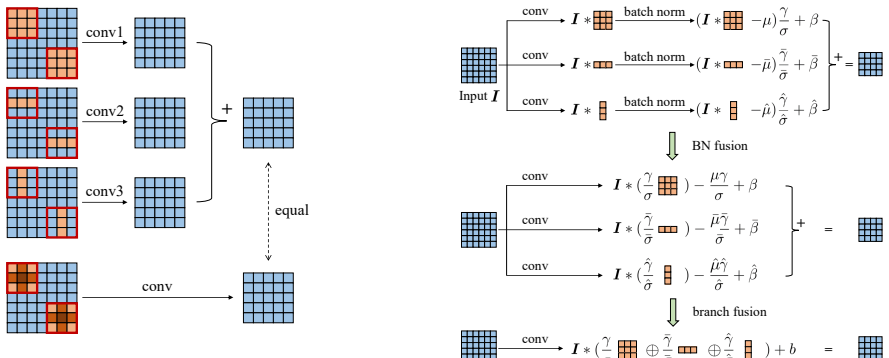
The load-bearing object is the additivity of convolutions with compatible kernel sizes: if two kernels act on the same input with the same stride and their outputs are summed, they are equivalent to a single kernel formed by element-wise addition on corresponding positions, $I * K^{(1)} + I * K^{(2)} = I * (K^{(1)} \oplus K^{(2)})$. The second mechanism is batch-normalization fusion, which absorbs the BN scale and shift into the convolution kernel as a scaled kernel plus a bias. Together, these identities let the three training-time branches be converted, layer by layer, into one standard convolution, so the inference graph is unchanged while the trained weights carry the extra information.
What would settle it
Train the same baseline and its ACNet counterpart on CIFAR-100 at least ten times with different random seeds and compare the distributions of top-1 accuracy; if the ACNet mean advantage is not larger than the baseline's run-to-run standard deviation, the claimed systematic margin fails.
Extended reading notes
Core claim
The central claim is that training with Asymmetric Convolution Blocks and then exactly reparameterizing them back into standard layers produces a deployed network with higher accuracy and identical inference cost. For a $d\times d$ layer, an ACB is three parallel branches with kernels $d\times d$, $1\times d$, and $d\times 1$, each followed by batch normalization and summed at the output. After training, the batch normalization parameters are absorbed into each branch's kernel as a scale and bias, and the two asymmetric kernels are added onto the corresponding positions of the square kernel; equation (8) in the paper states that the fused layer's output equals the sum of the three branch outputs. The paper reports top-1 accuracy gains from 0.27 to 1.52 percentage points across CIFAR-10, CIFAR-100, and ImageNet, and presents ablations showing that the central crisscross 'skeleton' positions carry larger magnitudes and matter more than corners, with ACB training intensifying this imbalance.
Load-bearing premise
The central claim depends on the reported accuracy gains being systematic rather than run-to-run training noise; each configuration was run once, and the smallest reported gain is 0.27 percentage points.
Editorial extensions
If this is right
- A developer can replace square-kernel layers with ACBs during training and ship the original architecture, so the accuracy gain costs no extra inference time, memory, or energy at deployment.
- Because the deployed model is exactly the baseline structure, it remains compatible with downstream compression such as pruning and quantization.
- The skeleton-versus-corner magnitude measurements suggest that convolutional parameters are not equally valuable across spatial positions, which pruning or quantization policies could exploit.
- The reported rotation experiments indicate that ACB-trained models degrade less on 180-degree rotated and upside-down inputs, pointing toward a partial resistance benefit.
- The use of batch-normalization fusion means the method applies to any architecture that already uses BN after square-kernel convolutions, covering most modern CNN designs.
Reading between the lines
- Editorial inference: the same additivity argument should apply to larger square kernels, so $5\times 5$ or $7\times 7$ layers could be strengthened with $1\times d$ and $d\times 1$ branches in the same cost-free way.
- Editorial inference: since the fused model is structurally identical to the baseline, the gain should combine additively with other training-time-only techniques, including channel attention or label smoothing, without architectural conflict.
- Editorial inference: if skeleton strengthening is the operative mechanism, the benefit of ACB should be larger on tasks requiring precise spatial localization, such as semantic segmentation, than on tasks dominated by global texture; this is a direct test of the authors' explanation.
Signed reviews
Editorial analysis
A structured set of objections, weighed in public.
Referee Report
Summary. The paper proposes the Asymmetric Convolution Block (ACB), a training-time replacement for standard square-kernel convolutional layers. An ACB consists of three parallel branches with d×d, 1×d, and d×1 kernels, each followed by batch normalization, whose outputs are summed. After training, the ACB is exactly fused back into a single standard convolutional layer using two steps: BN fusion, which folds the batch-normalization scale and shift into the branch kernels and a bias, and branch fusion, which exploits the additivity of convolutions with compatible kernel sizes. The deployed network therefore has the same architecture and inference cost as the original model. The authors report accuracy improvements on CIFAR-10, CIFAR-100, and ImageNet across several architectures (Cifar-quick, VGG-16, ResNet-56, WRN-16-8, DenseNet-40, AlexNet, ResNet-18, DenseNet-121), and they provide analyses linking the improvement to enhanced robustness to rotational distortions and to strengthening the 'skeleton' (central cross) positions of square kernels.
Significance. If the reported empirical gains are systematic, ACB is a simple, architecture-neutral, hyperparameter-free training-time plug-in that yields free accuracy improvements with no extra inference-time computation, memory, or energy cost. This is a practically valuable contribution, and the exactness of the fusion procedure is a genuine strength: the derivations in Section 3 (BN fusion and branch fusion, Eqs. 6-8) are mathematically straightforward and independently checkable, and the provided code supports reproducibility. The skeleton analysis, while partly descriptive, adds insight into where convolutional kernels concentrate information. However, the central claim is empirical, and the current experimental evidence is thin: every reported gain comes from a single training run per configuration, with no variance or significance estimates, and one of the headline numbers is internally inconsistent. These issues must be addressed before the claimed 'clear margin' can be taken as established.
major comments (3)
- [Section 4, Tables 1-3] All accuracy improvements in Tables 1-3 are based on a single training run per configuration, with no reported variance, standard deviations, or significance tests. The reported gains range from 0.27 percentage points (DenseNet-40 on CIFAR-100, Table 2) to 1.52 percentage points (AlexNet on ImageNet, Table 3). For models trained on CIFAR with standard stochastic augmentation and initialization, run-to-run variation of a few tenths of a percentage point is common, so the smallest margins are plausibly within training noise. The paper should provide mean and standard deviation over multiple seeds (at least 3-5) for at least the smaller gains, or paired-seed comparisons in which the baseline and ACNet are trained from the same initial weights with identical schedules, to demonstrate that the improvement is systematic.
- [Section 4.2, Table 3 and accompanying text] There is an internal inconsistency in the reported DenseNet-121 gain: Table 3 lists the Top-1 improvement as 0.67 percentage points, but the text states that the Top-1 accuracy of DenseNet-121 is 'lifted by ... 1.18%'. Since the size of the claimed improvement is the central empirical result, this discrepancy must be resolved and the text and table made consistent. As written, it erodes confidence in the accuracy of the reported numbers.
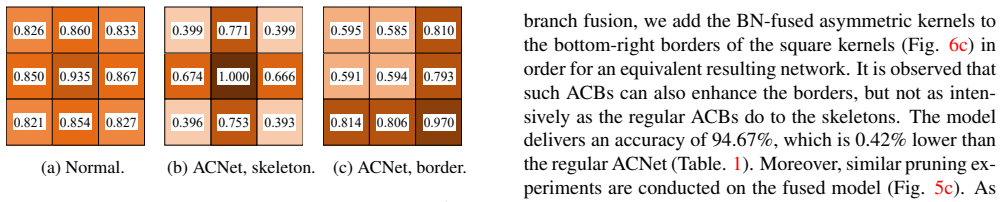
- [Section 4.4, Figures 5 and 6] The claim that ACB 'strengthens the kernel skeletons' and that this is responsible for the accuracy improvement is partly by construction: the horizontal and vertical kernels are fused exactly onto the skeleton positions of the square kernel, so the increased skeleton magnitudes in Figure 6b are an arithmetic consequence rather than an independent discovery. The border-shift experiment (Figure 6c) shows a smaller but still positive gain (94.67% vs. 95.09% for the regular ACNet), which suggests that some benefit remains even when the asymmetric kernels are fused onto border positions. The authors do hedge with 'partly attribute', but the title and abstract present skeleton strengthening as the main explanatory mechanism. The causal role of skeleton enhancement should be either argued more carefully with an additional control (for example, an ablation that preserves the same number of extra parameters but applies them to all positions) or the explanatory claim should be softened.
minor comments (4)
- [Section 4.3, Table 4] Table 4 is difficult to read because the rows use checkmarks without clearly indicating which of the three listed components (horizontal kernel, vertical kernel, BN in branch) are present in each configuration. The authors should label each row explicitly, e.g., 'only horizontal', 'horizontal+vertical', 'all three', or use separate columns with ✓/✗ marks.
- [Section 3.3, Eq. (6)] The notation in Eq. (6) uses the same symbol F for the square-kernel filter and for the fused kernel F', which is understandable but could be confusing; the authors may want to introduce distinct symbols for the original square-kernel filter and the asymmetric kernels to avoid notational overload.
- [Abstract and Section 1] The phrase 'clear margin' is stronger than what the smallest reported improvements (0.27-0.46 percentage points on CIFAR) support without variance information. The authors could soften this claim or qualify it in light of the single-run nature of the experiments.
- [Section 4.2] The description of the AlexNet baseline as coming from the TensorFlow GitHub repository with batch normalization added is useful, but the authors should report the actual commands or training configuration more fully to aid reproducibility, since AlexNet training setups vary widely.
Circularity Check
No significant circularity: the exact-fusion derivation is self-contained algebra and the accuracy gains are external empirical comparisons.
full rationale
The paper's central derivation (Section 3.2-3.3, Eqs. 3-8) is a direct application of the linearity and additivity of convolution plus exact batch-normalization fusion. No constant is fitted to a target result and then renamed a prediction: the fused kernel F'(j) and bias term b_j are closed-form functions of the trained branch weights, and Eq. 8 states an identity that holds for any trained weights. The claimed accuracy improvements in Tables 1-3 are comparisons against independently trained baselines, not outputs of the paper's own fitted parameters. Self-citations ([5]-[7]) are used only as methodological inspiration for pruning-based analysis, not as load-bearing support for the main claim. The skeleton explanation is partly tied to the design choice of fusing asymmetric kernels onto the skeleton positions, but the paper explicitly acknowledges that the asymmetric weights could cancel (Section 4.4) and provides a border-shift control experiment, so the observation that skeletons are enhanced is an empirical result rather than an assumed input. One internal inconsistency (the text says the DenseNet-121 top-1 gain is 1.18% while Table 3 reports 0.67%) and single-run reporting are correctness and reproducibility concerns, not circularity.
Assumptions & free parameters
assumptions (4)
- standard math The additivity of convolution with compatible kernel sizes (Eq. 3) holds, and batch normalization can be folded into the preceding convolutional kernel at inference (Eq. 2).
- domain assumption Every replaced 3x3 layer is a standard convolution with stride 1 and compatible padding, so the three branch outputs have the same spatial resolution and can be summed.
- domain assumption Baseline and ACNet are trained with identical configurations to full convergence, so accuracy differences are attributable to the ACB structure.
- domain assumption The importance of a weight is proportional to its absolute magnitude, so the average kernel magnitude matrix A reflects functional importance.
Cite this review
Pith. "Pith review of ACNet: Strengthening the Kernel Skeletons for Powerful CNN via Asymmetric Convolution Blocks." pith.science (2026). https://pith.science/paper/V3Z4UGUM
@misc{pith2026190803930,
  author       = {Pith},
  title        = {Pith review of: ACNet: Strengthening the Kernel Skeletons for Powerful CNN via Asymmetric Convolution Blocks},
  year         = {2026},
  howpublished = {\url{https://pith.science/paper/V3Z4UGUM}},
  note         = {Machine review of arXiv:1908.03930}
}
read the original abstract
As designing appropriate Convolutional Neural Network (CNN) architecture in the context of a given application usually involves heavy human works or numerous GPU hours, the research community is soliciting the architecture-neutral CNN structures, which can be easily plugged into multiple mature architectures to improve the performance on our real-world applications. We propose Asymmetric Convolution Block (ACB), an architecture-neutral structure as a CNN building block, which uses 1D asymmetric convolutions to strengthen the square convolution kernels. For an off-the-shelf architecture, we replace the standard square-kernel convolutional layers with ACBs to construct an Asymmetric Convolutional Network (ACNet), which can be trained to reach a higher level of accuracy. After training, we equivalently convert the ACNet into the same original architecture, thus requiring no extra computations anymore. We have observed that ACNet can improve the performance of various models on CIFAR and ImageNet by a clear margin. Through further experiments, we attribute the effectiveness of ACB to its capability of enhancing the model's robustness to rotational distortions and strengthening the central skeleton parts of square convolution kernels.
Figures


Figures from the paper (2 more)

Reference graph
Works this paper leans on
-
[1]
Tensorflow: A system for large-scale machine learning
Mart ´ın Abadi, Paul Barham, Jianmin Chen, Zhifeng Chen, Andy Davis, Jeffrey Dean, Matthieu Devin, Sanjay Ghe- mawat, Geoffrey Irving, Michael Isard, et al. Tensorflow: A system for large-scale machine learning. In OSDI, vol- ume 16, pages 265–283, 2016. 2
work page 2016
-
[2]
Matthieu Courbariaux, Itay Hubara, Daniel Soudry, Ran El-Yaniv, and Yoshua Bengio. Binarized neural networks: Training deep neural networks with weights and activations constrained to+ 1 or-1. arXiv preprint arXiv:1602.02830 ,
-
[3]
Imagenet: A large-scale hierarchical im- age database
Jia Deng, Wei Dong, Richard Socher, Li-Jia Li, Kai Li, and Li Fei-Fei. Imagenet: A large-scale hierarchical im- age database. In Computer Vision and Pattern Recognition,
-
[4]
Exploiting linear structure within con- volutional networks for efficient evaluation
Emily L Denton, Wojciech Zaremba, Joan Bruna, Yann Le- Cun, and Rob Fergus. Exploiting linear structure within con- volutional networks for efficient evaluation. In Advances in neural information processing systems, pages 1269–1277,
-
[5]
Centripetal sgd for pruning very deep convolutional networks with complicated structure
Xiaohan Ding, Guiguang Ding, Yuchen Guo, and Jungong Han. Centripetal sgd for pruning very deep convolutional networks with complicated structure. In Proceedings of the IEEE Conference on Computer Vision and Pattern Recogni- tion, pages 4943–4953, 2019. 3
work page 2019
-
[6]
Approximated oracle filter pruning for destructive cnn width optimization
Xiaohan Ding, Guiguang Ding, Yuchen Guo, Jungong Han, and Chenggang Yan. Approximated oracle filter pruning for destructive cnn width optimization. In International Confer- ence on Machine Learning, pages 1607–1616, 2019. 3
work page 2019
-
[7]
Auto-balanced filter pruning for efficient convolu- tional neural networks
Xiaohan Ding, Guiguang Ding, Jungong Han, and Sheng Tang. Auto-balanced filter pruning for efficient convolu- tional neural networks. In Thirty-Second AAAI Conference on Artificial Intelligence, 2018. 7
work page 2018
-
[8]
GoogLe. Tensorflow-alexnet. https://github.com/ tensorflow/models/blob/master/research/ slim/nets/alexnet.py, 2017. 5
work page 2017
Show all 37 references
-
[9]
Dynamic net- work surgery for efficient dnns
Yiwen Guo, Anbang Yao, and Yurong Chen. Dynamic net- work surgery for efficient dnns. In Advances In Neural In- formation Processing Systems, pages 1379–1387, 2016. 3, 7
2016
-
[10]
Deep learning with limited numerical precision
Suyog Gupta, Ankur Agrawal, Kailash Gopalakrishnan, and Pritish Narayanan. Deep learning with limited numerical precision. In International Conference on Machine Learn- ing, pages 1737–1746, 2015. 3
2015
-
[11]
Deep com- pression: Compressing deep neural networks with pruning, trained quantization and huffman coding
Song Han, Huizi Mao, and William J Dally. Deep com- pression: Compressing deep neural networks with pruning, trained quantization and huffman coding. arXiv preprint arXiv:1510.00149, 2015. 7
2015 arXiv
-
[12]
Learning both weights and connections for efficient neural network
Song Han, Jeff Pool, John Tran, and William Dally. Learning both weights and connections for efficient neural network. In Advances in Neural Information Processing Systems , pages 1135–1143, 2015. 3, 7
2015
-
[13]
Deep residual learning for image recognition
Kaiming He, Xiangyu Zhang, Shaoqing Ren, and Jian Sun. Deep residual learning for image recognition. In Proceed- ings of the IEEE conference on computer vision and pattern recognition, pages 770–778, 2016. 1, 5
2016
-
[14]
Squeeze-and-excitation net- works
Jie Hu, Li Shen, and Gang Sun. Squeeze-and-excitation net- works. In Proceedings of the IEEE conference on computer vision and pattern recognition, pages 7132–7141, 2018. 1, 3
2018
-
[15]
Densely connected convolutional networks
Gao Huang, Zhuang Liu, Kilian Q Weinberger, and Laurens van der Maaten. Densely connected convolutional networks. In Proceedings of the IEEE conference on computer vision and pattern recognition, volume 1, page 3, 2017. 1, 5
2017
-
[16]
Batch normalization: Accelerating deep network training by reducing internal co- variate shift
Sergey Ioffe and Christian Szegedy. Batch normalization: Accelerating deep network training by reducing internal co- variate shift. In International Conference on Machine Learn- ing, pages 448–456, 2015. 1, 3, 6
2015
-
[17]
Speeding up convolutional neural networks with low rank expansions
Max Jaderberg, Andrea Vedaldi, and Andrew Zisserman. Speeding up convolutional neural networks with low rank expansions. arXiv preprint arXiv:1405.3866, 2014. 2, 3
2014 arXiv
-
[18]
Flattened convolutional neural networks for feedforward ac- celeration
Jonghoon Jin, Aysegul Dundar, and Eugenio Culurciello. Flattened convolutional neural networks for feedforward ac- celeration. arXiv preprint arXiv:1412.5474, 2014. 2, 3
2014 arXiv
-
[19]
Learning multiple layers of features from tiny images
Alex Krizhevsky and Geoffrey Hinton. Learning multiple layers of features from tiny images. 2009. 2, 5
2009
-
[20]
Imagenet classification with deep convolutional neural net- works
Alex Krizhevsky, Ilya Sutskever, and Geoffrey E Hinton. Imagenet classification with deep convolutional neural net- works. In Advances in neural information processing sys- tems, pages 1097–1105, 2012. 1, 5
2012
-
[21]
Pruning filters for efficient convnets
Hao Li, Asim Kadav, Igor Durdanovic, Hanan Samet, and Hans Peter Graf. Pruning filters for efficient convnets. arXiv preprint arXiv:1608.08710, 2016. 7
2016 arXiv
-
[22]
Learning efficient convolutional networks through network slimming
Zhuang Liu, Jianguo Li, Zhiqiang Shen, Gao Huang, Shoumeng Yan, and Changshui Zhang. Learning efficient convolutional networks through network slimming. In 2017 IEEE International Conference on Computer Vision (ICCV), pages 2755–2763. IEEE, 2017. 3
2017
-
[23]
Efficient dense modules of asymmetric con- volution for real-time semantic segmentation
Shao-Yuan Lo, Hsueh-Ming Hang, Sheng-Wei Chan, and Jing-Jhih Lin. Efficient dense modules of asymmetric con- volution for real-time semantic segmentation. arXiv preprint arXiv:1809.06323, 2018. 2, 3
2018 arXiv
-
[24]
Thinet: A filter level pruning method for deep neural network compression
Jian-Hao Luo, Jianxin Wu, and Weiyao Lin. Thinet: A filter level pruning method for deep neural network compression. In Proceedings of the IEEE international conference on com- puter vision, pages 5058–5066, 2017. 3
2017
-
[25]
Enet: A deep neural network architec- ture for real-time semantic segmentation
Adam Paszke, Abhishek Chaurasia, Sangpil Kim, and Eu- genio Culurciello. Enet: A deep neural network architec- ture for real-time semantic segmentation. arXiv preprint arXiv:1606.02147, 2016. 2, 3
2016 arXiv
-
[26]
Automatic differentiation in pytorch
Adam Paszke, Sam Gross, Soumith Chintala, Gregory Chanan, Edward Yang, Zachary DeVito, Zeming Lin, Al- ban Desmaison, Luca Antiga, and Adam Lerer. Automatic differentiation in pytorch. In NIPS-W, 2017. 2
2017
-
[27]
Xnor-net: Imagenet classification using bi- nary convolutional neural networks
Mohammad Rastegari, Vicente Ordonez, Joseph Redmon, and Ali Farhadi. Xnor-net: Imagenet classification using bi- nary convolutional neural networks. InEuropean Conference on Computer Vision, pages 525–542. Springer, 2016. 3
2016
-
[28]
Very deep convo- lutional networks for large-scale image recognition
Karen Simonyan and Andrew Zisserman. Very deep convo- lutional networks for large-scale image recognition. arXiv preprint arXiv:1409.1556, 2014. 1, 5
2014 arXiv
-
[29]
Prac- tical bayesian optimization of machine learning algorithms
Jasper Snoek, Hugo Larochelle, and Ryan P Adams. Prac- tical bayesian optimization of machine learning algorithms. In Advances in neural information processing systems, pages 2951–2959, 2012. 5
2012
-
[30]
Design of kernels in convolutional neural networks for image classifi- cation
Zhun Sun, Mete Ozay, and Takayuki Okatani. Design of kernels in convolutional neural networks for image classifi- cation. In European Conference on Computer Vision, pages 51–66. Springer, 2016. 1
2016
-
[31]
Inception-v4, inception-resnet and the impact of residual connections on learning
Christian Szegedy, Sergey Ioffe, Vincent Vanhoucke, and Alexander A Alemi. Inception-v4, inception-resnet and the impact of residual connections on learning. In Thirty-First AAAI Conference on Artificial Intelligence, 2017. 1
2017
-
[32]
Going deeper with convolutions
Christian Szegedy, Wei Liu, Yangqing Jia, Pierre Sermanet, Scott Reed, Dragomir Anguelov, Dumitru Erhan, Vincent Vanhoucke, and Andrew Rabinovich. Going deeper with convolutions. In Proceedings of the IEEE conference on computer vision and pattern recognition , pages 1–9, 2015. 1, 3
2015
-
[33]
Rethinking the inception archi- tecture for computer vision
Christian Szegedy, Vincent Vanhoucke, Sergey Ioffe, Jon Shlens, and Zbigniew Wojna. Rethinking the inception archi- tecture for computer vision. In Proceedings of the IEEE con- ference on computer vision and pattern recognition , pages 2818–2826, 2016. 1, 2, 3
2016
-
[34]
Be- yond filters: Compact feature map for portable deep model
Yunhe Wang, Chang Xu, Chao Xu, and Dacheng Tao. Be- yond filters: Compact feature map for portable deep model. In International Conference on Machine Learning , pages 3703–3711, 2017. 3
2017
-
[35]
Wide residual net- works
Sergey Zagoruyko and Nikos Komodakis. Wide residual net- works. arXiv preprint arXiv:1605.07146, 2016. 1, 5
2016 arXiv
-
[36]
Learning transferable architectures for scalable image recognition
Barret Zoph, Vijay Vasudevan, Jonathon Shlens, and Quoc V Le. Learning transferable architectures for scalable image recognition. In Proceedings of the IEEE conference on computer vision and pattern recognition, pages 8697–8710,
-
[2009]
IEEE Conference on , pages 248–255
CVPR 2009. IEEE Conference on , pages 248–255. IEEE, 2009. 2, 5
2009
Reviewed August 14, 2026 · model on record in the stance chip above.
Discussion (0). Continue with ORCID to comment.