Incremental Learning in Mirror Flows
Pith reviewed 2026-06-26 07:39 UTC · model grok-4.3
The pith
When initialized near the domain boundary, rescaled mirror flow trajectories converge to a limiting flow that performs incremental learning.
A machine-rendered reading of the paper's core claim, the machinery that carries it, and where it could break.
Core claim
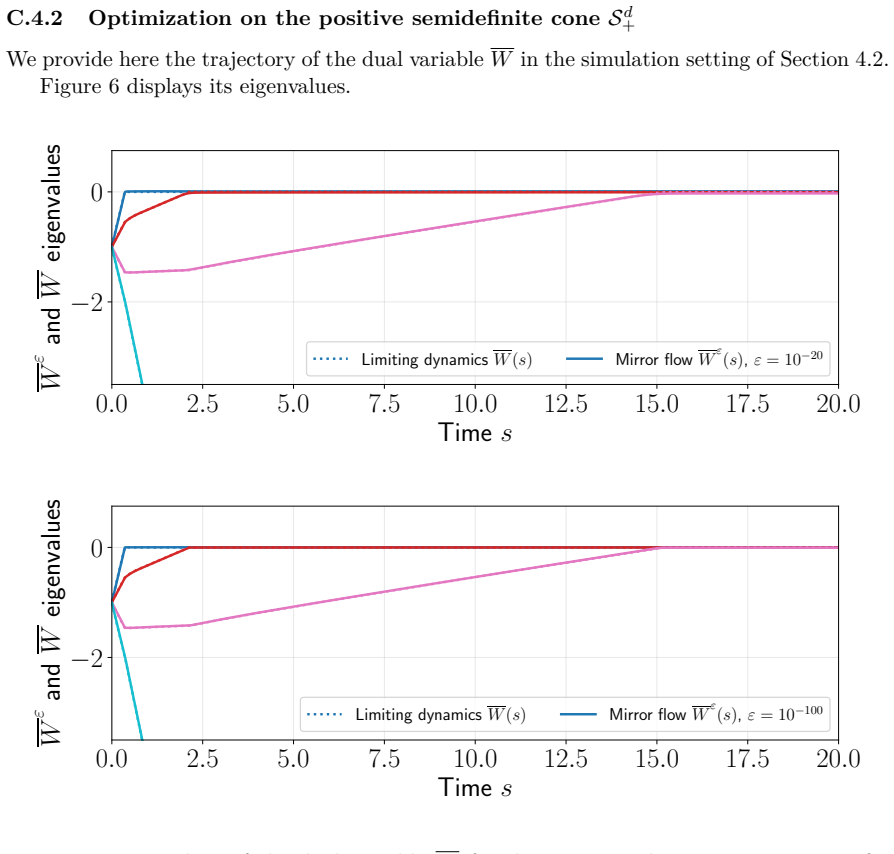
We study mirror flows generated by a convex quadratic loss and a general convex lower semicontinuous mirror potential. We show that, when initialized near the boundary of the domain of the mirror potential, their rescaled trajectories converge to a limiting mirror flow whose potential is the indicator function of the domain. In this limit, the primal variable minimizes the loss over a time-dependent hypothesis set: the subdifferential of the support function of the domain, evaluated at the dual variable. This characterization provides a general mechanism for incremental learning in mirror flows.
What carries the argument
The limiting mirror flow with the indicator function potential, which enforces minimization of the loss over the time-dependent hypothesis set defined by the subdifferential of the domain's support function at the dual variable.
If this is right
- The mechanism applies to any convex lower semicontinuous mirror potential.
- The primal variable learns incrementally by minimizing over successively adjusted hypothesis sets driven by the dual variable.
- Rescaling is essential to observe the convergence to the limiting incremental behavior.
- Initialization close to the boundary is necessary for the trajectories to enter this regime.
Where Pith is reading between the lines
- If many optimization algorithms can be viewed as mirror flows, this may indicate a broader principle for when they exhibit incremental learning.
- Future work could test whether the same limit holds for non-quadratic losses.
- Simulations on polytopes or balls could verify the time-dependent hypothesis sets in practice.
Load-bearing premise
Initialization must be sufficiently close to the boundary of the mirror potential's domain.
What would settle it
A counterexample computation where a mirror flow started near the boundary has rescaled trajectories that do not converge to the indicator-potential flow or do not minimize over the described time-dependent set.
Figures
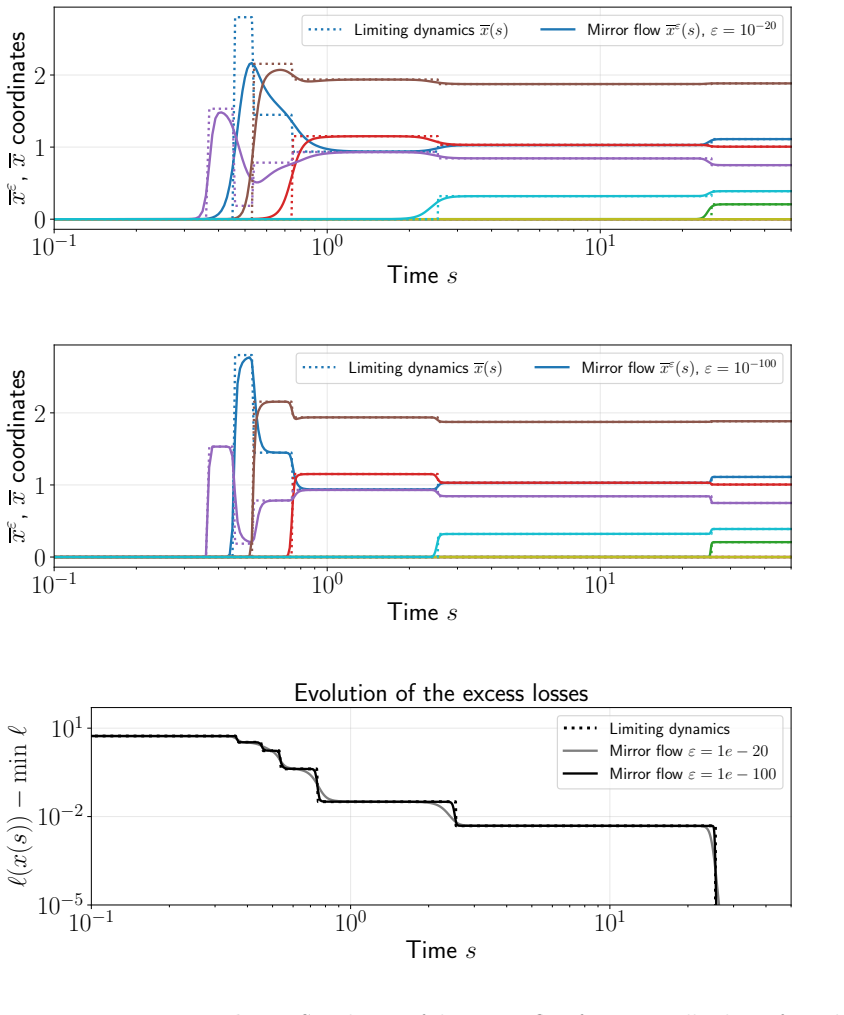

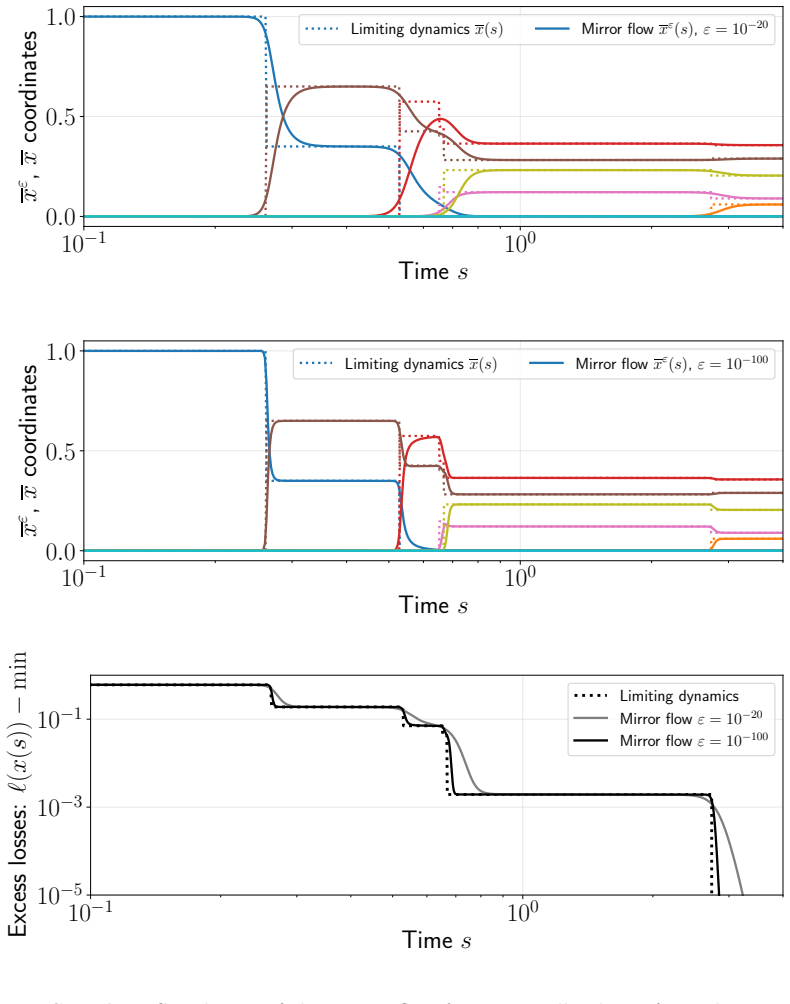
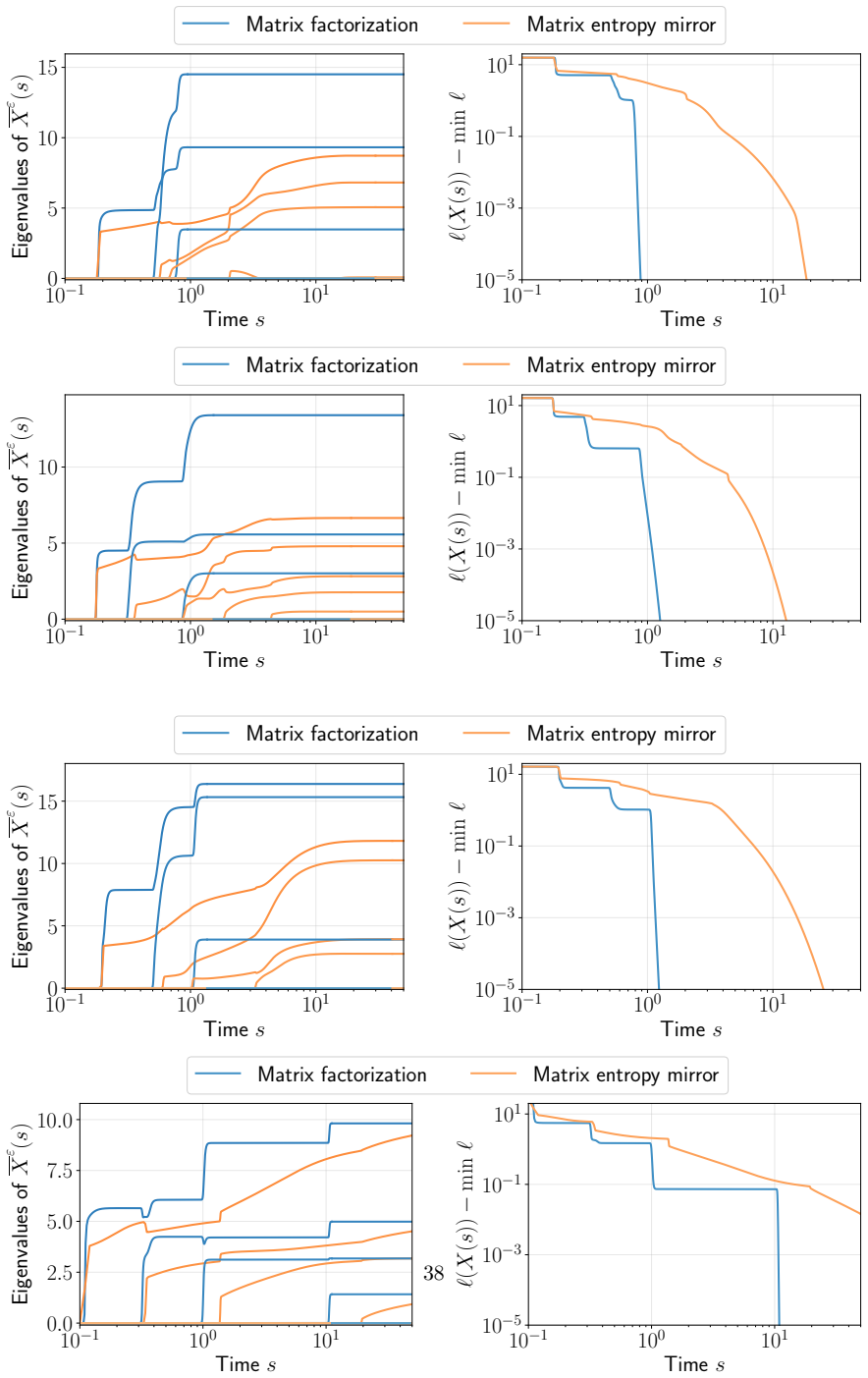
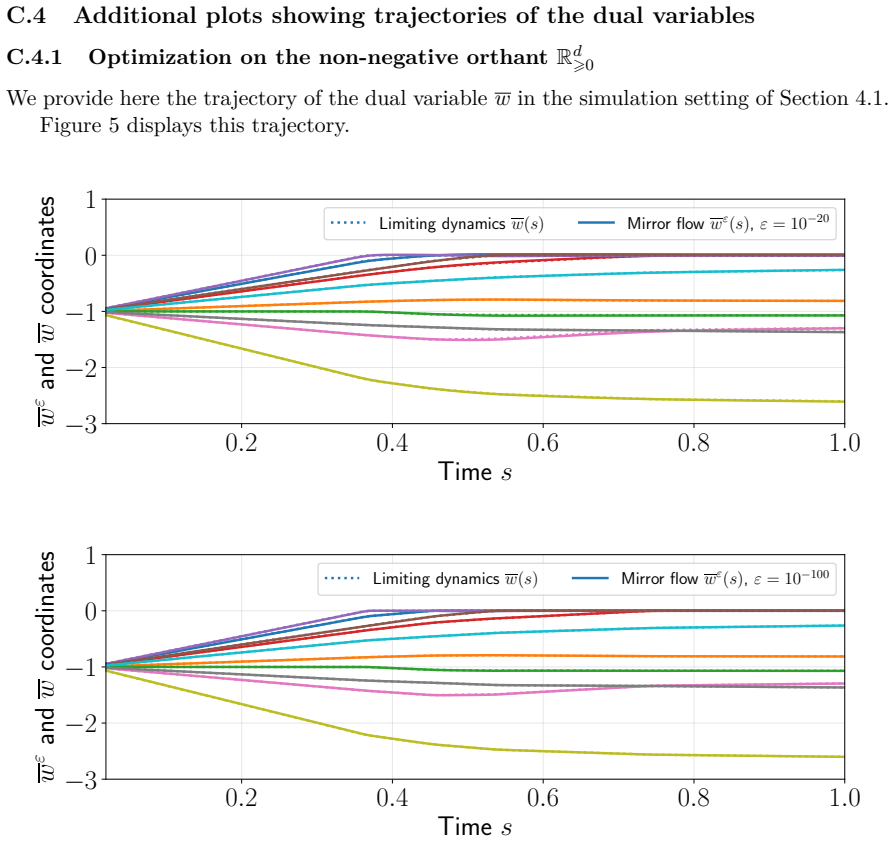

read the original abstract
We study mirror flows generated by a convex quadratic loss and a general convex lower semicontinuous mirror potential. We show that, when initialized near the boundary of the domain of the mirror potential, their rescaled trajectories converge to a limiting mirror flow whose potential is the indicator function of the domain. In this limit, the primal variable minimizes the loss over a time-dependent hypothesis set: the subdifferential of the support function of the domain, evaluated at the dual variable. This characterization provides a general mechanism for incremental learning in mirror flows.
Editorial analysis
A structured set of objections, weighed in public.
Referee Report
Summary. The manuscript studies mirror flows generated by a convex quadratic loss and a general convex lower semicontinuous mirror potential ψ. It shows that, when initialized near the boundary of the domain of ψ, rescaled trajectories converge to a limiting mirror flow whose potential is the indicator function of the domain. In this limit, the primal variable minimizes the loss over a time-dependent hypothesis set given by the subdifferential of the support function of the domain evaluated at the dual variable. This is presented as providing a general mechanism for incremental learning in mirror flows.
Significance. If the stated convergence holds, the result supplies a precise asymptotic characterization linking mirror flows to incremental learning via time-dependent hypothesis sets. The generality of the mirror potential strengthens the scope relative to more restrictive cases. The near-boundary initialization condition, however, is load-bearing for the claimed generality and requires further justification to establish robustness.
major comments (2)
- [Abstract] Abstract: the convergence to the indicator-potential limiting flow and the resulting time-dependent hypothesis set ∂σ_D(·) are established only under the near-boundary initialization hypothesis. For the characterization to constitute a 'general mechanism for incremental learning,' either the regime must be shown to arise naturally from the dynamics or the result must be extended to interior initializations; otherwise the scope of the incremental-learning claim is restricted.
- [Main theorem (convergence result)] Main convergence statement: the rescaling argument and passage to the indicator limit require explicit control on the error terms and verification that the quadratic loss remains compatible with the indicator potential; without these controls the limiting characterization of the hypothesis set may not hold uniformly.
minor comments (2)
- Clarify the precise definition of the support function σ_D and its relation to the domain D throughout the text.
- Ensure all technical conditions on ψ (convexity, lower semicontinuity, domain) are stated explicitly before the main convergence result.
Simulated Author's Rebuttal
We thank the referee for the careful review and constructive suggestions. We address each major comment below. The near-boundary initialization is central to the limiting analysis, and we will revise the abstract and add explicit details to the convergence proof to clarify scope and strengthen the error controls.
read point-by-point responses
-
Referee: [Abstract] Abstract: the convergence to the indicator-potential limiting flow and the resulting time-dependent hypothesis set ∂σ_D(·) are established only under the near-boundary initialization hypothesis. For the characterization to constitute a 'general mechanism for incremental learning,' either the regime must be shown to arise naturally from the dynamics or the result must be extended to interior initializations; otherwise the scope of the incremental-learning claim is restricted.
Authors: We agree that the stated convergence and the time-dependent hypothesis set characterization hold specifically under the near-boundary initialization. The manuscript already states this condition in the abstract and theorem statements; the generality claimed refers to the arbitrary convex lsc mirror potential ψ rather than to arbitrary initializations. The near-boundary regime arises naturally in applications where trajectories approach the boundary of dom(ψ), which is relevant for modeling incremental learning under domain constraints. We will revise the abstract to foreground this initialization hypothesis more explicitly. Extending the result to interior initializations would require a separate analysis and is outside the current scope, as the limiting indicator flow does not generally emerge from interior starts. revision: partial
-
Referee: [Main theorem (convergence result)] Main convergence statement: the rescaling argument and passage to the indicator limit require explicit control on the error terms and verification that the quadratic loss remains compatible with the indicator potential; without these controls the limiting characterization of the hypothesis set may not hold uniformly.
Authors: The proof of the main convergence result does contain rescaling estimates that control the error terms between the original flow and the limiting indicator flow, together with a verification that the quadratic loss passes to the limit compatibly (via weak convergence arguments and subdifferential inclusions). However, these controls can be made more prominent. We will revise the manuscript to include an explicit lemma or remark isolating the error bounds and confirming uniform compatibility of the loss with the indicator potential, ensuring the hypothesis-set characterization holds in the stated topology. revision: yes
Circularity Check
No circularity; conditional convergence result derived from dynamics under explicit assumption
full rationale
The paper states and proves a convergence theorem: rescaled trajectories of the mirror flow converge to the indicator-potential flow precisely when initialized near the boundary of dom(ψ). This is presented as a derived property of the ODE dynamics rather than presupposed. No equations reduce a prediction to a fitted input by construction, no self-citation chains justify uniqueness or ansatzes, and the initialization condition is stated openly as the operative hypothesis rather than smuggled in. The result is therefore self-contained against external benchmarks and receives the default non-circularity finding.
Axiom & Free-Parameter Ledger
axioms (2)
- domain assumption Loss is convex quadratic and mirror potential is convex lower semicontinuous.
- domain assumption Initialization is near the boundary of the domain of the mirror potential.
Forward citations
Cited by 1 Pith paper
-
Effective dynamics of the Sinkhorn algorithm in the regime of low entropy regularization
Derives the cold Sinkhorn limiting dynamics as tau approaches zero, proving finite-time convergence to unregularized OT and improved O(tau^{-1}) iteration complexity for dual suboptimality.
Reference graph
Works this paper leans on
-
[1]
Sgd learning on neural networks: leap complexity and saddle-to-saddle dynamics
Emmanuel Abbe, Enric Boix-Adsera, and Theodor Misiakiewicz. Sgd learning on neural networks: leap complexity and saddle-to-saddle dynamics. In Conference on Learning Theory , pages 2552--2623. PMLR, 2023
2023
-
[2]
Implicit regularization in deep matrix factorization
Sanjeev Arora, Nadav Cohen, Wei Hu, and Yuping Luo. Implicit regularization in deep matrix factorization. In Advances in Neural Information Processing Systems , volume 32, 2019
2019
-
[3]
A closer look at memorization in deep networks
Devansh Arpit, Stanis aw Jastrz e bski, Nicolas Ballas, David Krueger, Emmanuel Bengio, Maxinder Kanwal, Tegan Maharaj, Asja Fischer, Aaron Courville, Yoshua Bengio, and Simon Lacoste-Julien. A closer look at memorization in deep networks. In International Conference on Machine Learning , pages 233--242. PMLR, 2017
2017
-
[4]
Convergence de fonctionnelles convexes
Hedy Attouch. Convergence de fonctionnelles convexes. In Journ \'e es d’Analyse Non Lin \'e aire: Proceedings, Besan c on, France, June 1977 , pages 1--40. Springer, 1977
1977
-
[5]
Variational convergence for functions and operators
Hedy Attouch. Variational convergence for functions and operators . Applicable Mathematics Series. Pitman, 1984
1984
-
[6]
On learning G aussian multi-index models with gradient flow
Alberto Bietti, Joan Bruna, and Loucas Pillaud-Vivien. On learning G aussian multi-index models with gradient flow. arXiv preprint arXiv:2310.19793 , 2023
-
[7]
Convex analysis and monotone operator theory in Hilbert spaces
Heinz Bauschke and Patrick Combettes. Convex analysis and monotone operator theory in Hilbert spaces . Springer, 2nd edition, 2017
2017
-
[8]
Incremental learning in diagonal linear networks
Rapha \"e l Berthier. Incremental learning in diagonal linear networks. Journal of Machine Learning Research , 24(171):1--26, 2023
2023
-
[9]
Diagonal linear networks and the lasso regularization path
Rapha \"e l Berthier. Diagonal linear networks and the lasso regularization path. arXiv preprint arXiv:2509.18766 , 2025
-
[10]
Positive Definite Matrices
Rajendra Bhatia. Positive Definite Matrices . Princeton University Press, 2009
2009
-
[11]
An adaptive inverse scale space method for compressed sensing
Martin Burger, Michael M \"o ller, Martin Benning, and Stanley Osher. An adaptive inverse scale space method for compressed sensing. Mathematics of Computation , 82(281):269--299, 2013
2013
-
[12]
Nonlinear inverse scale space methods for image restoration
Martin Burger, Stanley Osher, Jinjun Xu, and Guy Gilboa. Nonlinear inverse scale space methods for image restoration. In International Workshop on Variational, Geometric, and Level Set Methods in Computer Vision , pages 25--36. Springer, 2005
2005
-
[13]
Gradient flow dynamics of shallow relu networks for square loss and orthogonal inputs
Etienne Boursier, Loucas Pillaud-Vivien, and Nicolas Flammarion. Gradient flow dynamics of shallow relu networks for square loss and orthogonal inputs. Advances in Neural Information Processing Systems , 35:20105--20118, 2022
2022
-
[14]
Opérateurs maximaux monotones et semi-groupes de contractions dans les espaces de Hilbert
Haim Br \'e zis. Opérateurs maximaux monotones et semi-groupes de contractions dans les espaces de Hilbert . Elsevier, 1973
1973
-
[15]
Error estimation for bregman iterations and inverse scale space methods in image restoration
Martin Burger, Elena Resmerita, and Lin He. Error estimation for bregman iterations and inverse scale space methods in image restoration. Computing , 81(2):109--135, 2007
2007
-
[16]
Local minima and plateaus in hierarchical structures of multilayer perceptrons
Kenji Fukumizu and Shun-ichi Amari. Local minima and plateaus in hierarchical structures of multilayer perceptrons. Neural Networks , 13(3):317--327, 2000
2000
-
[17]
Implicit regularization of discrete gradient dynamics in linear neural networks
Gauthier Gidel, Francis Bach, and Simon Lacoste-Julien. Implicit regularization of discrete gradient dynamics in linear neural networks. In Advances in Neural Information Processing Systems , volume 32, 2019
2019
-
[18]
The implicit bias of depth: How incremental rank learning helps generalize
Daniel Gissin, Shai Shalev-Shwartz, and Amit Daniely. The implicit bias of depth: How incremental rank learning helps generalize. In International Conference on Learning Representations , 2020
2020
-
[19]
Implicit regularization in matrix factorization
Suriya Gunasekar, Blake Woodworth, Srinadh Bhojanapalli, Behnam Neyshabur, and Nati Srebro. Implicit regularization in matrix factorization. In Advances in Neural Information Processing Systems , volume 30, 2017
2017
-
[20]
Arthur Jacot, Fran c ois Ged, Berfin S im s ek, Cl \'e ment Hongler, and Franck Gabriel. Saddle-to-saddle dynamics in deep linear networks: Small initialization training, symmetry, and sparsity. arXiv preprint arXiv:2106.15933 , 2021
-
[21]
Sgd on neural networks learns functions of increasing complexity
Dimitris Kalimeris, Gal Kaplun, Preetum Nakkiran, Benjamin Edelman, Tristan Yang, Boaz Barak, and Haofeng Zhang. Sgd on neural networks learns functions of increasing complexity. Advances in Neural Information Processing Systems , 32, 2019
2019
-
[22]
Towards resolving the implicit bias of gradient descent for matrix factorization: Greedy low-rank learning
Zhiyuan Li, Yuping Luo, and Kaifeng Lyu. Towards resolving the implicit bias of gradient descent for matrix factorization: Greedy low-rank learning. In International Conference on Learning Representations , 2021
2021
-
[23]
Implicit regularization for group sparsity
Jiangyuan Li, Thanh Nguyen, Chinmay Hegde, and Raymond Wong. Implicit regularization for group sparsity. arXiv preprint arXiv:2301.12540 , 2023
-
[24]
Implicit bias of gradient descent on reparametrized models: On equivalence to mirror descent
Zhiyuan Li, Tianhao Wang, Jason Lee, and Sanjeev Arora. Implicit bias of gradient descent on reparametrized models: On equivalence to mirror descent. Advances in Neural Information Processing Systems , 2022
2022
-
[25]
Problem Complexity and Method Efficiency in Optimization
Arkadij Semenovi c Nemirovskij and David Borisovich Yudin. Problem Complexity and Method Efficiency in Optimization . Wiley-Interscience, 1983
1983
-
[26]
Sparse recovery via differential inclusions
Stanley Osher, Feng Ruan, Jiechao Xiong, Yuan Yao, and Wotao Yin. Sparse recovery via differential inclusions. Applied and Computational Harmonic Analysis , 41(2):436--469, 2016
2016
-
[27]
Saddle-to-saddle dynamics in diagonal linear networks
Scott Pesme and Nicolas Flammarion. Saddle-to-saddle dynamics in diagonal linear networks. Advances in Neural Information Processing Systems , 36:7475--7505, 2023
2023
-
[28]
Implicit regularization in deep learning may not be explainable by norms
Noam Razin and Nadav Cohen. Implicit regularization in deep learning may not be explainable by norms. In Advances in Neural Information Processing Systems , volume 33, pages 21174--21187, 2020
2020
-
[29]
Convex analysis
Ralph Tyrrell Rockafellar. Convex analysis . Princeton Mathematical Series, 1970
1970
-
[30]
Exact solutions to the nonlinear dynamics of learning in deep linear neural networks
Andrew Saxe, James McClelland, and Surya Ganguli. Exact solutions to the nonlinear dynamics of learning in deep linear neural networks. In International Conference on Learning Representations , 2014
2014
-
[31]
Learning in-context n -grams with transformers: Sub- n -grams are near-stationary points
Aditya Varre, Gizem Y\" u ce, and Nicolas Flammarion. Learning in-context n -grams with transformers: Sub- n -grams are near-stationary points. In Aarti Singh, Maryam Fazel, Daniel Hsu, Simon Lacoste-Julien, Felix Berkenkamp, Tegan Maharaj, Kiri Wagstaff, and Jerry Zhu, editors, Proceedings of the 42nd International Conference on Machine Learning , volume...
2025
-
[32]
Kernel and rich regimes in overparametrized models
Blake Woodworth, Suriya Gunasekar, Jason Lee, Edward Moroshko, Pedro Savarese, Itay Golan, Daniel Soudry, and Nathan Srebro. Kernel and rich regimes in overparametrized models. In Conference on Learning Theory , pages 3635--3673. PMLR, 2020
2020
-
[33]
Saddle-to-saddle dynamics explains a simplicity bias across neural network architectures
Yedi Zhang, Andrew Saxe, and Peter Latham. Saddle-to-saddle dynamics explains a simplicity bias across neural network architectures. arXiv preprint arXiv:2512.20607 , 2025
discussion (0)
Sign in with ORCID, Apple, or X to comment. Anyone can read and Pith papers without signing in.