REVIEW 5 major objections 5 minor 15 references
Interpretable Encrypted Searchable Neural Networks
T0 review · 5 major / 5 minor · reviewed 2026-08-14 · deepseek-v4-flash
Pith's one-line read Probabilistic ranking of encrypted indexes, learned from random queries, can bring encrypted search close to O(log N) query time while updating index weights in the cloud.
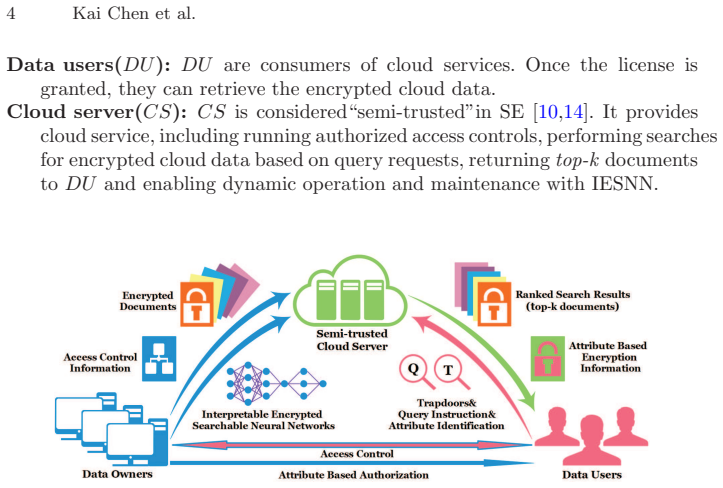
desk verdict An intriguing but unsubstantiated proposal for ML-based searchable encryption; the central O(log N) claim collapses without a ranking guarantee, so it doesn't yet merit peer review. read the letter →
The pith
A machine-rendered reading of the paper's core claim, the machinery that carries it, and where it could break.
The reading
What carries the argument
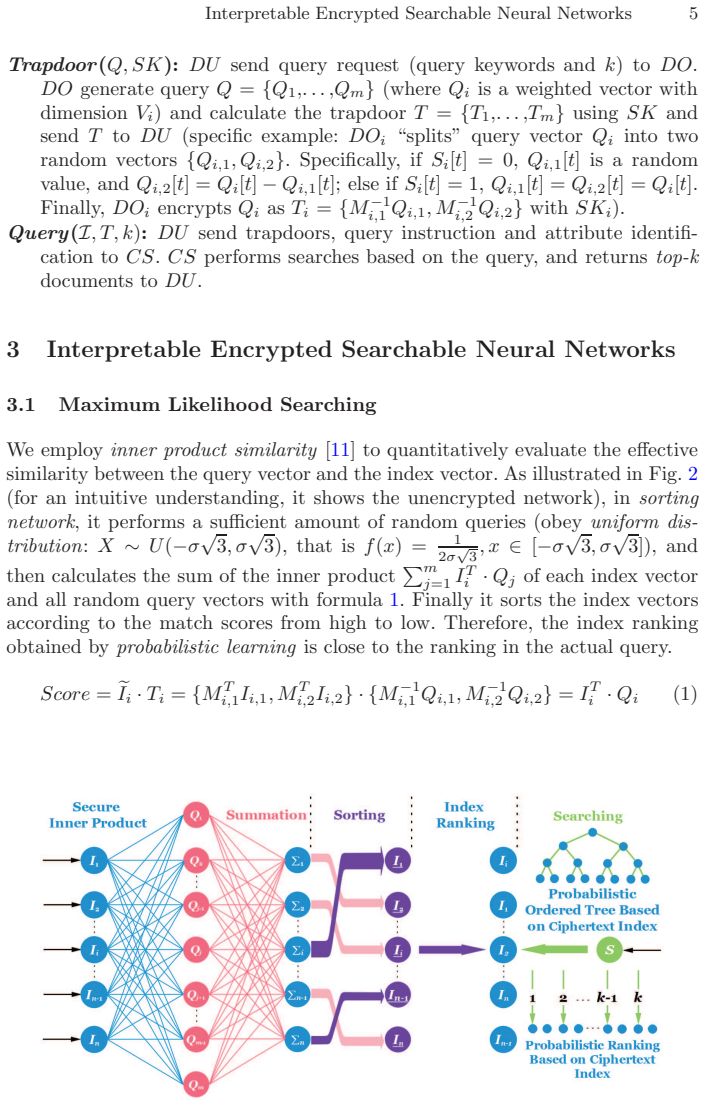
The load-bearing object is the sorting network built from encrypted index vectors. Each document index is a weighted vector over the keyword dictionary, padded with pseudo-keywords and encrypted by splitting the vector and multiplying with random invertible matrices so that inner products can still be computed on ciphertext. During setup the network issues many random queries $Q_j \sim U(-\sigma\sqrt{3}, \sigma\sqrt{3})$, computes the sum $\sum_j I_i^T Q_j$ for each index, and sorts indices by this score; that precomputed order is the probabilistic ranking used for queries. Updates are carried by two auxiliary networks: a searching adversarial network computes residual weight changes and ranking shifts from top-k feedback, and a weight-update network applies those changes through vector and matrix operations that are locally homomorphic to plaintext increments.
What would settle it
Take a document set with known relevance judgments, build the sorting network exactly as described, then issue real user queries of varying popularity. If the precision of top-k retrieval from the probabilistic ranking falls below a linear-scan baseline whenever the query is not popular, or if precision collapses in the k-regions identified in the paper's Fig. 3, the central claim is false.
Extended reading notes
Core claim
The paper's central claim is that ranking encrypted index vectors by the sum of their inner products with many random query vectors gives an ordering close to the ordering a real user query would produce, and that this probabilistic ranking supports top-k retrieval in time close to O(log N). On top of this, a searching adversarial network and a weight-update network (combining backpropagation with a discrete recurrent network) let the cloud update index weights automatically, so dynamic operations add, delete, change, and search for keywords without expensive communication. The authors state that this combination outperforms tree-based search [3,13] and matrix-based multi-keyword ranked search [1,6], and that the update operations are performed in the cloud with only small amounts of data touched.
Load-bearing premise
The whole design rests on the assumption that summing inner products with many uniformly random query vectors produces an index ranking close to the ranking a real user query would produce; the paper states this closeness without proof.
Editorial extensions
If this is right
- Top-k retrieval no longer needs a full scan or a balanced tree: the precomputed probabilistic ranking lets the cloud read off the top-k indexes, bringing query complexity toward O(log N).
- Dynamic updates (adding or removing documents or keywords) can be executed in the cloud by adjusting index weights, eliminating the download-decrypt-update-upload cycle of earlier schemes.
- The index itself becomes a training signal: ciphertext-based sorting can produce rankings consistent with plaintext analysis, so encrypted data can feed machine-learning pipelines.
- Precision depends on how 'popular' the query vector is; the authors report that unpopular queries lower precision because the probabilistic ranking is not strictly ordered.
Reading between the lines
- If the probabilistic-ranking assumption is formalized, the natural next step is an error bound: for a given number of random queries and query distribution, how close the learned ranking is to the optimal ranking can likely be quantified with concentration inequalities; the paper does not attempt this.
- The sorting network's reliance only on inner products suggests the idea could transfer to any encrypted inner-product scheme, not just the particular matrix-splitting encryption used here.
- A practical deployment would need a privacy analysis of the update residuals: returning top-k feedback to the adversarial network reveals ranking information that a semi-trusted cloud could exploit; the paper asserts security in the known-background model but does not analyze this leakage.
- The approach could combine with tree indices: probabilistic ranking could choose which subtree to descend first, potentially making tree search robust in multi-owner settings where ordinary balanced trees degrade.
Signed reviews
Editorial analysis
A structured set of objections, weighed in public.
Referee Report
Summary. The paper proposes IESNN, a framework that combines probabilistic learning, adversarial learning, and automatic weight update with searchable encryption. The claimed contributions are a probabilistic ranking of encrypted index vectors that brings query complexity closer to O(log N), cloud-side automatic weight updates without expensive communication, and low computation/communication overhead compared with prior searchable encryption schemes. The manuscript describes a system architecture, a sorting network based on random queries, a searching adversarial network (SAN), a weight update network (WUN), and an experimental comparison on a collection of 400 IEEE INFOCOM papers.
Significance. If the central claims were established, the paper would address a real problem: reducing the computation and communication cost of dynamic searchable encryption while preserving privacy. The paper also usefully identifies the opportunity to combine machine learning ideas with encrypted search and gives a concrete ASPE-style encryption construction in Section 2.2. However, the load-bearing assertions, especially the probabilistic-ranking closeness assumption and the O(log N) query complexity claim, are stated without proof or algorithmic specification, and the experimental evidence is too thin to validate them. The manuscript is better viewed as a high-level proposal than as a verified scheme; in its current form it does not provide the formal support expected for the claimed results.
major comments (5)
- [§3.1, Eq. (1)] The central ranking assumption is unproved and is not supported by the paper's own experiments. The text states that after sorting index vectors by sum of inner products with random queries, 'the index ranking obtained by probabilistic learning is close to the ranking in the actual query.' Algebraically, sum_j I_i^T Q_j = I_i^T (sum_j Q_j), so the entire ordering is determined by one fixed direction R = sum_j Q_j in the feature space. Nothing in the paper shows that ranking by this fixed random direction approximates ranking under an arbitrary user query q; for any fixed direction one can construct queries for which the two rankings differ substantially. The caption of Fig. 3 itself concedes that 'the probabilistic ranking of the index vector is not strictly ordered' and that precision is 'high or low' depending on how popular the query is. Since the abstract's near-logarithmic complexity claim depends on this assumption, the central argument lacks the necessary support.
- [§3.1, 'probabilistic query algorithm'] No algorithm is actually given for the claimed O(log N) probabilistic query. The text says that probabilistic query 'brings the query complexity closer to O(log N)', but it does not specify how a user query is mapped to a logarithmic-length search path in the probabilistic ranking, nor does it provide a complexity analysis accounting for the cost of building and maintaining the sorted order. Figure 3 reports only a qualitative comparison of numbers of retrieved indexes; it does not provide the algorithmic steps or a formal complexity bound that would let a reader verify the O(log N) claim.
- [§3.3, Eqs. (3) and (4)] The automatic weight-update mechanism is underspecified at a load-bearing point. The equations use net_j(t) without defining it, and the update principle introduces Delta I_alpha and Delta I_beta without specifying how the increment is computed. The 'local homomorphism' argument asserts (I_alpha + Delta I_alpha)^T M is approximately I_alpha^T M + Delta I_beta^T M, but no relation between Delta I_alpha and Delta I_beta is given, so the approximation is not derivable from the preceding definitions. Because automatic in-cloud update without communication is one of the paper's headline contributions, this gap is substantial.
- [§3.2, Eq. (2)] The searching adversarial network is described only at a high level, and Eq. (2) is not connected to the described update procedure. The minimax objective in Eq. (2) is a standard GAN-style formulation, but the text says SAN 'only require simple residual calculations and index sorting floating steps' and gives no derivation of those steps from Eq. (2). There is also no convergence analysis and no argument that the 'optimal game equilibrium' is reached in the encrypted setting. This matters because the claim that cloud-side automatic updates preserve search quality depends on SAN behaving as described.
- [§3.1 and Fig. 3] The experimental evaluation is not sufficient to support the claimed improvements. The only experiment uses a single small dataset (400 papers, 2,000 keywords), reports no numerical precision or recall values, gives no error bars or statistical tests, and does not measure communication or computation overhead despite those being central claims in the abstract. The caption mentions averaging 100 experimental results, but without the actual numbers and variance, the reader cannot assess whether the differences in Fig. 3 are meaningful.
minor comments (5)
- [Author affiliation and abstract] There are typographical issues, such as 'Techno logy' in the affiliation and 'po ssible' in the abstract; a careful proofread is needed.
- [§3.2, Eq. (2)] The variables x and y in Eq. (2) and the distributions pi(x) and pq(y) are not formally defined before the equation, which makes the objective hard to interpret.
- [Table 1] The checkmark criteria such as 'high-precision query' and 'high-quality ranked search' are not quantitatively defined, so the comparison in Table 1 is difficult to verify.
- [§3.3] The activation functions sgn and satlins are used without definition or reference, which is a barrier to reproducing the proposed update rules.
- [§3.4] The phrase 'query-learning-update-learning-query self-attention loop' is vague and not tied to the self-attention mechanism in the cited reference [15].
Circularity Check
No circular derivation: the central probabilistic-ranking closeness is an unproven empirical assumption, not a result forced by the paper's own inputs.
full rationale
I walked the paper's derivation chain and found no step in which a prediction or claimed first-principles result reduces to its own inputs by construction. The closest candidate is Section 3.1's assertion that ranking index vectors by the sum of inner products with many uniform random queries is 'close to the ranking in the actual query.' That is an unproven modeling assumption, and the paper's own Fig. 3 caption concedes that precision varies with query popularity. However, this is a validity or correctness concern, not circularity: no parameter is fitted to a subset of data and then renamed a prediction; the claimed O(log N) complexity is unsupported by any algorithmic or complexity analysis, but it is not derived from an assumption that already contains the conclusion. Equation (1) is a standard algebraic identity showing that the encryption scheme preserves inner products, and it is used as a design invariant rather than as an input that later reappears as the output. The adversarial and weight-update modules are described at a high level, but they do not import a prior result from the same authors or invoke a uniqueness theorem. There are no load-bearing self-citations, no fitted-input-called-prediction pattern, and no renaming of a known result as organization. The paper is benchmarked against external prior schemes, so its comparative claims are not self-referential. Thus the appropriate circularity score is 0, with the caveat that the paper's main assumption about probabilistic ranking is unsupported and should be examined under correctness risk, not circularity.
Assumptions & free parameters
free parameters (3)
- sigma (scale of uniform random query distribution)
- Number of random queries for probabilistic ranking
- U_i (number of pseudo-keywords per dictionary)
assumptions (5)
- domain assumption Inner-product similarity between query and index vectors is an appropriate relevance score for ranking.
- ad hoc to paper The sorted order of index vectors by sums of inner products with random queries approximates the order for real queries.
- ad hoc to paper Ciphertext index weights can be updated in the cloud with a local homomorphism that keeps inner products close to plaintext updates.
- domain assumption The cloud server is semi-trusted in the known-background threat model.
- standard math Matrix encryption preserves the inner product.
invented entities (3)
-
Searching adversarial network (SAN)
-
Weight update network (WUN)
-
Probabilistic ranking of encrypted index
Cite this review
Pith. "Pith review of Interpretable Encrypted Searchable Neural Networks." pith.science (2026). https://pith.science/paper/V4JH3PP6
@misc{pith2026190804998,
  author       = {Pith},
  title        = {Pith review of: Interpretable Encrypted Searchable Neural Networks},
  year         = {2026},
  howpublished = {\url{https://pith.science/paper/V4JH3PP6}},
  note         = {Machine review of arXiv:1908.04998}
}
abstract
In cloud security, traditional searchable encryption (SE) requires high computation and communication overhead for dynamic search and update. The clever combination of machine learning (ML) and SE may be a new way to solve this problem. This paper proposes interpretable encrypted searchable neural networks (IESNN) to explore probabilistic query, balanced index tree construction and automatic weight update in an encrypted cloud environment. In IESNN, probabilistic learning is used to obtain search ranking for searchable index, and probabilistic query is performed based on ciphertext index, which reduces the computational complexity of query significantly. Compared to traditional SE, it is proposed that adversarial learning and automatic weight update in response to user's timely query of the latest data set without expensive communication overhead. The proposed IESNN performs better than the previous works, bringing the query complexity closer to $O(\log N)$ and introducing low overhead on computation and communication.
Figures

Figures from the paper (3 more)


Reference graph
Works this paper leans on
-
[1]
Cao, N., Wang, C., Li, M., Ren, K., Lou, W.: Privacy-preser ving multi-keyword ranked search over encrypted cloud data. IEEE Trans. Parall el Distrib. Syst. 25(1), 222–233 (2014)
work page 2014
-
[2]
Goodfellow, I.J., Pouget-Abadie, J., Mirza, M., Xu, B., W arde-Farley, D., Ozair, S., Courville, A.C., Bengio, Y.: Generative adversa rial networks. CoRR abs/1406.2661 (2014)
arXiv 2014
-
[3]
Journal of Systems and Soft- ware 137(3), 380–395 (2018)
Guo, Z., Zhang, H., Sun, C., Wen, Q., Li, W.: Secure multi-k eyword ranked search over encrypted cloud data for multiple data owners. Journal of Systems and Soft- ware 137(3), 380–395 (2018)
work page 2018
-
[4]
C ognitive Science 30(4), 725–731 (2006)
Hinton, G.E., Osindero, S., Welling, M., Teh, Y.W.: Unsup ervised discovery of nonlinear structure using contrastive backpropagation. C ognitive Science 30(4), 725–731 (2006)
work page 2006
-
[5]
Kumar, D.V.N.S., Thilagam, P.S.: Approaches and challen ges of privacy preserving search over encrypted data. Inf. Syst. 81, 63–81 (2019)
work page 2019
-
[6]
Li, R., Xu, Z., Kang, W., Yow, K., Xu, C.: Efficient multi-key word ranked query over encrypted data in cloud computing. Future Generation C omp. Syst. 30(1), 179–190 (2014)
work page 2014
-
[7]
Park, J.H., Kim, Y.S., Eom, I.K., Lee, K.Y.: Economic load dispatch for piecewise quadratic cost function using hopfield neural network. IEEE Trans. Power Syst. 8(3), 1030–1038 (1993)
work page 1993
-
[8]
Song, D.X., Wagner, D.A., Perrig, A.: Practical techniqu es for searches on en- crypted data. In: IEEE S & P 2000. pp. 44–55. IEEE Computer Soc iety (2000)
work page 2000
Show all 15 references
-
[9]
: Verifiable privacy- preserving multi-keyword text search in the cloud supporti ng similarity-based rank- ing
Sun, W., Wang, B., Cao, N., Li, M., Lou, W., Hou, Y.T., Li, H. : Verifiable privacy- preserving multi-keyword text search in the cloud supporti ng similarity-based rank- ing. IEEE Trans. Parallel Distrib. Syst. 25(11), 3025–3035 (2014)
2014
-
[10]
In: INFOCOM 2010
Wang, C., Wang, Q., Ren, K., Lou, W.: Privacy-preserving public auditing for data storage security in cloud computing. In: INFOCOM 2010. pp. 5 25–533 (2010)
2010
-
[11]
Morgan Kaufmann ( 1999)
Witten, I.H., Moffat, A., Bell, T.C.: Managing Gigabytes : Compressing and Index- ing Documents and Images, Second Edition. Morgan Kaufmann ( 1999)
1999
-
[12]
In: ACM SIGMOD 2009
Wong, W.K., Cheung, D.W., Kao, B., Mamoulis, N.: Secure k nn computation on encrypted databases. In: ACM SIGMOD 2009. pp. 139–152. ACM ( 2009)
2009
-
[13]
IEEE Trans
Xia, Z., Wang, X., Sun, X., Wang, Q.: A secure and dynamic m ulti-keyword ranked search scheme over encrypted cloud data. IEEE Trans. Parall el Distrib. Syst. 27(2), 340–352 (2016)
2016
-
[14]
In: INFOCOM 2010
Yu, S., Wang, C., Ren, K., Lou, W.: Achieving secure, scal able, and fine-grained data access control in cloud computing. In: INFOCOM 2010. pp . 534–542. IEEE (2010)
2010
-
[15]
In: ICML 2019
Zhang, H., Goodfellow, I.J., Metaxas, D.N., Odena, A.: S elf-attention generative adversarial networks. In: ICML 2019. pp. 7354–7363. PMLR (2 019)
2019
Reviewed August 14, 2026 · model on record in the stance chip above.
Discussion (0). Continue with ORCID to comment.