REVIEW 4 major objections 5 minor
Enfold: Folding World Model Imagination into Predictive Representations for Ultra-Efficient Embodied Control
T0 review · 4 major / 5 minor · reviewed 2026-08-04 · deepseek-v4-flash
Pith's one-line read A world model's future-generating computation can be folded into a representation read from the present alone, making action prediction up to ten times faster without sacrificing task success.
desk verdict Solid empirical paper; the core efficiency claim holds, but the mechanism claim is under-tested because no controlled alternative future-predictive target is compared. read the letter →
The pith
A machine-rendered reading of the paper's core claim, the machinery that carries it, and where it could break.
The reading
What carries the argument
The load-bearing object is the multi-level generator-state target: internal features exposed at selected depths and corruption levels as a teacher-forced generator converts a corrupted latent of the real future into a coherent trajectory. These states are concatenated and layer-normalized, and a timestep-conditioned prediction head maps the current-only representation onto them (G2R). The representation is detached before conditioning future generation (R2G) and before task readouts, so task gradients cannot reshape the encoder. The mechanism makes the generator a training-time supervisor and optional decoder rather than an action-time component.
What would settle it
Train the identical model with the multi-level generator-state target replaced by random, noise-matched vectors of the same shape while keeping all other losses and the downstream protocol fixed. If average success stays near 97.8%, the specific generator computation is not load-bearing; if it falls toward the action-only level (~94.9%), the generator-state target is what carries the claim.
Extended reading notes
Core claim
Enfold claims that future-conditioned generative computation can be internalized in a current-only representation. During training, a video generator processes the observed future under corruption and exposes states at several depths; a timestep-conditioned head predicts these states from the current context and instruction, and a detached copy of the representation also conditions future generation and task readouts. At deployment, action prediction runs only the encoder and action head. The paper reports 97.8% and 91.77% average success on its two simulated suites, a 3.7x latency reduction (10.1x with operator-level acceleration) against the strongest world-action baseline considered, impr
Load-bearing premise
The central premise is that the fixed set of generator depths chosen as supervision targets is both predictable from the current context and sufficient for control; the paper's own small probe shows no universally best layer, so the multi-level target could be mis-specified for tasks or corruption levels outside the probe.
Editorial extensions
If this is right
- At control time, action prediction needs only the encoder and an action head, so world-model reasoning costs one forward pass instead of a full generative rollout.
- The same representation is a functional input to future generation, so a robot can imagine a rollout only when needed while keeping the control loop cheap.
- Supervision from multi-level generator states beats future-pixel and action-only supervision, and multi-level concatenation adds the largest gains on goal-directed and multi-stage tasks.
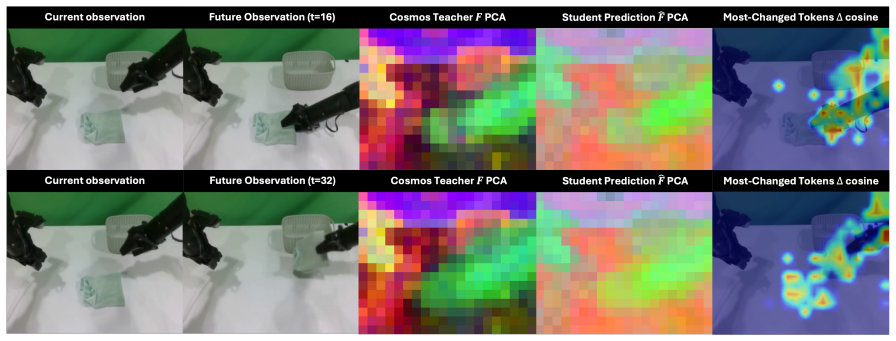
- The representation suppresses nuisance variation from the generator (lighting sensitivity roughly 8-10x lower than raw generator features) while retaining more feature diversity, consistent with predictive filtering rather than feature collapse.
- When the current scene is perturbed, both the imagined continuation and the executed actions redirect, indicating the policy is not replaying a fixed trajectory.
Reading between the lines
- A direct extension the paper does not pursue is learned selection of which generator depths supervise the encoder; its own probe shows the most informative layer shifts with corruption level, so a per-input or per-task routing could strengthen the G2R target.
- The paper's projection interpretation suggests the G2R objective is an amortized conditional expectation; if so, the same scheme could be applied to any predictive teacher, not just a video generator, by exposing intermediate states of other future-constructing computations.
- The token-geometry results point toward a testable hypothesis: the representation learns interaction relations (gripper-object) rather than object categories; one could probe this with a decodability experiment on relational predicates.
- The 10.1x latency number includes operator-level acceleration, so the architectural contribution to speed is the 3.7x; separating the two matters when porting the method to a different runtime.
Editorial analysis
A structured set of objections, weighed in public.
Referee Report
Summary. The paper proposes Enfold, a method for transferring the internal computation of a video world generator into a current-only representation. During training, multi-level generator states obtained from a teacher-forced pass over the observed future supervise a current-only predictive encoder (G2R), the learned representation conditions future generation (R2G), and task heads read the representation with stop-gradient. At deployment, the generator is not executed for action prediction. The authors report strong control results on LIBERO (97.8% average success), RoboTwin2.0 (91.77%), and real bimanual tasks, with 3.7x lower latency than Fast-WAM and 10.1x for a TensorRT-accelerated variant. Additional analyses probe layer selection, future-prediction improvements from R2G, representation statistics, and human-intervention behavior.
Significance. If the central claim holds, the paper makes a useful conceptual and practical contribution: world models can serve as training-time sources of structured predictive supervision rather than as mandatory inference-time simulators. The latency gains are concrete, and the detached task-readout design cleanly separates representation learning from policy optimization. The paper is commendably transparent about several limitations, including the small layer-selection probe, the qualitative nature of the intervention evidence, and the need for uncertainty estimates on close benchmark margins. However, the mechanism claim — that the specific generator-state target, rather than future-predictive supervision in general, drives the gains — is not yet isolated by the reported experiments.
major comments (4)
- [Section 5.2, Tables 1-2] No uncertainty intervals are reported for any success rate, and several headline margins are very small: Enfold is 0.2 points above Fast-WAM on LIBERO average and 0.19 points above on RoboTwin2.0. The text itself states that these margins are too small to support a ranking claim without uncertainty estimates. Please report standard errors, confidence intervals, or multiple-seed evaluations, and adjust the strength of the comparative claims accordingly. This is essential for the central efficiency-accuracy trade-off claim.
- [Section 5.4, Table 4; Section 4.2, Eqs. (3)-(4)] The G2R ablation does not isolate the causal role of generator states as the supervision target. Future-pixel prediction is a much harder reconstruction objective, and action-only training changes the gradient protocol by letting task gradients shape the encoder. Neither is a controlled substitute for a future-predictive feature target. The paper should include a baseline in which the current-only encoder predicts future features from a frozen visual encoder (e.g., DINOv3 or V-JEPA) under the same architecture, loss, stop-gradient task head, and compute. In addition, the paper never reports how well the current-only encoder actually predicts the multi-level generator target on held-out clips. Reporting G2R loss or cosine similarity would directly substantiate the claim that the generator's internal computation is 'internalized' rather than only weakly correlated with a strong auxiliary o
- [Section 3, Appendix C] The supervision layers L={7,15,23,27} are a load-bearing design choice, but the selection is post hoc on a 20-video probe. The appendix explicitly cautions that this probe is insufficient to establish a precise layer ranking, and Figure 2 shows no universally best layer. Because the G2R target and all downstream results depend on this fixed set, the paper should provide additional evidence that the choice is stable: e.g., a sensitivity analysis over alternative layer sets, a cross-task layer-selection experiment, or a validation-set criterion that does not reuse the final test set. Without this, the target specification remains an unexplained empirical choice.
- [Section 5.3, Appendix B.5] The human-intervention evidence is qualitative only, and the appendix states that no matched frozen-representation or no-intervention rollout is reported. The claim that the method 'adapts' rather than replays is central to the paper's narrative, but the current evidence is a few hand-picked rollouts. Please either add quantitative intervention experiments with multiple seeds and a recovery-rate metric, or clearly demote this claim to a qualitative illustration and remove it from the abstract-level conclusions about counterfactual consistency.
minor comments (5)
- [Section 4.2, Eq. (3)] The symbol LN is used without definition. Presumably layer normalization; please define it at first use.
- [Section 5.4, Table 4] The first row label 'F uture pixels' contains a spacing artifact; should be 'Future pixels'. Similar spacing artifacts appear in Section 5.5 headings and elsewhere, e.g., 'F rom', 'T oken'. A careful proofread is needed.
- [Table 3 and Table 7] Several table cells appear to be improperly typeset (e.g., '92.293.3' and '86.183.3'). Please check all numerical entries for formatting and column alignment.
- [Appendix B.4] The effective-rank comparison uses different sample sizes (20 clips in Appendix C, 100 clips in Figure 6). The text says raw values are not compared across sets, which is appropriate, but the caption of Figure 6 should state this explicitly to avoid reader confusion.
- [Appendix A, Eq. (14)] The information-theoretic statement I(Y;Z|X)=0 is correct for deterministic U_phi but may be surprising to readers because Z is a function of X. Please add one sentence clarifying that this is a statement about the learned encoder at a fixed time, and that R2G gains reflect reorganization, not additional information about Y.
Circularity Check
No significant circularity: the central distillation scheme is assessed against external benchmarks with controlled ablations.
full rationale
The paper's central mechanism is a training-time distillation (G2R) from a fixed external generator (Cosmos-Predict 2.5 2B) into a current-only encoder, with stopped gradients, plus a functional test (R2G) that conditions the same generator on the learned representation. The target in Eq. 3 is defined by the teacher-forced generator processing the observed future, not by the student's output; the student is trained to predict that target through a timestep-conditioned head (Eq. 4). This is a genuine prediction task rather than a tautology. The choice of generator layers L={7,15,23,27} is explicitly empirical, based on a 20-video probe (Section 3, Appendix C), and is not presented as a derived first-principles result; that is a design choice and an overfitting risk, not circularity. Table 4 compares generator-state supervision against future-pixel and action-only targets under an unchanged downstream protocol, which isolates the supervision target. The R2G result (Table 5) compares Enfold to a matched video-only Cosmos baseline; although z is computed from the same context and supplies no new observation, the improvement is an empirical demonstration that the representation reorganizes available context, not an identity forced by construction. The paper's own Appendix A explicitly acknowledges the moving-target nature of the G2R objective and provides only an idealized projection interpretation, not a convergence claim. Self-citations, such as the staged real-robot evaluation protocol from Aha-WAM, are evaluation details and not load-bearing for the main derivation. Overall, the control results are grounded in external benchmarks and the core claim does not reduce to its inputs.
Assumptions & free parameters
free parameters (3)
- Generator supervision layers L={7,15,23,27} =
{7,15,23,27}
- Loss coefficients λ_R2G=1, λ_task=1 =
1, 1
- Action sampling hyperparameters =
10 Euler steps, noise shift 5.0, guidance 1.0, replan cadence 10/24 actions
assumptions (5)
- standard math L2 conditional-expectation decomposition of the G2R objective (Appendix A, Eqs. 10–12) is valid and justifies the predictive-projection interpretation.
- domain assumption Intermediate states of a video generator organize appearance, spatial layout, and interaction across levels of abstraction, and these states can be predicted from current context plus instruction.
- ad hoc to paper The fixed layer set L={7,15,23,27} and timestep-conditioned head suffice to capture complementary transition structure.
- domain assumption Stop-gradient task readouts do not meaningfully degrade control relative to allowing task gradients to shape the encoder.
- domain assumption Pretrained Cosmos and DINOv3 backbones are suitable fixed feature sources for the generative teacher and predictive encoder.
Cite this review
Pith. "Pith review of Enfold: Folding World Model Imagination into Predictive Representations for Ultra-Efficient Embodied Control." pith.science (2026). https://pith.science/paper/V4PR57ZV
@misc{pith2026260726657,
  author       = {Pith},
  title        = {Pith review of: Enfold: Folding World Model Imagination into Predictive Representations for Ultra-Efficient Embodied Control},
  year         = {2026},
  howpublished = {\url{https://pith.science/paper/V4PR57ZV}},
  note         = {Machine review of arXiv:2607.26657}
}
abstract
World generative models are typically used through what they produce: a rendered future, a video-conditioned action, or latent context computed by a costly generative branch. We argue that their more reusable asset is the computation that constructs a future. As a generator transforms a corrupted future into a coherent trajectory, its intermediate states organize appearance, spatial layout, and interaction across levels of abstraction. Can this future-generative computation be internalized in a representation inferred from the present alone? We present Enfold, which transfers this computation into a representation predicted from the current visual context and language instruction. During training, multi-level states exposed as the generator processes the observed future supervise a current-only encoder. The learned representation is fed back to condition future generation and is read by task heads without allowing task gradients to reshape the encoder. At deployment, action prediction no longer executes the generator. Across LIBERO, RoboTwin2.0, and real-robot tasks, Enfold supports strong control while reducing action latency by $3.7\times$ relative to Fast--WAM, Enfold-Flash reaches $10.1\times$. Representation analyses show that it suppresses nuisance variation and preferentially captures changes that emerge over longer horizons. When the current scene is altered by human intervention, both the generated continuation and the executed actions adapt, which is inconsistent with fixed trajectory replay. These results recast a world generator as a source of predictive control representations: its future need not be materialized at every step if its internal structure can be enfolded into the present.
Figures


Figures from the paper (11 more)



Reviewed August 4, 2026 · model on record in the stance chip above.
Discussion (0). Continue with ORCID to comment.