REVIEW 4 major objections 4 minor 49 references
Continuous time random walk concepts applied to extended mode coupling theory: A study of the Stokes-Einstein breakdown
T0 review · 4 major / 4 minor · reviewed 2026-08-14 · deepseek-v4-flash
Pith's one-line read Adding renewal-theory time splitting to extended mode-coupling theory reproduces the Stokes-Einstein breakdown in supercooled Salol.
desk verdict A serious attempt to extend MCT to the Stokes-Einstein breakdown, but the key renewal step is an assumption and the Fig. 2 prediction is a consequence of that assumption rather than a robust result; still worth refereeing. read the letter →
The pith
A machine-rendered reading of the paper's core claim, the machinery that carries it, and where it could break.
The reading
What carries the argument
The load-bearing object is the renewal-theory decomposition of a two-process random walk into a persistence function and a diffusive part. For a waiting-time distribution that is a mixture of two exponentials with timescales $\tau_1,\tau_2$, the persistent time is $\langle \tau_p\rangle=(\tau_1^2+\tau_2^2)/(\tau_1+\tau_2)$ and the exchange time is $\langle\tau_x\rangle=(\tau_1+\tau_2)/2$, so $\langle\tau_p\rangle>\langle\tau_x\rangle$ whenever the two channels differ; this is the identity that makes the first jump slower than later jumps. The paper maps $P(t)$ to the RFOT activated process and $\phi_{\rm diff}$ to the unchanged $\phi_s=\phi_s^{\rm hop}\phi_s^{\rm MCT}$, converting the Unified theory into Eq. (24). This persistent-versus-exchange asymmetry is what transfers the slow timescale into structural relaxation while leaving diffusion fast.
What would settle it
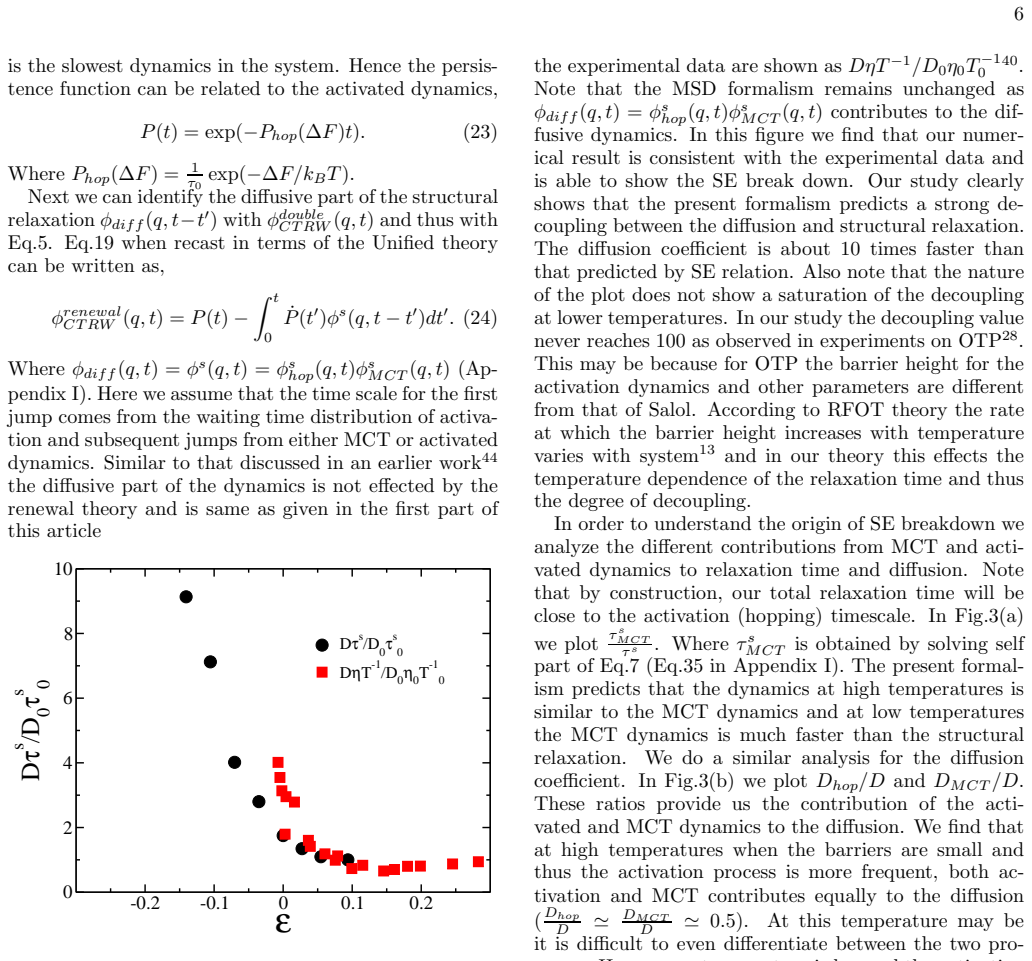
Track single-particle trajectories in a simulation of a supercooled liquid and extract the first-jump waiting time and the subsequent-jump waiting times separately. The extended theory predicts that the first-jump time should follow the RFOT activated rate $\exp(-\Delta F/k_BT)$ and should exceed the exchange time increasingly as $T$ drops, with $D\tau_s/D_0\tau_{s0}$ rising monotonically to roughly ten near the Salol $T_g$; a first-jump time no slower than later jumps, or a saturating or absent decoupling in $D\tau_s$, would falsify the mechanism.
Extended reading notes
Core claim
The central claim is that the earlier Unified theory fails at the Stokes-Einstein breakdown for a structural reason, not a parameter one. Because its relaxation function factorizes as $\phi=\phi_{\rm MCT}\phi_{\rm hop}$, it is equivalent to a CTRW in which activated and MCT-like channels contribute two exponential waiting-time distributions; known CTRW results say such a mixture relaxes on the fast timescale, so both $\tau_s$ and $D$ are MCT-controlled and never decouple. The paper's fix is the renewal-theory form (Eq. 24), $\phi_{\rm renewal}(q,t)=P(t)-\int_0^t \dot P(t')\phi_s(q,t-t')\,dt'$, with persistence function $P(t)=\exp(-P_{\rm hop}(\Delta F)t)$ assigned to activated hopping and the diffusive part $\phi_s=\phi_s^{\rm hop}\phi_s^{\rm MCT}$. In the extended theory, at low temperature structural relaxation is governed by the activated rate while diffusion remains MCT-like, so $D\tau_s/D_0\tau_{s0}$ rises to about ten as Salol is cooled toward $T_g$, in line with the experimental $D\eta/T$ data. The paper further finds that the dynamic length scale extracted from the wavenumber dependence of $\tau_s$ grows faster than the RFOT static length scale.
Load-bearing premise
The load-bearing premise is the mapping, introduced in Sec. II D, that at low temperatures the activated process is the slowest process, so the persistence function is $P(t)=\exp(-P_{\rm hop}(\Delta F)t)$, and that the diffusive correlator $\phi_s=\phi_s^{\rm hop}\phi_s^{\rm MCT}$ is not altered by renewal. If the first-jump time is not controlled by the activated barrier, or if renewal changes the diffusion channel, the predicted decoupling in Fig. 2 does not follow.
Editorial extensions
If this is right
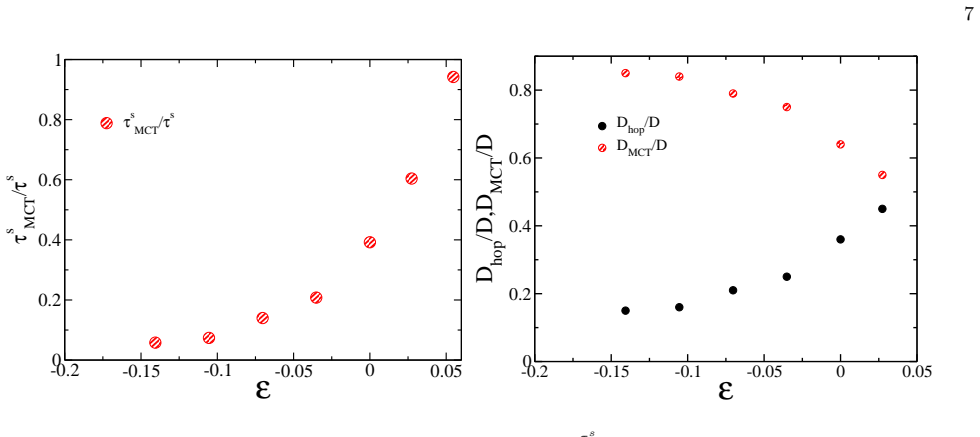
- At low temperatures the structural relaxation time $\tau_s$ is set by the activated barrier $\Delta F(T)$, while the diffusion coefficient stays controlled by the MCT-like process, so the two decouple as $T$ decreases.
- The failure of the original Unified theory is generic: any extended MCT that combines activated and MCT channels only through a product of correlators is equivalent to a two-channel CTRW and will be dominated by the fast process, so it cannot produce a strong SE breakdown.
- In the extended theory, the ratio $D\tau_s/D_0\tau_{s0}$ for Salol grows to about ten near $T_g$ and does not saturate, matching the experimental $D\eta/T$ trend.
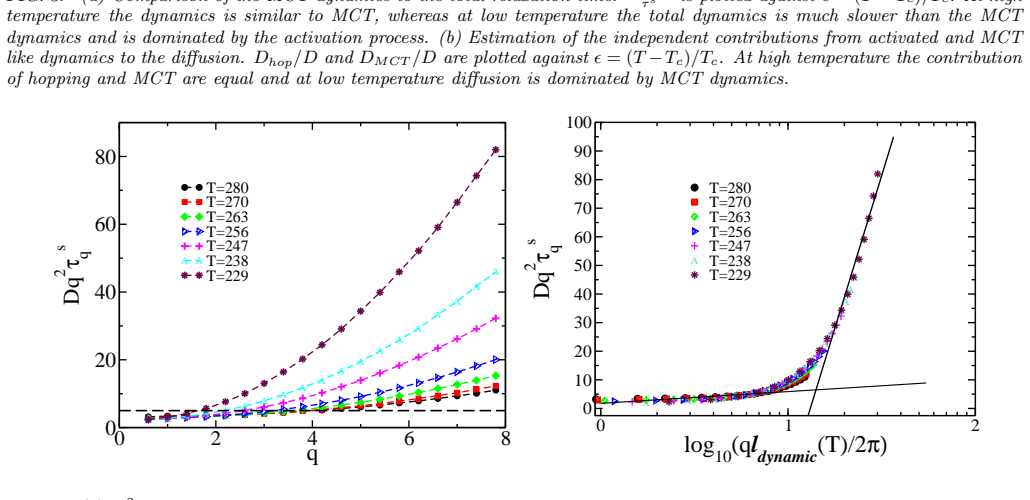
- The dynamic correlation length obtained from the Fickian-to-non-Fickian crossover in $D q^2 \tau_q^s$ scales the relaxation data onto a master curve and grows faster than the static RFOT length.
- At high temperatures, activated and MCT contributions to diffusion are comparable, so the theory recovers Stokes-Einstein behavior above the onset.
Reading between the lines
- The persistent/exchange split could be measured directly from molecular-dynamics trajectories by classifying rearrangements into first and subsequent hops, giving a microscopic signature of the SE breakdown independent of the macroscopic $D\tau_s$.
- Because the barrier $\Delta F$ is tied to configurational entropy through RFOT, the theory implies the magnitude of the SE breakdown should correlate with how steeply the entropy drops on cooling, a prediction that could be tested across glassformers with different fragilities.
- The master-curve collapse of $D q^2\tau_q^s$ against $q\,l_{\rm dynamic}$ suggests that the Fickian-to-non-Fickian crossover is a scaling feature that, if confirmed in other systems, would make $l_{\rm dynamic}$ a well-defined operational measure of dynamical heterogeneity.
Signed reviews
Editorial analysis
A structured set of objections, weighed in public.
Referee Report
Summary. The paper examines the Unified MCT+RFOT theory for supercooled liquids and shows that this theory, in its original form (schemes 1 and 2), fails to reproduce the Stokes-Einstein (SE) breakdown for Salol. The authors first demonstrate that the Unified theory has the same structure as a continuous-time random walk with two exponential waiting-time distributions, where the total relaxation is dominated by the fast process. They then extend the theory using renewal-theory concepts: the first jump (persistence) is assigned to the slow activated dynamics, while subsequent jumps are described by the unchanged Unified two-channel correlation function. This gives Eq. (24), which is shown in Fig. 2 to reproduce the experimental SE breakdown with a decoupling ratio of about 10 at low temperature. The paper also computes a dynamic correlation length from the wavenumber dependence of the relaxation time and finds that it grows faster than the static RFOT length scale.
Significance. If the central mapping is accepted, the paper offers a microscopically motivated extension of MCT that captures the SE breakdown, a hallmark of supercooled liquids, and it makes a falsifiable prediction about a rapidly growing dynamic length scale. The formal observation that the Unified theory is equivalent to a two-exponential CTRW and is therefore dominated by the fast process is a useful and clearly presented result. The comparison with the Salol experiments is concrete, and the authors correctly identify that a full self-consistent extension of MCT should incorporate renewal statistics. However, the load-bearing identification of the persistence function with a single activated exponential (Eq. 23) is posited rather than derived, and the unchanged diffusion part (Eq. 24) is an additional assumption. The numerical predictions also rely on unspecified parameters tau0 and gamma. These issues limit the present form of the theory's predictive power, but they are addressable within the scope of a revision.
major comments (4)
- [Sec. II D, Eq. (23)] The identification P(t)=exp(-Phop(Delta F)t) is an assumption, not a consequence of the renewal formalism developed in Eqs. (20)-(22). For the two-exponential mixture of Eq. (20), the survival probability is 1/2 exp(-t/tau1)+1/2 exp(-t/tau2), which is not a single exponential. The persistent-time inequality of Eq. (22) only establishes that the mean first-jump time exceeds the mean exchange time; it does not fix the functional form of P(t). Since the strong decoupling between relaxation and diffusion shown in Fig. 2 follows directly from placing the slow activated rate in P(t) and the fast MCT product in phi_diff, this mapping is load-bearing and needs either a derivation from the CTRW statistics or an explicit statement that it is a phenomenological ansatz with supporting evidence.
- [Sec. II D, Eq. (24)] The identification phi_diff(t-t') = phi_s(t-t') = phi_s_hop phi_s_MCT means that the activated hopping process appears both in the persistence term P(t) and in the subsequent-dynamics term. In a renewal description, after the first jump the waiting time distribution for all subsequent jumps should be specified; here the same phi_s that already contains phi_s_hop is recycled. The statement that 'the diffusive part of the dynamics is not effected by the renewal theory and is same as given in the first part of this article' is asserted without derivation. This makes the decomposition in Eq. (24) ambiguous and prevents Eq. (24) from being a genuine renewal equation for the two-process system described in Sec. II D.
- [Sec. III A and Sec. II B] The diffusion coefficient used in Fig. 2 is the long-time limit of the MSD of the original Unified theory (Eq. (10)), not a quantity derived from the renewal-modified dynamics of Eq. (24). The paper explicitly states that 'the MSD formalism remains unchanged' but does not justify why the first-jump slowdown leaves the long-time diffusion coefficient unaltered. This matters because the SE breakdown in Fig. 2 is obtained by combining the new slow relaxation time with the old, unchanged diffusion; a self-consistent extension of the Unified theory should derive D from the same renewal process. The authors should either provide a CTRW argument that D is indeed unchanged in the stationary state or acknowledge that the predicted breakdown is a hybrid construction.
- [Appendix II and Sec. III A] The numerical values of the microscopic attempt time tau0 (Eq. (23)) and the binary friction gamma (Eq. (1)) are never specified. The Salol results in Figs. 2-5 depend on these parameters, so the calculations cannot be reproduced from the information given. The authors should list the values and, ideally, show the sensitivity of the SE-breakdown ratio to reasonable variations in tau0 and gamma.
minor comments (4)
- [Abstract and Introduction] The phrase 'continuous time random work' (used in the abstract and in Sec. I) should be 'continuous time random walk'.
- [Sec. III B, Fig. 4] The threshold Dq^2 tau_q^s = 5 used to define q*(T) is arbitrary; the dependence of l_dynamic on this threshold should be discussed.
- [Sec. II D, Eq. (24)] Eq. (24) uses the self part phi_s for the diffusive part, while Eq. (18) uses phi_diff; the relationship between phi_diff and phi_s should be stated explicitly when Eq. (24) is introduced.
- [References] Reference 40 is incomplete ('C. D. et al.'); the full author list and journal information should be provided.
Circularity Check
SE breakdown in Fig. 2 is built into Eq. (23): setting the persistence function to the activated exponential makes the slow relaxation (and hence Dτ_s growth) an input, not a derived consequence.
-
self definitional
[Sec. II D, Eqs. (23)-(24), and Fig. 2]
"At low temperatures the activated dynamics is the slowest dynamics in the system. Hence the persistence function can be related to the activated dynamics, P (t) = exp( −Phop(∆ F )t)."
This sentence is the load-bearing step. Eq. (24) defines the structural relaxation as φ_renewal = P(t) − ∫ ˙P(t') φ_s(t−t') dt', and τ_s is then read off from φ_renewal(q=7,t)=0.1. With P(t) chosen as the activated exponential, τ_s is forced to follow the activated rate 1/P_hop at low temperature. Diffusion, by contrast, is still computed from the unchanged MSD whose low-T limit is the MCT part (D_hop ∝ P_hop → 0, Fig. 3b). The growth of Dτ_s shown in Fig. 2 is therefore the logical content of inserting the slow activated process into the relaxation channel and leaving the fast MCT process in the diffusion channel; the decoupling is assumed in Eq. (23), not produced by the CTRW/renewal equations.
-
other
[Sec. II D, Eqs. (20)-(24) and Appendix I]
"<τ p>= <τ 2 x > 2!<τ x > = (τ2 1 +τ2 2 ) (τ1 +τ2). ... At low temperatures the activated dynamics is the slowest dynamics in the system. Hence the persistence function can be related to the activated dynamics, P (t) = exp( −Phop(∆ F )t). ... Where φ dif f(q,t ) = φ s(q,t ) = φ s hop(q,t )φ s M CT (q,t ) (Appendix I)."
The persistent-time moment (Eq. 22) is computed for the two-exponential waiting-time mixture P_waiting(t) = (1/(2τ1))e^(−t/τ1) + (1/(2τ2))e^(−t/τ2), whose survival probability is a bi-exponential [e^(−t/τ1)+e^(−t/τ2)]/2, not the single activated exponential substituted in Eq. (23). The slow relaxation that drives the SE breakdown is thus an inserted ansatz, not the survival function of the renewal process analyzed in Eqs. (20)-(22). Moreover, the diffusive part in Eq. (24) is the full φ_s_hop φ_s_MCT, which already contains the activated hopping channel, so after the first activated jump the subsequent-jump term again includes activation; the first-jump/rest decomposition double counts the activated process.
full rationale
The paper's central claim—that the extended Unified theory explains the SE breakdown—is produced by the mapping in Sec. II D. Eq. (23) identifies the persistence function P(t) with the activated exponential exp(−P_hop t), and Eq. (24) then defines the structural relaxation in terms of that P(t). Since τ_s is extracted from φ_renewal and diffusion is still calculated from the unmodified MSD, the predicted decoupling at low temperatures is the direct consequence of this identification: the relaxation channel has been given the slow activated rate, while the diffusion channel retains the faster MCT-dominated part. The prior Unified theory's failure to show SE breakdown and the persistent-time inequality <τp> > <τx> are independent results, and the dynamic lengthscale is a further computed consequence, so the paper is not entirely circular. But the headline prediction of Fig. 2 does not follow from the CTRW/renewal formalism alone; it follows because the slow process was placed, by ansatz, in P(t) and the fast process was left in the diffusive part. This is a partial, construction-level circularity rather than a complete absence of independent content, hence score 6.
Assumptions & free parameters
free parameters (4)
- RFOT barrier parameters (TA, TK, S_fit) for Salol =
TA=330 K, TK=175 K, S_fit=2.651
- Microscopic attempt time tau0 =
not specified in text
- Binary friction gamma =
not specified in text
- Threshold for Fickian-to-non-Fickian definition, Dq^2 tau_q^s = 5 =
5
assumptions (6)
- domain assumption Factorization phi(q,t) ~ phi_MCT(q,t) phi_hop(q,t) (Eq.5).
- domain assumption Activated jump rate is given by RFOT: P_hop=1/tau0 exp(-Delta F/kBT), with barrier from Eq.37 using empirical S_c.
- ad hoc to paper The persistence function of the renewal process equals the activated process: P(t)=exp(-P_hop t) (Eq.23).
- ad hoc to paper The diffusive part of relaxation is unaffected by renewal: phi_diff=phi_s=phi_s_hop phi_s_MCT (Eq.24).
- ad hoc to paper The combined waiting time distribution is an equal-weight mixture of two exponentials (Eq.20).
- domain assumption Percus-Yevick hard-sphere structure factor with LJ-to-hard-sphere mapping represents Salol.
Cite this review
Pith. "Pith review of Continuous time random walk concepts applied to extended mode coupling theory: A study of the Stokes-Einstein breakdown." pith.science (2026). https://pith.science/paper/V4SHG5AK
@misc{pith2026190801972,
  author       = {Pith},
  title        = {Pith review of: Continuous time random walk concepts applied to extended mode coupling theory: A study of the Stokes-Einstein breakdown},
  year         = {2026},
  howpublished = {\url{https://pith.science/paper/V4SHG5AK}},
  note         = {Machine review of arXiv:1908.01972}
}
read the original abstract
In an attempt to extend the mode coupling theory (MCT) to lower temperatures, an Unified theory was proposed which within the MCT framework incorporated the activated dynamics via the random first order transition theory (RFOT). Here we show that the theory although successful in describing other properties of supercooled liquids is unable to capture the Stokes-Einstein breakdown. We then show using continuous time random work (CTRW) formalism that the Unified theory is equivalent to a CTRW dynamics in presence of two waiting time distributions. It is known from earlier work on CTRW that in such cases the total dynamics is dominated by the fast motion. This explains the failure of the Unified theory in predicting the SE breakdown as both the structural relaxation and the diffusion process are described by the comparatively fast MCT like dynamics. The study also predicts that other forms of extended MCT will face a similar issue. We next modify the Unified theory by applying the concept of renewal theory, usually used in CTRW models where the distribution has a long tail. According to this theory the first jump given by the persistent time is slower than the subsequent jumps given by the exchange time. We first show that for systems with two waiting time distributions even when both the distributions are exponential the persistent time is larger than the exchange time. We also identify the persistent time with the slower activated process. The extended Unified theory can now explain the SE breakdown. In this extended theory at low temperatures the structural relaxation is described by the activated dynamics whereas the diffusion is primarily determined by the MCT like dynamics leading to a decoupling between them. We also calculate a dynamic lengthscale from the wavenumber dependence of the relaxation time. We find that this dynamic length scale grows faster than the static length scale.
Figures

Figures from the paper (2 more)

Reference graph
Works this paper leans on
-
[1]
J.-P. Hansen and I. R. McDonald, Theory of simple liquids, 2nd ed. (Academic Press, London, 1986)
work page 1986
-
[2]
A. Einstein, Ann. Phys. 17, 549 (1905); English translation: A. Einstein, Investigations on the theory of the Brownian movement, Dover, NY (1956)
work page 1905
-
[3]
L. D. Landau and E. M. Lifshitz, Fluid Mechanics, 2nd. Ed., Pergamon Press (1987)
work page 1987
- [4]
-
[5]
Sastry, Nature 409 , 164 (2001)
S. Sastry, Nature 409 , 164 (2001)
2001
- [6]
- [7]
-
[8]
M. T. Cicerone and M. Ediger, J. Chem. Phys. 103 , 5684 (1995)
work page 1995
Show all 49 references
-
[9]
Williams and J
G. Williams and J. Fournier, J. Chem. Phys. 104 , 5690 (1996)
1996
-
[10]
Hurley and P
M. Hurley and P. Harrowell, Phys. Rev. E 52 , 1694 (1995)
1995
-
[11]
A. I. Mel'Cuk, R. A. Ramos, H. Gould, W. Klein, and R. D. Mountain, Phys. Rev. Lett. 75 , 2522 (1995)
1995
-
[12]
W. Kob, C. Donati, S. J. Plimpton, P. H. Poole, and S. C. Glotzer, Phys. Rev. Lett. 79 , 2827 (1997)
1997
-
[13]
Lubchenko and P
V. Lubchenko and P. G. Wolynes, J. Chem. Phys. 119 , 9088 (2003)
2003
-
[14]
Sengupta, S
S. Sengupta, S. Karmakar, C. Dasgupta, and S. Sastry, J. Chem. Phys. 138 , 12A548 (2013)
2013
-
[15]
G. M. Hocky, L. Berthier, W. Kob, and D. R. Reichman, Phys. Rev. E 89 , 052311 (2014)
2014
-
[16]
Flenner, H
E. Flenner, H. Staley, and G. Szamel, Phys. Rev. Lett. 112 , 097801 (2014)
2014
-
[17]
Staley, E
H. Staley, E. Flenner, and G. Szamel, J. Chem. Phys. 143 , 244501 (2015)
2015
-
[18]
Götze, J
W. Götze, J. Phys: Condens. Matter 11 , A1 (1999)
1999
-
[19]
Flenner and G
E. Flenner and G. Szamel, Phys. Rev. E 72 , 031508 (2005)
2005
-
[20]
G tze and L
W. G tze and L. Sj gren, Z. Phys. B: Condens. Matter 65 , 415 (1987)
1987
-
[21]
G tze and L
W. G tze and L. Sj gren, Transp. Theory Stat. Phys. 24 , 801 (1995)
1995
-
[22]
S. M. Bhattacharyya, B. Bagchi, and P. G. Wolynes, Phys. Rev. E 72 , 031509 (2005)
2005
-
[23]
Chong, Phys
S.-H. Chong, Phys. Rev. E 78 , 041501 (2008)
2008
-
[24]
S. M. Bhattacharyya, B. Bagchi, and P. G. Wolynes, PNAS 105 (2008)
2008
-
[25]
Adam and J
G. Adam and J. H. Gibbs, J. Chem. Phys. 43 , 139 (1965)
1965
-
[26]
Vasconcelos, F
Sengupta, Shiladitya, F. Vasconcelos, F. Affouard, and S. Sastry, J. Chem. Phys. 135 , 194503 (2011)
2011
-
[27]
Banerjee, S
A. Banerjee, S. Sengupta, S. Sastry, and S. M. Bhattacharyya, Phys. Rev. Lett. 113 , 225701 (2014)
2014
-
[28]
M. K. MapesStephen, F. Swallen, and M. D. Ediger, J. Phys. Chem. B 110 , 507 (2006)
2006
-
[29]
A. V. Barzykin and M. Tachiya, Phys. Rev. Lett. 73 , 3479 (1994)
1994
-
[30]
K. Seki, B. Bagchi, and M. Tachiya, Phys. Rev. E 77 , 031505 (2008)
2008
-
[31]
Grimmett and D
G. Grimmett and D. Stirzaker, Probability and Random Processes, 3rd. ed. (Oxford University Press, 2001)
2001
-
[32]
Y. Jung, J. P. Garrahan, and D. Chandler, J. Chem. Phys. 123 , 084509 (2005)
2005
-
[33]
Kawasaki, J
K. Kawasaki, J. Stat. Phys. 110 , 1249 (2003)
2003
-
[34]
Berthier and G
L. Berthier and G. Tarjus, Phys. Rev. E 82 , 031502 (2010)
2010
-
[35]
M. K. Nandi, A. Banerjee, S. Sengupta, S. Sastry, and S. M. Bhattacharyya, J Chem. Phys. 143 , 174504 (2015)
2015
-
[36]
M. K. Nandi, A. Banerjee, C. Dasgupta, and S. M. Bhattacharyya, Phys. Rev. Lett. 119 , 265502 (2017)
2017
-
[37]
S. M. Bhattacharyya, B. Bagchi, and P. G. Wolynes, arXiv:0902.4078v2
-
[38]
F. A. Lindemann, Phys. Z. 11 , 609 (1910)
1910
-
[39]
C. D. et al. , Phys Rev Lett 69, 3666 (1992)
1992
-
[40]
E. W. Montroll and G. H. Weiss, J. Math. Phys. (N.Y.) 6 , 167 (1965)
1965
-
[41]
Garrahan and D
J. Garrahan and D. Chandler, Phys. Rev. Lett. 89 , 035704 (2002)
2002
-
[42]
Berthier and J
L. Berthier and J. Garrahan, Phys. Rev. E 68 , 041201 (2003)
2003
-
[43]
D. C. L. Berthier and J. P. Garrahan, Europhys. Lett. 69 , 320 (2005)
2005
-
[44]
S. F. Swallen, P. A. Bonvallet, R. J. McMahon, and M. D. Ediger, Phys. Rev. Lett. 90 , 015901 (2003)
2003
-
[45]
W. Kob, S. Roldán-Vargas, and L. Berthier, Nat. Phys. 8 , 164 (2012)
2012
-
[46]
K. H. Nagamanasa, S. Gokhale, A. Sood, and R. Ganapathy, Nat. Phys. 11 , 403 (2015)
2015
-
[47]
Berthier, Phys
L. Berthier, Phys. Rev. E 69 , 020201(R) (2004)
2004
-
[48]
Richert and C
R. Richert and C. A. Angell, J Chem Phys 108, 9016 (1998)
1998
-
[49]
B \"o hmer, K
R. B \"o hmer, K. Ngai, C. Angell, and D. Plazek, J. Chem. Phys. 99 , 4201 (1993)
1993
Reviewed August 14, 2026 · model on record in the stance chip above.
Discussion (0). Continue with ORCID to comment.