REVIEW 4 major objections 5 minor 56 references
Diversify and Conquer: Open-set Disagreement for Robust Semi-supervised Learning with Outliers
T0 review · 4 major / 5 minor · reviewed 2026-08-07 · deepseek-v4-flash
Pith's one-line read When labels are scarce, disagreement among models finds the outliers
desk verdict DAC is a solid, well-engineered OSSL method that deserves review, but the central open-set-disagreement hypothesis is under-tested and the abstract overstates the CIFAR-10 results. read the letter →
The pith
A machine-rendered reading of the paper's core claim, the machinery that carries it, and where it could break.
The reading
What carries the argument
The central object is the multi-head predictor $\tilde{g} = \{g_1, \ldots, g_K\}$ on a shared encoder, trained by the diversification objective $L_{\text{div}} = \sum_i L_{\text{ssl}}(g_i) + \lambda_{\text{mi}} \sum_{i \neq j} L_{\text{mi}}(g_i, g_j)$, where $L_{\text{mi}}$ is the mutual information between head predictions on unlabeled embeddings. The consensus score $\hat{s}_b = \mathbb{E}_{(g_i,g_j)}[\exp(-\|p(g_i|z_b) - p(g_j|z_b)\|)]$ quantifies open-set disagreement: values near 1 mean the heads agree (inlier), near 0 mean they disagree (outlier). The scores feed three downstream mechanisms: a min-max normalization plus EMA memory queue for stability, a soft-rejection weight $\omega(u_b) = (s_b/\tau_{\text{open}})^{t_\omega}$ below an Otsu-derived threshold $\tau_{\text{open}}$, and an open-set knowledge distillation loss $L_{\text{kd}}$ that pushes the shared encoder to separate low-consensus samples from known-class clusters in embedding space.
What would settle it
Train DAC on a benchmark with 1–2 labeled samples per class and plot the consensus-score histograms for inliers and outliers separately; if the two distributions overlap so much that an outlier-detection AUROC near chance, the open-set disagreement signal has dissolved and the robustness claim for underspecified labels is refuted. A cheaper check is to ablate the mutual information loss on CIFAR-10 with 5 labels per class and measure whether inlier disagreement grows as much as outlier disagreement, as the paper's limitation note predicts.
Extended reading notes
Core claim
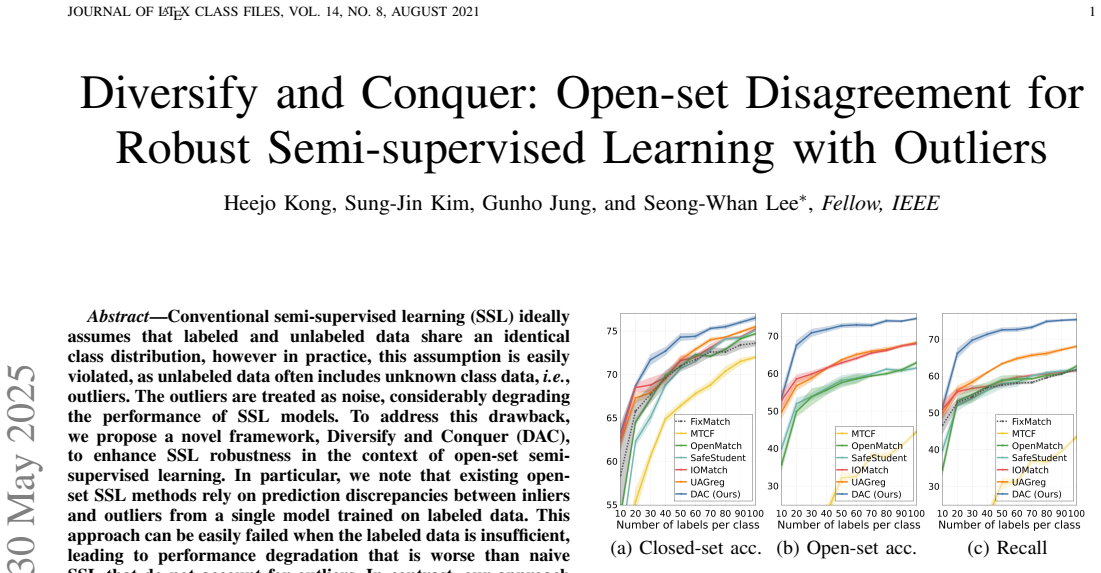
The paper's central claim is that open-set disagreement—prediction inconsistency across models that are each biased differently toward the unlabeled distribution—is a usable detector for unknown-class samples, and that it remains usable when labeled data is underspecified. The authors show experimentally that SSL models trained on the same labeled set but different unlabeled mixtures produce similar predictions for inliers but diverging predictions for outliers, and they elevate this observation into a training objective. Their framework, DAC, creates K divergent heads on a shared encoder, drives the heads to be statistically independent on unlabeled data through a mutual information loss, and defines a consensus score per sample as the average exponential-negative-L1 distance between all head pairs. Low consensus marks an outlier; the scores are then distilled into the shared feature extractor via a graph-based knowledge distillation loss and used to softly reweight the unsupervised loss so that likely outliers contribute little. The paper reports that this outperforms existing open-set SSL methods across CIFAR-10/100, ImageNet-30, and Semi-iNat-2021, and that unlike single-model detectors it does not over-reject inliers when labels are very scarce.
Load-bearing premise
The load-bearing premise is that multiple SSL models trained with the same labels will keep agreeing on inliers while disagreeing on outliers; if labels are so scarce that inliers also split the heads, the consensus score can no longer separate known from unknown samples.
Editorial extensions
If this is right
- OSSL can be solved without a detector trained on labeled data alone; the consensus of diverse heads trained on unlabeled data supplies the outlier signal, so the method does not collapse when labels are too sparse to train a reliable single model.
- The multi-head design delivers ensemble-like disagreement at roughly single-model inference cost, making disagreement-based outlier detection practical within a single training run.
- Soft rejection—down-weighting rather than discarding likely outliers—preserves ambiguous inliers and yields better closed-set accuracy than hard rejection, directly countering the over-rejection failure of prior methods.
- DAC improves closed-set accuracy when attached to several SSL baselines (MixMatch, SimMatch, SoftMatch), indicating the disagreement mechanism is a general add-on rather than a FixMatch-specific fix.
- The advantage over single-model OSSL methods widens as labeled samples become fewer and as the outlier fraction grows, which is the regime where prior detect-and-filter methods break down.
Reading between the lines
- If open-set disagreement is as fundamental as the paper claims, the same consensus-score computation could be applied at inference time to flag novel classes in an open-set recognition setting, not just during SSL training.
- The uniform mutual information penalty is a blunt instrument: a variant that applies diversity only to low-confidence samples could avoid the 'excessive separation' the authors themselves report as a limitation and likely improve the CIFAR-10 results.
- The pairwise L1-distance consensus could be replaced by a learned agreement metric or a softmax over agreement values; which aggregation is best is an empirical question the paper leaves open.
- The Otsu threshold presumes a bimodal consensus-score histogram; adapting the threshold to the expected outlier fraction (e.g., when outliers are rare) would test whether the method degrades gracefully outside the balanced setting.
Editorial analysis
A structured set of objections, weighed in public.
Referee Report
Summary. This manuscript proposes DAC, an open-set semi-supervised learning method that trains a shared feature extractor with multiple classification heads. Each head is trained with a standard SSL objective plus a pairwise mutual-information penalty that encourages divergent predictions on unlabeled data; the average pairwise L1 agreement among heads (Eq. 7) defines a consensus score used to identify outliers, reweight the unsupervised loss (Eq. 13), and distill a virtual unknown class into the feature extractor (Eqs. 10-12). The paper reports experiments on CIFAR-10/100, ImageNet-30, and Semi-iNat-2021, comparing with standard SSL and OSSL baselines, and includes ablations, hyperparameter sensitivity, mismatch-ratio and correlated-outlier experiments.
Significance. If the central hypothesis holds—that differently biased heads remain consistent on inliers but disagree on outliers even with very few labels—DAC would be a practically useful single-training alternative to ensembles for OSSL. Strengths of the submission include released code, a unified USB-based evaluation test bed, extensive ablations, sensitivity analyses, and experiments on a real-world dataset (Semi-iNat-2021), as well as a clearly described soft-rejection mechanism. However, the paper's headline claim of significant state-of-the-art improvement is not uniformly supported by its own tables (CIFAR-10 open-set accuracy is lower than IOMatch), and the core consensus-score mechanism lacks a direct quantitative evaluation of inlier/outlier separation. The method's novelty depends on whether inlier consistency survives the mutual-information penalty in the low-label regime, which the current evidence does not yet establish.
major comments (4)
- [III-B, Eq. (6)] The central outlier signal is the consensus score of Eqs. (7)-(8), whose validity requires that the K heads agree on inliers and disagree on outliers (Section II-B). However, Lmi in Eq. (6) is minimized over all pairs of heads on all unlabeled data, including inliers; the only force keeping inlier predictions consistent is the supervised loss on 5-25 labeled samples per class. The Limitations section concedes that mutual information "encourages diverse predictions indiscriminately for both inliers and outliers, potentially causing excessive separation." Figures 6-7 are qualitative heatmaps and histograms; they do not quantify how well the consensus score separates inliers from outliers. Please report a threshold-free separation metric (AUROC or PR-AUC) of s_b against ground-truth inlier/outlier labels across the label-count settings, or the mean inlier-vs-outlier consensus gap with error bars. Without this, the reweighting in Eq. (13) might be suppressing inliers precisely in the underspecified regime that the paper targets.
- [IV-A, Evaluation metrics] The manuscript states that "we report the best results across all training epochs" and that each method is evaluated using "its best checkpoint model based on closed-set performance." This is test-set-based model selection: the closed-set accuracy used to pick the checkpoint is computed on known-class test data. This can inflate all numbers and, more importantly, can bias the open-set balanced accuracy ranking, because the chosen checkpoint is not selected on outlier-detection performance. Please either report results at the final epoch, use a held-out validation split for model selection, or otherwise justify why this protocol does not advantage the proposed method over baselines.
- [Abstract; IV-B, Tables 1-2] The abstract claims the method "significantly surpasses state-of-the-art OSSL methods across various protocols," but Table 2 shows the opposite on CIFAR-10: IOMatch open-set balanced accuracy is 74.8/75.1/79.0 for 5/10/25 labels per class whereas DAC is 70.1/71.5/75.1, so DAC is lower in all three columns. The text's explanation that all hyperparameters were tuned on CIFAR-50-500 is plausible but not demonstrated. Please either add per-dataset tuned results for CIFAR-10, report the fixed-hyperparameter results as a separate robustness check, or qualify the abstract so it does not claim uniform state-of-the-art improvement.
- [II-B vs III-B, Fig. 2 vs Fig. 6] The motivating experiment (Fig. 2) trains fully independent SSL models on disjoint unlabeled subsets, whereas the implemented DAC uses a shared encoder and all heads see the same unlabeled batches, with diversity induced only by Lmi and the gradient-blocking scheme. The authors note in Section IV-C that their heads show "more similar predictions overall" than the independent models in Fig. 2. Because the central claim is that open-set disagreement emerges in the implemented architecture, the paper should provide a quantitative comparison of the consensus distributions (e.g., overlap of inlier/outlier score histograms or AUROC) between the independent-model setup and the shared-encoder DAC setup, rather than relying on the qualitative Fig. 6 heatmaps.
minor comments (5)
- [Eq. (6)] There is a typo in Eq. (6): the second factor in the product of marginals should be p(gj|zb), not p(gi|zb).
- [Throughout] Please fix typographical errors: "corupt" in Section I, "datsasets" in Section IV-A, "I NTRODUCTION" in the header, and "Mismatched" in Section IV-E.
- [Fig. 2 caption] The Fig. 2 caption says "CIFAR-50-500" while Section IV uses "CIFAR-50" with various labeled-sample counts; unify the notation (e.g., CIFAR-50-500 vs CIFAR-50-100) to avoid confusion.
- [Algorithm 1 and Eq. (14)] In Algorithm 1, Ltotal is first set to Ls + Ldiv and then augmented with Lu and Lkd; for clarity, align the pseudocode with Eq. (14) by defining the complete total loss once and stating which terms are active during the warm-up phase.
- [Related works] The method's name overlaps with the title of reference [10] ("Diversify & Conquer"); a sentence distinguishing the two uses would help avoid confusion.
Circularity Check
No significant circularity; DAC's outlier signal is an emergent self-training quantity validated on held-out ground truth, not a fitted parameter or self-citation chain.
full rationale
The paper's consensus scores are computed from the trained divergent heads and then used to reweight the unsupervised loss and to distill open-set targets into the shared feature extractor. This is a self-referential training loop, but it is standard self-training rather than circular reasoning: the final claims are evaluated on held-out open-set test data via balanced accuracy (Eq. 15), and the consensus scores are never fitted to ground-truth outlier labels. The hyperparameters are fixed before evaluation, and the ablation studies show the incremental contribution of each loss component. The only self-citation, reference [27], is used as a baseline and as a source of experimental protocols (e.g., correlated-outlier settings), not as a justification of the method's correctness. The authors' own limitation that the mutual-information loss indiscriminately separates inliers and outliers is an acknowledged weakness that could undermine the mechanism, but it does not make the derivation circular; it is an empirical risk. No equation reduces by construction to its own inputs, and no load-bearing claim is imported solely from the authors' prior work.
Assumptions & free parameters
free parameters (9)
- lambda_u (supervised loss weight) =
1.0
- lambda_mi (mutual information weight) =
0.5
- lambda_kd (distillation weight) =
1.5
- tau (pseudo-label confidence threshold) =
0.95
- alpha (EMA momentum for consensus scores) =
0.9
- t_e (sharpening temperature for memory bank affinities) =
0.1
- t_w (soft rejection temperature) =
1.5
- K (number of divergent heads) =
10
- M (memory bank size) =
256 * mu * B
assumptions (4)
- domain assumption Multiple SSL models or heads trained on unlabeled data agree on inliers and disagree on outliers (open-set disagreement hypothesis).
- standard math The batch-based empirical KL divergence (Eq. 6) is a reliable estimator of mutual information between heads.
- domain assumption Otsu's threshold on the consensus score distribution separates inliers from outliers.
- domain assumption FixMatch's assumptions (confident pseudo-labels are correct, strong augmentations preserve semantics) hold in the OSSL setting.
invented entities (1)
-
Virtual (C+1)-th unknown class
Cite this review
Pith. "Pith review of Diversify and Conquer: Open-set Disagreement for Robust Semi-supervised Learning with Outliers." pith.science (2026). https://pith.science/paper/V5C2Z4PS
@misc{pith2026250524443,
  author       = {Pith},
  title        = {Pith review of: Diversify and Conquer: Open-set Disagreement for Robust Semi-supervised Learning with Outliers},
  year         = {2026},
  howpublished = {\url{https://pith.science/paper/V5C2Z4PS}},
  note         = {Machine review of arXiv:2505.24443}
}
read the original abstract
Conventional semi-supervised learning (SSL) ideally assumes that labeled and unlabeled data share an identical class distribution, however in practice, this assumption is easily violated, as unlabeled data often includes unknown class data, i.e., outliers. The outliers are treated as noise, considerably degrading the performance of SSL models. To address this drawback, we propose a novel framework, Diversify and Conquer (DAC), to enhance SSL robustness in the context of open-set semi-supervised learning. In particular, we note that existing open-set SSL methods rely on prediction discrepancies between inliers and outliers from a single model trained on labeled data. This approach can be easily failed when the labeled data is insufficient, leading to performance degradation that is worse than naive SSL that do not account for outliers. In contrast, our approach exploits prediction disagreements among multiple models that are differently biased towards the unlabeled distribution. By leveraging the discrepancies arising from training on unlabeled data, our method enables robust outlier detection even when the labeled data is underspecified. Our key contribution is constructing a collection of differently biased models through a single training process. By encouraging divergent heads to be differently biased towards outliers while making consistent predictions for inliers, we exploit the disagreement among these heads as a measure to identify unknown concepts. Our code is available at https://github.com/heejokong/DivCon.
Figures


Figures from the paper (6 more)


Reference graph
Works this paper leans on
-
[1]
O’Connor, and Kevin McGuinness
Eric Arazo, Diego Ortego, Paul Albert, Noel E. O’Connor, and Kevin McGuinness. Pseudo-labeling and confirmation bias in deep semi- supervised learning. In Proc. International Joint Conference on Neural Networks (IJCNN), pages 1–8, 2020
work page 2020
-
[2]
Cubuk, Alex Kurakin, Ki- hyuk Sohn, Han Zhang, and Colin Raffel
David Berthelot, Nicholas Carlini, Ekin D. Cubuk, Alex Kurakin, Ki- hyuk Sohn, Han Zhang, and Colin Raffel. Remixmatch: Semi-supervised learning with distribution matching and augmentation anchoring. In Proc. International Conference on Learning Representations (ICLR) , 2020
work page 2020
-
[3]
Goodfellow, Nicolas Papernot, Avital Oliver, and Colin Raffel
David Berthelot, Nicholas Carlini, Ian J. Goodfellow, Nicolas Papernot, Avital Oliver, and Colin Raffel. Mixmatch: A holistic approach to semi- supervised learning. In Advances in Neural Information Processing Systems (NeurIPS), pages 5050–5060, 2019
work page 2019
-
[4]
Kay Henning Brodersen, Cheng Soon Ong, Klaas Enno Stephan, and Joachim M. Buhmann. The balanced accuracy and its posterior distribu- tion. In Proc. International Conference on Pattern Recognition (ICPR) , pages 3121–3124, 2010
work page 2010
-
[5]
Curriculum labeling: Revisiting pseudo-labeling for semi-supervised learning
Paola Cascante-Bonilla, Fuwen Tan, Yanjun Qi, and Vicente Ordonez. Curriculum labeling: Revisiting pseudo-labeling for semi-supervised learning. In Proc. AAAI Conference on Artificial Intelligence (AAAI) , pages 6912–6920, 2021
work page 2021
-
[6]
Softmatch: Addressing the quantity-quality tradeoff in semi-supervised learning
Hao Chen, Ran Tao, Yue Fan, Yidong Wang, Jindong Wang, Bernt Schiele, Xing Xie, Bhiksha Raj, and Marios Savvides. Softmatch: Addressing the quantity-quality tradeoff in semi-supervised learning. In Proc. International Conference on Learning Representations (ICLR) , 2023
work page 2023
-
[7]
Ting Chen, Simon Kornblith, Kevin Swersky, Mohammad Norouzi, and Geoffrey E. Hinton. Big self-supervised models are strong semi- supervised learners. In Advances in Neural Information Processing Systems (NeurIPS), 2020
work page 2020
-
[8]
Exploring simple siamese representation learning
Xinlei Chen and Kaiming He. Exploring simple siamese representation learning. In Proceedings of the IEEE/CVF conference on computer vision and pattern recognition , pages 15750–15758, 2021
work page 2021
Show all 56 references
-
[9]
Semi- supervised learning under class distribution mismatch
Yanbei Chen, Xiatian Zhu, Wei Li, and Shaogang Gong. Semi- supervised learning under class distribution mismatch. In Proc. AAAI Conference on Artificial Intelligence (AAAI) , pages 3569–3576, 2020
2020
-
[10]
Daesol Cho, Seungjae Lee, and H. Jin Kim. Diversify & conquer: Outcome-directed curriculum RL via out-of-distribution disagreement. In Advances in Neural Information Processing Systems (NeurIPS), 2023
2023
-
[11]
The cityscapes dataset for semantic urban scene under- standing
Marius Cordts, Mohamed Omran, Sebastian Ramos, Timo Rehfeld, Markus Enzweiler, Rodrigo Benenson, Uwe Franke, Stefan Roth, and Bernt Schiele. The cityscapes dataset for semantic urban scene under- standing. In Proc. IEEE Conference on Computer Vision and Pattern Recognition (CV...
2016
-
[12]
Cubuk, Barret Zoph, Jonathon Shlens, and Quoc V
Ekin D. Cubuk, Barret Zoph, Jonathon Shlens, and Quoc V . Le. Randaugment: Practical automated data augmentation with a reduced search space. In Proc. IEEE Conference on Computer Vision and Pattern Recognition (CVPR) Workshops, pages 3008–3017, 2020
2020
-
[13]
Imagenet: A large-scale hierarchical image database
Jia Deng, Wei Dong, Richard Socher, Li-Jia Li, Kai Li, and Li Fei- Fei. Imagenet: A large-scale hierarchical image database. In Proc. IEEE Conference on Computer Vision and Pattern Recognition (CVPR) , pages 248–255, 2009
2009
-
[14]
Semi- supervised learning via weight-aware distillation under class distribution mismatch
Pan Du, Suyun Zhao, Zisen Sheng, Cuiping Li, and Hong Chen. Semi- supervised learning via weight-aware distillation under class distribution mismatch. In Proc. IEEE International Conference on Computer Vision (ICCV), pages 16410–16420, 2023
2023
-
[15]
Mutexmatch: Semi-supervised learning with mutex- based consistency regularization
Yue Duan, Zhen Zhao, Lei Qi, Lei Wang, Luping Zhou, Yinghuan Shi, and Yang Gao. Mutexmatch: Semi-supervised learning with mutex- based consistency regularization. IEEE Trans. on Neural Networks and Learning Systems, pages 8441–8455, 2024
2024
-
[16]
Ssb: Simple but strong baseline for boosting performance of open-set semi- supervised learning
Yue Fan, Anna Kukleva, Dengxin Dai, and Bernt Schiele. Ssb: Simple but strong baseline for boosting performance of open-set semi- supervised learning. In Proc. IEEE International Conference on Com- puter Vision (ICCV) , pages 16068–16078, 2023
2023
-
[17]
Semi-supervised learning by entropy minimization
Yves Grandvalet and Yoshua Bengio. Semi-supervised learning by entropy minimization. In Advances in Neural Information Processing Systems (NeurIPS), pages 529–536, 2004
2004
-
[18]
Safe deep semi-supervised learning for unseen-class unlabeled data
Lan-Zhe Guo, Zhenyu Zhang, Yuan Jiang, Yufeng Li, and Zhi-Hua Zhou. Safe deep semi-supervised learning for unseen-class unlabeled data. In Proc. International Conference on Machine Learning (ICML) , pages 3897–3906, 2020
2020
-
[19]
Binary decomposition: A problem transformation perspective for open-set semi-supervised learning
Jun-Yi Hang and Min-Ling Zhang. Binary decomposition: A problem transformation perspective for open-set semi-supervised learning. In Proc. International Conference on Machine Learning (ICML) , pages 17505–17518, 2024
2024
-
[20]
Deep residual learning for image recognition
Kaiming He, Xiangyu Zhang, Shaoqing Ren, and Jian Sun. Deep residual learning for image recognition. In Proc. IEEE Conference on Computer Vision and Pattern Recognition (CVPR) , pages 770–778, 2016
2016
-
[21]
Safe-student for safe deep semi-supervised learning with unseen-class unlabeled data
Rundong He, Zhongyi Han, Xiankai Lu, and Yilong Yin. Safe-student for safe deep semi-supervised learning with unseen-class unlabeled data. In Proc. IEEE Conference on Computer Vision and Pattern Recognition (CVPR), pages 14565–14574, 2022
2022
-
[22]
SAFER- STUDENT for safe deep semi-supervised learning with unseen-class unlabeled data
Rundong He, Zhongyi Han, Xiankai Lu, and Yilong Yin. SAFER- STUDENT for safe deep semi-supervised learning with unseen-class unlabeled data. IEEE Trans. on Knowledge and Data Engineering, pages 318–334, 2024
2024
-
[23]
Using self-supervised learning can improve model robustness and un- certainty
Dan Hendrycks, Mantas Mazeika, Saurav Kadavath, and Dawn Song. Using self-supervised learning can improve model robustness and un- certainty. In Advances in Neural Information Processing Systems (NeurIPS), pages 15637–15648, 2019
2019
-
[24]
Trash to treasure: Harvesting OOD data with cross-modal matching for open-set semi-supervised learning
Junkai Huang, Chaowei Fang, Weikai Chen, Zhenhua Chai, Xiaolin Wei, Pengxu Wei, Liang Lin, and Guanbin Li. Trash to treasure: Harvesting OOD data with cross-modal matching for open-set semi-supervised learning. In Proc. IEEE International Conference on Computer Vision (ICCV), ...
2021
-
[25]
They are not completely use- less: Towards recycling transferable unlabeled data for class-mismatched semi-supervised learning
Zhuo Huang, Jian Yang, and Chen Gong. They are not completely use- less: Towards recycling transferable unlabeled data for class-mismatched semi-supervised learning. IEEE Trans. on Multimedia , pages 1844– 1857, 2022
2022
-
[26]
Label propagation for deep semi-supervised learning
Ahmet Iscen, Giorgos Tolias, Yannis Avrithis, and Ondrej Chum. Label propagation for deep semi-supervised learning. In Proc. IEEE Con- ference on Computer Vision and Pattern Recognition (CVPR) , pages 5070–5079, 2019
2019
-
[27]
Unknown-aware graph regularization for robust semi-supervised learn- ing from uncurated data
Heejo Kong, Suneung Kim, Ho-Joong Kim, and Seong-Whan Lee. Unknown-aware graph regularization for robust semi-supervised learn- ing from uncurated data. In Proc. AAAI Conference on Artificial Intelligence (AAAI), pages 13265–13273, 2024
2024
-
[28]
Learning multiple layers of features from tiny images
Alex Krizhevsky and Geoffrey Hinton. Learning multiple layers of features from tiny images. Department of Computer Science, University of Tronto, 2009
2009
-
[29]
Alina Kuznetsova, Hassan Rom, Neil Alldrin, Jasper R. R. Uijlings, Ivan Krasin, Jordi Pont-Tuset, Shahab Kamali, Stefan Popov, Matteo JOURNAL OF LATEX CLASS FILES, VOL. 14, NO. 8, AUGUST 2021 14 Malloci, Alexander Kolesnikov, Tom Duerig, and Vittorio Ferrari. The open images d...
2021
-
[30]
Temporal ensembling for semi-supervised learning
Samuli Laine and Timo Aila. Temporal ensembling for semi-supervised learning. In Proc. International Conference on Learning Representations (ICLR), 2017
2017
-
[31]
Pseudo-label: The simple and efficient semi-supervised learning method for deep neural networks
Dong-Hyun Lee. Pseudo-label: The simple and efficient semi-supervised learning method for deep neural networks. In Proc. International Conference on Machine Learning (ICML) Workshops , page 896, 2013
2013
-
[32]
Diversify and disam- biguate: Learning from underspecified data
Yoonho Lee, Huaxiu Yao, and Chelsea Finn. Diversify and disam- biguate: Learning from underspecified data. In Proc. International Conference on Machine Learning (ICML) Workshops , 2022
2022
-
[33]
Diversify and dis- ambiguate: Out-of-distribution robustness via disagreement
Yoonho Lee, Huaxiu Yao, and Chelsea Finn. Diversify and dis- ambiguate: Out-of-distribution robustness via disagreement. In Proc. International Conference on Learning Representations (ICLR) , 2023
2023
-
[34]
Junnan Li, Caiming Xiong, and Steven C. H. Hoi. Comatch: Semi- supervised learning with contrastive graph regularization. In Proc. IEEE International Conference on Computer Vision (ICCV), pages 9455–9464, 2021
2021
-
[35]
Iomatch: Simpli- fying open-set semi-supervised learning with joint inliers and outliers utilization
Zekun Li, Lei Qi, Yinghuan Shi, and Yang Gao. Iomatch: Simpli- fying open-set semi-supervised learning with joint inliers and outliers utilization. In Proc. IEEE International Conference on Computer Vision (ICCV), pages 15824–15833, 2023
2023
-
[36]
Rethinking safe semi-supervised learning: Transferring the open- set problem to a close-set one
Qiankun Ma, Jiyao Gao, Bo Zhan, Yunpeng Guo, Jiliu Zhou, and Yan Wang. Rethinking safe semi-supervised learning: Transferring the open- set problem to a close-set one. In Proc. IEEE International Conference on Computer Vision (ICCV) , pages 16370–16379, 2023
2023
-
[37]
Umap: Uniform manifold approximation and projection for dimension reduction
Leland McInnes, John Healy, and James Melville. Umap: Uniform manifold approximation and projection for dimension reduction. arXiv preprint arXiv:1802.03426, 2018
2018 arXiv
-
[38]
Goodfellow
Avital Oliver, Augustus Odena, Colin Raffel, Ekin Dogus Cubuk, and Ian J. Goodfellow. Realistic evaluation of deep semi-supervised learning algorithms. In Advances in Neural Information Processing Systems (NeurIPS), pages 3239–3250, 2018
2018
-
[39]
A threshold selection method from gray-level his- tograms
Nobuyuki Otsu. A threshold selection method from gray-level his- tograms. IEEE Trans. on Systems, Man, and Cybernetics , pages 62–66, 1979
1979
-
[40]
Openmatch: Open-set consistency regularization for semi-supervised learning with outliers
Kuniaki Saito, Donghyun Kim, and Kate Saenko. Openmatch: Open-set consistency regularization for semi-supervised learning with outliers. In Advances in Neural Information Processing Systems (NeurIPS) , 2021
2021
-
[41]
Regulariza- tion with stochastic transformations and perturbations for deep semi- supervised learning
Mehdi Sajjadi, Mehran Javanmardi, and Tolga Tasdizen. Regulariza- tion with stochastic transformations and perturbations for deep semi- supervised learning. In Advances in Neural Information Processing Systems (NeurIPS), pages 1163–1171, 2016
2016
-
[42]
Fixmatch: Simplifying semi-supervised learning with consis- tency and confidence
Kihyuk Sohn, David Berthelot, Nicholas Carlini, Zizhao Zhang, Han Zhang, Colin Raffel, Ekin Dogus Cubuk, Alexey Kurakin, and Chun- Liang Li. Fixmatch: Simplifying semi-supervised learning with consis- tency and confidence. In Advances in Neural Information Processing Systems (...
2020
-
[43]
Graph-based semi-supervised learning: A comprehensive review
Zixing Song, Xiangli Yang, Zenglin Xu, and Irwin King. Graph-based semi-supervised learning: A comprehensive review. IEEE Trans. on Neural Networks and Learning Systems , pages 8174–8194, 2023
2023
-
[44]
The semi-supervised inaturalist challenge at the fgvc8 workshop
Jong-Chyi Su and Subhransu Maji. The semi-supervised inaturalist challenge at the fgvc8 workshop. In arXiv preprint arXiv:2106.01364 , 2021
2021 arXiv
-
[45]
Mean teachers are better role models: Weight-averaged consistency targets improve semi-supervised deep learning results
Antti Tarvainen and Harri Valpola. Mean teachers are better role models: Weight-averaged consistency targets improve semi-supervised deep learning results. In Advances in Neural Information Processing Systems (NeurIPS), pages 1195–1204, 2017
2017
-
[46]
USB: A unified semi-supervised learning benchmark for classification
Yidong Wang, Hao Chen, Yue Fan, Wang Sun, Ran Tao, Wenxin Hou, Renjie Wang, Linyi Yang, Zhi Zhou, Lan-Zhe Guo, Heli Qi, Zhen Wu, Yufeng Li, Satoshi Nakamura, Wei Ye, Marios Savvides, Bhiksha Raj, Takahiro Shinozaki, Bernt Schiele, Jindong Wang, Xing Xie, and Yue Zhang. USB: A ...
2022
-
[47]
Freematch: Self-adaptive thresholding for semi-supervised learning
Yidong Wang, Hao Chen, Qiang Heng, Wenxin Hou, Yue Fan, Zhen Wu, Jindong Wang, Marios Savvides, Takahiro Shinozaki, Bhiksha Raj, Bernt Schiele, and Xing Xie. Freematch: Self-adaptive thresholding for semi-supervised learning. In Proc. International Conference on Learning Repre...
2023
-
[48]
Out-of-distributed semantic pruning for robust semi-supervised learning
Yu Wang, Pengchong Qiao, Chang Liu, Guoli Song, Xiawu Zheng, and Jie Chen. Out-of-distributed semantic pruning for robust semi-supervised learning. In Proc. IEEE Conference on Computer Vision and Pattern Recognition (CVPR), pages 23849–23858, 2023
2023
-
[49]
Scomatch: Alleviating overtrusting in open-set semi-supervised learning
Zerun Wang, Liuyu Xiang, Lang Huang, Jiafeng Mao, Ling Xiao, and Toshihiko Yamasaki. Scomatch: Alleviating overtrusting in open-set semi-supervised learning. In Proc. European Conference on Computer Vision (ECCV), pages 217–233, 2025
2025
-
[50]
Hovy, Thang Luong, and Quoc Le
Qizhe Xie, Zihang Dai, Eduard H. Hovy, Thang Luong, and Quoc Le. Unsupervised data augmentation for consistency training. In Advances in Neural Information Processing Systems (NeurIPS) , 2020
2020
-
[51]
Self-training for class- incremental semantic segmentation
Lu Yu, Xialei Liu, and Joost van de Weijer. Self-training for class- incremental semantic segmentation. IEEE Trans. on Neural Networks and Learning Systems , pages 9116–9127, 2023
2023
-
[52]
Multi-task curriculum framework for open-set semi-supervised learning
Qing Yu, Daiki Ikami, Go Irie, and Kiyoharu Aizawa. Multi-task curriculum framework for open-set semi-supervised learning. In Proc. European Conference on Computer Vision (ECCV) , pages 438–454, 2020
2020
-
[53]
Wide residual networks
Sergey Zagoruyko and Nikos Komodakis. Wide residual networks. In Proc. British Machine Vision Conference (BMVC) , 2016
2016
-
[54]
Flexmatch: Boosting semi- supervised learning with curriculum pseudo labeling
Bowen Zhang, Yidong Wang, Wenxin Hou, Hao Wu, Jindong Wang, Manabu Okumura, and Takahiro Shinozaki. Flexmatch: Boosting semi- supervised learning with curriculum pseudo labeling. In Advances in Neural Information Processing Systems (NeurIPS) , 2021
2021
-
[55]
Simmatchv2: Semi-supervised learning with graph consistency
Mingkai Zheng, Shan You, Lang Huang, Chen Luo, Fei Wang, Chen Qian, and Chang Xu. Simmatchv2: Semi-supervised learning with graph consistency. In Proc. IEEE International Conference on Computer Vision (ICCV), pages 16386–16396, 2023
2023
-
[56]
Simmatch: Semi-supervised learning with similarity match- ing
Mingkai Zheng, Shan You, Lang Huang, Fei Wang, Chen Qian, and Chang Xu. Simmatch: Semi-supervised learning with similarity match- ing. In Proc. IEEE Conference on Computer Vision and Pattern Recognition (CVPR), pages 14451–14461, 2022. Heejo Kong received the B.S. degree in Ma...
2022
Reviewed August 7, 2026 · model on record in the stance chip above.
Discussion (0). Sign in to comment.