REVIEW 4 major objections 6 minor 69 references
Effects of One-particle Reduced Density Matrix Optimization in Variational Quantum Eigensolvers
T0 review · 4 major / 6 minor · reviewed 2026-08-06 · deepseek-v4-flash
Pith's one-line read This paper claims that adding a penalty for 1-RDM drift between iterations to the VQE cost function improves both molecular-property accuracy and, for poorly expressive ansätze, the energy itself, reducing GateFabric errors from 0.14–0.26…
desk verdict A plausible but unproven 1-RDM penalty for VQE: the property gains look real, yet without a Phase 1-extension control the causal claim is not established. read the letter →
The pith
A machine-rendered reading of the paper's core claim, the machinery that carries it, and where it could break.
The reading
What carries the argument
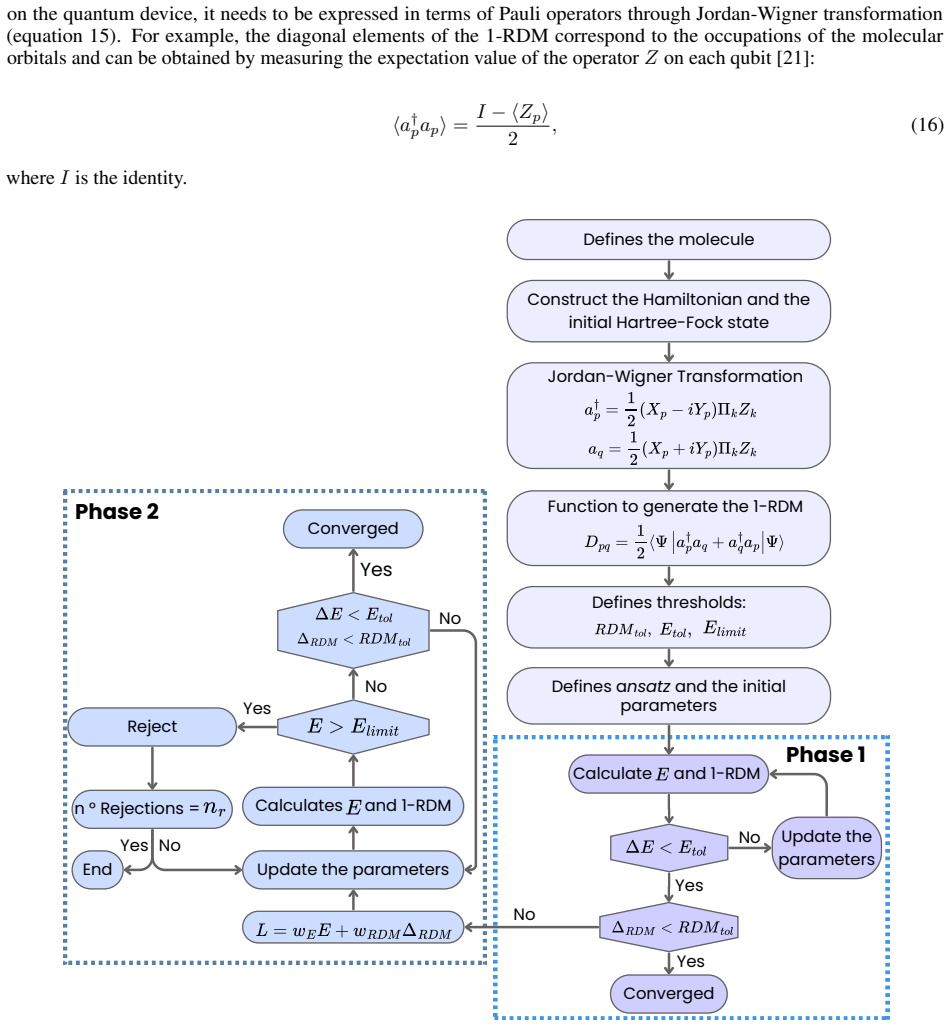
The central object is the one-particle reduced density matrix, $D_{pq} = \langle \Psi(\theta) | a_p^\dagger a_q | \Psi(\theta) \rangle$, symmetrized as $\tfrac{1}{2}\langle \Psi | a_p^\dagger a_q + a_q^\dagger a_p | \Psi \rangle$ so that measurements give real values. The mechanism that carries the argument is the two-phase cost function $L = w_E E + w_{\mathrm{RDM}} \Delta_{\mathrm{RDM}}$, with $\Delta_{\mathrm{RDM}}$ defined as the RMSD between consecutive 1-RDMs; this penalty converts the classical electronic-structure convergence criterion of a stable density matrix into a term the variational optimizer must minimize while the energy-rejection rule keeps the energy from degrading. The active-space 1-RDM from VQE is merged with the Hartree-Fock 1-RDM for frozen orbitals, which is what lets the method report full-molecule densities, dipole moments, and charges from a small quantum circuit.
What would settle it
Run the same two-phase protocol with the $\Delta_{\mathrm{RDM}}$ penalty weight set to zero, or with a penalty on an unrelated observable, keeping the Phase 2 step count, learning rate, and energy-rejection threshold identical; if the reported improvements in dipole moments and GateFabric energies persist, the 1-RDM penalty itself is not what causes them.
Extended reading notes
Core claim
The paper's central claim is that optimizing the 1-RDM alongside the energy, rather than relying on energy minimization alone, improves the accuracy of both energies and density-derived molecular properties in VQE. The algorithm runs ordinary energy minimization in Phase 1, then switches to the cost function $L = w_E E + w_{\mathrm{RDM}} \Delta_{\mathrm{RDM}}$, where $\Delta_{\mathrm{RDM}}$ is the RMSD between the 1-RDMs of consecutive iterations, with a rule that rejects parameter updates that worsen the energy beyond a set limit. Tests on CH5+ show that with k-UpCCGSD in an active space (4,4), Phase 2 shrinks the reported errors in dipole moments, electron density topology, electrostatic potential, and Mulliken charges even though the energy barely moves. With GateFabric in active space (2,2), where ordinary VQE misses the CISD energy by 0.14–0.26 Hartree, the two-phase procedure reduces the error to about $10^{-8}$ Hartree. The authors take this as evidence that energy is not a sufficient convergence criterion and that simultaneous 1-RDM optimization is an effective strategy for variational quantum algorithms.
Load-bearing premise
The load-bearing premise is that stopping the 1-RDM from changing between iterations is the same as making it more accurate; the paper does not measure the 1-RDM against an external reference during training or compare Phase 2 with a control that keeps optimizing the energy alone for the same number of extra steps.
Editorial extensions
If this is right
- For ansätze whose energies are already close to a high-level reference, the 1-RDM penalty does not move the energy much but can substantially improve density-derived properties.
- For ansätze with large energy errors, the same Phase 2 penalty can rescue the energy itself, reducing errors by several orders of magnitude.
- Energy convergence alone is an unreliable criterion for wavefunction quality; monitoring the 1-RDM convergence is needed when molecular properties are the goal.
- The approach preserves the standard VQE structure, so it can be added without iterative Hamiltonian reconstruction or full 1-RDM diagonalization.
Reading between the lines
- A control that continues Phase 1 energy minimization for the same number of extra steps, with the same rejection rule but no $\Delta_{\mathrm{RDM}}$ penalty, would separate the penalty's effect from the effect of simply optimizing longer; the GateFabric rescue may depend on that distinction.
- Because $\Delta_{\mathrm{RDM}}$ measures self-consistency rather than distance to the true density matrix, a natural strengthening is to penalize a direct deviation from a reference-density proxy, such as natural-orbital occupancies from a cheaper classical calculation.
- On noisy hardware, $\Delta_{\mathrm{RDM}}$ is a difference of measured expectation values, so its sampling noise will exceed the energy's; noise-aware weight tuning and extra measurement shots for Phase 2 are a practical follow-up.
Editorial analysis
A structured set of objections, weighed in public.
Referee Report
Summary. The paper proposes a two-phase VQE protocol in which, after energy minimization (Phase 1), a penalty term is added to the cost function in Phase 2. The penalty is the RMSD between the 1-RDMs of consecutive iterations (ΔRDM, Eq. 18), yielding L = w_E E + w_RDM ΔRDM (Eq. 19). The method is tested on the CH5+ dissociation profile using the k-UpCCGSD ansatz with active space (4,4) and the GateFabric ansatz with active space (2,2), comparing to CISD references in the same active spaces. The authors report that for k-UpCCGSD the energies barely change (10^-5–10^-7 Hartree) while dipole moments, electron densities, electrostatic potentials, and Mulliken charges improve substantially, and for GateFabric the energy error drops from ~0.14–0.26 Hartree to ~10^-8 Hartree. The central claim is that simultaneous optimization of energy and 1-RDM is an effective strategy for improving both energies and molecular properties in VQE.
Significance. If the causal role of the 1-RDM penalty were established, the approach could be a practical, simple addition to VQE for improving density-derived properties, which are relevant for molecular simulations on near-term quantum hardware. The paper addresses a real limitation of energy-only VQE and the idea of borrowing density convergence criteria from classical electronic structure is intuitive. However, the current evidence does not support the central claim: the penalty term is not validated against any external error measure, no control experiment isolates the effect of the penalty from extra optimization steps and the rejection rule, and the hyperparameters are chosen without sensitivity analysis. Because the central mechanism is plausible but unproven, the paper's significance is conditional on substantial additional numerical experiments.
major comments (4)
- [Sec. 2.4, Eq. (18)] The penalty term ΔRDM is the RMSD between consecutive 1-RDMs, not the distance to a reference density. Reducing ΔRDM only indicates that successive iterates become similar; it does not imply that the 1-RDM is closer to the exact or CISD 1-RDM. In fact, an optimization that converges to a wrong local minimum will have small ΔRDM but large error. The manuscript nowhere compares ΔRDM to an external error measure, such as ||D - D_CISD||, either during training or at the end of optimization. The statement in Sec. 3.1 that 'the RMSD of 1-RDM was reduced, improving the quality of the description of this matrix' is therefore a logical non sequitur and undermines the central claim that the penalty improves 1-RDM fidelity.
- [Sec. 3.2, Table 5] The reported GateFabric improvement (from -39.6578 to -39.9176 in 11–12 Phase 2 steps) is not causally tied to the 1-RDM penalty. Phase 2 differs from Phase 1 in two ways simultaneously: it adds the penalty term to the cost function and it introduces an energy-rejection rule (updates that increase energy beyond E_limit are rejected). No control is reported in which Phase 1 energy minimization is continued for the same number of extra steps with w_RDM = 0, with and without the rejection rule. Given that the penalty term is numerically tiny (ΔRDM ≈ 1.5e-2 versus E ≈ -39.7, so the penalty contributes about 4e-4 of the objective's magnitude), the observed 0.26 Hartree improvement could simply be continued SGD escaping a plateau, aided by the rejection filter, rather than an effect of the density penalty. The authors need to demonstrate that the gradient of the penalty term, not the energy gradient, is responsible for the escape.
- [Sec. 3.1, Tables 1 and 2] For k-UpCCGSD, the energy changes by only 10^-5–10^-7 Hartree between VQE and VQE*, yet property errors improve by orders of magnitude (e.g., the dipole moment error at R = 1.8 Å changes from -4.65e-1 to -7.00e-5 Debye). This pattern is exactly what one would expect if the optimization is moving along near-null directions of the energy landscape, but such motion is not specific to the 1-RDM penalty; additional energy-only steps could produce the same effect. Without a control in which Phase 1 is extended for the same number of iterations, the improvements in molecular properties cannot be attributed to the penalty term. This is a load-bearing gap in the argument.
- [Sec. 2.4, Eq. (19)] The cost function L = w_E E + w_RDM ΔRDM is not a fixed objective because ΔRDM depends on the previous iteration's parameters; the reference density changes at every step. The optimization is therefore a temporal-difference scheme rather than a standard minimization of a static function. The manuscript does not discuss this aspect or its implications for convergence and for the meaning of 'simultaneous optimization of energy and 1-RDM'. Additionally, the hyperparameters (w_E, w_RDM, E_tol, RDM_tol, n_r, E_limit, and the SGD learning rate) are all fixed to hand-picked values with no sensitivity analysis, so the robustness of the reported improvements is unknown.
minor comments (6)
- [Abstract and throughout] There are many typographical issues, including 'ans\"atzes' instead of 'ansätze' and inconsistent spacing in 'VQE *'. The manuscript would benefit from a careful proofread.
- [Sec. 3.1.2] The text refers to 'Figure 5' twice and also to 'Figure 4' with repetitive phrasing; the figure captions and cross-references should be reconciled.
- [Table 1 and Table 5] The 'Steps' column lists two numbers (e.g., '7 (13)') and the caption says the values in parentheses refer to Phase 2, but it is unclear whether the first number is Phase 1 steps and the second is total steps or Phase 2 steps. Please clarify the notation.
- [Sec. 2.5] The sentence 'In the code developed to optimize 1-RDM in the VQE flow, the following threshold condition:' is a fragment; it should be rewritten to introduce the list of parameters properly.
- [References] Reference [31] lists 'MJ Frish' but the correct author is 'M. J. Frisch'.
- [Figure 3] The flowchart is difficult to follow, particularly the decision branches for Phase 1 and Phase 2. A cleaner diagram with labeled paths would improve readability.
Circularity Check
Central claims are externally benchmarked to CISD and not circular; only the reported ΔRDM reduction restates the algorithm's own termination rule.
-
self definitional
[Section 2.4 (Optimization of 1-RDM), Eqs. (18)-(19), and Section 3.2, Table 5.]
"Optimization continues until both the energy and ∆RDM fall below their respective thresholds. ... The 1-RDM generated by VQE presented significant errors, whose ∆RDM was approximately 10−2, while in VQE* this error was reduced to 10−7 (Table 5)."
∆RDM (Eq. 18) is the RMSD between consecutive iterations, and it is exactly the quantity penalized in Eq. 19 and used as the stopping criterion, with 'Etol and RDMtol equal to 1 × 10⁻⁶'. Phase 2 therefore terminates only when ∆RDM < RDMtol, so the reported Phase 2 values (7.20e-7 to 9.90e-7) are guaranteed by the termination rule rather than discovered. Describing this enforced convergence as 'a significant improvement in the description of the 1-RDM' is a restatement of the algorithm's design, not an independent verification of 1-RDM accuracy. This point is minor because the headline energy and molecular-property claims are separately benchmarked against the external CISD reference.
full rationale
The paper's derivation chain is otherwise self-contained. Phase 2 minimizes L = wE E + wRDM ΔRDM (Eq. 19), but the reported energies, dipole moments, electron densities, electrostatic potentials, and Mulliken charges are all computed from the final 1-RDM via standard formulas (Eqs. 6-13) and compared against CISD values from Gaussian 09, an external reference that never enters the cost function. No parameter is fitted to the CISD target: the weights wE = wRDM = 1 and the thresholds are hand-set, and the energy improvements (GateFabric errors dropping to 1e-8 Hartree in Table 5) are measured against CISD, so they do not reduce to the training objective by construction. The inspiration for the ΔRDM penalty is cited to standard classical practice (PySCF, Gaussian), not to the authors' own prior work, and no load-bearing uniqueness theorem is imported. The genuine weaknesses are a missing control that continues Phase 1 energy-only optimization for the same number of extra steps and the tiny magnitude of the penalty relative to the energy term; these are causal-attribution and experimental-design concerns about whether the 1-RDM penalty causes the improvement, not circularity. The only quotable reduction is the ΔRDM convergence claim, which merely restates the RDMtol stopping rule; since it is not load-bearing for the externally benchmarked property results, the overall circularity score is low.
Assumptions & free parameters
free parameters (5)
- wE, wRDM =
1, 1
- Etol, RDMtol =
1e-6
- nr =
10
- Elimit =
E + 1e-4 Hartree
- SGD learning rate =
0.4
assumptions (6)
- standard math The variational principle: the measured expectation value of the Hamiltonian is an upper bound on the exact ground state energy.
- standard math The Jordan-Wigner mapping faithfully represents fermionic creation and annihilation operators as Pauli operators.
- domain assumption Frozen orbitals outside the active space are adequately described by Hartree-Fock, so the merged 1-RDM in Eq. 14 is valid.
- domain assumption CISD in the same active space is a reliable reference for energies and molecular properties.
- domain assumption The active spaces (4,4) and (2,2) capture the chemically relevant correlation of CH5+ in the STO-3G basis.
- domain assumption Stochastic gradient descent with learning rate 0.4 reaches a meaningful optimum for the chosen cost functions.
Cite this review
Pith. "Pith review of Effects of One-particle Reduced Density Matrix Optimization in Variational Quantum Eigensolvers." pith.science (2026). https://pith.science/paper/V5GEU4ZB
@misc{pith2026250707667,
  author       = {Pith},
  title        = {Pith review of: Effects of One-particle Reduced Density Matrix Optimization in Variational Quantum Eigensolvers},
  year         = {2026},
  howpublished = {\url{https://pith.science/paper/V5GEU4ZB}},
  note         = {Machine review of arXiv:2507.07667}
}
read the original abstract
The variational quantum eigensolver (VQE) is a promising method for simulating molecular systems on near-term quantum computers. This approach employs energy estimation; however, other relevant molecular properties can be extracted from the one-particle reduced density matrix (1-RDM) generated by VQE. The accuracy of these properties strongly depends on the reliability and convergence of the 1-RDM, which is not guaranteed by energy-only optimization. Thus, we investigate the effect of optimizing the 1-RDM within VQE to improve the accuracy of both the energy and molecular properties. A two-step algorithm was implemented that optimizes the energy and 1-RDM by incorporating a penalty term in the cost function to enforce the convergence of the 1-RDM. The first step focuses on energy minimization, while in the second step, a weighted penalty is added to the cost function to promote simultaneous improvement of the energy and 1-RDM. This approach was tested and validated for the k-UpCCGSD and GateFabric ans\"atzes with active spaces (4,4) and (2,2), respectively. k-UpCCGSD produces energies close to CISD, so optimizing 1-RDM has little effect on the energy but significantly improves electronic properties such as electron density, dipole moments, and atomic charges. GateFabric initially shows higher energy deviations from CISD, but optimizing 1-RDM substantially improves both the energy accuracy and the quality of 1-RDM. These results demonstrate that simultaneous optimization of energy and 1-RDM is an effective strategy to improve the accuracy of energies and molecular properties in variational quantum algorithms.
Figures


Figures from the paper (4 more)


Reference graph
Works this paper leans on
-
[1]
Hiroshi Nakatsuji and Hiroyuki Nakashima. Free-complement local-schrödinger-equation method for solving the schrödinger equation of atoms and molecules: Basic theories and features. The Journal of Chemical Physics, 142(8), 2015
work page 2015
-
[2]
Introduction to computational chemistry
Frank Jensen. Introduction to computational chemistry. John wiley & sons, 2017
work page 2017
-
[3]
Execution of a quantum algorithm for calculating energies of some quantum mechanical systems
Siddhartha K Chaganti, Amit S Kesari, and Chandra Chowdhury. Execution of a quantum algorithm for calculating energies of some quantum mechanical systems. Chemical Physics, 576:112082, 2024
work page 2024
-
[4]
Elucidating reaction mechanisms on quantum computers
Markus Reiher et al. Elucidating reaction mechanisms on quantum computers. Proceedings of the national academy of sciences, 114(29):7555–7560, 2017
work page 2017
-
[5]
Evaluating the evidence for exponential quantum advantage in ground-state quantum chemistry
Seunghoon Lee et al. Evaluating the evidence for exponential quantum advantage in ground-state quantum chemistry. Nature communications, 14(1):1952, 2023
work page 1952
-
[6]
Spin coupling is all you need: Encoding strong electron correlation on quantum computers
Daniel Marti-Dafcik, Hugh GA Burton, and David P Tew. Spin coupling is all you need: Encoding strong electron correlation on quantum computers. arXiv preprint arXiv:2404.18878, 2024
arXiv 2024
-
[7]
Complete Active Space Iterative Coupled Cluster Theory
Robin Feldmann et al. Complete active space iterative coupled cluster theory. arXiv preprint arXiv:2404.06070, 2024
work page Pith review arXiv 2024
-
[8]
Michael Nofer et al. Quantum computing. Business & Information Systems Engineering, 65(4):361–367, 2023
work page 2023
Show all 69 references
-
[9]
Simulating physics with computers
Richard P Feynman. Simulating physics with computers. In Feynman and computation, pages 467–488. Int J Theor Phys, 1982
1982
-
[10]
A survey of important issues in quantum computing and communica- tions
Zebo Yang, Maede Zolanvari, and Raj Jain. A survey of important issues in quantum computing and communica- tions. IEEE Communications Surveys & Tutorials, 25(2):1059–1094, 2023
2023
-
[11]
Machine learning theory and applications: Hands-on use cases with python on classical and quantum machines
Xavier Vasques. Machine learning theory and applications: Hands-on use cases with python on classical and quantum machines. John Wiley & Sons, 2024
2024
-
[12]
Quantum simulation of exact electron dynamics can be more efficient than classical mean-field methods
Ryan Babbush et al. Quantum simulation of exact electron dynamics can be more efficient than classical mean-field methods. Nature Communications, 14(1):4058, 2023
2023
-
[13]
Quantum computing and chemistry
Jared D Weidman et al. Quantum computing and chemistry. Cell Reports Physical Science, 5(9), 2024
2024
-
[14]
Quantum measurements and the abelian stabilizer problem
A Yu Kitaev. Quantum measurements and the abelian stabilizer problem. arXiv preprint quant-ph/9511026, 1995
1995 arXiv
-
[15]
A survey of nisq era hybrid quantum-classical machine learning research
Gennaro De Luca. A survey of nisq era hybrid quantum-classical machine learning research. Journal of Artificial Intelligence and Technology, 2(1):9–15, 2022
2022
-
[16]
Quantum computing in the nisq era and beyond
John Preskill. Quantum computing in the nisq era and beyond. Quantum, 2:79, 2018
2018
-
[17]
A variational eigenvalue solver on a photonic quantum processor
Alberto Peruzzo et al. A variational eigenvalue solver on a photonic quantum processor. Nature communications, 5(1):4213, 2014
2014
-
[18]
Variational quantum algorithms
Marco Cerezo et al. Variational quantum algorithms. Nature Reviews Physics, 3(9):625–644, 2021
2021
-
[19]
Evaluating variational quantum eigensolver approaches for simplified models of molecular systems: A case study on protocatechuic acid
de Jesus et al. Evaluating variational quantum eigensolver approaches for simplified models of molecular systems: A case study on protocatechuic acid. Molecules, 30(1):119, 2024
2024
-
[20]
Calculating the ground-state energy of benzene under spatial deformations with noisy quantum computing
Wassil Sennane, Jean-Philip Piquemal, and Marko J Ranˇci´c. Calculating the ground-state energy of benzene under spatial deformations with noisy quantum computing. Physical Review A, 107(1):012416, 2023
2023
-
[21]
Hartree-fock on a superconducting qubit quantum computer
GOOGLE AI QUANTUM et al. Hartree-fock on a superconducting qubit quantum computer. Science, 369(6507):1084–1089, 2020
2020
-
[22]
Vqe method: a short survey and recent developments
Dmitry A Fedorov et al. Vqe method: a short survey and recent developments. Materials Theory, 6(1):2, 2022. 17
2022
-
[23]
Quantification of electron correlation for approximate quantum calculations
Shunyue Yuan, Yueqing Chang, and Lucas K Wagner. Quantification of electron correlation for approximate quantum calculations. The Journal of Chemical Physics, 157(19), 2022
2022
-
[24]
Density functional theory transformed into a one-electron reduced-density-matrix functional theory for the capture of static correlation
Daniel Gibney, Jan-Niklas Boyn, and David A Mazziotti. Density functional theory transformed into a one-electron reduced-density-matrix functional theory for the capture of static correlation. The Journal of Physical Chemistry Letters, 13(6):1382–1388, 2022
2022
-
[25]
Modern quantum chemistry: introduction to advanced electronic structure theory
Attila Szabo and Neil S Ostlund. Modern quantum chemistry: introduction to advanced electronic structure theory. Courier Corporation, 1996
1996
-
[26]
The electron density: a fidelity witness for quantum computation
Mårten Skogh et al. The electron density: a fidelity witness for quantum computation. Chemical Science, 15(6):2257–2265, 2024
2024
-
[27]
Correlated reference-assisted variational quantum eigensolver
Nhan Trong Le and Lan Nguyen Tran. Correlated reference-assisted variational quantum eigensolver. The Journal of Physical Chemistry A, 127(24):5222–5230, 2023
2023
-
[28]
Reduced density matrix sampling: Self-consistent embedding and multiscale electronic structure on current generation quantum computers
Jules Tilly et al. Reduced density matrix sampling: Self-consistent embedding and multiscale electronic structure on current generation quantum computers. Physical Review Research, 3(3):033230, 2021
2021
-
[29]
Efficient energy measurement of chemical systems via one-particle re- duced density matrix: A nof-vqe approach for optimized sampling
Juan Felipe Huan Lew-Yee and Mario Piris. Efficient energy measurement of chemical systems via one-particle re- duced density matrix: A nof-vqe approach for optimized sampling. Journal of Chemical Theory and Computation, 21(5):2402–2413, 2025
2025
-
[30]
Pyscf: the python- based simulations of chemistry framework
Qiming Sun, Timothy C Berkelbach, Nick S Blunt, George H Booth, Sheng Guo, et al. Pyscf: the python- based simulations of chemistry framework. Wiley Interdisciplinary Reviews: Computational Molecular Science, 8(1):e1340, 2018
2018
-
[31]
Gaussian 09, revision a
MJ Frish et al. Gaussian 09, revision a. 02. Gaussian Inc, Wallingford CT, 2009
2009
-
[32]
The variational quantum eigensolver: a review of methods and best practices
Jules Tilly et al. The variational quantum eigensolver: a review of methods and best practices. Physics Reports, 986:1–128, 2022
2022
-
[33]
Quantum chemistry in the age of quantum computing.Chemical reviews, 119(19):10856–10915, 2019
Yudong Cao et al. Quantum chemistry in the age of quantum computing.Chemical reviews, 119(19):10856–10915, 2019
2019
-
[34]
A comparison of the bravyi–kitaev and jordan–wigner transformations for the quantum simulation of quantum chemistry
Andrew Tranter et al. A comparison of the bravyi–kitaev and jordan–wigner transformations for the quantum simulation of quantum chemistry. Journal of chemical theory and computation, 14(11):5617–5630, 2018
2018
-
[35]
Quantum computational chemistry
Sam McArdle et al. Quantum computational chemistry. Reviews of Modern Physics, 92(1):015003, 2020
2020
-
[36]
Strategies for quantum computing molecular energies using the unitary coupled cluster ansatz
Jonathan Romero et al. Strategies for quantum computing molecular energies using the unitary coupled cluster ansatz. Quantum Science and Technology, 4(1):014008, 2018
2018
-
[37]
Generalized unitary coupled cluster wave functions for quantum computation
Joonho Lee et al. Generalized unitary coupled cluster wave functions for quantum computation. Journal of chemical theory and computation, 15(1):311–324, 2018
2018
-
[38]
Local, expressive, quantum-number-preserving vqe ansätze for fermionic systems
Gian-Luca R Anselmetti et al. Local, expressive, quantum-number-preserving vqe ansätze for fermionic systems. New Journal of Physics, 23(11):113010, 2021
2021
-
[39]
Universal quantum circuits for quantum chemistry
Juan Miguel Arrazola et al. Universal quantum circuits for quantum chemistry. Quantum, 6:742, 2022
2022
-
[41]
Post-hartree-fock methods: configuration interaction, many-body perturbation theory, coupled-cluster theory
Jacob Townsend, Justin K Kirkland, and Konstantinos D V ogiatzis. Post-hartree-fock methods: configuration interaction, many-body perturbation theory, coupled-cluster theory. In Mathematical Physics in Theoretical Chemistry, pages 63–117. Elsevier, 2019
2019
-
[42]
Toward a quantum computing formulation of the electron nuclear dynamics method via fukutome unitary representation
Juan C Domínguez, Ismael de Farias, and Jorge A Morales. Toward a quantum computing formulation of the electron nuclear dynamics method via fukutome unitary representation. arXiv preprint arXiv:2411.17657, 2024
2024 arXiv
-
[43]
Molecular electrostatic potential anal- ysis: A powerful tool to interpret and predict chemical reactivity
Cherumuttathu H Suresh, Geetha S Remya, and Puthannur K Anjalikrishna. Molecular electrostatic potential anal- ysis: A powerful tool to interpret and predict chemical reactivity. Wiley Interdisciplinary Reviews: Computational Molecular Science, 12(5):e1601, 2022
2022
-
[44]
Molecular electron density theory: a modern view of reactivity in organic chemistry
Luis R Domingo. Molecular electron density theory: a modern view of reactivity in organic chemistry. Molecules, 21(10):1319, 2016
2016
-
[45]
Electrostatic potential topology for probing molecular structure, bonding and reactivity
Shridhar R Gadre, Cherumuttathu H Suresh, and Neetha Mohan. Electrostatic potential topology for probing molecular structure, bonding and reactivity. Molecules, 26(11):3289, 2021
2021
-
[46]
Introduction to qtaim and beyond
Fernando Cortés-Guzmán, Juan I Rodríguez, and James SM Anderson. Introduction to qtaim and beyond. In Advances in Quantum Chemical Topology Beyond QTAIM, pages 1–19. Elsevier, 2023. 18
2023
-
[47]
Molecular electrostatic potentials: significance and applications
Peter Politzer and Jane S Murray. Molecular electrostatic potentials: significance and applications. Chemical reactivity in confined systems: theory, modelling and applications, pages 113–134, 2021
2021
-
[48]
A viewpoint on population analyses
Ernest R Davidson and Aurora E Clark. A viewpoint on population analyses. International journal of quantum chemistry, 122(8):e26860, 2022
2022
-
[49]
Casscf with extremely large active spaces using the adaptive sampling configuration interaction method
Daniel S Levine, Diptarka Hait, Norm M Tubman, Susi Lehtola, K Birgitta Whaley, and Martin Head-Gordon. Casscf with extremely large active spaces using the adaptive sampling configuration interaction method. Journal of chemical theory and computation, 16(4):2340–2354, 2020
2020
-
[50]
Resource-efficient chemistry on quantum computers with the variational quantum eigensolver and the double unitary coupled-cluster approach
Mekena Metcalf, Nicholas P Bauman, Karol Kowalski, and Wibe A De Jong. Resource-efficient chemistry on quantum computers with the variational quantum eigensolver and the double unitary coupled-cluster approach. Journal of chemical theory and computation, 16(10):6165–6175, 2020
2020
-
[51]
Automated construction of molecular active spaces from atomic valence orbitals
Elvira R Sayfutyarova, Qiming Sun, Garnet Kin-Lic Chan, and Gerald Knizia. Automated construction of molecular active spaces from atomic valence orbitals. Journal of chemical theory and computation, 13(9):4063– 4078, 2017
2017
-
[52]
Quantifying coherence with principal diagonal elements of density matrix
Manis Hazra and Debabrata Goswami. Quantifying coherence with principal diagonal elements of density matrix. APL Quantum, 1(3), 2024
2024
-
[53]
General formulation of quantum information
IBM QUANTUM. General formulation of quantum information. https://learning.quantum. ibm.com/course/general-formulation-of-quantum-information/density-matrices# reduced-states-and-the-partial-trace , 2024. Acesso em: 21 jun. 2025
2024
-
[54]
Quantum information and quantum noise
Gabriel T Landi. Quantum information and quantum noise. en. graduate course in Quantum Information and Quantum noise, 2018
2018
-
[55]
Root mean square error (rmse) or mean absolute error (mae)?–arguments against avoiding rmse in the literature
Tianfeng Chai and Roland R Draxler. Root mean square error (rmse) or mean absolute error (mae)?–arguments against avoiding rmse in the literature. Geoscientific model development, 7(3):1247–1250, 2014
2014
-
[56]
Overlap properties of chemical bonds in generic systems including unusual bonding situations
Renaldo T MOURA JR et al. Overlap properties of chemical bonds in generic systems including unusual bonding situations. Journal of Molecular Modeling, 26(11):301, 2020
2020
-
[57]
Nature of the chemical bond in protonated methane
Felipe P Fleming, André GH Barbosa, and Pierre M Esteves. Nature of the chemical bond in protonated methane. The Journal of Physical Chemistry A, 110(43):11903–11905, 2006
2006
-
[58]
From kekulé’s tetravalent methane to five-, six-, and seven-coordinate protonated methanes
George A Olah and Golam Rasul. From kekulé’s tetravalent methane to five-, six-, and seven-coordinate protonated methanes. Accounts of chemical research, 30(6):245–250, 1997
1997
-
[59]
Chemistry of star-forming regions
Eric Herbst. Chemistry of star-forming regions. The Journal of Physical Chemistry A, 109(18):4017–4029, 2005
2005
-
[60]
The ion chemistry of interstellar clouds
David Smith. The ion chemistry of interstellar clouds. Chemical reviews, 92(7):1473–1485, 1992
1992
-
[61]
CH + 5 stability and mass spectrometry
George M Kramer. CH + 5 stability and mass spectrometry. Science, 286(5442):1051–1051, 1999
1999
-
[62]
Molecular electronic-structure theory
Trygve Helgaker, Poul Jorgensen, and Jeppe Olsen. Molecular electronic-structure theory. John Wiley & Sons, 2013
2013
-
[63]
Self-consistent molecular-orbital methods
Warren J Hehre, Robert F Stewart, and John A Pople. Self-consistent molecular-orbital methods. i. use of gaussian expansions of slater-type atomic orbitals. The Journal of Chemical Physics, 51(6):2657–2664, 1969
1969
-
[64]
Schleyer, J Stephen Binkley, and John A Pople
John B Collins, Paul von R. Schleyer, J Stephen Binkley, and John A Pople. Self-consistent molecular orbital methods. xvii. geometries and binding energies of second-row molecules. a comparison of three basis sets. The Journal of Chemical Physics, 64(12):5142–5151, 1976
1976
-
[65]
Essentials of computational chemistry: theories and models
Christopher J Cramer. Essentials of computational chemistry: theories and models. John Wiley & Sons, 2013
2013
-
[66]
Pennylane: Automatic differentiation of hybrid quantum-classical computations
Ville Bergholm, Josh Izaac, Maria Schuld, Christian Gogolin, Shahnawaz Ahmed, Vishnu Ajith, M Sohaib Alam, Guillermo Alonso-Linaje, B AkashNarayanan, Ali Asadi, et al. Pennylane: Automatic differentiation of hybrid quantum-classical computations. arXiv preprint arXiv:1811.04968, 2018
2018 arXiv
-
[67]
Entanglement-variational hardware-efficient ansatz for eigensolvers
Xin Wang et al. Entanglement-variational hardware-efficient ansatz for eigensolvers. Physical Review Applied, 21(3):034059, 2024
2024
-
[68]
Critic2: A program for real-space analysis of quantum chemical interactions in solids
Alberto Otero-De-La-Roza, Erin R Johnson, and Víctor Luaña. Critic2: A program for real-space analysis of quantum chemical interactions in solids. Computer Physics Communications, 185(3):1007–1018, 2014
2014
-
[69]
An efficient method for calculating atomic charges of peptides and proteins from electronic populations
Young Kee Kang and Harold A Scheraga. An efficient method for calculating atomic charges of peptides and proteins from electronic populations. The Journal of Physical Chemistry B, 112(17):5470–5478, 2008
2008
-
[70]
Atomic orbitals in molecules: general electronegativity and improvement of mulliken population analysis
Haigang Lu, Dadi Dai, Pin Yang, and Lemin Li. Atomic orbitals in molecules: general electronegativity and improvement of mulliken population analysis. Physical Chemistry Chemical Physics, 8(3):340–346, 2006. 19 Supplementary Materials 1.38 Å1.33 Å 1.57 Å 1.77 Å 2.00 Å Figure S...
2006
Reviewed August 6, 2026 · model on record in the stance chip above.
Discussion (0). Sign in to comment.