REVIEW 4 major objections 3 minor 75 references
Bayesian Analysis of the $^{86}$Sr$(\alpha, \alpha)$ Reaction to Constrain the $^{86}$Sr$(\alpha, n)$ Cross Section at Astrophysical Energies
T0 review · 4 major / 3 minor · reviewed 2026-08-05 · deepseek-v4-flash
Pith's one-line read This paper claims that three elastic-scattering measurements of 86Sr(α,α), analyzed with a Bayesian optical-model fit, constrain the 86Sr(α,n)89Zr cross section at 6.2 MeV to about 50% uncertainty.
desk verdict New 86Sr(α,α) data and a careful Bayesian OMP analysis give a real but conditional ~50% uncertainty on the 86Sr(α,n) cross section; the quote needs a caveat because the imaginary-potential energy dependence is prior-driven, and the paper's own cross-section test shifts the median by 2x. read the letter →
The pith
A machine-rendered reading of the paper's core claim, the machinery that carries it, and where it could break.
The reading
What carries the argument
The load-bearing object is a six-parameter alpha optical model potential: a real Woods-Saxon volume term plus a purely imaginary volume term, with Coulomb radius fixed and energy dependence only in the depths. The real depth falls linearly with energy; the imaginary depth is tried in two forms, linear and Fermi, each handled as its own model. A Bayesian posterior over all potential, normalization, scatter, and beam-energy parameters is sampled with dynamic nested sampling, with a hand-tuned constraint c = V r^1.6 to select phase-shift ambiguity families near a standard starting potential. The posterior samples are then fed into a Hauser-Feshbach statistical-model calculation at 6.2 MeV, and
What would settle it
A direct 86Sr(α,n)89Zr measurement at Eα≈6.2 MeV with total uncertainty below about 20%, or an elastic-scattering measurement at a lower energy (say 8–10 MeV) that shifts the fitted imaginary tail. If the direct cross section falls outside the paper's 68% band (roughly 0.14–0.39 μb after combining linear and Fermi results) or the tail strength changes with the new data, the claim that elastic data alone constrain the cross section to 50% fails.
Extended reading notes
Core claim
The paper's core discovery is that a single, moderate-precision elastic-scattering measurement at three beam energies can reduce the uncertainty of a low-energy (α,n) cross section to about a factor of 1.5 in the upward direction. The authors perform a fully Bayesian analysis of the 86Sr(α,α) data with a six-parameter volume-absorption Woods-Saxon optical model, leaving the overall normalization and additional scatter as free parameters, restricting the discrete phase-shift ambiguity with a V r^1.6 constraint, and treating linear and Fermi forms of the imaginary-depth energy dependence as two separate models. Propagating correlated posterior samples through Hauser-Feshbach calculations gives
Load-bearing premise
The whole 50% band depends on the assumed way the absorbing part of the nuclear force grows with energy; the elastic data themselves do not constrain that energy dependence, so the posterior reflects the prior assumptions about it.
Editorial extensions
If this is right
- A roughly 50%-constrained 86Sr(α,n)89Zr cross section at 6.2 MeV replaces the order-of-magnitude spread among optical models in weak r-process network calculations for this nucleus.
- Elastic scattering data can serve as a practical surrogate for direct (α,n) measurements when the Bayesian model accounts for normalization and parameter correlations.
- Future elastic-scattering campaigns should target the imaginary potential at r > 10 fm, since that tail determines the astrophysical cross section.
- Direct (α,n) data are best used to update optical-model parameters coherently rather than by simple rescaling or model selection; a few high-energy points alone can actually increase low-energy uncertainty if the potential is not updated simultaneously.
- The two energy-dependence models give very different imaginary depths yet overlapping cross sections, so the predictive quantity is the joint parameter space, not any single optical-model parameter.
Reading between the lines
- The 50% number is a posterior conditioned on the assumed energy dependence of the imaginary well; a different but equally plausible energy dependence could move the median, so the result is best read as a constraint within this optical-model family rather than a model-free cross-section measurement.
- A direct test would be to apply the same Bayesian pipeline to existing elastic-scattering data on neighboring isotopes near N≈50; if the >10 fm imaginary tail correlates with their measured (α,n) cross sections, the proposed mechanism generalizes across the weak r-process region.
- The paper's tail-strength diagnostic suggests a simplified reaction-rate prescription: instead of comparing full optical potentials, rate libraries could tabulate the imaginary tail strength at a fixed radius (say 12 fm) and propagate its uncertainty, making uncertainty quantification cheaper than full posterior recalculation.
- Because the linear and Fermi models disagree by a factor of about 4 in imaginary depth yet give overlapping cross sections, future measurements that discriminate the imaginary depth at small radii would not necessarily improve astrophysical predictions; only data sensitive to the tail would.
Editorial analysis
A structured set of objections, weighed in public.
Referee Report
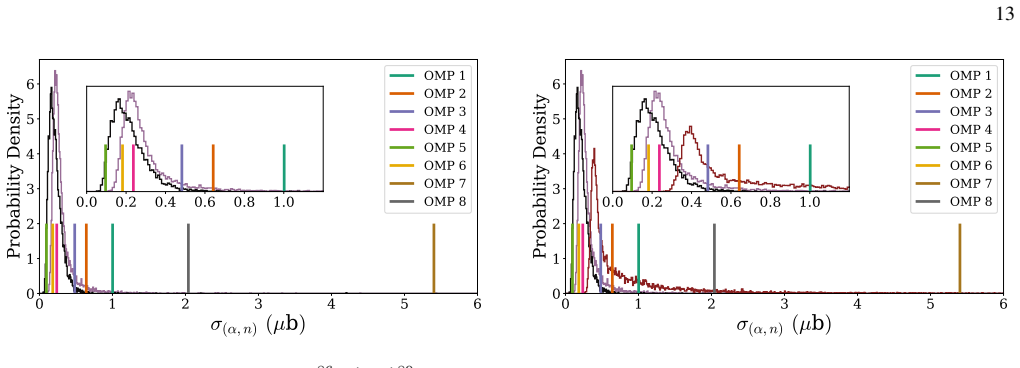
Summary. The paper reports 86Sr(α,α) elastic scattering angular distributions at 12.1, 18.1, and 20.5 MeV and analyzes them with a fully specified Bayesian model using a six-parameter Woods-Saxon alpha optical potential, with either linear or Fermi energy dependence for the imaginary depth. Posterior samples are propagated through TALYS Hauser-Feshbach calculations to predict the 86Sr(α,n)89Zr cross section at Eα = 6.2 MeV. The linear and Fermi models give median cross sections of 0.26 and 0.20 μb with 68% intervals of about +0.13/−0.06 and +0.10/−0.06, respectively. When three measured (α,n) cross sections at 10.18, 10.79, and 11.40 MeV are included, the linear-model median increases to 0.51 μb and the upper uncertainty grows to a factor of about 2.6. The authors conclude that the elastic scattering data constrain the low-energy (α,n) cross section to roughly 50%.
Significance. The methodological contribution is valuable: the forward model, priors, likelihoods, and sampling procedure are explicit; the bespoke optical-model code is checked against ECIS97 to 3%; and the posterior is propagated through Hauser-Feshbach calculations with parameter correlations preserved. If the 50% constraint were robust, it would be a useful step for weak r-process nucleosynthesis calculations. However, the manuscript itself states that the imaginary-potential energy dependence, which carries the extrapolation to 6.2 MeV, is not constrained by the data, and the cross-section data test in Sec. IV C shifts the central value by a factor of about two. The significance is therefore conditional on the assumed energy-dependence priors and the single-energy proxy for the reaction-rate uncertainty.
major comments (4)
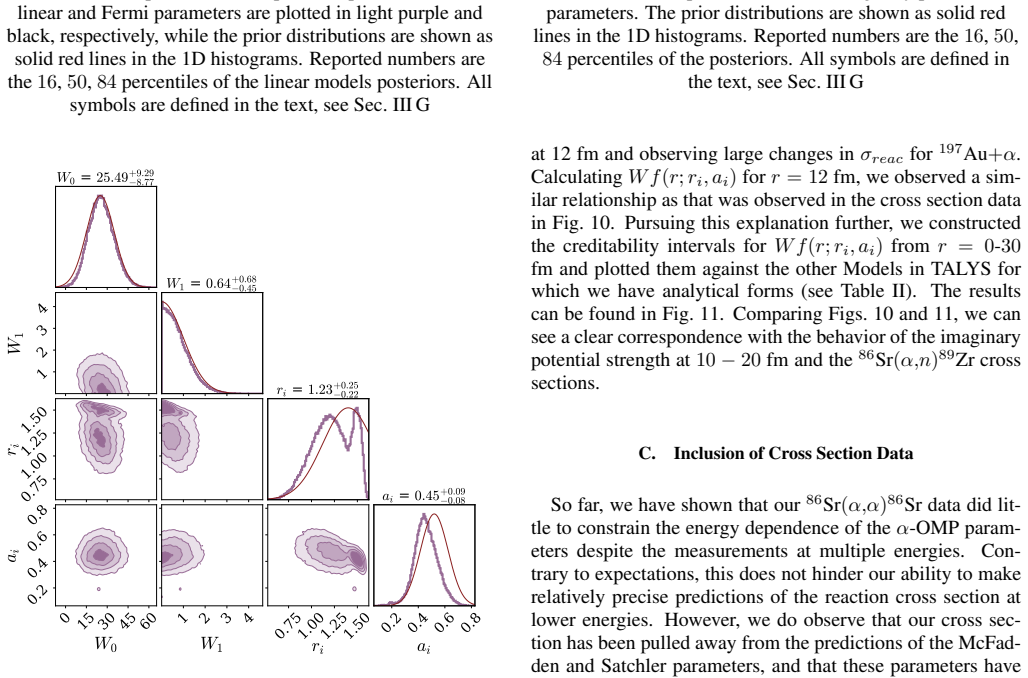
- [Sec. IV A and Table III] The central 50% constraint is not an empirical constraint on the 6.2 MeV cross section. The paper states: 'Our data does not constrain the energy dependence of the imaginary potential at all, and the posterior value is only based on our initial assumptions.' For the linear model, W1 retains its HalfNormal(1) prior (Eq. 18); for the Fermi model, W1 and W2 retain their truncated-normal priors (Eqs. 20-21). Since the extrapolation from 12-21 MeV down to 6.2 MeV is controlled entirely by W(E), the posterior of the (α,n) cross section is largely a projection of prior choices through TALYS. Please provide a prior-sensitivity study (e.g., wider or alternate W1, W2 priors) and/or explicitly reframe the claim as conditional on the assumed energy dependence.
- [Sec. IV C, Eq. 25 and Table III] The internal test with measured (α,n) data undermines the stability implied by the '50%' claim. Adding 86Sr(α,n) cross sections at 10.18, 10.79 and 11.40 MeV shifts the linear-model median at 6.2 MeV from 0.26 to 0.51 μb and increases the 84%/median ratio from 1.5 to 2.57. These data are only 4-5 MeV above the target energy, so a factor-of-two shift demonstrates that the elastic-only posterior is not robust under additional information the same model treats as relevant. The paper calls this 'tension'; the authors should either reconcile this tension or substantially soften the headline statement.
- [Sec. III F] The discrete-ambiguity restriction c = V r^1.6 with a hand-tuned range (printed as '380 < c < 270 MeV·fm^n', presumably 270 < c < 380) is an additional assumption that confines the posterior to the McFadden-Satchler family. The choice n=1.6 and the c-range are motivated by mode separation, but they directly affect the real-potential depth and hence the low-energy cross-section prediction. Please quantify the sensitivity of the 6.2 MeV cross-section posterior to the choice of n and to the c-range boundaries.
- [Sec. III and Sec. V] The paper assumes 'that the variation at this single data point will be indicative of the overall reaction rate uncertainty' and states it made no attempt to calculate the reaction rate. Because the rate integrand (Eq. 7) receives contributions from a range of energies around the 5.9 MeV c.m. peak, a 68% interval at a single laboratory energy is not automatically a 50% reaction-rate uncertainty. Either compute the rate uncertainty from the posterior samples or explicitly limit the claim to the cross section at 6.2 MeV.
minor comments (3)
- [Sec. III F] The inequality '380 < c < 270 MeV·fm^n' contains no allowed values; it should presumably be '270 < c < 380 MeV·fm^n'.
- [Sec. III B, Sec. V, abstract] Typographical issues: 'Boeltzmann' should be 'Boltzmann', 'creditability' should be 'credibility', and 'constraint' appears where 'constrain' is meant.
- [Figs. 2-4] Only linear-model credibility bands are shown, with the Fermi-model fits described as 'seemingly identical.' A quantitative comparison or a supplementary figure would aid reproducibility.
Circularity Check
No significant circularity: the 6.2 MeV cross-section is a genuine extrapolation, but its claimed precision is partly prior-driven and should be read as conditional on unconstrained imaginary-potential energy-dependence assumptions.
full rationale
The paper does not use the 86Sr(α,n) cross section at 6.2 MeV in its main likelihood; instead, it fits elastic-scattering angular distributions at 12.08, 18.10, and 20.53 MeV, propagates the posterior through TALYS, and reports the resulting 6.2 MeV (α,n) cross-section posterior. The target quantity is therefore not an input to the fit, so the central prediction is not circular by construction. The strongest caveat is the paper's own admission in Sec. IV A: 'Our data does not constrain the energy dependence of the imaginary potential at all, and the posterior value is only based on our initial assumptions.' This means the 6.2 MeV cross-section uncertainty is partly a projection of the W1/W2 priors rather than a pure data constraint. That is a real limitation and a prior-sensitivity risk, but it is not a circular reduction: the cross-section posterior is a nonlinear Hauser-Feshbach function of all optical-model parameters, not an identity with any fitted quantity. The paper also provides a genuine cross-check in Sec. IV C: when measured (α,n) cross sections from Ref. [63] are added, the 6.2 MeV median shifts from 0.26 to 0.51 μb and the uncertainty grows to about a factor of 2.57, showing that the prediction is falsifiable and not statistically forced by the elastic-scattering fit. The self-citation to Ref. [49] for the discrete-ambiguity constraint is a methodological borrowing, not a load-bearing appeal to an unverified uniqueness theorem. The discrete-ambiguity constraint is transparently described, albeit with an apparent typo in the printed inequality ('380 < c < 270'), and it restricts the posterior to the McFadden-Satchler family, but this is a stated modeling choice, not a circular use of the target cross section. Overall, the paper's central claim is independent content: it is an extrapolation with identifiable assumptions, and its own cross-section-data test reveals tension rather than agreement by construction. The main weakness is correctness/robustness risk, not circularity; hence the low circularity score.
Assumptions & free parameters
free parameters (6)
- Discrete-ambiguity exponent n =
1.6
- Real-depth energy slope V1 =
HalfNormal(1) prior; posterior shifted to lower values
- Linear imaginary-depth energy slope W1 =
HalfNormal(1) prior; posterior identical to prior
- Fermi imaginary inflection energy W1 =
Truncated normal N(10, 0.5); posterior identical to prior
- Fermi imaginary width W2 =
Truncated normal N(2.0, 0.5); posterior identical to prior
- Prior means for depths and geometry (V0 = 185 MeV, W0 = 25 MeV, r = 1.4 fm, a = 0.52 fm, ri = 1.4 fm, ai = 0.52 fm) =
McFadden-Satchler values with 20-40% spreads
assumptions (6)
- domain assumption The α-nucleus interaction is a Woods-Saxon volume potential with a volume-only imaginary term and fixed Coulomb radius 1.3 fm (Eq. 2)
- domain assumption The real depth falls linearly with energy and the imaginary depth is either linear or Fermi in energy (Eqs. 4-6)
- domain assumption Hauser-Feshbach statistical model with TALYS 2.0 defaults and BSFG level density describes 86Sr(α,n)89Zr
- ad hoc to paper The posterior may be restricted to the discrete-ambiguity family nearest McFadden-Satchler via c = V r^1.6 with a hand-set range
- ad hoc to paper Uncertainty at the single energy Eα = 6.2 MeV is indicative of the overall reaction-rate uncertainty at about 2 GK
- domain assumption For the cross-section-data extension, σ(α,n) ≈ 0.93 σreac with 10% uncertainty at 10.18-11.40 MeV
Cite this review
Pith. "Pith review of Bayesian Analysis of the $^{86}$Sr$(\alpha, \alpha)$ Reaction to Constrain the $^{86}$Sr$(\alpha, n)$ Cross Section at Astrophysical Energies." pith.science (2026). https://pith.science/paper/V5TVMSQW
@misc{pith2026250905461,
  author       = {Pith},
  title        = {Pith review of: Bayesian Analysis of the $^86$Sr$(\alpha, \alpha)$ Reaction to Constrain the $^86$Sr$(\alpha, n)$ Cross Section at Astrophysical Energies},
  year         = {2026},
  howpublished = {\url{https://pith.science/paper/V5TVMSQW}},
  note         = {Machine review of arXiv:2509.05461}
}
abstract
The Alpha Optical Model Potential (\aomp \!) is a phenomenological approach used to describe elastic scattering where multiple reaction channels are open. It is one of the most critical inputs for the calculation of thermonuclear reaction rates in explosive stellar environments, but uncertainties within the $\alpha$-OMP lead to imprecise predictions hindering comparisons between calculations and observations. In order to improve the precision of the $\alpha$-OMP, additional nuclear physics data are required. In this paper, a measurement of the $^{86}$Sr($\alpha$, $\alpha$) elastic scattering cross section at multiple energies is reported. A local optical potential is constructed via a fully Bayesian analysis of the elastic scattering data. The resulting uncertainties on the low energy cross sections relevant to nuclear astrophysics are then calculated and shown to be on the order of $50 \%$.
Figures


Figures from the paper (7 more)




Reference graph
Works this paper leans on
-
[1]
We treat the data from each energy as having an un- known normalization and additional statistical uncer- tainty
-
[2]
We constrain the posterior modes that arise due the dis- crete ambiguity via Eq. (22)
-
[3]
Our potential priors are centered around the values of McFadden and Satchler [33]
-
[4]
Two separate models are constructed and fit that assume either a linear or Fermi energy dependence for the imag- inary depth. Priors: Eα;k ∼ N(Ecal;k, σ2 stat;k +σ 2 sys;k) 1 The relationship between the real radius and depth is often referred to as the “continuous ambiguity”, but is nothing more than run-of-the-mill pa- rameter correlation. V0 ∼ N(185,[0...
-
[5]
Frebel, Annual Review of Nuclear and Particle Science68, 237–269 (2018)
A. Frebel, Annual Review of Nuclear and Particle Science68, 237–269 (2018)
work page 2018
-
[6]
C. J. Horowitz, A. Arcones, B. C ˆot´e, I. Dillmann, W. Nazarewicz, I. U. Roederer, H. Schatz, A. Aprahamian, D. Atanasov, A. Bauswein, T. C. Beers, J. Bliss, M. Brodeur, 15 J. A. Clark, A. Frebel, F. Foucart, C. J. Hansen, O. Just, A. Kankainen, G. C. McLaughlin, J. M. Kelly, S. N. Liddick, D. M. Lee, J. Lippuner, D. Martin, J. Mendoza-Temis, B. D. Metzg...
work page 2019
-
[7]
A. Psaltis, M. Jacobi, F. Montes, A. Arcones, C. J. Hansen, and H. Schatz, The Astrophysical Journal966, 11 (2024)
work page 2024
-
[8]
S. E. Woosley and R. D. Hoffman, The Astrophysical Journal 395, 202 (1992)
work page 1992
Show all 75 references
-
[9]
R. D. Hoffman, S. E. Woosley, and Y . Qian, The Astrophysical Journal482, 951–962 (1997)
1997
- [10]
-
[11]
Hauser and H
W. Hauser and H. Feshbach, Phys. Rev.87, 366 (1952)
1952
-
[12]
Mohr, Phys
P. Mohr, Phys. Rev. C94, 035801 (2016)
2016
-
[13]
Pereira and F
J. Pereira and F. Montes, Phys. Rev. C93, 034611 (2016)
2016
-
[14]
Bliss, A
J. Bliss, A. Arcones, F. Montes, and J. Pereira, Phys. Rev. C 101, 055807 (2020)
2020
-
[15]
Psaltis, A
A. Psaltis, A. Arcones, F. Montes, P. Mohr, C. J. Hansen, M. Ja- cobi, and H. Schatz, ApJ935, 27 (2022), arXiv:2204.07136 [astro-ph.HE]
2022 arXiv
-
[16]
P. E. Hodgson,The nucleon optical model(World Scientific, 1994)
1994
-
[17]
G. G. Kiss, T. N. Szegedi, P. Mohr, M. Jacobi, G. Gy ¨urky, R. Husz ´ank, and A. Arcones, ApJ908, 202 (2021), arXiv:2009.13169 [nucl-ex]
2021 arXiv
-
[18]
T. N. Szegedi, G. G. Kiss, P. Mohr, A. Psaltis, M. Jacobi, G. G. Barnaf¨oldi, T. Sz¨ucs, G. Gy¨urky, and A. Arcones, Phys. Rev. C 104, 035804 (2021)
2021
-
[19]
W. J. Ong, M. L. Avila, P. Mohr, K. E. Rehm, D. Santiago- Gonzalez, J. Chen, C. R. Hoffman, Z. Meisel, F. Montes, and J. Pereira, Phys. Rev. C105, 055803 (2022)
2022
-
[20]
Foug `eres, M
C. Foug `eres, M. L. Avila, H. Jayatissa, D. Santiago-Gonzalez, K. Brandenburg, Z. Meisel, P. Mohr, F. Montes, C. M ¨uller- Gatermann, D. Neto, W. J. Ong, J. Pereira, K. E. Rehm, T. L. Tang, I. A. Tolstukhin, L. Varriano, G. Wilson, and J. Wu, Phys. Rev. C109, 065805 (2024), a...
2024 arXiv
-
[21]
Foug `eres, M
C. Foug `eres, M. L. Avila, A. Psaltis, M. Anastasiou, S. Bae, L. Balliet, K. Bhatt, L. Dienis, H. Jayatissa, V . Karayonchev, P. Mohr, F. Montes, D. Neto, F. de Oliveira Santos, W. J. Ong, K. E. Rehm, W. Reviol, D. Santiago-Gonzalez, N. Sen- sharma, R. S. Sidhu, and I. A. Tol...
2025 arXiv
-
[22]
Williams, C
M. Williams, C. Angus, A. M. Laird, B. Davids, C. A. Diget, A. Fernandez, E. J. Williams, A. N. Andreyev, H. Asch, A. A. Avaa, G. Bartram, S. Chakraborty, I. Dillmann, K. Directo, D. T. Doherty, E. Geerlof, C. J. Griffin, A. Grimes, G. Hack- man, J. Henderson, K. Hudson, D. Hu...
2025
-
[23]
P. Mohr, T. Rauscher, H. Oberhummer, Z. M ´at´e, Z. F ¨ul¨op, E. Somorjai, M. Jaeger, and G. Staudt, Phys. Rev. C55, 1523 (1997)
1997
-
[24]
Somorjai, Z
E. Somorjai, Z. F ¨ul¨op, A. Z. Kiss, C. E. Rolfs, H. P. Trautvet- ter, U. Greife, M. Junker, S. Goriely, M. Arnould, M. Rayet, T. Rauscher, and H. Oberhummer, A&A333, 1112 (1998)
1998
-
[25]
F ¨ul¨op, G
Z. F ¨ul¨op, G. Gy ¨urky, Z. M ´at´e, E. Somorjai, L. Zolnai, D. Galaviz, M. Babilon, P. Mohr, A. Zilges, T. Rauscher, H. Oberhummer, and G. Staudt, Phys. Rev. C64, 065805 (2001)
2001
-
[26]
W. Rapp, I. Dillmann, F. K ¨appeler, U. Giesen, H. Klein, T. Rauscher, D. Hentschel, and S. Hilpp, Phys. Rev. C78, 025804 (2008)
2008
-
[27]
Palumbo, W
A. Palumbo, W. P. Tan, J. G ¨orres, A. Best, M. Couder, R. Crowter, R. J. deBoer, S. Falahat, P. J. LeBlanc, H. Y . Lee, S. O’Brien, E. Strandberg, M. Wiescher, J. P. Greene, Z. F¨ul¨op, G. G. Kiss, E. Somorjai, N. ¨Ozkan, G. Efe, and R. T. G ¨uray, Phys. Rev. C85, 035808 (2012)
2012
-
[28]
Mesytec,MSI-8-PT, Mesytec, Putzbrunn, Germany (2023)
2023
-
[29]
ORTEC,V785 - V785N 32/16 Channel Peak Sensing ADC Se- ries, ORTEC, Viareggio, Italy (2021)
2021
-
[30]
Ritt and A
S. Ritt and A. P., in10 th Real Time Conference Proceeding (1997)
1997
-
[31]
J. B. MARION, Rev. Mod. Phys.38, 660 (1966)
1966
-
[32]
Ajzenberg-Selove, Nuclear Physics A523, 1 (1991)
F. Ajzenberg-Selove, Nuclear Physics A523, 1 (1991)
1991
-
[33]
Acf-metals/tucson,az/carbon foils,
“Acf-metals/tucson,az/carbon foils,”
-
[34]
Marshall, SciPost Phys
C. Marshall, SciPost Phys. Codebases , 37 (2024)
2024
-
[35]
Wojdyr, Journal of Applied Crystallography43, 1126 (2010)
M. Wojdyr, Journal of Applied Crystallography43, 1126 (2010)
2010
-
[36]
P. Mohr, Z. F ¨ul¨op, G. Gy ¨urky, G. Kiss, T. Sz ¨ucs, A. Arcones, M. Jacobi, and A. Psaltis, Atomic Data and Nuclear Data Ta- bles142, 101453 (2021)
2021
-
[37]
McFadden and G
L. McFadden and G. Satchler, Nuclear Physics84, 177 (1966)
1966
-
[38]
Avrigeanu, P
V . Avrigeanu, P. E. Hodgson, and M. Avrigeanu, Phys. Rev. C 49, 2136 (1994)
1994
-
[39]
Avrigeanu, M
V . Avrigeanu, M. Avrigeanu, and C. M˘an˘ailescu, Phys. Rev. C 90, 044612 (2014)
2014
-
[40]
Nolte, H
M. Nolte, H. Machner, and J. Bojowald, Phys. Rev. C36, 1312 (1987)
1987
-
[41]
Demetriou, C
P. Demetriou, C. Grama, and S. Goriely, Nuclear Physics A 707, 253 (2002)
2002
-
[42]
N. N. Le and N. Q. Hung, Phys. Rev. C105, 014602 (2022)
2022
-
[43]
Varner, W
R. Varner, W. Thompson, T. McAbee, E. Ludwig, and T. Clegg, Physics Reports201, 57 (1991)
1991
-
[44]
Liang, X.-H
C.-T. Liang, X.-H. Li, and C.-H. Cai, Journal of Physics G: Nuclear and Particle Physics36, 085104 (2009)
2009
-
[45]
Koning, S
A. Koning, S. Hilaire, and S. Goriely, The European Physical Journal A59(2023), 10.1140/epja/s10050-023-01034-3
2023 doi
-
[46]
Hamad, K
G. Hamad, K. Brandenburg, Z. Meisel, C. R. Brune, D. E. Carter, D. C. Ingram, Y . Jones-Alberty, T. N. Massey, M. Sax- ena, D. Soltesz, S. K. Subedi, and A. V . V oinov, Phys. Rev. C 106, 025804 (2022)
2022
-
[47]
Levkovskiet al., Inter-Vesi, Moscow, USSR (1991)
V . Levkovskiet al., Inter-Vesi, Moscow, USSR (1991)
1991
-
[48]
J. R. Newton, C. Iliadis, A. E. Champagne, A. Coc, Y . Parpot- tas, and C. Ugalde, Phys. Rev. C75, 045801 (2007)
2007
-
[49]
Rauscher, Phys
T. Rauscher, Phys. Rev. C81, 045807 (2010)
2010
-
[50]
C. D. Pruitt, J. E. Escher, and R. Rahman, Phys. Rev. C107, 014602 (2023)
2023
-
[51]
A. E. Lovell and F. M. Nunes, Phys. Rev. C97, 064612 (2018)
2018
-
[52]
Marshall, P
C. Marshall, P. Morfouace, N. de S ´er´eville, and R. Longland, Phys. Rev. C102, 024609 (2020)
2020
-
[53]
Marshall, K
C. Marshall, K. Setoodehnia, G. C. Cinquegrana, J. H. Kelly, F. Portillo Chaves, A. Karakas, and R. Longland, Phys. Rev. C 107, 035806 (2023)
2023
-
[54]
Odell, C
D. Odell, C. R. Brune, and D. R. Phillips, Phys. Rev. C105, 014625 (2022)
2022
-
[55]
S Sivia and J
D. S Sivia and J. Skilling,Data Analysis A Bayesian Tutorial (2006)
2006
-
[56]
R. S. de Souza, S. R. Boston, A. Coc, and C. Iliadis, Phys. Rev. C99, 014619 (2019)
2019
-
[57]
R. S. de Souza, C. Iliadis, and A. Coc, The Astrophysical Jour- nal872, 75 (2019). 16
2019
-
[58]
R. S. de Souza, T. H. Kiat, A. Coc, and C. Iliadis, The Astro- physical Journal894, 134 (2020)
2020
-
[59]
Drisko, G
R. Drisko, G. Satchler, and R. Bassel, Physics Letters5, 347 (1963)
1963
-
[60]
Skilling, inAmerican Institute of Physics Conference Se- ries, American Institute of Physics Conference Series, V ol
J. Skilling, inAmerican Institute of Physics Conference Se- ries, American Institute of Physics Conference Series, V ol. 735, edited by R. Fischer, R. Preuss, and U. V . Toussaint (2004) pp. 395–405
2004
-
[61]
Skilling, Bayesian Anal.1, 833 (2006)
J. Skilling, Bayesian Anal.1, 833 (2006)
2006
-
[62]
J. S. Speagle, MNRAS493, 3132 (2020), arXiv:1904.02180 [astro-ph.IM]
2020 arXiv
-
[63]
joshspeagle/dynesty: v2.1.4,
S. Koposov, J. Speagle, K. Barbary, G. Ashton, E. Bennett, J. Buchner, C. Scheffler, B. Cook, C. Talbot, J. Guillochon, P. Cubillos, A. A. Ramos, M. Dartiailh, Ilya, E. Tollerud, D. Lang, B. Johnson, jtmendel, E. Higson, T. Vandal, T. Daylan, R. Angus, patelR, P. Cargile, P. S...
2024
-
[64]
Higson, W
E. Higson, W. Handley, M. Hobson, and A. Lasenby, Statistics and Computing29, 891 (2019), arXiv:1704.03459 [stat.CO]
2019 arXiv
-
[65]
Raynal,Optical-model and coupled-channel calculations in nuclear physics(IAEA., 1971) pp
J. Raynal,Optical-model and coupled-channel calculations in nuclear physics(IAEA., 1971) pp. 281–322
1971
-
[66]
Iliadis, R
C. Iliadis, R. Longland, A. Coc, F. X. Timmes, and A. E. Cham- pagne, Journal of Physics G: Nuclear and Particle Physics42, 034007 (2015)
2015
-
[67]
Oprea, T
A. Oprea, T. Glodariu, D. Filipescu, I. Gheorghe, A. Mitu, M. Boromiza, D. Bucurescu, C. Costache, I. Cata-Danil, N. Florea, D. G. Ghita, A. Ionescu, N. Marginean, R. Marginean, C. Mihai, R. Mihai, A. Negret, C. Nita, A. Ola- cel, S. Pascu, C. Sotty, R. Suvaila, L. Stan, L. St...
2017
-
[68]
Igo, Phys
G. Igo, Phys. Rev. Lett.1, 72 (1958)
1958
-
[69]
Igo, Phys
G. Igo, Phys. Rev.115, 1665 (1959)
1959
-
[70]
D. F. Jackson and C. G. Morgan, Phys. Rev.175, 1402 (1968)
1968
-
[71]
P. Mohr, Z. F ¨ul¨op, G. Gy¨urky, G. G. Kiss, and T. Sz ¨ucs, Phys. Rev. Lett.124, 252701 (2020)
2020
-
[72]
Frahn and R
W. Frahn and R. Venter, Annals of Physics24, 243 (1963)
1963
-
[73]
Melkanoff, T
M. Melkanoff, T. Sawada, and J. Raynal,Nuclear Optical Model Calculations(Numerical Analysis Research, Depart- ment of Engineering, Department of Physics, University of Cal- ifornia, Los Angeles, and the Department of Physics, University of Southern California, 1965)
1965
-
[74]
Gy ¨urky, P
G. Gy ¨urky, P. Mohr, A. Angyal, Z. Hal ´asz, G. G. Kiss, Z. M´atyus, T. N. Szegedi, T. Sz¨ucs, and Z. F ¨ul¨op, Phys. Rev. C 107, 025803 (2023)
2023
-
[75]
A. L. Sallaska, C. Iliadis, A. E. Champange, S. Goriely, S. Starrfield, and F. X. Timmes, ApJS207, 18 (2013), arXiv:1304.7811 [astro-ph.SR]
2013 arXiv
Reviewed August 5, 2026 · model on record in the stance chip above.
Discussion (0). Sign in to comment.