REVIEW 4 major objections 5 minor 30 references
Quantum magnetoresistive (hc/2e)/m periodic oscillations in a superconducting ring
T0 review · 4 major / 5 minor · reviewed 2026-08-14 · deepseek-v4-flash
Pith's one-line read Under high current and low temperature, an aluminum ring develops magnetoresistance oscillations with periods as short as (hc/2e)/20, which the authors attribute to multiple Andreev reflections multiplying the effective Cooper-pair charge.
desk verdict Claims of (hc/2e)/m oscillations up to m=20 rest on Fourier peaks that are indistinguishable from harmonics of an anharmonic Phi0-periodic signal; the paper lacks the baseline needed to support its central claim. read the letter →
The pith
A machine-rendered reading of the paper's core claim, the machinery that carries it, and where it could break.
The reading
What carries the argument
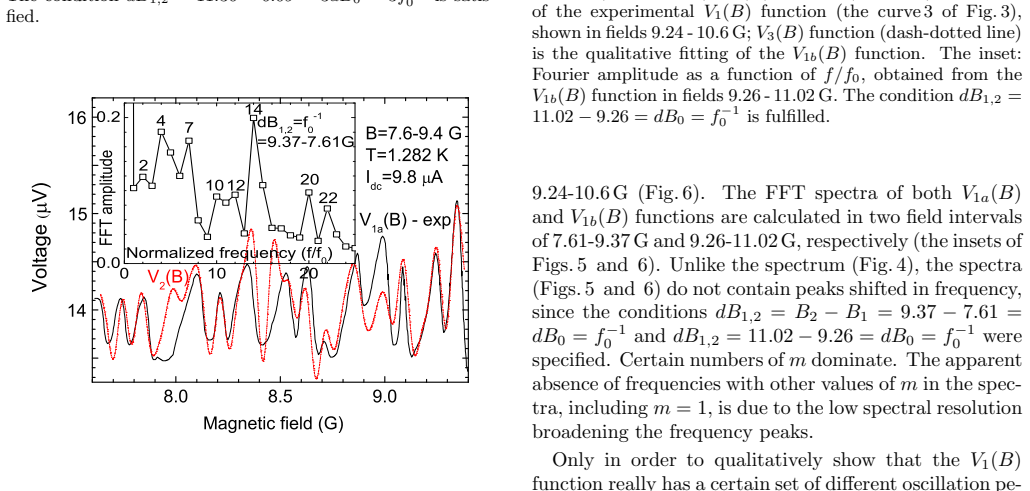
The load-bearing object is the Fourier spectrum of the magnetoresistance waveform. By choosing field windows with $dB_{1,2}=j\,dB_0$ ($j=1$ or 3), the authors force spectral-window artifacts to land at known multiples of the fundamental frequency, so peaks at $f_m=m f_0$ can be assigned to physical periods $\Phi_0/m$. The explanation they attach to those peaks is multiple Andreev reflection (MAR): in a diffusive normal region between superconducting banks, a quasiparticle bounces back and forth as electron and hole, and after $n$ reflections it transfers $m=n/2$ (or $n/2-1$) Cooper pairs, making the supercurrent respond as if the pair charge were $2em$. The mechanism is supported by the condition that the inelastic scattering length $2\lambda_Q$ is much larger than the normal-region length $2\xi(T)$, so many reflections can occur before decoherence.
What would settle it
Compute the FFT of a model waveform that is strictly periodic with period $\Phi_0$ but has the sharply peaked shape of the low-current Little-Parks curve, using the same field window and sampling; if the model produces comparable peaks at $m f_0$ for $m=2\text{–}20$, then the data do not require fractional periods.
Extended reading notes
Core claim
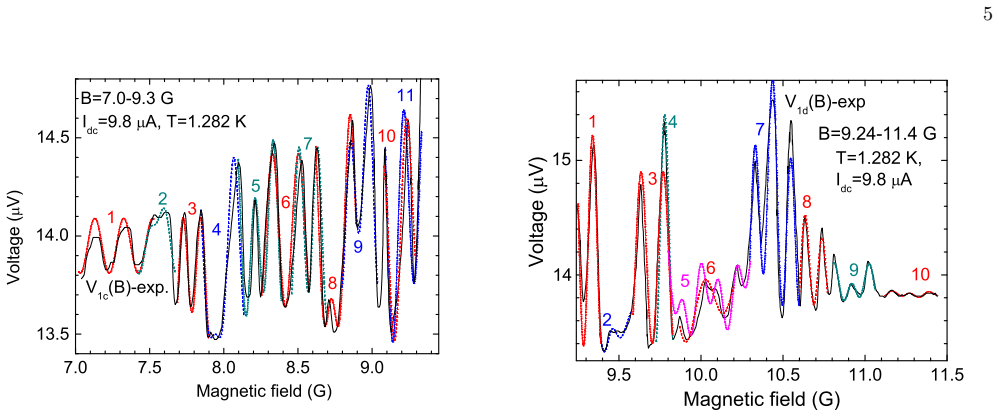
The central claim is that the measured $V(B)$ curves, recorded at $I_{dc}=7.5\text{–}11\,\mu\text{A}$ and $T\approx1.28\,\text{K}$ in fields of order 6–12 G, contain real oscillations at the fractional flux periods $\Phi_0/m$ for $m=2$ up to 20. The evidence is a set of FFT spectra taken over field windows deliberately chosen to be exact integer multiples of the fundamental period $dB_0=\Phi_0/S_{\rm eff}$; in those spectra the peaks at $f_m=m f_0$ have amplitudes close to that of $f_0$. The authors fit short segments of the waveform with sums of sines at these frequencies and conclude that the ring is not merely showing a distorted $\Phi_0$-periodic response, but a superposition of fractional-period components. They state that this is the first study of such $(hc/2e)/m$ oscillations and that the period reduction by a factor $m$ can be interpreted as an effective Cooper-pair charge $e^*=2em$ generated by multiple Andreev reflections in a diffusive phase-slip center or SNS junction.
Load-bearing premise
The central claim depends on treating the evenly spaced peaks in the frequency plot as independent physical oscillation periods; if those peaks are only the ordinary overtones of a non-sinusoidal $\Phi_0$-periodic signal, the fractional-period interpretation collapses.
Editorial extensions
If this is right
- If the fractional periods are real, flux quantization in a driven superconducting ring is not locked to a single quantum $\Phi_0$; the circulating current can respond at periods $\Phi_0/2$ through $\Phi_0/20$.
- The same field-window FFT procedure can be applied to other rings, cylinders, or SNS devices to search for $(hc/2e)/m$ oscillations in different materials and geometries.
- The MAR mechanism implies the dominant values of $m$ and the maximum $m$ should depend on bias current and temperature through the ratio $2\Delta(T,B)/(eV)$, making the oscillation spectrum electrically tunable.
- The observation in a homogeneous ring, with no intentional weak links, means a current-induced phase-slip center or SNS junction can act as the Andreev reflector, extending MAR physics from fabricated junctions to self-formed nonequilibrium regions.
Reading between the lines
- A decisive check the paper does not perform is to compare the measured harmonic amplitudes against those of a distorted but strictly $\Phi_0$-periodic waveform; if a realistic saw-toothed Little-Parks curve reproduces the near-flat spectrum up to $m=20$, the fractional-period interpretation would not be required.
- If MAR is the cause, the distribution of $m$ values should shift systematically when $I_{dc}$ changes, because the instantaneous voltage sets the number of allowed reflections; measuring the same ring across a current ramp would give a direct test.
- The claimed effect sits naturally next to the earlier $hc/4e$ observations in hybrid systems; a useful extension would be to look for temperature and field boundaries where the system switches between pure $\Phi_0$, $\Phi_0/2$, and higher-order periodicity.
Signed reviews
Editorial analysis
A structured set of objections, weighed in public.
Referee Report
Summary. The paper reports magnetoresistance measurements on a superconducting aluminum mesoscopic ring at currents above the critical current and temperatures slightly below Tc. The authors claim to observe quantum oscillations with periods Phi0/m for integer m up to 20, which they interpret as an effective superconducting charge e* = 2em produced by multiple Andreev reflection in a phase-slip center or SNS junction. Evidence for the fractional periods is drawn from Fourier spectra of short field intervals (Figs. 4–6) and from piecewise sinusoidal fits of the form s + p sum_k a_k sin(2π m f0 B + phi_k) (Figs. 5–8). The paper also reports hysteresis in V(B) and two dissipative states, but the central novelty is the fractional-period claim.
Significance. If the fractional-period claim were correct, this would be a striking nonequilibrium effect, extending Little-Parks physics to strongly driven superconducting rings and implying a Cooper-pair charge enhanced by a factor m. The data and analysis, however, do not rule out the standard interpretation that the spectral peaks at multiples of f0 are ordinary higher harmonics of a non-sinusoidal waveform with the fundamental Little-Parks period. The paper provides no quantitative baseline for the harmonic content, no statistical tests, and the fitting is explicitly qualitative. The claim as presented is therefore not supported, and the effective-charge interpretation is definitional rather than a consequence of an independently established fractional-period observation.
major comments (4)
- [Results and Discussion, Fourier analysis (Figs. 4–6)] The FFT spectra shown in Figs. 4–6 contain peaks at frequencies f_m = m f0. For any periodic signal with fundamental period dB0 = 1/f0, a nonsinusoidal waveform produces exactly such peaks as its Fourier harmonics. The statement in the text that "Inharmonicity of oscillations is believed to make a very low contribution to the higher harmonics" is an assertion with no quantitative support. No control is presented for the harmonic content generated by the measured nonlinear V(I) characteristic, and no estimate is given for spectral leakage from the finite field window, which has length dB0 or 3 dB0. Without such a baseline, these spectra cannot distinguish independent (hc/2e)/m oscillations from the ordinary Fourier decomposition of a distorted Phi0-periodic oscillation. This ambiguity is load-bearing because the entire fractional-period claim rests on these peaks.
- [Results and Discussion, fitting of V1(B) (Figs. 5–8)] The fitting functions V2, V3, Fk, and Ak are sums of sinusoids at frequencies m f0 with phases restricted to multiples of pi/4. The text states explicitly that "The fitting has nothing to do with the theoretical description of the V1(B) oscillations." Since any periodic function can be approximated by such a finite Fourier sum, the visual agreement between the fits and the data does not provide additional evidence for independent fractional periods. No residuals, goodness-of-fit metrics, or comparison against the null model of a single anharmonic Phi0-periodic waveform are presented. The conclusion that the data "really has a certain set of different oscillation periods" is therefore not justified by the fitting procedure.
- [Results and Discussion, experimental data (Figs. 2–3)] The central evidence is based on one measured curve (V1, curve 3 of Fig. 3) and a small number of field intervals. Other measurements are described in the text as "not presented here" or "not shown," and no raw traces with error bars, run-to-run statistics, or significance tests are given. Given the harmonic ambiguity, the reproducibility of the claimed peaks is essential. The sparse, hand-picked data presentation does not allow the reader to assess whether the spectral features are robust or merely noise and windowing artifacts.
- [Conclusion, interpretation] The inference from a period Phi0/m to an effective charge e* = 2em is definitional through the fluxoid quantization relation Phi0 = hc/e*. If a true fractional period were established, this inference would follow, but it would not independently confirm the physical mechanism. Because the evidence for the fractional periods is not established (comments above), the central claim of an increased Cooper-pair charge is unsupported. The multiple Andreev reflection mechanism is offered only as a possible cause; no model links the observed set of m values to the MAR process, and the estimate 2Δ/eV ≈ 10 is an order-of-magnitude ratio that does not predict the observed distribution or amplitudes of harmonics.
minor comments (5)
- [Results and Discussion, first paragraph after Fig. 1] The notation dB0 and dB1,2 is introduced without a clear definition of the subscript convention; the authors should define these quantities explicitly at first use to avoid confusion between the fundamental period and the field-window length.
- [Results and Discussion, gap expression] The formula "Δ(T) = 3.07 kTc Δ(0)(1 − T/Tc)^1/2" appears dimensionally inconsistent and is likely a typographical error; the authors should replace it with the standard BCS temperature dependence, for example Δ(T) ≈ 1.76 kTc (1 − T/Tc)^1/2 near Tc.
- [References] Reference [7] contains a typographical error: "John Willey and Sons" should be "John Wiley and Sons."
- [Abstract and Conclusion] The phrase "modified to the sum of harmonic (hc/2e)/m periodic oscillations" is ambiguous; it should clarify whether the fundamental period itself changes or whether additional periodic components appear on top of the Phi0-periodic signal.
- [Fig. 2 caption] The caption of Fig. 2 does not adequately distinguish the curves labeled 1a, 1b, and 2; in particular, the relationship between the inset curves and the main panel should be stated more explicitly.
Circularity Check
The fractional-period claim is the Fourier harmonic series of the Phi0-periodic V(B) waveform renamed as independent Phi0/m oscillations, and the effective-charge interpretation is the defining flux-quantization relation reapplied.
-
renaming known result
[Results and Discussion, Fourier analysis (Figs. 4-6, text after Fig. 4)]
"The contributions of the fundamental frequency and many higher harmonics to the spectrum are close. This indicates the presence of various fractional (Phi0/m = (hc/2e)/m) periods of V1(B) oscillations that are not a consequence of the inharmonicity of the hc/2e oscillations. Inharmonicity of oscillations is believed to make a very low contribution to the higher harmonics of the fundamental frequency f0."
A V(B) signal with the Little-Parks fundamental period dB0 = Phi0/S_eff has, by Fourier's theorem, components exactly at f_m = m f0. The peaks at m f0 are therefore the harmonic decomposition of a Phi0-periodic waveform, not an independent detection of Phi0/m periods. The paper gives no quantitative baseline or control for the assertion that inharmonicity contributes very little; it merely renames the harmonics as fractional periods. The later statement that certain numbers of m dominate is read off the same peaks, so the observation reduces to the Fourier representation of the input waveform.
-
fitted input called prediction
[Results and Discussion, qualitative fitting of V1a/V1b (Figs. 5-6, before Eqs. for V2 and V3)]
"Only in order to qualitatively show that the V1(B) function really has a certain set of different oscillation periods, the different sections of V1(B) were approximated by fitting functions. The fitting has nothing to do with the theoretical description of the V1(B) oscillations. ... The results of the spectra were taken into account (Figs. 5 and 6); therefore, ak are close to the Fourier amplitudes obtained from the spectra."
The fitting functions V2, V3, Fk, Ak are constructed by choosing frequencies m f0 and amplitudes ak taken from the same FFT spectra that are supposed to demonstrate the fractional periods. The fit therefore cannot corroborate the fractional-period interpretation: its success is guaranteed by construction, since it is a sum of sinusoids at exactly the peaks being tested. The text even states the fitting 'has nothing to do with the theoretical description,' confirming that it is not an independent prediction.
1 more flagged steps
-
self definitional
[Conclusion (with Introduction's fluxoid quantization definition)]
"The decrease in the oscillation period by a factor of m can be interpreted as an increase in the effective charge of the Cooper pairs by a factor of m, which occurs as a result of multiple Andreev reflections in the phase slip center or SNS junction formed in the ring."
The flux quantum is defined in the Introduction as Phi* = n(hc/e*) = n Phi0 with e* = 2e. Thus a period Phi0/m is, by that definition, equivalent to e* = 2em; the 'interpretation' adds no independent content. It is a valid translation only if a genuine Phi0/m period has already been established, and that establishment rests on the harmonic-renaming step above. The multiple-Andreev-reflection discussion supplies a speculative mechanism but not an independent measurement of the charge.
full rationale
The paper's central inference chain is: FFT peaks at m f0 imply fractional periods Phi0/m; Phi0/m implies effective charge 2em. The first step is circular in the sense that every non-sinusoidal Phi0-periodic signal has Fourier components exactly at m f0, so the peaks are the harmonic series of the fundamental-period waveform unless a quantitative anharmonicity baseline is provided; the paper asserts rather than demonstrates that baseline. The second step is definitional: flux period and effective charge are tied by the quantization formula Phi0 = hc/e*, so period Phi0/m and charge 2em are the same statement. The piecewise sinusoid fits are not independent evidence because their frequencies and amplitudes are taken from the very spectra they are said to confirm. No load-bearing self-citation chain was found; the MAR discussion cites prior work, including one self-citation, but it is offered as a possible interpretation rather than the proof of the fractional periods. The result therefore reduces, at its core, to renaming harmonic content as fractional periods and then reapplying the flux-quantization definition.
Assumptions & free parameters
free parameters (3)
- Harmonic fitting coefficients for V2, V3, F1-F11, A1-A10 =
Lists in text; e.g., V2 uses m=2,4,7,10,12,14,20,22 with amplitudes 0.08-0.2
- Dominant harmonic index sets per spectral window =
m=2,4,7,10,12,14,20,22 for V1a/V2; m=3,5,7,9,11,13,16,18 for V1b/V3
- Field analysis intervals =
e.g., 7.61-9.37 G, 9.26-11.02 G, 6.09-11.36 G
assumptions (5)
- domain assumption The measured voltage V(B) is dominated by the ring's resistive state; the upper and lower R(T) segments correspond to current wires and ring respectively.
- domain assumption The nonequilibrium diffusion length lambda_Q = 6-9 micrometers and the condition l_in >> l_n hold, enabling many Andreev reflections.
- ad hoc to paper Inharmonicity makes a very low contribution to higher harmonics.
- domain assumption The two dissipative states and their field-sweep dependence are intrinsic to the ring and reproducible.
- standard math Standard Fourier analysis conventions with fictitious frequencies apply; selected field intervals of length dB0 avoid frequency shifts.
invented entities (2)
-
Effective superconducting charge e* = 2em (m-fold Cooper pair charge)
-
Superconducting barrier for hot quasiparticle diffusion at the transition from narrow to wide current wire
Cite this review
Pith. "Pith review of Quantum magnetoresistive (hc/2e)/m periodic oscillations in a superconducting ring." pith.science (2026). https://pith.science/paper/V63TS6RG
@misc{pith2026190804111,
  author       = {Pith},
  title        = {Pith review of: Quantum magnetoresistive (hc/2e)/m periodic oscillations in a superconducting ring},
  year         = {2026},
  howpublished = {\url{https://pith.science/paper/V63TS6RG}},
  note         = {Machine review of arXiv:1908.04111}
}
read the original abstract
It was experimentally found that quantum magnetoresistive hc/2e periodic oscillations of the Little-Parks type in a superconducting mesoscopic ring with decreasing temperature and increasing applied dc current are modified to the sum of harmonic (hc/2e)/m periodic oscillations. Multiple Andreev reflection can be a possible cause of this effect.
Figures


Figures from the paper (2 more)
Reference graph
Works this paper leans on
-
[1]
5 − 11 µ A also have a hysteresis decreasing with increasing Idc
284 K and high currents Idc = 7. 5 − 11 µ A also have a hysteresis decreasing with increasing Idc. In addition, the curves 1a, 1b, and 2 of the Fig. 2 show anomalous negative magnetoresistance in two field intervals: fields close to zero and low fields. Figure 2 shows two of these unusual V (B) functions measured at Idc = 8. 2 µ A and T = 1 . 280 K (curves 1...
-
[2]
W. A. Little and R. D. Parks, Phys. Rev. Lett. 9, 9 (1962)
1962
-
[3]
P. Santhanam, C. P. Umbach, and C. C. Chi, Phys. Rev. B 40, 11392 (1989)
work page 1989
-
[4]
38 µ A and T = 1. 312 K. of a sharp drop in R(T ) occurs at Tch = 1. 403 K and the resistance disappears at Tcn = 1 . 318 K. The supercon- ducting critical temperature Tc = 1. 339 K is determined by the middle of the R(T ) transition. The contribution of the ring, expected from the geometry, to the total resis- tance of the structure is 23 Ω. We assume th...
-
[5]
The structure is a dirty superconductor, since l << ξ 0 (where ξ0 = 1
1 × 10− 16 Ω m2, where ρ is the resistivity of the wire. The structure is a dirty superconductor, since l << ξ 0 (where ξ0 = 1 . 6 µ m is the superconducting coherence length of pure aluminum at T = 0 K). Near Tc for the dirty case [11], ξ(T ) = ξ(0)(1 − T /T c)− 1/2 (where ξ(0) = 0 . 85(ξ0l)1/2 = 0 . 11 µ m). The condition of quasi- one-dimensional super...
-
[6]
The values of f0 found from the period of the Little-Parks type oscillations (the inset of Fig
569 G− 1. The values of f0 found from the period of the Little-Parks type oscillations (the inset of Fig. 2) and the spectrum (Fig. 4) coincide. In addition to f0, the spec- trum contains many higher harmonics of the fundamental frequency f0, defined as fm = mf0 (where m = 2 − 20). Some frequency peaks (Fig. 4) are shifted by 1/3, since the condition dB1,2...
-
[7]
0 - 8. 3 G. The curves 1, 3, 5, 6, 8, 11 (dash-dotted lines) and 2, 4, 7, 9, 10 (dashed lines) are approximations of individua l sections of the V1c(B) function with a set of fitting functions Fk(B). perimental V1(B) function. The prevalence in the spec- tra (the insets of Figs. 5 and 6) of certain frequencies fm = mf0 (where m = 2, 4, 7, 10, 12, 14, 20, 2...
-
[8]
280 K (curves 1a, 1b) and at Idc = 9
2 µ A and T = 1 . 280 K (curves 1a, 1b) and at Idc = 9 . 8 µ A and T = 1 . 282 K (curve 2). The arrows indicate the field sweep direction. The inset shows V (B) function at Idc =
Show all 30 references
-
[9]
24 - 11. 4 G. The curves 1, 3, 5, 7, 9, 10 (dash-dotted lines) and 2, 4, 6, 8 (dashed lines) are approximations of individual se c- tions of the V1d(B) function with a set of fitting functions Ak(B). F2(B) = 14 + 0 . 14sin(2π 7f0B + π/ 4)+ +0. 06sin(2π 14f0B − 3π/ 4); F3(B) = 1...
-
[10]
The maximum oscillation amplitude decreased from 25 µ V to 0 with an increase in the current Idc from 7.5 to 11 µ A
284 K (not presented here). The maximum oscillation amplitude decreased from 25 µ V to 0 with an increase in the current Idc from 7.5 to 11 µ A. Thus, this ampli- tude reached 20 and 2 µ V at currents of 8.2 and 9.8 µ A (Fig. 2), respectively. At currents Idc = 7. 7 − 8. 6 µ A...
-
[11]
26 = dB0 = f − 1 0 is fulfilled
02 − 9. 26 = dB0 = f − 1 0 is fulfilled. 9.24-10.6 G (Fig. 6). The FFT spectra of both V1a(B) and V1b(B) functions are calculated in two field intervals of 7.61-9.37 G and 9.26-11.02 G, respectively (the insets of Figs. 5 and 6). Unlike the spectrum (Fig. 4), the spectra (Figs. ...
-
[12]
We believe that two regions of the NMR are due to several transitions between the diamagnetic and paramagnetic 7 states of wide current wires with a change in the field
282K) ≈ 22 − 26 G was greater than the field at which the NMR disappears ( B = 12 G), since the effect of the large direct current Idc is not taken into account. We believe that two regions of the NMR are due to several transitions between the diamagnetic and paramagnetic 7 stat...
-
[13]
London, Phys
F. London, Phys. Rev. 74, 562 (1948)
1948
-
[14]
D. Y. Vodolazov, and F. M. Peeters, Phys. Rev. B 85, 024508 (2012)
2012
-
[15]
Vloeberghs, V
H. Vloeberghs, V. V. Moshchalkov, C. Van Haesendonck, R. Jonckheere, and Y. Bruynseraede, Phys. Rev. Lett. 69, 1268 (1992)
1992
-
[16]
Zadorozhny and Y
Y. Zadorozhny and Y. Liu, Europhys. Lett. 55, 712 (2001)
2001
-
[17]
V. T. Petrashov, V. N. Antonov, P. Delsing, and Claeson, Phys. Rev. Lett. 70, 347 (1993)
1993
-
[18]
Barone and G
A. Barone and G. Paterno. Physics and Application of the Josephson Effect. John Willey and Sons, New York, 1982
1982
-
[19]
Dubonos, V.I
S.V. Dubonos, V.I. Kuznetsov, I.N. Zhilyaev, A.V. Nikulov, A.A. Firsov, JETP Letters 77, 371 (2003) (original Russian text: S.V. Dubonos, V.I. Kuznetsov, I.N. Zhilyaev, A.V. Nikulov, A.A. Firsov, Pis’ma v Zhurnal Eksperimental’noi i Teoreticheskoi Fiziki 77, 439 (2003)), https...
2003 arXiv
-
[20]
V. I. Kuznetsov, A. A. Firsov, S. V. Dubonos, Phys. Rev. B 77, 094521 (2008), https://doi.org/10.1103/PhysRevB.77.094521
2008 doi
-
[21]
Gershenson and W
M. Gershenson and W. L. McLean, J. Low Temp. Phys. 47, 123 (1982)
1982
-
[22]
V. V. Schmidt, The Physics of Superconductors (Eds. P. Muller, A. Ustinov, Springer-Verlag, Berlin-Heidelberg, 1997)
1997
-
[23]
Tidecks, Current-Induced Nonequilibrium Phenomena in Quasi-One-Dimensional Superconductors , Springer Tracts in Modern Physics, vol
R. Tidecks, Current-Induced Nonequilibrium Phenomena in Quasi-One-Dimensional Superconductors , Springer Tracts in Modern Physics, vol. 121, Springer-Verlag, Berlin-Heidelberg, 1990
1990
-
[24]
V. I. Kuznetsov, A. A. Firsov, Physica C 492, 11 (2013), https://doi.org/10.1016/j.physc.2013.05.003
2013 doi
-
[26]
Octavio, M
M. Octavio, M. Tinkham, G. E. Blonder, and T. M. Klap- wijk, Phys. Rev. B 27, 6739 (1983)
1983
-
[27]
Bardas and D
A. Bardas and D. V. Averin, Phys. Rev. B 56, R8518 (1997)
1997
-
[28]
E. V. Bezuglyi, E. N. Bratus’, V. S. Shumeiko, G. Wendin, and H. Takayanagi, Phys. Rev. B 62, 14439 (2000)
2000
-
[29]
V. I. Kuznetsov, A. A. Firsov, JETP Lett. 104, 709 (2016) (original Russian text: V. I. Kuznetsov, A. A. Firsov, Pis’ma v Zhurnal Eksperimen- tal’noi i Teoreticheskoi Fiziki 104, 721 (2016)), https://doi.org/10.1134/S0021364016220100
2016 doi
-
[30]
V. A. Schweigert and F. M. Peeters, Phys. Rev. B 60, 3084 (1999)
1999
-
[52]
2 K, resistance per square of film thick- ness Rsq = ρ/d = 1
7 Ω at T = 4 . 2 K, resistance per square of film thick- ness Rsq = ρ/d = 1 . 97 Ω, the ratio of resistances at T = 300 K and 4.2 K is equal to R300K/R 4.2K = 1 . 8. The mean free path of quasiparticles l = 10 nm was found from the refined theoretical [10] relation ρl =
Reviewed August 14, 2026 · model on record in the stance chip above.
Discussion (0). Continue with ORCID to comment.