StippleDiffusion: Capacity-Constrained Stippling using Controlled Diffusion
Pith reviewed 2026-05-19 18:35 UTC · model grok-4.3
The pith
A diffusion-based sampler produces capacity-constrained stipples for any target density using a single trained checkpoint.
A machine-rendered reading of the paper's core claim, the machinery that carries it, and where it could break.
Core claim
Restricting diffusion training and inference to the late-stage denoising regime, initializing from a density-weighted rejection sample, and replacing zero-convolution injection with a sigmoid-gated 1x1 projection allows a ControlNet branch on an optimal-transport-grid point-set diffusion baseline to satisfy both a learned local point-distribution prior and a continuous image-defined capacity constraint simultaneously.
What carries the argument
ControlNet branch on an optimal-transport-grid point-set diffusion model, conditioned on target density map and high-resolution image, with late-stage denoising and sigmoid-gated 1x1 projection.
If this is right
- Stippling becomes end-to-end differentiable and can be inserted into larger image-processing or rendering pipelines without custom gradients.
- A single checkpoint replaces the need to re-optimize or retrain for every new density map or point budget.
- Generation cost remains nearly constant as the requested number of points grows, unlike iterative optimizers whose runtime scales with output size.
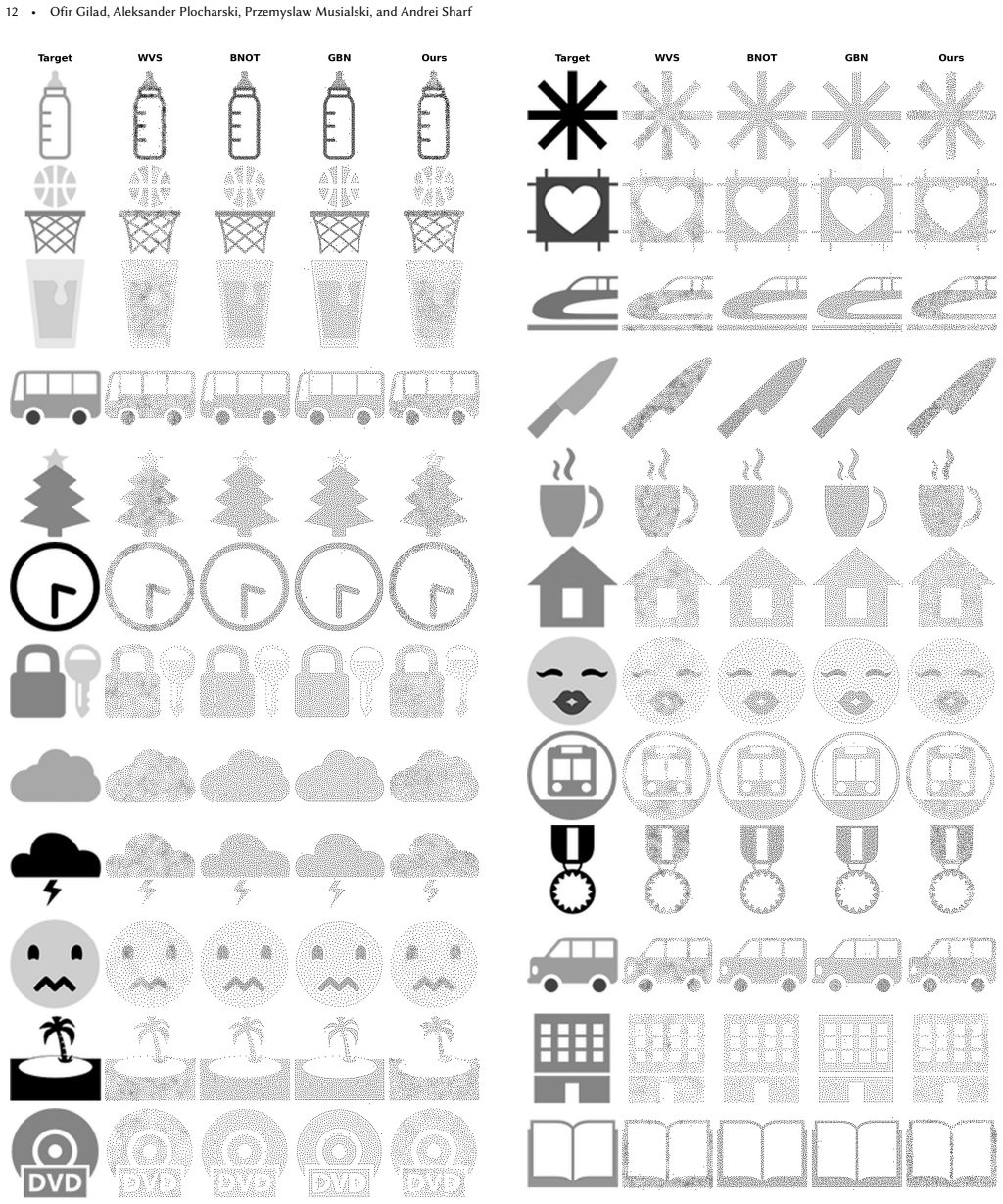
- The same model produces stipples that match per-density baselines on every metric reported for the Icons-50 benchmark.
Where Pith is reading between the lines
- The constant-time scaling could support interactive applications where a user adjusts density on the fly and expects immediate visual feedback.
- Because the model learns a density prior rather than memorizing specific point counts, it may transfer to related tasks such as adaptive sampling in rendering or simulation.
- The late-stage conditioning trick might be reusable for other capacity-constrained point processes where full diffusion from noise is too expensive.
Load-bearing premise
Restricting training and inference to late-stage denoising, initializing from a density-weighted rejection sample, and using a sigmoid-gated projection instead of zero-convolutions is enough to preserve the base model's blue-noise structure under strong density signals.
What would settle it
Generate stipples with the model on a new constant-density target and compare the local spacing statistics against a traditional blue-noise optimizer; visible clustering or loss of uniformity would falsify the claim that the modifications preserve the prior.
Figures


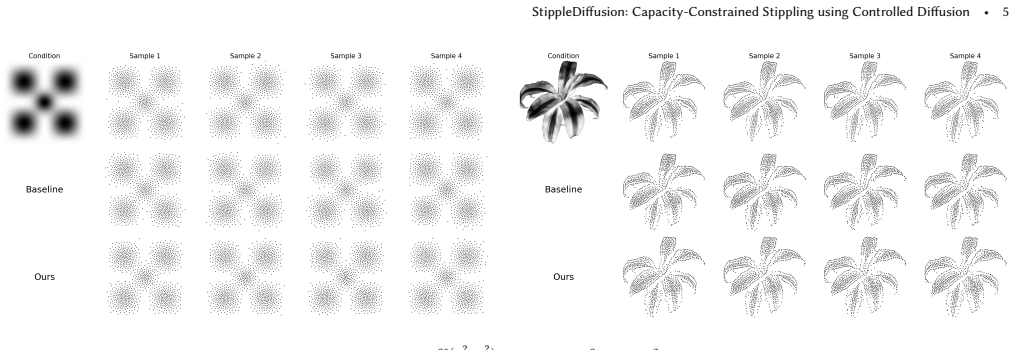


read the original abstract
Stipple patterns, point sets whose local density tracks a target image, are traditionally produced by per-density iterative optimizers, which are slow, non-differentiable, and must be re-run from scratch for each new target. Learned alternatives have so far addressed only unconditional point generation; capacity-constrained, image-conditioned stippling has remained out of reach. We present the first diffusion-based sampler that simultaneously satisfies a learned local point-distribution prior and a continuous, image-defined capacity constraint at inference. The method is a ControlNet branch built on top of an optimal-transport-grid point-set diffusion baseline, conditioned on the target density map and a high-resolution image. Two design choices make the combination tractable: training and inference are restricted to the late-stage denoising regime, initialized from a density-weighted rejection sample, and the standard zero-convolution injection is replaced with a sigmoid-gated 1x1 projection that preserves the base model's blue-noise structure under hard density signals. A single trained checkpoint accepts arbitrary target densities at inference, generalizes to point budgets that were not seen during training, and produces stipples in time nearly independent of the output point count. On the Icons-50 benchmark, our learned sampler reaches parity with per-density-optimized baselines on every reported metric while remaining differentiable end-to-end.
Editorial analysis
A structured set of objections, weighed in public.
Referee Report
Summary. The manuscript introduces StippleDiffusion, a diffusion-based sampler for capacity-constrained stippling. It augments an optimal-transport-grid point-set diffusion baseline with a ControlNet branch conditioned on target density maps and high-resolution images. Training and inference are restricted to the late-stage denoising regime, initialized from a density-weighted rejection sample, and the standard zero-convolution injection is replaced by a sigmoid-gated 1x1 projection. A single checkpoint is claimed to accept arbitrary target densities at inference, generalize to unseen point budgets, run in time nearly independent of output point count, and reach parity with per-density-optimized baselines on the Icons-50 benchmark while remaining end-to-end differentiable.
Significance. If the performance and generalization claims hold, the work would be a notable contribution to learned point-set generation in graphics by delivering the first image-conditioned, capacity-constrained diffusion model for stippling. The combination of a preserved blue-noise prior with hard density constraints and differentiability could enable new end-to-end optimization pipelines. The single-checkpoint generalization across densities and budgets is a potentially high-impact feature if quantitatively verified.
major comments (2)
- [Abstract] Abstract: The assertion that the learned sampler 'reaches parity with per-density-optimized baselines on every reported metric' on Icons-50 supplies no numerical values, error bars, named metrics, or evaluation-protocol details. This absence prevents assessment of whether the parity claim is supported and directly affects the credibility of the generalization and inference-time claims.
- [Method] Method (design choices paragraph): The manuscript states that restricting training/inference to late-stage denoising, using density-weighted rejection initialization, and substituting zero-convolution with a sigmoid-gated 1x1 projection 'preserves the base model's blue-noise structure under hard density signals,' yet reports no ablation studies, spectral analyses, local-capacity-violation rates, or comparisons against alternative conditioning mechanisms. These three choices are load-bearing for the headline claims of generalization to unseen budgets and point-count-independent runtime.
minor comments (1)
- [Abstract] The abstract would be strengthened by naming at least the primary quantitative metrics (e.g., blue-noise energy, capacity error) used for the Icons-50 comparison.
Simulated Author's Rebuttal
We thank the referee for the constructive feedback, which helps clarify our claims and strengthen the justification of key design decisions. We address each major comment below and have made corresponding revisions to the manuscript.
read point-by-point responses
-
Referee: [Abstract] Abstract: The assertion that the learned sampler 'reaches parity with per-density-optimized baselines on every reported metric' on Icons-50 supplies no numerical values, error bars, named metrics, or evaluation-protocol details. This absence prevents assessment of whether the parity claim is supported and directly affects the credibility of the generalization and inference-time claims.
Authors: We agree that the abstract would be strengthened by including concrete numerical support. In the revised manuscript we have updated the abstract to name the primary metrics (density-matching MSE and spectral discrepancy), report the mean values with standard deviations across the Icons-50 set, and briefly reference the evaluation protocol detailed in Section 4.2. These additions directly address the concern about credibility of the generalization and runtime claims. revision: yes
-
Referee: [Method] Method (design choices paragraph): The manuscript states that restricting training/inference to late-stage denoising, using density-weighted rejection initialization, and substituting zero-convolution with a sigmoid-gated 1x1 projection 'preserves the base model's blue-noise structure under hard density signals,' yet reports no ablation studies, spectral analyses, local-capacity-violation rates, or comparisons against alternative conditioning mechanisms. These three choices are load-bearing for the headline claims of generalization to unseen budgets and point-count-independent runtime.
Authors: We acknowledge that explicit validation of these three choices would improve the paper. While the main text explains the motivation for each choice (late-stage restriction for efficiency, rejection initialization to respect capacity, and gated projection to avoid disrupting the learned prior), we have added a dedicated ablation subsection and supplementary figures. These include (i) spectral plots confirming blue-noise preservation, (ii) local capacity-violation statistics, and (iii) direct comparisons against standard zero-convolution injection. The new results support the generalization and runtime claims without altering the core method. revision: yes
Circularity Check
No significant circularity in derivation chain
full rationale
The paper introduces a ControlNet-based adaptation of an existing optimal-transport-grid point-set diffusion model, with specific design choices (late-stage denoising restriction, density-weighted rejection initialization, and sigmoid-gated 1x1 projection) to handle image-conditioned capacity constraints. These are presented as empirical engineering decisions enabling the claimed generalization and inference efficiency, supported by benchmark results on Icons-50 rather than any closed-form derivation. No equations or steps reduce the output distribution or performance metrics to fitted parameters or self-citations by construction; the central claims rest on the novel combination and its empirical validation, which remains independent of the inputs.
Axiom & Free-Parameter Ledger
axioms (1)
- domain assumption The pre-trained optimal-transport-grid point-set diffusion baseline already encodes a suitable blue-noise prior that can be preserved under additional density conditioning.
Lean theorems connected to this paper
-
IndisputableMonolith/Foundation/RealityFromDistinction.leanreality_from_one_distinction unclear?
unclearRelation between the paper passage and the cited Recognition theorem.
Two design choices make the combination tractable: training and inference are restricted to the late-stage denoising regime, initialized from a density-weighted rejection sample, and the standard zero-convolution injection is replaced with a sigmoid-gated 1×1 projection
-
IndisputableMonolith/Cost/FunctionalEquation.leanwashburn_uniqueness_aczel unclear?
unclearRelation between the paper passage and the cited Recognition theorem.
We reinterpret structured point generation through an optimal transport formulation to enable learning of blue-noise-like distributions under constraints
What do these tags mean?
- matches
- The paper's claim is directly supported by a theorem in the formal canon.
- supports
- The theorem supports part of the paper's argument, but the paper may add assumptions or extra steps.
- extends
- The paper goes beyond the formal theorem; the theorem is a base layer rather than the whole result.
- uses
- The paper appears to rely on the theorem as machinery.
- contradicts
- The paper's claim conflicts with a theorem or certificate in the canon.
- unclear
- Pith found a possible connection, but the passage is too broad, indirect, or ambiguous to say the theorem truly supports the claim.
Reference graph
Works this paper leans on
-
[1]
Capacity-constrained point distributions: a variant of Lloyd's method , year =
Balzer, Michael and Schl\". Capacity-constrained point distributions: a variant of Lloyd's method , year =. ACM SIGGRAPH 2009 Papers , articleno =. doi:10.1145/1576246.1531392 , abstract =
-
[2]
Li, Hongwei and Nehab, Diego and Wei, Li-Yi and Sander, Pedro V. and Fu, Chi-Wing , title =. Proceedings of the 2010 ACM SIGGRAPH Symposium on Interactive 3D Graphics and Games , articleno =. 2010 , isbn =. doi:10.1145/1730804.1730985 , abstract =
-
[3]
Secord, Adrian , title =. Proceedings of the 2nd International Symposium on Non-Photorealistic Animation and Rendering , pages =. 2002 , isbn =. doi:10.1145/508530.508537 , abstract =
-
[4]
Ahmed, Abdalla G. M. and Ren, Jing and Wonka, Peter , title =. 2022 , issue_date =. doi:10.1145/3550454.3555519 , journal =
- [5]
-
[6]
Hierarchical Poisson disk sampling distributions , journal =
Mccool, Michael and Fiume, Eugene , year =. Hierarchical Poisson disk sampling distributions , journal =
-
[7]
Floating Points: A Method for Computing Stipple Drawings , volume =
Deussen, Oliver and Hiller, Stefan and Overveld, Cornelius and Strothotte, Thomas , year =. Floating Points: A Method for Computing Stipple Drawings , volume =. Computer Graphics Forum , doi =
-
[8]
Yin Xu and Ligang Liu and Craig Gotsman and Steven J. Gortler , keywords =. Capacity-Constrained Delaunay Triangulation for point distributions , journal =. 2011 , note =. doi:https://doi.org/10.1016/j.cag.2011.03.031 , url =
-
[9]
Variational Blue Noise Sampling , year=
Chen, Zhonggui and Yuan, Zhan and Choi, Yi-King and Liu, Ligang and Wang, Wenping , journal=. Variational Blue Noise Sampling , year=
-
[10]
Computer Graphics Forum , volume =
Schmaltz, Christian and Gwosdek, Pascal and Bruhn, Andrés and Weickert, Joachim , title =. Computer Graphics Forum , volume =. doi:https://doi.org/10.1111/j.1467-8659.2010.01716.x , url =. https://onlinelibrary.wiley.com/doi/pdf/10.1111/j.1467-8659.2010.01716.x , abstract =
-
[11]
Fattal, Raanan , title =. ACM Trans. Graph. , month = jul, articleno =. 2011 , issue_date =. doi:10.1145/2010324.1964943 , abstract =
-
[12]
Journal of Graphics, GPU, and Game Tools , pages=
Accurate spectral analysis of two-dimensional point sets , number=. Journal of Graphics, GPU, and Game Tools , pages=. 2011 , doi=
work page 2011
-
[13]
ACM SIGGRAPH 2019 Posters , articleno =
Ma, Lei and Deng, Hong and Wang, Beibei and Chen, Yanyun and Boubekeur, Tamy , title =. ACM SIGGRAPH 2019 Posters , articleno =. 2019 , isbn =. doi:10.1145/3306214.3338606 , abstract =
-
[14]
IEEE International Conference on Computer Vision (ICCV) , year=
Adding Conditional Control to Text-to-Image Diffusion Models , author=. IEEE International Conference on Computer Vision (ICCV) , year=
-
[15]
Xue, Zhongmin and Wang, Beibei and Ma, Lei , title =. Advances in Computer Graphics: 38th Computer Graphics International Conference, CGI 2021, Virtual Event, September 6–10, 2021, Proceedings , pages =. 2021 , isbn =. doi:10.1007/978-3-030-89029-2_24 , abstract =
-
[16]
Example-Based Sampling with Diffusion Models , author=. 2023 , eprint=
work page 2023
-
[17]
3D Multiphase Heterogeneous Microstructure Generation Using Conditional Latent Diffusion Models , author=. 2025 , eprint=
work page 2025
-
[18]
3D Shape Generation and Completion through Point-Voxel Diffusion , author=. 2021 , eprint=
work page 2021
-
[19]
PC^2 : Projection-Conditioned Point Cloud Diffusion for Single-Image 3D Reconstruction , author=. 2023 , eprint=
work page 2023
-
[20]
Recurrent Diffusion for 3D Point Cloud Generation From a Single Image , year=
Zhou, Yan and Ye, Dewang and Zhang, Huaidong and Xu, Xuemiao and Sun, Huajie and Xu, Yewen and Liu, Xiangyu and Zhou, Yuexia , journal=. Recurrent Diffusion for 3D Point Cloud Generation From a Single Image , year=
-
[21]
GECCO: Geometrically-Conditioned Point Diffusion Models , author=. 2023 , eprint=
work page 2023
-
[22]
Efficient Diffusion Training via Min-SNR Weighting Strategy , doi =
Tiankai, Hang and Gu, Shuyang and Li, Chen and Bao, Jianmin and Chen, Dong and Hu, Han and Geng, Xin and Guo, Baining , year =. Efficient Diffusion Training via Min-SNR Weighting Strategy , doi =
-
[23]
GLIGEN: Open-Set Grounded Text-to-Image Generation , author=. 2023 , eprint=
work page 2023
- [24]
-
[25]
RePaint: Inpainting using Denoising Diffusion Probabilistic Models , author=. 2022 , eprint=
work page 2022
-
[26]
SDEdit: Guided Image Synthesis and Editing with Stochastic Differential Equations , author=. 2022 , eprint=
work page 2022
-
[27]
Cascaded Diffusion Models for High Fidelity Image Generation , author=. 2021 , eprint=
work page 2021
-
[28]
U-Net: Convolutional Networks for Biomedical Image Segmentation , author=. 2015 , eprint=
work page 2015
-
[29]
Sinkhorn Distances: Lightspeed Computation of Optimal Transportation Distances , author=. 2013 , eprint=
work page 2013
-
[30]
ACM Transactions on Graphics , year =
Subr, Kartic and Kautz, Jan , title =. ACM Transactions on Graphics , year =
-
[31]
ACM Transactions on Graphics , year =
Pilleboue, Adrien and Singh, Gurprit and Coeurjolly, David and Kazhdan, Michael and Ostromoukhov, Victor , title =. ACM Transactions on Graphics , year =
- [32]
-
[33]
Floating Points: A Method for Computing Stipple Drawings , journal =
Deussen, Oliver and Hiller, Stefan and. Floating Points: A Method for Computing Stipple Drawings , journal =. 2000 , volume =. doi:10.1111/1467-8659.00396 , publisher =
- [34]
-
[35]
Analysis and synthesis of point distributions based on pair correlation , journal =. 2012 , volume =. doi:10.1145/2366145.2366189 , publisher =
-
[36]
ACM Transactions on Graphics , year =
Qin, Hongxing and Chen, Yi and He, Jinlong and Chen, Baoquan , title =. ACM Transactions on Graphics , year =. doi:10.1145/3072959.3119910 , publisher =
-
[37]
Sliced optimal transport sampling , journal =
Paulin, Lo. Sliced optimal transport sampling , journal =. 2020 , volume =. doi:10.1145/3386569.3392395 , publisher =
-
[38]
Nader, Georges and Guennebaud, Ga. Instant transport maps on. ACM Transactions on Graphics , year =
-
[39]
ACM Transactions on Graphics , year =
Ostromoukhov, Victor and Donohue, Charles and Jodoin, Pierre-Marc , title =. ACM Transactions on Graphics , year =
-
[40]
ACM Transactions on Graphics , year =
Ostromoukhov, Victor , title =. ACM Transactions on Graphics , year =. doi:10.1145/1276377.1276475 , publisher =
-
[41]
Ahmed, Abdalla G. M. and Perrier, H. Low-discrepancy blue noise sampling , journal =. 2016 , volume =. doi:10.1145/2980179.2980218 , publisher =
-
[42]
ACM Transactions on Graphics , year =
Kopf, Johannes and Cohen-Or, Daniel and Deussen, Oliver and Lischinski, Dani , title =. ACM Transactions on Graphics , year =. doi:10.1145/1141911.1141916 , publisher =
-
[43]
Fast tile-based adaptive sampling with user-specified
Wachtel, Florent and Pilleboue, Adrien and Coeurjolly, David and Breeden, Katherine and Singh, Gurprit and Cathelin, Ga. Fast tile-based adaptive sampling with user-specified. ACM Transactions on Graphics , year =. doi:10.1145/2601097.2601107 , publisher =
-
[44]
Du, Qiang and Faber, Vance and Gunzburger, Max , title =. SIAM Review , year =. doi:10.1137/S0036144599352836 , publisher =
-
[45]
Okabe, Atsuyuki and Boots, Barry and Sugihara, Kokichi and Chiu, Sung Nok , title =. 2000 , publisher =
work page 2000
-
[46]
Computer Graphics Forum , volume =
Lagae, Ares and Dutré, Philip , title =. Computer Graphics Forum , volume =. doi:https://doi.org/10.1111/j.1467-8659.2007.01100.x , url =. https://onlinelibrary.wiley.com/doi/pdf/10.1111/j.1467-8659.2007.01100.x , abstract =
-
[47]
Bonneel, Nicolas and van de Panne, Michiel and Paris, Sylvain and Heidrich, Wolfgang , title =. ACM Trans. Graph. , month = dec, pages =. 2011 , issue_date =. doi:10.1145/2070781.2024192 , abstract =
-
[48]
Wei, Li-Yi and Wang, Rui , title =. ACM Trans. Graph. , month = jul, articleno =. 2011 , issue_date =. doi:10.1145/2010324.1964945 , abstract =
-
[49]
Deep Point Correlation Design , journal =
Leimk. Deep Point Correlation Design , journal =. 2019 , volume =
work page 2019
-
[50]
Deep point correlation design , year =
Leimk\". Deep point correlation design , year =. ACM Trans. Graph. , month = nov, articleno =. doi:10.1145/3355089.3356562 , abstract =
discussion (0)
Sign in with ORCID, Apple, or X to comment. Anyone can read and Pith papers without signing in.