Robust Pretty Good Measurement via Hybrid Classical-Quantum Pseudoinverse Approximation and Circuit-Level Realization
Pith reviewed 2026-06-27 06:32 UTC · model grok-4.3
The pith
A threshold-regularized Moore-Penrose pseudoinverse replaces the inverse square root in Pretty Good Measurement to keep it stable for singular or ill-conditioned ensemble operators.
A machine-rendered reading of the paper's core claim, the machinery that carries it, and where it could break.
Core claim
Replacing the inverse square root in the PGM formula with a threshold-regularized Moore-Penrose pseudoinverse produces measurement operators that remain well-defined and physically meaningful across all spectral regimes, including rank-deficient cases. When this preprocessing step is paired with block-encoding-based quantum circuits and oblivious amplitude amplification, the resulting hybrid procedure yields discrimination performance that matches theoretical predictions and remains stable on both synthetic ill-conditioned ensembles and real datasets where conventional PGM fails numerically.
What carries the argument
The threshold-regularized Moore-Penrose pseudoinverse of the ensemble operator, used to construct the PGM measurement operators while preserving support awareness.
If this is right
- Discrimination remains stable on ill-conditioned and degenerate ensembles where standard PGM becomes numerically unstable.
- Measurement operators stay physically meaningful because the framework explicitly incorporates support awareness.
- Circuit-level outputs match theoretical predictions when block encoding and spectral transformations are used.
- Oblivious amplitude amplification raises the success probability of the circuit realization without changing the underlying measurement.
- The same preprocessing works for both synthetic and real datasets.
Where Pith is reading between the lines
- The same regularization technique could be applied to other quantum measurements that involve operator square roots or inverses.
- Hardware experiments on current devices could test whether the hybrid preprocessing overhead remains acceptable when the ensemble is supplied directly from a quantum source.
- If the threshold choice can be made adaptive, the method might extend to time-varying or unknown ensembles without retuning.
Load-bearing premise
The threshold-regularized pseudoinverse remains well-defined across spectral regimes and produces measurement operators whose approximation error stays small enough to preserve physical meaning in rank-deficient cases.
What would settle it
Run the regularized circuit on an ensemble whose operator is exactly singular and measure whether the observed discrimination error deviates from the error predicted by the regularized formula by more than the circuit's shot noise.
Figures
read the original abstract
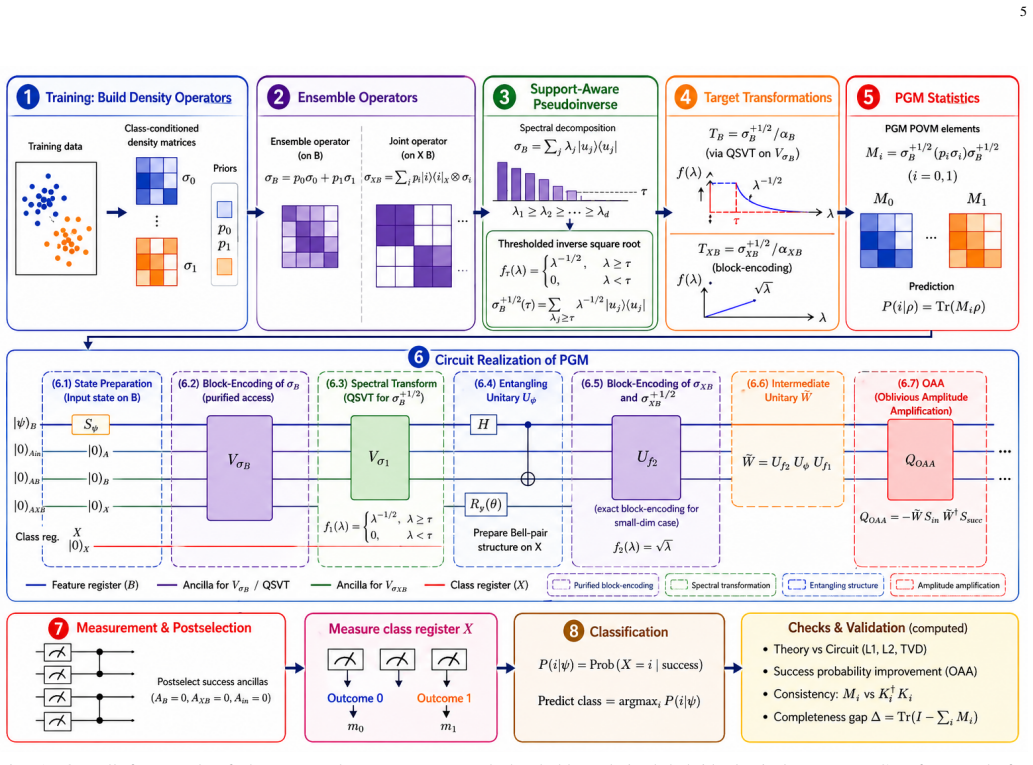
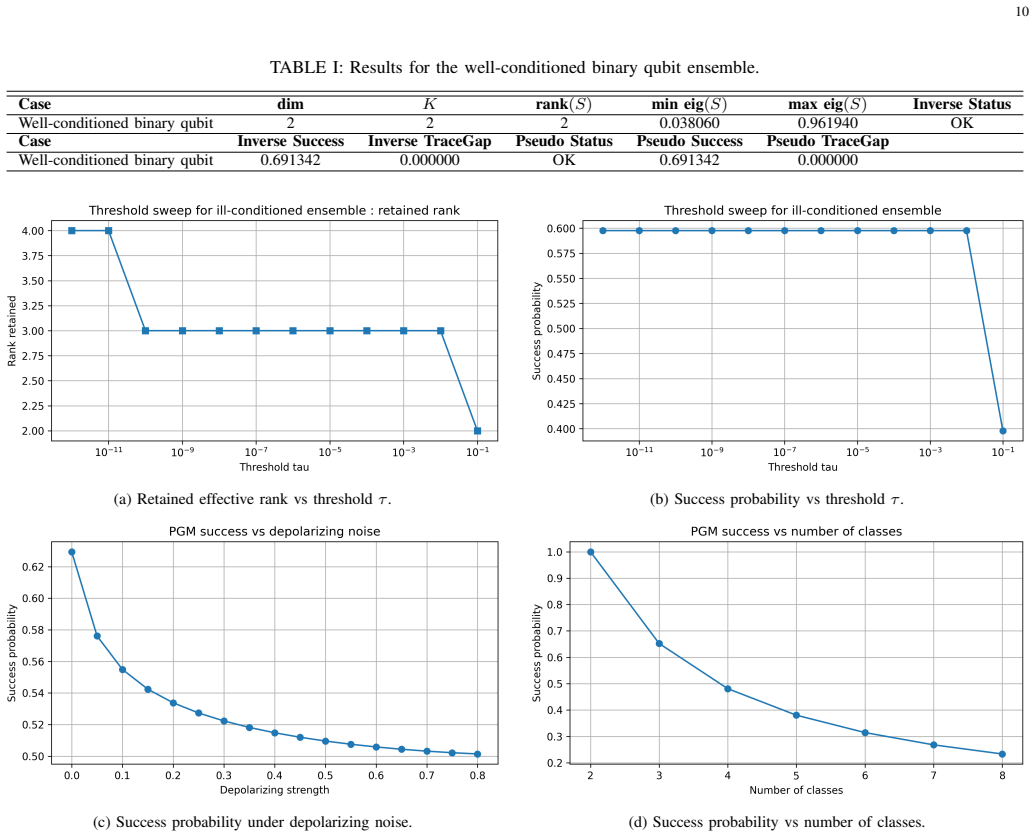
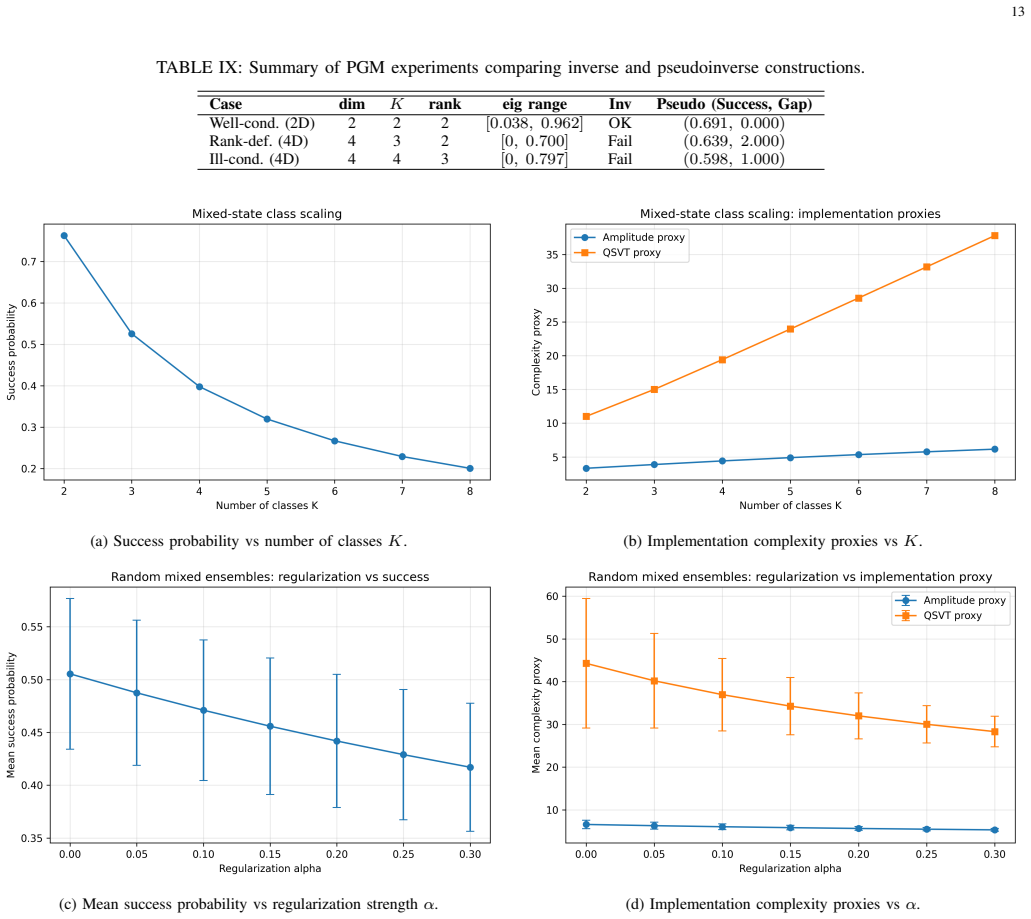
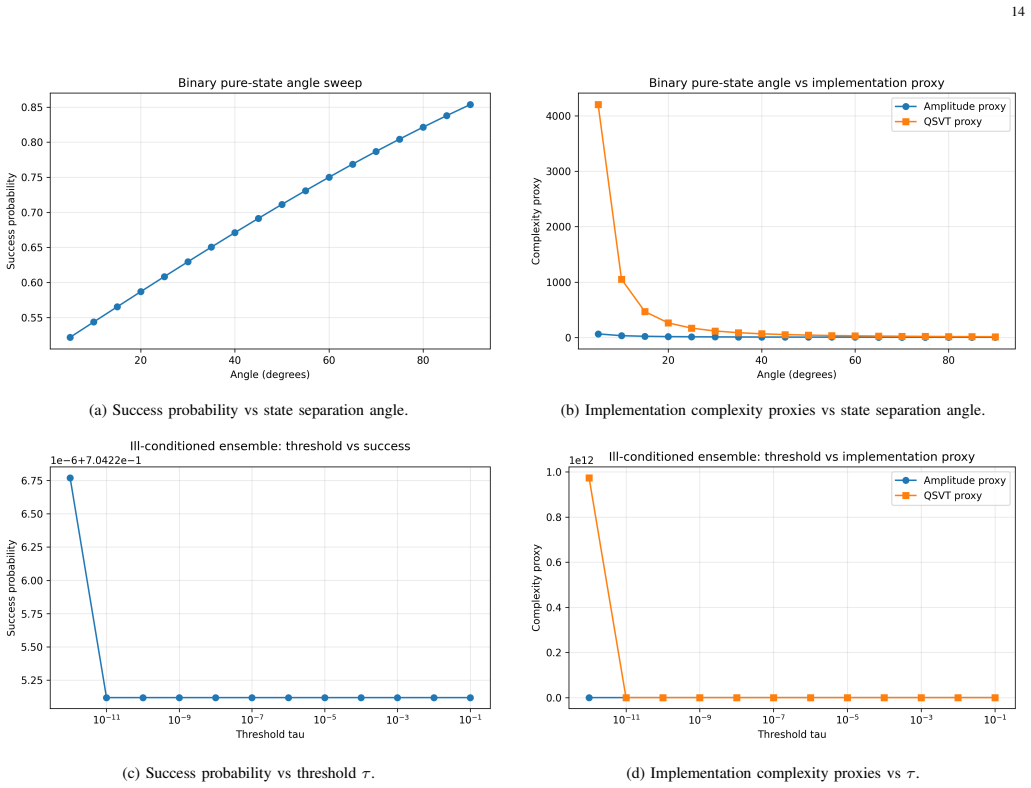
Pretty Good Measurement (PGM) is a near-optimal strategy for quantum state discrimination, but its practical realization becomes unstable when the ensemble operator is singular or ill-conditioned. We introduce a numerically robust PGM formulation based on the Moore-Penrose pseudoinverse, replacing the standard inverse square root with a threshold-regularized variant that remains well-defined across different spectral regimes. We develop a hybrid classical-quantum framework that combines pseudoinverse-based spectral preprocessing with quantum circuit realizations using block-encoding and spectral-transformation techniques. The framework incorporates support awareness, yielding physically meaningful measurement operators even in rank-deficient cases, and employs oblivious amplitude amplification to improve circuit-level success probabilities. Extensive numerical and circuit-level simulations show close agreement between theoretical predictions and quantum circuit outputs. Experiments on synthetic and real datasets, including ill-conditioned and degenerate scenarios, demonstrate stable discrimination performance where standard PGM becomes numerically unstable. The results establish a practical hybrid classical-quantum framework for robust quantum state discrimination and extend previous circuit-based implementations of the PGM testing stage toward pseudoinverse-aware measurement design.
Editorial analysis
A structured set of objections, weighed in public.
Referee Report
Summary. The paper introduces a robust formulation of Pretty Good Measurement (PGM) for quantum state discrimination using a threshold-regularized Moore-Penrose pseudoinverse to handle singular or ill-conditioned ensemble operators. It develops a hybrid classical-quantum framework that combines pseudoinverse-based spectral preprocessing with quantum circuit realizations via block-encoding and spectral-transformation techniques, incorporates support awareness for rank-deficient cases, and employs oblivious amplitude amplification. Extensive numerical and circuit-level simulations on synthetic and real datasets, including ill-conditioned and degenerate scenarios, are reported to show close agreement with theory and stable discrimination performance where standard PGM becomes numerically unstable.
Significance. If the central claims hold, the work would supply a practical hybrid method for realizing near-optimal quantum measurements in realistic, rank-deficient or ill-conditioned settings and would extend prior circuit-based PGM implementations toward pseudoinverse-aware design. The reported numerical validation across diverse datasets and the circuit-level realizations constitute concrete strengths supporting potential utility in quantum information processing tasks.
major comments (2)
- [Abstract] Abstract (paragraph on robust PGM formulation): the claim that the threshold-regularized pseudoinverse yields physically meaningful measurement operators in rank-deficient cases without unacceptable approximation errors rests on an unproven assumption; no operator-norm or trace-distance bound is supplied to guarantee that the deviation from the standard (singular) PGM remains below the discrimination gap for arbitrary spectra, so the assertions of near-optimality and stability rest solely on empirical behavior.
- [Abstract] Abstract (experiments paragraph): the reported 'close agreement between theoretical predictions and quantum circuit outputs' and 'stable discrimination performance' are asserted for ill-conditioned and degenerate scenarios, yet the manuscript supplies neither an explicit threshold-selection rule nor quantitative error bounds on the regularized operators, leaving the generalization of the empirical results without analytical support.
minor comments (2)
- The abstract refers to 'support awareness' and 'oblivious amplitude amplification' without defining the precise circuit constructions or the manner in which support awareness is enforced at the operator level; a short clarifying sentence or reference to the relevant section would improve readability.
- No comparison baselines (e.g., standard PGM with ad-hoc regularization or other robust discrimination schemes) are mentioned in the abstract, which would help situate the performance gains.
Simulated Author's Rebuttal
We thank the referee for the careful reading and constructive feedback. The comments correctly identify that certain claims in the abstract rest on numerical evidence rather than general analytical guarantees. We address each point below and will revise the manuscript accordingly.
read point-by-point responses
-
Referee: [Abstract] Abstract (paragraph on robust PGM formulation): the claim that the threshold-regularized pseudoinverse yields physically meaningful measurement operators in rank-deficient cases without unacceptable approximation errors rests on an unproven assumption; no operator-norm or trace-distance bound is supplied to guarantee that the deviation from the standard (singular) PGM remains below the discrimination gap for arbitrary spectra, so the assertions of near-optimality and stability rest solely on empirical behavior.
Authors: We agree that no general operator-norm or trace-distance bound is derived to guarantee the deviation stays below the discrimination gap for arbitrary spectra. The threshold-regularized pseudoinverse is constructed to approximate the Moore-Penrose pseudoinverse while ensuring numerical stability and support awareness for physical validity in rank-deficient cases. The manuscript relies on extensive numerical validation across synthetic and real datasets to demonstrate small approximation errors and stable performance. We will revise the abstract to clarify that near-optimality and stability claims are supported by the reported empirical results rather than universal analytical bounds. revision: yes
-
Referee: [Abstract] Abstract (experiments paragraph): the reported 'close agreement between theoretical predictions and quantum circuit outputs' and 'stable discrimination performance' are asserted for ill-conditioned and degenerate scenarios, yet the manuscript supplies neither an explicit threshold-selection rule nor quantitative error bounds on the regularized operators, leaving the generalization of the empirical results without analytical support.
Authors: The referee correctly notes the absence of an explicit threshold-selection rule and general quantitative error bounds. Thresholds in the experiments are chosen based on the condition number and smallest singular values of the ensemble operator to maintain stability. We will add a discussion in the manuscript describing the heuristic used for threshold selection in the reported simulations and explicitly note the empirical scope of the error control and generalization. revision: yes
Circularity Check
No circularity; derivation is self-contained
full rationale
The paper proposes a threshold-regularized Moore-Penrose pseudoinverse variant for stable PGM in singular/ill-conditioned cases, develops a hybrid classical-quantum circuit framework using block-encoding and amplitude amplification, and validates via numerical simulations and experiments on synthetic/real datasets. No load-bearing step reduces a claimed result or prediction to a fitted parameter, self-citation chain, or definitional equivalence by the paper's own equations. The formulation, support-awareness mechanism, and empirical stability claims are independent of the inputs; the derivation chain introduces new regularization and circuit techniques without self-referential collapse.
Axiom & Free-Parameter Ledger
free parameters (1)
- regularization threshold
Reference graph
Works this paper leans on
-
[1]
M. A. Nielsen and I. L. Chuang,Quantum Computation and Quantum Information. Cambridge University Press, 2010
2010
-
[2]
Quantum algorithms: an overview , volume=
A. Montanaro, “Quantum algorithms: an overview,”npj Quantum Information, vol. 2, p. 15023, 2016. [Online]. Available: https: //doi.org/10.1038/npjqi.2015.23
-
[3]
A. Chefles, “Quantum state discrimination,”Contemporary Physics, vol. 41, no. 6, pp. 401–424, 2010. [Online]. Available: https: //doi.org/10.1080/00107510010002599
-
[4]
S. M. Barnett and S. Croke, “Quantum state discrimination,”Advances in Optics and Photonics, vol. 1, no. 2, pp. 238–278, 2009. [Online]. Available: https://doi.org/10.1364/AOP.1.000238
-
[5]
P. Hausladen and W. K. Wootters, “A ‘pretty good’ measurement for distinguishing quantum states,”Journal of Modern Optics, vol. 41, no. 12, pp. 2385–2390, 1994. [Online]. Available: https: //doi.org/10.1080/09500349414552221 21
-
[6]
Reversing quantum dynamics with near- optimal quantum and classical fidelity,
H. Barnum and E. Knill, “Reversing quantum dynamics with near- optimal quantum and classical fidelity,”Journal of Mathematical Physics, vol. 43, no. 5, pp. 2097–2106, 2002. [Online]. Available: https://doi.org/10.1063/1.1459754
-
[7]
A many-valued approach to quantum computational logics,
M. L. Dalla Chiara, R. Giuntini, G. Sergioli, and R. Leporini, “A many-valued approach to quantum computational logics,”Fuzzy Sets and Systems, vol. 335, pp. 94–111, 2018. [Online]. Available: https://www.sciencedirect.com/science/article/pii/S0165011416304560
2018
-
[8]
Mixed-quantum-state detection with inconclusive results,
Y . C. Eldar, “Mixed-quantum-state detection with inconclusive results,” Physical Review A, vol. 67, no. 4, p. 042309, 2003. [Online]. Available: https://doi.org/10.1103/PhysRevA.67.042309
-
[9]
J. Bae and L.-C. Kwek, “Quantum state discrimination and its applications,”Journal of Physics A: Mathematical and Theoretical, vol. 48, no. 8, p. 083001, 2015. [Online]. Available: https: //iopscience.iop.org/article/10.1088/1751-8113/48/8/083001
-
[10]
Multi-class classification based on quantum state discrimination,
R. Giuntini, A. C. G. Arango, H. Freytes, F. H. Holik, and G. Sergioli, “Multi-class classification based on quantum state discrimination,” Fuzzy Sets and Systems, vol. 467, p. 108509, 2023. [Online]. Available: https://doi.org/10.1016/j.fss.2023.03.012
-
[11]
Quantum algorithm for linear systems of equations,
A. W. Harrow, A. Hassidim, and S. Lloyd, “Quantum algorithm for linear systems of equations,”Physical Review Letters, vol. 103, no. 15, p. 150502, 2009. [Online]. Available: https://doi.org/10.1103/ PhysRevLett.103.150502
2009
-
[12]
and Kothari, Robin and Somma, Rolando D
A. M. Childs, R. Kothari, and R. D. Somma, “Quantum linear systems algorithm with exponentially improved dependence on precision,”SIAM Journal on Computing, vol. 46, no. 6, pp. 1920–1950, 2017. [Online]. Available: https://doi.org/10.1137/16M1087072
work page internal anchor Pith review doi:10.1137/16m1087072 1920
-
[13]
D. W. Berry, A. M. Childs, R. Cleve, R. Kothari, and R. D. Somma, “Simulating hamiltonian dynamics with a truncated taylor series,” Physical Review Letters, vol. 114, no. 9, p. 090502, 2015. [Online]. Available: https://doi.org/10.1103/PhysRevLett.114.090502
-
[14]
Quantum singular value transformation and beyond,
A. Gily ´en, Y . Su, G. H. Low, and N. Wiebe, “Quantum singular value transformation and beyond,”Proceedings of the 51st Annual ACM SIGACT Symposium on Theory of Computing, 2019. [Online]. Available: https://doi.org/10.1145/3313276.33163
-
[15]
G. H. Low and I. L. Chuang, “Optimal hamiltonian simulation by quantum signal processing,”Physical Review Letters, vol. 118, no. 1, p. 010501, 2017. [Online]. Available: https://doi.org/10.1103/PhysRevLett. 118.010501
-
[16]
Variational quantum algorithms,
M. Cerezo, A. Arrasmith, R. Babbushet al., “Variational quantum algorithms,”Nature Reviews Physics, vol. 3, pp. 625–644, 2021. [Online]. Available: https://doi.org/10.1038/s42254-021-00348-9
-
[17]
Quantum Error Correction: An Introductory Guide,
M. Schuld, I. Sinayskiy, and F. Petruccione, “An introduction to quantum machine learning,”Contemporary Physics, vol. 56, no. 2, pp. 172–185, 2015. [Online]. Available: https://doi.org/10.1080/00107514. 2014.964942
-
[18]
A new quantum approach to binary classification,
G. Sergioli, R. Giuntini, and H. Freytes, “A new quantum approach to binary classification,”PLOS ONE, vol. 14, no. 5, p. e0216224, 2019. [Online]. Available: https://doi.org/10.1371/journal.pone.0216224
-
[19]
Quantum-inspired algorithm for direct multi-class classification,
R. Giuntini, F. Holik, D. Park, H. Freytes, C. Blank, and G. Sergioli, “Quantum-inspired algorithm for direct multi-class classification,” Applied Soft Computing, vol. 134, p. 109956, 2023. [Online]. Available: https://doi.org/10.1016/j.asoc.2022.109956
-
[20]
Quantum circuit design methodology for multiple linear regression,
S. Dutta, A. Suau, S. Dutta, S. Roy, B. K. Behera, and P. K. Panigrahi, “Quantum circuit design methodology for multiple linear regression,” IET Quantum Communication, vol. 1, no. 2, pp. 55–61, 2020. [Online]. Available: https://doi.org/10.1049/iet-qtc.2020.0013
-
[21]
On the reciprocal of the general algebraic matrix,
E. H. Moore, “On the reciprocal of the general algebraic matrix,” Bulletin of the American Mathematical Society, vol. 26, no. 9, pp. 394– 395, 1920
1920
-
[22]
A generalized inverse for matrices,
R. Penrose, “A generalized inverse for matrices,”Mathematical Pro- ceedings of the Cambridge Philosophical Society, vol. 51, pp. 406–413,
-
[23]
A generalized inverse for matrices,
[Online]. Available: https://doi.org/10.1017/S0305004100030401
-
[24]
Enhancing the quantum linear systems algorithm using richardson extrapolation,
A. C. V ´azquez, R. Hiptmair, and S. Woerner, “Enhancing the quantum linear systems algorithm using richardson extrapolation,” ACM Transactions on Quantum Computing, vol. 3, no. 1, pp. 1–37,
-
[25]
Available: https://doi.org/10.1145/3490631
[Online]. Available: https://doi.org/10.1145/3490631
-
[26]
Lupus yolo dataset,
A. Choudhary, “Lupus yolo dataset,” https://www.kaggle.com/datasets/ ayushcl/lupus-yolo, 2024, accessed: 2026-05-01
2024
discussion (0)
Sign in with ORCID, Apple, or X to comment. Anyone can read and Pith papers without signing in.