REVIEW 2 major objections 3 minor 30 references
Context-Aware Information Lapse for Timely Status Updates in Remote Control Systems
T0 review · 2 major / 3 minor · reviewed 2026-08-14 · deepseek-v4-flash
Pith's one-line read Scheduling status updates by a context-weighted error metric, not by age, improves remote control and provably bounds average lapse.
desk verdict A clean, useful metric—context-aware lapse—with a working Lyapunov policy for status updates; but the main theorem carries an unstated independence assumption that the CartPole experiment probably violates, so the headline evidence needs qualification. read the letter →
The pith
A machine-rendered reading of the paper's core claim, the machinery that carries it, and where it could break.
The reading
What carries the argument
The central object is the product $F(t)=\omega(t)\delta(Q(t))$ with squared error; $Q(t)$ is the difference between true and monitor-known status, and $\omega(t)$ is a context weight expressing urgency. The argument is carried by a Lyapunov drift-plus-penalty decomposition: with the penalty chosen as $f(t)=\sum_i \omega_i(t+1)(Q_i(t+1)^2-A_i(t)^2)$, minimizing drift plus penalty at each slot reduces to an index rule that uses the predicted next-slot weight $\omega_i(t+1)$ alongside the current error. The one-step lookahead is what lets context information enter the decision.
What would settle it
Run the policy of Eq. (6) in a simulation where $\omega_i(t+1)$ is deliberately set to a function of $Q_i(t)$ or $A_i(t)$, for example $\omega_i(t+1)=|Q_i(t)A_i(t)|$, with the same channel and increment statistics; if the average lapse still respects the Theorem 1 bound, the independence assumption is not load-bearing, and if it does not, the theorem's scope is exactly the independent case.
Extended reading notes
Core claim
The discovery is that a single product metric, context-aware information lapse, can absorb both the stochastic evolution of the source and the context-dependent importance of its status, and that minimizing it in a multi-user system reduces to an index rule. Under squared error, the paper defines $Q_i(t)$ as the monitor's estimation error, $A_i(t)$ as its per-slot increment, and $F_i(t)=\omega_i(t)Q_i(t)^2$ as the lapse. It proves (Theorem 1) that the policy scheduling $K$ users with the largest $(\mathbb{E}[\omega_i](1/(p_i\pi_i)-1)+\omega_i(t+1))p_iQ_i(t)^2$ achieves average lapse at most $\sum_i \mathbb{E}[\omega_i]/(p_i\pi_i)\cdot\mathbb{E}[A_i^2]$, and it chooses the randomized stationary schedule $\pi$ by a water-filling solution to minimize the bound. Simulations show the resulting policy outperforms AoI-based scheduling in average lapse, threshold-violation probability, and CartPole control.
Load-bearing premise
The proof assumes the next-slot context weight is statistically independent of the current error and of the error increment; the CartPole demonstration defines the weight from predicted motion driven by the same random force that creates the error, so the demonstration does not strictly satisfy the theorem's assumption.
Editorial extensions
If this is right
- If the bound in Theorem 1 holds, a scheduler that knows next-slot context and current error can guarantee a finite average context-aware lapse without knowing the full distribution of the error process beyond its second moment.
- When the error increment is identically one and the weight is constant, the context-aware lapse reduces to the conventional AoI, so AoI-based scheduling becomes a special case of the proposed rule.
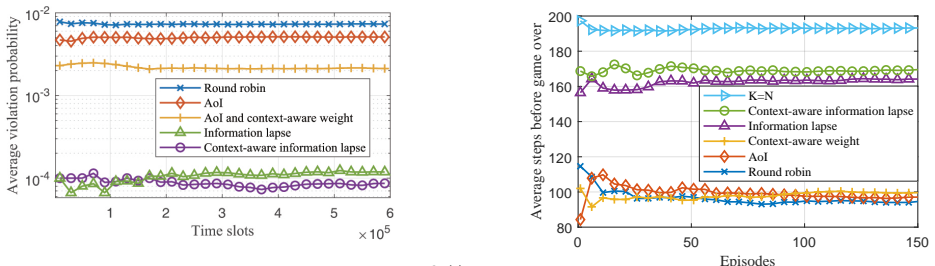
- The context-aware policy cuts threshold-violation probability by about a factor of fifty compared with the AoI-based policy in the simulated setting, even though the scheduling problem was not designed to minimize violations.
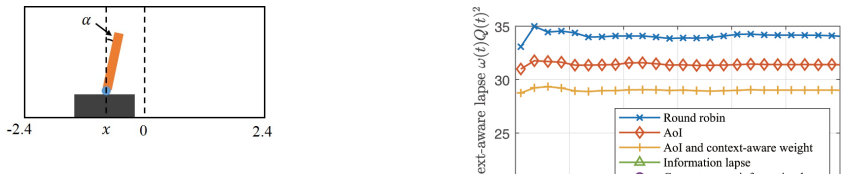
- In the CartPole remote-control experiment, the context-aware lapse scheduler lets the controller keep poles balanced for substantially more steps than schedules based on AoI or round robin.
Reading between the lines
- The paper's bound relies on the independence of $\omega_i(t+1)$ from $Q_i(t)$ and $A_i(t)$; in the CartPole experiment the weight is derived from predicted motion driven by the same random force that creates error, so a direct test of whether correlation breaks the bound would sharpen the scope of the result.
- The same index structure should extend to vector-valued or higher-order error lapses as long as the lapse is quadratic; a non-quadratic $\delta$ would require a new drift-penalty choice rather than the simple square used in Theorem 1.
- A practical consequence left implicit is that the value of context prediction grows with how predictable the context weight is; if $\omega(t+1)$ is nearly deterministic given current observations, the lookahead term adds little and a context-unaware lapse policy may suffice.
Signed reviews
Editorial analysis
A structured set of objections, weighed in public.
Referee Report
Summary. The paper introduces the context-aware information lapse F(t)=ω(t)δ(Q(t)) as a timeliness metric for remote control systems, where ω captures context-dependent importance and δ(Q) captures the error between actual and estimated status. For a multi-user status update system with K of N users served per slot, it formulates the minimization of average squared lapse, proposes a drift-plus-penalty scheduling policy (Eq. (6)) that serves the K users with the largest values of (E[ω_i](1/(p_iπ_i)-1)+ω_i(t+1))p_iQ_i(t)^2, and proves an upper bound on the average lapse under this policy (Theorem 1). Numerical results compare the proposed policy with round-robin, AoI-based, and context-aware AoI baselines in an i.i.d. model and in an OpenAI CartPole control task, reporting substantial gains in threshold-violation probability and control performance.
Significance. The paper addresses a real limitation of AoI by coupling staleness with both the stochastic evolution of the status and its context-dependent importance. The Lyapunov drift-plus-penalty framework is a standard and, apart from the independence issue detailed below, algebraically sound vehicle for deriving an index policy. The CartPole evaluation is a useful step beyond synthetic queueing simulations, and the paper explicitly compares against several baselines. If the missing independence assumptions are added and the CartPole experiment is appropriately qualified as a heuristic case study, the proposed metric and policy would be a meaningful contribution to context-aware status update design.
major comments (2)
- [Section III / Appendix A] The proof of Theorem 1 silently requires that A_i(t) is independent of ω_i(t+1) (and of the scheduling/channel state) in addition to the assumptions stated in Section III. Specifically, the drift calculation cancels the cross term E[(1-D_i(t))Q_i(t)A_i(t)], and the final step from Eq. (10) to the bound replaces E[ω_i(t+1)A_i(t)^2] with E[ω_i]E[A_i^2]. Section III only assumes A_i(t) independent of Q_i(t) and ω_i(t) independent of Q_i(t); it never states independence between A_i(t) and ω_i(t+1). As written, Theorem 1 is therefore not proven under the stated model assumptions.
- [Section IV (CartPole)] The CartPole experiment defines the context weight as ω_i(t+1)=9 when x(t+1)v_x(t+1)>0 (and similarly for α, α̇), where x, v_x, α, α̇ evolve under the same random force that generates A_i(t). Hence A_i(t) and ω_i(t+1) are dependent, violating the condition needed for Theorem 1. Additionally, because the weight depends on the actual state while Q_i(t) is the estimation error, ω_i(t) is not independent of Q_i(t), contrary to the Section III assumption. The paper should either modify the CartPole setup to satisfy the model assumptions or explicitly state that the CartPole results are a heuristic demonstration outside the scope of the theoretical guarantee.
minor comments (3)
- [Section III] The text spells 'Karush-Kuhn-Tucker' as 'Karush-Kuhn-Tucher'; this should be corrected.
- [Appendix A] The telescoping step after Eq. (12) silently shifts the time index in the sum over E[ω_i(t+1)Q_i(t+1)^2] and drops boundary terms. The authors should state the limsup argument and the bounded-second-moment condition needed for the boundary terms to vanish.
- [Section IV] The threshold-violation probabilities are only described qualitatively as 'approximately 10^-4' and 'approximately 1/50'; reporting the precise numbers or confidence intervals would make the improvement easier to assess.
Circularity Check
No circularity: the scheduling policy and its bound are derived from stated model assumptions, and the flagged independence gap is a rigor concern, not a circular reduction.
full rationale
The paper's derivation chain is self-contained. The context-aware information lapse is introduced by definition in Eq. (1), not derived from the scheduling objective. The scheduling problem (5) directly minimizes the average squared-error lapse, and policy (6) is obtained in Appendix A by a standard Lyapunov drift-plus-penalty argument; Theorem 1's upper bound (7) is a mathematical consequence of the stated assumptions (zero-mean increments A_i(t), independence of A_i(t) from Q_i(t), and independence of omega_i(t) from Q_i(t)) together with the choice of pi. No parameter is fitted to a subset of data and then relabeled as a prediction. The numerical evaluation uses external benchmarks: threshold-violation probability and CartPole control steps, neither of which is the optimized objective. The only substantive concern raised in the skeptical reading is an unstated independence condition between omega_i(t+1) and A_i(t) needed for the final averaging step, and the possibility that the hand-designed CartPole weight is correlated with the random force; that is a correctness or assumption-relevance issue, not circularity, because no equation is defined in terms of the target result and no self-citation is used to forbid alternatives. The self-citations in the bibliography (e.g., refs. [7], [19], [20]) are contextual or provide a baseline policy for comparison; they are not load-bearing for the paper's central claim. Thus the circularity score is 0.
Assumptions & free parameters
free parameters (3)
- Simulation context-weight values =
9 and 1
- Violation thresholds =
5 when weight is 9, 15 when weight is 1
- CartPole context rule =
omega=9 if x*vx>0 or alpha*alphadot>0, else 1
assumptions (5)
- domain assumption A_i(t) has zero mean, finite variance, and is independent of current error Q_i(t)
- domain assumption omega_i(t) is a random variable with mean E[omega_i] and is independent of Q_i(t); Theorem 1 also needs independence from A_i(t)
- domain assumption Scheduler knows the one-step-ahead context weight omega_i(t+1) when making decision U(t)
- domain assumption Generation-to-delivery delay is negligible so Q(t+1)=(1-D(t))Q(t)+A(t)
- domain assumption Channel successes are independent across users and slots with probabilities p_i
invented entities (1)
-
Context-aware information lapse F(t)=omega(t)*delta(Q(t))
Cite this review
Pith. "Pith review of Context-Aware Information Lapse for Timely Status Updates in Remote Control Systems." pith.science (2026). https://pith.science/paper/V77J37D4
@misc{pith2026190804446,
  author       = {Pith},
  title        = {Pith review of: Context-Aware Information Lapse for Timely Status Updates in Remote Control Systems},
  year         = {2026},
  howpublished = {\url{https://pith.science/paper/V77J37D4}},
  note         = {Machine review of arXiv:1908.04446}
}
read the original abstract
Emerging applications in Internet of Things (IoT), such as remote monitoring and control, extensively rely on timely status updates. Age of Information (AoI) has been proposed to characterize the freshness of information in status update systems. However, it only considers the time elapsed since the generation of the latest packet, and is incapable of capturing other critical information in remote control systems, such as the stochastic evolution and the importance of the source status. In order to evaluate the timeliness of status updates in remote control systems, we propose a context-aware metric, namely the context-aware information lapse. The context-aware information lapse characterizes both the stochastic evolution of the source status and the context-aware importance of the status. In this paper, the minimization of average context-aware lapse in a multi-user system is considered, and a corresponding user scheduling policy is proposed based on Lyapunov optimization. Numerical results show that compared to AoI-based policy, the context-aware-lapse-based policy can achieve a substantial improvement in terms of error-threshold violation probability and control performance.
Figures

Figures from the paper (1 more)
Reference graph
Works this paper leans on
-
[29]
C. Kam, S. Kompella, G. D. Nguyen, J. E. Wieselthier, and A. Ephremides, “Towards an “effective age” concept,” IEEE SPAWC, Kalamata, June 2018
work page 2018
-
[1]
Minimizing age of infor- mation in vehicular networks,
S. Kaul, M. Gruteser, V . Rai, and J. Kenney, “Minimizing age of infor- mation in vehicular networks,” in 2011 8th Annual IEEE Communica- tions Society Conference on Sensor, Mesh and Ad Hoc Communications and Networks, Salt Lake City, UT, June, 2011
work page 2011
-
[2]
Real-time status: How often should one update?
S. Kaul, R. Yates, and M. Gruteser, “Real-time status: How often should one update?” in 2012 IEEE Conference on Computer Communications (INFOCOM), Mar. 2012
work page 2012
-
[3]
Sampling for Data Freshness Optimization: Non-linear Age Functions
Y . Sun and B. Cyr, “Sampling for data freshness optimization: Non- linear age functions,” arXiv:1812.07241, 2018
work page Pith review arXiv 2018
-
[4]
Delay and peak-age violation probability in short-packet transmissions,
R. Devassy, G. Durisi, G. C. Ferrante, O. Simeone, and E. Uysal- Biyikoglu, “Delay and peak-age violation probability in short-packet transmissions,” arXiv:1805.03271, 2018
arXiv 2018
-
[5]
Update or wait: How to keep your data fresh,
Y . Sun, E. Uysal-Biyikoglu, R. D. Yates, C. E. Koksal and N. B. Shroff, “Update or wait: How to keep your data fresh,”IEEE Trans. Inf. Theory, vol. 63, no. 11, pp. 7492-7508, Nov. 2019
work page 2019
-
[6]
Age and value of information: Non-linear age case,
A. Kosta, N. Pappas, A. Ephremides, and V . Angelakis, “Age and value of information: Non-linear age case,” in 2017 IEEE International Symposium on Information Theory (ISIT) , June 2017
work page 2017
-
[7]
X. Zheng, S. Zhou, Z. Jiang, and Z. Niu, “Closed-form analysis of non- linear age-of-information in status updates with an energy harvesting transmitter,” IEEE Trans. Wireless Commun. , early access, 2019
work page 2019
Show all 30 references
-
[8]
A risk-sensitive approach for packet inter-delivery time optimization in networked cyber-physical systems,
X. Guo, R. Singh, P. R. Kumar, and Z. Niu, “A risk-sensitive approach for packet inter-delivery time optimization in networked cyber-physical systems,” IEEE/ACM Trans. Netw., vol. 26, pp. 1976–1989, Aug. 2018
1976
-
[9]
Effect of message transmission path diversity on status age,
C. Kam, S. Kompella, G. D. Nguyen, and A. Ephremides, “Effect of message transmission path diversity on status age,” IEEE Trans. Inf. Theory, vol. 62, pp. 1360–1374, Mar. 2016
2016
-
[10]
Optimizing age-of-information in a multi- class queueing system,
L. Huang and E. Modiano, “Optimizing age-of-information in a multi- class queueing system,” in 2015 IEEE International Symposium on Information Theory (ISIT) , June 2015
2015
-
[11]
Age-of-information in the presence of error,
K. Chen and L. Huang, “Age-of-information in the presence of error,” in 2016 IEEE International Symposium on Information Theory (ISIT) , July 2016
2016
-
[12]
Age of information in G/G/1/1 systems,
A. Soysal and S. Ulukus, “Age of information in G/G/1/1 systems,” arXiv: 1805.12586, 2018
2018 arXiv
-
[13]
Optimizing data freshness, throughput, and delay in multi-server information-update systems,
A. M. Bedewy, Y . Sun, and N. B. Shroff, “Optimizing data freshness, throughput, and delay in multi-server information-update systems,” in IEEE International Symposium on Information Theory (ISIT), July 2016
2016
-
[14]
On the age of information in status update systems with packet management,
M. Costa, M. Codreanu, and A. Ephremides, “On the age of information in status update systems with packet management,” IEEE Trans. Inf. Theory, vol. 62, pp. 1897–1910, Apr. 2016
1910
-
[15]
A general formula for the stationary distribution of the age of information and its applica- tion to single-server queues,
Y . Inoue, H. Masuyama, T. Takine, and T. Tanaka, “A general formula for the stationary distribution of the age of information and its applica- tion to single-server queues,” arXiv:1804.06139, 2018
2018 arXiv
-
[16]
The age of information: Real-time status updating by multiple sources,
R. D. Yates and S. K. Kaul, “The age of information: Real-time status updating by multiple sources,” IEEE Trans. Inf. Theory , vol. 65, no. 3, pp. 1807–1827, Mar. 2019
2019
-
[17]
Scheduling policies for minimizing age of information in broadcast wireless networks,
I. Kadota, A. Sinha, E. Uysal-Biyikoglu, R. Singh, and E. Modiano, “Scheduling policies for minimizing age of information in broadcast wireless networks,” arXiv:1801.01803, 2018
2018 arXiv
-
[18]
Can decentralized status update achieve universally near-optimal age-of-information in wireless multiaccess channels?
Z. Jiang, B. Krishnamachari, S. Zhou, and Z. Niu, “Can decentralized status update achieve universally near-optimal age-of-information in wireless multiaccess channels?” 2018 30th International Teletraffic Congress (ITC 30) , Sept. 2018
2018
-
[19]
Decen- tralized status update for age-of-information optimization in wireless multiaccess channels,
Z. Jiang, B. Krishnamachari, X. Zheng, S. Zhou, and Z. Niu, “Decen- tralized status update for age-of-information optimization in wireless multiaccess channels,” in 2018 IEEE International Symposium on Information Theory (ISIT) , June 2018
2018
-
[20]
A unified sampling and scheduling approach for status update in multiaccess wireless,
Z. Jiang, B. Krishnamachari, J. Sun, S. Zhou, and Z. Niu, “A unified sampling and scheduling approach for status update in multiaccess wireless,” IEEE INFOCOM, Apr. 2019
2019
-
[21]
Age of infor- mation under energy replenishment constraints,
B. T. Bacinoglu, E. T. Ceran, and E. Uysal-Biyikoglu, “Age of infor- mation under energy replenishment constraints,” in Information Theory and Applications Workshop (ITA) , Feb. 2015
2015
-
[22]
Lazy is timely: Status updates by an energy harvesting source,
R. D. Yates, “Lazy is timely: Status updates by an energy harvesting source,” in 2015 IEEE International Symposium on Information Theory (ISIT), June 2015
2015
-
[23]
Optimal status update for age of infor- mation minimization with an energy harvesting source,
X. Wu, J. Yang, and J. Wu, “Optimal status update for age of infor- mation minimization with an energy harvesting source,” IEEE Trans. Green Commun. Netw., vol. 2, no. 1, pp. 193–204, Mar. 2018
2018
-
[24]
Scheduling status updates to minimize age of information with an energy harvesting sensor,
B. T. Bacinoglu and E. Uysal-Biyikoglu, “Scheduling status updates to minimize age of information with an energy harvesting sensor,” in IEEE International Symposium on Information Theory (ISIT) , June 2017
2017
-
[25]
Age-minimal transmission for energy harvesting sensors with finite batteries: Online policies,
A. Arafa, J. Yang, S. Ulukus, and H. V . Poor, “Age-minimal transmission for energy harvesting sensors with finite batteries: Online policies,” arXiv: 1806.07271, 2018
2018 arXiv
-
[26]
Age of information in energy harvesting status update systems: When to preempt in service?
S. Farazi, A. G. Klein, and D. R. Brown, “Age of information in energy harvesting status update systems: When to preempt in service?” in IEEE International Symposium on Information Theory (ISIT) , June 2018
2018
-
[27]
Sampling for remote estimation through queues: Age of information and beyond,
T. Z. Ornee and Y . Sun, “Sampling for remote estimation through queues: Age of information and beyond,” arXiv:1902.03552, 2019
1902 arXiv
-
[28]
Finite-state markov channel-a useful model for radio communication channels,
H. S. Wang and N. Moayeri, “Finite-state markov channel-a useful model for radio communication channels,” IEEE Trans. Veh. Technol., vol. 44, pp. 163–171, Feb. 1995
1995
-
[30]
Neuronlike adaptive elements that can solve difficult learning control problems,
A. G. Barto, R. S. Sutton, and C. W. Anderson, “Neuronlike adaptive elements that can solve difficult learning control problems,” IEEE Transactions on Systems, Man, and Cybernetics, vol. 13, no. 5, pp. 834- 846, Sept.-Oct. 1983
1983
Reviewed August 14, 2026 · model on record in the stance chip above.
Discussion (0). Continue with ORCID to comment.