REVIEW 5 major objections 5 minor 143 references
Federated Learning for Large Models in Medical Imaging: A Comprehensive Review
T0 review · 5 major / 5 minor · reviewed 2026-08-05 · deepseek-v4-flash
Pith's one-line read Federated learning can cover medical imaging end to end: this survey argues that CT and MRI reconstruction and downstream diagnosis should be treated as stages of one federated workflow, not as separate problems.
desk verdict A useful but overclaimed survey: the reconstruction-to-analysis framing is real, the 'large models' in the title are not; deserves peer review but needs major revision before it can be a trustworthy reference. read the letter →
The pith
A machine-rendered reading of the paper's core claim, the machinery that carries it, and where it could break.
The reading
What carries the argument
The organizing mechanism is a two-stage full-stack pipeline: upstream image reconstruction (CT and MRI, formalized by data-fidelity-plus-regularization objectives) and downstream analysis (diagnosis and segmentation), joined by the FedAvg parameter-exchange loop. To keep this pipeline viable under real clinical heterogeneity, the load-bearing device is personalized federated adaptation: a global shared backbone plus client-local modules (hypernetworks, batch-normalization layers, decoders, prompts), with communication-cost controls (pruning, quantization, low-rank adapters, knowledge distillation) that make large-model federated training feasible.
What would settle it
Run a systematic literature search with explicit inclusion criteria over the same scope (FL for medical imaging, roughly 2017–2024) and count whether any earlier survey or method explicitly couples reconstruction and downstream analysis as a federated workflow; if such works appear before this survey, the claimed gap is overstated. Separately, count the parameter sizes of models in Tables II–V: if almost all are task-specific networks below foundation-model scale, the 'large models' framing is not supported by the evidence presented.
Extended reading notes
Core claim
The paper's central claim is that prior federated learning surveys in medical imaging fragment the workflow, treating reconstruction, segmentation, and diagnosis separately, and thus miss that FL can and should be organized as a full-stack pipeline. It argues that by pairing FL with personalized components—hypernetworks, client-specific normalization, local decoders, visual prompts—and with communication-efficient tools such as pruning, quantization, low-rank adapters, and knowledge distillation, hospitals can jointly train physics-driven reconstruction models and downstream diagnostic models without sharing raw images. The survey positions large models and efficient compression as the enabl
Load-bearing premise
The survey's value rests on the assumption that earlier surveys really do stop short of the full reconstruction-to-analysis pipeline and that the methods chosen for Tables II–V fairly represent the field; no formal inclusion criteria are given, so the 'comprehensive' scope is asserted rather than demonstrated.
Editorial extensions
If this is right
- Reconstruction quality should be reported not just as image similarity but as its effect on downstream diagnosis, since the pipeline framing makes reconstruction an upstream stage of clinical analysis.
- Personalized components (client-specific normalization, hypernetworks, local decoders) become a default design for handling heterogeneous scanners and protocols, rather than optional add-ons.
- Compression methods—pruning, quantization, low-rank adaptation, knowledge distillation—are prerequisites for training or updating large models federated on hospital hardware.
- FL by itself does not guarantee privacy; the paper's review of gradient inversion, mask leakage, and backdoors implies that secure aggregation, differential privacy, and monitoring must be layered on.
- Post-deployment model updating will need federated continual learning with shift detection, since clinical data distributions change over time.
Reading between the lines
- The paper's 'large models' label is testable by checking its own tables: if most surveyed methods are small task-specific networks rather than foundation-scale models, the label is aspirational rather than descriptive.
- A natural next benchmark would be to train reconstruction and diagnosis jointly in one federated loop on heterogeneous scanner data and compare it against separately federated stages; the paper does not report such an experiment.
- The governance barriers it lists—ethics reviews, data-use agreements, liability, PACS integration—suggest that the binding constraint on federated medical imaging over the next several years may be administrative and legal, not algorithmic.
Editorial analysis
A structured set of objections, weighed in public.
Referee Report
Summary. The paper is a survey of federated learning (FL) applied to medical imaging, organized around a two-stage pipeline: upstream image reconstruction (CT and MRI) and downstream image analysis (diagnosis and segmentation). It claims to be the first to treat reconstruction and analysis as an interconnected federated workflow, with additional attention to large models and compression. The survey reviews a range of FL methods, summarizes them in five tables, and discusses challenges and future directions including privacy, security, communication efficiency, scalability to large models, post-deployment adaptation, and clinical adoption.
Significance. If the claimed scope were delivered, the survey would be a useful reference: it brings together upstream reconstruction and downstream analysis under one FL-oriented narrative, and it collects recent work on CT/MRI reconstruction and segmentation that is not always covered in earlier FL surveys. The paper also gives practical attention to communication-efficient techniques (pruning, quantization, LoRA, knowledge distillation) and to non-technical adoption barriers (HIPAA/GDPR, ethics review, liability), which are often omitted. The authors have included several recent and relevant works, including personalization methods (HyperFed, FedBN, pFedHN) and physics-driven reconstruction frameworks. However, the survey's central claim of being a 'comprehensive' treatment of FL for 'large models' is not fully supported: the large-model theme is mostly forward-looking, and no systematic search or inclusion criteria are provided, making the coverage claim unverifiable.
major comments (5)
- [Section I and Table I] The paper's title and abstract promise a focus on 'large models' in FL, and Section I states that the survey covers 'the integration of emerging large medical foundation models' into FL. Yet the reviewed methods in Sections III and IV are predominantly task-specific CNNs, hypernetworks, GANs, unrolled networks, ResNets, U-Nets, capsule networks, and ViTs—none of which are demonstrated to be 'large models' in the sense of foundation-scale parameter counts. The only LLM-based method (SCAN-PhysFed, [41]) uses an LLM to generate prompts, not as the federated model. The substantial discussion of large-model scalability is confined to Section V.E, which is future-looking rather than a survey of existing FL-for-large-model works. This is a load-bearing mismatch between the paper's stated contribution and its actual content.
- [Section I and all tables] The 'comprehensive' claim is not verifiable because no search strategy, databases, inclusion/exclusion criteria, time window, or PRISMA-style protocol are described. Prior surveys are compared in Table I but the selection is ad hoc. Without a defined population of candidate papers, the reader cannot assess whether the reviewed set is representative. This undermines the central claim that the survey uniquely covers the full pipeline. I would ask the authors to either add a methods subsection describing the review protocol, or explicitly soften the 'comprehensive' claim to 'a curated overview'.
- [Table I] The row for the current paper is titled 'A Survey on Federated Learning for Deploying Foundation Medical Models: From Imaging to Diagnosis (Ours)' and lists 'Full-stack clinical analysis, Federated Learnig, Foundation Model, Secure large model deployment'—a different title and different keywords from the manuscript's actual title ('Federated Learning for Large Models in Medical Imaging: A Comprehensive Review') and abstract. Apart from the typo in 'Learnig', this inconsistency indicates that the scope comparison table was not updated to match the final manuscript. Since the table is central evidence for the paper's claimed novelty, this mismatch should be corrected.
- [Section V.E] The section on scalability to large models, while reasonable as a future-perspective, is not a survey of existing FL methods for large models. For example, the paragraph on model compression mentions FedSparsify and int8 quantization applied to relatively small models, and the LoRA-based MeLo [130] is framed only as a centralized fine-tuning method, not as a federated method. The text does not provide evidence that the surveyed works themselves are large-model FL. This is related to the first comment: the section should either be reframed as 'the path toward large-model FL' or the paper should include actual large-model FL works if such exist.
- [References [10], [40], [41], [112], [115], [116] and Tables II-IV] A notable share of the papers reviewed in detail are authored by the same group as this survey (e.g., [40], [41], [112], [115], [116], along with related self-citations [10], [102], [103]). This is not improper per se, but in a survey claiming comprehensiveness, the selection process should be transparent to rule out coverage bias. I am not accusing the authors of deliberate omission, but the absence of any selection criteria makes it impossible to judge whether the emphasis on their own methods reflects the literature's overall shape or the authors' familiarity. I recommend adding a paragraph in Section I stating how papers were collected and why the selected works are representative.
minor comments (5)
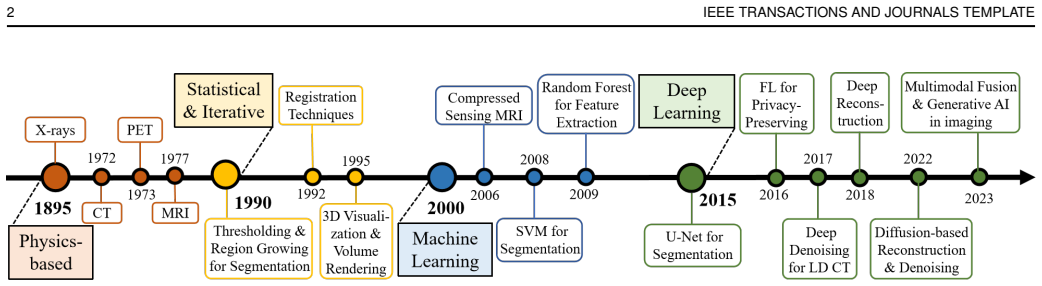
- [Fig. 2 caption] The caption reads 'Fical Imaging and Medical Image Analysis'; should be 'Medical Imaging and Medical Image Analysis'.
- [Table I] The row for 'Ours' contains 'Federated Learnig' and 'Sever-End' (in the earlier row) — typos that should be corrected.
- [Section III.C, Table III] The table entry for [60] says 'FedPR' but the text at line 'FedPR [60] utilizes prompt-based learning...' is consistent, yet in Table III the contribution text reads 'Proposes FedPR to learn visual prompts in null space of global prompts...' with 'catastrophic forgetting'—this is fine. However, the reference formatting for [80] in the text (FedMedICL) lacks author names, making it look like a placeholder; it should be completed.
- [Section V.B] There is a minor typo: 'Developes Louvain-based subgraph partitioning' in Table III should be 'Develops'. Also in section V.C, 'pruning masks... reveal client-specific data distributions' is an interesting claim but no citation is given for the general assertion beyond mask-based attacks; a citation would help.
- [Section IV.B and Table V] The text refers to 'FUNAvg [91]' but the table lists 'Tolle et al. [91]' with 'Funavg'—please make the citation style and capitalization consistent. Also, the description of FedDUS [92] in Section IV.B says 'introduces a semi-supervised federated self-supervised learning (FSSL) framework' but the table says 'Federated Semi-Supervised Learning with Dynamic Update Strategy'; this is not a contradiction, but the terminology is inconsistent.
Circularity Check
No significant circularity: the paper is a literature review with no fitted inputs, predictions, or derivation chain that reduces to its own assumptions.
full rationale
This is a survey paper, not a derivation. It introduces no empirical predictions, no fitted parameters, and no equations whose outputs are constructed from the inputs. The central claim is that prior surveys do not cover the full reconstruction-to-analysis pipeline and that this review fills that gap. That claim is a scope assertion supported by a comparison with other surveys in Table I and by the organization of Sections III and IV. It is not derived from the surveyed papers in a way that would make the conclusion equivalent to the premise. The paper does cite several works by its own authors (e.g., [10], [40], [41], [112], [115], [116]), but these citations are used as examples of existing FL methods or as background motivation, not as load-bearing evidence for the survey's own scope or uniqueness. No uniqueness theorem, ansatz, or construction is imported from these self-citations to force a conclusion. The absence of explicit inclusion criteria and the apparent mismatch between the title and the Table I 'Ours' entry are legitimate quality/verifiability concerns, but they are issues of rigor and transparency, not circularity. The 'large models' theme is admittedly thin in the surveyed methods and largely forward-looking in Section V.E, but that is an overstatement or coverage weakness, not a logical circularity. Therefore the score is 0.
Assumptions & free parameters
assumptions (2)
- domain assumption The reviewed papers are representative of the state of the art in FL for medical imaging.
- domain assumption The reconstruction/analysis dichotomy covers the full medical imaging pipeline.
Cite this review
Pith. "Pith review of Federated Learning for Large Models in Medical Imaging: A Comprehensive Review." pith.science (2026). https://pith.science/paper/V7BDKAKW
@misc{pith2026250820414,
  author       = {Pith},
  title        = {Pith review of: Federated Learning for Large Models in Medical Imaging: A Comprehensive Review},
  year         = {2026},
  howpublished = {\url{https://pith.science/paper/V7BDKAKW}},
  note         = {Machine review of arXiv:2508.20414}
}
read the original abstract
Artificial intelligence (AI) has demonstrated considerable potential in the realm of medical imaging. However, the development of high-performance AI models typically necessitates training on large-scale, centralized datasets. This approach is confronted with significant challenges due to strict patient privacy regulations and legal restrictions on data sharing and utilization. These limitations hinder the development of large-scale models in medical domains and impede continuous updates and training with new data. Federated Learning (FL), a privacy-preserving distributed training framework, offers a new solution by enabling collaborative model development across fragmented medical datasets. In this survey, we review FL's contributions at two stages of the full-stack medical analysis pipeline. First, in upstream tasks such as CT or MRI reconstruction, FL enables joint training of robust reconstruction networks on diverse, multi-institutional datasets, alleviating data scarcity while preserving confidentiality. Second, in downstream clinical tasks like tumor diagnosis and segmentation, FL supports continuous model updating by allowing local fine-tuning on new data without centralizing sensitive images. We comprehensively analyze FL implementations across the medical imaging pipeline, from physics-informed reconstruction networks to diagnostic AI systems, highlighting innovations that improve communication efficiency, align heterogeneous data, and ensure secure parameter aggregation. Meanwhile, this paper provides an outlook on future research directions, aiming to serve as a valuable reference for the field's development.
Figures

Reference graph
Works this paper leans on
-
[41]
Simultaneous ct-mri reconstruction for constrained imaging geometries using structural coupling and compressive sensing,
Y . Xi, J. Zhao, J. R. Bennett, M. R. Stacy, A. J. Sinusas, and G. Wang, “Simultaneous ct-mri reconstruction for constrained imaging geometries using structural coupling and compressive sensing,” IEEE Transactions on Biomedical Engineering , vol. 63, no. 6, pp. 1301– 1309, 2015
2015
-
[130]
A survey of model compression and its feedback mechanism in federated learning,
D.-D. Le, A.-K. Tran, T.-B. Pham, and T.-N. Huynh, “A survey of model compression and its feedback mechanism in federated learning,” in Proceedings of the 5th ACM Workshop on Intelligent Cross-Data Analysis and Retrieval , 2024, pp. 37–42
work page 2024
-
[40]
Personalized federated few-shot learning,
Y . Zhao, G. Yu, J. Wang, C. Domeniconi, M. Guo, X. Zhang, and L. Cui, “Personalized federated few-shot learning,” IEEE Transactions on Neural Networks and Learning Systems , vol. 35, no. 2, pp. 2534– 2544, 2022
2022
-
[112]
A survey on homomorphic encryption schemes: Theory and implementation,
A. Acar, H. Aksu, A. S. Uluagac, and M. Conti, “A survey on homomorphic encryption schemes: Theory and implementation,” ACM Computing Surveys (Csur) , vol. 51, no. 4, pp. 1–35, 2018
work page 2018
-
[115]
A novel privacy-enhancing framework for low-dose ct denoising,
Z. Yang, H. Huangfu, M. Ran, Z. Wang, H. Yu, M. Sun, and Y . Zhang, “A novel privacy-enhancing framework for low-dose ct denoising,” IEEE Transactions on Artificial Intelligence , 2025
work page 2025
-
[116]
Efficient parallel split learning over resource-constrained wireless edge networks,
Z. Lin, G. Zhu, Y . Deng, X. Chen, Y . Gao, K. Huang, and Y . Fang, “Efficient parallel split learning over resource-constrained wireless edge networks,” IEEE Transactions on Mobile Computing , vol. 23, no. 10, pp. 9224–9239, 2024
2024
-
[10]
Biological data annotation via a human-augmenting ai-based labeling system,
D. van der Wal, I. Jhun, I. Laklouk, J. Nirschl, L. Richer, R. Rojansky, T. Theparee, J. Wheeler, J. Sander, F. Feng et al. , “Biological data annotation via a human-augmenting ai-based labeling system,” NPJ digital medicine, vol. 4, no. 1, p. 145, 2021
2021
-
[102]
Fair federated medical image segmentation via client contribution estimation,
M. Jiang, H. R. Roth, W. Li, D. Yang, C. Zhao, V . Nath, D. Xu, Q. Dou, and Z. Xu, “Fair federated medical image segmentation via client contribution estimation,” in Proceedings of the IEEE/CVF Conference on Computer Vision and Pattern Recognition, 2023, pp. 16 302–16 311
work page 2023
-
[103]
Federated multi-centric image segmentation with uneven label dis- tribution,
F. Galati, R. Cortese, F. Prados, M. Lorenzi, and M. A. Zuluaga, “Federated multi-centric image segmentation with uneven label dis- tribution,” in International Conference on Medical Image Computing and Computer-Assisted Intervention . Springer, 2024, pp. 350–360
work page 2024
Show all 143 references
-
[1]
Adversaries can exploit these updates using optimization-based reverse engineering techniques to infer client-specific inputs or latent features [104]
While FL safeguards data privacy by transmitting only model updates, such as gradients or parameters, rather than raw data, it remains vulnerable to privacy leakage. Adversaries can exploit these updates using optimization-based reverse engineering techniques to infer client-s...
-
[2]
While current efforts mainly focus on data privacy protection [105], the intellectual property of model architectures remains under-protected and vulnerable to exploitation. This issue is particularly critical in cross-institutional collaborations and commercial de- ployments,...
-
[3]
As demonstrated by Yuan et al
Pruned weight masks, which indicate retained and removed parameters, can inadvertently reveal client-specific data distributions. As demonstrated by Yuan et al. [106], adversaries may infer membership of private samples by analyzing mask patterns. Furthermore, Chu et al. [107]...
-
[4]
Artificial intelligence: A powerful paradigm for scientific research,
Y . Xu, X. Liu, X. Cao, C. Huang, E. Liu, S. Qian, X. Liu, Y . Wu, F. Dong, C.-W. Qiu et al., “Artificial intelligence: A powerful paradigm for scientific research,” The Innovation, vol. 2, no. 4, 2021
2021
-
[5]
Ai revolutionizing industries world- wide: A comprehensive overview of its diverse applications,
A. B. Rashid and A. K. Kausik, “Ai revolutionizing industries world- wide: A comprehensive overview of its diverse applications,” Hybrid Advances, p. 100277, 2024
2024
-
[6]
Scientific discovery in the age of artificial intelligence,
H. Wang, T. Fu, Y . Du, W. Gao, K. Huang, Z. Liu, P. Chandak, S. Liu, P. Van Katwyk, A. Deac et al. , “Scientific discovery in the age of artificial intelligence,” Nature, vol. 620, no. 7972, pp. 47–60, 2023
2023
-
[7]
How artificial intelligence is shaping medical imag- ing technology: a survey of innovations and applications,
L. Pinto-Coelho, “How artificial intelligence is shaping medical imag- ing technology: a survey of innovations and applications,” Bioengineer- ing, vol. 10, no. 12, p. 1435, 2023
2023
-
[8]
Data-centric artificial intelligence: A survey,
D. Zha, Z. P. Bhat, K.-H. Lai, F. Yang, Z. Jiang, S. Zhong, and X. Hu, “Data-centric artificial intelligence: A survey,” ACM Computing Surveys, vol. 57, no. 5, pp. 1–42, 2025
2025
-
[9]
Machine learning and artificial intelligence: a paradigm shift in big data-driven drug design and discovery,
P. Pasrija, P. Jha, P. Upadhyaya, M. S. Khan, and M. Chopra, “Machine learning and artificial intelligence: a paradigm shift in big data-driven drug design and discovery,” Current Topics in Medicinal Chemistry , vol. 22, no. 20, pp. 1692–1727, 2022
2022
-
[11]
Secure, privacy-preserving and federated machine learning in medical imaging,
G. A. Kaissis, M. R. Makowski, D. R ¨uckert, and R. F. Braren, “Secure, privacy-preserving and federated machine learning in medical imaging,” Nature Machine Intelligence , vol. 2, no. 6, pp. 305–311, 2020
2020
-
[12]
Communication-efficient learning of deep networks from decentral- ized data,
B. McMahan, E. Moore, D. Ramage, S. Hampson, and B. A. y Arcas, “Communication-efficient learning of deep networks from decentral- ized data,” in Artificial intelligence and statistics . PMLR, 2017, pp. 1273–1282
2017
-
[13]
Physics- driven spectrum-consistent federated learning for palmprint verifica- tion,
Z. Yang, A. B. J. Teoh, B. Zhang, L. Leng, and Y . Zhang, “Physics- driven spectrum-consistent federated learning for palmprint verifica- tion,” International Journal of Computer Vision , vol. 132, no. 10, pp. 4253–4268, 2024
2024
-
[14]
Federated learning for data privacy preservation in vehicular cyber-physical systems,
Y . Lu, X. Huang, Y . Dai, S. Maharjan, and Y . Zhang, “Federated learning for data privacy preservation in vehicular cyber-physical systems,” IEEE Network, vol. 34, no. 3, pp. 50–56, 2020
2020
-
[15]
Impact of upstream medical image processing on downstream performance of a head ct triage neural network,
S. M. Hooper, J. A. Dunnmon, M. P. Lungren, D. Mastrodicasa, D. L. Rubin, C. R ´e, A. Wang, and B. N. Patel, “Impact of upstream medical image processing on downstream performance of a head ct triage neural network,” Radiology: Artificial Intelligence , vol. 3, no. 4, p. e200229, 2021
2021
-
[16]
Computational medical image reconstruction techniques: a comprehensive review,
R. Gothwal, S. Tiwari, and S. Shivani, “Computational medical image reconstruction techniques: a comprehensive review,” Archives of Com- putational Methods in Engineering , vol. 29, no. 7, pp. 5635–5662, 2022
2022
-
[17]
Low-dose ct with a residual encoder-decoder convolutional neural network,
H. Chen, Y . Zhang, M. K. Kalra, F. Lin, Y . Chen, P. Liao, J. Zhou, and G. Wang, “Low-dose ct with a residual encoder-decoder convolutional neural network,” IEEE transactions on medical imaging , vol. 36, no. 12, pp. 2524–2535, 2017
2017
-
[18]
Data and physics driven deep learning models for fast mri reconstruction: Fundamentals and methodologies,
J. Huang, Y . Wu, F. Wang, Y . Fang, Y . Nan, C. Alkan, D. Abraham, C. Liao, L. Xu, Z. Gao et al., “Data and physics driven deep learning models for fast mri reconstruction: Fundamentals and methodologies,” arXiv preprint arXiv:2401.16564 , 2024
2024 arXiv
-
[19]
Impact of dementia: Health disparities, population trends, care interventions, and economic costs,
M. P. Aranda, I. N. Kremer, L. Hinton, J. Zissimopoulos, R. A. Whitmer, C. H. Hummel, L. Trejo, and C. Fabius, “Impact of dementia: Health disparities, population trends, care interventions, and economic costs,” Journal of the American Geriatrics Society , vol. 69, no. 7, pp. ...
2021
-
[20]
Residual cyclegan for robust domain transformation of histopathological tissue slides,
T. de Bel, J.-M. Bokhorst, J. van der Laak, and G. Litjens, “Residual cyclegan for robust domain transformation of histopathological tissue slides,” Medical Image Analysis , vol. 70, p. 102004, 2021
2021
-
[21]
A novel early diagnos- tic framework for chronic diseases with class imbalance,
X. Yuan, S. Chen, C. Sun, and L. Yuwen, “A novel early diagnos- tic framework for chronic diseases with class imbalance,” Scientific reports, vol. 12, no. 1, p. 8614, 2022
2022
-
[22]
Ai in medical imaging informatics: current challenges and future directions,
A. S. Panayides, A. Amini, N. D. Filipovic, A. Sharma, S. A. Tsaftaris, A. Young, D. Foran, N. Do, S. Golemati, T. Kurc et al., “Ai in medical imaging informatics: current challenges and future directions,” IEEE journal of biomedical and health informatics , vol. 24, no. 7, pp...
2020
-
[23]
Federated learning for medical image analysis: A survey,
H. Guan, P.-T. Yap, A. Bozoki, and M. Liu, “Federated learning for medical image analysis: A survey,” Pattern Recognition, p. 110424, 2024
2024
-
[24]
Review of federated learning and machine learning-based methods for medical image analysis,
N. Hernandez-Cruz, P. Saha, M. M. K. Sarker, and J. A. Noble, “Review of federated learning and machine learning-based methods for medical image analysis,” Big Data and Cognitive Computing , vol. 8, no. 9, p. 99, 2024
2024
-
[25]
Federated learning in medical image analysis: A systematic survey,
F. R. da Silva, R. Camacho, and J. M. R. Tavares, “Federated learning in medical image analysis: A systematic survey,” Electronics, vol. 13, no. 1, p. 47, 2023
2023
-
[26]
Federated learning for rare disease detection: a survey,
J. Wang and F. Ma, “Federated learning for rare disease detection: a survey,” Rare Disease and Orphan Drugs Journal , vol. 2, no. 4, pp. N–A, 2023
2023
-
[27]
A survey on trustworthi- ness in foundation models for medical image analysis,
C. Shi, R. Rezai, J. Yang, Q. Dou, and X. Li, “A survey on trustworthi- ness in foundation models for medical image analysis,” arXiv preprint arXiv:2407.15851, 2024
2024 arXiv
-
[28]
Federated learning in radiomics: A comprehensive meta-survey on medical image analysis,
A. Raza, A. Guzzo, M. Ianni, R. Lappano, A. Zanolini, M. Maggiolini, and G. Fortino, “Federated learning in radiomics: A comprehensive meta-survey on medical image analysis,” Computer Methods and Programs in Biomedicine , p. 108768, 2025
2025
-
[29]
Fedavg with fine tuning: Local updates lead to representation learning,
L. Collins, H. Hassani, A. Mokhtari, and S. Shakkottai, “Fedavg with fine tuning: Local updates lead to representation learning,” Advances in Neural Information Processing Systems , vol. 35, pp. 10 572–10 586, 2022
2022
-
[30]
Knowledge distillation: A survey,
J. Gou, B. Yu, S. J. Maybank, and D. Tao, “Knowledge distillation: A survey,” International Journal of Computer Vision , vol. 129, no. 6, pp. 1789–1819, 2021
2021
-
[31]
Data-free knowledge distillation for heterogeneous federated learning,
Z. Zhu, J. Hong, and J. Zhou, “Data-free knowledge distillation for heterogeneous federated learning,” in International conference on machine learning. PMLR, 2021, pp. 12 878–12 889
2021
-
[32]
Real-world data: towards achieving the achievable in cancer care,
C. M. Booth, S. Karim, and W. J. Mackillop, “Real-world data: towards achieving the achievable in cancer care,” Nature reviews Clinical oncology, vol. 16, no. 5, pp. 312–325, 2019
2019
-
[33]
Federated optimization in heterogeneous networks,
T. Li, A. K. Sahu, M. Zaheer, M. Sanjabi, A. Talwalkar, and V . Smith, “Federated optimization in heterogeneous networks,” Proceedings of Machine learning and systems , vol. 2, pp. 429–450, 2020
2020
-
[34]
Model-contrastive federated learning,
Q. Li, B. He, and D. Song, “Model-contrastive federated learning,” in Proceedings of the IEEE/CVF conference on computer vision and pattern recognition, 2021, pp. 10 713–10 722
2021
-
[35]
Tackling the objective inconsistency problem in heterogeneous federated optimiza- tion,
J. Wang, Q. Liu, H. Liang, G. Joshi, and H. V . Poor, “Tackling the objective inconsistency problem in heterogeneous federated optimiza- tion,” Advances in neural information processing systems , vol. 33, pp. 7611–7623, 2020
2020
-
[36]
Communication-efficient federated learning via knowledge distillation,
C. Wu, F. Wu, L. Lyu, Y . Huang, and X. Xie, “Communication-efficient federated learning via knowledge distillation,”Nature Communications, vol. 13, no. 1, p. 2032, 2022
-
[37]
Fedbn: Federated learning on non-iid features via local batch normalization,
X. Li, M. Jiang, X. Zhang, M. Kamp, and Q. Dou, “Fedbn: Federated learning on non-iid features via local batch normalization,” arXiv preprint arXiv:2102.07623, 2021
2021 arXiv
-
[38]
Personalized federated learning using hypernetworks,
A. Shamsian, A. Navon, E. Fetaya, and G. Chechik, “Personalized federated learning using hypernetworks,” in International conference on machine learning . PMLR, 2021, pp. 9489–9502
2021
-
[39]
Fedtp: Federated learning by transformer personalization,
H. Li, Z. Cai, J. Wang, J. Tang, W. Ding, C.-T. Lin, and Y . Shi, “Fedtp: Federated learning by transformer personalization,” IEEE transactions on neural networks and learning systems , 2023
2023
-
[42]
Low-dose ct image denoising using a generative adversarial network with wasserstein distance and perceptual loss,
Q. Yang, P. Yan, Y . Zhang, H. Yu, Y . Shi, X. Mou, M. K. Kalra, Y . Zhang, L. Sun, and G. Wang, “Low-dose ct image denoising using a generative adversarial network with wasserstein distance and perceptual loss,” IEEE transactions on medical imaging , vol. 37, no. 6, pp. 1348–...
2018
-
[43]
Hypernetwork- based physics-driven personalized federated learning for ct imaging,
Z. Yang, W. Xia, Z. Lu, Y . Chen, X. Li, and Y . Zhang, “Hypernetwork- based physics-driven personalized federated learning for ct imaging,” IEEE Transactions on Neural Networks and Learning Systems, vol. 36, no. 2, pp. 3136–3150, 2025
2025
-
[44]
Patient-level anatomy meets scanning-level physics: Personalized fed- erated low-dose ct denoising empowered by large language model,
Z. Yang, Y . Chen, Z. Wang, H. Shan, Y . Chen, and Y . Zhang, “Patient-level anatomy meets scanning-level physics: Personalized fed- erated low-dose ct denoising empowered by large language model,” in IEEE/CVF Conference on Computer Vision and Pattern Recognition , 2025
2025
-
[45]
Federated condition generalization on low-dose ct reconstruction via cross-domain learning,
S. Chen, B. Cao, Y . Du, Y . Zhang, J. He, Z. Bian, D. Zeng, and J. Ma, “Federated condition generalization on low-dose ct reconstruction via cross-domain learning,” in International Conference on Medical Image Computing and Computer-Assisted Intervention . Springer, 2023, pp. 47–56
2023
-
[46]
Personalized artifacts modeling and federated learning for multi-institutional low-dose ct reconstruction,
J. Xu, Y .-N. Zhu, X. Zhang, and Q. Ding, “Personalized artifacts modeling and federated learning for multi-institutional low-dose ct reconstruction,” Inverse Problems and Imaging , pp. 0–0, 2025
2025
-
[47]
Federated cyclegan for privacy-preserving image- to-image translation,
J. Song and J. C. Ye, “Federated cyclegan for privacy-preserving image- to-image translation,” arXiv preprint arXiv:2106.09246 , 2021
2021 arXiv
-
[48]
Fedfdd: Federated learning with frequency domain decomposition for low-dose ct denois- ing,
X. Chen, Z. Li, Z. Xu, C. Ouyang, C. Qin et al., “Fedfdd: Federated learning with frequency domain decomposition for low-dose ct denois- ing,” in Medical Imaging with Deep Learning , 2024
2024
-
[49]
Semi-centralized federated learning network for low-dose ct imaging,
D. Li, H. Wang, J. Liao, M. Meng, C. Zeng, Y . Wang, D. Zeng, and J. Ma, “Semi-centralized federated learning network for low-dose ct imaging,” in Medical Imaging 2023: Physics of Medical Imaging , vol. 12463. SPIE, 2023, pp. 1024–1028
2023
-
[50]
Robust multi-institution low-dose ct imaging with semi- supervised federated learning network,
D. Li, C. Zeng, J. Liao, M. Meng, H. Wang, Y . Wang, D. Zeng, and J. Ma, “Robust multi-institution low-dose ct imaging with semi- supervised federated learning network,” in Medical Imaging 2023: Physics of Medical Imaging , vol. 12463. SPIE, 2023, pp. 694–699
2023
-
[51]
Radiation dose reduction in chest ct—review of available options,
T. Kubo, Y . Ohno, H. U. Kauczor, and H. Hatabu, “Radiation dose reduction in chest ct—review of available options,” European journal of radiology, vol. 83, no. 10, pp. 1953–1961, 2014
1953
-
[52]
Tradeoffs between image quality and dose,
J. A. Seibert, “Tradeoffs between image quality and dose,” Pediatric radiology, vol. 34, pp. S183–S195, 2004
2004
-
[53]
Estimation of observer performance for reduced radiation dose levels in ct: eliminating reduced dose levels that are too low is the first step,
J. G. Fletcher, L. Yu, J. L. Fidler, D. L. Levin, D. R. DeLone, D. M. Hough, N. Takahashi, S. K. Venkatesh, A.-M. G. Sykes, D. Whiteet al., “Estimation of observer performance for reduced radiation dose levels in ct: eliminating reduced dose levels that are too low is the firs...
2017
-
[54]
Rapid brain mri acquisition techniques at ultra-high fields,
K. Setsompop, D. A. Feinberg, and J. R. Polimeni, “Rapid brain mri acquisition techniques at ultra-high fields,” NMR in Biomedicine , vol. 29, no. 9, pp. 1198–1221, 2016
2016
-
[55]
Designing clinical mri for enhanced workflow and value,
D. J. Lin, A. M. Doshi, J. Fritz, and M. P. Recht, “Designing clinical mri for enhanced workflow and value,” Journal of Magnetic Resonance Imaging, vol. 60, no. 1, pp. 29–39, 2024
2024
-
[56]
Deep learning-based super-resolution and denoising algorithm improves reliability of dynamic contrast-enhanced mri in diffuse glioma,
J. Lee, W. Jung, S. Yang, J. H. Park, I. Hwang, J. W. Chung, S. H. Choi, and K. S. Choi, “Deep learning-based super-resolution and denoising algorithm improves reliability of dynamic contrast-enhanced mri in diffuse glioma,” Scientific Reports, vol. 14, no. 1, p. 25349, 2024
2024
-
[57]
Adaptive channel- modulated personalized federated learning for magnetic resonance image reconstruction,
J. Lyu, Y . Tian, Q. Cai, C. Wang, and J. Qin, “Adaptive channel- modulated personalized federated learning for magnetic resonance image reconstruction,” Computers in Biology and Medicine , vol. 165, p. 107330, 2023
2023
-
[58]
Specificity- preserving federated learning for mr image reconstruction,
C.-M. Feng, Y . Yan, S. Wang, Y . Xu, L. Shao, and H. Fu, “Specificity- preserving federated learning for mr image reconstruction,” IEEE Transactions on Medical Imaging, vol. 42, no. 7, pp. 2010–2021, 2022
2010
-
[59]
Multi-institutional collaborations for improving deep learning-based magnetic resonance image reconstruction using federated learning,
P. Guo, P. Wang, J. Zhou, S. Jiang, and V . M. Patel, “Multi-institutional collaborations for improving deep learning-based magnetic resonance image reconstruction using federated learning,” in Proceedings of the IEEE/CVF conference on computer vision and pattern recognition ,...
2021
-
[60]
Federated pseudo modality generation for incomplete multi-modal mri reconstruc- tion,
Y . Yan, C.-M. Feng, Y . Li, R. S. M. Goh, and L. Zhu, “Federated pseudo modality generation for incomplete multi-modal mri reconstruc- tion,” arXiv preprint arXiv:2308.10910 , 2023
2023 arXiv
-
[61]
One model to unite them all: Personalized federated learning of multi-contrast mri synthesis,
O. Dalmaz, M. U. Mirza, G. Elmas, M. Ozbey, S. U. Dar, E. Ceyani, K. K. Oguz, S. Avestimehr, and T. C ¸ ukur, “One model to unite them all: Personalized federated learning of multi-contrast mri synthesis,” Medical Image Analysis , vol. 94, p. 103121, 2024
2024
-
[62]
Cross-modal vertical federated learning for mri reconstruction,
Y . Yan, H. Wang, Y . Huang, N. He, L. Zhu, Y . Xu, Y . Li, and Y . Zheng, “Cross-modal vertical federated learning for mri reconstruction,” IEEE Journal of Biomedical and Health Informatics , vol. 28, no. 11, pp. 6384–6394, 2024. AUTHOR et al.: TITLE 15
2024
-
[63]
Learning federated visual prompt in null space for mri reconstruction,
C.-M. Feng, B. Li, X. Xu, Y . Liu, H. Fu, and W. Zuo, “Learning federated visual prompt in null space for mri reconstruction,” in Proceedings of the IEEE/CVF Conference on Computer Vision and Pattern Recognition, 2023, pp. 8064–8073
2023
-
[64]
Generalizable reconstruction for accelerating mr imaging via federated learning with neural architecture search,
R. Wu, C. Li, J. Zou, X. Liu, H. Zheng, and S. Wang, “Generalizable reconstruction for accelerating mr imaging via federated learning with neural architecture search,” IEEE Transactions on Medical Imaging , 2024
2024
-
[65]
Federated learning of generative image priors for mri reconstruction,
G. Elmas, S. U. Dar, Y . Korkmaz, E. Ceyani, B. Susam, M. Ozbey, S. Avestimehr, and T. C ¸ ukur, “Federated learning of generative image priors for mri reconstruction,” IEEE Transactions on Medical Imaging, vol. 42, no. 7, pp. 1996–2009, 2022
1996
-
[66]
Model-based federated learning for accurate mr image reconstruction from undersampled k- space data,
R. Wu, C. Li, J. Zou, Y . Liang, and S. Wang, “Model-based federated learning for accurate mr image reconstruction from undersampled k- space data,” Computers in Biology and Medicine , vol. 180, p. 108905, 2024
2024
-
[67]
Fame: A federated adversarial learning framework for privacy-preserving mri reconstruction,
S. Ahmed, J. Feng, J. Ferzund, M. Yaqub, M. U. Ali, M. A. Manan, and A. Raheem, “Fame: A federated adversarial learning framework for privacy-preserving mri reconstruction,” Applied Magnetic Resonance , pp. 1–42, 2025
2025
-
[68]
Self-supervised federated learning for fast mr imaging,
J. Zou, T. Pei, C. Li, R. Wu, and S. Wang, “Self-supervised federated learning for fast mr imaging,” IEEE Transactions on Instrumentation and Measurement, vol. 73, pp. 1–11, 2023
2023
-
[69]
Fedgraphmri-net: A federated graph neural network framework for robust mri reconstruction across non-iid data,
S. Ahmed, F. Jinchao, M. A. Manan, M. Yaqub, M. U. Ali, and A. Ra- heem, “Fedgraphmri-net: A federated graph neural network framework for robust mri reconstruction across non-iid data,” Biomedical Signal Processing and Control, vol. 102, p. 107360, 2025
2025
-
[70]
Differential privacy,
C. Dwork, “Differential privacy,” in International colloquium on au- tomata, languages, and programming . Springer, 2006, pp. 1–12
2006
-
[71]
What makes for good views for contrastive learning?
Y . Tian, C. Sun, B. Poole, D. Krishnan, C. Schmid, and P. Isola, “What makes for good views for contrastive learning?” Advances in neural information processing systems , vol. 33, pp. 6827–6839, 2020
2020
-
[72]
Federated end-to-end unrolled models for magnetic resonance image reconstruction,
B. R. Levac, M. Arvinte, and J. I. Tamir, “Federated end-to-end unrolled models for magnetic resonance image reconstruction,” Bio- engineering, vol. 10, no. 3, p. 364, 2023
2023
-
[73]
Scaffold: Stochastic controlled averaging for federated learn- ing,
S. P. Karimireddy, S. Kale, M. Mohri, S. Reddi, S. Stich, and A. T. Suresh, “Scaffold: Stochastic controlled averaging for federated learn- ing,” in International conference on machine learning . PMLR, 2020, pp. 5132–5143
2020
-
[74]
Adaptive federated optimization,
S. Reddi, Z. Charles, M. Zaheer, Z. Garrett, K. Rush, J. Kone ˇcn`y, S. Kumar, and H. B. McMahan, “Adaptive federated optimization,” arXiv preprint arXiv:2003.00295 , 2020
2003 arXiv
-
[75]
A federated learning-based model for the detection of lung cancer from ct scan images,
M. I. A. Palash and M. A. Yousuf, “A federated learning-based model for the detection of lung cancer from ct scan images,” in 2024 6th International Conference on Electrical Engineering and Information & Communication Technology (ICEEICT). IEEE, 2024, pp. 741–745
2024
-
[76]
Blockchain-federated-learning and deep learning models for covid-19 detection using ct imaging,
R. Kumar, A. A. Khan, J. Kumar, N. A. Golilarz, S. Zhang, Y . Ting, C. Zheng, W. Wang et al. , “Blockchain-federated-learning and deep learning models for covid-19 detection using ct imaging,”IEEE Sensors Journal, vol. 21, no. 14, pp. 16 301–16 314, 2021
2021
-
[77]
Federated learning for detecting covid-19 in chest ct images: a lightweight federated learning approach,
W. Lai and Q. Yan, “Federated learning for detecting covid-19 in chest ct images: a lightweight federated learning approach,” in 2022 4th International Conference on Frontiers Technology of Information and Computer (ICFTIC). IEEE, 2022, pp. 146–149
2022
-
[78]
A new lung cancer detection method based on the chest ct images using federated learning and blockchain systems,
A. Heidari, D. Javaheri, S. Toumaj, N. J. Navimipour, M. Rezaei, and M. Unal, “A new lung cancer detection method based on the chest ct images using federated learning and blockchain systems,” Artificial intelligence in medicine , vol. 141, p. 102572, 2023
2023
-
[79]
Sift: A serial framework with textual guidance for federated learning,
X. Li, W. Zhang, Y . Yu, W.-S. Zheng, T. Zhang, and R. Wang, “Sift: A serial framework with textual guidance for federated learning,” in International Conference on Medical Image Computing and Computer- Assisted Intervention. Springer, 2024, pp. 655–665
2024
-
[80]
Distributed federated learning-based deep learning model for privacy mri brain tumor detection,
L. Zhou, M. Wang, and N. Zhou, “Distributed federated learning-based deep learning model for privacy mri brain tumor detection,” arXiv preprint arXiv:2404.10026, 2024
2024 arXiv
-
[81]
Multi-site fmri analysis using privacy-preserving federated learning and domain adaptation: Abide results,
X. Li, Y . Gu, N. Dvornek, L. H. Staib, P. Ventola, and J. S. Duncan, “Multi-site fmri analysis using privacy-preserving federated learning and domain adaptation: Abide results,” Medical image analysis, vol. 65, p. 101765, 2020
2020
-
[82]
Federated disentangled representation learning for unsupervised brain anomaly detection,
C. I. Bercea, B. Wiestler, D. Rueckert, and S. Albarqouni, “Federated disentangled representation learning for unsupervised brain anomaly detection,” Nature Machine Intelligence , vol. 4, no. 8, pp. 685–695, 2022
2022
-
[83]
Fedmedicl: Towards holistic evaluation of distribution shifts in feder- ated medical imaging,
“Fedmedicl: Towards holistic evaluation of distribution shifts in feder- ated medical imaging,” in International Conference on Medical Image Computing and Computer-Assisted Intervention . Springer, 2024, pp. 383–393
2024
-
[84]
End-to-end privacy preserving deep learning on multi-institutional medical imaging,
G. Kaissis, A. Ziller, J. Passerat-Palmbach, T. Ryffel, D. Usynin, A. Trask, I. Lima Jr, J. Mancuso, F. Jungmann, M.-M. Steinborn et al., “End-to-end privacy preserving deep learning on multi-institutional medical imaging,” Nature Machine Intelligence, vol. 3, no. 6, pp. 473– ...
2021
-
[85]
Federated learning for predicting clinical outcomes in patients with covid-19,
I. Dayan, H. R. Roth, A. Zhong, A. Harouni, A. Gentili, A. Z. Abidin, A. Liu, A. B. Costa, B. J. Wood, C.-S. Tsai et al., “Federated learning for predicting clinical outcomes in patients with covid-19,” Nature medicine, vol. 27, no. 10, pp. 1735–1743, 2021
2021
-
[86]
Mh-pflgb: Model heterogeneous personalized federated learning via global bypass for medical image analysis,
L. Xie, M. Lin, C. Xu, T. Luan, Z. Zeng, W. Qian, C. Li, Y . Fang, Q. Shen, and Z. Wu, “Mh-pflgb: Model heterogeneous personalized federated learning via global bypass for medical image analysis,” in International Conference on Medical Image Computing and Computer- Assisted In...
2024
-
[87]
Federated learning for privacy preservation in smart healthcare systems: A comprehensive survey,
M. Ali, F. Naeem, M. Tariq, and G. Kaddoum, “Federated learning for privacy preservation in smart healthcare systems: A comprehensive survey,” IEEE journal of biomedical and health informatics , vol. 27, no. 2, pp. 778–789, 2022
2022
-
[88]
Collaborative federated learning for healthcare: Multi-modal covid-19 diagnosis at the edge,
A. Qayyum, K. Ahmad, M. A. Ahsan, A. Al-Fuqaha, and J. Qadir, “Collaborative federated learning for healthcare: Multi-modal covid-19 diagnosis at the edge,” IEEE Open Journal of the Computer Society , vol. 3, pp. 172–184, 2022
2022
-
[89]
Mo- bilenetv2: Inverted residuals and linear bottlenecks,
M. Sandler, A. Howard, M. Zhu, A. Zhmoginov, and L.-C. Chen, “Mo- bilenetv2: Inverted residuals and linear bottlenecks,” in Proceedings of the IEEE conference on computer vision and pattern recognition, 2018, pp. 4510–4520
2018
-
[90]
Capsules for object segmentation,
R. LaLonde and U. Bagci, “Capsules for object segmentation,” arXiv preprint arXiv:1804.04241, 2018
2018 arXiv
-
[91]
Dynamic routing between capsules,
S. Sabour, N. Frosst, and G. E. Hinton, “Dynamic routing between capsules,” Advances in neural information processing systems , vol. 30, 2017
2017
-
[92]
Mixture of experts: a literature survey,
S. Masoudnia and R. Ebrahimpour, “Mixture of experts: a literature survey,” Artificial Intelligence Review , vol. 42, pp. 275–293, 2014
2014
-
[93]
Federated learning with knowledge distillation for multi-organ segmentation with partially labeled datasets,
S. Kim, H. Park, M. Kang, K. H. Jin, E. Adeli, K. M. Pohl, and S. H. Park, “Federated learning with knowledge distillation for multi-organ segmentation with partially labeled datasets,” Medical image analysis , vol. 95, p. 103156, 2024
2024
-
[94]
Funavg: Federated uncertainty weighted averaging for datasets with diverse labels,
M. T ¨olle, F. Navarro, S. Eble, I. Wolf, B. Menze, and S. Engelhardt, “Funavg: Federated uncertainty weighted averaging for datasets with diverse labels,” in International Conference on Medical Image Comput- ing and Computer-Assisted Intervention. Springer, 2024, pp. 405–415
2024
-
[95]
Feddus: Lung tumor segmentation on ct images through federated semi-supervised with dynamic update strategy,
D. Wang, C. Han, Z. Zhang, T. Zhai, H. Lin, B. Yang, Y . Cui, Y . Lin, Z. Zhao, L. Zhao et al. , “Feddus: Lung tumor segmentation on ct images through federated semi-supervised with dynamic update strategy,” Computer Methods and Programs in Biomedicine , vol. 249, p. 108141, 2024
2024
-
[96]
Influence of data distribution on federated learning performance in tumor segmentation,
G. Luo, T. Liu, J. Lu, X. Chen, L. Yu, J. Wu, D. Z. Chen, and W. Cai, “Influence of data distribution on federated learning performance in tumor segmentation,” Radiology: Artificial Intelligence , vol. 5, no. 3, p. e220082, 2023
2023
-
[97]
Precision and robust models on healthcare institution federated learning for predicting hcc on portal venous ct images,
C.-H. Hsiao, F. Y .-S. Lin, T.-L. Sun, Y .-Y . Liao, C.-H. Wu, Y .-C. Lai, H.-P. Wu, P.-R. Liu, B.-R. Xiao, C.-H. Chen et al. , “Precision and robust models on healthcare institution federated learning for predicting hcc on portal venous ct images,” IEEE Journal of Biomedical ...
2024
-
[98]
Automated pancreas segmentation using multi-institutional collaborative deep learning,
P. Wang, C. Shen, H. R. Roth, D. Yang, D. Xu, M. Oda, K. Mis- awa, P.-T. Chen, K.-L. Liu, W.-C. Liao et al. , “Automated pancreas segmentation using multi-institutional collaborative deep learning,” in Domain Adaptation and Representation Transfer, and Distributed and Collabor...
2020
-
[99]
Multi- institutional pet/ct image segmentation using federated deep trans- former learning,
I. Shiri, B. Razeghi, A. V . Sadr, M. Amini, Y . Salimi, S. Fer- dowsi, P. Boor, D. G ¨und¨uz, S. V oloshynovskiy, and H. Zaidi, “Multi- institutional pet/ct image segmentation using federated deep trans- former learning,” Computer Methods and Programs in Biomedicine , vol. 24...
2023
-
[100]
Real world federated learning with a knowledge distilled transformer for cardiac ct imaging,
M. T ¨olle, P. Garthe, C. Scherer, J. M. Seliger, A. Leha, N. Kr ¨uger, S. Simm, S. Martin, S. Eble, H. Kelm et al. , “Real world federated learning with a knowledge distilled transformer for cardiac ct imaging,” npj Digital Medicine , vol. 8, no. 1, p. 88, 2025
2025
-
[101]
Feddg: Fed- erated domain generalization on medical image segmentation via episodic learning in continuous frequency space,
Q. Liu, C. Chen, J. Qin, Q. Dou, and P.-A. Heng, “Feddg: Fed- erated domain generalization on medical image segmentation via episodic learning in continuous frequency space,” in Proceedings of the IEEE/CVF conference on computer vision and pattern recognition , 2021, pp. 1013–...
2021
-
[104]
Fedsynthct-brain: A federated learning framework for multi-institutional brain mri-to-ct synthesis,
C. B. Raggio, M. K. Zabaleta, N. Skupien, O. Blanck, F. Cicone, G. L. Cascini, P. Zaffino, L. Migliorelli, and M. F. Spadea, “Fedsynthct-brain: A federated learning framework for multi-institutional brain mri-to-ct synthesis,” Computers in Biology and Medicine , vol. 192, p. 1...
2025
-
[105]
Physics-/model-based and data-driven methods for low-dose computed tomography: A survey,
W. Xia, H. Shan, G. Wang, and Y . Zhang, “Physics-/model-based and data-driven methods for low-dose computed tomography: A survey,” IEEE signal processing magazine , vol. 40, no. 2, pp. 89–100, 2023
2023
-
[106]
Regformer: A local– nonlocal regularization-based model for sparse-view ct reconstruction,
W. Xia, Z. Yang, Z. Lu, Z. Wang, and Y . Zhang, “Regformer: A local– nonlocal regularization-based model for sparse-view ct reconstruction,” IEEE Transactions on Radiation and Plasma Medical Sciences , vol. 8, no. 2, pp. 184–194, 2023
2023
-
[107]
Deep leakage from gradients,
L. Zhu, Z. Liu, and S. Han, “Deep leakage from gradients,” Advances in neural information processing systems , vol. 32, 2019
2019
-
[108]
Intellectual property protection for deep learning models: Taxonomy, methods, attacks, and evaluations,
M. Xue, Y . Zhang, J. Wang, and W. Liu, “Intellectual property protection for deep learning models: Taxonomy, methods, attacks, and evaluations,” IEEE Transactions on Artificial Intelligence, vol. 3, no. 6, pp. 908–923, 2021
2021
-
[109]
Membership inference attacks and defenses in neural network pruning,
X. Yuan and L. Zhang, “Membership inference attacks and defenses in neural network pruning,” in 31st USENIX Security Symposium (USENIX Security 22) , 2022, pp. 4561–4578
2022
-
[110]
Priprune: Quantifying and preserving privacy in pruned federated learning,
T. Chu, M. Yang, N. Laoutaris, and A. Markopoulou, “Priprune: Quantifying and preserving privacy in pruned federated learning,” ACM Transactions on Modeling and Performance Evaluation of Computing Systems, vol. 10, no. 2, pp. 1–30, 2025
2025
-
[111]
Dp-norm: Differential privacy primal-dual algorithm for decentralized federated learning,
T. Fukami, T. Murata, K. Niwa, and I. Tyou, “Dp-norm: Differential privacy primal-dual algorithm for decentralized federated learning,” IEEE Transactions on Information Forensics and Security , 2024
2024
-
[113]
Secure multi-party computation,
O. Goldreich, “Secure multi-party computation,” Manuscript. Prelimi- nary version, vol. 78, no. 110, pp. 1–108, 1998
1998
-
[114]
Efficiency optimization techniques in privacy- preserving federated learning with homomorphic encryption: A brief survey,
Q. Xie, S. Jiang, L. Jiang, Y . Huang, Z. Zhao, S. Khan, W. Dai, Z. Liu, and K. Wu, “Efficiency optimization techniques in privacy- preserving federated learning with homomorphic encryption: A brief survey,” IEEE Internet of Things Journal , vol. 11, no. 14, pp. 24 569– 24 580, 2024
2024
-
[117]
Splitfed: When federated learning meets split learning,
C. Thapa, P. C. M. Arachchige, S. Camtepe, and L. Sun, “Splitfed: When federated learning meets split learning,” in Proceedings of the AAAI conference on artificial intelligence , vol. 36, no. 8, 2022, pp. 8485–8493
2022
-
[118]
Dynamic corrected split federated learning with homomorphic en- cryption for u-shaped medical image networks,
Z. Yang, Y . Chen, H. Huangfu, M. Ran, H. Wang, X. Li, and Y . Zhang, “Dynamic corrected split federated learning with homomorphic en- cryption for u-shaped medical image networks,” IEEE Journal of Biomedical and Health Informatics , vol. 27, no. 12, pp. 5946–5957, 2023
2023
-
[119]
Inject backdoor in mea- sured data to jeopardize full-stack medical image analysis system,
Z. Yang, Y . Chen, M. Sun, and Y . Zhang, “Inject backdoor in mea- sured data to jeopardize full-stack medical image analysis system,” in International Conference on Medical Image Computing and Computer- Assisted Intervention. Springer, 2024, pp. 393–402
2024
-
[120]
Backdoor attacks and defenses in federated learning: State-of-the-art, taxonomy, and future directions,
X. Gong, Y . Chen, Q. Wang, and W. Kong, “Backdoor attacks and defenses in federated learning: State-of-the-art, taxonomy, and future directions,” IEEE Wireless Communications , vol. 30, no. 2, pp. 114– 121, 2022
2022
-
[121]
Byzantine-resilient secure fed- erated learning,
J. So, B. G ¨uler, and A. S. Avestimehr, “Byzantine-resilient secure fed- erated learning,” IEEE Journal on Selected Areas in Communications , vol. 39, no. 7, pp. 2168–2181, 2020
2020
-
[122]
Collaborative optimization of wireless com- munication and computing resource allocation based on multi-agent federated weighting deep reinforcement learning,
J. Wu and X. Fang, “Collaborative optimization of wireless com- munication and computing resource allocation based on multi-agent federated weighting deep reinforcement learning,” arXiv preprint arXiv:2404.01638, 2024
2024 arXiv
-
[123]
Federated learning for internet of things: A comprehensive survey,
D. C. Nguyen, M. Ding, P. N. Pathirana, A. Seneviratne, J. Li, and H. V . Poor, “Federated learning for internet of things: A comprehensive survey,”IEEE Communications Surveys & Tutorials, vol. 23, no. 3, pp. 1622–1658, 2021
2021
-
[124]
Frcr: Raft consensus scheme based on semi asynchronous federal reconstruction,
B. Rong and Z. Zheng, “Frcr: Raft consensus scheme based on semi asynchronous federal reconstruction,” IEEE Transactions on Network and Service Management , vol. 19, no. 4, pp. 3822–3834, 2022
2022
-
[125]
Fedufd: Personalized edge computing using federated uncertainty-driven feature distillation
Z. Shao, B. Li, Z. Wang, Y . Yang, P. Wang, and J. Luo, “Fedufd: Personalized edge computing using federated uncertainty-driven feature distillation.”
-
[126]
Federated learning with privacy preserving for multi-institutional three-dimensional brain tumor segmentation,
M. E. Yahiaoui, M. Derdour, R. Abdulghafor, S. Turaev, M. Gasmi, A. Bennour, A. Aborujilah, and M. A. Sarem, “Federated learning with privacy preserving for multi-institutional three-dimensional brain tumor segmentation,” Diagnostics, vol. 14, no. 24, p. 2891, 2024
2024
-
[127]
Probing the efficacy of federated parameter-efficient fine- tuning of vision transformers for medical image classification,
N. Alkhunaizi, F. Almalik, R. Al-Refai, M. Naseer, and K. Nan- dakumar, “Probing the efficacy of federated parameter-efficient fine- tuning of vision transformers for medical image classification,” in International Conference on Medical Image Computing and Computer- Assisted I...
2024
-
[128]
Communication- efficient federated learning for multi-institutional medical image clas- sification,
S. Zhou, B. A. Landman, Y . Huo, and A. Gokhale, “Communication- efficient federated learning for multi-institutional medical image clas- sification,” in Medical Imaging 2022: Imaging Informatics for Health- care, Research, and Applications , vol. 12037. SPIE, 2022, pp. 6–12
2022
-
[129]
Model compression for communication efficient federated learning,
S. M. Shah and V . K. Lau, “Model compression for communication efficient federated learning,” IEEE Transactions on Neural Networks and Learning Systems , vol. 34, no. 9, pp. 5937–5951, 2021
2021
-
[131]
Towards sparsified federated neuroimaging models via weight pruning,
D. Stripelis, U. Gupta, N. Dhinagar, G. V . Steeg, P. M. Thompson, and J. L. Ambite, “Towards sparsified federated neuroimaging models via weight pruning,” in International Workshop on Distributed, Collabo- rative, and Federated Learning . Springer, 2022, pp. 141–151
2022
-
[132]
Enhancing autism spectrum disorder classification with lightweight quantized cnns and federated learning on abide-1 dataset,
S. Gupta, M. R. I. Bhuiyan, S. S. Chowa, S. Montaha, R. Rahman, S. T. Mehedi, and Z. Rahman, “Enhancing autism spectrum disorder classification with lightweight quantized cnns and federated learning on abide-1 dataset,” Mathematics, vol. 12, no. 18, p. 2886, 2024
2024
-
[133]
Melo: Low-rank adaptation is better than fine-tuning for medical image diagnosis,
Y . Zhu, Z. Shen, Z. Zhao, S. Wang, X. Wang, X. Zhao, D. Shen, and Q. Wang, “Melo: Low-rank adaptation is better than fine-tuning for medical image diagnosis,” in 2024 IEEE International Symposium on Biomedical Imaging (ISBI) . IEEE, 2024, pp. 1–5
2024
-
[134]
Medical image analysis with nvidia jetson gpu modules,
P. Kr ¨omer and J. Nowakov ´a, “Medical image analysis with nvidia jetson gpu modules,” in Advances in Intelligent Networking and Col- laborative Systems: The 13th International Conference on Intelligent Networking and Collaborative Systems (INCoS-2021) 13 . Springer, 2022, pp...
2021
-
[135]
Blazeneo: Blazing fast polyp segmentation and neoplasm detection,
N. S. An, P. N. Lan, D. V . Hang, D. V . Long, T. Q. Trung, N. T. Thuy, and D. V . Sang, “Blazeneo: Blazing fast polyp segmentation and neoplasm detection,” IEEE Access, vol. 10, pp. 43 669–43 684, 2022
2022
-
[136]
Adapting vision foundation models for real-time ultrasound image segmentation,
X. Zhang, E. Z. Chen, L. Zhao, X. Chen, Y . Liu, B. Maihe, J. S. Duncan, T. Chen, and S. Sun, “Adapting vision foundation models for real-time ultrasound image segmentation,” arXiv preprint arXiv:2503.24368, 2025
2025 arXiv
-
[137]
Federated continual learning: Concepts, challenges, and solutions,
P. Hamedi, R. Razavi-Far, and E. Hallaji, “Federated continual learning: Concepts, challenges, and solutions,” arXiv preprint arXiv:2502.07059, 2025
2025 arXiv
-
[138]
Future-proofing medical imaging with privacy- preserving federated learning and uncertainty quantification: A review,
N. Koutsoubis, A. Waqas, Y . Yilmaz, R. P. Ramachandran, M. Scha- bath, and G. Rasool, “Future-proofing medical imaging with privacy- preserving federated learning and uncertainty quantification: A review,” arXiv preprint arXiv:2409.16340 , 2024
2024 arXiv
-
[139]
Privacy-preserving federated learning and uncertainty quantification in medical imaging,
N. Koutsoubis, A. Waqas, Y . Yilmaz, R. P. Ramachandran, M. B. Schabath, and G. Rasool, “Privacy-preserving federated learning and uncertainty quantification in medical imaging,” Radiology: Artificial Intelligence, p. e240637, 2025
2025
-
[140]
What does the gdpr mean for the medical community?
B. McCall, “What does the gdpr mean for the medical community?” The Lancet, vol. 391, no. 10127, pp. 1249–1250, 2018
2018
-
[141]
Hipaa and protecting health information in the 21st century,
I. G. Cohen and M. M. Mello, “Hipaa and protecting health information in the 21st century,” Jama, vol. 320, no. 3, pp. 231–232, 2018
2018
-
[142]
Cybersecurity in healthcare system: Evaluation and assessment of the cybersecurity readiness of mobile field hospital’s resilience,
N.-B. Ahmed, “Cybersecurity in healthcare system: Evaluation and assessment of the cybersecurity readiness of mobile field hospital’s resilience,” Ph.D. dissertation, IMT-MINES ALES-IMT-Mines Al `es Ecole Mines-T ´el´ecom, 2022
2022
-
[143]
Towards transparent healthcare: advancing local explanation methods in explainable artificial intelligence,
C. Metta, A. Beretta, R. Pellungrini, S. Rinzivillo, and F. Giannotti, “Towards transparent healthcare: advancing local explanation methods in explainable artificial intelligence,” Bioengineering, vol. 11, no. 4, p. 369, 2024
2024
Reviewed August 5, 2026 · model on record in the stance chip above.
Discussion (0). Sign in to comment.