REVIEW 4 major objections 4 minor 101 references
Photon rings in a holographic toy model
T0 review · 4 major / 4 minor · reviewed 2026-08-07 · deepseek-v4-flash
Pith's one-line read This paper claims that in a warped AdS3 black hole, the high-frequency ringdown spectrum is exactly governed by the photon ring: the real part of each mode is the ring's orbital angular velocity, the imaginary part is its Lyapunov…
desk verdict A careful, mostly correct analytic extension of the photon-ring/QNM correspondence to warped AdS3 black holes; the advertised two-ring story is real but conditional on a boundary-condition choice that the paper makes by fiat. read the letter →
The pith
A machine-rendered reading of the paper's core claim, the machinery that carries it, and where it could break.
The reading
What carries the argument
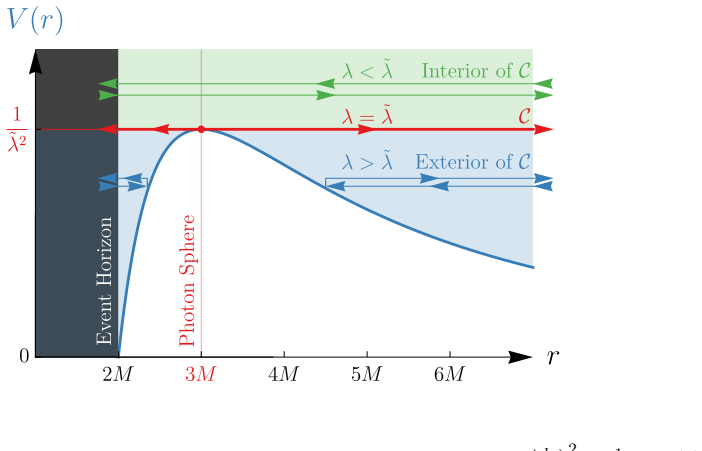
The load-bearing object is the photon ring as a locus in geodesic phase space, defined by $\delta r = r - \tilde r_\pm = 0$ and $\delta\lambda = \lambda - \tilde\lambda_\pm = 0$, meaning radial position and specific angular momentum are simultaneously critical. Around this locus the wave equation reduces to an inverted harmonic oscillator, and the QNM frequencies are fixed by two per-ring parameters: the angular velocity $\tilde\Omega_\pm = 1/\tilde\lambda_\pm$ and the time Lyapunov exponent $\gamma_{L\pm}$. The exact wave equation is solved by hypergeometric functions, and the eikonal spectrum is rederived by a Penrose limit into the ring, by the highest-weight representation of the emergent $SL(2,\mathbb{R})$ quasinormal algebra, and by null-geodesic geometric optics; all four derivations agree. This reproduces the known Kerr relation (2.20) in a setting where it can be checked exactly.
What would settle it
Compute the scalar quasinormal-mode spectrum of the warped AdS3 black hole under a boundary condition at infinity actually dictated by a candidate holographic dual, such as the warped conformal boundary conditions, rather than chosen so that the Kerr relation holds, and check whether the eikonal frequencies still equal $\tilde\Omega_\pm k - i(n+\tfrac{1}{2})\gamma_{L\pm}$ with the geometric photon-ring parameters; equally decisive would be showing that the finite-flux modes, claimed to be governed by the inner photon ring behind the inner horizon, cannot be excited by any causal exterior process.
Extended reading notes
Core claim
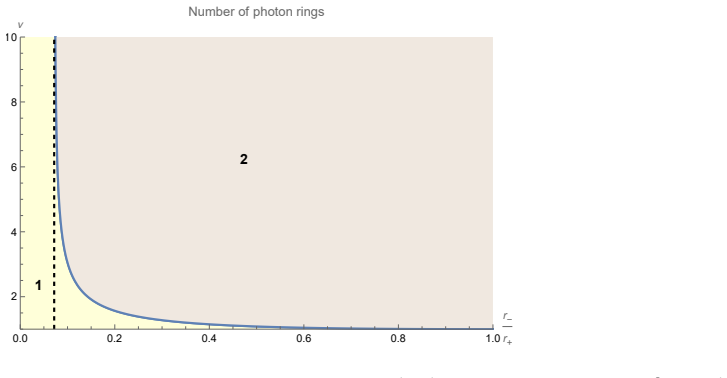
The central claim is that in a warped AdS3 black hole, the eikonal quasinormal-mode spectrum is exactly governed by the photon ring, in the same way the Kerr photon shell geometrizes the high-frequency Kerr QNM spectrum. Concretely, the exact resonant frequencies reduce to $\omega \approx \tilde\Omega_\pm k - i(n+\tfrac{1}{2})\gamma_{L\pm}$ at large $k$, with the sign $\pm$ labeling the outer photon ring ($\tilde r_+ > r_+$) and the inner photon ring ($\tilde r_- < r_-$, inside the inner horizon). The paper shows that the choice of boundary condition at infinity is what selects the ring: standard outgoing-at-infinity modes are controlled by the outer ring, while finite-flux or Dirichlet modes are controlled by the inner ring. The match is demonstrated in four independent ways—from the exact hypergeometric wave solution, from the Penrose limit of the near-ring geometry, from an emergent $SL(2,\mathbb{R})$ quasinormal symmetry, and from geometric optics—and in the extremal and near-extremal limits the spectrum reduces to the earlier self-dual warped AdS3 result. The paper leaves the dual warped-CFT computation to future work, so the holographic half of the correspondence is not yet closed.
Load-bearing premise
The paper's photon-ring/QNM correspondence rests on choosing quasinormal-mode boundary conditions at infinity in a spacetime that is not conformally complete; the authors explicitly pick the boundary condition so that the Kerr relation continues to hold, and different reasonable choices (outgoing versus finite-flux) give different photon rings, with the inner-ring modes sitting behind the inner horizon.
Editorial extensions
If this is right
- For any warped AdS3 black hole, the full eikonal ringdown is determined by two numbers per photon ring, the angular velocity and Lyapunov exponent; no other horizon or boundary data enter.
- Which photon ring appears in the eikonal spectrum is a diagnostic of the boundary condition, so measuring the real and imaginary parts of high-overtone modes could distinguish candidate holographic boundary conditions.
- The extremal and near-extremal limits reproduce the self-dual warped AdS3 spectrum, showing that the correspondence survives through the throat limit continuously.
- In the unwarped BTZ limit the photon ring is pushed to infinity and the spectrum degenerates, which explains why the BTZ toy model could not exhibit a photon-ring/QNM link.
Reading between the lines
- If a consistent warped-CFT dual is found, its Ruelle resonances should match one of the two eikonal branches; the inner-ring branch would then be a prediction about a causally inaccessible region that the dual theory may nonetheless encode.
- The inner photon ring's role suggests a general lesson for Kerr: near-extremal holography may need to track both the outer photon shell and the near-horizon throat orbits, not just the NHEKline.
- A sharper test is to perturb the warped AdS3 black hole with gravitational or higher-spin fields; the eikonal formula should survive with spin subleading, as it does in Kerr, which would check whether the correspondence is field-universal.
- The non-commutativity of the BTZ and eikonal limits noted in Appendix A hints that photon-ring data are erased at the unwarped point, so any holographic dictionary built on the photon ring will have a discontinuity in parameter space.
Editorial analysis
A structured set of objections, weighed in public.
Referee Report
Summary. The paper studies the massless scalar wave equation on the warped AdS3 black hole (3.1) and claims that, in the eikonal limit, the quasinormal-mode spectrum is exactly governed by the black hole's photon ring: the real part of the frequency equals the orbital angular velocity of the ring and the imaginary part equals the Lyapunov exponent, in analogy with the Kerr relation (2.20). The authors solve the radial equation exactly in terms of hypergeometric functions, obtain the eikonal spectra in Eqs. (3.59) and (3.64), and reproduce them by four independent methods: the Penrose limit (Sec. 3.3), a near-ring conformal symmetry analysis (Sec. 3.4), geometric optics (Sec. 3.5), and the exact hypergeometric result. They also study the extremal and near-extremal limits (Sec. 3.7) and compare with the BTZ limit in Appendix A. The central observation is that two different boundary conditions at infinity select two different photon rings: outgoing-at-infinity modes are governed by the outer ring, while finite-flux/Dirichlet modes are governed by an inner ring located behind the inner horizon.
Significance. If the claimed correspondence holds, the paper provides a rare fully analytic toy model where the photon ring, the eikonal QNM spectrum, and a possible holographic dual (warped CFT) can be placed on a common footing. The technical strengths are substantial: the hypergeometric solution is explicit, the photon-ring parameters Ω± and γL± are derived directly from the metric rather than fitted, and four independent derivations agree with each other and with the exact eikonal limit. The paper is also commendably transparent about its assumptions. However, the advertised photon-ring/QNM correspondence is conditional on a choice of boundary conditions at infinity, and that choice is not justified by an independent physical or holographic principle. The finite-flux/Dirichlet alternative produces a spectrum governed by a ring inside the inner horizon, which is causally inaccessible to external observers; the paper even states that the outgoing condition gives divergent flux. The central claim is therefore defensible only as a conditional statement, and the manuscript's conclusions are stronger than the evidence establishes.
major comments (4)
- [Sec. 3, p. 22] The boundary condition that selects the outer photon ring is chosen by fiat. The paper states: 'we will identify a choice of resonant boundary conditions that provide a reasonable definition of QNMs, such that the familiar relation (2.20) from Kerr between the eikonal QNM spectrum and the black hole photon ring continues to hold.' Since the spacetime is not conformally complete, as the paper itself notes, the standard Kerr-like notion of a QNM is not forced. The finite-flux/Dirichlet condition is equally natural and yields the opposite association. The manuscript therefore demonstrates a conditional correspondence rather than establishing that the photon ring governs the QNM spectrum; the reader is left without an independent reason to prefer the outgoing condition.
- [Sec. 3.2, Eq. (3.51)] The 'usual QNM boundary conditions' are not satisfied in the standard sense. Imposing purely outgoing waves at infinity (Q_+ = 0) leads to a divergent flux at infinity, as shown in Eq. (3.51) and admitted in the text. Thus the modes whose eikonal limit is Eq. (3.59) are not QNMs under the finite-flux definition that is standard in flat and AdS spacetimes. Calling both choices 'equally reasonable' is not supported by an argument; this is a load-bearing ambiguity because the central claim concerns which ring governs the physical ringdown spectrum.
- [Sec. 3.2.2, Eqs. (3.9) and (3.64)] The finite-flux/Dirichlet spectrum is governed by the inner photon ring at r̃_- < r_- (Eq. (3.9)), which lies behind the inner horizon and is causally inaccessible to exterior observers. If the correct holographic or physical boundary condition is the finite-flux/Dirichlet one, the advertised outer-ring correspondence fails, and the alternative spectrum is tied to a ring that no external observer can probe. The paper does not provide a physical or holographic argument ruling out this alternative, so the outer-ring claim remains conditional.
- [Secs. 3.3, 3.4, 3.5] The four derivations presented as independent checks do not resolve the boundary-condition ambiguity. The Penrose-limit derivation, the near-ring conformal symmetry analysis, and the geometric-optics derivation all implement the same outgoing-wave selection that was already used in Sec. 3.2, and all recover the same eikonal spectrum (3.59) or (3.64). They are therefore internal consistency checks of the exact computation, not independent evidence that the outgoing condition is the correct one. The conditional status of the central claim is unaffected by the agreement among these methods.
minor comments (4)
- [Sec. 3.2.1, Eq. (3.56)] The notation sign(k) in the exact frequency formulas should be defined explicitly, since k can be negative and the eikonal limit requires a choice of branch; this is clear from context but would benefit from a sentence.
- [Sec. 3.2, Eqs. (3.61) and (3.66)] The statement that the purely imaginary modes 'have no eikonal limit' is coordinate-dependent, as the quadratic-ensemble comparison in Appendix A demonstrates. Please add a clarifying remark noting that the existence of a real part in the eikonal limit depends on the coordinate choice.
- [Appendix A, after Eq. (A.11)] The discussion of the discrepancy with Ref. [50] is left open ('This apparent discrepancy deserves further clarification'). If this is not resolved in the present work, it should at least be flagged more prominently in the conclusions as an unresolved issue.
- [Sec. 2.11] The paper states that the dual CFT computation is not performed and is left for future work. This is fine, but the abstract and title may oversell the 'holographic' status of the result; the holographic interpretation remains programmatic until such a computation exists.
Circularity Check
No significant circularity: the eikonal QNM spectra are derived from the exact hypergeometric wave equation and match independently computed photon-ring parameters.
full rationale
The central match is not fitted. In Sec. 3.2 the massless scalar equation (3.28) is solved exactly; the hypergeometric parameters A, B, C in (3.33) contain only omega, k, and metric parameters, and the QNM conditions (3.53)-(3.65) are algebraic quantization conditions. The photon-ring quantities Omega_tilde_plus/minus and gamma_L_plus/minus are derived separately in Sec. 3.1 from V=V'=0, Eq. (3.6), and geodesic deviation, Eqs. (3.14), (3.25). The eikonal limits (3.59) and (3.64) follow by expanding the exact solutions, not by substituting (2.20) into the wave equation. The only a priori element is the choice of boundary condition at infinity: the paper states explicitly that WAdS3 is not conformally complete and that it will select resonant conditions 'such that the familiar relation (2.20) from Kerr between the eikonal QNM spectrum and the black hole photon ring continues to hold' (Sec. 3, p.22). This is a definitional ambiguity, and the paper considers both outgoing and finite-flux/Dirichlet conditions, attributing the outer-ring spectrum to the former and the inner-ring spectrum to the latter. Since both spectra are derived from the same exact solution and the alternative is exhibited, this is a conditional limitation rather than a circular reduction. Self-citations [18] and [19] provide context and the extremal comparison, but Sec. 3.7 recovers [19] by an independent near-horizon computation. No parameter is fitted and no advertised result is assumed as an input.
Assumptions & free parameters
assumptions (5)
- domain assumption The warped AdS3 black hole metric (3.1) is a valid spacetime and the restriction ν > 1 avoids closed timelike curves.
- domain assumption The massless scalar wave equation captures the eikonal QNM spectrum; spin effects are subleading.
- standard math The Penrose limit of the photon ring yields the exact eikonal QNM spectrum, as established in [96].
- domain assumption The WAdS3 black hole is not conformally complete, so QNM boundary conditions at infinity are ambiguous; the paper's two choices are reasonable.
- standard math Hypergeometric function connection formulas and special function identities used in Sec. 3.2 are correct.
Cite this review
Pith. "Pith review of Photon rings in a holographic toy model." pith.science (2026). https://pith.science/paper/VAOLZZOR
@misc{pith2026250607989,
  author       = {Pith},
  title        = {Pith review of: Photon rings in a holographic toy model},
  year         = {2026},
  howpublished = {\url{https://pith.science/paper/VAOLZZOR}},
  note         = {Machine review of arXiv:2506.07989}
}
abstract
Light circling around an astrophysical black hole can spend a long time skirting its unstably bound photon orbits before escaping to infinity. To a distant observer, this orbiting light would appear as a bright ring encircling the image of the black hole. Though not yet resolved by radio-interferometric observations from the ground, this ``photon ring'' will be the target of future space-based black hole observations. Motivated by this experimental prospect, studies have sought to elucidate the theoretical connections between the photon ring -- an observable, classical effect -- and the putative holographic description of black holes in quantum gravity. General relativity predicts that the detailed structure of the photon ring encodes the high-frequency (eikonal) spectrum of quasinormal modes (QNMs) emitted by a perturbed black hole as it rings down, and also that the photon ring displays an emergent conformal symmetry that acts upon this spectrum. In holography, the classical QNM frequencies are expected to map to Ruelle resonances of the dual quantum theory. In this paper, we explore these connections in a lower-dimensional toy model based on Warped AdS$_3$ black holes that shares many features with the (3+1)-dimensional Kerr background -- including a photon ring at finite radius -- while still providing analytic control of the QNM frequencies.
Figures


Figures from the paper (4 more)


Reference graph
Works this paper leans on
-
[1]
E. H. T. Collaboration,First m87 event horizon telescope results. i. the shadow of the supermassive black hole,The Astrophysical Journal Letters875(apr, 2019) L1
2019
-
[2]
E. H. T. Collaboration,First sagittarius a* event horizon telescope results. i. the shadow of the supermassive black hole in the center of the milky way,The Astrophysical Journal Letters930(may, 2022) L12
2022
-
[3]
M. D. Johnsonet. al.,The Black Hole Explorer: motivation and vision,Proc. SPIE Int. Soc. Opt. Eng.13092(2024) 130922D [2406.12917]
arXiv 2024
-
[4]
A. Lupsasca, A. C´ ardenas-Avenda˜ no, D. C. M. Palumbo, M. D. Johnson, S. E. Gralla, D. P. Marrone, P. Galison, P. Tiede and L. Keeble,The Black Hole Explorer: Photon Ring Science, Detection and Shape Measurement,2406.09498
-
[5]
S. E. Gralla, D. E. Holz and R. M. Wald,Black Hole Shadows, Photon Rings, and Lensing Rings,Phys. Rev. D100(2019), no. 2 024018 [1906.00873]
arXiv 2019
-
[6]
M. D. Johnsonet. al.,Universal interferometric signatures of a black hole’s photon ring, Sci. Adv.6(2020), no. 12 eaaz1310 [1907.04329]
arXiv 2020
-
[7]
How narrow is the M87* ring? II. A new geometric model
W. Lockhart and S. E. Gralla,How narrow is the M87* ring – II. A new geometric model, Mon. Not. Roy. Astron. Soc.517(2022), no. 2 2462–2470 [2208.09989]
work page Pith review arXiv 2022
-
[8]
P. Tiede, M. D. Johnson, D. W. Pesce, D. C. M. Palumbo, D. O. Chang and P. Galison, Measuring Photon Rings with the ngEHT,Galaxies10(2022), no. 6 111 [2210.13498]. [9]LIGO Scientific, VirgoCollaboration, B. P. Abbottet. al.,Observation of Gravitational Waves from a Binary Black Hole Merger,Phys. Rev. Lett.116(2016), no. 6 061102 [1602.03837]. [10]VIRGOCol...
arXiv 2022
Show all 101 references
-
[11]
K. D. Kokkotas and B. G. Schmidt,Quasinormal modes of stars and black holes,Living Rev. Rel.2(1999) 2 [gr-qc/9909058]
1999 arXiv
-
[12]
Nollert,TOPICAL REVIEW: Quasinormal modes: the characteristic ‘sound’ of black holes and neutron stars,Class
H.-P. Nollert,TOPICAL REVIEW: Quasinormal modes: the characteristic ‘sound’ of black holes and neutron stars,Class. Quant. Grav.16(1999) R159–R216
1999
-
[13]
Berti, V
E. Berti, V. Cardoso and A. O. Starinets,Quasinormal modes of black holes and black branes,Class. Quant. Grav.26(2009) 163001 [0905.2975]
2009 arXiv
-
[14]
E. Bertiet. al.,Black hole spectroscopy: from theory to experiment,2505.23895
-
[15]
’t Hooft,Dimensional reduction in quantum gravity,Conf
G. ’t Hooft,Dimensional reduction in quantum gravity,Conf. Proc. C930308(1993) 284–296 [gr-qc/9310026]
1993 arXiv
-
[16]
Susskind,The World as a hologram,J
L. Susskind,The World as a hologram,J. Math. Phys.36(1995) 6377–6396 [hep-th/9409089]. 48
1995 arXiv
-
[17]
J. M. Maldacena,The Large N limit of superconformal field theories and supergravity,Adv. Theor. Math. Phys.2(1998) 231–252 [hep-th/9711200]
1998 arXiv
-
[18]
Hadar, D
S. Hadar, D. Kapec, A. Lupsasca and A. Strominger,Holography of the photon ring,Class. Quant. Grav.39(2022), no. 21 215001 [2205.05064]
2022 arXiv
-
[19]
Kapec, A
D. Kapec, A. Lupsasca and A. Strominger,Photon rings around warped black holes,Class. Quant. Grav.40(2023), no. 9 095006 [2211.01674]
2023 arXiv
-
[20]
Dodelson and H
M. Dodelson and H. Ooguri,Singularities of thermal correlators at strong coupling,Phys. Rev. D103(2021), no. 6 066018 [2010.09734]
2021 arXiv
-
[21]
Dodelson and A
M. Dodelson and A. Zhiboedov,Gravitational orbits, double-twist mirage, and many-body scars,JHEP12(2022) 163 [2204.09749]
2022 arXiv
-
[22]
Dodelson, C
M. Dodelson, C. Iossa, R. Karlsson, A. Lupsasca and A. Zhiboedov,Black hole bulk-cone singularities,JHEP07(2024) 046 [2310.15236]
2024 arXiv
-
[23]
Guica, T
M. Guica, T. Hartman, W. Song and A. Strominger,The Kerr/CFT Correspondence,Phys. Rev. D80(2009) 124008 [0809.4266]
2009 arXiv
-
[24]
El-Showk and M
S. El-Showk and M. Guica,Kerr/CFT, dipole theories and nonrelativistic CFTs,JHEP12 (2012) 009 [1108.6091]
2012 arXiv
-
[25]
Guica,An integrable Lorentz-breaking deformation of two-dimensional CFTs,SciPost Phys.5(2018), no
M. Guica,An integrable Lorentz-breaking deformation of two-dimensional CFTs,SciPost Phys.5(2018), no. 5 048 [1710.08415]
2018 arXiv
-
[26]
Detournay, T
S. Detournay, T. Hartman and D. M. Hofman,Warped Conformal Field Theory,Phys.Rev. D86(2012) 124018 [1210.0539]
2012 arXiv
-
[27]
R. A. Konoplya and A. Zhidenko,Quasinormal modes of black holes: From astrophysics to string theory,Rev. Mod. Phys.83(2011) 793–836 [1102.4014]
2011 arXiv
-
[28]
Motl,An Analytical computation of asymptotic Schwarzschild quasinormal frequencies, Adv
L. Motl,An Analytical computation of asymptotic Schwarzschild quasinormal frequencies, Adv. Theor. Math. Phys.6(2003) 1135–1162 [gr-qc/0212096]
2003 arXiv
-
[29]
Motl and A
L. Motl and A. Neitzke,Asymptotic black hole quasinormal frequencies,Adv. Theor. Math. Phys.7(2003), no. 2 307–330 [hep-th/0301173]
2003 arXiv
-
[30]
Kapec and A
D. Kapec and A. Sheta,pp-Waves and the Hidden Symmetries of Black Hole Quasinormal Modes,2412.08551
-
[31]
Banados, C
M. Banados, C. Teitelboim and J. Zanelli,The Black hole in three-dimensional space-time, Phys. Rev. Lett.69(1992) 1849–1851 [hep-th/9204099]
1992 arXiv
-
[32]
Banados, M
M. Banados, M. Henneaux, C. Teitelboim and J. Zanelli,Geometry of the (2+1) black hole, Phys. Rev.D48(1993) 1506–1525 [gr-qc/9302012]. [Erratum: Phys. Rev.D88,069902(2013)]
1993 arXiv
-
[33]
S. S. Gubser, I. R. Klebanov and A. M. Polyakov,Gauge theory correlators from noncritical string theory,Phys. Lett. B428(1998) 105–114 [hep-th/9802109]. 49
1998 arXiv
-
[34]
Witten,Anti-de Sitter space and holography,Adv
E. Witten,Anti-de Sitter space and holography,Adv. Theor. Math. Phys.2(1998) 253–291 [hep-th/9802150]
1998 arXiv
-
[35]
Strominger,Black hole entropy from near horizon microstates,JHEP02(1998) 009 [hep-th/9712251]
A. Strominger,Black hole entropy from near horizon microstates,JHEP02(1998) 009 [hep-th/9712251]
1998 arXiv
-
[36]
Hartman, C
T. Hartman, C. A. Keller and B. Stoica,Universal Spectrum of 2d Conformal Field Theory in the Large c Limit,JHEP09(2014) 118 [1405.5137]
2014 arXiv
-
[37]
Birmingham, I
D. Birmingham, I. Sachs and S. N. Solodukhin,Conformal field theory interpretation of black hole quasinormal modes,Phys. Rev. Lett.88(2002) 151301 [hep-th/0112055]
2002 arXiv
-
[38]
Birmingham,Choptuik scaling and quasinormal modes in the AdS / CFT correspondence,Phys
D. Birmingham,Choptuik scaling and quasinormal modes in the AdS / CFT correspondence,Phys. Rev. D64(2001) 064024 [hep-th/0101194]
2001 arXiv
-
[39]
O. J. C. Dias, H. S. Reall and J. E. Santos,The BTZ black hole violates strong cosmic censorship,JHEP12(2019) 097 [1906.08265]
2019 arXiv
-
[40]
Anninos, W
D. Anninos, W. Li, M. Padi, W. Song and A. Strominger,Warped AdS(3) Black Holes, JHEP0903(2009) 130 [0807.3040]
2009 arXiv
-
[41]
K. A. Moussa, G. Clement and C. Leygnac,The Black holes of topologically massive gravity, Class. Quant. Grav.20(2003) L277–L283 [gr-qc/0303042]
2003 arXiv
-
[42]
Nutku,Exact solutions of topologically massive gravity with a cosmological constant, Class
Y. Nutku,Exact solutions of topologically massive gravity with a cosmological constant, Class. Quant. Grav.10(1993) 2657–2661
1993
-
[43]
Gurses,Perfect Fluid Sources in 2+1 Dimensions,Class
M. Gurses,Perfect Fluid Sources in 2+1 Dimensions,Class. Quant. Grav.11(1994), no. 10 2585
1994
-
[44]
Detournay, D
S. Detournay, D. Orlando, P. M. Petropoulos and P. Spindel,Three-dimensional black holes from deformed anti-de Sitter,JHEP07(2005) 072 [hep-th/0504231]
2005 arXiv
-
[45]
Jugeau, G
F. Jugeau, G. Moutsopoulos and P. Ritter,From accelerating and Poincare coordinates to black holes in spacelike warped AdS 3, and back,Class. Quant. Grav.28(2011) 035001 [1007.1961]
2011 arXiv
-
[46]
Bieliavsky, P
P. Bieliavsky, P. Spindel and R. Wutte,Aspects of Warped AdS 3 geometries,2410.09688
-
[47]
Comp` ere, M
G. Comp` ere, M. Guica and M. J. Rodriguez,Two Virasoro symmetries in stringy warped AdS3,JHEP12(2014) 012 [1407.7871]
2014 arXiv
-
[48]
Apolo and W
L. Apolo and W. Song,Strings on warped AdS 3 viaT ¯Jdeformations,JHEP10(2018) 165 [1806.10127]
2018 arXiv
-
[49]
Chen and Z.-b
B. Chen and Z.-b. Xu,Quasinormal modes of warped AdS(3) black holes and AdS/CFT correspondence,Phys. Lett. B675(2009) 246–251 [0901.3588]
2009 arXiv
-
[50]
V. L. Martin, R. Poddar and A. Th´ orarinsd´ ottir,A Selberg zeta function for warped AdS3 black holes,JHEP01(2023) 049 [2210.01118]. 50
2023 arXiv
-
[51]
J. M. Bardeen,Timelike and null geodesics in the Kerr metric,Proceedings, Ecole d’Et´ e de Physique Th´ eorique: Les Astres Occlus : Les Houches, France, August, 1972, 215-240 (1973) 215–240
1973
-
[52]
Teo,Spherical Photon Orbits Around a Kerr Black Hole,Gen
E. Teo,Spherical Photon Orbits Around a Kerr Black Hole,Gen. Rel. Grav.35(2003), no. 11 1909–1926
2003
-
[53]
J. M. Bardeen, W. H. Press and S. A. Teukolsky,Rotating black holes: Locally nonrotating frames, energy extraction, and scalar synchrotron radiation,Astrophys. J.178(1972) 347
1972
-
[54]
Raffaelli,Hidden conformal symmetry on the black hole photon sphere,JHEP03(2022) 125 [2112.12543]
B. Raffaelli,Hidden conformal symmetry on the black hole photon sphere,JHEP03(2022) 125 [2112.12543]
2022 arXiv
-
[55]
J. P. Luminet,Image of a spherical black hole with thin accretion disk,Astron. Astrophys. 75(1979) 228–235
1979
-
[56]
Marck,Shortcut method of solution of geodesic equations for Schwarzschild black hole, Class
J.-A. Marck,Shortcut method of solution of geodesic equations for Schwarzschild black hole, Class. Quant. Grav.13(1996) 393–402 [gr-qc/9505010]
1996 arXiv
-
[57]
S. E. Gralla, A. Lupsasca and A. Strominger,Observational Signature of High Spin at the Event Horizon Telescope,Mon. Not. Roy. Astron. Soc.475(2018), no. 3 3829–3853 [1710.11112]
2018 arXiv
-
[58]
S. E. Gralla and A. Lupsasca,Observable shape of black hole photon rings,Phys. Rev. D 102(2020), no. 12 124003 [2007.10336]
2020 arXiv
-
[59]
S. E. Gralla and A. Lupsasca,Null geodesics of the Kerr exterior,Phys. Rev. D101(2020), no. 4 044032 [1910.12881]
2020 arXiv
-
[60]
J. M. Bardeen and G. T. Horowitz,The Extreme Kerr throat geometry: A Vacuum analog of AdS(2) x S**2,Phys. Rev. D60(1999) 104030 [hep-th/9905099]
1999 arXiv
-
[61]
Kapec and A
D. Kapec and A. Lupsasca,Particle motion near high-spin black holes,Class. Quant. Grav. 37(2020), no. 1 015006 [1905.11406]
2020 arXiv
-
[62]
Carter,Hamilton-Jacobi and Schr¨ odinger separable solutions of Einstein ’s equations, Communications in Mathematical Physics10(1968), no
B. Carter,Hamilton-Jacobi and Schr¨ odinger separable solutions of Einstein ’s equations, Communications in Mathematical Physics10(1968), no. 4 280 – 310
1968
-
[63]
Kinnersley,Type D Vacuum Metrics,J
W. Kinnersley,Type D Vacuum Metrics,J. Math. Phys.10(1969) 1195–1203
1969
-
[64]
Bredberg, T
I. Bredberg, T. Hartman, W. Song and A. Strominger,Black Hole Superradiance From Kerr/CFT,JHEP04(2010) 019 [0907.3477]
2010 arXiv
-
[65]
S. E. Gralla, A. Lupsasca and A. Strominger,Near-horizon Kerr Magnetosphere,Phys. Rev. D93(2016), no. 10 104041 [1602.01833]
2016 arXiv
-
[66]
Lupsasca, D
A. Lupsasca, D. R. Mayerson, B. Ripperda and S. Staelens,A Beginner’s Guide to Black Hole Imaging and Associated Tests of General Relativity, pp. 183–237. Springer, Singapore, 2024.2402.01290
2024
-
[67]
S. E. Gralla and A. Lupsasca,Lensing by Kerr Black Holes,Phys. Rev. D101(2020), no. 4 044031 [1910.12873]. 51
2020 arXiv
-
[68]
H. Yang, D. A. Nichols, F. Zhang, A. Zimmerman, Z. Zhang and Y. Chen, Quasinormal-mode spectrum of Kerr black holes and its geometric interpretation,Phys. Rev. D86(2012) 104006 [1207.4253]
2012 arXiv
-
[69]
E. W. Leaver,An Analytic representation for the quasi normal modes of Kerr black holes, Proc. Roy. Soc. Lond. A402(1985) 285–298
1985
-
[70]
Ferrari and B
V. Ferrari and B. Mashhoon,New approach to the quasinormal modes of a black hole,Phys. Rev. D30(1984) 295–304
1984
-
[71]
Mashhoon,Stability of charged rotating black holes in the eikonal approximation,Phys
B. Mashhoon,Stability of charged rotating black holes in the eikonal approximation,Phys. Rev. D31(1985), no. 2 290–293
1985
-
[72]
Iyer and C
S. Iyer and C. M. Will,Black Hole Normal Modes: A WKB Approach. 1. Foundations and Application of a Higher Order WKB Analysis of Potential Barrier Scattering,Phys. Rev. D 35(1987) 3621
1987
-
[73]
Iyer,Black Hole Normal Modes: A WKB Approach
S. Iyer,Black Hole Normal Modes: A WKB Approach. 2. Schwarzschild black holes,Phys. Rev. D35(1987) 3632
1987
-
[74]
Aharony, S
O. Aharony, S. S. Gubser, J. M. Maldacena, H. Ooguri and Y. Oz,Large N field theories, string theory and gravity,Phys. Rept.323(2000) 183–386 [hep-th/9905111]
2000 arXiv
-
[75]
S. S. Gubser and I. R. Klebanov,Absorption by branes and Schwinger terms in the world volume theory,Phys. Lett. B413(1997) 41–48 [hep-th/9708005]
1997 arXiv
-
[76]
Schomerus,Strings for Quantumchromodynamics,Conf
V. Schomerus,Strings for Quantumchromodynamics,Conf. Proc. C060726(2006) 151–161 [0706.1209]
2006 arXiv
-
[77]
J. D. Brown and M. Henneaux,Central Charges in the Canonical Realization of Asymptotic Symmetries: An Example from Three-Dimensional Gravity,Commun.Math.Phys.104 (1986) 207–226
1986
-
[78]
Strominger,The dS / CFT correspondence,JHEP10(2001) 034 [hep-th/0106113]
A. Strominger,The dS / CFT correspondence,JHEP10(2001) 034 [hep-th/0106113]
2001 arXiv
-
[79]
Carroll physics and flat space holography
D. Grumiller, “Carroll physics and flat space holography.” Talk at Strings 2025, Abu Dhabi,
2025
-
[80]
Raclariu,Lectures on Celestial Holography,2107.02075
A.-M. Raclariu,Lectures on Celestial Holography,2107.02075
-
[81]
Donnay,Celestial holography: An asymptotic symmetry perspective,Phys
L. Donnay,Celestial holography: An asymptotic symmetry perspective,Phys. Rept.1073 (2024) 1–41 [2310.12922]
2024 arXiv
-
[82]
J. M. Maldacena and A. Strominger,Black hole grey body factors and d-brane spectroscopy, Phys. Rev. D55(1997) 861–870 [hep-th/9609026]
1997 arXiv
-
[83]
Song and J
W. Song and J. Xu,Correlation Functions of Warped CFT,JHEP04(2018) 067 [1706.07621]
2018 arXiv
-
[84]
Festuccia and H
G. Festuccia and H. Liu,A Bohr-Sommerfeld quantization formula for quasinormal frequencies of AdS black holes,Adv. Sci. Lett.2(2009) 221–235 [0811.1033]. 52
2009 arXiv
-
[85]
Skenderis, M
K. Skenderis, M. Taylor and B. C. van Rees,Topologically Massive Gravity and the AdS/CFT Correspondence,JHEP09(2009) 045 [0906.4926]
2009 arXiv
-
[86]
Horava and C
P. Horava and C. M. Melby-Thompson,Anisotropic Conformal Infinity,Gen. Rel. Grav.43 (2011) 1391–1400 [0909.3841]
2011 arXiv
-
[87]
Bouchareb and G
A. Bouchareb and G. Clement,Black hole mass and angular momentum in topologically massive gravity,Class.Quant.Grav.24(2007) 5581–5594 [0706.0263]
2007 arXiv
-
[88]
Compere and S
G. Compere and S. Detournay,Centrally extended symmetry algebra of asymptotically Godel spacetimes,JHEP03(2007) 098 [hep-th/0701039]
2007 arXiv
-
[89]
Compere and S
G. Compere and S. Detournay,Boundary conditions for spacelike and timelike warpedAdS 3 spaces in topologically massive gravity,JHEP08(2009) 092 [0906.1243]
2009 arXiv
-
[90]
Blagojevic and B
M. Blagojevic and B. Cvetkovic,Asymptotic structure of topologically massive gravity in spacelike stretched AdS sector,JHEP09(2009) 006 [0907.0950]
2009 arXiv
-
[91]
Henneaux, C
M. Henneaux, C. Martinez and R. Troncoso,Asymptotically warped anti-de Sitter spacetimes in topologically massive gravity,Phys. Rev. D84(2011) 124016 [1108.2841]
2011 arXiv
-
[92]
E. T. Whittaker and G. N. Watson,A Course of Modern Analysis. Cambridge Mathematical Library. Cambridge University Press, 4 ed., 1996
1996
-
[93]
F. W. J. Olver, , D. W. Lozier, R. F. Boisvert and C. W. Clark,The NIST Handbook of Mathematical Functions. Cambridge Univ. Press, 2010
2010
-
[94]
Penrose,Any Space-Time has a Plane Wave as a Limit, pp
R. Penrose,Any Space-Time has a Plane Wave as a Limit, pp. 271–275. Springer Netherlands, Dordrecht, 1976
1976
-
[95]
Blau,Plane waves and penrose limits, 2011
M. Blau,Plane waves and penrose limits, 2011
2011
-
[96]
Fransen,Quasinormal modes from Penrose limits,Class
K. Fransen,Quasinormal modes from Penrose limits,Class. Quant. Grav.40(2023), no. 20 205004 [2301.06999]
2023 arXiv
-
[97]
Subramanyan, S
V. Subramanyan, S. S. Hegde, S. Vishveshwara and B. Bradlyn,Physics of the Inverted Harmonic Oscillator: From the lowest Landau level to event horizons,Annals Phys.435 (2021) 168470 [2012.09875]
2021 arXiv
-
[98]
Bonelli, C
G. Bonelli, C. Iossa, D. P. Lichtig and A. Tanzini,Exact solution of Kerr black hole perturbations via CFT2 and instanton counting: Greybody factor, quasinormal modes, and Love numbers,Phys. Rev. D105(2022), no. 4 044047 [2105.04483]
2022 arXiv
-
[99]
Detournay and C
S. Detournay and C. Zwikel,Phase transitions in warped AdS 3 gravity,JHEP05(2015) 074 [1504.00827]
2015 arXiv
-
[100]
Aggarwal, A
A. Aggarwal, A. Castro, S. Detournay and B. M¨ uhlmann,Near-extremal limits of warped black holes,SciPost Phys.15(2023), no. 3 083 [2304.10102]
2023 arXiv
-
[101]
Ciambelli, S
L. Ciambelli, S. Detournay and A. Somerhausen,New chiral gravity,Phys. Rev. D102 (2020), no. 10 106017 [2008.06793]. 53
2020 arXiv
-
[102]
Comp` ere, W
G. Comp` ere, W. Song and A. Strominger,New Boundary Conditions for AdS3,JHEP05 (2013) 152 [1303.2662]. 54
2013 arXiv
-
[2025]
Accessed: 2025-06-09
2025
Reviewed August 7, 2026 · model on record in the stance chip above.
Discussion (0). Sign in to comment.