REVIEW 5 major objections 5 minor 123 references
StyleTailor: Towards Personalized Fashion Styling via Hierarchical Negative Feedback
T0 review · 5 major / 5 minor · reviewed 2026-08-06 · deepseek-v4-flash
Pith's one-line read StyleTailor claims that turning failed garment searches and try-ons into corrective prompts improves personalized AI fashion styling on all four evaluation axes.
desk verdict A real and reasonably engineered agent pipeline for fashion styling, but the headline gains are inflated by circular VQAScore optimization; worth refereeing only if the authors add independent evaluation. read the letter →
The pith
A machine-rendered reading of the paper's core claim, the machinery that carries it, and where it could break.
The reading
What carries the argument
The load-bearing mechanism is the three-level negative-feedback loop: item-level VLM diagnosis that turns a rejected garment image into negation terms for re-search; outfit-level handoff of rejected sets as negative context to the next Design Expert, with acceptance decided by a geometric-mean VQAScore over garment components; and try-on-level VLM diagnosis injected as negative prompts into FLUX.1.Kontext regeneration. Candidate try-ons are also selected by CLIPScore between the masked generated region and the original garment. The loop is what converts a single-pass retrieve-then-generate pipeline into an iterative one.
What would settle it
Gather a hundred human raters, show each of the 64 test cases (user image plus paired descriptions) the baseline output and the StyleTailor output side by side, blind to condition, and ask which better matches the stated preference. If human preference fails to reproduce the 0.906-versus-0.650 gap in VQAScore, the main claim does not survive. A cheaper check: recompute Style Consistency with a multimodal alignment scorer that was not used anywhere in selection, and see whether the improvement over baseline persists.
Extended reading notes
Core claim
The paper's core claim is that failures can be made productive in agentic styling. The Designer and Consultant agents are not improved by fine-tuning; instead, every rejection—an ill-matched product image, an incoherent outfit, an implausible try-on—is run through a VLM that abstracts the problem into a short negative prompt ('wrong material', 'inconsistent gender'), and that prompt is aggregated with earlier counterexamples and injected into the next search or generation attempt. At item level the wrong image is rerun with negated cues; at outfit level the failed set is handed to the next, stronger expert as a negative example; at try-on level the failed synthesis is regenerated with the di
Load-bearing premise
The load-bearing premise is that VQAScore—used inside the system at both item and outfit gates and then reused as the Style Consistency evaluation metric—is an unbiased measure of whether the output actually matches the user's intended style.
Editorial extensions
If this is right
- If the claimed gains hold, agentic fashion styling can improve without any model training, purely by harvesting the agent's own rejected outputs as corrective context.
- The same three-level feedback pattern transfers to other retrieval-plus-generation tasks—interior design, outfit planning, gift recommendation—where a scorer can judge intermediate products.
- Outfit-level feedback can be read as a principled way to coordinate multiple large language models: order experts by capability and let failures escalate with accumulated negative context.
- The proposed four-metric suite gives a reusable benchmark for agent-driven fashion systems, not just for this agent.
- Because performance is inherited from the underlying VLMs and the FLUX.1.Kontext editor, StyleTailor's quality should scale up as those backbones improve, with no architectural change.
Reading between the lines
- The evaluation uses VQAScore both as the gate inside Designer and as the Style Consistency metric, so a portion of the reported gain may reflect the agent optimizing the scorer it is later judged by; an independent human-rating study is needed to know how much of the gap is real alignment.
- Aggregating outfit acceptance as a product of per-garment normalized scores assumes garment components contribute independently to outfit quality, which ignores color harmony and silhouette interplay—precisely the couplings outfit-level feedback is meant to capture.
- A testable extension: replace the VLM diagnosis step with an explicit instruction to name the single most salient mismatch, and count how often the abstracted negative prompt actually removes the failure mode on the next iteration—this would isolate the diagnostic prompt quality as a variable.
- The paper's cost and efficiency analysis suggests roughly 13 minutes and under a dime per full styling request, which makes the framework deployable enough that the feedback loop could be run interactively with a real user in the loop; the same loop could then learn from user rejections directly rather than from a VLM's guess about user intent.
Editorial analysis
A structured set of objections, weighed in public.
Referee Report
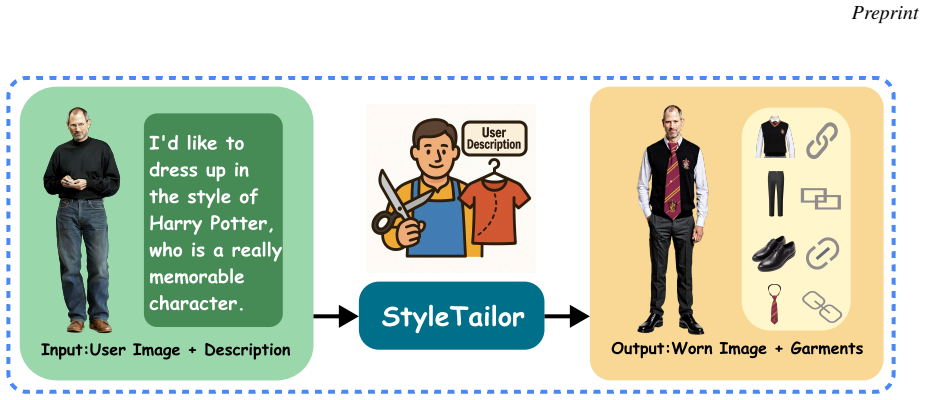
Summary. The paper proposes StyleTailor, an agentic pipeline for personalized fashion styling that integrates garment design interpretation, web retrieval, virtual try-on, and evaluation. The Designer uses a Style Interpreter and Shopping Advisor with item-level and outfit-level negative feedback, while the Consultant performs virtual try-on with FLUX.1.Kontext and try-on-level negative feedback. The authors evaluate on 64 LookBook images with four metrics (Style Consistency, Visual Quality, Face Similarity, VLM Artist) and report that StyleTailor outperforms its own no-feedback baseline, with additional ablations for each feedback level.
Significance. If the empirical claims hold, StyleTailor is a useful integration of agent-based retrieval and virtual try-on, and the hierarchical negative feedback idea is a plausible way to improve VLM-driven fashion workflows. The paper is transparent about implementation details, prompt templates, and per-module cost/efficiency, which is a strength. However, the central quantitative claim is currently not well supported because the main Style Consistency metric is also the optimization objective inside the pipeline, the comparison set contains no external state-of-the-art methods, and the 64-sample evaluation lacks uncertainty quantification. The framework is promising, but the evidence as presented is not yet at the level of a benchmark claim.
major comments (5)
- [Section 3.3 (Eqs. 3-4) and Section 4.2] The Style Consistency metric is VQAScore(I_K, V(I_0)+P), while the Designer explicitly maximizes VQAScore to select each garment (Eq. 3) and to accept an outfit (Eq. 4). The feedback loops run until VQAScore thresholds are met; the no-feedback baseline does not run these loops. The headline gain (Style Consistency 0.906 vs 0.650 in Table 1) therefore partly measures the amount of VQAScore optimization rather than alignment with user intent. This is load-bearing for the benchmark claim. The authors should add an independent evaluation (human preference study or a different scoring model not used anywhere in the pipeline) and report Style Consistency with a held-out evaluator/selection split.
- [Section 4.3 and Table 1] The section is titled "Comparison with State-of-the-art Methods," but the only comparator is the authors' own no-feedback ablation. No external VTON, retrieval, or agent baseline is included. The claim of "outperforming strong baselines" overstates the evidence. The authors should add at least one or two standard fashion virtual-try-on or recommendation methods, or, failing that, position the results as an ablation study rather than a SOTA comparison.
- [Section 4.1 and Table 1] The evaluation uses only 64 images and reports no error bars, confidence intervals, or significance tests. Several differences are small (e.g., VLM Artist 8.60 vs 8.41; Visual Quality 0.764 vs 0.767 for w/o Item-level feedback), and the ablation ranking is inconsistent (Face Similarity: baseline 0.362 vs w/o Try-on 0.351). Without per-sample results, paired tests, or confidence intervals, the quantitative conclusions are fragile. Please add uncertainty quantification and make per-sample scores available.
- [Appendix B and Section 4.2] The VLM Artist evaluator uses qwen-vl-max (App. B.4), and the item-level and try-on-level feedback mechanisms also use qwen-vl-max (App. B.2.2 and B.3). The aesthetic score may therefore partly reflect the system's success in satisfying the same model family that guided generation, which is a second, independent circularity. Use a different VLM family for evaluation or, preferably, human raters.
- [Appendix B] The thresholds tau (per garment category), omega, sigma (per garment category), the number of try-on candidates l, and the iteration limits are manually specified free parameters, with no sensitivity analysis or validation split. Because these parameters control how much feedback is applied, the ablated differences in Table 1 could reflect threshold choices rather than the feedback mechanism itself. Report a sensitivity sweep or otherwise justify the chosen values.
minor comments (5)
- [Throughout] Typos: "Harry Porter" should be "Harry Potter" (Fig. 1 and Appendix prompts); Fig. 3 label "Causal Pants" should likely be "Casual Pants"; "Accpetable" appears in the VLM Artist prompt (Appendix E.3).
- [Eq. (1)] The symbol K is used both for the number of garment categories and in the indexing of the expert sequence; define these two counts with different symbols to avoid confusion.
- [Appendix E.1.1] The prompt instructs the model to generate detailed clothing prompts "in Mandarin Chinese," while examples and the rest of the pipeline use English; clarify which language is expected.
- [Section 4.2] The Visual Quality metric is reported as a mean without specifying the exact IQAScore model variant/version used. Please add this detail for reproducibility.
- [Section 4.2] The VLM Artist returns four sub-scores (design, fit, coherence, mood) but the paper reports only the mean. Reporting sub-scores or their agreement would strengthen the evaluation.
Circularity Check
Style Consistency gains reduce in part to VQAScore maximization: the same VQAScore used to select garments (Eq. 3) and accept outfits (Eq. 4) is reused as the headline evaluation metric (§4.2); VLM Artist also uses the same model family that generated the feedback.
-
fitted input called prediction
[§3.3 (Shopping Advisor Eq. 3; outfit-level Eq. 4) vs. §4.2 (Style Consistency)]
"The best-matching image is selected as: g0 = arg max_{1≤i≤M} VQAScore(gi, d). ... For each generated garment Gi ... we compute a raw alignment score si = VQAScore(Gi, P) ... If the final score s0 exceeds an acceptance threshold ω, the result is accepted. ... we ... input the combined text along with the generated image to compute VQAScore(IK,(V(I0)+P))."
The headline Style Consistency metric in Tab. 1 is exactly the VQAScore function used inside the Designer to pick each garment (Eq. 3) and to accept/reject the outfit (Eq. 4). The no-feedback baseline does not run these VQAScore-maximizing item/outfit loops, so the reported gain (0.906 vs 0.650) partly measures how well the system optimized its own evaluation score, rather than an independent measure of alignment with user intent. The selection is fitted to the metric by construction, so the improvement on this column is partially forced.
-
other
[Appendix B.2.2, B.3, B.4]
"we set the item-level negative feedback mechanism VLM for providing suggestions as qwen-vl-max. ... we set the try-on-level negative feedback mechanism VLM for providing suggestions as qwen-vl-max. ... In the VLM Artist module, the VLM we use is qwen-vl-max."
The VLM Artist aesthetic score is produced by qwen-vl-max, the same model family that supplies the item-level and try-on-level negative feedback used to iteratively modify the outputs until thresholds are met. The baseline without feedback does not receive this same-model guidance, so the higher VLM Artist score (8.60 vs 7.35) is not an independent aesthetic judgment; to an unknown degree the evaluator is scoring outputs it helped generate.
full rationale
The core circularity is metric endogeneity rather than self-citation. The paper's central quantitative claim—that StyleTailor outperforms the no-feedback baseline on Style Consistency—is supported by reusing VQAScore as both the optimization target inside the Designer (Eqs. 3-4) and the evaluation metric in §4.2. Because the baseline does not execute the VQAScore-maximizing feedback loops, part of the improvement is locked in by construction. A secondary same-model issue affects the VLM Artist score, where qwen-vl-max both generates the item/try-on feedback and evaluates the final image. The remaining metrics (IQAScore, InsightFace) are external and show smaller, more plausible gains; the qualitative comparison is not itself circular. There are no load-bearing self-citations: refs. [11,12] are prior VTON works used as background, not as justification for the main result. The small dataset (64 images), lack of error bars, and absence of an external SOTA or human-preference comparison do not by themselves constitute circularity but they amplify the risk that the endogenous metric drives the headline conclusion. Overall: partial circularity in the central claim, score 6.
Assumptions & free parameters
free parameters (4)
- Item-level thresholds tau per garment category =
[0.7, 0.7, 0.7, 0.6, 0.6, 0.6, 0.6, 0.6]
- Outfit-level threshold omega =
0.65
- Try-on-level thresholds sigma per garment category =
[0.7, 0.7, 0.7, 0.5, 0.5, 0.6, 0.6, 0.6]
- Number of try-on candidates l =
3
assumptions (5)
- domain assumption FLUX.1.Kontext can perform the sequential garment replacement required by the framework with acceptable fidelity
- domain assumption VQAScore reliably measures visual-semantic alignment for garment images and full try-on images
- domain assumption OpenPose and HumanParsing masks correctly localize the target garment region for CLIPScore candidate selection
- domain assumption Web search over Amazon, Taobao, Walmart, and Etsy yields an adequate candidate pool for any style description
- domain assumption Increasing expert model capability (claude-sonnet-4, gemini-2.5-pro, llama-4-maverick, qwen-vl-max) improves outfit-level refinement
Cite this review
Pith. "Pith review of StyleTailor: Towards Personalized Fashion Styling via Hierarchical Negative Feedback." pith.science (2026). https://pith.science/paper/VATIMH4Q
@misc{pith2026250806555,
  author       = {Pith},
  title        = {Pith review of: StyleTailor: Towards Personalized Fashion Styling via Hierarchical Negative Feedback},
  year         = {2026},
  howpublished = {\url{https://pith.science/paper/VATIMH4Q}},
  note         = {Machine review of arXiv:2508.06555}
}
read the original abstract
The advancement of intelligent agents has revolutionized problem-solving across diverse domains, yet solutions for personalized fashion styling remain underexplored, which holds immense promise for promoting shopping experiences. In this work, we present StyleTailor, the first collaborative agent framework that seamlessly unifies personalized apparel design, shopping recommendation, virtual try-on, and systematic evaluation into a cohesive workflow. To this end, StyleTailor pioneers an iterative visual refinement paradigm driven by multi-level negative feedback, enabling adaptive and precise user alignment. Specifically, our framework features two core agents, i.e., Designer for personalized garment selection and Consultant for virtual try-on, whose outputs are progressively refined via hierarchical vision-language model feedback spanning individual items, complete outfits, and try-on efficacy. Counterexamples are aggregated into negative prompts, forming a closed-loop mechanism that enhances recommendation quality. To assess the performance, we introduce a comprehensive evaluation suite encompassing style consistency, visual quality, face similarity, and artistic appraisal. Extensive experiments demonstrate StyleTailor's superior performance in delivering personalized designs and recommendations, outperforming strong baselines without negative feedback and establishing a new benchmark for intelligent fashion systems.
Figures


Figures from the paper (2 more)


Reference graph
Works this paper leans on
-
[1]
Tom B. Brown, Benjamin Mann, Nick Ryder, Melanie Subbiah, Jared Kaplan, Prafulla Dhariwal, Arvind Nee- lakantan, Pranav Shyam, Girish Sastry, Amanda Askell, Sandhini Agarwal, Ariel Herbert-V oss, Gretchen Krueger, Tom Henighan, Rewon Child, Aditya Ramesh, Daniel M. Ziegler, Jeffrey Wu, Clemens Winter, Christopher Hesse, Mark Chen, Eric Sigler, Mateusz Lit...
2020
-
[2]
Llama: Open and efficient foundation language models, 2023
Hugo Touvron, Thibaut Lavril, Gautier Izacard, Xavier Martinet, Marie-Anne Lachaux, Timothée Lacroix, Baptiste Rozière, Naman Goyal, Eric Hambro, Faisal Azhar, Aurelien Rodriguez, Armand Joulin, Edouard Grave, and Guillaume Lample. Llama: Open and efficient foundation language models, 2023
2023
-
[3]
Agent ai: Surveying the horizons of multimodal interaction, 2024
Zane Durante, Qiuyuan Huang, Naoki Wake, Ran Gong, Jae Sung Park, Bidipta Sarkar, Rohan Taori, Yusuke Noda, Demetri Terzopoulos, Yejin Choi, Katsushi Ikeuchi, Hoi V o, Li Fei-Fei, and Jianfeng Gao. Agent ai: Surveying the horizons of multimodal interaction, 2024
2024
-
[4]
Qwen2.5 technical report, 2025
Qwen, :, An Yang, Baosong Yang, Beichen Zhang, Binyuan Hui, Bo Zheng, Bowen Yu, Chengyuan Li, Dayiheng Liu, Fei Huang, Haoran Wei, Huan Lin, Jian Yang, Jianhong Tu, Jianwei Zhang, Jianxin Yang, Jiaxi Yang, Jingren Zhou, Junyang Lin, Kai Dang, Keming Lu, Keqin Bao, Kexin Yang, Le Yu, Mei Li, Mingfeng Xue, Pei Zhang, Qin Zhu, Rui Men, Runji Lin, Tianhao Li,...
2025
-
[5]
Matchat: A large language model and application service platform for materials science.Chinese Physics B, 32(11):118104, November 2023
Chen Zi-Yi, Xie Fan-Kai, Wan Meng, Yuan Yang, Liu Miao, Wang Zong-Guo, Meng Sheng, and Wang Yan-Gang. Matchat: A large language model and application service platform for materials science.Chinese Physics B, 32(11):118104, November 2023. 9 Preprint
2023
-
[6]
Paper2code: Automating code generation from scientific papers in machine learning, 2025
Minju Seo, Jinheon Baek, Seongyun Lee, and Sung Ju Hwang. Paper2code: Automating code generation from scientific papers in machine learning, 2025
2025
-
[7]
Paper2poster: Towards multimodal poster automation from scientific papers, 2025
Wei Pang, Kevin Qinghong Lin, Xiangru Jian, Xi He, and Philip Torr. Paper2poster: Towards multimodal poster automation from scientific papers, 2025
2025
-
[8]
Woosung Koh, Janghan Yoon, MinHyung Lee, Youngjin Song, Jaegwan Cho, Jaehyun Kang, Taehyeon Kim, Se-Young Yun, Youngjae Yu, and Bongshin Lee.c2: Scalable auto-feedback for LLM-based chart generation. In Luis Chiruzzo, Alan Ritter, and Lu Wang, editors,Proceedings of the 2025 Conference of the Nations of the Americas Chapter of the Association for Computat...
2025
Show all 123 references
-
[9]
Foam-agent: Towards automated intelligent cfd workflows, 2025
Ling Yue, Nithin Somasekharan, Yadi Cao, and Shaowu Pan. Foam-agent: Towards automated intelligent cfd workflows, 2025
2025
-
[10]
Tryondiffusion: A tale of two unets
Luyang Zhu, Dawei Yang, Tyler Zhu, Fitsum Reda, William Chan, Chitwan Saharia, Mohammad Norouzi, and Ira Kemelmacher-Shlizerman. Tryondiffusion: A tale of two unets. InProceedings of the IEEE/CVF Conference on Computer Vision and Pattern Recognition (CVPR), pages 4606–4615, June 2023
2023
-
[11]
Imagdressing-v1: Customizable virtual dressing
Fei Shen, Xin Jiang, Xin He, Hu Ye, Cong Wang, Xiaoyu Du, Zechao Li, and Jinhui Tang. Imagdressing-v1: Customizable virtual dressing. InProceedings of the AAAI Conference on Artificial Intelligence, volume 39, pages 6795–6804, 2025
2025
-
[12]
Imaggarment-1: Fine-grained garment generation for controllable fashion design.arXiv preprint arXiv:2504.13176, 2025
Fei Shen, Jian Yu, Cong Wang, Xin Jiang, Xiaoyu Du, and Jinhui Tang. Imaggarment-1: Fine-grained garment generation for controllable fashion design.arXiv preprint arXiv:2504.13176, 2025
2025 arXiv
-
[13]
Towards mitigating hallucination in large language models via self-reflection, 2023
Ziwei Ji, Tiezheng Yu, Yan Xu, Nayeon Lee, Etsuko Ishii, and Pascale Fung. Towards mitigating hallucination in large language models via self-reflection, 2023
2023
-
[14]
Domain specialization as the key to make large language models disruptive: A comprehensive survey, 2024
Chen Ling, Xujiang Zhao, Jiaying Lu, Chengyuan Deng, Can Zheng, Junxiang Wang, Tanmoy Chowdhury, Yun Li, Hejie Cui, Xuchao Zhang, Tianjiao Zhao, Amit Panalkar, Dhagash Mehta, Stefano Pasquali, Wei Cheng, Haoyu Wang, Yanchi Liu, Zhengzhang Chen, Haifeng Chen, Chris White, Quanq...
2024
-
[15]
A survey on hallucination in large language models: Principles, taxonomy, challenges, and open questions.ACM Transactions on Information Systems, 43(2):1–55, January 2025
Lei Huang, Weijiang Yu, Weitao Ma, Weihong Zhong, Zhangyin Feng, Haotian Wang, Qianglong Chen, Weihua Peng, Xiaocheng Feng, Bing Qin, and Ting Liu. A survey on hallucination in large language models: Principles, taxonomy, challenges, and open questions.ACM Transactions on Info...
2025
-
[16]
Autoact: Automatic agent learning from scratch for qa via self-planning, 2024
Shuofei Qiao, Ningyu Zhang, Runnan Fang, Yujie Luo, Wangchunshu Zhou, Yuchen Eleanor Jiang, Chengfei Lv, and Huajun Chen. Autoact: Automatic agent learning from scratch for qa via self-planning, 2024
2024
-
[17]
Evaluating text-to-visual generation with image-to-text generation.arXiv preprint arXiv:2404.01291, 2024
Zhiqiu Lin, Deepak Pathak, Baiqi Li, Jiayao Li, Xide Xia, Graham Neubig, Pengchuan Zhang, and Deva Ramanan. Evaluating text-to-visual generation with image-to-text generation.arXiv preprint arXiv:2404.01291, 2024
2024 arXiv
-
[18]
IQA-PyTorch: Pytorch toolbox for image quality assessment
Chaofeng Chen and Jiadi Mo. IQA-PyTorch: Pytorch toolbox for image quality assessment. [Online]. Available: https://github.com/chaofengc/IQA-PyTorch, 2022
2022
-
[19]
Facial geometric detail recovery via implicit representation
Xingyu Ren, Alexandros Lattas, Baris Gecer, Jiankang Deng, Chao Ma, and Xiaokang Yang. Facial geometric detail recovery via implicit representation. In2023 IEEE 17th International Conference on Automatic Face and Gesture Recognition (FG), 2023
2023
-
[20]
ReAct: Synergizing reasoning and acting in language models
Shunyu Yao, Jeffrey Zhao, Dian Yu, Nan Du, Izhak Shafran, Karthik Narasimhan, and Yuan Cao. ReAct: Synergizing reasoning and acting in language models. InInternational Conference on Learning Representations (ICLR), 2023
2023
-
[21]
Expert- prompting: Instructing large language models to be distinguished experts, 2025
Benfeng Xu, An Yang, Junyang Lin, Quan Wang, Chang Zhou, Yongdong Zhang, and Zhendong Mao. Expert- prompting: Instructing large language models to be distinguished experts, 2025
2025
-
[22]
Pptagent: Generating and evaluating presentations beyond text-to-slides, 2025
Hao Zheng, Xinyan Guan, Hao Kong, Jia Zheng, Weixiang Zhou, Hongyu Lin, Yaojie Lu, Ben He, Xianpei Han, and Le Sun. Pptagent: Generating and evaluating presentations beyond text-to-slides, 2025
2025
-
[23]
Xu, Xiangru Tang, Mingchen Zhuge, Jiayi Pan, Yueqi Song, Bowen Li, Jaskirat Singh, Hoang H
Xingyao Wang, Boxuan Li, Yufan Song, Frank F. Xu, Xiangru Tang, Mingchen Zhuge, Jiayi Pan, Yueqi Song, Bowen Li, Jaskirat Singh, Hoang H. Tran, Fuqiang Li, Ren Ma, Mingzhang Zheng, Bill Qian, Yanjun Shao, Niklas Muennighoff, Yizhe Zhang, Binyuan Hui, Junyang Lin, Robert Brenna...
2025
-
[24]
Xintong Han, Zuxuan Wu, Zhe Wu, Ruichi Yu, and Larry S. Davis. Viton: An image-based virtual try-on network, 2018. 10 Preprint
2018
-
[25]
Xintong Han, Xiaojun Hu, Weilin Huang, and Matthew R. Scott. Clothflow: A flow-based model for clothed person generation. InProceedings of the IEEE/CVF International Conference on Computer Vision (ICCV), October 2019
2019
-
[26]
Uvton: Uv mapping to consider the 3d structure of a human in image-based virtual try-on network
Shizuma Kubo, Yusuke Iwasawa, Masahiro Suzuki, and Yutaka Matsuo. Uvton: Uv mapping to consider the 3d structure of a human in image-based virtual try-on network. InProceedings of the IEEE/CVF International Conference on Computer Vision (ICCV) Workshops, Oct 2019
2019
-
[27]
Swapnet: Garment transfer in single view images
Amit Raj, Patsorn Sangkloy, Huiwen Chang, Jingwan Lu, Duygu Ceylan, and James Hays. Swapnet: Garment transfer in single view images. InProceedings of the European Conference on Computer Vision (ECCV), September 2018
2018
-
[28]
Image based virtual try-on network from unpaired data
Assaf Neuberger, Eran Borenstein, Bar Hilleli, Eduard Oks, and Sharon Alpert. Image based virtual try-on network from unpaired data. InProceedings of the IEEE/CVF Conference on Computer Vision and Pattern Recognition (CVPR), June 2020
2020
-
[29]
Text2human: Text-driven controllable human image generation.ACM Transactions on Graphics (TOG), 41(4):1–11, 2022
Yuming Jiang, Shuai Yang, Haonan Qiu, Wayne Wu, Chen Change Loy, and Ziwei Liu. Text2human: Text-driven controllable human image generation.ACM Transactions on Graphics (TOG), 41(4):1–11, 2022
2022
-
[30]
Multimodal garment designer: Human-centric latent diffusion models for fashion image editing
Alberto Baldrati, Davide Morelli, Giuseppe Cartella, Marcella Cornia, Marco Bertini, and Rita Cucchiara. Multimodal garment designer: Human-centric latent diffusion models for fashion image editing. InProceedings of the IEEE/CVF International Conference on Computer Vision, 2023
2023
-
[31]
High-resolution image synthesis with latent diffusion models, 2021
Robin Rombach, Andreas Blattmann, Dominik Lorenz, Patrick Esser, and Björn Ommer. High-resolution image synthesis with latent diffusion models, 2021
2021
-
[32]
Adding conditional control to text-to-image diffusion models, 2023
Lvmin Zhang, Anyi Rao, and Maneesh Agrawala. Adding conditional control to text-to-image diffusion models, 2023
2023
-
[33]
Flux.1 kontext: Flow matching for in-context image generation and editing in latent space, 2025
Black Forest Labs, Stephen Batifol, Andreas Blattmann, Frederic Boesel, Saksham Consul, Cyril Diagne, Tim Dockhorn, Jack English, Zion English, Patrick Esser, Sumith Kulal, Kyle Lacey, Yam Levi, Cheng Li, Dominik Lorenz, Jonas Müller, Dustin Podell, Robin Rombach, Harry Saini,...
2025
-
[34]
Openpose: Realtime multi-person 2d pose estimation using part affinity fields.IEEE Transactions on Pattern Analysis and Machine Intelligence, 43(1):172–186, 2021
Zhe Cao, Gines Hidalgo, Tomas Simon, Shih-En Wei, and Yaser Sheikh. Openpose: Realtime multi-person 2d pose estimation using part affinity fields.IEEE Transactions on Pattern Analysis and Machine Intelligence, 43(1):172–186, 2021
2021
-
[35]
Realtime multi-person 2d pose estimation using part affinity fields, 2017
Zhe Cao, Tomas Simon, Shih-En Wei, and Yaser Sheikh. Realtime multi-person 2d pose estimation using part affinity fields, 2017
2017
-
[36]
Hand keypoint detection in single images using multiview bootstrapping, 2017
Tomas Simon, Hanbyul Joo, Iain Matthews, and Yaser Sheikh. Hand keypoint detection in single images using multiview bootstrapping, 2017
2017
-
[37]
Convolutional pose machines, 2016
Shih-En Wei, Varun Ramakrishna, Takeo Kanade, and Yaser Sheikh. Convolutional pose machines, 2016
2016
-
[38]
Self-correction for human parsing, 2019
Peike Li, Yunqiu Xu, Yunchao Wei, and Yi Yang. Self-correction for human parsing, 2019
2019
-
[39]
Clipscore: A reference-free evaluation metric for image captioning, 2022
Jack Hessel, Ari Holtzman, Maxwell Forbes, Ronan Le Bras, and Yejin Choi. Clipscore: A reference-free evaluation metric for image captioning, 2022
2022
-
[40]
Pixel-level domain transfer
Donggeun Yoo, Namil Kim, Sunggyun Park, Anthony S Paek, and In So Kweon. Pixel-level domain transfer. In European conference on computer vision, pages 517–532. Springer, 2016
2016
-
[41]
Topiq: A top-down approach from semantics to distortions for image quality assessment.IEEE Transactions on Image Processing, 33:2404–2418, 2024
Chaofeng Chen, Jiadi Mo, Jingwen Hou, Haoning Wu, Liang Liao, Wenxiu Sun, Qiong Yan, and Weisi Lin. Topiq: A top-down approach from semantics to distortions for image quality assessment.IEEE Transactions on Image Processing, 33:2404–2418, 2024
2024
-
[42]
I want to wear a white T-shirt and blue jeans
Haoning Wu, Zicheng Zhang, Weixia Zhang, Chaofeng Chen, Chunyi Li, Liang Liao, Annan Wang, Erli Zhang, Wenxiu Sun, Qiong Yan, Xiongkuo Min, Guangtai Zhai, and Weisi Lin. Q-align: Teaching lmms for visual scoring via discrete text-defined levels.International Conference on Mach...
2024
-
[43]
I want to wear a white T-shirt
You need to generate requests for certain garments for the virtual try-on system to pick and apply to an image. For example, "I want to wear a white T-shirt" is a valid request
-
[44]
The data should be comprised of 32 entries for both men and women and include 3 categories, specific, referential and vague
-
[45]
I want a blue shirt, black pants and a white hat
Specific samples should be the majority, calling for a certain composition of garments. Example: "I want a blue shirt, black pants and a white hat."
-
[46]
I want to dress like Harry Porter
Referential samples should refer to an existing character, occupation, etc. Example: "I want to dress like Harry Porter."
-
[47]
Just give me something cute
Vague samples should be requesting the system to do the decision based on some abstract hints. Example: "Just give me something cute." Now output your dataset for men and women separately. We have also included the dataset generated using the above method in the supplementary ...
2025
-
[49]
Generate a detailed prompt in JSON format that describes: • The requested clothing with rich detail following the template: [style (informal/formal/comic, etc.)], [color],[pattern (dots/stripes, etc.)], [build (slim/wide, etc.)], [texture (wool/silk/artificial, etc.)], [other ...
-
[51]
upper body
Classify as either "upper body" plus "lower body" or "dresses". Then identify if there are "shoes", "hat", "glasses", "belt" or "scarf" existing. 15 Preprint /da◎abase6. Output a simple tagged description that could be used to search for the required clothes in online shops. T...
-
[52]
Template:
Also include a shortened, integrated version of the description required. Template:
-
[56]
Do NOT include any additional text, explanations, or markdown code blocks (e.g., json)
Your outputMUST BEa single, valid JSON string. Do NOT include any additional text, explanations, or markdown code blocks (e.g., json)
-
[57]
category
The JSON structure should be exactly as follows: { "category": [a list of all valid categories that you see from "upper body", "lower body", "dresses", "shoes", "hat", "glasses", "belt" or "scarf"],,→ "prompts": { "gender": "[MUST HAVE the person's gender, man / woman]", "uppe...
-
[58]
16 Preprint /da◎abase7
Each full length prompt section should include gender preference, type, design, build and other valueable details in short phrases and should end with HD, no model. 16 Preprint /da◎abase7. YOU MUST INCLUDE THE TYPE OF CLOTHES TO SEARCHlike shirt, T-shirt, jeans, pants, dress, ...
-
[59]
Men’s, white, 100 percent cotton, mandarin collar, long sleeves, formal shirt, loose cut, chest pocket, HD, no model
Examples are given below: • For upper body: "Men’s, white, 100 percent cotton, mandarin collar, long sleeves, formal shirt, loose cut, chest pocket, HD, no model." • For upper body short: "long-sleeved mandarin collar white shirt with a pocket." • For lower body: "Women’s, dar...
-
[61]
upper body
"upper body" + "lower body" or "dresses" and their shortened version areMUST HA VES. Other categories are optional depending on the image User clothing request: user clothing description Now consider the given image of their portrait given alongside their requests. Jinja Args:...
-
[62]
Analyze the user’s clothing description and full-body image 2.Your ONLY output must be a single, valid JSON string
-
[63]
Generate a detailed prompt in JSON format that describes: • The requested clothing with rich detail following the template: [style (informal/formal/comic, etc.)], [color], [pattern (dots/stripes, etc.)], [build (slim/wide, etc.)], [texture (wool/silk/artificial, etc.)], [other...
-
[64]
Extract clothing details including fabric types, fit, color, style category, and decorations
-
[65]
upper body
Classify as either "upper body" + "lower body" or "dresses". Then identify if there are "shoes", "hat", "glasses", "belt" or "scarf" existing
-
[66]
Output a simple tagged description that could be used to search for the required clothes in online shops. Tags should include descriptions about design details like: • Color and texture (global features) design • Collar and sleeve (large features) design • Button or zipper (sm...
-
[67]
17 Preprint /da◎abaseTemplate:Instructions:
Also include a shortened, integrated version of the description required. 17 Preprint /da◎abaseTemplate:Instructions:
-
[68]
user clothing description
Analyze the user’s clothing description: " user clothing description "
-
[69]
Examine the provided full-body image to understand physical attributes
-
[70]
Generate detailed clothing prompts in Mandarin Chinese following the format requirements
-
[71]
Do NOT include any additional text, explanations, or markdown code blocks (e.g., “‘json)
Your outputMUST BEa single, valid JSON string. Do NOT include any additional text, explanations, or markdown code blocks (e.g., “‘json)
-
[72]
category
The JSON structure should be exactly as follows: { "category": [a list of all valid categories that you see from "upper body", "lower body", "dresses", "shoes", "hat", "glasses", "belt" or "scarf"],,→ "prompts": { "gender": "[MUST HAVE the person's gender, man / woman]", "uppe...
-
[73]
Each full length prompt section should include gender preference, type, design, build and other valueable details in short phrases and should end with HD, no model
-
[74]
YOU MUST INCLUDE THE TYPE OF CLOTHES TO SEARCHlike shirt, T-shirt, jeans, pants, dress, skirt or something else
-
[75]
Men’s, white, 100 percent cotton, mandarin collar, long sleeves, formal shirt, loose cut, chest pocket, HD, no model
Examples are given below: • For upper body: "Men’s, white, 100 percent cotton, mandarin collar, long sleeves, formal shirt, loose cut, chest pocket, HD, no model." • For upper body short: "long-sleeved mandarin collar white shirt with a pocket." • For lower body: "Women’s, dar...
-
[76]
Always ensure valid JSON output
-
[77]
upper body
"upper body" + "lower body" or "dresses" and their shortened version areMUST HA VES. Other categories are optional depending on the image User clothing request: user clothing description In addition, here are some examples where the user is not satisfied about. Please use them...
-
[78]
Compare the text description with the retrieved search result image
-
[79]
Identify discrepancies between the requested garment and the actual image
-
[82]
positive prompt
Return results in valid JSON format with "positive prompt" and "negative prompt" keys Requirements:
-
[83]
Be abstract and generalizable to any search situation
-
[84]
Focus on fundamental issues like image quality, garment type accuracy, style matching
-
[85]
Avoid overly specific details that won’t apply broadly
-
[86]
Ensure positive and negative prompts are complementary opposites
-
[87]
Keep prompts under 3 words each
-
[88]
YOU SHOULD ONLY GENERATE ONE PAIR OF PROMPTS AT A TIME Template:Chain of Thought Process:
-
[89]
Analyze the text description: What garment characteristics were requested?
-
[90]
Examine the search result image: What is actually shown?
-
[91]
Identify the primary discrepancy: Is it about image quality, garment type, style, color, or other attributes?
-
[93]
Shoes, Women's, dark brown, leather, high heels, ankle strap, elegant style, HD, no model
Formulate prompts: Create positive guidance and negative prevention that applies broadly Example scenarios and outputs: • Example 1: Description: "Shoes, Women's, dark brown, leather, high heels, ankle strap, elegant style, HD, no model",→ Image: Very low resolution shoes Issu...
-
[94]
Compare the original description with the virtual try-on result
-
[95]
Identify discrepancies between the requested clothing description and the generated result
-
[96]
Focus on abstract, generalizable issues rather than specific details
-
[97]
Generate symmetrical positive/negative prompt pairs
-
[98]
positive prompt
Return results in valid JSON format with "positive prompt" and "negative prompt" keys being list items Requirements: • Be abstract and generalizable to any situation • Focus on fundamental issues like body consistency, garment type accuracy, style matching • Avoid overly speci...
-
[99]
Analyze the original description: What might be the person’s key physical characteristics?
-
[100]
Examine the generated result: What clothing was actually produced?
-
[101]
user clothing description
Compare with the requested description: "user clothing description"
-
[102]
Identify the primary discrepancy: Is it about garment type, fit, style, color, or something else?
-
[103]
Abstract the issue: What general category does this problem fall into?
-
[104]
women's dress
Formulate prompts: Create positive guidance and negative prevention that applies broadly Example scenarios and outputs: • Example 1: Description: "women's dress" Generated: Man in dress Issue: Gender inconsistency Output: { "positive_prompt": ["consistent gender"], "negative_p...
-
[105]
Analyze the user’s full-body image to extract comprehensive physical attributes
-
[106]
Generate a detailed description that focuses on: • Facial features and characteristics • Body proportions and physical build • Pose and positioning • Skin tone and hair details • Overall appearance markers for consistency tracking
-
[107]
Ignore all clothing items and accessories
-
[108]
Output detailed physical description in natural English
-
[109]
Maintain 50-100 words for consistent evaluation
-
[110]
Use proper XML tags to enclose description sections Template:Instructions:
-
[111]
Examine the provided full-body image to identify: • Facial structure: round, oval, square, heart-shaped, angular, etc. • Eye characteristics: size, shape, color if visible, eyebrow shape • Nose features: size, shape, bridge characteristics • Mouth and lip features: size, shape...
-
[112]
Generate comprehensive person description excluding all clothing and accessories
-
[113]
Output in the following format in English: <person description>A [ethnicity] [gender] with [facial struc- ture] face shape, [eye description], [nose description], [mouth description], [hair description], [skin tone] complexion, [height build description], [body proportions], [...
-
[114]
Ensure description is 50-100 words in length
-
[115]
Use <evaluation focus >facial </evaluation focus >for: primarily face-focused analysis
-
[116]
Use <evaluation focus >body </evaluation focus >for: body proportion and build focus
-
[117]
The following is its prompt
Use <evaluation focus >pose </evaluation focus >for: posture and positioning focus 22 Preprint Besides, theVLM Artistmetric requires a VLM for evaluation. The following is its prompt. /da◎abasePrompt: VLM Artist System Prompt:You are a fashion and garment aesthetics evaluator ...
-
[118]
Analyze the garment(s) and styling in the provided image
-
[119]
Evaluate clothing design elements, fit quality, and aesthetic appeal
-
[120]
Assess how well the garments work together as a cohesive outfit
-
[121]
Comment on the mood, style, and visual impact of the clothing
-
[122]
Never comment on the person’s physical appearance, body, or personal attributes
-
[123]
Focus solely on the garments, their design, fit, and styling choices
-
[124]
Provide constructive fashion analysis with ratings and comments
-
[125]
Output your evaluation in valid JSON format. Template: 1.Instructions: • Garment design: silhouette, cut, structure, design details • Color palette: harmony, contrast, seasonal appropriateness • Fabric and texture: quality appearance, drape, finish • Fit assessment: how well g...
-
[126]
Focus exclusively on clothing and styling - avoid any personal commentary
-
[127]
Rate each category from 1-10 (1 = poor, 10 = excellent)
-
[128]
Criteria for each category. • Detailed description of each score for design rating: 1: Impossible to make 2: Very bad design choice 3: Bad design choice such as improper material usage 4: Minor design issue 5: Accpetable but not good 6: Decent design with no mistakes 7: Good d...
-
[129]
design":
Output in the following JSON format: { "design": "Analysis of individual pieces including silhouette, cut, design elements, fabric appearance, and construction quality",,→ "design rating": 1-10, "fit": "Evaluation of how well the garments fit the wearer's form, including propo...
-
[130]
Ensure comments are concise but informative (50 words each)
-
[131]
Overall rating should reflect the average of individual ratings
-
[132]
Below is the image to comment on: 24
Focus on constructive analysis that evaluates fashion merit. Below is the image to comment on: 24
Reviewed August 6, 2026 · model on record in the stance chip above.
Discussion (0). Sign in to comment.