Exact Four-Parameter Rotating NS--NS Vacuum in Double Field Theory
Pith reviewed 2026-06-27 16:04 UTC · model grok-4.3
The pith
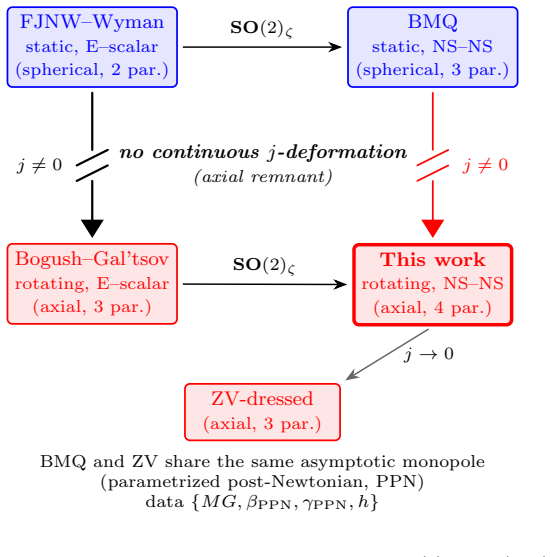
An exact four-parameter rotating NS-NS vacuum solution is constructed in Double Field Theory by applying compact SO(2) S-duality to a rotating Einstein-scalar seed.
A machine-rendered reading of the paper's core claim, the machinery that carries it, and where it could break.
Core claim
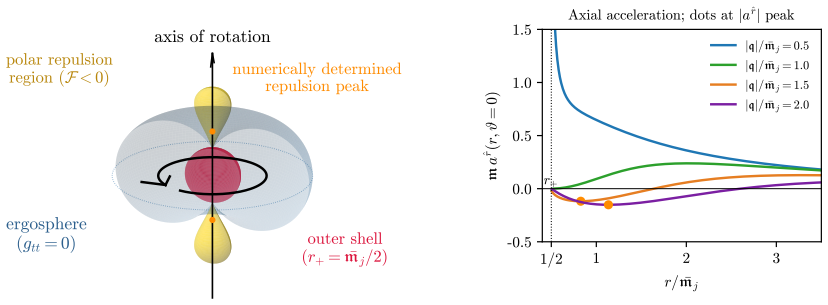
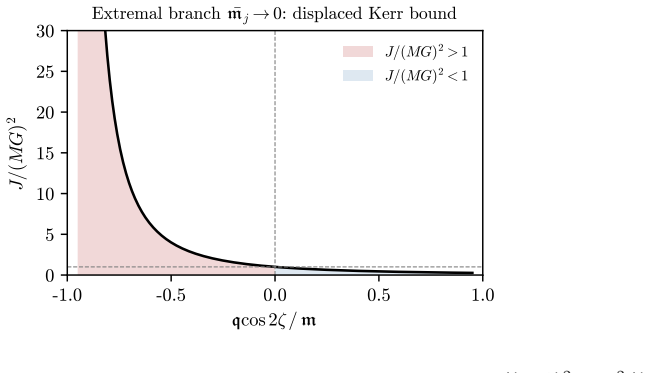
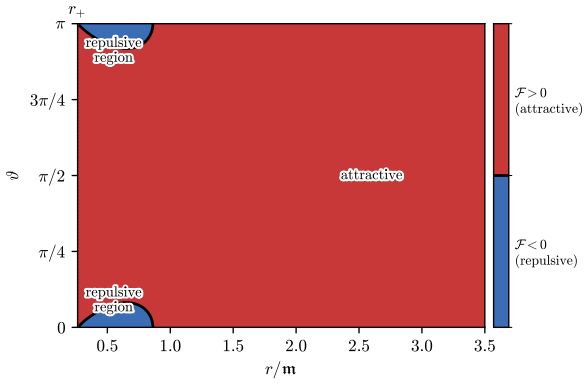
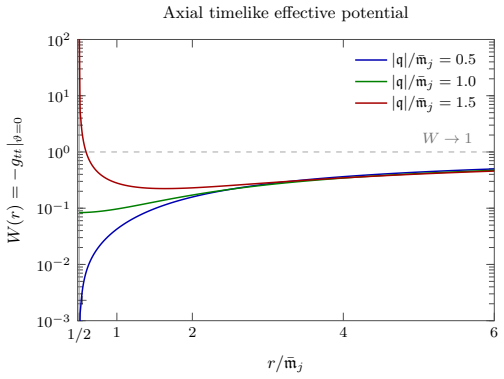
The central claim is the existence of an exact rotating NS-NS vacuum solution with parameters {m, j, q, zeta} obtained via compact SO(2) S-duality from a rotating Einstein-scalar seed. In the static limit the geometry is an axial Zipoy-Voorhees branch with H-flux, not the Burgess-Myers-Quevedo solution. At the Kerr horizon locus the outer shell is generically singular in curvature, but for |q| greater than the square root of m squared minus j squared the polar geodesics are repelled and the rotation axis becomes regular, with the inverse metric finite on axis while the lower-index metric diverges.
What carries the argument
Compact SO(2) S-duality transformation applied to a rotating Einstein-scalar seed, which generates the full set of NS-NS fields g, B, and phi with independent charges.
If this is right
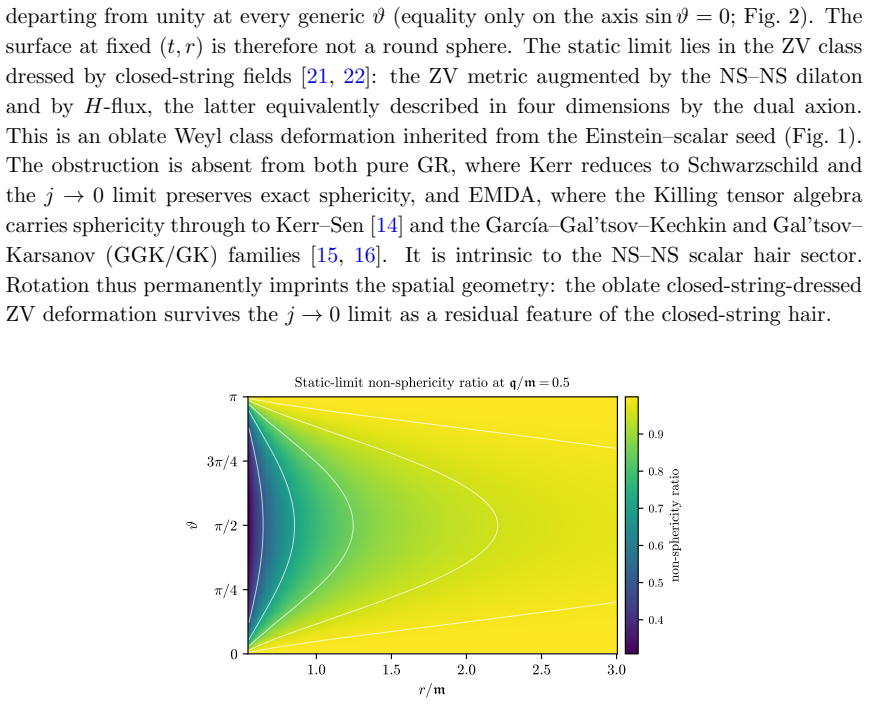
- The static limit exhibits an oblate deformation due to H-flux that is absent in pure general relativity and in Einstein-Maxwell-dilaton-axion.
- The two static branches share identical monopole PPN parameters but differ at the quadrupole level.
- Above the charge threshold |q| > sqrt(m^2 - j^2) the axis is curvature-regular while off-axis the inverse metric diverges.
- The axis-local degeneracy between g and its inverse may provide a setting where O(D,D) variables remain well-defined even if the Riemannian metric is singular.
Where Pith is reading between the lines
- The solution supplies a concrete arena in which to test whether string-frame effects alter geodesic motion near the would-be horizon compared with Einstein gravity.
- The persistence of geometric memory after rotation is switched off suggests that other compact duality transformations could generate families of static NS-NS geometries sharing the same leading multipoles.
- The lifting of degeneracy at ell=2 offers a potential observational discriminant between pure NS-NS vacua and Einstein-Maxwell-dilaton-axion at higher post-Newtonian orders.
Load-bearing premise
A rotating Einstein-scalar seed solution exists and the compact SO(2) S-duality transformation applied to it produces a valid solution of the NS-NS vacuum equations.
What would settle it
Direct substitution of the constructed metric, B-field, and dilaton into the NS-NS equations of motion to check whether they hold identically, or explicit computation of the curvature invariants showing a singularity at the outer shell for |q| below the threshold.
Figures
read the original abstract
We construct an exact rotating vacuum of the NS--NS sector, equivalently a Double Field Theory vacuum. The construction applies compact $\mathbf{SO}(2)$ S-duality to a rotating Einstein--scalar seed. The solution has four independent parameters $\{\mathfrak{m},j,\mathfrak{q},\zeta\}$. To our knowledge, this is the first explicit rotating solution of the pure NS--NS vacuum equations with all three NS--NS fields $\{g,B,\phi\}$ determined analytically, independent dilaton and $H$-flux charges, and no Maxwell sector. The static limit is obtained by taking the rotation parameter $j\to 0$. In this limit the geometry is not the spherical Burgess--Myers--Quevedo solution. Instead, it is an axial Zipoy--Voorhees branch carrying $H$-flux, so an oblate deformation remains after rotation is switched off. This geometric memory is absent in pure general relativity and in Einstein--Maxwell--dilaton--axion. The two static branches nevertheless share the same $\ell=0$ parametrized post-Newtonian data $\{MG,\beta_{\mathrm{PPN}},\gamma_{\mathrm{PPN}},h\}$. They give two inequivalent NS--NS geometries at identical monopole charges, with the degeneracy lifted at $\ell=2$. At the Kerr horizon locus the outer shell is generically singular in curvature. Above the threshold $|\mathfrak{q}|>\sqrt{\mathfrak{m}^{2}-j^{2}}$, polar geodesics are repelled outward and the rotation axis becomes regular in curvature at the shell. On that axis the inverse metric $g^{\mu\nu}$ stays finite while the lower-index Riemannian metric components diverge, whereas off the axis the inverse metric itself diverges. This axis-local degeneracy may offer a setting for non-Riemannian geometry in Double Field Theory, where $g_{\mu\nu}$ is not fundamental and the $\mathbf{O}(D,D)$ variables $\{d,\mathcal{H}_{AB}\}$ remain well defined.
Editorial analysis
A structured set of objections, weighed in public.
Referee Report
Summary. The paper constructs an exact four-parameter rotating NS-NS vacuum solution in Double Field Theory by applying a compact SO(2) S-duality transformation to a rotating Einstein-scalar seed. The solution is parametrized by {m, j, q, ζ} with all three NS-NS fields {g, B, ϕ} determined analytically and independent dilaton/H-flux charges. The static limit (j → 0) is an axial Zipoy-Voorhees branch carrying H-flux rather than the Burgess-Myers-Quevedo solution. Properties analyzed include curvature singularities at the Kerr horizon locus, outward repulsion of polar geodesics for |q| > √(m² - j²), regularity of the rotation axis above this threshold, and an axis-local degeneracy where g^{μν} remains finite while g_{μν} diverges (potentially relevant for non-Riemannian DFT). The two static branches share ℓ=0 PPN data but differ at ℓ=2.
Significance. If the duality step is verified, the result supplies the first explicit rotating pure NS-NS vacuum with independent charges and no Maxwell sector, enabling direct study of geometric memory effects absent in GR or EMDA and possible non-Riemannian regimes in DFT where O(D,D) variables remain well-defined. The explicit analytic form and the lifting of degeneracy at quadrupole order are concrete strengths for further analytic and observational work.
major comments (1)
- [Construction method] Construction section (method paragraph following the abstract): the central claim that the compact SO(2) S-duality applied to the rotating Einstein-scalar seed yields a solution of the NS-NS vacuum equations is load-bearing. The manuscript provides no explicit transformed field components, no direct substitution into the Einstein-dilaton-H equations, and no reference to a general theorem guaranteeing preservation of the vacuum under this map. This verification step must be supplied before the exact-solution claim can be accepted.
minor comments (2)
- [Abstract] Abstract: the static-limit statement that the geometry 'is not the spherical Burgess-Myers-Quevedo solution' should be accompanied by a brief citation to the original BMQ reference for clarity.
- [Notation] Notation: the use of fraktur m and q for mass and charge parameters is introduced without an explicit statement of their relation to the seed solution parameters; a short dictionary in the construction section would remove ambiguity.
Simulated Author's Rebuttal
We thank the referee for their thorough review and positive assessment of the significance of our work. We address the major comment point by point below and will make the requested revisions to the manuscript.
read point-by-point responses
-
Referee: [Construction method] Construction section (method paragraph following the abstract): the central claim that the compact SO(2) S-duality applied to the rotating Einstein-scalar seed yields a solution of the NS-NS vacuum equations is load-bearing. The manuscript provides no explicit transformed field components, no direct substitution into the Einstein-dilaton-H equations, and no reference to a general theorem guaranteeing preservation of the vacuum under this map. This verification step must be supplied before the exact-solution claim can be accepted.
Authors: We agree that providing explicit verification is essential for the claim. In the revised manuscript, we will include the explicit expressions for the transformed metric, B-field, and dilaton obtained via the compact SO(2) S-duality transformation. We will also either directly substitute these into the NS-NS equations of motion to verify they are satisfied or provide a reference to the general theorem in the DFT literature that ensures the duality maps solutions to solutions. This addresses the load-bearing aspect of the construction. revision: yes
Circularity Check
No circularity: explicit construction via external seed and standard duality map
full rationale
The derivation applies a compact SO(2) S-duality transformation (standard in the literature) to an independently existing rotating Einstein-scalar seed. The resulting four-parameter NS-NS solution is obtained by direct substitution and does not reduce to any fitted parameter, self-defined quantity, or self-citation chain. The static limit and geometric properties follow from the explicit fields rather than from re-labeling the inputs. No load-bearing step equates output to input by construction.
Axiom & Free-Parameter Ledger
Reference graph
Works this paper leans on
-
[1]
B. P. Abbottet al.[LIGO Scientific and Virgo], Phys. Rev. Lett. 116, 061102 (2016)
2016
-
[2]
Akiyamaet al.[EHT], Astrophys
K. Akiyamaet al.[EHT], Astrophys. J. Lett. 875, L1 (2019)
2019
-
[3]
Akiyamaet al.[EHT], Astrophys
K. Akiyamaet al.[EHT], Astrophys. J. Lett. 930, L12 (2022)
2022
-
[4]
Israel, Phys
W. Israel, Phys. Rev. 164, 1776 (1967)
1967
-
[5]
Carter, Phys
B. Carter, Phys. Rev. Lett. 26, 331 (1971)
1971
-
[6]
S. W. Hawking, Commun. Math. Phys. 25, 152 (1972)
1972
-
[7]
D. C. Robinson, Phys. Rev. Lett. 34, 905 (1975)
1975
-
[8]
M. B. Green, J. H. Schwarz, and E. Witten,Superstring Theory(Cambridge University Press, Cambridge, 1987)
1987
-
[9]
C. G. Callan, D. Friedan, E. J. Martinec, and M. J. Perry, Nucl. Phys. B 262, 593 (1985)
1985
-
[10]
C. M. Hull and B. Zwiebach, JHEP 09, 099 (2009). – 19 –
2009
-
[11]
O. Hohm, C. Hull and B. Zwiebach, JHEP 08, 008 (2010)
2010
-
[12]
Angus, K
S. Angus, K. Cho and J.-H. Park, Eur. Phys. J. C 78, 500 (2018)
2018
-
[13]
Park, Eur
J.-H. Park, Eur. Phys. J. C 85, 1104 (2025)
2025
-
[14]
Sen, Phys
A. Sen, Phys. Rev. Lett. 69, 1006 (1992)
1992
-
[15]
Garc´ ıa, D
A. Garc´ ıa, D. V. Gal’tsov and O. V. Kechkin, Phys. Rev. Lett. 74, 1276 (1995)
1995
-
[16]
Gal’tsov and R
D. Gal’tsov and R. Karsanov, Phys. Rev. D 111, 104011 (2025)
2025
-
[17]
Bogush and D
I. Bogush and D. Gal’tsov, Phys. Rev. D 102, 124006 (2020)
2020
-
[18]
I. Z. Fisher, Zh. Eksp. Teor. Fiz.18, 636 (1948) [ arXiv:gr-qc/9911008]
Pith/arXiv arXiv 1948
-
[19]
A. I. Janis, E. T. Newman and J. Winicour, Phys. Rev. Lett. 20, 878 (1968)
1968
-
[20]
Wyman, Phys
M. Wyman, Phys. Rev. D 24, 839 (1981)
1981
-
[21]
D. M. Zipoy, J. Math. Phys. 7, 1137 (1966)
1966
-
[22]
B. H. Voorhees, Phys. Rev. D 2, 2119 (1970)
1970
-
[23]
C. P. Burgess, R. C. Myers and F. Quevedo, Nucl. Phys. B 442, 75 (1995)
1995
-
[24]
Choi and J.-H
K. Choi and J.-H. Park, Phys. Rev. Lett. 129, 061603 (2022)
2022
-
[25]
Morand and J.-H
K. Morand and J.-H. Park, Eur. Phys. J. C 77, 685 (2017)
2017
-
[26]
Kerr-like metric in 4D Double Field Theory,
S. Li and Y. Liu, “Kerr-like metric in 4D Double Field Theory,” arXiv:2404.04758 [hep-th]
-
[27]
Exact Four-Parameter Rotating NS–NS Vacuum in Double Field Theory: Maple/GRTensorIII and Mathematica Verification,
H. Jang, M. Kim and J.-H. Park, “Exact Four-Parameter Rotating NS–NS Vacuum in Double Field Theory: Maple/GRTensorIII and Mathematica Verification,” GitHub (2026), github.com/Jeong24th/Kerr DFT (MIT License)
2026
-
[28]
V. S. Manko and I. D. Novikov, Class. Quantum Grav. 9, 2477 (1992)
1992
-
[29]
Bertotti, L
B. Bertotti, L. Iess and P. Tortora, Nature 425, 374 (2003)
2003
-
[30]
C. M. Will, Living Rev. Rel. 17, 4 (2014)
2014
-
[31]
Lee, J.-H
H. Lee, J.-H. Park, L. Velasco-Sevilla and L. Yin, Phys. Lett. B 858, 139215 (2024)
2024
-
[32]
Morand, J.-H
K. Morand, J.-H. Park and M. Park, Phys. Rev. Lett. 128, 041602 (2022)
2022
-
[33]
S. D. Mathur, Fortsch. Phys. 53, 793 (2005) [arXiv:hep-th/0502050]
Pith/arXiv arXiv 2005
-
[34]
S. M. Ko, J.-H. Park and M. Suh, JCAP 06, 002 (2017). – 20 –
2017
discussion (0)
Sign in with ORCID, Apple, or X to comment. Anyone can read and Pith papers without signing in.