REVIEW 3 major objections 4 minor 32 references
This paper claims that INT8 post-training quantization makes ARM edge inference dispatch-invariant, with byte-identical outputs across microarchitectures and execution providers.
Reviewed by Pith at T0; open to challenge. T0 means a machine referee read the full paper against a public rubric. the ladder, T0–T4 →
T0 review · deepseek-v4-flash
2026-08-01 00:01 UTC pith:VCXFM6BR
load-bearing objection A genuinely new and mostly solid empirical result on INT8 reproducibility across ARM parts, but the title's 'dispatch-invariant' goes a bit beyond what the timing evidence actually proves. the 3 major comments →
INT8 Quantization Makes ARM Edge Inference Dispatch-Invariant
The pith
A machine-rendered reading of the paper's core claim, the machinery that carries it, and where it could break.
Core claim
The central discovery is that INT8 post-training quantization makes inference dispatch-invariant on ARM: under the TFLite/XNNPACK CPU path, MobileNetV2 and ResNet50V2 produce byte-identical outputs on Cortex-A76 and Cortex-A72 across 500 ImageNet images per model, including every intermediate INT32 accumulator and INT8 tensor on a 50-image subset. The explanatory claim is H1+H2: a conv or gemm whose input lies on the quantization grid is deterministic regardless of which kernel executes it, and a QuantizeLinear node after every layer keeps inputs on the grid. The operator-level reason is that both ARM paths - SDOT and the NEON multiply-accumulate fallback - accumulate exactly into INT32 with
What carries the argument
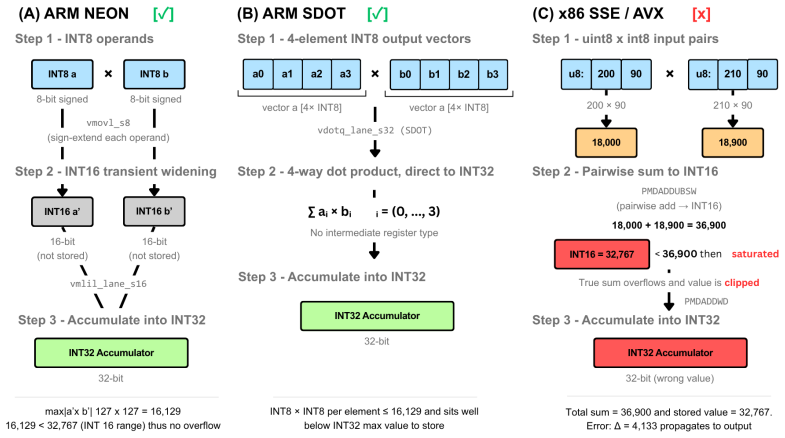
Two properties, H1 and H2. H1 (discrete-grid absorption) is the claim that if every element of a conv/gemm's input lies exactly on the quantization grid (scale s, zero-point z), then the operator's FP32 output is byte-identical across execution providers. H2 (requantization ratchet) is the claim that every QuantizeLinear node in a QDQ graph emits a tensor on that grid, so the precondition is restored at every layer boundary. The carrying mechanism is the exact INT32 accumulator: ARM's SDOT and NEON/SMULL paths both compute integer dot products exactly, without the saturating INT16 intermediate that x86's PMADDUBSW introduces; because integer addition is associative, SIMD width and reduction-
Load-bearing premise
The claim that the two devices demonstrably execute different microkernel families rests on timing signatures and documented dispatch rules rather than direct instruction-level proof; if both devices actually ran the same code, the byte-identical outputs would demonstrate determinism but not dispatch-invariance.
What would settle it
Run the same INT8 TFLite models on a Cortex-A76 and Cortex-A72 while using perf stat to count SDOT instructions on the A76; if the A76 shows no SDOT execution, the dispatch-difference premise fails. Conversely, an adversarially chosen input or a channel dimension beyond the stated bound that triggers an INT32 overflow or a saturating intermediate would break byte-identity and falsify the generalization.
If this is right
- On a mixed ARM fleet running the same INT8 QDQ model under a runtime with exact INT32 kernels, outputs are byte-identical across microarchitectures; continuous-output consumers such as calibration, anomaly scoring, audit logs, and A/B comparisons get consistency across hardware.
- FP32 remains provider-dependent even on a single microarchitecture: switching execution provider can flip outputs on every image, so FP32 reproducibility claims must be scoped to the provider, not to the hardware.
- INT8's label changes relative to FP32 are identical on every tested ARM device, so no hardware-specific label drift exists in quantized production CNNs.
- Hardware fingerprinting that relies on output divergence cannot distinguish ARM microarchitectures through INT8 CNN inference; auditing must target FP32 inference, autoregressive generation, or timing side channels.
- The x86 saturating-INT16 mechanism is the boundary: platforms using PMADDUBSW can fragment INT8 outputs, while platforms with direct INT32 accumulation - ARM and VNNI - should not.
Where Pith is reading between the lines
- If H1+H2 is structural rather than specific to the tested runtimes, byte-identity should extend to other ARM runtimes and to untested microarchitectures such as Cortex-A55, A78, and Oryon; this is directly testable without new theory.
- The proof's bound suggests a crisp sufficient condition for cross-platform bit-exact INT8 inference: any kernel family with exact INT32 accumulation and no saturating intermediates will exhibit the same invariance, regardless of SIMD-width differences.
- The FP32 execution-provider divergence on fixed hardware provides a practical check for whether a runtime's advertised provider is actually active: if outputs are identical across providers, dispatch likely fell back silently.
- A direct instruction-count confirmation would strengthen the dispatch claim, but byte-identity itself is a determinism result that holds even if the kernel families were identical; the dispatch-invariance reading is the stronger, less certain part.
Editorial analysis
A structured set of objections, weighed in public.
Referee Report
Summary. The paper studies numerical reproducibility of neural-network inference on ARM edge hardware. It reports, on four Raspberry Pi devices spanning Cortex-A53/A72/A76 under ONNX Runtime, that FP32 CPU-EP outputs are byte-identical across microarchitectures, while switching to the XNNPACK execution provider on a fixed A76 device produces divergent FP32 outputs on all 1,000 CIFAR-10 images (mean remaining precision 14.97 of 23 mantissa bits). INT8 QDQ post-training quantization is reported to collapse both axes: all five conditions produce byte-identical outputs. The authors propose a structural explanation, H1+H2: discrete-grid inputs make Conv/Gemm dispatch-deterministic, and QuantizeLinear at each layer boundary restores that precondition. They then test the prediction on MobileNetV2 and ResNet50V2 under TensorFlow Lite/XNNPACK, reporting byte-identical final outputs and byte-identical intermediate INT8/INT32 tensors between Cortex-A76 (SDOT) and Cortex-A72 (NEON) over 500 ImageNet images per model, and attribute the x86 failure mode to PMADDUBSW saturating INT16 intermediates.
Significance. If the central claim holds, the paper makes a valuable and practical contribution: it delimits the Schlögl et al. EQC/RP phenomenon on ARM, identifies INT8 QDQ as a reproducible serving mode, and gives a concrete instruction-level reason why x86 and ARM differ. The empirical evidence is unusually strong in one respect: the production-CNN byte-identity results include layer-by-layer INT32 accumulator comparisons over 50 images per model (109 tensors for MobileNetV2, 156 for ResNet50V2), and the limitation sections are candid. The parameter-free Prop. 2-style arithmetic argument is a genuine attempt at a mechanistic explanation. The main weakness is that the headline generalization to 'different microkernel families demonstrably execute' rests on indirect timing evidence that the authors themselves acknowledge is not definitive.
major comments (3)
- [§5.1 and §5.2] The central claim that byte-identity holds across different ARM microkernel families is not empirically secured. The only evidence that the A76 and A72 devices ran different XNNPACK kernels is the timing asymmetry: 5.04× INT8/FP32 speedup on A76 versus ~1.0× on A72. As the authors admit, no perf stat was run and the Pi 5 thermal state (88–91 °C) adds latency variability. The alternative explanation — that both devices ran the same NEON/SMULL kernel family and the timing difference reflects A76's higher throughput — is not excluded. In that case the byte-identical outputs demonstrate same-code determinism, not dispatch-invariance. This is load-bearing because the abstract and introduction state that 'different ARM microkernel families demonstrably execute.' The authors should either provide direct dispatch confirmation (e.g., perf stat or instruction-level traces) or explicitly relabel th
- [§5.3, Prop. 2] Proposition 2's proof contains an incorrect product bound. It states that for (a_k, b_k) ∈ [−128, 127]^2, |a_k b_k| ≤ 127×128 = 16,256, but the maximum absolute product in that domain is (−128)·(−128) = 16,384. With 16,384 per product, K = 131,072 gives 16,384 × 131,072 = 2^31, which exceeds the INT32 positive limit. The theorem as stated is therefore not proven. This is easily fixable: either restrict weights to [−127, 127] as XNNPACK does, or lower the stated K bound to 131,071. Because the tested models have K ≤ 2048, the empirical conclusions are unaffected, but the proposition's claim of a general bound should be corrected.
- [§4.2, Def. 1 / Prop. 1] The explanatory status of H1 needs clarification. Definition 1 defines discrete-grid absorption as the property that the FP32 output is byte-identical under the compared providers, and Proposition 1 is then a restatement of that property plus the requantization assumption. As the paper itself notes, Proposition 1 is 'an empirical property, not a theorem.' The independent mechanistic content comes from the localization experiment and from Prop. 2. I recommend the authors state more explicitly that H1 is a shorthand for the empirical finding, not a prediction derived from first principles, so readers do not mistake a definition for an explanation.
minor comments (4)
- [Abstract and §5.1] The abstract says 'timing evidence confirms SDOT dispatch on A76 and NEON multiply-accumulate on A72,' but §5.1 explicitly calls the timing evidence 'strong but indirect.' Please align the language; 'consistent with' rather than 'confirms' would be more accurate unless direct confirmation is added.
- [Introduction] Typo in first paragraph: 'rutn' should be 'run.'
- [§5.3, Eq. (1)] The proof would be clearer if it stated explicitly that the bound applies to the running accumulator after each SDOT instruction, and if it noted that the XNNPACK symmetric-weight constraint [−127, 127] is what makes the 16,256 product bound valid for the actual kernel.
- [Table 2] The distinction between 'EP (intended)' and 'EP (resolved)' is useful, but the table caption could note that the resolved provider was parsed from telemetry; this is stated in the text but not in the caption.
Circularity Check
No significant circularity: the byte-identity result is an out-of-sample measurement, Prop. 2 is a parameter-free arithmetic bound, and no load-bearing self-citation is present.
full rationale
The paper's central empirical claim—that INT8 QDQ inference is byte-identical between Cortex-A76 SDOT and Cortex-A72 NEON paths on MobileNetV2 and ResNet50V2—is not fitted or derived from the claimed explanation. The H1+H2 invariant is an empirical decomposition measured on a separate small CNN (CifarSmall), and the production-CNN test uses 500 unseen ImageNet images per model with all intermediate tensors compared. No constants are tuned to force the result. Proposition 2 is a parameter-free arithmetic bound (K ≤ 131,072, with products bounded by 16,256) showing that both ARM kernel families compute the same exact INT32 sum; this is an independent mathematical statement, not a restatement of the data. The paper is transparent that Proposition 1 is stated as an empirical property, not a theorem, and that direct perf-stat confirmation of microkernel dispatch was not performed. Those are correctness/evidence limitations, not circularity. There are no self-citations: the cited EQC/RP, XNNPACK, oneDNN, and ARM references are external. The small-CNN/provider results are honestly bounded, and the silent-fallback artifact is excluded from positive evidence. The only mild framing concern is that H1 and H2 are named after the byte-identity properties they are used to explain, but because the production measurement is independent and Prop. 2 carries the arithmetic weight, this does not reduce the derivation to its inputs.
Axiom & Free-Parameter Ledger
free parameters (1)
- Per-tensor/per-layer quantization scales and zero-points =
e.g., s=0.003922, z=-128 for CifarSmall input QDQ; per-layer values from calibration
axioms (4)
- domain assumption Integer addition is exact and associative in the INT32 accumulator; ARM SDOT and NEON/SMLAL/SADALP paths have no saturating intermediate (no PMADDUBSW analogue).
- domain assumption The A76 and A72 devices actually executed different XNNPACK kernel families (SDOT vs NEON multiply-accumulate).
- ad hoc to paper H1: any Conv/Gemm with inputs on an int8 grid is byte-identical across dispatch paths.
- ad hoc to paper H2: QuantizeLinear at every layer boundary restores the grid precondition.
read the original abstract
On x86, kernel dispatch fragments the outputs of the same neural network into many equivalence classes across hardware. We ask whether the same fragmentation governs ARM edge inference, where most edge ML actually runs. Across four Raspberry Pi devices spanning Cortex-A53, A72, and A76 under ONNX Runtime CPU, microarchitecture is not observable in the outputs of a fixed FP32 CNN. Holding hardware constant at Cortex-A76 and switching only the execution provider, FP32 outputs disagree on every CIFAR-10 image with a mean remaining precision of 14.97 of 23 mantissa bits. INT8 QDQ post-training quantization collapses both axes to a single equivalence class. We trace this to a structural property of QDQ graphs that we call H1+H2: discrete-grid inputs make any Conv dispatch-deterministic (H1) and QuantizeLinear at every layer boundary preserves that precondition (H2). H1+H2 predicts that bit-exact agreement should extend to production CNNs under runtimes that confirmably exercise different ARM microkernels. We verify this on MobileNetV2 and ResNet50V2 under TensorFlow Lite with XNNPACK, where timing evidence confirms SDOT dispatch on A76 and NEON multiply-accumulate on A72 yet every intermediate INT32 accumulator and every final output is byte-identical across 500 ImageNet images per model. We then identify the specific x86 mechanism that breaks the same invariant on x86, namely PMADDUBSW saturating INT16 intermediates, which has no ARM analogue. The Schl\"ogl et al. divergence phenomenon is delineated rather than contradicted. For practitioners deploying quantized CNNs across heterogeneous ARM fleets, the operational consequence is direct. INT8 inference is the reproducible mode and the relevant behavioral variation axis is precision, not microarchitecture.
Figures


Reference graph
Works this paper leans on
-
[1]
I. Colbert, A. Pappalardo, and J. Petri-Koenig. A2Q: Accumulator-aware quan- tization with guaranteed overflow avoidance. InProc. 2023 IEEE/CVF Int. Conf. Computer Vision (ICCV), pages 16989–16998, Paris, France, Oct. 2023. doi: 10.1109/ICCV51070.2023.01558. URLhttps://openaccess.thecvf.com/ content/ICCV2023/papers/Colbert_A2Q_Accumulator-Aware_Quantizati...
arXiv 2023
-
[2]
J. Demmel and H. D. Nguyen. Fast reproducible floating-point summation. InProc. 21st IEEE Symposium on Computer Arithmetic (ARITH), pages 163–172, Austin, TX, USA, Apr. 2013. doi: 10.1109/ARITH.2013.9
-
[4]
Dukhan and The XNNPACK Authors
M. Dukhan and The XNNPACK Authors. XNNPACK: High-efficiency floating-point and quantized neural network inference on ARM, x86, WebAssembly, and RISC-V plat- forms. Google AI / TensorFlow Blog, 2021. URLhttps://blog.tensorflow.org/ 2020/07/accelerating-tensorflow-lite-xnnpack-integration.html. Accessed: 2026-06-18
2021
- [5]
-
[6]
D. Gope, J. Beu, V. Ganesh, and M. Mattina. ARM Cortex-A INT8 optimizations for edge ML inference: A survey of microkernel dispatch and instruction selection. arXiv preprint arXiv:2501.00032, Jan. 2025. URLhttps://arxiv.org/abs/2501.00032
Pith/arXiv arXiv 2025
-
[7]
C. Guo, G. Pleiss, Y. Sun, and K. Q. Weinberger. On calibration of modern neural networks. InProc. 34th Int. Conf. Machine Learning (ICML), volume 70 ofProceedings of Machine Learning Research, pages 1321–1330, Sydney, NSW, Australia, Aug. 2017. PMLR. URLhttps://proceedings.mlr.press/v70/guo17a.html
2017
-
[8]
K. He, X. Zhang, S. Ren, and J. Sun. Identity mappings in deep residual networks. In B. Leibe, J. Matas, N. Sebe, and M. Welling, editors,Computer Vision – ECCV 2016, volume 9908 ofLecture Notes in Computer Science, pages 630–645, Cham, Switzerland,
2016
-
[9]
N. J. Higham.Accuracy and Stability of Numerical Algorithms. Society for Industrial and Applied Mathematics (SIAM), Philadelphia, PA, USA, 2nd edition, 2002. ISBN 978-0-89871-521-7. doi: 10.1137/1.9780898718027
-
[10]
IEEE standard for floating-point arithmetic
IEEE Computer Society. IEEE standard for floating-point arithmetic. IEEE Std 754- 2019 (Revision of IEEE Std 754-2008), July 2019
2019
-
[11]
oneDNN developer guide: INT8 inference and quantization
Intel Corporation. oneDNN developer guide: INT8 inference and quantization. Intel oneAPI Documentation, 2024. URLhttps://oneapi-src.github.io/oneDNN/dev_ guide_int8_computations.html. Accessed: 2026-06-18
2024
-
[12]
B. Jacob, S. Kligys, B. Chen, M. Zhu, M. Tang, A. Howard, H. Adam, and D. Kalenichenko. Quantization and training of neural networks for efficient integer- arithmetic-only inference. InProc. 2018 IEEE/CVF Conf. Computer Vision and Pat- tern Recognition (CVPR), pages 2704–2713, Salt Lake City, UT, USA, June 2018. doi: 10.1109/CVPR.2018.00286
arXiv 2018
-
[13]
S. R. Jain, A. Gural, M. Wu, and C. H. Dick. Efficient computation reduction in bayesian neural networks through feature decomposition and memorization. arXiv preprint arXiv:2006.10226, June 2020. URLhttps://arxiv.org/abs/2006.10226. 12
Pith/arXiv arXiv 2006
-
[14]
R. Krishnamoorthi. Quantizing deep convolutional networks for efficient inference: A whitepaper. arXiv preprint arXiv:1806.08342, June 2018. URLhttps://arxiv.org/ abs/1806.08342
Pith/arXiv arXiv 2018
-
[15]
Krizhevsky
A. Krizhevsky. Learning multiple layers of features from tiny images. Technical report, Department of Computer Science, University of Toronto, Toronto, ON, Canada, 2009. URLhttps://www.cs.toronto.edu/~kriz/learning-features-2009-TR.pdf
2009
-
[16]
ONNX Runtime documentation: Quantize ONNX mod- els
Microsoft Corporation. ONNX Runtime documentation: Quantize ONNX mod- els. ONNX Runtime Documentation, 2024. URLhttps://onnxruntime.ai/docs/ performance/model-optimizations/quantization.html. Accessed: 2026-06-18
2024
-
[17]
Nagel, R
M. Nagel, R. A. Amjad, M. van Baalen, C. Louizos, and T. Blankevoort. Up or down? adaptive rounding for post-training quantization. InProc. 37th Int. Conf. Machine Learning (ICML), volume 119 ofProceedings of Machine Learning Research, pages 7197–7206. PMLR, July 2020. URLhttps://proceedings.mlr.press/v119/ nagel20a.html
2020
-
[18]
cuDNN developer guide: Reproducibility (determin- ism)
NVIDIA Corporation. cuDNN developer guide: Reproducibility (determin- ism). NVIDIA Technical Documentation, 2024. URLhttps://docs.nvidia.com/ deeplearning/cudnn/developer-guide/index.html#reproducibility. Accessed: 2026-06-18
2024
-
[19]
H. V. Pham, S. Qian, J. Wang, T. Lutellier, J. Rosenthal, L. Tan, Y. Yu, and N. Na- gappan. Problems and opportunities in training deep learning software systems: An analysis of variance. InProc. 35th IEEE/ACM Int. Conf. Automated Software Engi- neering (ASE ’20), pages 771–783, Virtual Event, Australia, Sept. 2020. ACM. doi: 10.1145/3324884.3416545
arXiv 2020
-
[20]
V. J. Reddi, C. Cheng, D. Kanter, P. Mattson, G. Schmuelling, C.-J. Wu, B. Ander- son, M. Breughe, M. Charlebois, W. Chou, R. Chukka, C. Coleman, S. Davis, P. Deng, G. Diamos, J. Duke, D. Fick, J. S. Gardner, I. Hubara, S. Idgunji, T. B. Jablin, J. Jiao, T. St. John, P. Kanwar, D. Lee, J. Liao, A. Lokhmotov, F. Massa, P. Meng, P. Micike- vicius, C. Osborn...
arXiv 2020
-
[21]
D. Sán Adrián, P. Llopis, J. Garcia-Blas, and J. Carretero. The cambrian explosion of edge AI hardware: Benchmarking heterogeneous microarchitectures for INT8 inference. arXiv preprint arXiv:2506.11728, June 2025. URLhttps://arxiv.org/abs/2506. 11728
Pith/arXiv arXiv 2025
-
[22]
M. Sandler, A. Howard, M. Zhu, A. Zhmoginov, and L.-C. Chen. MobileNetV2: In- verted residuals and linear bottlenecks. InProc. 2018 IEEE/CVF Conf. Computer Vision and Pattern Recognition (CVPR), pages 4510–4520, Salt Lake City, UT, USA, June 2018. doi: 10.1109/CVPR.2018.00474
arXiv 2018
-
[23]
A. Schlögl, T. Kupek, and R. Böhme. Forensicability of deep neural network inference pipelines. InProc. 2021 IEEE Int. Conf. Acoustics, Speech and Signal Processing (ICASSP), pages 2515–2519, Toronto, ON, Canada (virtual), June 2021. doi: 10.1109/ ICASSP39728.2021.9414301
arXiv 2021
-
[24]
A. Schlögl, T. Kupek, and R. Böhme. iNNformant: Boundary samples as telltale watermarks. InProc. 2021 ACM Workshop on Information Hiding and Multimedia Security (IH&MMSec ’21), pages 81–86, Virtual Event, Belgium, June 2021. ACM. doi: 10.1145/3437880.3460411
arXiv 2021
-
[25]
Schlögl, N
A. Schlögl, N. Hofer, and R. Böhme. Causes and effects of unanticipated numerical deviations in neural network inference frameworks. InProc. 37th Int. Conf. Neural In- formation Processing Systems (NeurIPS ’23), volume 36, pages 56095–56107, New Or- leans, LA, USA, Dec. 2023. URLhttps://papers.neurips.cc/paper_files/paper/ 13 2023/hash/af076c3bdbf935b81d8...
2023
-
[26]
Sculley, G
D. Sculley, G. Holt, D. Golovin, E. Davydov, T. Phillips, D. Ebner, V. Chaud- hary, M. Young, J.-F. Crespo, and D. Dennison. Hidden technical debt in machine learning systems. InAdvances in Neural Information Process- ing Systems 28 (NIPS 2015), pages 2503–2511, Montréal, QC, Canada, Dec
2015
-
[27]
S. Shanmugavelu, M. Taillefumier, C. Culver, O. Hernandez, M. Coletti, and A. Se- dova. Impacts of floating-point non-associativity on reproducibility for HPC and deep learning applications. InProc. SC ’24 Workshops of the Int. Conf. High Performance Computing, Network, Storage, and Analysis (SC-W ’24), pages 170–179, Atlanta, GA, USA, Nov. 2024. IEEE Pre...
arXiv 2024
-
[28]
H. Wu, P. Judd, X. Zhang, M. Isaev, and P. Micikevicius. Integer quantization for deep learning inference: Principles and empirical evaluation. arXiv preprint arXiv:2004.09602, Apr. 2020. URLhttps://arxiv.org/abs/2004.09602
Pith/arXiv arXiv 2004
-
[29]
J. Yuan, H. Li, X. Ding, W. Xie, Y.-J. Li, W. Zhao, K. Wan, J. Shi, X. Hu, and Z. Liu. Understanding and mitigating numerical sources of nondeterminism in LLM inference. InAdvances in Neural Information Processing Systems 38 (NeurIPS 2025), volume 38, pages 169819–169851, San Diego, CA, USA, Dec. 2025. URLhttps://openreview. net/forum?id=Q3qAsZAEZw. Oral ...
arXiv 2025
-
[30]
Hardwareandsoftware platform inference
C.Zhang, H.Foerster, R.D.Mullins, Y.Zhao, andI.Shumailov. Hardwareandsoftware platform inference. InProc. 42nd Int. Conf. Machine Learning (ICML), volume 267 ofProceedings of Machine Learning Research, Vancouver, BC, Canada, July 2025. PMLR. URLhttps://proceedings.mlr.press/v267/zhang25u.html. Also available as arXiv:2411.05197. 14
Pith/arXiv arXiv 2025
-
[2015]
URLhttps://papers.nips.cc/paper/2015/hash/ 86df7dcfd896fcaf2674f757a2463eba-Abstract.html
Curran Associates, Inc. URLhttps://papers.nips.cc/paper/2015/hash/ 86df7dcfd896fcaf2674f757a2463eba-Abstract.html
2015
-
[2016]
doi: 10.1007/978-3-319-46493-0\_38
Springer International Publishing. doi: 10.1007/978-3-319-46493-0\_38
-
[2019]
URLhttps://arxiv.org/abs/1907.02129
Pith/arXiv arXiv 1907
discussion (0)
Sign in with ORCID, Apple, or X to comment. Anyone can read and Pith papers without signing in.