REVIEW 3 major objections 6 minor 96 references
Unleashing High-Quality Image Generation in Diffusion Sampling Using Second-Order Levenberg-Marquardt-Langevin
T0 review · 3 major / 6 minor · reviewed 2026-08-07 · deepseek-v4-flash
Pith's one-line read This paper proposes Levenberg-Marquardt-Langevin, a training-free second-order sampler that approximates the diffusion Hessian as a rank-one outer product of the noise prediction and reports consistent image-quality gains at negligible…
desk verdict The proposed Hessian sampler degenerates to the DPM-Solver baseline under its own stated hyperparameters, so the reported FID gains cannot be caused by the mechanism. read the letter →
The pith
A machine-rendered reading of the paper's core claim, the machinery that carries it, and where it could break.
The reading
What carries the argument
The load-bearing object is the 'LM-approximated Hessian geometry': the rank-one matrix $H_{\mathrm{LM}} = \frac{1}{\sigma(t)^2\|\varepsilon_\theta\|^2}\varepsilon_\theta\varepsilon_\theta^\top$ from Proposition 1, regarded as the Hessian of the log-density, plus its damped version $H_{\mathrm{LM}} + \lambda I$. Damping converts a singular outer product into an invertible matrix whose inverse is computed in $O(d)$ time via the Sherman-Morrison identity $I - \frac{u u^\top}{\lambda + \|u\|^2}$, replacing the quadratic-complexity Hessian inversion that makes Newton-Langevin infeasible at diffusion scale. In Algorithm 1 this inverse acts as a preconditioner on the (EMA-mixed) noise prediction, followed by a unit-spectrum normalization, then a DPM-Solver step advances the latent state. This inverse-preconditioned update is the method's entire second-order content, and the theoretical sections are devoted to showing this approximation is accurate, the damped dynamics targets the right measure, and convergence is exponentially fast.
What would settle it
Run Algorithm 1 with the averaging coefficient set to exactly zero (no mixing of the previous step's prediction) and compare FID with the reported κ=1e-8 results on CIFAR-10 at 10 NFEs. If the scores are identical, the Hessian-guided update is not the source of the improvement; a direct numerical check of Algorithm 1 steps 11-13 will also show whether the normalized output equals the input prediction at κ=1e-8.
Extended reading notes
Core claim
The central claim, stated on the paper's own terms, is that the Hessian of the diffused log-density admits a tractable low-rank form: Proposition 1 asserts $\nabla^2_{x_t}\log p_t(x_t) \approx \frac{1}{\sigma(t)^2\|\varepsilon_\theta\|^2}\varepsilon_\theta\varepsilon_\theta^\top$, a scaled outer product of the noise prediction. Adding $\lambda I$ makes this rank-one, singular matrix invertible, and the Sherman-Morrison formula gives the inverse as $\frac{1}{\lambda'\sigma(t)^2\|\varepsilon_\theta\|^2}\bigl(I - \frac{\varepsilon_\theta\varepsilon_\theta^\top}{\lambda' + \|\varepsilon_\theta\|^2}\bigr)$, where the bracketed matrix is the geometric essence carried into Algorithm 1. The sampler applies this damped inverse to an EMA-mixed noise prediction, restores the original norm, and hands the result to DPM-Solver, with theory (Propositions 2-4) bounding the approximation error in Hilbert-Schmidt norm, identifying the stationary measure, and giving exponential $\chi^2$-ergodic convergence. The paper's experiments then claim that this training-free change improves FID and perceptual metrics across six pretrained models at nearly identical wall-clock cost.
Load-bearing premise
The claimed quality gains rest entirely on the step that applies the Hessian geometry actually changing the noise-prediction direction; at the tiny averaging coefficient (κ=1e-8) used in the main experiments, that step mathematically leaves the prediction unchanged, so the gains depend on the coefficient being effectively larger than the paper reports.
Editorial extensions
If this is right
- Any pretrained diffusion model, including latent and transformer-based text-to-image models, can adopt LML without retraining, auxiliary networks, or model-specific assumptions.
- Wall-clock measurements in the paper show LML adds only fractions of a second even at 100 function evaluations, so the quality gain, if real, is essentially free at inference time.
- Because LML only rewrites the noise prediction before the solver step, it composes with DPM-Solver, DDIM, ControlNet conditioning, and other pipeline components rather than replacing them.
- At low NFE budgets (5-10 steps), where first-order samplers lose the most FID, LML reports its largest relative gains, which is the operating regime for interactive or batch image generation.
Reading between the lines
- The same damped low-rank preconditioner could plausibly be attached to other ODE solvers, such as UniPC or DDIM, or combined with optimized timestep schedules; the paper only tests it with DDIM and DPM-Solver, so a compounding effect is an open testable possibility.
- The mirror-duality view flagged in Remark 1 suggests the construction is not specific to score-based diffusion: a Levenberg-Marquardt-Langevin dual-space sampler can likely be written down for flow matching and rectified flow models.
- An adaptive schedule for the damping coefficient $\lambda$ or the mixing coefficient $\kappa$, tuned per timestep rather than fixed globally as in the paper, is a natural extension that the authors' own limitation section invites.
Editorial analysis
A structured set of objections, weighed in public.
Referee Report
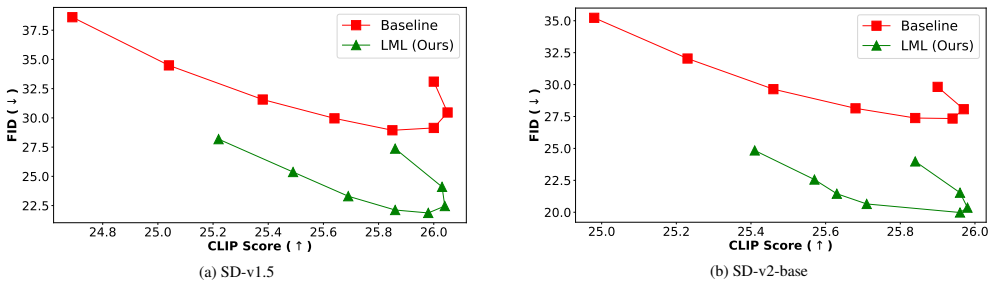
Summary. The paper proposes a training-free, second-order diffusion sampler called Levenberg-Marquardt-Langevin (LML). The method approximates the Hessian of the log-density of the diffused distribution by a scaled outer product of the noise prediction (Proposition 1), stabilizes it with a damping term, and applies its inverse to the noise prediction at each step before feeding the result to DPM-Solver (Algorithm 1). The authors report significant FID and perceptual-metric improvements over DDIM, PNDM, DPM-Solver, DPM-Solver++, and UniPC across CIFAR-10, CelebA-HQ, SD-1.5, SD2-base, SD-XL, and PixArt-α, with negligible computational overhead, and provide theoretical results on approximation error and convergence.
Significance. If the mechanism worked as described, the contribution would be significant: a training-free, nearly zero-overhead sampler that improves generation quality across a wide range of diffusion models by exploiting second-order geometry. The paper is clearly written, the algorithm is precisely specified, and the experimental protocol is extensive, including wall-clock time measurements and Pareto curves. These are strengths that make the central flaw easy to identify. Unfortunately, the claimed improvement is internally inconsistent with the stated hyperparameters: with the paper's chosen κ=1e-8, the LML update is numerically the identity map on the noise prediction, so the sampler is indistinguishable from DPM-Solver. The reported gains therefore cannot be attributed to the proposed Hessian guidance, undermining the central claim.
major comments (3)
- [Algorithm 1 (steps 11–13) and Supp. B.2] With the EMA coefficient fixed to κ=1×10^-8 in Supp. B.2, the mixture eε_i = κ ε_{i+1} + (1-κ) ε_i is numerically identical to ε_i in float32. Then step 11 gives fH^{-1}_i = I - eε_i eε_i^T / (λ + ||eε_i||²), step 12 yields fH^{-1}_i ε_i = (λ/(λ+||ε_i||²)) ε_i, and step 13 rescales this to ||ε_i||, returning exactly ε_i. Thus the algorithm reduces to DPM-Solver with the unmodified noise prediction. This is directly contradicted by Table 1, which reports LML improving CIFAR-10 FID at 10 NFEs from 11.13 (DPM-Solver) to 6.54, and by Table 3 showing large gains on SD models. The improvement cannot be produced by the described mechanism; either a much larger κ was used in practice, or the baseline differs in an undocumented way.
- [§3.2, Eq. (8) and §3.4, step 13] The normalization in step 13 removes any scalar factor introduced by the damped inverse, so the Hessian guidance can only affect the update through a change in the direction of ε_i. When eε_i = ε_i, the direction is unchanged exactly. With κ=1e-8, the directional perturbation is O(κ), i.e., about 1e-8, which is far below the precision needed to explain the large experimental differences reported in Tables 1–4. The paper provides no analysis or ablation showing that such a tiny perturbation can produce the observed gains; its own Supp. B.2 statement that this κ value 'contributes minimally to performance enhancement' is inconsistent with the magnitude of the claimed improvements.
- [Supp. A.2, Eqs. (13)–(16)] The proof of Proposition 1 assumes that p_t(xt) is approximately Gaussian with mean α_t y_θ(xt,t), where y_θ is the learned denoiser. This is not justified: y_θ is not the true posterior mean in general, and the derivation uses ε_θ to express both the score and the Jacobian, making the approximation circular. Even if this approximation were accepted, the resulting Hessian form does not rescue the identity-problem in Algorithm 1, because the algorithm normalizes away the scalar factor. The theoretical claim about second-order geometry is therefore not established, and it is not connected to the actual numerical behavior of the sampler under the reported settings.
minor comments (6)
- [§3.3, first paragraph] The phrase 'at each nose level' appears to be a typo for 'noise level'.
- [Supp. C.2, caption of Figure 11] The dataset name is misspelled as 'CIAFR-10'; it should be 'CIFAR-10'.
- [Table 4 caption] The benchmark name appears as 'T2I-BC' in the caption and 'T2I-CB' in the main text; please standardize the abbreviation.
- [Figure 10, Supp. B.2] The κ-axis labels appear corrupted (e.g., '1 × 10 8'); presumably they denote 1e-8, 2e-8, etc., but as printed they are ambiguous.
- [§3.2, after Eq. (8)] The notation λ' is introduced and then the paper says it will 'not distinguish between λ and λ''; this can confuse the reader when λ appears in Algorithm 1, where the damping parameter is not accompanied by the schedule-dependent factor.
- [Proposition 2 and Supp. A.6] The statement of Proposition 2 uses quantities δ1, δ2, δ3, and D_y without defining them in the main text; the proof in Supp. A.6 only partially clarifies these definitions, and the bound is not interpretable as written.
Circularity Check
With κ=1e-8 the LML update is the identity mapping on the noise prediction, so the reported FID gains cannot be produced by the claimed Hessian mechanism; the central 'prediction' reduces to the baseline by construction.
-
self definitional
[Algorithm 1, steps 7 and 11-13; Supp. B.2]
"eεi =κ∗ε i+1 + (1−κ)∗ε i ... fH −1 i =I− eεi eε⊤ i λ+∥eεi∥2 ... ε LM i = fH −1 i εi ... ε LM i = ∥εi∥ ∥εLM i ∥ εLM i ... we have chosen to fixκ= 1×10 −8 for all tests in Tables 1 and 3. This is a very small value that contributes minimally to performance enhancement."
Setting κ=0 makes eε_i = ε_i. Then fH^{-1}_i ε_i = [I − ε_i ε_i^T/(λ+∥ε_i∥^2)] ε_i = (λ/(λ+∥ε_i∥^2)) ε_i, a positive scalar multiple of ε_i. Step 13 rescales this vector back to the original norm ∥ε_i∥, returning exactly ε_i. With the stated κ=1e-8 in float32, eε_i differs from ε_i by 1e-8(ε_{i+1}−ε_i), at or below machine precision, so the 'Hessian-guided' direction is numerically identical to the unmodified noise prediction. Algorithm 1 therefore reduces to DPM-Solver with ε_i, and the large FID improvements in Tables 1 and 3 cannot originate from the LML Hessian mechanism; the claimed mechanism is vacuous by construction.
full rationale
The central claim is that an LML-approximated Hessian geometry improves diffusion sampling quality. But Algorithm 1's construction makes the Hessian-guided gradient equal to the original noise prediction whenever the EMA coefficient is zero, and the paper fixes κ=1e-8. Mathematically, fH^{-1}_i ε_i is a positive scalar multiple of ε_i, and the normalization in step 13 restores the original norm, so the final vector is ε_i itself. The perturbation from κ=1e-8 is far below float32 precision relative to typical noise-prediction magnitudes, so numerically the algorithm is indistinguishable from feeding ε_i directly into DPM-Solver. The reported improvements—e.g., CIFAR-10 FID from 30.87 to 17.28 at 5 NFEs and from 17.45 to 6.54 at 10 NFEs—therefore cannot be explained by the Hessian step described in the paper; they would have to come from an undocumented implementation difference. This is a case where the method's central 'prediction' reduces to its input by construction, not a mere overclaim or a minor self-citation issue. The paper also cites the authors' own [84] for the Fisher-analytical form used in Proposition 2, but that self-citation is secondary to the identity-by-construction problem. Score 8 reflects that the main empirical result is internally inconsistent with the stated hyperparameters and that the claimed Hessian guidance is, at the stated setting, a vacuous transformation.
Assumptions & free parameters
free parameters (2)
- damping coefficient λ =
0.0008 to 0.00005 on CIFAR-10 (Table 6); 0.001 on SD-1.5 (Table 7); tuned per dataset and per NFE
- EMA coefficient κ =
1e-8 for Tables 1 and 3; other values in ablations (Supp Figure 10)
assumptions (3)
- domain assumption The learned noise predictor ε_θ approximates the true score well enough that the Gaussian form p_t(x_t) ≈ (1/√(2πσ_t)) exp(-‖x_t - α_t y_θ‖²/(2σ_t²)) holds (Supp A.2, Eq. 13).
- domain assumption The Gauss-Newton approximation omitting the second-derivative term r(x_t) ∂²r/∂x_t² in Eq. 16 is valid for diffusion models.
- ad hoc to paper The mirror Poincaré condition with φ = log p(·) + λ‖·‖²/2 holds for the target distribution (Assumption 1 in Supp A.8).
Cite this review
Pith. "Pith review of Unleashing High-Quality Image Generation in Diffusion Sampling Using Second-Order Levenberg-Marquardt-Langevin." pith.science (2026). https://pith.science/paper/VD5J4XIK
@misc{pith2026250524222,
  author       = {Pith},
  title        = {Pith review of: Unleashing High-Quality Image Generation in Diffusion Sampling Using Second-Order Levenberg-Marquardt-Langevin},
  year         = {2026},
  howpublished = {\url{https://pith.science/paper/VD5J4XIK}},
  note         = {Machine review of arXiv:2505.24222}
}
read the original abstract
The diffusion models (DMs) have demonstrated the remarkable capability of generating images via learning the noised score function of data distribution. Current DM sampling techniques typically rely on first-order Langevin dynamics at each noise level, with efforts concentrated on refining inter-level denoising strategies. While leveraging additional second-order Hessian geometry to enhance the sampling quality of Langevin is a common practice in Markov chain Monte Carlo (MCMC), the naive attempts to utilize Hessian geometry in high-dimensional DMs lead to quadratic-complexity computational costs, rendering them non-scalable. In this work, we introduce a novel Levenberg-Marquardt-Langevin (LML) method that approximates the diffusion Hessian geometry in a training-free manner, drawing inspiration from the celebrated Levenberg-Marquardt optimization algorithm. Our approach introduces two key innovations: (1) A low-rank approximation of the diffusion Hessian, leveraging the DMs' inherent structure and circumventing explicit quadratic-complexity computations; (2) A damping mechanism to stabilize the approximated Hessian. This LML approximated Hessian geometry enables the diffusion sampling to execute more accurate steps and improve the image generation quality. We further conduct a theoretical analysis to substantiate the approximation error bound of low-rank approximation and the convergence property of the damping mechanism. Extensive experiments across multiple pretrained DMs validate that the LML method significantly improves image generation quality, with negligible computational overhead.
Figures


Figures from the paper (8 more)




Reference graph
Works this paper leans on
-
[1]
Learning multiple layers of features from tiny images.https://www
Krizhevsky Alex. Learning multiple layers of features from tiny images.https://www. cs. toronto. edu/kriz/learning- features-2009-TR. pdf, 2009. 7
2009
-
[2]
Springer Science & Business Media, 2008
Luigi Ambrosio, Nicola Gigli, and Giuseppe Savar ´e.Gra- dient flows: in metric spaces and in the space of probability measures. Springer Science & Business Media, 2008. 2
2008
-
[3]
Estimating the optimal covariance with imperfect mean in diffusion probabilistic models
Fan Bao, Chongxuan Li, Jiacheng Sun, Jun Zhu, and Bo Zhang. Estimating the optimal covariance with imperfect mean in diffusion probabilistic models. InProceedings of the 39th International Conference on Machine Learning, pages 1555–1584. PMLR, 2022. 1
2022
-
[4]
Springer series in statistics.Principles and Theory for Data Mining and Machine Learning
P Bickel, P Diggle, S Fienberg, U Gather, I Olkin, and S Zeger. Springer series in statistics.Principles and Theory for Data Mining and Machine Learning. Cham, Switzerland: Springer, 2009. 6
2009
-
[5]
Existence and uniqueness of so- lutions to fokker–planck type equations with irregular coef- ficients.Communications in Partial Differential Equations, 33(7):1272–1317, 2008
C Le Bris and P-L Lions. Existence and uniqueness of so- lutions to fokker–planck type equations with irregular coef- ficients.Communications in Partial Differential Equations, 33(7):1272–1317, 2008. 3
2008
-
[6]
A limited memory algorithm for bound constrained optimization.SIAM Journal on scientific computing, 16(5): 1190–1208, 1995
Richard H Byrd, Peihuang Lu, Jorge Nocedal, and Ciyou Zhu. A limited memory algorithm for bound constrained optimization.SIAM Journal on scientific computing, 16(5): 1190–1208, 1995. 5
1995
-
[7]
On the trajectory regularity of ode-based diffu- sion sampling.arXiv preprint arXiv:2405.11326, 2024
Defang Chen, Zhenyu Zhou, Can Wang, Chunhua Shen, and Siwei Lyu. On the trajectory regularity of ode-based diffu- sion sampling.arXiv preprint arXiv:2405.11326, 2024. 1
arXiv 2024
-
[8]
Junsong Chen, Jincheng Yu, Chongjian Ge, Lewei Yao, Enze Xie, Yue Wu, Zhongdao Wang, James Kwok, Ping Luo, Huchuan Lu, et al. Pixart-α: Fast training of diffusion transformer for photorealistic text-to-image synthesis.arXiv preprint arXiv:2310.00426, 2023. 8
Show all 96 references
-
[9]
Stochastic gradient hamiltonian monte carlo
Tianqi Chen, Emily Fox, and Carlos Guestrin. Stochastic gradient hamiltonian monte carlo. InInternational confer- ence on machine learning, pages 1683–1691. PMLR, 2014. 2
2014
-
[10]
Dsl-fiqa: As- sessing facial image quality via dual-set degradation learn- ing and landmark-guided transformer
Wei-Ting Chen, Gurunandan Krishnan, Qiang Gao, Sy- Yen Kuo, Sizhou Ma, and Jian Wang. Dsl-fiqa: As- sessing facial image quality via dual-set degradation learn- ing and landmark-guided transformer. InProceedings of the IEEE/CVF Conference on Computer Vision and Pattern Recogni...
2024
-
[11]
Re- thinking the diffusion models for numerical tabular data im- putation from the perspective of wasserstein gradient flow
Zhichao Chen, Haoxuan Li, Fangyikang Wang, Odin Zhang, Hu Xu, Xiaoyu Jiang, Zhihuan Song, and Eric H Wang. Re- thinking the diffusion models for numerical tabular data im- putation from the perspective of wasserstein gradient flow. arXiv preprint arXiv:2406.15762, 2024. 5
2024 arXiv
-
[12]
Exponential ergod- icity of mirror-langevin diffusions.Advances in Neural In- formation Processing Systems, 33:19573–19585, 2020
Sinho Chewi, Thibaut Le Gouic, Chen Lu, Tyler Maunu, Philippe Rigollet, and Austin Stromme. Exponential ergod- icity of mirror-langevin diffusions.Advances in Neural In- formation Processing Systems, 33:19573–19585, 2020. 1, 6, 3
2020
-
[13]
Diffusion models beat gans on image synthesis
Prafulla Dhariwal and Alexander Nichol. Diffusion models beat gans on image synthesis. InAdvances in Neural Infor- mation Processing Systems, pages 8780–8794, 2021. 1
2021
-
[14]
A note on quadratic transportation and diver- gence inequality.Statistics & Probability Letters, 100:115– 123, 2015
Ying Ding. A note on quadratic transportation and diver- gence inequality.Statistics & Probability Letters, 100:115– 123, 2015. 6
2015
-
[15]
Genie: Higher-order denoising diffusion solvers.Advances in Neu- ral Information Processing Systems, 35:30150–30166, 2022
Tim Dockhorn, Arash Vahdat, and Karsten Kreis. Genie: Higher-order denoising diffusion solvers.Advances in Neu- ral Information Processing Systems, 35:30150–30166, 2022. 1, 3
2022
-
[16]
Gauss-newton/levenberg-marquardt optimiza- tion.Tech
Ethan Eade. Gauss-newton/levenberg-marquardt optimiza- tion.Tech. Rep., 2013. 3
2013
-
[17]
An adaptive multi-step levenberg–marquardt method.Journal of Scien- tific Computing, 78:531–548, 2019
Jinyan Fan, Jianchao Huang, and Jianyu Pan. An adaptive multi-step levenberg–marquardt method.Journal of Scien- tific Computing, 78:531–548, 2019. 5
2019
-
[18]
Pectp: Parameter-efficient cross-task prompts for incremental vi- sion transformer.arXiv preprint arXiv:2407.03813, 2024
Qian Feng, Hanbin Zhao, Chao Zhang, Jiahua Dong, Henghui Ding, Yu-Gang Jiang, and Hui Qian. Pectp: Parameter-efficient cross-task prompts for incremental vi- sion transformer.arXiv preprint arXiv:2407.03813, 2024. 5
2024 arXiv
-
[19]
Lw2g: Learning whether to grow for prompt-based continual learning.arXiv preprint arXiv:2409.18860, 2024
Qian Feng, Dawei Zhou, Hanbin Zhao, Chao Zhang, and Hui Qian. Lw2g: Learning whether to grow for prompt-based continual learning.arXiv preprint arXiv:2409.18860, 2024. 5
2024 arXiv
-
[20]
Unit stepsize for the newton method close to critical solu- tions.Mathematical Programming, 187(1):697–721, 2021
Andreas Fischer, Alexey F Izmailov, and Mikhail V Solodov. Unit stepsize for the newton method close to critical solu- tions.Mathematical Programming, 187(1):697–721, 2021. 5
2021
-
[21]
Iap: Improving continual learning of vision- language models via instance-aware prompting.arXiv preprint arXiv:2503.20612, 2025
Hao Fu, Hanbin Zhao, Jiahua Dong, Chao Zhang, and Hui Qian. Iap: Improving continual learning of vision- language models via instance-aware prompting.arXiv preprint arXiv:2503.20612, 2025. 5 9
2025 arXiv
-
[22]
Quasi - newton hamiltonian monte carlo
Tianfan Fu, Luo Luo, and Zhihua Zhang. Quasi - newton hamiltonian monte carlo. InProceedings of the Conference on Uncertainty in Artificial Intelligence (UAI), 2016. 3
2016
-
[23]
Fast diffusion probabilistic model sampling through the lens of backward error analysis.arXiv preprint arXiv:2304.11446, 2023
Yansong Gao, Zhihong Pan, Xin Zhou, Le Kang, and Pratik Chaudhari. Fast diffusion probabilistic model sampling through the lens of backward error analysis.arXiv preprint arXiv:2304.11446, 2023. 1
2023 arXiv
-
[24]
Hilbert-schmidt operators.Classes of Linear Op- erators Vol
Israel Gohberg, Seymour Goldberg, Marinus A Kaashoek, Israel Gohberg, Seymour Goldberg, and Marinus A Kaashoek. Hilbert-schmidt operators.Classes of Linear Op- erators Vol. I, pages 138–147, 1990. 6
1990
-
[25]
An efficient step size control for continuation methods.BIT Numerical Mathemat- ics, 20:475–485, 1980
J Hackl, HJ Wacker, and W Zulehner. An efficient step size control for continuation methods.BIT Numerical Mathemat- ics, 20:475–485, 1980. 5
1980
-
[26]
Measuring color- fulness in natural images
David Hasler and Sabine E Suesstrunk. Measuring color- fulness in natural images. InHuman vision and electronic imaging VIII, pages 87–95. SPIE, 2003. 7
2003
-
[27]
Eat: An enhancer for aesthetics-oriented transformers
Shuai He, Anlong Ming, Shuntian Zheng, Haobin Zhong, and Huadong Ma. Eat: An enhancer for aesthetics-oriented transformers. InProceedings of the 31st ACM international conference on multimedia, pages 1023–1032, 2023. 7
2023
-
[28]
Neue begr ¨undung der theorie quadratis- cher formen von unendlichvielen ver ¨anderlichen.Journal f¨ur die reine und angewandte Mathematik, 1909(136):210– 271, 1909
Ernst Hellinger. Neue begr ¨undung der theorie quadratis- cher formen von unendlichvielen ver ¨anderlichen.Journal f¨ur die reine und angewandte Mathematik, 1909(136):210– 271, 1909. 6
1909
-
[29]
Gans trained by a two time-scale update rule converge to a local nash equilib- rium.Advances in Neural Information Processing Systems (NeurIPS), 2017
Martin Heusel, Hubert Ramsauer, Thomas Unterthiner, Bernhard Nessler, and Sepp Hochreiter. Gans trained by a two time-scale update rule converge to a local nash equilib- rium.Advances in Neural Information Processing Systems (NeurIPS), 2017. 4
2017
-
[30]
Denoising diffu- sion probabilistic models.Advances in Neural Information Processing Systems, 33:6840–6851, 2020
Jonathan Ho, Ajay Jain, and Pieter Abbeel. Denoising diffu- sion probabilistic models.Advances in Neural Information Processing Systems, 33:6840–6851, 2020. 1, 2
2020
-
[31]
Fleet, Mohammad Norouzi, and Tim Salimans
Jonathan Ho, Chitwan Saharia, William Chan, David J. Fleet, Mohammad Norouzi, and Tim Salimans. Cascaded diffu- sion models for high fidelity image generation.Journal of Machine Learning Research, 23(47):1–33, 2022. 1
2022
-
[32]
Cambridge university press, 2012
Roger A Horn and Charles R Johnson.Matrix analysis. Cambridge university press, 2012. 4
2012
-
[33]
Mirrored langevin dynamics.Advances in Neural Informa- tion Processing Systems, 31, 2018
Ya-Ping Hsieh, Ali Kavis, Paul Rolland, and V olkan Cevher. Mirrored langevin dynamics.Advances in Neural Informa- tion Processing Systems, 31, 2018. 2
2018
-
[34]
T2i-compbench: A comprehensive bench- mark for open-world compositional text-to-image genera- tion.Advances in Neural Information Processing Systems, 36:78723–78747, 2023
Kaiyi Huang, Kaiyue Sun, Enze Xie, Zhenguo Li, and Xihui Liu. T2i-compbench: A comprehensive bench- mark for open-world compositional text-to-image genera- tion.Advances in Neural Information Processing Systems, 36:78723–78747, 2023. 8
2023
-
[35]
Gotta go fast when generating data with score-based models.arXiv preprint arXiv:2105.14080, 2021
Alexia Jolicoeur-Martineau, Ke Li, R ´emi Pich ´e-Taillefer, Tal Kachman, and Ioannis Mitliagkas. Gotta go fast when generating data with score-based models.arXiv preprint arXiv:2105.14080, 2021. 1
2021 arXiv
-
[36]
The variational formulation of the fokker–planck equation.SIAM journal on mathematical analysis, 29(1):1–17, 1998
Richard Jordan, David Kinderlehrer, and Felix Otto. The variational formulation of the fokker–planck equation.SIAM journal on mathematical analysis, 29(1):1–17, 1998. 2
1998
-
[37]
Univ of California Press, 1987
Mark Kac.Enigmas of chance: an autobiography. Univ of California Press, 1987. 2
1987
-
[38]
springer, 2014
Ioannis Karatzas and Steven Shreve.Brownian motion and stochastic calculus. springer, 2014. 3
2014
-
[39]
Progressive growing of gans for improved quality, stability, and variation.arXiv preprint arXiv:1710.10196, 2017
Tero Karras, Timo Aila, Samuli Laine, and Jaakko Lehtinen. Progressive growing of gans for improved quality, stability, and variation.arXiv preprint arXiv:1710.10196, 2017. 4, 7
2017 arXiv
-
[40]
Elucidating the design space of diffusion-based generative models.arXiv preprint arXiv:2206.00364, 2022
Tero Karras, Miika Aittala, Timo Aila, and Samuli Laine. Elucidating the design space of diffusion-based generative models.arXiv preprint arXiv:2206.00364, 2022. 5
2022 arXiv
-
[41]
Stabilization of geometrically nonlinear topology optimization by the levenberg–marquardt method
Atsushi Kawamoto. Stabilization of geometrically nonlinear topology optimization by the levenberg–marquardt method. Structural and Multidisciplinary Optimization, 37:429–433,
-
[42]
Pick-a-pic: An open dataset of user preferences for text-to-image generation
Yuval Kirstain, Adam Polyak, Uriel Singer, Shahbuland Ma- tiana, Joe Penna, and Omer Levy. Pick-a-pic: An open dataset of user preferences for text-to-image generation. Advances in Neural Information Processing Systems, 36: 36652–36663, 2023. 7
2023
-
[43]
Dynamical newton-like methods with adaptive stepsize for solving nonlinear alge- braic equations.Computers, Materials, & Continua, 31(3): 173–200, 2012
Cheng-Yu Ku and Weichung Yeih. Dynamical newton-like methods with adaptive stepsize for solving nonlinear alge- braic equations.Computers, Materials, & Continua, 31(3): 173–200, 2012. 5
2012
-
[44]
On information and sufficiency.The annals of mathematical statistics, 22(1): 79–86, 1951
Solomon Kullback and Richard A Leibler. On information and sufficiency.The annals of mathematical statistics, 22(1): 79–86, 1951. 6
1951
-
[45]
A method for the solution of certain non-linear problems in least squares.Quarterly of applied mathematics, 2(2):164–168, 1944
Kenneth Levenberg. A method for the solution of certain non-linear problems in least squares.Quarterly of applied mathematics, 2(2):164–168, 1944. 1
1944
-
[46]
Facescore: Benchmarking and enhanc- ing face quality in human generation.arXiv preprint arXiv:2406.17100, 2024
Zhenyi Liao, Qingsong Xie, Chen Chen, Hannan Lu, and Zhijie Deng. Facescore: Benchmarking and enhanc- ing face quality in human generation.arXiv preprint arXiv:2406.17100, 2024. 7
2024 arXiv
-
[47]
Microsoft coco: Common objects in context
Tsung-Yi Lin, Michael Maire, Serge Belongie, James Hays, Pietro Perona, Deva Ramanan, Piotr Doll´ar, and C Lawrence Zitnick. Microsoft coco: Common objects in context. In Computer Vision–ECCV 2014: 13th European Conference, Zurich, Switzerland, September 6-12, 2014, Proceeding...
2014
-
[48]
Flow matching for generative mod- eling.arXiv preprint arXiv:2210.02747, 2022
Yaron Lipman, Ricky TQ Chen, Heli Ben-Hamu, Maximil- ian Nickel, and Matt Le. Flow matching for generative mod- eling.arXiv preprint arXiv:2210.02747, 2022. 5
2022 arXiv
-
[49]
Mirror diffusion models for constrained and wa- termarked generation.Advances in Neural Information Pro- cessing Systems, 36:42898–42917, 2023
Guan-Horng Liu, Tianrong Chen, Evangelos Theodorou, and Molei Tao. Mirror diffusion models for constrained and wa- termarked generation.Advances in Neural Information Pro- cessing Systems, 36:42898–42917, 2023. 5
2023
-
[50]
Pseudo numerical methods for diffusion models on manifolds.arXiv preprint arXiv:2202.09778, 2022
Luping Liu, Yi Ren, Zhijie Lin, and Zhou Zhao. Pseudo numerical methods for diffusion models on manifolds.arXiv preprint arXiv:2202.09778, 2022. 1, 5, 6, 7, 8
2022 arXiv
-
[51]
Dpm-solver: A fast ode solver for diffusion probabilistic model sampling in around 10 steps.Advances in Neural Information Processing Systems, 35:5775–5787,
Cheng Lu, Yuhao Zhou, Fan Bao, Jianfei Chen, Chongxuan Li, and Jun Zhu. Dpm-solver: A fast ode solver for diffusion probabilistic model sampling in around 10 steps.Advances in Neural Information Processing Systems, 35:5775–5787,
-
[52]
Dpm-solver++: Fast solver for guided sampling of diffusion probabilistic models.arXiv preprint arXiv:2211.01095, 2022
Cheng Lu, Yuhao Zhou, Fan Bao, Jianfei Chen, Chongx- uan Li, and Jun Zhu. Dpm-solver++: Fast solver for guided sampling of diffusion probabilistic models.arXiv preprint arXiv:2211.01095, 2022. 1, 6, 7, 8
2022 arXiv
-
[53]
An algorithm for least-squares esti- mation of nonlinear parameters.Journal of the society for Industrial and Applied Mathematics, 11(2):431–441, 1963
Donald W Marquardt. An algorithm for least-squares esti- mation of nonlinear parameters.Journal of the society for Industrial and Applied Mathematics, 11(2):431–441, 1963. 1 10
1963
-
[54]
A stochastic newton mcmc method for large- scale statistical inverse problems with application to seismic inversion.SIAM Journal on Scientific Computing, 34(3): A1460–A1487, 2012
James Martin, Lucas C Wilcox, Carsten Burstedde, and Omar Ghattas. A stochastic newton mcmc method for large- scale statistical inverse problems with application to seismic inversion.SIAM Journal on Scientific Computing, 34(3): A1460–A1487, 2012. 1, 3
2012
-
[55]
Problem complexity and method efficiency in opti- mization
Arkadij Semenovi ˇc Nemirovskij and David Borisovich Yudin. Problem complexity and method efficiency in opti- mization. 1983. 5
1983
-
[56]
Springer, 2018
Yurii Nesterov et al.Lectures on convex optimization. Springer, 2018. 2, 1
2018
-
[57]
Efficient training of neural nets for nonlinear adaptive filtering using a recursive levenberg-marquardt algorithm.IEEE Transactions on Sig- nal Processing, 48(7):1915–1927, 2000
Lester SH Ngia and Jonas Sjoberg. Efficient training of neural nets for nonlinear adaptive filtering using a recursive levenberg-marquardt algorithm.IEEE Transactions on Sig- nal Processing, 48(7):1915–1927, 2000. 5
1915
-
[58]
GLIDE: Towards photorealis- tic image generation and editing with text-guided diffusion models
Alexander Quinn Nichol, Prafulla Dhariwal, Aditya Ramesh, Pranav Shyam, Pamela Mishkin, Bob Mcgrew, Ilya Sutskever, and Mark Chen. GLIDE: Towards photorealis- tic image generation and editing with text-guided diffusion models. InProceedings of the 39th International Conference...
2022
-
[59]
Sdxl: Improving latent diffusion mod- els for high-resolution image synthesis.arXiv preprint arXiv:2307.01952, 2023
Dustin Podell, Zion English, Kyle Lacey, Andreas Blattmann, Tim Dockhorn, Jonas M ¨uller, Joe Penna, and Robin Rombach. Sdxl: Improving latent diffusion mod- els for high-resolution image synthesis.arXiv preprint arXiv:2307.01952, 2023. 8
2023 arXiv
-
[60]
Newton’s method and its use in optimiza- tion.European Journal of Operational Research, 181(3): 1086–1096, 2007
Boris T Polyak. Newton’s method and its use in optimiza- tion.European Journal of Operational Research, 181(3): 1086–1096, 2007. 3
2007
-
[61]
Learn- ing transferable visual models from natural language super- vision
Alec Radford, Jong Wook Kim, Chris Hallacy, Aditya Ramesh, Gabriel Goh, Sandhini Agarwal, Girish Sastry, Amanda Askell, Pamela Mishkin, Jack Clark, et al. Learn- ing transferable visual models from natural language super- vision. InInternational Conference on Machine Learning ...
2021
-
[62]
Hierarchical text-conditional image gen- eration with clip latents.arXiv preprint arXiv:2204.06125,
Aditya Ramesh, Prafulla Dhariwal, Alex Nichol, Casey Chu, and Mark Chen. Hierarchical text-conditional image gen- eration with clip latents.arXiv preprint arXiv:2204.06125,
-
[63]
The fokker-planck equation, 1996
H Risken. The fokker-planck equation, 1996. 6
1996
-
[64]
Free hunch: Denoiser covariance estimation for diffusion models without extra costs
Severi Rissanen, Markus Heinonen, and Arno Solin. Free hunch: Denoiser covariance estimation for diffusion models without extra costs. InThe Thirteenth International Confer- ence on Learning Representations, 2025. 1, 3
2025
-
[65]
Monte carlo statistical methods, 1999
CP Robert. Monte carlo statistical methods, 1999. 1
1999
-
[66]
Convex analysis:(pms-28)
Ralph Tyrell Rockafellar. Convex analysis:(pms-28). 2015. 3
2015
-
[67]
High-resolution image synthesis with latent diffusion models
Robin Rombach, Andreas Blattmann, Dominik Lorenz, Patrick Esser, and Bj ¨orn Ommer. High-resolution image synthesis with latent diffusion models. InProceedings of the IEEE/CVF Conference on Computer Vision and Pattern Recognition, pages 10684–10695, 2022. 1, 3, 5, 6, 7, 8
2022
-
[68]
Levenberg-marquardt optimization.Notes, University Of Toronto, 52, 1996
Sam Roweis. Levenberg-marquardt optimization.Notes, University Of Toronto, 52, 1996. 1, 3
1996
-
[69]
Fleet, and Mohammad Norouzi
Chitwan Saharia, William Chan, Saurabh Saxena, Lala Li, Jay Whang, Emily Denton, Seyed Kamyar Seyed Ghasemipour, Raphael Gontijo-Lopes, Burcu Karagol Ayan, Tim Salimans, Jonathan Ho, David J. Fleet, and Mohammad Norouzi. Photorealistic text-to-image diffusion models with deep ...
-
[70]
Photorealistic text-to-image diffusion models with deep lan- guage understanding
Chitwan Saharia, William Chan, Saurabh Saxena, Lala Li, Jay Whang, Emily L Denton, Kamyar Ghasemipour, Raphael Gontijo Lopes, Burcu Karagol Ayan, Tim Sali- mans, Jonathan Ho, David J Fleet, and Mohammad Norouzi. Photorealistic text-to-image diffusion models with deep lan- guag...
2022
-
[71]
Laion-5b: An open large-scale dataset for training next generation image-text models.Advances in neural in- formation processing systems, 35:25278–25294, 2022
Christoph Schuhmann, Romain Beaumont, Richard Vencu, Cade Gordon, Ross Wightman, Mehdi Cherti, Theo Coombes, Aarush Katta, Clayton Mullis, Mitchell Worts- man, et al. Laion-5b: An open large-scale dataset for training next generation image-text models.Advances in neural in- fo...
2022
-
[72]
Adjustment of an inverse matrix corresponding to a change in one element of a given matrix.The Annals of Mathematical Statistics, 21(1): 124–127, 1950
Jack Sherman and Winifred J Morrison. Adjustment of an inverse matrix corresponding to a change in one element of a given matrix.The Annals of Mathematical Statistics, 21(1): 124–127, 1950. 4, 1
1950
-
[73]
Stochastic quasi-newton langevin monte carlo
Umut Simsekli, Roland Badeau, Taylan Cemgil, and Ga ¨el Richard. Stochastic quasi-newton langevin monte carlo. In International Conference on Machine Learning, pages 642–
-
[74]
Deep unsupervised learning using nonequilibrium thermodynamics
Jascha Sohl-Dickstein, Eric Weiss, Niru Maheswaranathan, and Surya Ganguli. Deep unsupervised learning using nonequilibrium thermodynamics. InInternational Confer- ence on Machine Learning, pages 2256–2265. PMLR, 2015. 1
2015
-
[75]
Denois- ing diffusion implicit models
Jiaming Song, Chenlin Meng, and Stefano Ermon. Denois- ing diffusion implicit models. InInternational Conference on Learning Representations, 2021. 1, 7, 8
2021
-
[76]
Generative modeling by esti- mating gradients of the data distribution.Advances in neural information processing systems, 32, 2019
Yang Song and Stefano Ermon. Generative modeling by esti- mating gradients of the data distribution.Advances in neural information processing systems, 32, 2019. 1, 2, 3, 5
2019
-
[77]
Score-based generative modeling through stochastic differential equa- tions.arXiv preprint arXiv:2011.13456, 2020
Yang Song, Jascha Sohl-Dickstein, Diederik P Kingma, Ab- hishek Kumar, Stefano Ermon, and Ben Poole. Score-based generative modeling through stochastic differential equa- tions.arXiv preprint arXiv:2011.13456, 2020. 1, 5, 6
2011 arXiv
-
[78]
Texttoucher: Fine-grained text-to- touch generation
Jiahang Tu, Hao Fu, Fengyu Yang, Hanbin Zhao, Chao Zhang, and Hui Qian. Texttoucher: Fine-grained text-to- touch generation. InProceedings of the AAAI Conference on Artificial Intelligence, pages 7455–7463, 2025. 5
2025
-
[79]
Driveditfit: Fine-tuning diffusion transformers for autonomous driving data generation.ACM Transactions on Multimedia Computing, Communications and Applications, 21(3):1–29, 2025
Jiahang Tu, Wei Ji, Hanbin Zhao, Chao Zhang, Roger Zim- mermann, and Hui Qian. Driveditfit: Fine-tuning diffusion transformers for autonomous driving data generation.ACM Transactions on Multimedia Computing, Communications and Applications, 21(3):1–29, 2025. 5
2025
-
[80]
Total variation distance and the distribution of relative information
Sergio Verd ´u. Total variation distance and the distribution of relative information. In2014 information theory and appli- cations workshop (ITA), pages 1–3. IEEE, 2014. 6
2014
-
[81]
Springer, 2009
C ´edric Villani et al.Optimal transport: old and new. Springer, 2009. 2, 6
2009
-
[82]
Belm: Bidirectional explicit linear multi-step sampler 11 for exact inversion in diffusion models.arXiv preprint arXiv:2410.07273, 2024
Fangyikang Wang, Hubery Yin, Yuejiang Dong, Humin- hao Zhu, Chao Zhang, Hanbin Zhao, Hui Qian, and Chen Li. Belm: Bidirectional explicit linear multi-step sampler 11 for exact inversion in diffusion models.arXiv preprint arXiv:2410.07273, 2024. 5
-
[83]
Gad-pvi: A general accelerated dynamic-weight particle-based variational inference frame- work.Entropy, 26(8):679, 2024
Fangyikang Wang, Huminhao Zhu, Chao Zhang, Hanbin Zhao, and Hui Qian. Gad-pvi: A general accelerated dynamic-weight particle-based variational inference frame- work.Entropy, 26(8):679, 2024. 5
2024
-
[84]
Efficiently access diffusion fisher: Within the outer product span space, 2025
Fangyikang Wang, Hubery Yin, Shaobin Zhuang, Huminhao Zhu, Yinan Li, Lei Qian, Chao Zhang, Hanbin Zhao, Hui Qian, and Chen Li. Efficiently access diffusion fisher: Within the outer product span space, 2025. 1, 3, 6, 2
2025
-
[85]
Bayesian learning via stochas- tic gradient langevin dynamics
Max Welling and Yee W Teh. Bayesian learning via stochas- tic gradient langevin dynamics. InProceedings of the 28th international conference on machine learning (ICML-11), pages 681–688. Citeseer, 2011. 2
2011
-
[86]
Towards more accurate diffusion model acceleration with a timestep tuner
Mengfei Xia, Yujun Shen, Changsong Lei, Yu Zhou, Deli Zhao, Ran Yi, Wenping Wang, and Yong-Jin Liu. Towards more accurate diffusion model acceleration with a timestep tuner. InProceedings of the IEEE/CVF Conference on Com- puter Vision and Pattern Recognition, pages 5736–5745,
-
[87]
Accelerating diffu- sion sampling with optimized time steps
Shuchen Xue, Zhaoqiang Liu, Fei Chen, Shifeng Zhang, Tianyang Hu, Enze Xie, and Zhenguo Li. Accelerating diffu- sion sampling with optimized time steps. InProceedings of the IEEE/CVF Conference on Computer Vision and Pattern Recognition, pages 8292–8301, 2024. 1
2024
-
[88]
Adding conditional control to text-to-image diffusion models
Lvmin Zhang, Anyi Rao, and Maneesh Agrawala. Adding conditional control to text-to-image diffusion models. In Proceedings of the IEEE/CVF International Conference on Computer Vision, pages 3836–3847, 2023. 8
2023
-
[89]
Tackling the singularities at the endpoints of time intervals in diffusion models.arXiv preprint arXiv:2403.08381, 2024
Pengze Zhang, Hubery Yin, Chen Li, and Xiaohua Xie. Tackling the singularities at the endpoints of time intervals in diffusion models.arXiv preprint arXiv:2403.08381, 2024. 8
2024 arXiv
-
[90]
Fast sampling of dif- fusion models with exponential integrator.arXiv preprint arXiv:2204.13902, 2022
Qinsheng Zhang and Yongxin Chen. Fast sampling of dif- fusion models with exponential integrator.arXiv preprint arXiv:2204.13902, 2022. 1
2022 arXiv
-
[91]
Unipc: A unified predictor-corrector framework for fast sampling of diffusion models.Advances in Neural Information Processing Systems, 36, 2024
Wenliang Zhao, Lujia Bai, Yongming Rao, Jie Zhou, and Jiwen Lu. Unipc: A unified predictor-corrector framework for fast sampling of diffusion models.Advances in Neural Information Processing Systems, 36, 2024. 6, 7, 8
2024
-
[92]
Dpm- solver-v3: Improved diffusion ode solver with empirical model statistics.Advances in Neural Information Process- ing Systems, 36:55502–55542, 2023
Kaiwen Zheng, Cheng Lu, Jianfei Chen, and Jun Zhu. Dpm- solver-v3: Improved diffusion ode solver with empirical model statistics.Advances in Neural Information Process- ing Systems, 36:55502–55542, 2023
2023
-
[93]
Fast ode-based sampling for diffusion models in around 5 steps
Zhenyu Zhou, Defang Chen, Can Wang, and Chun Chen. Fast ode-based sampling for diffusion models in around 5 steps. InProceedings of the IEEE/CVF Conference on Com- puter Vision and Pattern Recognition, pages 7777–7786,
-
[94]
Analyzing and improving model collapse in rectified flow models.arXiv preprint arXiv:2412.08175,
Huminhao Zhu, Fangyikang Wang, Tianyu Ding, Qing Qu, and Zhihui Zhu. Analyzing and improving model collapse in rectified flow models.arXiv preprint arXiv:2412.08175,
-
[95]
Neural sinkhorn gradient flow.arXiv preprint arXiv:2401.14069, 2024
Huminhao Zhu, Fangyikang Wang, Chao Zhang, Hanbin Zhao, and Hui Qian. Neural sinkhorn gradient flow.arXiv preprint arXiv:2401.14069, 2024. 5 12 Unleashing High-Quality Image Generation in Diffusion Sampling Using Second-Order Levenberg-Marquardt-Langevin Supplementary Material...
2024 arXiv
-
[96]
18, we obtain the LM annealing SDE in Eq
to Eq. 18, we obtain the LM annealing SDE in Eq. 9. A.5. Derivation of Eq. 10 Here, we will prove that the marginal distribution of Eq. 10 is the same as that of Eq. 9. We will first state the Feyn- man–Kac formula. Theorem 2.(Feynman–Kac formula, [37]) For an Ito SDE as follo...
Reviewed August 7, 2026 · model on record in the stance chip above.
Discussion (0). Sign in to comment.