State-of-the-art Observation, Calibration, and Imaging Framework for Solar and Heliospheric Sciences with SKA
Pith reviewed 2026-07-01 03:10 UTC · model grok-4.3
The pith
The Sun's extreme brightness and variability require non-standard SKA signal chain setups plus spectropolarimetric snapshot imaging with high dynamic range and fidelity.
A machine-rendered reading of the paper's core claim, the machinery that carries it, and where it could break.
Core claim
The Sun is a surprisingly difficult radio source to observe and image, even with the SKA. Configuring the signal chain to enable solar observations while maintaining linearity is the very first non-standard requirement. Capturing the dynamics in solar radio emission in their full glory requires a spectropolarimetric snapshot capability with high dynamic range and fidelity.
What carries the argument
Spectropolarimetric snapshot capability with high dynamic range and fidelity, supported by non-standard signal-chain configuration to maintain linearity across the Sun's brightness range.
If this is right
- Millisecond-scale coherent bursts and solar-cycle variations can be tracked simultaneously in the same dataset.
- Fractional polarizations from less than 1 percent to nearly 100 percent become measurable with high purity.
- Brightness temperatures from 10^4 K to 10^13 K can be recovered without saturation or loss of faint features.
- Angular scales from compact sources to structures larger than a degree can be imaged in a single observation.
Where Pith is reading between the lines
- The same linearity and snapshot requirements may apply to observations of other extremely bright transients with next-generation arrays.
- Successful solar calibration pipelines could be adapted to reduce artifacts in observations of other extended, variable sources.
- Routine solar monitoring modes on the SKA could supply real-time inputs for space-weather forecasting models.
Load-bearing premise
The SKA hardware and software can be reconfigured for solar observations without compromising its primary science goals or introducing unmanageable calibration artifacts.
What would settle it
A test showing that solar-mode reconfiguration produces persistent calibration errors that prevent dynamic range from reaching the levels required to image both thermal and coherent burst emission.
Figures
read the original abstract
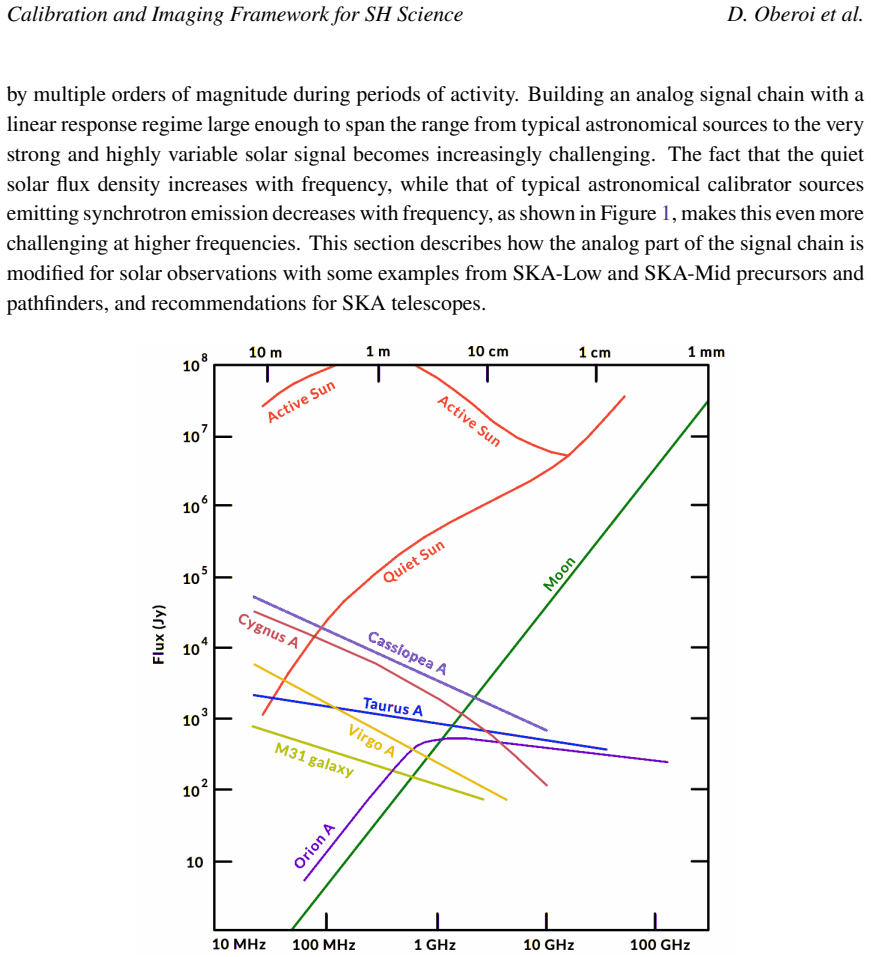
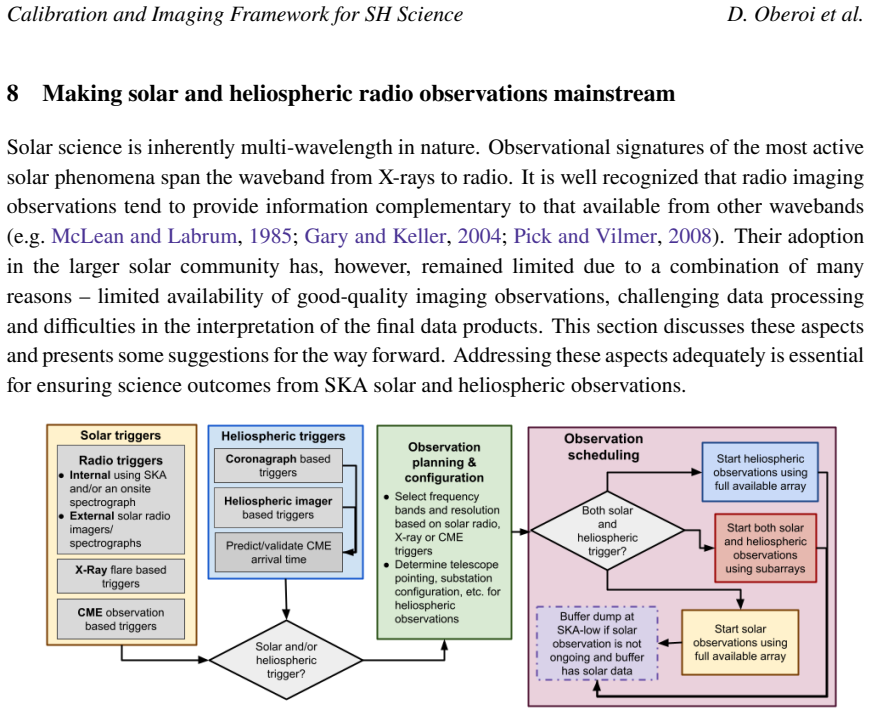
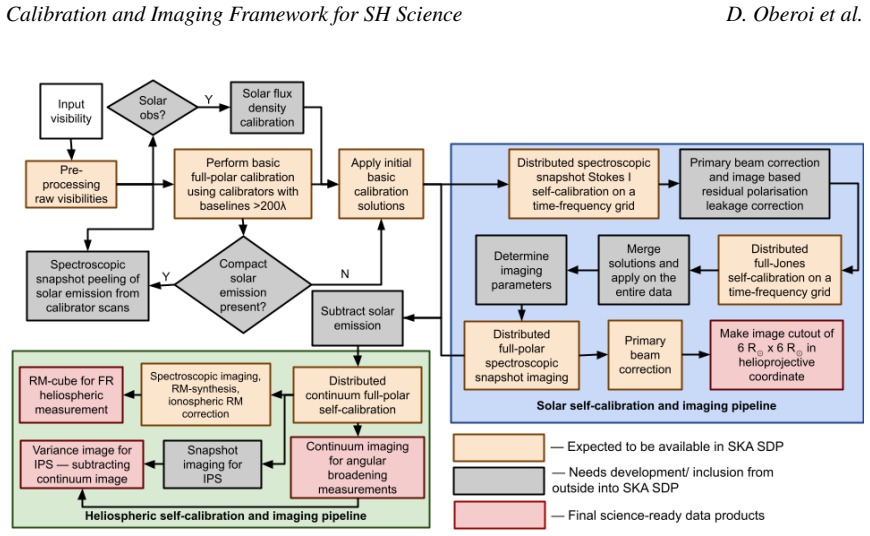
The Sun is a surprisingly difficult radio source to observe and image, even with the SKA. It is multiple orders brighter than the typical radio sources, which sensitive radio telescopes like SKA are optimized for. So, configuring the signal chain to enable solar observations while maintaining linearity is the very first non-standard requirement to be met. Next, solar radio emission spans an impressive range along every single phase-space parameter that can be used to describe it -- time scales from solar cycles to millisecond; spectral scales from smooth thermal emission to $\sim$100 kHz coherent emission; brightness temperatures from $10^4$ K for gyrosynchrotron emissions to $10^{13}$ K for bright type-III bursts; fractional polarizations from less than 1\% to nearly 100\%; and angular scales extending beyond a degree. Capturing the dynamics in solar radio emission in their full glory requires, on the one hand, that all the data that goes into making an image be acquired over very short temporal and spectral spans and, on the other, also imposes requirements for very high imaging dynamic range with high polarization purity. Extracting the information at the requisite temporal and spectral scales from SKA data will require a spectropolarimetric snapshot capability with high dynamic range and fidelity. Additionally, some of the most interesting insights into solar physics and space weather come from studying solar activity, which remains inherently unpredictable. This chapter discusses the various considerations that need to be addressed to help realize the promise of solar and heliospheric science from SKA.
Editorial analysis
A structured set of objections, weighed in public.
Referee Report
Summary. The manuscript discusses the observational challenges of the Sun for the SKA, enumerating its extreme properties across brightness temperature (10^4–10^13 K), timescales (milliseconds to solar cycle), spectral scales, fractional polarization (<1% to ~100%), and angular scales. It concludes that capturing solar radio dynamics requires non-standard signal-chain configuration to preserve linearity plus a spectropolarimetric snapshot imaging capability with high dynamic range and polarization fidelity. The text frames these as requirements derived from established solar radio emission parameters and notes the value for solar physics and space-weather studies.
Significance. If the stated requirements are adopted, the work would help enable high-fidelity solar and heliospheric observations with the SKA by compiling known emission properties into a coherent set of instrumental and operational needs. The paper correctly grounds its arguments in standard solar radio astronomy without introducing unsubstantiated quantitative claims or derivations.
minor comments (2)
- [Abstract] Abstract: the statement that the Sun is 'multiple orders brighter than the typical radio sources, which sensitive radio telescopes like SKA are optimized for' would be more precise if accompanied by a reference to SKA design sensitivity or representative solar flux values.
- [Abstract] Abstract: the final sentence refers to 'this chapter' and 'the various considerations' but provides no outline of the manuscript structure or section headings.
Simulated Author's Rebuttal
We thank the referee for their positive assessment of the manuscript, accurate summary of its content, and recommendation for minor revision. The referee correctly notes that the arguments are grounded in established solar radio astronomy without unsubstantiated claims.
Circularity Check
No significant circularity
full rationale
The manuscript is a requirements discussion that enumerates established solar radio emission properties (brightness temperatures, timescales, polarization fractions, angular scales) drawn from standard solar radio astronomy and states the consequent need for spectropolarimetric snapshot imaging with high dynamic range. No derivations, equations, predictions, fitted parameters, or self-citation chains appear; the text contains no load-bearing steps that reduce to inputs by construction. The central claims are direct logical consequences of the listed observational requirements and remain independent of any internal fitting or renaming.
Axiom & Free-Parameter Ledger
Reference graph
Works this paper leans on
-
[1]
Spectral Index of the Diffuse Radio Background Measured From 100 to 200 MHz
Spectral Index of the Diffuse Radio Background Measured from 100 to 200 MHz. , keywords =. doi:10.1088/0004-6256/136/2/641 , archivePrefix =. 0806.2868 , primaryClass =
work page internal anchor Pith review Pith/arXiv arXiv doi:10.1088/0004-6256/136/2/641
-
[2]
Science China Physics, Mechanics, and Astronomy , keywords =
A novel fine spectral structure of solar radio bursts with periodic beaded stripes observed by CBSm of CMP-II. Science China Physics, Mechanics, and Astronomy , keywords =. doi:10.1007/s11433-025-2716-4 , archivePrefix =. 2506.06819 , primaryClass =
-
[3]
High-resolution Observational Features of Type I Solar Radio Bursts. , keywords =. doi:10.3847/1538-4357/add143 , adsurl =
-
[4]
Investigating an Erupting Metric-decimetric Radio Depression and Its Physical Origin. , keywords =. doi:10.3847/1538-4357/adcb46 , archivePrefix =. 2504.06086 , primaryClass =
-
[5]
Journal of Geophysical Research (Space Physics) , keywords =
Exploring the Origin of Multi-Periodic Pulsations During a White-Light Flare. Journal of Geophysical Research (Space Physics) , keywords =. doi:10.1029/2025JA033772 , archivePrefix =. 2504.08321 , primaryClass =
-
[6]
A Radio-interferometric Imaging Method Based on the Wavelet Tight Frame. , keywords =. doi:10.3847/1538-3881/ada28d , adsurl =
-
[7]
Radio dimming associated with filament eruptions in the meter and decimeter wavebands. , keywords =. doi:10.1051/0004-6361/202453282 , archivePrefix =. 2504.08391 , primaryClass =
-
[8]
A L _ q Proximal Gradient Algorithm for Radio-interferometric Imaging. , keywords =. doi:10.1088/1538-3873/adb334 , adsurl =
-
[9]
Predicting the Arrival Time of an Interplanetary Shock Based on DSRT Spectrum Observations for the Corresponding Type II Radio Burst and a Blast Wave Theory. , keywords =. doi:10.3847/1538-4357/ad150f , adsurl =
-
[10]
Nature Astronomy , year = 2023, month = jun, volume =
A super radio camera with a one-kilometre lens. Nature Astronomy , year = 2023, month = jun, volume =. doi:10.1038/s41550-023-01932-y , adsurl =
-
[11]
A Formalism for Calibrating the Instrumental Polarization of Radio Interferometric Arrays at Meter Wavelengths Using Unpolarized Sky: A Demonstration Using MWA Observations. , keywords =. doi:10.3847/1538-4365/adc443 , archivePrefix =. 2503.16675 , primaryClass =
-
[12]
doi:10.5281/zenodo.16590564 , url =
Kansabanik, Devojyoti and Patra, Deepan , title =. doi:10.5281/zenodo.16590564 , url =
-
[13]
OCTAD-S: digital fast Fourier transform spectrometers by FPGA , volume=
Iwai, Kazumasa and Kubo, Yûki and Ishibashi, Hiromitsu and Naoi, Takahiro and Harada, Kenichi and Ema, Kenji and Hayashi, Yoshinori and Chikahiro, Yuichi , year=. OCTAD-S: digital fast Fourier transform spectrometers by FPGA , volume=. Earth, Planets and Space , publisher=. doi:10.1186/s40623-017-0681-8 , number=
-
[14]
GaLactic and Extragalactic All-sky Murchison Widefield Array (GLEAM) survey - I. A low-frequency extragalactic catalogue. , keywords =. doi:10.1093/mnras/stw2337 , archivePrefix =. 1610.08318 , primaryClass =
work page internal anchor Pith review Pith/arXiv arXiv doi:10.1093/mnras/stw2337
-
[15]
Journal of Space Weather and Space Climate , keywords =
SunCET: The Sun Coronal Ejection Tracker Concept. Journal of Space Weather and Space Climate , keywords =. doi:10.1051/swsc/2021004 , archivePrefix =. 2101.09215 , primaryClass =
-
[16]
, title =
Kraus, John D. , title =. 1986 , publisher =
1986
-
[17]
First Spectroscopic Imaging Observations of the Sun at Low Radio Frequencies with the Murchison Widefield Array Prototype. , keywords =. doi:10.1088/2041-8205/728/2/L27 , archivePrefix =. 1101.0620 , primaryClass =
work page internal anchor Pith review Pith/arXiv arXiv doi:10.1088/2041-8205/728/2/l27 2041
-
[18]
2015 , publisher=
Advancing Astrophysics with the Square Kilometre Array (AASKA14) , author=. 2015 , publisher=
2015
-
[19]
An Introduction with Problems and Solutions (2nd edition)
Physics of the Solar Corona. An Introduction with Problems and Solutions (2nd edition). doi:10.1007/3-540-30766-4 , adsurl =
-
[21]
The Astrophysical Journal , abstract =
Sharma, Rohit and Oberoi, Divya , title =. The Astrophysical Journal , abstract =. 2020 , month =. doi:10.3847/1538-4357/abb949 , url =
-
[22]
On the Relative Brightness of Coronal Holes at Low Frequencies. , keywords =. doi:10.1007/s11207-019-1396-8 , adsurl =
-
[23]
The Low-Frequency Solar Corona in Circular Polarization. , keywords =. doi:10.1007/s11207-019-1502-y , archivePrefix =. 1907.10878 , primaryClass =
-
[24]
arXiv e-prints , keywords =
Observation and Modeling of Small Spatial Structures of Solar Radio Noise Storms using the uGMRT. arXiv e-prints , keywords =
-
[25]
The Astrophysical Journal , abstract =
Zhang, PeiJin and Zucca, Pietro and Kozarev, Kamen and Carley, Eoin and Wang, ChuanBing and Franzen, Thomas and Dabrowski, Bartosz and Krankowski, Andrzej and Magdalenic, Jasmina and Vocks, Christian , title =. The Astrophysical Journal , abstract =. 2022 , month =. doi:10.3847/1538-4357/ac6b37 , url =
-
[26]
On the source sizes of type II radio bursts with LOFAR. arXiv e-prints , keywords =. doi:10.48550/arXiv.2507.01408 , archivePrefix =. 2507.01408 , primaryClass =
-
[27]
Imaging-spectroscopy of a band-split type II solar radio burst with the Murchison Widefield Array. , keywords =. doi:10.1051/0004-6361/202244456 , archivePrefix =. 2212.07698 , primaryClass =
-
[28]
The Astrophysical Journal Letters , keywords =
First Robust Detection of Linear Polarization from Metric Solar Emissions: Challenging Established Paradigms. The Astrophysical Journal Letters , keywords =. doi:10.3847/2041-8213/adef0e , archivePrefix =. 2507.05196 , primaryClass =
-
[29]
Bastian, T. S. and Shimojo, M. and Bárta, M. and White, S. M. and Iwai, K. , TITLE=. Frontiers in Astronomy and Space Sciences , VOLUME=. 2022 , URL=. doi:10.3389/fspas.2022.977368 , ISSN=
-
[30]
Observing the Sun with the Atacama Large Millimeter/Submillimeter Array (ALMA): Polarization Observations at 3 mm. , keywords =. doi:10.1007/s11207-024-02265-3 , archivePrefix =. 2401.06343 , primaryClass =
-
[31]
Spectropolarimetric Imaging of Metric Type III Solar Radio Bursts. , keywords =. doi:10.1007/s11207-020-01616-0 , adsurl =
-
[32]
A Survey of Coronal Cavity Density Profiles. , keywords =. doi:10.1088/0004-637X/700/2/1205 , adsurl =
-
[33]
Journal of Geophysical Research (Space Physics) , keywords =
Coronal prominence structure and dynamics: A magnetic flux rope interpretation. Journal of Geophysical Research (Space Physics) , keywords =. doi:10.1029/2006JA011871 , adsurl =
-
[34]
, volume = 156, number = 3, pages = 123, doi =
-
[35]
Synthesis Imaging in Radio Astronomy II , series =
-
[36]
doi:10.48550/arXiv.2412.10072 , keywords =
arXiv e-prints , pages =. doi:10.48550/arXiv.2412.10072 , keywords =
-
[37]
doi:10.1007/s11207-011-9776-8 , keywords =
, volume = 275, number =. doi:10.1007/s11207-011-9776-8 , keywords =
-
[38]
, volume = 914, number = 1, pages = 52, doi =
-
[39]
doi:10.1051/0004-6361/202039094 , keywords =
, volume = 644, pages =. doi:10.1051/0004-6361/202039094 , keywords =
-
[40]
2021 XXXIVth General Assembly and Scientific Symposium of the International Union of Radio Science (URSI GASS , pages = 4, doi =
2021
-
[41]
, volume = 558, pages =. doi:10.1051/0004-6361/201322068 , keywords =
-
[42]
, volume = 100, pages = 279, doi =
-
[43]
MeerKAT Science: On the Pathway to the SKA , pages = 1, doi =
-
[44]
Astronomy and Astrophyics Supplement , volume = 104, pages =
-
[45]
Nonlinear force-free modelling: influence of inaccuracies in the measured magnetic vector , author =. A&A , volume = 511, pages =. doi:10.1051/0004-6361/200912812 , url =
-
[46]
The Astrophysical Journal , publisher =
A CRITICAL ASSESSMENT OF NONLINEAR FORCE-FREE FIELD MODELING OF THE SOLAR CORONA FOR ACTIVE REGION 10953 , author =. The Astrophysical Journal , publisher =. doi:10.1088/0004-637X/696/2/1780 , url =
-
[47]
Handbook of Markov Chain Monte Carlo , author =
-
[48]
The Astrophysical Journal , publisher =
Coronal Heating Law Constrained by Microwave Gyroresonant Emission , author =. The Astrophysical Journal , publisher =. doi:10.3847/1538-4357/abdab1 , url =
-
[49]
The Astrophysical Journal , publisher =
Coronal Magnetic Field Measurements along a Partially Erupting Filament in a Solar Flare , author =. The Astrophysical Journal , publisher =. doi:10.3847/1538-4357/ac2f99 , url =
-
[50]
The Astrophysical Journal , publisher =
A Fully Self-consistent Model for Solar Flares , author =. The Astrophysical Journal , publisher =. doi:10.3847/1538-4357/ab93db , url =
-
[51]
A&A , volume = 435, number = 2, pages =
Thermal and non-thermal energies of solar flares , author =. A&A , volume = 435, number = 2, pages =. doi:10.1051/0004-6361:20041918 , url =
-
[52]
The Astrophysical Journal , publisher =
Revealing the Evolution of Non-thermal Electrons in Solar Flares Using 3D Modeling , author =. The Astrophysical Journal , publisher =. doi:10.3847/1538-4357/aabae9 , url =
-
[53]
Strong-to-weak shear transition in post-flare loops , author =
The standard flare model in three dimensions - I. Strong-to-weak shear transition in post-flare loops , author =. A&A , volume = 543, pages =. doi:10.1051/0004-6361/201219311 , url =
-
[54]
Upper limit on solar flare energy , author =
The standard flare model in three dimensions - II. Upper limit on solar flare energy , author =. A&A , volume = 549, pages =. doi:10.1051/0004-6361/201220406 , url =
-
[55]
Frontiers in Astronomy and Space Sciences , volume = 9, doi =
Interrogating solar flare loop models with IRIS observations 2: Plasma properties, energy transport, and future directions , author =. Frontiers in Astronomy and Space Sciences , volume = 9, doi =
-
[56]
Frontiers in Astronomy and Space Sciences , volume = 9, doi =
Interrogating solar flare loop models with IRIS observations 1: Overview of the models, and mass flows , author =. Frontiers in Astronomy and Space Sciences , volume = 9, doi =
-
[57]
Advances in Space Research , volume = 32, number = 6, pages =
Flare characteristics: Properties of eruptive and non-eruptive events and their associations , author =. Advances in Space Research , volume = 32, number = 6, pages =. doi:https://doi.org/10.1016/S0273-1177(03)00308-9 , issn =
-
[58]
The Astrophysical Journal , publisher =
A Comparative Study between Eruptive X-Class Flares Associated with Coronal Mass Ejections and Confined X-Class Flares , author =. The Astrophysical Journal , publisher =. doi:10.1086/519765 , url =
-
[59]
Solar Physics , volume = 293, number = 2, pages = 16, doi =
A Comparative Study of the Eruptive and Non-eruptive Flares Produced by the Largest Active Region of Solar Cycle 24 , author =. Solar Physics , volume = 293, number = 2, pages = 16, doi =
-
[60]
Journal of Physics: Conference Series , publisher =
Solar energetic particle propagation from solar flare , author =. Journal of Physics: Conference Series , publisher =. doi:10.1088/1742-6596/901/1/012015 , url =
-
[61]
Annual Review of Astronomy and Astrophysics , volume = 33, number = 1, pages =
High-Energy Particles in Solar Flares , author =. Annual Review of Astronomy and Astrophysics , volume = 33, number = 1, pages =. doi:10.1146/annurev.aa.33.090195.001323 , url =. https://doi.org/10.1146/annurev.aa.33.090195.001323 , abstract =
-
[62]
Solar flares and energetic particles , author =. Philosophical Transactions of the Royal Society A: Mathematical, Physical and Engineering Sciences , volume = 370, number = 1970, pages =. doi:10.1098/rsta.2012.0104 , url =. https://royalsocietypublishing.org/doi/pdf/10.1098/rsta.2012.0104 , abstract =
-
[63]
CASA, the Common Astronomy Software Applications for Radio Astronomy
CASA, the Common Astronomy Software Applications for Radio Astronomy , author =. Publications of the Astronomical Society of the Pacific , publisher =. doi:10.1088/1538-3873/ac9642 , url =
work page internal anchor Pith review doi:10.1088/1538-3873/ac9642
-
[64]
Nature , volume = 606, number = 7915, pages =
Solar flare accelerates nearly all electrons in a large coronal volume , author =. Nature , volume = 606, number = 7915, pages =. doi:10.1038/s41586-022-04728-8 , issn =
-
[65]
doi:10.48550/arXiv.2301.06522 , keywords =
arXiv e-prints , pages =. doi:10.48550/arXiv.2301.06522 , keywords =
-
[66]
Algorithm for Tracing Radio Rays in Solar Corona and Chromosphere
arXiv e-prints , pages =. doi:10.48550/arXiv.1006.5635 , keywords =
work page internal anchor Pith review Pith/arXiv arXiv doi:10.48550/arxiv.1006.5635
-
[67]
doi:10.48550/arXiv.2301.00795 , keywords =
arXiv e-prints , pages =. doi:10.48550/arXiv.2301.00795 , keywords =
-
[68]
The Astrophysical Journal , volume = 922, number = 2, pages = 103, doi =
-
[69]
The Astrophysical Journal , publisher =
THREE-DIMENSIONAL RADIO AND X-RAY MODELING AND DATA ANALYSIS SOFTWARE: REVEALING FLARE COMPLEXITY , author =. The Astrophysical Journal , publisher =. doi:10.1088/0004-637X/799/2/236 , url =
-
[70]
The Astrophysical Journal , volume = 925, number = 2, pages = 165, doi =
-
[71]
Annual Review of Astronomy and Astrophysics , volume = 27, number = 1, pages =
Classification of Solar Flares , author =. Annual Review of Astronomy and Astrophysics , volume = 27, number = 1, pages =. doi:10.1146/annurev.aa.27.090189.002225 , url =
-
[72]
Vistas in Astronomy , volume = 34, pages =
Solar flares: A review , author =. Vistas in Astronomy , volume = 34, pages =. doi:https://doi.org/10.1016/0083-6656(91)90014-J , issn =
-
[73]
Magnetic Reconnection in Space and Laboratory Plasmas , publisher =
Magnetic Reconnection at the Sun , author =. Magnetic Reconnection in Space and Laboratory Plasmas , publisher =. doi:https://doi.org/10.1029/GM030p0063 , isbn = 9781118664223, chapter =
-
[74]
The Astronomical Journal , publisher =
MeerKAT Primary-beam Measurements in the L Band , author =. The Astronomical Journal , publisher =. doi:10.3847/1538-3881/ac460a , url =
-
[75]
doi:10.1007/1-4020-2814-8_4 , editor =
Astrophysics and Space Science Library , series =. doi:10.1007/1-4020-2814-8_4 , editor =
-
[76]
American Astronomical Society Meeting Abstracts \#220 , series =
-
[77]
Solar Physics , volume = 247, number = 2, pages =
An Instrument to Measure Coronal Emission Line Polarization , author =. Solar Physics , volume = 247, number = 2, pages =. doi:10.1007/s11207-007-9103-6 , issn =
-
[78]
Frontiers in Astronomy and Space Sciences , volume = 9, doi =
Coronal spectral diagnostics: The coronal solar magnetism observatory (COSMO) , author =. Frontiers in Astronomy and Space Sciences , volume = 9, doi =
-
[79]
doi:10.1017/S1743921317011334 , keywords =
Space Weather of the Heliosphere: Processes and Forecasts , volume = 335, pages =. doi:10.1017/S1743921317011334 , keywords =
-
[80]
The Third Triennial Earth-Sun Summit (TESS , volume = 54, pages =
-
[81]
The Astrophysical Journal , publisher =
Force-free Field Reconstructions Enhanced by Chromospheric Magnetic Field Data , author =. The Astrophysical Journal , publisher =. doi:10.3847/1538-4357/aaf384 , url =
discussion (0)
Sign in with ORCID, Apple, or X to comment. Anyone can read and Pith papers without signing in.