REVIEW 3 major objections 6 minor 1 cited by
An Empirical Study of Fuzz Harness Degradation
T0 review · 3 major / 6 minor · reviewed 2026-08-15 · deepseek-v4-flash
Pith's one-line read Fuzz harnesses in OSS-Fuzz keep finding bugs for years without updates, with coverage staying stable on average, as long as they still build.
desk verdict First large-scale longitudinal study of harness decay in OSS-Fuzz; valuable taxonomy and open artifacts, but the 'no explicit updates' longevity claim depends on an unvalidated update-detection heuristic. read the letter →
The pith
A machine-rendered reading of the paper's core claim, the machinery that carries it, and where it could break.
The reading
What carries the argument
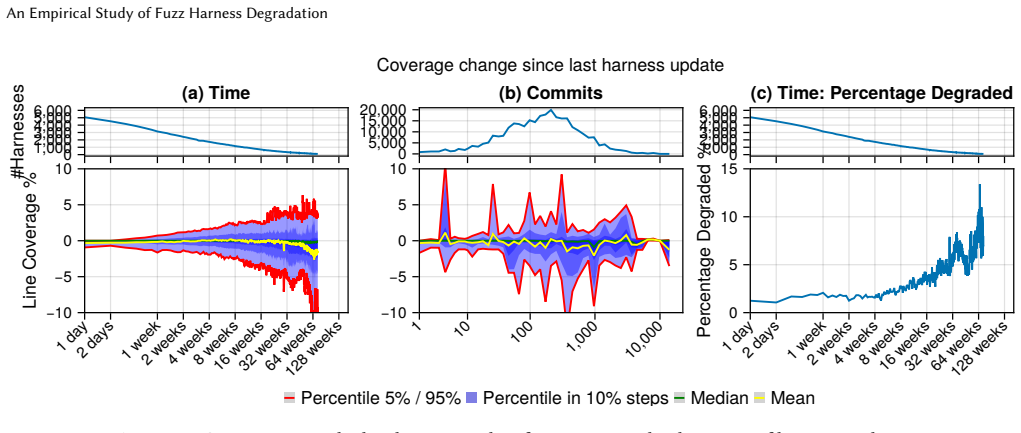
The central object is the harness version, defined by a heuristic that detects harness-changing commits: any change to a C/C++ file in the project whose path contains 'fuzz' (excluding 'fuzzy'), any change to a file defining the standard entry point LLVMFuzzerTestOneInput or LLVMFuzzerInitialize, and any OSS-Fuzz repository change outside project metadata and Docker/Jenkins files. Each daily Clang line-coverage report from OSS-Fuzz is then attached to the currently active harness version, and coverage is measured as relative line-coverage percentage, using the maximum of the first three days after an update as the baseline to compensate for slow saturation. The argument that degradation is rare rests on the resulting coverage-change curves over time and over changed lines, while the causal taxonomy is built from 308 manually examined coverage drops filtered for a 5-percentage-point sustained decline.
What would settle it
Recompute the coverage-change curves using only coverage days whose Fuzz Introspector report shows no external-library files in the denominator and whose run completed without timeout or out-of-memory; if the median coverage since the last harness update then declines by several percentage points within a year, the surprising-longevity conclusion collapses to a measurement artifact.
Extended reading notes
Core claim
The authors establish a counter-intuitive result: fuzz harnesses in OSS-Fuzz have a surprisingly long effective lifetime. Coverage measured from the days after each harness update shows only a slight downward trend in the mean and a neutral median, and bug-finding per changed line of code stays roughly flat over at least the first half year of a harness version's life. Harness updates themselves have only a modest average effect — a mean coverage increase of 0.26% and a median of exactly 0% — yet the minority of updates that raise coverage by more than 5 percentage points produce a clear burst of newly found bugs. When coverage does drop sharply, the categorized root causes are partial build failures (such as a dependency that stops compiling), project code added or changed without corresponding harness maintenance, external library code that inflates the coverage denominator, and corpus-size collapses caused by out-of-memory or timeout runs being recorded as successful coverage measurements. The paper concludes that the real risk is not slow rot but discrete, silent events that break or distort coverage, and it contributes metrics to detect those events.
Load-bearing premise
The longevity result is computed from OSS-Fuzz's daily line-coverage reports, and the paper shows those reports can be distorted — third-party libraries can enter the coverage denominator and out-of-memory or timeout runs are recorded as successful measurements; if those artifacts are widespread, the apparent stability is partly a measurement artifact rather than genuine harness longevity.
Editorial extensions
If this is right
- A harness that still builds can be treated as a continuing asset: its bug-finding rate per changed line stays roughly flat for at least half a year, so maintainers can prioritize other work over routine harness refresh.
- The benefits of harness maintenance are concentrated in discrete events: updates that lift coverage by more than 5 percentage points are followed by a burst of newly found bugs, while the average update changes coverage by almost nothing.
- Roughly one harness version in 20 loses at least 5 percentage points of coverage within half a year, and the cause is usually a build failure, newly added code, a distorted coverage report, or a shrunken corpus — so monitoring for those specific events is the practical response.
- Projects whose coverage stays below about 35% find roughly one bug per 14,474 changed lines, versus one per 3,985 lines for higher-coverage projects, making coverage level a first-order driver of fuzzing return.
- The proposed metrics — tracking removed or renamed harnesses, coverage stability over time, harness statefulness, and corpus size relative to covered complexity — would in principle detect all of the categorized causes of coverage drops and are being contributed to OSS-Fuzz and Fuzz Introspector.
Reading between the lines
- If the stability result generalizes beyond OSS-Fuzz's mature, security-critical projects, automatic harness-generation and maintenance tools (including LLM-based ones) should target discrete breakage events rather than continuous re-synthesis; keeping builds green and the coverage denominator clean may matter more than frequent regeneration.
- A testable extension follows from the taxonomy: projects that pin their dependencies or exclude third-party libraries from coverage reports should show fewer spurious 'degradation' alarms, which the proposed metrics could verify by comparing alarmed versus non-alarmed projects across such policy changes.
- The harness-change heuristic likely undercounts updates made in separate harness repositories or in code paths that do not match the pattern; cross-checking the heuristic against per-harness Fuzz Introspector reports could raise or lower the longevity estimate.
- Because the paper itself shows that out-of-memory and timeout runs are recorded as successful coverage and that external code can inflate the denominator, a re-analysis that excludes those artifacts could shift the stable mean and median downward; the magnitude of the shift would quantify how much of the 'surprising longevity' is real.
Signed reviews
Editorial analysis
A structured set of objections, weighed in public.
Referee Report
Summary. The paper presents a large-scale longitudinal study of fuzz harness degradation in Google's OSS-Fuzz platform. Using coverage reports, commit histories, Monorail bug data, and Fuzz Introspector reports for 433 C/C++ projects and 29,019 harness versions over 2016–2024, the authors address five research questions on the immediate effects of harness updates, the rate of coverage degradation over time, the degradation of bug-finding capability, the causes of coverage drops, and practical detection metrics. The central findings are that overall coverage in OSS-Fuzz remains stable, that harness updates have only a small mean effect on coverage (0.26%), that bug-finding capability does not automatically decline for harnesses that still build, that approximately 5% of harness versions lose at least 5 percentage points of coverage within half a year, and that manual analysis of 308 coverage-drop cases yields four main causes: partial build failures, added project code or churn, third-party code polluting coverage reports, and corpus-size decreases caused by OOM/timeout measurement artifacts. The authors also report contributions to OSS-Fuzz and Fuzz Introspector in the form of new detection metrics.
Significance. This is, to my knowledge, the first systematic longitudinal study of fuzz harness degradation at the scale of a major continuous fuzzing platform. If the findings hold, they have practical value: they suggest that harnesses in mature OSS-Fuzz projects are more resilient than often assumed, while also identifying concrete, actionable failure modes. The paper is unusually transparent: the dataset, scraping code, analysis notebook, and case-study notes are public, the data-cleaning steps are documented in detail, and the 308 degradation cases were manually reviewed with category counts provided. The proposed metrics, if integrated, could help maintainers detect silent degradation. However, the significance is conditional on two methodological pillars: the heuristic that identifies harness-update events, and the integrity of the coverage reports used to measure stability. Both are explicitly acknowledged as imperfect in the manuscript, but the magnitude of their impact on the central claims is not quantified.
major comments (3)
- [§3.1.4, Figs. 3–5] The harness-change heuristic is load-bearing for the 'no explicit updates' longevity claim, and its false-negative rate is unmeasured. The heuristic counts a commit as a harness change only if it touches an OSS-Fuzz file other than project.yaml/Dockerfile/Jenkins, or a C/C++ file whose path contains 'fuzz' (excluding 'fuzzy') or that defines LLVMFuzzerTestOneInput/LLVMFuzzerInitialize. This misses several plausible update modes: changes to project build files (CMakeLists.txt, Makefile) that add or alter fuzz targets; dependency version bumps or vendored-code updates that change what the harness links against; header or signature changes in files whose names do not contain 'fuzz'; harnesses moved to files outside the matching paths; and commits to separate fuzzing repositories beyond the two projects manually detected. The manual 'suspicious gaps' check described in §3.1.4 can only catch long silent periods in relatively active projects; it does not provide a quantitative false-negative rate for projects with frequent commits. Because RQ2 and RQ3 define 'time since last harness update' based entirely on this heuristic (Figures 3–5), a non-trivial false-negative rate would mean that many periods labeled 'unmaintained' actually contain maintenance, in which case the observed flat coverage and sustained bug rates would be expected even if unmaintained harnesses do degrade. I request a validation of the heuristic against a statistically sampled subset of manually labeled commits, or an alternative confirmation using OSS-Fuzz build logs to establish when harness files were actually built or changed.
- [§3.5.3, §3.5.4, §3.3] Coverage measurement artifacts are not excluded from the RQ2 stability analysis, even though the paper's own evidence indicates they affect the coverage metric on a large scale. The paper shows that third-party code entering the coverage report can cause a 93-percentage-point relative coverage drop (grpc-httpjson-transcoding, §3.5.3) and that OOM/timeout runs are recorded as successful coverage measurements (§3.5.4), an issue stated in §3.6 to affect 'at least 10% of harnesses'. These artifacts are included in the coverage data used to compute the 'surprisingly stable' coverage result and the roughly 5% degradation rate in Figure 3. The manuscript does not provide a sensitivity analysis that excludes known artifact patterns (e.g., harnesses with corpus-size drops or repeated OOM/timeout behavior) or corrects the denominator for external third-party code. Without such an analysis, the central claim that coverage is stable over time could be partly a property of the measurement infrastructure rather than of the harnesses. I ask the authors to rerun Figure 3 and the associated degradation statistics after removing or adjusting for these artifact-prone observations, and to report whether the qualitative conclusions change.
- [§3.3, §3.4] The exclusion of harnesses that no longer build is a scope limitation that should be stated as part of the central claim, not only in the methodology. The abstract and §3.3 conclude 'surprising longevity' of bug-finding capability, qualified by 'as long as they still build'. This is a legitimate conditional claim, but the practical implication is weakened because a harness that fails to build finds zero bugs and is the clearest form of degradation. The paper cites Nourry et al. [41] for the prevalence of broken builds, but does not combine that information with the new data to give an overall picture of how often unmaintained harnesses actually fail. I would like the authors to state explicitly, in the abstract or conclusion, the proportion of harness versions that stop building entirely during the study period, so that the conditional 'as long as they still build' is placed in context.
minor comments (6)
- [§3] The text says 'In total, we investigate four research questions' immediately before listing RQ1 through RQ5; this should be 'five'.
- [§3.1.4] The function name is misspelled as 'LLVMFuzzerInititalize'; it should be 'LLVMFuzzerInitialize'.
- [§3.5] There is a missing space in 'This results in267 instances'.
- [Fig. 4 caption] The caption describes coverage changes as '>5% coverage increase, >5% coverage decrease and everything in between', but the legend in the figure shows '< -5%', '-5% to +5%', and '< +5%'. Please reconcile the notation.
- [§3.3] The sentence 'we cut off the tail end where#Harnesses falls below 100' contains a rendering issue with the '#' character; please fix the typography.
- [§3.4] The phrase 'after which our data starts to be too sparse' is ambiguous; it is unclear whether 'after which' refers to half a year or to the cutoff point in the figure.
Circularity Check
No circularity: the study is a direct empirical analysis of independently collected OSS-Fuzz coverage, bug, and commit data.
full rationale
The paper contains no derivation chain that reduces to its inputs. Its central claims—stable average coverage and sustained bug-finding capability of harness versions that are not explicitly updated—are direct observations over OSS-Fuzz coverage reports, Monorail bug reports, and git commits. The harness-change heuristic in Section 3.1.4 is an independent input definition, not a fitted parameter: it classifies commits by file path and function-name patterns, while the outcomes (coverage change, bugs per modified line, time since last harness update) are measured from separate data sources. The paper explicitly reports results that contradict its own initial hypothesis, such as the near-zero mean coverage change (0.26%) after harness updates, which would not occur if the conclusion were built into the definition. The cited coauthored prior results, e.g., Zhu and Böhme on regression bugs and Böhme et al. on coverage-based benchmarking, are used for contextual comparison and are not load-bearing inputs that force the findings. The acknowledged measurement artifacts in Sections 3.5.3 and 3.5.4 are validity threats, not evidence of circularity. Therefore, the analysis is self-contained and no circular step can be identified.
Assumptions & free parameters
assumptions (4)
- domain assumption OSS-Fuzz daily coverage reports are a valid measure of fuzzer effectiveness over time.
- domain assumption Monorail bug and crash-revision data accurately reflect the bugs found by fuzzing.
- domain assumption The harness-change heuristic (path contains 'fuzz', functions LLVMFuzzerTestOneInput or LLVMFuzzerInitialize) correctly identifies harness updates.
- domain assumption OSS-Fuzz projects are representative of fuzzing practice in general.
Cite this review
Pith. "Pith review of An Empirical Study of Fuzz Harness Degradation." pith.science (2026). https://pith.science/paper/VDBZOPGD
@misc{pith2026250506177,
  author       = {Pith},
  title        = {Pith review of: An Empirical Study of Fuzz Harness Degradation},
  year         = {2026},
  howpublished = {\url{https://pith.science/paper/VDBZOPGD}},
  note         = {Machine review of arXiv:2505.06177}
}
read the original abstract
The purpose of continuous fuzzing platforms is to enable fuzzing for software projects via fuzz harnesses -- but as the projects continue to evolve, are these harnesses updated in lockstep, or do they run out of date? If these harnesses remain unmaintained, will they degrade over time in terms of coverage achieved or number of bugs found? This is the subject of our study. We study Google's OSS-Fuzz continuous fuzzing platform containing harnesses for 510 open-source C/C++ projects, many of which are security-critical. A harness is the glue code between the fuzzer and the project, so it needs to adapt to changes in the project. It is often added by a project maintainer or as part of a, sometimes short-lived, testing effort. Our analysis shows a consistent overall fuzzer coverage percentage for projects in OSS-Fuzz and a surprising longevity of the bug-finding capability of harnesses even without explicit updates, as long as they still build. However, we also identify and manually examine individual cases of harness coverage degradation and categorize their root causes. Furthermore, we contribute to OSS-Fuzz and Fuzz Introspector to support metrics to detect harness degradation in OSS-Fuzz projects guided by this research.
Figures


Figures from the paper (12 more)




Forward citations
Cited by 1 Pith paper
-
Thinking More, Harnessing Better: State Machine Guided Harness Automatic Generation with Project Digestion and Workflow Decomposition
SynapseFlow uses dataflow-based function grouping and a staged rollback LLM workflow to auto-generate fuzz harnesses, achieving higher coverage and bug detection than prior tools on 25 C projects.
Reference graph
Works this paper leans on
-
[41]
My fuzzers won’t build: An empirical study of fuzzing build failures
Olivier Nourry, Yutaro Kashiwa, Weiyi Shang, Honglin Shu, and Yasu- taka Kamei. My fuzzers won’t build: An empirical study of fuzzing build failures. ACM Transactions on Software Engineering and Method- ology
-
[1]
Tree-sitter. A Parser Generator Tool. Documentation, 2024. URL https: //tree-sitter.github.io/
work page 2024
-
[2]
An empirical study of design degradation: How software projects get worse over time
Iftekhar Ahmed, Umme Ayda Mannan, Rahul Gopinath, and Carlos Jensen. An empirical study of design degradation: How software projects get worse over time. In 2015 ACM/IEEE International Sym- posium on Empirical Software Engineering and Measurement (ESEM) , pages 1–10. IEEE, 2015
work page 2015
-
[3]
Maintenance of automated test suites in industry: An empirical study on visual gui testing
Emil Alégroth, Robert Feldt, and Pirjo Kolström. Maintenance of automated test suites in industry: An empirical study on visual gui testing. Information and Software Technology, 73:66–80, 2016
work page 2016
-
[4]
The analysis of current state of agile software devel- opment
Samer Atawneh. The analysis of current state of agile software devel- opment. Journal of Theoretical and Applied Information Technology , 97 (22):3197–3028, 2019
work page 2019
-
[5]
Soft- ware architecture degradation in open source software: A systematic literature review
Ahmed Baabad, Hazura Binti Zulzalil, Salmi Binti Baharom, et al. Soft- ware architecture degradation in open source software: A systematic literature review. IEEE Access, 8:173681–173709, 2020
work page 2020
-
[6]
Fudge: fuzz driver generation at scale
Domagoj Babić, Stefan Bucur, Yaohui Chen, Franjo Ivančić, Tim King, Markus Kusano, Caroline Lemieux, László Szekeres, and Wei Wang. Fudge: fuzz driver generation at scale. In Proceedings of the 2019 27th ACM Joint Meeting on European Software Engineering Conference and Symposium on the Foundations of Software Engineering , pages 975–985, 2019
work page 2019
-
[7]
Observations and lessons learned from automated testing
Stefan Berner, Roland Weber, and Rudolf K Keller. Observations and lessons learned from automated testing. In Proceedings of the 27th international conference on Software engineering , pages 571–579, 2005
work page 2005
Show all 59 references
-
[8]
Evaluating software degradation through entropy
Alessandro Bianchi, Danilo Caivano, Filippo Lanubile, and Giuseppe Visaggio. Evaluating software degradation through entropy. In Pro- ceedings Seventh International Software Metrics Symposium, pages 210–
-
[9]
Test Harness Definition
International Software Testing Qualifications Board. Test Harness Definition. International Software Testing Qualifications Board, 2024. URL https://glossary.istqb.org/en_US/term/test-harness
2024
-
[10]
Fine grained software degradation models for optimal rejuvenation policies
Andrea Bobbio, Matteo Sereno, and Cosimo Anglano. Fine grained software degradation models for optimal rejuvenation policies. Per- formance Evaluation, 46(1):45–62, 2001
2001
-
[11]
Fuzzing: On the exponential cost of vulnerability discovery
Marcel Böhme and Brandon Falk. Fuzzing: On the exponential cost of vulnerability discovery. In Proceedings of the 28th ACM joint meeting on European software engineering conference and symposium on the foundations of software engineering , pages 713–724, 2020
2020
-
[12]
Fuzzing: Challenges and reflections
Marcel Böhme, Cristian Cadar, and Abhik Roychoudhury. Fuzzing: Challenges and reflections. IEEE Software, 38(3):79–86, 2020
2020
-
[13]
On the reliability of coverage-based fuzzer benchmarking
Marcel Böhme, László Szekeres, and Jonathan Metzman. On the reliability of coverage-based fuzzer benchmarking. In Proceedings of the 44th International Conference on Software Engineering , pages 1621–1633, 2022
2022
-
[14]
Oss- fuzzgen: Automated fuzzing of open source java projects
Sheung Chi Chan, Adam Korczynski, and David Korczynski. Oss- fuzzgen: Automated fuzzing of open source java projects. 2023
2023
-
[15]
curl: command line tool and library for transferring data with URL syntax
curl Project. curl: command line tool and library for transferring data with URL syntax. https://github.com/curl/curl. Accessed: 2024-10-19
2024
-
[16]
An empirical study of oss-fuzz bugs
Zhen Yu Ding and Claire Le Goues. An empirical study of oss-fuzz bugs. In 2021 IEEE/ACM 18th International Conference on Mining Software Repositories (MSR), pages 131–142, 2021. doi: 10.1109/MSR52588.2021. 00026
2021
-
[17]
Beyond the coverage plateau: A comprehensive study of fuzz blockers (registered report)
Wentao Gao, Van-Thuan Pham, Dongge Liu, Oliver Chang, Toby Mur- ray, and Benjamin IP Rubinstein. Beyond the coverage plateau: A comprehensive study of fuzz blockers (registered report). In Proceed- ings of the 2nd International Fuzzing Workshop , pages 47–55, 2023
2023
-
[18]
googletest: GoogleTest - Google Testing and Mocking Frame- work
Google. googletest: GoogleTest - Google Testing and Mocking Frame- work. https://github.com/google/googletest, . Accessed: 2024-10-27
2024
-
[19]
OSS-Fuzz: Setting up a new project
Google. OSS-Fuzz: Setting up a new project . Google, . URL https: //google.github.io/oss-fuzz/
-
[20]
OSS-Fuzz: Accepting New Projects
Google. OSS-Fuzz: Accepting New Projects . Google, . URL https:// google.github.io/oss-fuzz/getting-started/accepting-new-projects/
-
[21]
OSS-Fuzz: Reward Program
Google. OSS-Fuzz: Reward Program . Google, . URL https://bughunters.google.com/about/rules/open-source/ 5097259337383936/oss-fuzz-reward-program-rules
-
[22]
OSS-Fuzz: Continuous Fuzzing for Open Source Software
Google. OSS-Fuzz: Continuous Fuzzing for Open Source Software . Google, 2017. URL https://github.com/google/oss-fuzz
2017
-
[23]
Fuzz Introspector Repository
Google. Fuzz Introspector Repository. Google, 2024. URL https://github. com/ossf/fuzz-introspector
2024
-
[24]
Fuzz Introspector: Fuzzing Introspection of OSS-Fuzz projects
Google. Fuzz Introspector: Fuzzing Introspection of OSS-Fuzz projects . Google, 2024. URL https://introspector.oss-fuzz.com/
2024
-
[25]
OSS-Fuzz-Gen: AI-Powered Fuzzing: Breaking the Bug Hunting Barrier
Google. OSS-Fuzz-Gen: AI-Powered Fuzzing: Breaking the Bug Hunting Barrier. Google, 2024. URL https://security.googleblog.com/2023/08/ai- powered-fuzzing-breaking-bug-hunting.html
2024
-
[26]
grpc-httpjson-transcoding
grpc-httpjson-transcoding Project. grpc-httpjson-transcoding. https: //github.com/grpc-ecosystem/grpc-httpjson-transcoding . Accessed: 2024-10-19
2024
-
[27]
The rise and evolution of agile software development
Rashina Hoda, Norsaremah Salleh, and John Grundy. The rise and evolution of agile software development. IEEE software, 35(5):58–63, 2018
2018
-
[28]
{FuzzGen}: Automatic fuzzer generation
Kyriakos Ispoglou, Daniel Austin, Vishwath Mohan, and Mathias Payer. {FuzzGen}: Automatic fuzzer generation. In 29th USENIX Security Symposium (USENIX Security 20) , pages 2271–2287, 2020
2020
-
[29]
Sp-fuzz: Fuzzing soft plc with semi-automated harness synthesis
Seungho Jeon and Jung Taek Seo. Sp-fuzz: Fuzzing soft plc with semi-automated harness synthesis. In International Conference on Information Security Applications, pages 282–293. Springer, 2023
2023
-
[30]
Utopia: Automatic generation of fuzz driver using unit tests
Bokdeuk Jeong, Joonun Jang, Hayoon Yi, Jiin Moon, Junsik Kim, Intae Jeon, Taesoo Kim, WooChul Shim, and Yong Ho Hwang. Utopia: Automatic generation of fuzz driver using unit tests. In 2023 IEEE Symposium on Security and Privacy (SP) , pages 2676–2692. IEEE, 2023
2023
-
[31]
Winnie: Fuzzing windows applications with harness synthesis and fast cloning
Jinho Jung, Stephen Tong, Hong Hu, Jungwon Lim, Yonghwi Jin, and Taesoo Kim. Winnie: Fuzzing windows applications with harness synthesis and fast cloning. In Proceedings of the 2021 Network and Distributed System Security Symposium (NDSS 2021) , 2021
2021
-
[32]
Empirical observations on software testing automation
Katja Karhu, Tiina Repo, Ossi Taipale, and Kari Smolander. Empirical observations on software testing automation. In 2009 International Conference on Software Testing Verification and Validation, pages 201–
2009
-
[33]
Evaluating fuzz testing
George Klees, Andrew Ruef, Benji Cooper, Shiyi Wei, and Michael Hicks. Evaluating fuzz testing. In Proceedings of the 2018 ACM SIGSAC conference on computer and communications security , pages 2123–2138, 2018. An Empirical Study of Fuzz Harness Degradation
2018
-
[34]
Effectiveness and scalability of fuzzing techniques in ci/cd pipelines
Thijs Klooster, Fatih Turkmen, Gerben Broenink, Ruben ten Hove, and Marcel Böhme. Effectiveness and scalability of fuzzing techniques in ci/cd pipelines. arXiv preprint arXiv:2205.14964, 2022
2022 arXiv
-
[35]
Fuzzing: a survey
Jun Li, Bodong Zhao, and Chao Zhang. Fuzzing: a survey. Cybersecu- rity, 1:1–13, 2018
2018
-
[36]
Fuzz testing in practice: Obstacles and solutions
Jie Liang, Mingzhe Wang, Yuanliang Chen, Yu Jiang, and Renwei Zhang. Fuzz testing in practice: Obstacles and solutions. In 2018 IEEE 25th International Conference on Software Analysis, Evolution and Reengineering (SANER), pages 562–566. IEEE, 2018
2018
-
[37]
Source-based Code Coverage
LLVM. Source-based Code Coverage. Clang Documentation. LLVM, 2024. URL https://clang.llvm.org/docs/SourceBasedCodeCoverage.html
2024
-
[38]
libFuzzer – A library for coverage-guided fuzz testing
LLVM. libFuzzer – A library for coverage-guided fuzz testing. LLVM,
-
[39]
Prompt fuzzing for fuzz driver generation
Yunlong Lyu, Yuxuan Xie, Peng Chen, and Hao Chen. Prompt fuzzing for fuzz driver generation. arXiv preprint arXiv:2312.17677, 2023
2023 arXiv
-
[40]
On the relevance of code anomalies for identifying architecture degradation symptoms
Isela Macia, Roberta Arcoverde, Alessandro Garcia, Christina Chavez, and Arndt Von Staa. On the relevance of code anomalies for identifying architecture degradation symptoms. In 2012 16Th european conference on software maintenance and reengineering , pages 277–286. IEEE, 2012
2012
-
[42]
The human side of fuzzing: Challenges faced by developers during fuzzing activities
Olivier Nourry, Yutaro Kashiwa, Bin Lin, Gabriele Bavota, Michele Lanza, and Yasutaka Kamei. The human side of fuzzing: Challenges faced by developers during fuzzing activities. ACM Transactions on Software Engineering and Methodology , 33(1):1–26, 2023
2023
-
[43]
Openssl: Tls/ssl and crypto library
OpenSSL Project. Openssl: Tls/ssl and crypto library. https://github. com/openssl/openssl. Accessed: 2024-10-19
2024
-
[44]
protobuf
protobuf Project. protobuf. https://github.com/protocolbuffers/ protobuf. Accessed: 2024-10-19
2024
-
[45]
Sok: Prudent evaluation practices for fuzzing
Moritz Schloegel, Nils Bars, Nico Schiller, Lukas Bernhard, Tobias Scharnowski, Addison Crump, Arash Ale-Ebrahim, Nicolai Bissantz, Marius Muench, and Thorsten Holz. Sok: Prudent evaluation practices for fuzzing. In 2024 IEEE Symposium on Security and Privacy (SP), pages 1974–...
2024
-
[46]
OSS-Fuzz-Google’s Continuous Fuzzing Service for Open Source Software, 2017
Kostya Serebryany. OSS-Fuzz-Google’s Continuous Fuzzing Service for Open Source Software, 2017
2017
-
[47]
serenity: The Serenity Operating System
serenity Project. serenity: The Serenity Operating System. https: //github.com/SerenityOS/serenity. Accessed: 2024-10-27
2024
-
[48]
sudo: Utility to execute a command as another user
sudo Project. sudo: Utility to execute a command as another user. https://github.com/sudo-project/sudo. Accessed: 2024-10-19
2024
-
[49]
Fuzzing: brute force vulnerability discovery
Michael Sutton, Adam Greene, and Pedram Amini. Fuzzing: brute force vulnerability discovery. Pearson Education, 2007
2007
-
[50]
An empir- ical study of security culture in open source software communities
Shao-Fang Wen, Mazaher Kianpour, and Stewart Kowalski. An empir- ical study of security culture in open source software communities. In Proceedings of the 2019 IEEE/ACM International Conference on Advances in Social Networks Analysis and Mining , pages 863–870, 2019
2019
-
[51]
Agile devel- opment: Mainstream adoption has changed agility
Dave West, Tom Grant, Mary Gerush, and David D’Silva. Agile devel- opment: Mainstream adoption has changed agility. Forrester Research, 2(1):41, 2010
2010
-
[52]
A survey of human- machine collaboration in fuzzing
Qian Yan, Minhuan Huang, and Huayang Cao. A survey of human- machine collaboration in fuzzing. In 2022 7th IEEE International Con- ference on Data Science in Cyberspace (DSC) , pages 375–382. IEEE, 2022
2022
-
[53]
The Fuzzing Book
Andreas Zeller, Rahul Gopinath, Marcel Böhme, Gordon Fraser, and Christian Holler. The Fuzzing Book. CISPA Helmholtz Center for Infor- mation Security, 2024. URL https://www.fuzzingbook.org/. Retrieved 2024-07-01 16:50:18+02:00
2024
-
[54]
In 30th USENIX Security Symposium (USENIX Security 21) , pages 2811–2828, 2021
Cen Zhang, Xingwei Lin, Yuekang Li, Yinxing Xue, Jundong Xie, Hongxu Chen, Xinlei Ying, Jiashui Wang, and Yang Liu.{APICraft}: Fuzz driver generation for closed-source {SDK} libraries. In 30th USENIX Security Symposium (USENIX Security 21) , pages 2811–2828, 2021
2021
-
[55]
Automata-guided control-flow-sensitive fuzz driver generation
Cen Zhang, Yuekang Li, Hao Zhou, Xiaohan Zhang, Yaowen Zheng, Xian Zhan, Xiaofei Xie, Xiapu Luo, Xinghua Li, Yang Liu, et al. Automata-guided control-flow-sensitive fuzz driver generation. In USENIX Security Symposium, pages 2867–2884, 2023
2023
-
[56]
Intelligen: Automatic driver synthesis for fuzz testing
Mingrui Zhang, Jianzhong Liu, Fuchen Ma, Huafeng Zhang, and Yu Jiang. Intelligen: Automatic driver synthesis for fuzz testing. In 2021 IEEE/ACM 43rd International Conference on Software Engineer- ing: Software Engineering in Practice (ICSE-SEIP) , pages 318–327. IEEE, 2021
2021
-
[57]
Daisy: Effective fuzz driver synthesis with object usage sequence analysis
Mingrui Zhang, Chijin Zhou, Jianzhong Liu, Mingzhe Wang, Jie Liang, Juan Zhu, and Yu Jiang. Daisy: Effective fuzz driver synthesis with object usage sequence analysis. In 2023 IEEE/ACM 45th International Conference on Software Engineering: Software Engineering in Practice (ICS...
2023
-
[58]
Regression greybox fuzzing
Xiaogang Zhu and Marcel Böhme. Regression greybox fuzzing. In Proceedings of the 2021 ACM SIGSAC Conference on Computer and Communications Security, pages 2169–2182, 2021. Philipp Görz, Joschua Schilling, Thorsten Holz, and Marcel Böhme A Supplementary Materials A.1 Coverage S...
2021
-
[2024]
URL https://llvm.org/docs/LibFuzzer.html
Reviewed August 15, 2026 · model on record in the stance chip above.
Discussion (0). Continue with ORCID to comment.