REVIEW 3 major objections 4 minor 35 references
Can External Validation Tools Improve Annotation Quality for LLM-as-a-Judge?
T0 review · 3 major / 4 minor · reviewed 2026-08-06 · deepseek-v4-flash
Pith's one-line read Tool-augmented LLM judges can outperform plain judges on factual and coding response pairs.
desk verdict Solid empirical study of tool-augmented judges; the headline improvement is real but tied to constructed labels with significant noise, so the central claim should be scoped carefully. read the letter →
The pith
A machine-rendered reading of the paper's core claim, the machinery that carries it, and where it could break.
The reading
What carries the argument
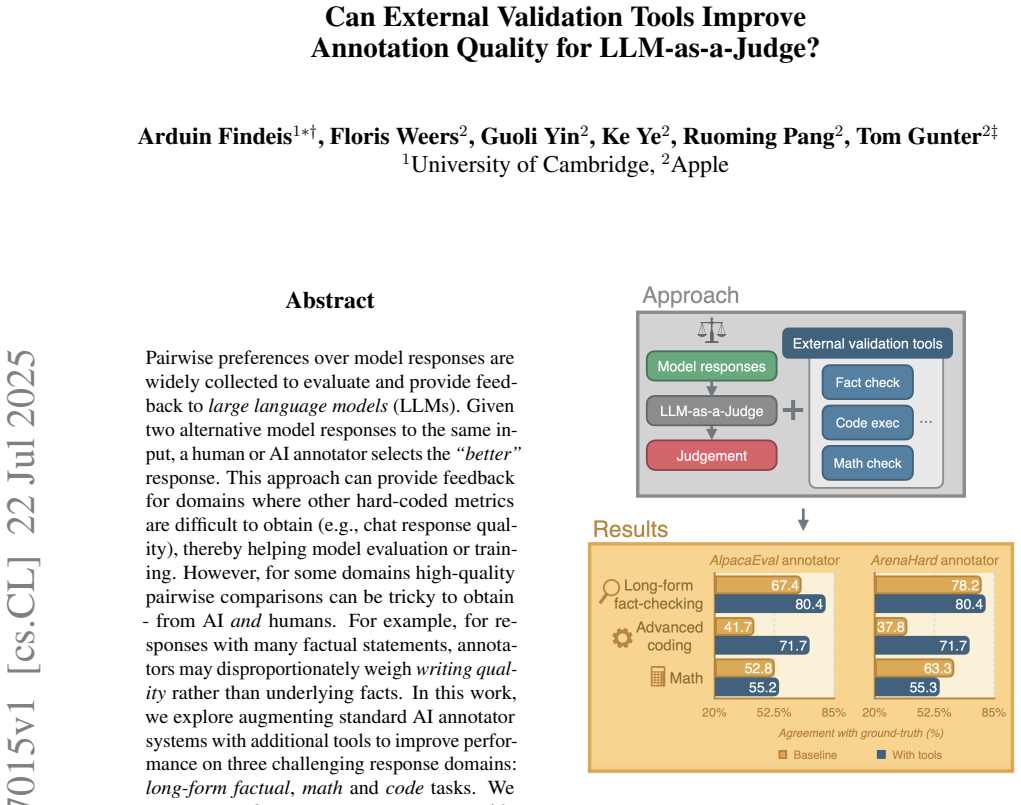
The load-bearing mechanism is the evaluation agent: an LLM-driven pipeline with (1) an initial domain assessment that decides per response whether fact-check, code-execution, or math-checking tools are likely to help, (2) tool execution — fact-checking adapted from the SAFE algorithm, and code/math checks run through a code interpreter — and (3) a final assessment that combines tool outputs with the original prompt and responses into a preference judgment with chain-of-thought reasoning. A critical design choice is the revert rule: when no tool is deemed useful, the agent falls back to the baseline annotator, which keeps out-of-domain regression near 2% and limits unnecessary cost. The tools supply external evidence independent of the LLM's internal knowledge, which is what lets the agent override stylistic or self-preferential biases.
What would settle it
Re-run the comparison on a LongFact-style pairwise set whose labels are independently verified by expert fact-checkers rather than constructed by the authors; if the tool-augmented judge does not beat its baseline on those expert labels (or if, on APPS pairs rewritten so correct and incorrect solutions are stylistically matched, the code-execution agent's gain vanishes), the central claim that external tools improve annotation quality would be falsified.
Extended reading notes
Core claim
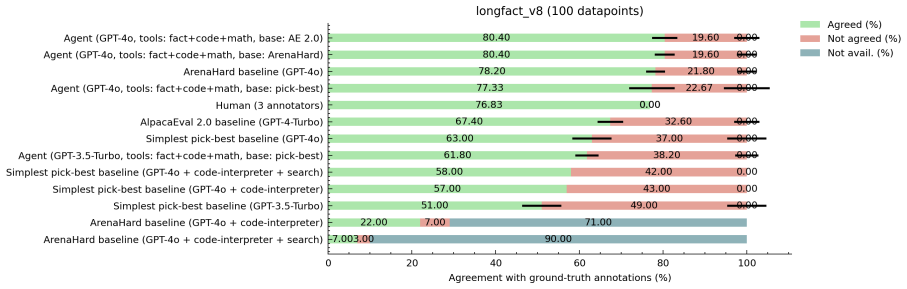
The discovery is that frozen LLM annotators, when wrapped in scaffolding that lets them fact-check via web search and verify via code execution, agree with ground-truth preferences substantially more often on long-form factual responses (e.g., 63% to 81% for a GPT-4o pick-best baseline) and on advanced APPS coding responses (e.g., 31% to 71% for GPT-3.5-Turbo, 38% to 72% for ArenaHard), while causing less than 2% regression on RewardBench chat, chat-hard, and safety categories. The paper also finds that plain baseline annotators perform below random on APPS competition pairs, preferring GPT-4-generated incorrect solutions over correct ground-truth solutions, while the code-execution agent does not show that bias. On hard GSM8k math the tool agent beats some baselines but not the strongest one (ArenaHard), though on the harder RewardMATH benchmark the agent outperforms both tested baselines.
Load-bearing premise
The load-bearing assumption is that the constructed pairwise ground-truth labels reliably reflect which response is better, even though human annotators agree with only 76.83% of the LongFact pairwise labels on non-tie judgments and the APPS pairs may carry style differences between correct and incorrect solutions.
Editorial extensions
If this is right
- Long-form factual annotation can be delegated to tool-augmented AI judges with higher agreement than the same frozen judge without tools, including on pairs where construction-based labels are hard for non-expert humans.
- Code correctness preferences in competition-level APPS are currently misjudged by leading plain annotators, and code-execution grounding corrects this bias; this suggests reward modeling and evaluation pipelines for code should include execution feedback.
- Because the agent reverts to baseline when tools do not apply, adding targeted tools need not degrade general chat/safety annotation by more than about 2%.
- The sensitivity of plain judges to prompt configuration (63% to 78% for GPT-4o on long-form factuality) means improvements from tools must be measured against strong baselines, not just simple pick-best prompts.
Reading between the lines
- If these results hold, a practical recipe emerges: keep a strong frozen judge as the default, add narrow, high-precision tool triggers for fact-dense and code domains, and reserve human annotation for tie-heavy or safety-critical pairs; the paper's revert design already embodies this but does not spell it out as a deployment rule.
- The APPS below-random baseline suggests that current AI-preference datasets in code may carry self-enhancement bias; one testable extension is to audit existing code preference datasets for whether the 'preferred' response is systematically the judge-model's own style, and to re-score them with execution-based judges.
- The mixed math results hint that code-execution tools help most when the judge must verify a concrete answer, and less when reasoning chains differ stylistically; a testable extension is to condition math-tool use on whether responses contain explicit derivations versus final answers.
Editorial analysis
A structured set of objections, weighed in public.
Referee Report
Summary. The paper proposes an agentic framework ('Evaluation Agent') that augments standard LLM-as-a-Judge baselines with external validation tools: a web-search-based fact checker, a code-execution tool, and a math checker. The system first assesses whether a response falls into a supported domain, runs the selected tools, and then merges the tool outputs into a final pairwise preference decision, reverting to the baseline annotator when no tool is selected. The authors evaluate the framework on three newly constructed pairwise datasets (LongFact pairwise, APPS competition pairwise, GSM8k hard pairwise) as well as on RewardBench, RewardMath, and TruthfulQA, reporting mean agreement over five seeds. The central observations are that external tools improve agreement on long-form factual responses (e.g., 63% to 81% for GPT-4o pick-best) and on advanced coding responses (e.g., 31% to 71% for GPT-3.5-Turbo), while causing only modest out-of-domain regression (at most ~2%), with mixed results on math tasks.
Significance. If the claims are confirmed, the paper makes a useful and timely contribution: it provides an open-source, extensible framework for grounding LLM-as-a-Judge annotations in external validation, together with an unusually thorough evaluation that includes multiple baselines, five seeds, out-of-domain checks, a tool-enabled API ablation (Appendix G), and full prompt disclosure. The finding that simple scaffolding matters (Appendix G) and that existing annotator benchmarks are saturated (Appendix C) is valuable for the community. However, the reliability of the newly constructed ground-truth labels is the pivotal unresolved issue: with LongFact human agreement of only 76.83% on non-tie judgments and an acknowledged style confound in APPS, the reported accuracy numbers are not yet a clean measure of annotation quality. The quantitative conclusions should therefore be treated as indicative rather than definitive until the ground-truth labels are independently adjudicated.
major comments (3)
- [Section 4.1 / Appendix K] The LongFact pairwise ground-truth labels are not reliable enough to support the paper's central claim. The authors report that human annotators agree with only 76.83% of the constructed labels on non-tie judgments and mark 18% of responses as ties. Since the evaluation metric is agreement with these constructed labels, a tool that specifically detects the injected errors (wrong dates, names, or numbers) can inflate reported accuracy without improving general preference annotation. Observation 3 compares the agent directly against the same human annotators, so the comparison inherits the label noise: lower human agreement may reflect label ambiguity or error rather than agent superiority. I ask for an independent expert adjudication of a held-out sample, or at least a detailed error analysis demonstrating that the constructed labels are correct in cases where humans disagree with the agent.
- [Section 4.3.3 / Observation 6] The APPS pairwise construction has a style confound that undermines the code-annotation claim. The paper states that "there may be slight style differences between correct and incorrect responses," and the baseline annotators indeed score only 26-42%, apparently preferring GPT-4-style generated code. Because the code-execution tool keys on actual correctness, the agent's 71-72% accuracy may reflect detection of the construction artifact rather than improved annotation quality on realistic coding-response pairs, where style and correctness are not so cleanly separated. To support the claim that external validation improves code annotation, please control for style (e.g., generate incorrect solutions that closely match the style of correct solutions) or add human/expert adjudicated labels on a sample of pairs and report the agent's performance on those pairs.
- [Section 3 / Appendix N] The method contains several free parameters that are neither swept nor justified: the confidence threshold for tool activation, the 50% tie-case revert probability when only one text is deemed tool-worthy, the maximum of three web searches per fact, and the separate math checker selected after unreported preliminary tests. The random 50% revert rule is particularly concerning because it introduces stochasticity into the final annotation path and could materially affect the seed-averaged means. Without a sensitivity analysis or clear criteria for these choices, it is difficult to separate the method's core benefit from implementation tuning; the current reporting makes the central conclusion dependent on several unreported design decisions.
minor comments (4)
- [Appendix M, Listing 4] The code snippets in the APPS example contain truncated expressions (e.g., "x[: n %" and "b[i %"), which make the example unverifiable; please ensure the listings are syntactically complete.
- [Section 4.2 / Appendix H] The main text says results are based on 5 seeds unless otherwise specified, but the RewardMath results in Appendix H use a single seed for the agent. Please state this explicitly wherever the RewardMath table is discussed.
- [Figure 9 caption] The caption says "a drop of up to 9% points"; the correct term is "9 percentage points."
- [Appendix N.1] There is a misspelling of "assessment" as "asessment" in the prompt listing; please check for similar typos throughout the appendix.
Circularity Check
No circular step: all headline claims compare agent predictions against independently constructed ground-truth labels; no parameter fitted to those labels is later called a prediction.
full rationale
The paper's central claims (Observations 1, 4, 5, and 7) are empirical comparisons of agreement with ground-truth labels. For LongFact pairwise, the labels come from manually injected factual errors and the fact-check tool uses web search, not the labels. For APPS pairwise, the labels come from unit-test-verified ground-truth solutions and the code-execution tool runs and tests code, not the labels. For GSM8k hard, the labels come from gold answers versus known-wrong GPT-4o outputs, and the math checker executes code. In none of these cases is the agent given the ground-truth label as input, so the measured agreement is not a tautology. The only notable design choices, the 50% tie-case revert probability and the creation of a separate math checker, are fixed engineering decisions rather than parameters fitted to the evaluation labels; they are not renamed as predictions. The paper contains no load-bearing self-citation and imports no uniqueness theorem from the authors' prior work; its external anchors (SAFE, LongFact, APPS, GSM8k) are third-party resources. The Limitations section and Appendix J acknowledge label-noise and style-confound concerns, but these are data-quality/validity issues, not circular derivation steps. The evaluation is therefore self-contained against external benchmarks, and no circularity is present.
Assumptions & free parameters
free parameters (4)
- Domain assessment confidence threshold =
Not specified in the paper (presumably a manual threshold on a 0-5 confidence scale)
- Tie-case revert probability =
0.5
- Max web searches per fact =
3 (default)
- Selection of separate math checker =
ad hoc
assumptions (4)
- domain assumption Agreement with ground-truth annotations is a valid proxy for annotation quality.
- domain assumption Web search results and code interpreter outputs provide reliable external validation signal.
- domain assumption The newly created datasets (LongFact pairwise, APPS competition pairwise, GSM8k hard pairwise) have correct ground-truth preferences.
- domain assumption The initial domain assessment correctly identifies when tools are useful.
Cite this review
Pith. "Pith review of Can External Validation Tools Improve Annotation Quality for LLM-as-a-Judge?." pith.science (2026). https://pith.science/paper/VDRCM53R
@misc{pith2026250717015,
  author       = {Pith},
  title        = {Pith review of: Can External Validation Tools Improve Annotation Quality for LLM-as-a-Judge?},
  year         = {2026},
  howpublished = {\url{https://pith.science/paper/VDRCM53R}},
  note         = {Machine review of arXiv:2507.17015}
}
read the original abstract
Pairwise preferences over model responses are widely collected to evaluate and provide feedback to large language models (LLMs). Given two alternative model responses to the same input, a human or AI annotator selects the "better" response. This approach can provide feedback for domains where other hard-coded metrics are difficult to obtain (e.g., chat response quality), thereby helping model evaluation or training. However, for some domains high-quality pairwise comparisons can be tricky to obtain - from AI and humans. For example, for responses with many factual statements, annotators may disproportionately weigh writing quality rather than underlying facts. In this work, we explore augmenting standard AI annotator systems with additional tools to improve performance on three challenging response domains: long-form factual, math and code tasks. We propose a tool-using agentic system to provide higher quality feedback on these domains. Our system uses web-search and code execution to ground itself based on external validation, independent of the LLM's internal knowledge and biases. We provide extensive experimental results evaluating our method across the three targeted response domains as well as general annotation tasks, using RewardBench (incl. AlpacaEval and LLMBar), RewardMath, as well as three new datasets for domains with saturated pre-existing datasets. Our results indicate that external tools can indeed improve performance in many, but not all, cases. More generally, our experiments highlight the sensitivity of performance to simple parameters (e.g., prompt) and the need for improved (non-saturated) annotator benchmarks. We share our code at https://github.com/apple/ml-agent-evaluator.
Figures


Figures from the paper (10 more)




Reference graph
Works this paper leans on
-
[1]
Yuntao Bai, Saurav Kadavath, Sandipan Kundu, Amanda Askell, Jackson Kernion, Andy Jones, Anna Chen, Anna Goldie, Azalia Mirhoseini, Cameron McKinnon, Carol Chen, Catherine Olsson, Christopher Olah, Danny Hernandez, Dawn Drain, Deep Ganguli, Dustin Li, Eli Tran-Johnson , Ethan Perez, Jamie Kerr, Jared Mueller, Jeffrey Ladish, Joshua Landau, Kamal Ndousse, ...
-
[2]
Anna Bavaresco, Raffaella Bernardi, Leonardo Bertolazzi, Desmond Elliott, Raquel Fern \'a ndez, Albert Gatt, Esam Ghaleb, Mario Giulianelli, Michael Hanna, Alexander Koller, Andr \'e F. T. Martins, Philipp Mondorf, Vera Neplenbroek, Sandro Pezzelle, Barbara Plank, David Schlangen, Alessandro Suglia, Aditya K. Surikuchi, Ece Takmaz, and Alberto Testoni. 20...
-
[3]
Nitay Calderon, Roi Reichart, and Rotem Dror. 2025. https://doi.org/10.48550/arXiv.2501.10970 The Alternative Annotator Test for LLM-as-a-Judge : How to Statistically Justify Replacing Human Annotators with LLMs . Preprint, arXiv:2501.10970
-
[4]
Chi-Min Chan, Weize Chen, Yusheng Su, Jianxuan Yu, Wei Xue, Shanghang Zhang, Jie Fu, and Zhiyuan Liu. 2023. https://doi.org/10.48550/arXiv.2308.07201 ChatEval : Towards Better LLM-based Evaluators through Multi-Agent Debate . Preprint, arXiv:2308.07201
-
[5]
Mark Chen, Jerry Tworek, Heewoo Jun, Qiming Yuan, Henrique Ponde de Oliveira Pinto, Jared Kaplan, Harri Edwards, Yuri Burda, Nicholas Joseph, Greg Brockman, Alex Ray, Raul Puri, Gretchen Krueger, Michael Petrov, Heidy Khlaaf, Girish Sastry, Pamela Mishkin, Brooke Chan, Scott Gray, Nick Ryder, Mikhail Pavlov, Alethea Power, Lukasz Kaiser, Mohammad Bavarian...
-
[6]
Wei-Lin Chiang, Lianmin Zheng, Ying Sheng, Anastasios Nikolas Angelopoulos, Tianle Li, Dacheng Li, Hao Zhang, Banghua Zhu, Michael Jordan, Joseph E. Gonzalez, and Ion Stoica. 2024. https://doi.org/10.48550/arXiv.2403.04132 Chatbot Arena : An Open Platform for Evaluating LLMs by Human Preference . Preprint, arXiv:2403.04132
-
[8]
Karl Cobbe, Vineet Kosaraju, Mohammad Bavarian, Mark Chen, Heewoo Jun, Lukasz Kaiser, Matthias Plappert, Jerry Tworek, Jacob Hilton, Reiichiro Nakano, Christopher Hesse, and John Schulman. 2021 b . https://arxiv.org/abs/2110.14168 Training Verifiers to Solve Math Word Problems . Preprint, arXiv:2110.14168
arXiv 2021
-
[9]
Yann Dubois, Bal \'a zs Galambosi, Percy Liang, and Tatsunori B. Hashimoto. 2024. https://doi.org/10.48550/arXiv.2404.04475 Length- Controlled AlpacaEval : A Simple Way to Debias Automatic Evaluators . Preprint, arXiv:2404.04475
Show all 35 references
-
[10]
Liang, and Tatsunori B
Yann Dubois, Chen Xuechen Li, Rohan Taori, Tianyi Zhang, Ishaan Gulrajani, Jimmy Ba, Carlos Guestrin, Percy S. Liang, and Tatsunori B. Hashimoto. 2023. AlpacaFarm : A Simulation Framework for Methods that Learn from Human Feedback . Advances in Neural Information Processing Sy...
2023
-
[11]
Zhao, Ni Lao, Hongrae Lee, Da-Cheng Juan, and Kelvin Guu
Luyu Gao, Zhuyun Dai, Panupong Pasupat, Anthony Chen, Arun Tejasvi Chaganty, Yicheng Fan, Vincent Y. Zhao, Ni Lao, Hongrae Lee, Da-Cheng Juan, and Kelvin Guu. 2023. https://doi.org/10.48550/arXiv.2210.08726 RARR : Researching and Revising What Language Models Say , Using Langu...
-
[12]
Zhibin Gou, Zhihong Shao, Yeyun Gong, Yelong Shen, Yujiu Yang, Nan Duan, and Weizhu Chen. 2023. CRITIC : Large Language Models Can Self-Correct with Tool-Interactive Critiquing . In The Twelfth International Conference on Learning Representations
2023
-
[13]
Dan Hendrycks, Steven Basart, Saurav Kadavath, Mantas Mazeika, Akul Arora, Ethan Guo, Collin Burns, Samir Puranik, Horace He, Dawn Song, and Jacob Steinhardt. 2021. https://arxiv.org/abs/2105.09938 Measuring Coding Challenge Competence With APPS . Preprint, arXiv:2105.09938
2021 arXiv
- [14]
- [15]
-
[16]
Hannah Rose Kirk, Alexander Whitefield, Paul R \"o ttger, Andrew Bean, Katerina Margatina, Juan Ciro, Rafael Mosquera, Max Bartolo, Adina Williams, He He, Bertie Vidgen, and Scott A. Hale. 2024. https://arxiv.org/abs/2404.16019 The PRISM Alignment Project : What Participatory ...
2024 arXiv
- [17]
- [18]
- [19]
-
[20]
Gonzalez, and Ion Stoica
Tianle Li, Wei-Lin Chiang, Evan Frick, Lisa Dunlap, Tianhao Wu, Banghua Zhu, Joseph E. Gonzalez, and Ion Stoica. 2024 b . https://doi.org/10.48550/arXiv.2406.11939 From Crowdsourced Data to High-Quality Benchmarks : Arena-Hard and BenchBuilder Pipeline . Preprint, arXiv:2406.11939
-
[21]
Hunter Lightman, Vineet Kosaraju, Yura Burda, Harri Edwards, Bowen Baker, Teddy Lee, Jan Leike, John Schulman, Ilya Sutskever, and Karl Cobbe. 2023. https://arxiv.org/abs/2305.20050 Let's Verify Step by Step . Preprint, arXiv:2305.20050
2023 arXiv
- [22]
- [23]
-
[24]
Sewon Min, Kalpesh Krishna, Xinxi Lyu, Mike Lewis, Wen-tau Yih, Pang Wei Koh, Mohit Iyyer, Luke Zettlemoyer, and Hannaneh Hajishirzi. 2023. https://arxiv.org/abs/2305.14251 FActScore : Fine-grained Atomic Evaluation of Factual Precision in Long Form Text Generation . Preprint,...
2023 arXiv
-
[25]
Long Ouyang, Jeff Wu, Xu Jiang, Diogo Almeida, Carroll L. Wainwright, Pamela Mishkin, Chong Zhang, Sandhini Agarwal, Katarina Slama, Alex Ray, John Schulman, Jacob Hilton, Fraser Kelton, Luke Miller, Maddie Simens, Amanda Askell, Peter Welinder, Paul Christiano, Jan Leike, and...
2022
- [26]
- [27]
-
[28]
Christiano
Nisan Stiennon, Long Ouyang, Jeffrey Wu, Daniel Ziegler, Ryan Lowe, Chelsea Voss, Alec Radford, Dario Amodei, and Paul F. Christiano. 2020. Learning to summarize with human feedback. Advances in Neural Information Processing Systems, 33:3008--3021
2020
-
[29]
Rickard Stureborg, Dimitris Alikaniotis, and Yoshi Suhara. 2024. Large Language Models are Inconsistent and Biased Evaluators . arXiv preprint
2024
- [30]
- [31]
- [32]
-
[33]
Zhen Yang, Ming Ding, Qingsong Lv, Zhihuan Jiang, Zehai He, Yuyi Guo, Jinfeng Bai, and Jie Tang. 2023. https://arxiv.org/abs/2309.03241 Gpt can solve mathematical problems without a calculator . Preprint, arXiv:2309.03241
2023 arXiv
- [34]
-
[35]
Xing, Hao Zhang, Joseph E
Lianmin Zheng, Wei-Lin Chiang, Ying Sheng, Siyuan Zhuang, Zhanghao Wu, Yonghao Zhuang, Zi Lin, Zhuohan Li, Dacheng Li, Eric P. Xing, Hao Zhang, Joseph E. Gonzalez, and Ion Stoica. 2023. https://doi.org/10.48550/arXiv.2306.05685 Judging LLM-as-a-Judge with MT-Bench and Chatbot ...
- [36]
Reviewed August 6, 2026 · model on record in the stance chip above.
Discussion (0). Sign in to comment.