REVIEW 2 major objections 1 minor 17 references
FS-I2P:A Hierarchical Focus-Sweep Registration Network with Dynamically Allocated Depth
T0 review · 2 major / 1 minor · reviewed 2026-06-30 · grok-4.3
Pith's one-line read A focus-sweep interaction module and dynamic layer allocation improve image-to-point cloud registration.
desk verdict The paper introduces a focus-sweep module and dynamic layer allocation for image-to-point cloud registration but the abstract gives no numbers or ablation details to show those pieces actually drive the claimed gains. read the letter →
The pith
A machine-rendered reading of the paper's core claim, the machinery that carries it, and where it could break.
The reading
What carries the argument
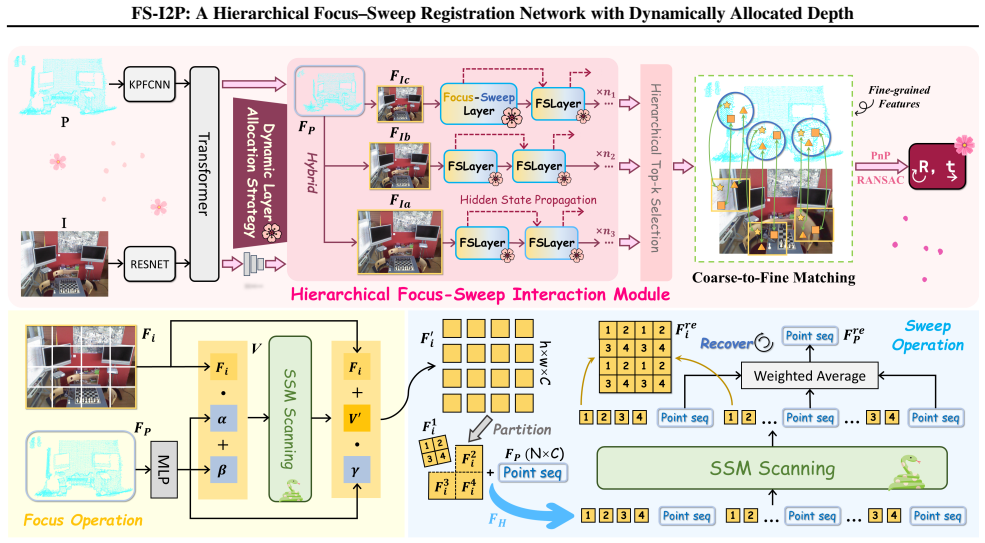
The Hierarchical Focus-Sweep Interaction Module, which performs focus-sweep style interactions to mitigate attention drift and intra-scale inconsistencies in an SSM-based framework, and the Dynamic Layer Allocation Strategy for adaptive iteration depth.
What would settle it
Reproducing the experiments with the focus-sweep module disabled or replaced by standard attention, while keeping other elements the same, and finding no drop in performance on the two benchmarks would falsify the contribution of the proposed components.
Extended reading notes
Core claim
The authors establish that the Hierarchical Focus-Sweep Interaction Module combined with the Dynamic Layer Allocation Strategy enhances multi-level cross-modal feature association and matching robustness, resulting in state-of-the-art performance on the RGB-D Scenes V2 and 7-Scenes benchmarks.
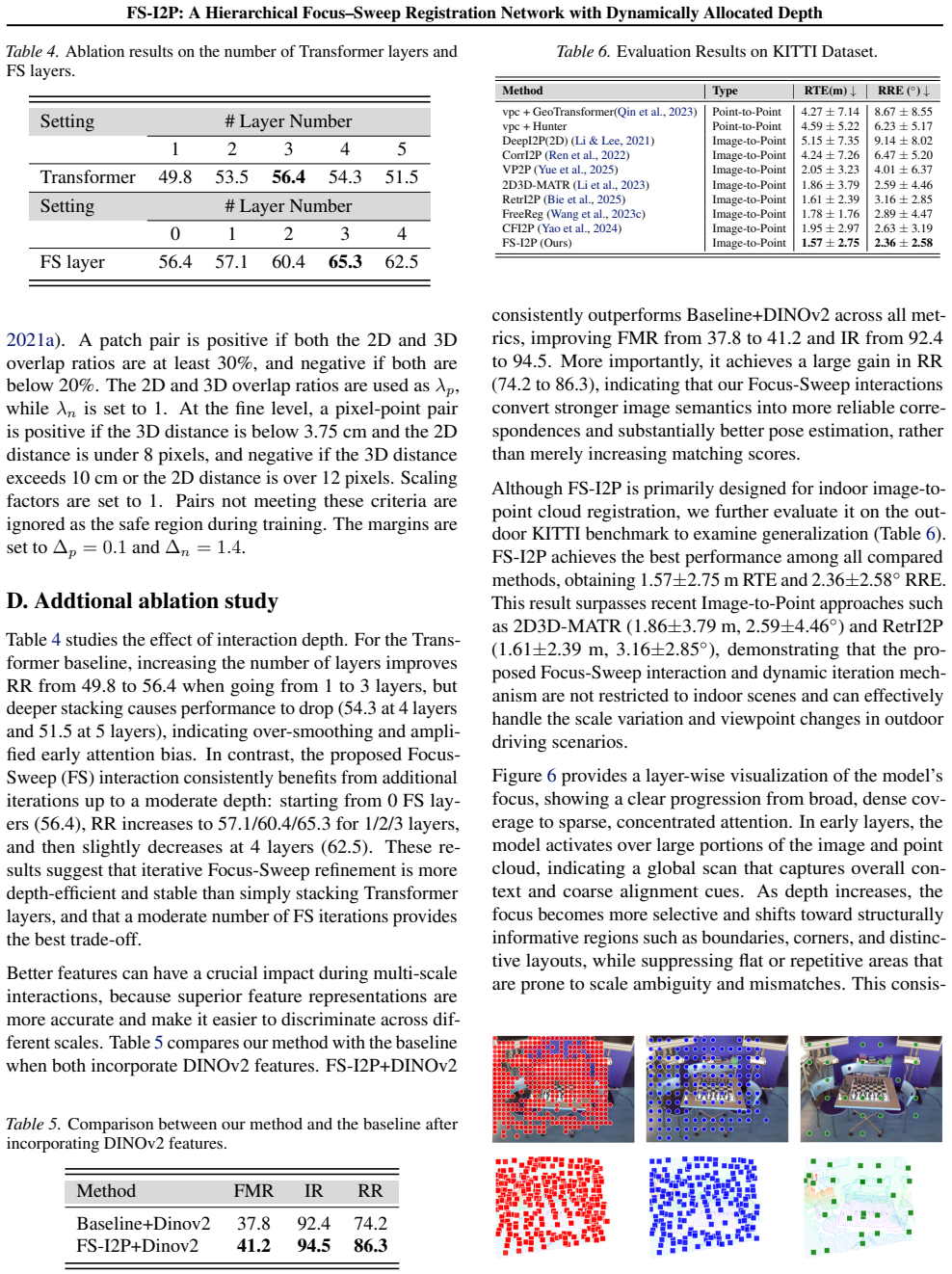
Load-bearing premise
The reported gains on the benchmarks result specifically from the focus-sweep module and dynamic allocation strategy rather than other factors like implementation choices or tuning.
Editorial extensions
If this is right
- The approach reduces erroneous correspondences in registration tasks affected by cross-modal discrepancies.
- Adaptive depth allocation allows better exploitation of geometric constraints during matching.
- The method achieves state-of-the-art results on RGB-D Scenes V2 and 7-Scenes.
- Multi-level feature association is strengthened through the hierarchical module.
Reading between the lines
- If the focus-sweep approach proves general, it may apply to other multi-scale transformer architectures facing similar drift issues.
- Dynamic allocation could lead to efficiency gains by varying computation based on input complexity.
- Further tests on outdoor or large-scale scenes would test if the gains transfer beyond indoor benchmarks.
Editorial analysis
A structured set of objections, weighed in public.
Referee Report
Summary. The paper proposes FS-I2P, a hierarchical focus-sweep registration network for image-to-point cloud registration. It introduces a Hierarchical Focus-Sweep Interaction Module within an SSM-based framework to enhance multi-level cross-modal feature association and a Dynamic Layer Allocation Strategy to adaptively determine iteration depth for better geometric constraints. The central claim is that this approach achieves state-of-the-art performance on the RGB-D Scenes V2 and 7-Scenes benchmarks, supported by extensive experiments and ablations.
Significance. If the reported gains are shown to be attributable to the focus-sweep module and dynamic allocation, the work could advance detection-free registration methods by addressing attention drift and scale ambiguity more effectively than prior transformer-based approaches. The SSM framework and adaptive depth allocation may also offer computational advantages in handling cross-modal discrepancies.
major comments (2)
- [Abstract] Abstract: the claim of state-of-the-art performance and supporting ablations is asserted without any quantitative numbers, error bars, baseline comparisons, or statistical tests, preventing verification that the Hierarchical Focus-Sweep Interaction Module and Dynamic Layer Allocation Strategy are responsible for the gains rather than other implementation details.
- [Experiments] Experiments section (as referenced in abstract): the central attribution claim requires ablation tables that isolate the incremental benefit of adding/removing the focus-sweep module and dynamic allocation while holding feature extraction, loss, optimizer, and other factors fixed; the absence of such controlled numbers leaves open the possibility that gains arise from unmentioned tuning or dataset-specific choices.
minor comments (1)
- [Abstract] Abstract: the acronym FS-I2P in the title is not expanded on first use in the abstract text.
Simulated Author's Rebuttal
We thank the referee for highlighting the need for clearer quantitative support in the abstract and more controlled ablations. We will revise both sections accordingly to strengthen the attribution of gains to the proposed modules.
read point-by-point responses
-
Referee: [Abstract] Abstract: the claim of state-of-the-art performance and supporting ablations is asserted without any quantitative numbers, error bars, baseline comparisons, or statistical tests, preventing verification that the Hierarchical Focus-Sweep Interaction Module and Dynamic Layer Allocation Strategy are responsible for the gains rather than other implementation details.
Authors: We agree that the abstract lacks specific quantitative support. In the revision we will insert key registration metrics (e.g., mean rotation/translation errors and success rates on RGB-D Scenes V2 and 7-Scenes) together with direct numerical comparisons to the strongest baselines, including standard deviations across runs where available. This will make the SOTA claim verifiable and directly tie reported gains to the focus-sweep and dynamic-allocation components. revision: yes
-
Referee: [Experiments] Experiments section (as referenced in abstract): the central attribution claim requires ablation tables that isolate the incremental benefit of adding/removing the focus-sweep module and dynamic allocation while holding feature extraction, loss, optimizer, and other factors fixed; the absence of such controlled numbers leaves open the possibility that gains arise from unmentioned tuning or dataset-specific choices.
Authors: We acknowledge that the existing ablation studies do not fully isolate the two modules under strictly controlled conditions. We will add new tables that incrementally enable/disable the Hierarchical Focus-Sweep Interaction Module and the Dynamic Layer Allocation Strategy while freezing all other elements (backbone, loss, optimizer, training schedule). These tables will report the resulting registration errors on both benchmarks, allowing readers to quantify the marginal contribution of each component. revision: yes
Circularity Check
No circularity in derivation chain; empirical proposal only
full rationale
The provided abstract and context contain no equations, derivations, first-principles results, or mathematical claims that could reduce to inputs by construction. The paper describes a proposed architecture (Hierarchical Focus-Sweep Interaction Module and Dynamic Layer Allocation Strategy) and reports empirical SOTA results plus ablations on external benchmarks (RGB-D Scenes V2, 7-Scenes). No self-citations, fitted parameters renamed as predictions, or ansatzes appear. The work is self-contained against external benchmarks with no load-bearing self-referential steps.
Assumptions & free parameters
Cite this review
Pith. "Pith review of FS-I2P:A Hierarchical Focus-Sweep Registration Network with Dynamically Allocated Depth." pith.science (2026). https://pith.science/paper/VDUMAQRO
@misc{pith2026260507607,
  author       = {Pith},
  title        = {Pith review of: FS-I2P:A Hierarchical Focus-Sweep Registration Network with Dynamically Allocated Depth},
  year         = {2026},
  howpublished = {\url{https://pith.science/paper/VDUMAQRO}},
  note         = {Machine review of arXiv:2605.07607}
}
read the original abstract
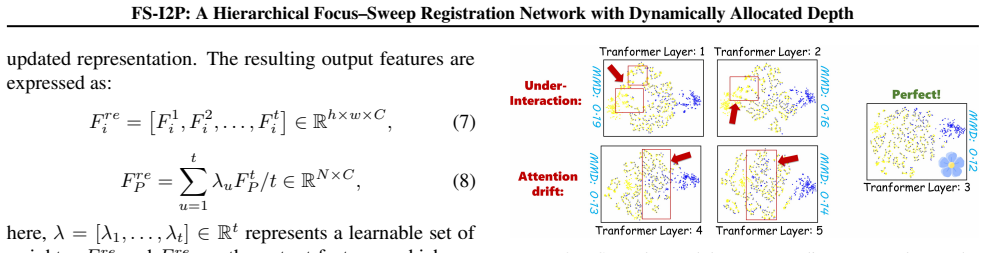
Image-to-point cloud registration is often challenged by viewpoint changes, cross-modal discrepancies, and repetitive textures, which induce scale ambiguity and consequently lead to erroneous correspondences. Recent detection-free methods alleviate this issue by leveraging multi-scale features and transformer-based interactions. However, they still suffer from attention drift across layers and intra-scale inconsistencies, hindering precise registration. Inspired by human behavior, we propose a ``Focus--Sweep'' paradigm and develop a Hierarchical Focus--Sweep Interaction Module within an SSM-based framework to enhance multi-level cross-modal feature association. In addition, we introduce a Dynamic Layer Allocation Strategy that adaptively determines the iteration depth to better exploit geometric constraints and improve matching robustness. Extensive experiments and ablations on two benchmarks, RGB-D Scenes V2 and 7-Scenes, demonstrate that our approach achieves state-of-the-art performance.
Figures

Figures from the paper (3 more)

Reference graph
Works this paper leans on
-
[1]
Predator: Registration of 3d point clouds with low overlap
Huang, S., Gojcic, Z., Usvyatsov, M., Wieser, A., and Schindler, K. Predator: Registration of 3d point clouds with low overlap. InProceedings of the IEEE/CVF Con- ference on computer vision and pattern recognition, pp. 4267–4276, 2021a. Huang, S., Gojcic, Z., Usvyatsov, M., Wieser, A., and Schindler, K. Predator: Registration of 3d point clouds with low o...
-
[2]
Khairuddin, A. R., Talib, M. S., and Haron, H. Review on simultaneous localization and mapping (slam). In 2015 IEEE international conference on control system, 10 FS-I2P: A Hierarchical Focus–Sweep Registration Network with Dynamically Allocated Depth computing and engineering (ICCSCE), pp. 85–90. IEEE,
work page 2015
-
[3]
Ef-3dgs: Event-aided free-trajectory 3d gaussian splatting.arXiv preprint arXiv:2410.15392,
Liao, B., Zhai, W., Wan, Z., Cheng, Z., Yang, W., Zhang, T., Cao, Y ., and Zha, Z.-J. Ef-3dgs: Event-aided free-trajectory 3d gaussian splatting.arXiv preprint arXiv:2410.15392,
-
[4]
Mao, Z., Yang, Y ., Ma, C., Jiang, D., Yao, J., Zhang, Y ., and Wang, Y . Safire: Saccade-fixation reiteration with mamba for referring image segmentation.arXiv preprint arXiv:2510.10160,
-
[5]
Real time localization and 3d reconstruction
Mouragnon, E., Lhuillier, M., Dhome, M., Dekeyser, F., and Sayd, P. Real time localization and 3d reconstruction. In 2006 IEEE Computer Society Conference on Computer Vision and Pattern Recognition (CVPR’06), volume 1, pp. 363–370. IEEE, 2006a. Mouragnon, E., Lhuillier, M., Dhome, M., Dekeyser, F., and Sayd, P. Real time localization and 3d reconstruction...
work page 2006
-
[6]
Pan, Y ., Sun, R., Wang, Y ., Yang, W., Zhang, T., and Zhang, Y . Purify then guide: A bi-directional bridge network for open-vocabulary semantic segmentation.IEEE Trans- actions on Circuits and Systems for Video Technology, 2024a. Pan, Y ., Sun, R., Wang, Y ., Zhang, T., and Zhang, Y . Re- thinking the implicit optimization paradigm with dual alignments ...
-
[7]
Impact of similarity measures on web-page clustering
Strehl, A., Ghosh, J., and Mooney, R. Impact of similarity measures on web-page clustering. InWorkshop on artifi- cial intelligence for web search (AAAI 2000), volume 58, pp. 64,
work page 2000
-
[8]
Tao, X., Wang, C., Ai, Y ., Cheng, Z., Li, Z., Liu, L., Chen, Y ., Li, X., Li, Q., Yang, W., et al. Geoguide: Hierarchi- cal geometric guidance for open-vocabulary 3d semantic segmentation.arXiv preprint arXiv:2603.26260,
Show all 17 references
-
[9]
Long-short range adaptive transformer with dynamic sampling for 3d object detection.IEEE Transactions on Circuits and Systems for Video Technology, 33(12): 7616–7629, 2023a
Wang, C., Deng, J., He, J., Zhang, T., Zhang, Z., and Zhang, Y . Long-short range adaptive transformer with dynamic sampling for 3d object detection.IEEE Transactions on Circuits and Systems for Video Technology, 33(12): 7616–7629, 2023a. Wang, C., Yang, W., and Zhang, T. Not ...
-
[10]
Wang, Z., Pan, T., Zhou, Q., and Wang, J
doi: 10.1609/aaai.v36i8.20839. Wang, Z., Pan, T., Zhou, Q., and Wang, J. Efficient exploration in resource-restricted reinforcement learn- ing.Proceedings of the AAAI Conference on Artifi- cial Intelligence, 37(8):10279–10287, Jun. 2023e. doi: 10.1609/aaai.v37i8.26224. Wang, Z...
-
[11]
Edgeregnet: Edge feature-based multimodal reg- istration network between images and lidar point clouds
Yue, Y ., Yuan, H., Miao, Q., Mao, X., Hamzaoui, R., and Eisert, P. Edgeregnet: Edge feature-based multimodal reg- istration network between images and lidar point clouds. arXiv preprint arXiv:2503.15284,
-
[12]
Exploring semantic masked autoencoder for self-supervised point cloud understanding.arXiv preprint arXiv:2506.21957, 2025a
Zha, Y ., Wang, C., Yang, W., and Zhang, T. Exploring semantic masked autoencoder for self-supervised point cloud understanding.arXiv preprint arXiv:2506.21957, 2025a. Zha, Y ., Wang, C., Yang, W., Zhang, T., and Wu, F. Ex- ploring vision semantic prompt for efficient point cl...
-
[13]
It is particularly effective for visualizing high- dimensional datasets by embedding them into two or three dimensions
is a nonlinear di- mensionality reduction technique used primarily for data visualization. It is particularly effective for visualizing high- dimensional datasets by embedding them into two or three dimensions. t-SNE aims to preserve the local structure of data points by model...
2016
-
[14]
, sin(2L−1x),cos(2 L−1x) , (20) where L is the length of the embedding
encodes positional information by transforming it into a sequence of sine and cosine terms: ϕ(x) = x,sin(2 0x),cos(2 0x), . . . , sin(2L−1x),cos(2 L−1x) , (20) where L is the length of the embedding. This transforma- tion incorporates spatial positioning into the features. To ...
2021
-
[15]
The margins are set to∆ p = 0.1and∆ n = 1.4
Pairs not meeting these criteria are ignored as the safe region during training. The margins are set to∆ p = 0.1and∆ n = 1.4. D. Addtional ablation study Table 4 studies the effect of interaction depth. For the Trans- former baseline, increasing the number of layers improves R...
2023
-
[16]
Image-to-Point2.05±3.234.01±6.372D3D-MATR (Li et al., 2023)Image-to-Point1.86±3.792.59±4.46RetrI2P (Bie et al.,
2023
-
[17]
Image-to-Point1.95±2.972.63±3.19FS-I2P (Ours) Image-to-Point1.57±2.752.36±2.58 consistently outperforms Baseline+DINOv2 across all met- rics, improving FMR from 37.8 to 41.2 and IR from 92.4 to 94.5. More importantly, it achieves a large gain in RR (74.2 to 86.3), indicating t...
Reviewed June 30, 2026 · model on record in the stance chip above.
Discussion (0). Continue with ORCID to comment.