REVIEW 3 major objections 4 minor 43 references
Projector Method for Nonlinear Light-Matter Interactions and Quantum Geometry
T0 review · 3 major / 4 minor · reviewed 2026-08-04 · deepseek-v4-flash
Pith's one-line read A projector-based Feynman diagram framework, implemented in Wannier functions with finite-spread corrections, computes nonlinear optical responses and quantum geometry of realistic materials, and the paper validates it by reproducing the sh
desk verdict Wannier-basis projector calculus is new and mostly sound; send it out, but ask for code/data and a real convergence test before the 'reliable tool' claim is taken at face value. read the letter →
The pith
A machine-rendered reading of the paper's core claim, the machinery that carries it, and where it could break.
The reading
What carries the argument
The engine is the projector P_a = Σ_i |u_{ai}⟩⟨u_{ai}| onto an energy subspace, together with two expansion rules that re-express products P_a (∂H) P_b and P_a (∂²H) P_b as combinations of projector derivatives and energy differences. Those rules convert Feynman-diagram vertex products into gauge-invariant combinations like the quantum Hermitian connection C, the interband quantum geometric tensor Q, and the triple phase product T. To make this work in a Wannier basis, the paper supplies corrected first- and second-order projector derivatives: the naive Hamiltonian-gauge derivative is supplemented by dipole and quadrupole matrices of the Wannier functions. A subspace-averaging scheme around
What would settle it
Calculate σ^{yyy}_{sh} for monolayer GeS using Wannier functions constructed with deliberately different localization protocols and compare the projector result with a direct, non-Wannier first-principles evaluation of the same response; if the quadrupole-truncated projector result changes outside the agreement spread seen among the sum-rule and Wilson-loop benchmarks, then the neglected octupole and higher Wannier moments are not negligible and the paper's central truncation fails.
Extended reading notes
Core claim
The paper's central claim is that every nonlinear conductivity vertex product can be rewritten so that only projectors and their derivatives appear, making gauge invariance component-wise automatic and degeneracies harmless. For shift current, the whole resonant response collapses to a Brillouin-zone integral over the quantum Hermitian connection C^{μ;αβ}_{ab} = Tr[P_b P_a^α (P_b^{μβ} + P_a^μ P_b^β)], together with a frequency-conserving delta. In the Wannier representation, the projector itself equals the Hamiltonian-gauge projector, but its derivatives do not: finite Wannier spread enters through dipole matrix A^α and quadrupole matrix D^{αβ}, and the paper provides explicit correction for
Load-bearing premise
The method assumes that all information about the spatial spread of the Wannier functions needed for projector derivatives is captured by their dipole and quadrupole moments, with octupole and higher multipole moments neglected.
Editorial extensions
If this is right
- Shift current in real materials can be computed from manifestly gauge-invariant projectors, without ever forming Berry connections or shift vectors explicitly.
- The sum-rule denominator 1/ε_ac is avoided, so the method does not need a broadening parameter to regularize near-degenerate transitions; band degeneracies are treated by constructing degenerate-subspace projectors.
- The same projector framework yields the interQGT and triple phase product, giving a unified way to compute injection-current, shift-current, and third-order/bicircular photocurrent geometric ingredients from one set of Wannier matrices.
- The finite-spread correction to projector derivatives is not optional: including the Wannier dipole and quadrupole moments is necessary to reproduce the first-principles shift current.
- Because the projector expressions match the generalized Wilson loop expression analytically, the two methods are two evaluations of the same geometric quantity, with numerical differences only from discretization and degeneracy handling.
Reading between the lines
- A direct test of the multipole truncation would be to run the same GeS calculation with several Wannier localizations and check whether the dipole/quadrupole-corrected result stays fixed; if it drifts, higher Wannier multipoles are contributing.
- The method's component-wise gauge invariance suggests it could be combined with k·p or tight-binding models of twisted or disordered systems, where projector derivatives can be evaluated analytically rather than by finite differences.
- Generalizing the Wannier correction from dipole/quadrupole to octupole should be straightforward in the same diagrammatic language, but the paper's formulas deliberately avoid it; adding octupole terms would quantify the truncation error of the present implementation.
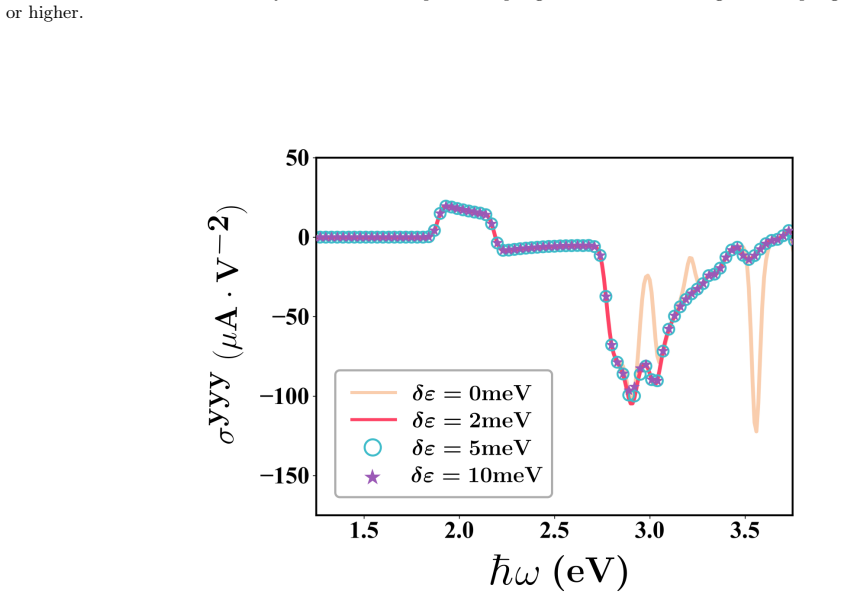
- The degeneracy-subspace averaging introduces an energy window δε as a convergence parameter; a systematic δε-sweep protocol could be exported to other materials with degeneracy lines.
Editorial analysis
A structured set of objections, weighed in public.
Referee Report
Summary. The paper develops a projector-based Feynman-diagram framework for nonlinear optical response and quantum geometry. It derives a gauge-invariant expression for the shift-current conductivity in terms of projectors and their derivatives, gives Wannier-representation formulas for projector derivatives with finite-spread corrections through dipole and quadrupole matrices, and proposes a degeneracy-handling strategy. As a numerical demonstration, it computes the shift current of monolayer GeS with the new method and compares it with the sum-rule and generalized Wilson-loop methods, and it reports k-resolved interQGT, QHC, and TPP quantities.
Significance. The theoretical derivation is careful and largely self-contained: the Supplement details the contour integrations, identifies injection versus shift-current contributions, and explicitly shows the cancellation between two- and three-vertex diagrams (Eqs. S15-S17). The Wannier-basis formulas in Eqs. (11)-(12) and the factorization in Table II are nontrivial and appear to be exact in the Wannier basis; the concern that octupole moments are neglected does not land, because only first and second derivatives of the basis functions are needed and the formulas avoid higher-order moments by construction. If validated, the method would be a useful alternative that avoids 1/epsilon divergences and handles degeneracies more naturally. However, the numerical validation currently establishes internal consistency among three implementations on one 16-band model, not accuracy against an independent reference.
major comments (3)
- [Sec. IV, Fig. 3(d); Eqs. (14)-(15)] The central accuracy claim is supported only by mutual consistency. The sum-rule benchmark sums auxiliary bands over the Nwan=16 disentangled states of the same Wannier model, and the Wilson-loop overlaps are built from the same TB Hamiltonian; moreover, Ref. [22] shares the present corresponding author, so the second benchmark is not independent. In the high-frequency range where the three curves deviate, no external reference is supplied and no convergence test with respect to Nwan or disentanglement window is reported. Since the projector method is exact within a given TB model, agreement among three implementations cannot establish accuracy against the true DFT response. Please add an independent check, e.g., a direct DFT calculation with a large empty-band sum, or a systematic Nwan-convergence study, and state the frequency range over which 'excellent agreement' is claimed.
- [Sec. IIIB, Eqs. (11)-(12); Suppl. Eq. (22)] The practical implementation of the Wannier correction terms is under-specified. The matrices A^alpha, D^{alpha beta}, and D^{alpha beta'} in Eq. (S22) are central to the finite-spread correction, but the paper does not state how they are computed from WANNIER90 output, nor does it provide a numerical test of their accuracy. Without this information, the implementation cannot be reproduced and errors in these matrices would directly bias Figs. 3(c) and 3(d). Please clarify how the dipole and quadrupole matrices are evaluated and validate them on a simple model or against a direct DFT calculation.
- [Sec. IIIC; Supplement Fig. 4] The degeneracy treatment introduces an energy window delta_epsilon and redistributes the computed quantity uniformly over the degenerate band pairs as C/(Ns Ms). Although the robustness window of 2-10 meV is reassuring, the paper does not provide a formal justification for the uniform redistribution or for choosing the smallest window. Since this procedure affects the quantitative result, a derivation or a clear convergence criterion for delta_epsilon should be given, especially because the high-frequency discrepancies in Fig. 3(d) may be sensitive to it.
minor comments (4)
- [Table II caption] The caption refers to 'interQGT, TGT and TPP'; 'TGT' should probably be 'QHC'. Please correct.
- [Eq. (15)] The notation Wba(k,q, r^alpha, beta beta) is confusing. Please define the arguments explicitly, particularly the repeated 'beta beta'.
- [Sec. IV] The sentence describing Fig. 3(c) says the results 'lead to discrepancies with purely first-principles calculations', but no 'purely first-principles' result is shown. Specify the reference calculation used for this comparison.
- [References] Refs. [20] and [42] are identical; please cite only once.
Circularity Check
No significant circularity: the central derivation is self-contained and the independent sum-rule benchmark supports it; the Wilson-loop comparison is a consistency check, not a circular reduction.
full rationale
The paper's derivation chain is self-contained. The shift-current expression in Eq. (7) is obtained from Feynman diagrams and the projector expansion rules (Eqs. (3)–(4)) with the detailed algebra in Sec. I of the Supplemental Material; it does not presuppose the final result. The Wannier-basis projector derivatives in Eqs. (11)–(12) are derived from the definitions of the Wannier functions and the dipole/quadrupole matrices, rather than fitted to the shift-current data; the stated neglect of octupole and higher multipoles is an acknowledged approximation, not a circular input. The benchmark against the sum-rule method (ref. 21) is genuinely independent: it is a separately published formalism implemented on the same Wannier model, and agreement checks the projector implementation. The generalized Wilson loop comparison (ref. 22) is less independent because that method shares the corresponding author and the paper itself proves algebraic equivalence to the projector expression in Eq. (16); however, this makes the numerical comparison a consistency check, not a circular reduction of the central claim. No fitted parameter is renamed as a prediction, no uniqueness theorem is imported from the authors' prior work, and the high-frequency discrepancies are explicitly attributed to band truncation and degeneracy treatment rather than used to redefine the projector result. The remaining limitation is validation accuracy within a truncated model, which is a correctness/evidence issue, not circularity under the stated rubric.
Assumptions & free parameters
free parameters (4)
- degeneracy energy window delta_epsilon =
2 meV
- sum-rule broadening eta =
40 meV
- smearing gamma =
30 meV
- disentanglement window =
16 bands
assumptions (6)
- domain assumption Completeness of the subspace decomposition and the expansion rules (Eqs. 3-4) for products of projector derivatives and derivatives of H
- domain assumption The Feynman diagram rules of Parker et al. (ref. 28) with the vertex and propagator components of Table I capture the full nonlinear conductivity
- domain assumption The Wannier basis from the 16-band disentanglement faithfully represents the DFT bands and the transition matrix elements in the optical window
- ad hoc to paper Truncation of Wannier multipole moments at quadrupole order (A^alpha, D^{alpha beta}); octupole and higher moments are negligible
- domain assumption Time-reversal symmetry and linearly polarized light: only Im C^{mu;(alpha beta)}_{[ab]} = -2i R^{alpha;mu}_{ab} r^alpha_{ab} r^beta_{ba} survives
- standard math Matsubara contour integration and the replacement d^omega_{ab} -> -i pi delta^omega_{ab} isolate the resonant response
Cite this review
Pith. "Pith review of Projector Method for Nonlinear Light-Matter Interactions and Quantum Geometry." pith.science (2026). https://pith.science/paper/VDV6WUXB
@misc{pith2026250909216,
  author       = {Pith},
  title        = {Pith review of: Projector Method for Nonlinear Light-Matter Interactions and Quantum Geometry},
  year         = {2026},
  howpublished = {\url{https://pith.science/paper/VDV6WUXB}},
  note         = {Machine review of arXiv:2509.09216}
}
read the original abstract
We develop a systematic projector-based Feynman diagram framework that intrinsically encodes quantum geometry for nonlinear optical responses. By explicitly incorporating geometric quantities such as the quantum geometric tensor, quantum hermitian connection, and triple phase product, the method ensures component-wise gauge invariance and seamlessly extends to multiband systems, enabling accurate calculations of quantum geometry and nonlinear optical responses. We derive the projector formalism in Wannier function basis and implement the \textit{ab initio} calculations of shift current in GeS, demonstrating excellent agreement with the sum rule and Wilson loop approaches. This work extends projector-based representations within the Wannier functions basis, offering an efficient and reliable tool for investigating nonlinear light-matter interactions and quantum geometry in realistic materials.
Figures


Figures from the paper (6 more)



Reference graph
Works this paper leans on
-
[22]
H. Wang, X. Tang, H. Xu, J. Li, and X. Qian, Gen- eralized wilson loop method for nonlinear light-matter interaction, npj Quantum Materials7, 61 (2022)
2022
-
[1]
K. v. Klitzing, G. Dorda, and M. Pepper, New method forhigh-accuracydeterminationofthefine-structurecon- stant based on quantized hall resistance, Phys. Rev. Lett. 45, 494 (1980)
1980
-
[2]
Chang and Q
M.-C. Chang and Q. Niu, Berry phase, hyperorbits, and the hofstadter spectrum, Phys. Rev. Lett.75, 1348 (1995)
1995
-
[3]
J. P. Provost and G. Vallee, Riemannian structure on manifolds of quantum states, Commun. Math. Phys.76, 289 (1980)
1980
-
[4]
phases” and “distance
A. K. Pati, Relation between “phases” and “distance” in quantum evolution, Phys. Lett. A159, 105 (1991)
1991
-
[5]
R. Cheng, Quantum Geometric Tensor (Fubini-Study Metric) in Simple Quantum System: A pedagogical In- troduction (2013), arXiv:1012.1337
arXiv 2013
-
[6]
Peotta and P
S. Peotta and P. Törma, Superfluidity in topologically nontrivial flat bands, Nature Communications6, 8944 (2015)
2015
-
[7]
Liang, T
L. Liang, T. I. Vanhala, S. Peotta, T. Siro, A. Harju, and P. Törmä, Band geometry, berry curvature, and super- fluid weight, Phys. Rev. B95, 024515 (2017)
2017
Show all 43 references
-
[8]
F. Xie, Z. Song, B. Lian, and B. A. Bernevig, Topology- BoundedSuperfluidWeightinTwistedBilayerGraphene, Phys. Rev. Lett.124, 167002 (2020)
2020
-
[9]
Kruchkov, Quantum transport anomalies in disper- sionless quantum states, Phys
A. Kruchkov, Quantum transport anomalies in disper- sionless quantum states, Phys. Rev. B107, L241102 (2023)
2023
-
[10]
Huhtinen and P
K.-E. Huhtinen and P. Törmä, Conductivity in flat bands from the kubo-greenwood formula, Phys. Rev. B108, 155108 (2023)
2023
-
[11]
Roy, Band geometry of fractional topological insula- tors, Phys
R. Roy, Band geometry of fractional topological insula- tors, Phys. Rev. B90, 165139 (2014)
2014
-
[12]
Mera and T
B. Mera and T. Ozawa, Kähler geometry and chern in- sulators: Relations between topology and the quantum metric, Phys. Rev. B104, 045104 (2021)
2021
-
[13]
P. J. Ledwith, A. Vishwanath, and D. E. Parker, Vor- texability: A unifying criterion for ideal fractional chern insulators, Phys. Rev. B108, 205144 (2023)
2023
-
[14]
Ahn, G.-Y
J. Ahn, G.-Y. Guo, and N. Nagaosa, Low-Frequency Di- vergence and Quantum Geometry of the Bulk Photo- voltaic Effect in Topological Semimetals, Phys. Rev. X 10, 041041 (2020)
2020
-
[15]
Ahn, G.-Y
J. Ahn, G.-Y. Guo, N. Nagaosa, and A. Vishwanath, Riemannian geometry of resonant optical responses, Nat. Phys.18, 290 (2022)
2022
-
[16]
Hanke, F
J.-P. Hanke, F. Freimuth, C. Niu, S. Blügel, and Y. Mokrousov, Mixed weyl semimetals and low- dissipation magnetization control in insulators by spin– orbit torques, Nature Communications8, 1479 (2017)
2017
-
[17]
C. Xiao, B. Xiong, and Q. Niu, Electric driving of mag- netization dynamics in a hybrid insulator, Phys. Rev. B 104, 064433 (2021)
2021
-
[18]
Morimoto and N
T. Morimoto and N. Nagaosa, Direct current generation by dielectric loss in ferroelectrics, Phys. Rev. B110, 045129 (2024)
2024
-
[19]
J. Hu, W. Li, Z. Guo, H. Wang, and K. Chang, Optical manifestations of quantum geometry in electron-phonon coupling (2025), arXiv:2410.09677
2025 arXiv
-
[21]
Ibañez Azpiroz, S
J. Ibañez Azpiroz, S. S. Tsirkin, and I. Souza, Ab initio calculation of the shift photocurrent by wannier interpo- lation, Phys. Rev. B97, 245143 (2018)
2018
-
[23]
Mitscherling, A
J. Mitscherling, A. Avdoshkin, and J. E. Moore, Gauge- invariant projector calculus for quantum state geometry and applications to observables in crystals, Phys. Rev. B 112, 085104 (2025)
2025
-
[24]
Avdoshkin, J
A. Avdoshkin, J. Mitscherling, and J. E. Moore, Multi- state geometry of shift current and polarization, Phys. Rev. Lett.135, 066901 (2025)
2025
-
[25]
Avdoshkin and F
A. Avdoshkin and F. K. Popov, Extrinsic geometry of quantum states, Phys. Rev. B107, 245136 (2023)
2023
-
[26]
Graf and F
A. Graf and F. Piéchon, Berry curvature and quantum metric inn-band systems: An eigenprojector approach, Phys. Rev. B104, 085114 (2021)
2021
-
[27]
Pozo and F
O. Pozo and F. de Juan, Computing observables without eigenstates: Applications to bloch hamiltonians, Phys. Rev. B102, 115138 (2020)
2020
-
[28]
D. E. Parker, T. Morimoto, J. Orenstein, and J. E. Moore, Diagrammatic approach to nonlinear optical re- sponse with application to Weyl semimetals, Phys. Rev. B99, 045121 (2019)
2019
-
[29]
V. M. Fridkin, Bulk photovoltaic effect in noncentrosym- metric crystals, Crystallogr. Rep.46, 654 (2001)
2001
-
[30]
von Baltz and W
R. von Baltz and W. Kraut, Theory of the bulk pho- tovoltaic effect in pure crystals, Phys. Rev. B23, 5590 (1981)
1981
-
[31]
J. E. Sipe and A. I. Shkrebtii, Second-order optical re- sponse in semiconductors, Phys. Rev. B61, 5337 (2000)
2000
-
[32]
S. M. Young and A. M. Rappe, First Principles Calcu- lation of the Shift Current Photovoltaic Effect in Ferro- electrics, Phys. Rev. Lett.109, 116601 (2012)
2012
-
[33]
L. Z. Tan, F. Zheng, S. M. Young, F. Wang, S. Liu, and A. M. Rappe, Shift current bulk photovoltaic effect in po- lar materials—hybrid and oxide perovskites and beyond, npj Comput. Mater.2, 16026 (2016)
2016
-
[34]
Morimoto and N
T. Morimoto and N. Nagaosa, Topological nature of non- linear optical effects in solids, Sci. Adv.2, e1501524 (2016)
2016
-
[35]
Dai and A
Z. Dai and A. M. Rappe, Recent progress in the theory of bulk photovoltaic effect, Chem. Phys. Rev.4, 011303 (2023)
2023
-
[36]
Nastos and J
F. Nastos and J. E. Sipe, Optical rectification and shift currents in GaAs and GaP response: Below and above the band gap, Phys. Rev. B74, 035201 (2006). 10
2006
-
[37]
Z. Lu, Z. Gong, J. Qi, H. Wang, and K. Chang, Pure momentum-shift bulk photovoltaic effect in ferroelectric flat-band mott insulators (2025), arXiv:2502.04624
2025 arXiv
-
[38]
I.Souza, N.Marzari,andD.Vanderbilt,Maximallylocal- ized wannier functions for entangled energy bands, Phys. Rev. B65, 035109 (2001)
2001
-
[39]
X. Wang, J. R. Yates, I. Souza, and D. Vanderbilt, Ab initio calculation of the anomalous hall conductivity by wannier interpolation, Phys. Rev. B74, 195118 (2006)
2006
-
[40]
Watanabe and Y
H. Watanabe and Y. Yanase, Chiral photocurrent in parity-violating magnet and enhanced response in topo- logical antiferromagnet, Phys. Rev. X11, 011001 (2021)
2021
-
[41]
S. A. Mikhailov, Quantum theory of third-harmonic gen- eration in graphene, Phys. Rev. B90, 241301 (2014)
2014
-
[42]
Z. Guo, Z. Lu, H. Wang, and K. Chang, Bicircular light- induced multistate geometric current, Phys. Rev. B112, 035162 (2025)
2025
-
[43]
Rangel, B
T. Rangel, B. M. Fregoso, B. S. Mendoza, T. Mori- moto, J. E. Moore, and J. B. Neaton, Large bulk photo- voltaic effect and spontaneous polarization of single-layer monochalcogenides, Phys. Rev. Lett.119, 067402 (2017)
2017
-
[44]
A. M. Cook, B. M. Fregoso, F. de Juan, S. Coh, and J. E. Moore, Design principles for shift current photovoltaics, Nat. Commun.8, 14176 (2017). 11 Supplementary Material I. Derivation of Resonant Second Order Response In this section, we present in detail the computational pro...
2017
Reviewed August 4, 2026 · model on record in the stance chip above.
Discussion (0). Continue with ORCID to comment.