REVIEW 3 major objections 4 minor 3 cited by
This paper argues that Dicke superradiance survives arbitrarily strong positional disorder, retaining the ideal N² peak scaling asymptotically.
Reviewed by Pith at T0; open to challenge. T0 means a machine referee read the full paper against a public rubric. the ladder, T0–T4 →
T0 review · deepseek-v4-flash
2026-08-04 09:43 UTC pith:VDXJ6PKJ
load-bearing objection The N² scaling under disorder is a solid numerical result; the spin-ordering explanation is plausible but not yet as proven as the paper claims. the 3 major comments →
Robust Superradiance and Spontaneous Spin Ordering in Disordered Waveguide Quantum Electrodynamics
The pith
A machine-rendered reading of the paper's core claim, the machinery that carries it, and where it could break.
Core claim
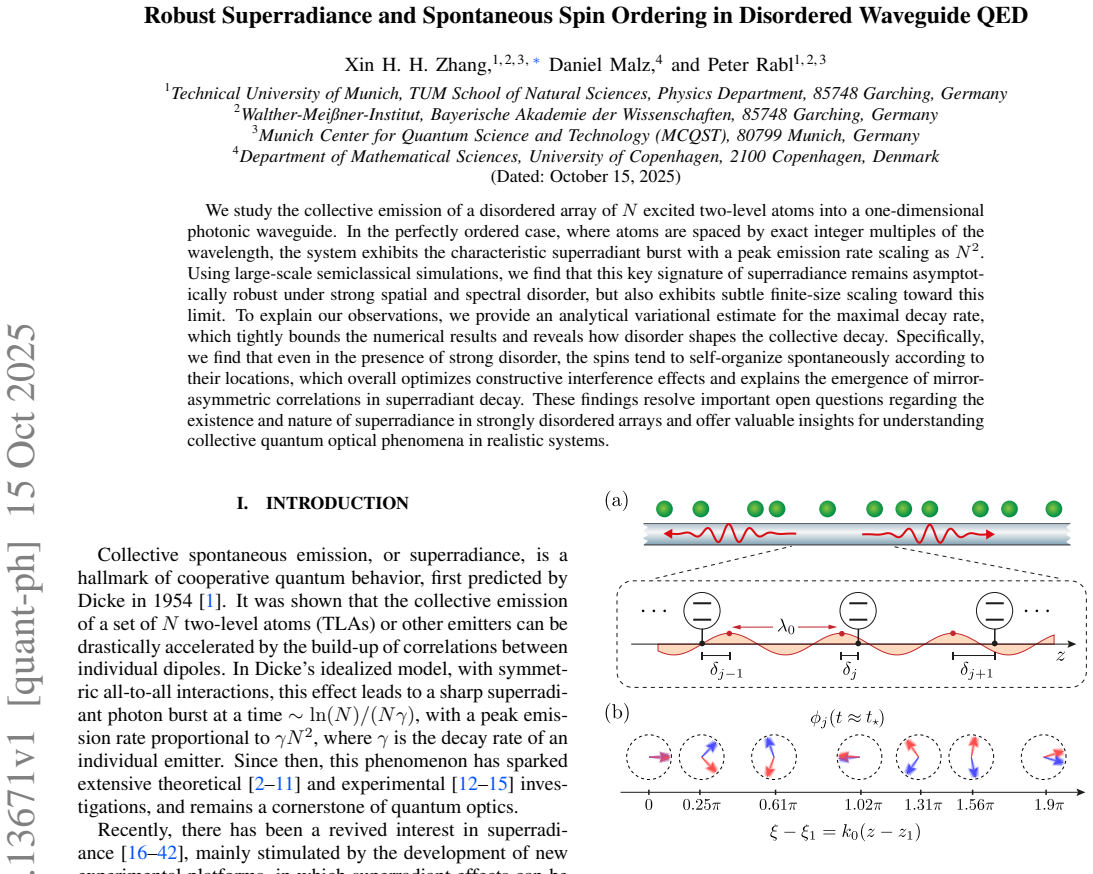
The central claim is that the superradiant peak retains the ideal Dicke scaling R* ∼ N² asymptotically, regardless of the strength of spatial disorder, and that the burst time t* ∼ log(N)/(γN) is likewise unchanged. The mechanism the authors identify is a spontaneous spin ordering: near the burst time, the atomic dipole orientations satisfy ϕ_j ≈ ϕ_1 ± (ξ_j − ξ_1), where ξ_j is the random propagation phase of atom j. These two position-dependent ordering patterns each make emission into one waveguide direction almost perfectly constructive, while suppressing emission into the opposite direction. The paper supports this claim with large-scale semiclassical simulations (discrete truncated Wign
What carries the argument
The key object is the product-state ansatz for the superradiant state, Eq. (27), which represents the many-body density matrix as a mixture of separable spin-coherent states. On each such state, the collective decay rate becomes a simple trigonometric double sum over relative dipole phases and propagation phases. Maximizing this sum over dipole orientations gives a variational upper bound R, and a lower estimate R< = (γ/8)N²(1 + (sin Θ/Θ)²) is obtained by choosing |ϕ_i − ϕ_j| = |ξ_i − ξ_j|. This bound explains the N² scaling and directly reveals the two optimal spin-ordering patterns. The simulations use the same separability ansatz to track individual trajectories, and the two-mode decompos
Load-bearing premise
The analytical explanation and the variational bound rely on the assumption that the superradiant state is well represented as a mixture of product (separable) states, so if entanglement between atoms plays an essential role in the large-N limit, the predicted spin ordering and the tight bound may not capture the exact dynamics.
What would settle it
Exact master-equation simulations for moderately large N (for example, N ≈ 30–50 atoms) with strong disorder Θ = 2π, using methods that do not assume separability, would settle whether the diagonal pattern p(Δξ, Δϕ) ≈ ±Δξ and the ratio R*/(γN²) persist with the predicted prefactor. If the N² scaling breaks down or the ordering pattern disappears in the exact calculation, the central claim would be falsified.
If this is right
- If the claim is correct, superradiant bursts should be observable in disordered atom arrays coupled to waveguides, with the emitted peak intensity growing quadratically in atom number, only reduced by a constant prefactor even for uniformly random positions.
- The asymptotic N² scaling is approached more slowly for disorder strengths that are integer multiples of π, so experiments or simulations at moderate N may see apparent deviations that vanish only at larger system sizes.
- Frequency disorder becomes irrelevant for large N because the burst time shrinks faster than the random detuning phases accumulate; the same argument should hold for other slow dephasing processes.
- The two spin-ordering patterns predict that successive photons are more likely to emerge from the same waveguide output than from opposite outputs, a measurable signature of the mechanism.
- Non-Markovian decay, modeled by coupling to lossy cavities, still preserves the N² and log(N)/N scalings as long as the cavity loss rate is large compared to γN, so superradiance is robust in realistic photonic environments.
Where Pith is reading between the lines
- The spin-ordering mechanism suggests a passive, disorder-adaptive way to route superradiant emission into a chosen direction: because the two patterns maximize emission into opposite outputs, preparing or post-selecting one pattern could produce directional superradiance without chiral light-matter coupling.
- The tightness of the variational bound hints at a general upper bound on collective decay in any mirror-symmetric one-dimensional bath: the peak rate is set by the squared sum of cosine phase differences, which may also apply to ring cavities or multi-mode waveguides.
- Since the product-state ansatz underlies both the analytic bound and the QSDMF confirmation, exact simulations at moderate N (with tensor networks or other non-separable methods) would be valuable to test whether small entanglement corrections change the sharpness of the ordering or the numerical prefactor.
- The mirror-asymmetric photon correlations could serve as a practical diagnostic: measuring g(2) autocorrelations versus cross-correlations in a waveguide experiment would indirectly confirm the spin-ordering mechanism even without direct access to atomic phases.
Editorial analysis
A structured set of objections, weighed in public.
Referee Report
Summary. The paper studies collective spontaneous emission from N two-level atoms coupled to a 1D waveguide with random spatial positions and random frequencies. Using two scalable semiclassical methods, DTWA and QSDMF, benchmarked against exact quantum-jump simulations for N=5,10,15, the authors find that the superradiant peak rate retains the ideal Dicke scaling R* ∼ γN² and the burst time scales as t* ∼ log(N)/(γN) even for strong disorder. They attribute this robustness to a spontaneous, position-dependent spin ordering: near the burst, the relative dipole phases satisfy |φ_i−φ_j| ≈ |ξ_i−ξ_j|, which keeps all interference terms in the collective decay rate positive. A variational product-state ansatz is used to derive an upper bound on the maximal decay rate, and QSDMF trajectory statistics are presented as evidence for the two mirror-related ordering patterns. The paper also addresses finite-size corrections, second-order photon correlations, frequency disorder, and non-Markovian effects.
Significance. If the central claims hold, the paper resolves a long-standing question: Dicke superradiance and its N² signature survive arbitrarily strong disorder, with only a disorder-dependent prefactor. The claimed mechanism—spontaneous spin ordering without external control—is physically appealing and would be a genuine new insight. The strengths of the paper are substantial: the central scaling result is supported by two independent semiclassical methods, benchmarked against exact results for N=5–15 with decreasing relative errors; the finite-size scaling exponents are tied to a parameter-free central-limit-theorem argument; data are deposited on Zenodo; and an independent, though loose, upper bound is derived. The main weakness is that the explanatory mechanism and the tighter variational bound rest on a product-state ansatz that is also built into the numerical method used to confirm it, so the spin-ordering evidence is not independent of the assumption under test.
major comments (3)
- [Sec. V A, Eq. (33)–(34), Fig. 7] The quantity R_< defined in Eq. (33) is a lower bound on the product-state maximum R, not an upper bound on R*. The inequality in Eq. (33) is R ≥ R_<, because the choice |φ_i−φ_j|=|ξ_i−ξ_j| is a particular product-state configuration. The subsequent interval R_< ≤ R ≤ γN²/4 constrains R, not the actual peak rate R*. Despite this, the caption of Fig. 7 labels R_< as an “approximate upper bound,” and the abstract/conclusions describe a “tight” variational bound. For Θ>π/2, no tight upper bound on R* is derived; the closeness of R_< to the numerical R* is an observed coincidence. This terminology should be corrected, and the status of R_< as a heuristic estimate for the strong-disorder regime should be stated explicitly.
- [Sec. V B and Sec. III B, Figs. 8–9] The spontaneous spin ordering is confirmed only with QSDMF, which by construction represents each trajectory as a product state (Sec. III B). The same product-state ansatz underlies the variational bound of Eq. (30), which is stated as valid “under the validity of Eq. (27).” Therefore, the numerical evidence in Figs. 8–9 is not an independent test of the mechanism: the observed diagonal structure in p(Δξ,Δϕ) and the rate anticorrelations could be an artifact of the separability assumption. The cited justification, Ref. [36], was established for the ordered/cascaded case, not for strongly disordered systems. To support the title claim, the authors should provide a test that relaxes the product-state constraint—for example, exact quantum-jump simulations for N=10–15 or QSD with matrix-product trajectories of bond dimension >1—and show that the ordering still appears.
- [Sec. IV B, Eq. (18)–(21)] The finite-size scaling analysis assumes R* ∝ N Γ_+ for a given disorder realization and then uses the CLT statistics of c to explain the 1/N versus 1/√N crossover. However, the connection between Γ_+ and the actual peak rate R* is not derived; the upper bound R_> in Eq. (A10) bounds the largest decay eigenvalue, not the dynamical peak, and is too loose by a factor of ~6 even in the clean case. The numerical fits in Eq. (18) are consistent with the CLT exponents, but the analytical argument does not by itself predict those exponents for R*. Please either derive a tighter relation between R* and Γ_+ or clearly label the CLT analysis as a heuristic explanation rather than a derivation.
minor comments (4)
- [Fig. 4 caption] The phrase “the same date” should read “the same data.”
- [Appendix A, Eq. (A5)] The matrix element is missing a comma: it should display the 2×2 matrix with entries 1+|c|², c√(1−|c|²), c*√(1−|c|²), and 1−|c|²; as typeset it appears as a single term.
- [References] Reference [70] is listed as “(to appear)” without a journal or arXiv identifier; please update if available.
- [Sec. V A, Eq. (32)] The phrase “exact upper bound” is correct only for the product-state maximum R under the validity of Eq. (27); the authors do note this later, but a one-sentence clarification at the point of Eq. (32) would avoid confusion.
Circularity Check
No circular reduction: central R*~N^2 scaling is parameter-free and benchmarked; only minor self-citation for the product-state input used in the spin-ordering interpretation.
full rationale
The central claim (R*~N^2 under strong disorder) is not circular: it is obtained from DTWA simulations benchmarked against exact quantum-jump simulations for N=5,10,15 (Fig. 3), and the finite-size correction exponents are derived from parameter-free central-limit estimates for the overlap c (Appendix A, Eqs. (19)-(21)). The variational bound in Eq. (30) is an optimization over product states, explicitly conditional ('under the validity of Eq. (27)'), and R< in Eq. (33) is a no-free-parameter lower bound, not a fit. The spin-ordering pattern Δϕ≈±Δξ is conjectured from R< and then observed in QSDMF; although QSDMF restricts each trajectory to a product state, the phase pattern is not inserted by hand and emerges from the stochastic unraveling, so this is not identity-by-construction. The only mild concern is the paper's reliance on the authors' own Ref. [36] for the separable-state description and for QSDMF's large-N exactness. That self-citation is not load-bearing for the N^2 scaling, is corroborated by independent Refs. [41,42] and by exact small-N benchmarks, but it means the spin-ordering mechanism has not been validated by a method that fully relaxes the product-state ansatz. This is a limitation, not a circular reduction.
Axiom & Free-Parameter Ledger
free parameters (1)
- r0, r1, r1' =
r0 ≈ 0.06 at large disorder; r1, r1' not quoted
axioms (4)
- domain assumption The waveguide is Markovian with linear dispersion, yielding the Lindblad master equation (1)-(3).
- domain assumption The superradiant state is accurately described by a mixture of product states (Eq. 27).
- standard math Central limit theorem for the overlap c in Eq. (6) and the phases ξ_j.
- ad hoc to paper R* ∝ N Γ_+ for a given disorder realization.
Cite this review
Pith. "Pith review of Robust Superradiance and Spontaneous Spin Ordering in Disordered Waveguide Quantum Electrodynamics." pith.science (2026). https://pith.science/paper/VDXJ6PKJ
@misc{pith2026251013671,
  author       = {Pith},
  title        = {Pith review of: Robust Superradiance and Spontaneous Spin Ordering in Disordered Waveguide Quantum Electrodynamics},
  year         = {2026},
  howpublished = {\url{https://pith.science/paper/VDXJ6PKJ}},
  note         = {Machine review of arXiv:2510.13671}
}
read the original abstract
We study the collective emission of a disordered array of $N$ excited two-level atoms into a one-dimensional photonic waveguide. In the perfectly ordered case, where atoms are spaced by exact integer multiples of the wavelength, the system exhibits the characteristic superradiant burst with a peak emission rate scaling as $N^2$. Using large-scale semiclassical simulations, we find that this key signature of superradiance remains asymptotically robust under strong spatial and spectral disorder, but also exhibits subtle finite-size scaling toward this limit. To explain our observations, we provide an analytical variational estimate for the maximal decay rate, which tightly bounds the numerical results and reveals how disorder shapes the collective decay. Specifically, we find that even in the presence of strong disorder, the spins tend to self-organize spontaneously according to their locations, which overall optimizes constructive interference effects and explains the emergence of mirror-asymmetric correlations in superradiant decay. These findings resolve important open questions regarding the existence and nature of superradiance in strongly disordered arrays and offer valuable insights for understanding collective quantum optical phenomena in realistic systems.
Figures


Forward citations
Cited by 3 Pith papers
-
Path integral approach to the truncated Wigner approximation of driven-dissipative spins
A Keldysh path-integral formulation of dissipative spin-1/2 TWA shows that SU(2) star-product corrections in the dissipative sector are essential and reproduces exact single-spin decay.
-
Steady-state spin order and superradiance beyond the Dicke limit
Incoherently pumped atoms in a ring cavity or a bidirectional waveguide sustain steady-state superradiant order with N² intensity, via chiral symmetry breaking or phase separation respectively.
-
Quantum to classical relaxation dynamics of the dissipative Rydberg gas
Using the truncated Wigner approximation on large 1D and 2D systems, the authors find a pronounced slowdown in magnetization relaxation and transient signatures of quantum kinetically constrained dynamics starting fro...
Reference graph
Works this paper leans on
-
[1]
(10) can be separated into a stochastic part dα(0) R/L =− κ 2 α(0) R/Ldt+ r κ 2 dWR/L, (B1) and a deterministic part d dt α(1) R/L =− κ 2 α(1) R/L + g√ 2 ˜JR/L
Reduction of the SDE By settingα R/L =α (0) R/L +α (1) R/L, the stochastic differential equation (SDE) in Eq. (10) can be separated into a stochastic part dα(0) R/L =− κ 2 α(0) R/Ldt+ r κ 2 dWR/L, (B1) and a deterministic part d dt α(1) R/L =− κ 2 α(1) R/L + g√ 2 ˜JR/L. (B2) For the initial state, we can letα (0) R/L(0) =α R/L(0)and α(1) R/L(0) = 0. The s...
-
[2]
With κ/(γN)≫1, Eq
Adiabatic Elimination In the Markovian limit, where the bosonic modes are heav- ily damped withκ≫γN, we can adiabatically elimi- nate the dynamics ofα R(t)andα L(t)to derive a set of re- duced stochastic equations for the spin variables only. With κ/(γN)≫1, Eq. (9) can be formally integrated as αR/L(t) = r γ 2κ ˜JR/L(t) + r 2 κ dWR/L/dt. (B3) This tells u...
-
[3]
That is, we can further have [64] λmax( ˆR2)≤6λ prod,max( ˆR2).(F8) We then have an upper bound ofλ max( ˆR2)given by λmax( ˆR)≤γN+ 6λ prod,max( ˆR2).(F9) Combining Eq
FromTr( ˆR1) =γN, we know−Tr( ˆR2)< γN, which bounds maximal eigenvalue of− ˆR2 byγNfrom above. That is, we can further have [64] λmax( ˆR2)≤6λ prod,max( ˆR2).(F8) We then have an upper bound ofλ max( ˆR2)given by λmax( ˆR)≤γN+ 6λ prod,max( ˆR2).(F9) Combining Eq. (F7) and (F9), we have λmax( ˆR)≤ 3 2 ΓmaxN− 1 2 γN→ 3γ 4 N 2(1 + sin Θ Θ ), (F10) of which ...
-
[4]
Bonifacio, P
R. Bonifacio, P. Schwendimann, and F. Haake, Quantum statis- tical theory of superradiance. ii, Phys. Rev. A4, 854 (1971)
1971
-
[5]
R. H. Dicke, Coherence in spontaneous radiation processes, Phys. Rev.93, 99 (1954)
1954
-
[6]
N. E. Rehler and J. H. Eberly, Superradiance, Phys. Rev. A3, 1735 (1971)
1971
-
[7]
Bonifacio, P
R. Bonifacio, P. Schwendimann, and F. Haake, Quantum statis- tical theory of superradiance. i, Phys. Rev. A4, 302 (1971)
1971
-
[8]
L. M. Narducci, C. A. Coulter, and C. M. Bowden, Exact diffu- sion equation for a model for superradiant emission, Phys. Rev. A9, 829 (1974)
1974
-
[9]
Degiorgio, Statistical properties of superradiant pulses, Op- tics Communications2, 362 (1971)
V . Degiorgio, Statistical properties of superradiant pulses, Op- tics Communications2, 362 (1971)
1971
-
[10]
Degiorgio and F
V . Degiorgio and F. Ghielmetti, Approximate solution to the superradiance master equation, Phys. Rev. A4, 2415 (1971)
1971
-
[11]
Haake and R
F. Haake and R. J. Glauber, Quantum statistics of superradiant pulses, Phys. Rev. A5, 1457 (1972)
1972
-
[12]
Skribanowitz, I
N. Skribanowitz, I. P. Herman, J. C. MacGillivray, and M. S. Feld, Observation of dicke superradiance in optically pumped hf gas, Phys. Rev. Lett.30, 309 (1973)
1973
-
[13]
G. S. Agarwal, Quantum statistical theories of spontaneous emission and their relation to other approaches, inQuantum Optics, edited by G. H ¨ohler (Springer, Berlin, Heidelberg,
-
[14]
Bonifacio and L
R. Bonifacio and L. A. Lugiato, Cooperative radiation pro- cesses in two-level systems: Superfluorescence, Phys. Rev. A 11, 1507 (1975)
1975
-
[15]
Gross and S
M. Gross and S. Haroche, Superradiance: An essay on the the- ory of collective spontaneous emission, Physics Reports93, 301 (1982)
1982
-
[16]
Goban, C.-L
A. Goban, C.-L. Hung, J. D. Hood, S.-P. Yu, J. A. Mu- niz, O. Painter, and H. J. Kimble, Superradiance for atoms 18 trapped along a photonic crystal waveguide, Phys. Rev. Lett. 115, 063601 (2015)
2015
-
[17]
Gross, C
M. Gross, C. Fabre, P. Pillet, and S. Haroche, Observation of near-infrared dicke superradiance on cascading transitions in atomic sodium, Phys. Rev. Lett.36, 1035 (1976)
1976
-
[18]
Q. H. F. Vrehen, H. M. J. Hikspoors, and H. M. Gibbs, Quantum beats in superfluorescence in atomic cesium, Phys. Rev. Lett. 38, 764 (1977)
1977
-
[19]
J. M. Raimond, P. Goy, M. Gross, C. Fabre, and S. Haroche, Statistics of millimeter-wave photons emitted by a rydberg- atom maser: An experimental study of fluctuations in single- mode superradiance, Phys. Rev. Lett.49, 1924 (1982)
1924
-
[20]
Pi ˜neiro Orioli, J
A. Pi ˜neiro Orioli, J. K. Thompson, and A. M. Rey, Emergent dark states from superradiant dynamics in multilevel atoms in a cavity, Phys. Rev. X12, 011054 (2022)
2022
-
[21]
B. Zhu, J. Schachenmayer, M. Xu, F. Herrera, J. G. Restrepo, M. J. Holland, and A. M. Rey, Synchronization of interacting quantum dipoles, New Journal of Physics17, 083063 (2015)
2015
-
[22]
selective radiance
A. Asenjo-Garcia, M. Moreno-Cardoner, A. Albrecht, H. J. Kimble, and D. E. Chang, Exponential improvement in photon storage fidelities using subradiance and “selective radiance” in atomic arrays, Phys. Rev. X7, 031024 (2017)
2017
-
[23]
Z. Wang, T. Jaako, P. Kirton, and P. Rabl, Supercorrelated ra- diance in nonlinear photonic waveguides, Phys. Rev. Lett.124, 213601 (2020)
2020
-
[24]
Rubies-Bigorda, S
O. Rubies-Bigorda, S. Ostermann, and S. F. Yelin, Character- izing superradiant dynamics in atomic arrays via a cumulant expansion approach, Phys. Rev. Res.5, 013091 (2023)
2023
-
[25]
S. J. Masson and A. Asenjo-Garcia, Universality of dicke su- perradiance in arrays of quantum emitters, Nature Communica- tions13, 1 (2022)
2022
-
[26]
D. Malz, R. Trivedi, and J. I. Cirac, Large-nlimit of dicke su- perradiance, Phys. Rev. A106, 013716 (2022)
2022
-
[27]
Reitz, C
M. Reitz, C. Sommer, and C. Genes, Cooperative quantum phe- nomena in light-matter platforms, PRX Quantum3, 010201 (2022)
2022
-
[28]
Cardenas-Lopez, S
S. Cardenas-Lopez, S. J. Masson, Z. Zager, and A. Asenjo- Garcia, Many-body superradiance and dynamical mirror sym- metry breaking in waveguide qed, Phys. Rev. Lett.131, 033605 (2023)
2023
-
[29]
W.-K. Mok, A. Asenjo-Garcia, T. C. Sum, and L.-C. Kwek, Dicke superradiance requires interactions beyond nearest neighbors, Phys. Rev. Lett.130, 213605 (2023)
2023
-
[30]
Ferioli, A
G. Ferioli, A. Glicenstein, I. Ferrier-Barbut, and A. Browaeys, A non-equilibrium superradiant phase transition in free space, Nature Physics19, 1345 (2023), publisher: Nature Publishing Group
2023
-
[31]
C. D. Mink and M. Fleischhauer, Collective radiative interac- tions in the discrete truncated Wigner approximation, SciPost Phys.15, 233 (2023)
2023
-
[32]
Tebbenjohanns, C
F. Tebbenjohanns, C. D. Mink, C. Bach, A. Rauschenbeutel, and M. Fleischhauer, Predicting correlations in superradiant emission from a cascaded quantum system, Phys. Rev. A110, 043713 (2024)
2024
-
[33]
Tiranov, V
A. Tiranov, V . Angelopoulou, C. J. van Diepen, B. Schrinski, O. A. D. Sandberg, Y . Wang, L. Midolo, S. Scholz, A. D. Wieck, A. Ludwig, A. S. Sørensen, and P. Lodahl, Collective super- and subradiant dynamics between distant optical quan- tum emitters, Science379, 389 (2023)
2023
-
[34]
Liedl, F
C. Liedl, F. Tebbenjohanns, C. Bach, S. Pucher, A. Rauschen- beutel, and P. Schneeweiss, Observation of superradiant bursts in a cascaded quantum system, Phys. Rev. X14, 011020 (2024)
2024
-
[35]
Fasser, L
M. Fasser, L. Ostermann, H. Ritsch, and C. Hotter, Subradiance and superradiant long-range excitation transport among quan- tum emitter ensembles in a waveguide, Optica Quantum2, 397 (2024)
2024
-
[36]
X. H. H. Zhang, D. Malz, and P. Rabl, Unraveling superradi- ance: Entanglement and mutual information in collective decay, Phys. Rev. Lett.135, 033602 (2025)
2025
-
[37]
C. Bach, F. Tebbenjohanns, C. Liedl, P. Schneeweiss, and A. Rauschenbeutel, Emergence of second-order coherence in superfluorescence (2024), arXiv:2407.12549 [quant-ph]
arXiv 2024
-
[38]
Windt, M
B. Windt, M. Bello, D. Malz, and J. I. Cirac, Effects of retar- dation on many-body superradiance in chiral waveguide qed, Phys. Rev. Lett.134, 173601 (2025)
2025
-
[39]
W.-K. Mok, S. J. Masson, D. M. Stamper-Kurn, T. Zelevinsky, and A. Asenjo-Garcia, Ground-state selection via many-body superradiant decay, Phys. Rev. Res.7, L022015 (2025)
2025
-
[40]
R. Holzinger and S. F. Yelin, Analytical prediction of the su- perradiant emission peak and timing in fully excited quantum emitter ensembles (2025), arXiv:2504.09985 [quant-ph]
arXiv 2025
-
[41]
J. T. Lee, S. Cardenas-Lopez, S. J. Masson, R. Trivedi, and A. Asenjo-Garcia, Exact many-body quantum dynamics in one- dimensional baths via ”superspins” (2025), arXiv:2505.00588 [quant-ph]
Pith/arXiv arXiv 2025
-
[42]
T. V ovk, A. V . de Walle, H. Pichler, and A. Bohrdt, Neural quantum states for emitter dynamics in waveguide qed (2025), arXiv:2508.08964 [quant-ph]
Pith/arXiv arXiv 2025
-
[43]
W.-K. Mok, A. Poddar, E. Sierra, C. C. Rusconi, J. Preskill, and A. Asenjo-Garcia, Universal scaling laws for correlated de- cay of many-body quantum systems (2024), arXiv:2406.00722 [quant-ph]
Pith/arXiv arXiv 2024
-
[44]
J. G. Bohnet, Z. Chen, J. M. Weiner, D. Meiser, M. J. Holland, and J. K. Thompson, A steady-state superradiant laser with less than one intracavity photon, Nature484, 78 (2012)
2012
-
[45]
N. S. Bassler, Absence of entanglement growth in dicke super- radiance (2025), arXiv:2504.13646 [quant-ph]
arXiv 2025
-
[46]
Rosario, L
P. Rosario, L. O. R. Solak, A. Cidrim, R. Bachelard, and J. Schachenmayer, Unraveling dicke superradiant decay with separable coherent spin states, Phys. Rev. Lett.135, 133602 (2025)
2025
-
[47]
Meiser, J
D. Meiser, J. Ye, D. R. Carlson, and M. J. Holland, Prospects for a millihertz-linewidth laser, Phys. Rev. Lett.102, 163601 (2009)
2009
-
[48]
D. Roy, C. M. Wilson, and O. Firstenberg, Colloquium: Strongly interacting photons in one-dimensional continuum, Rev. Mod. Phys.89, 021001 (2017)
2017
-
[49]
M. A. Norcia, M. N. Winchester, J. R. K. Cline, and J. K. Thompson, Superradiance on the millihertz linewidth strontium clock transition, Science Advances2, e1601231 (2016)
2016
-
[50]
Paulisch, M
V . Paulisch, M. Perarnau-Llobet, A. Gonz´alez-Tudela, and J. I. Cirac, Quantum metrology with one-dimensional superradiant photonic states, Phys. Rev. A99, 043807 (2019)
2019
-
[51]
Perarnau-Llobet, A
M. Perarnau-Llobet, A. Gonz ´alez-Tudela, and J. I. Cirac, Mul- timode fock states with large photon number: effective descrip- tions and applications in quantum metrology, Quantum Science and Technology5, 025003 (2020)
2020
-
[52]
Huber, A
J. Huber, A. M. Rey, and P. Rabl, Realistic simulations of spin squeezing and cooperative coupling effects in large ensembles of interacting two-level systems, Phys. Rev. A105, 013716 (2022)
2022
-
[53]
D. E. Chang, J. S. Douglas, A. Gonz ´alez-Tudela, C.-L. Hung, and H. J. Kimble, Colloquium: Quantum matter built from nanoscopic lattices of atoms and photons, Rev. Mod. Phys.90, 031002 (2018)
2018
-
[54]
A. S. Sheremet, M. I. Petrov, I. V . Iorsh, A. V . Poshakinskiy, and A. N. Poddubny, Waveguide quantum electrodynamics: Collec- tive radiance and photon-photon correlations, Rev. Mod. Phys. 95, 015002 (2023)
2023
-
[55]
Schachenmayer, A
J. Schachenmayer, A. Pikovski, and A. M. Rey, Many-body quantum spin dynamics with monte carlo trajectories on a dis- crete phase space, Phys. Rev. X5, 011022 (2015)
2015
-
[56]
Lalumi `ere, B
K. Lalumi `ere, B. C. Sanders, A. F. van Loo, A. Fedorov, A. Wallraff, and A. Blais, Input-output theory for waveguide qed with an ensemble of inhomogeneous atoms, Phys. Rev. A 88, 043806 (2013)
2013
-
[57]
Gisin and I
N. Gisin and I. C. Percival, The quantum-state diffusion model applied to open systems, Journal of Physics A: Mathematical and General25, 5677 (1992)
1992
-
[58]
Carmichael,An Open Systems Approach to Quantum Optics (Springer Berlin Heidelberg, 1993)
H. Carmichael,An Open Systems Approach to Quantum Optics (Springer Berlin Heidelberg, 1993). 19
1993
-
[59]
Dzsotjan, A
D. Dzsotjan, A. S. Sørensen, and M. Fleischhauer, Quantum emitters coupled to surface plasmons of a nanowire: A green’s function approach, Phys. Rev. B82, 075427 (2010)
2010
-
[60]
Z. Li, A. Delmonte, X. Turkeshi, and R. Fazio, Monitored long- range interacting systems: spin-wave theory for quantum trajec- tories, Nature Communications16, 4329 (2025)
2025
-
[61]
Note that for a chiral waveguide, the spatial dependence can be removed with a phase transformation for the spin operators
-
[62]
Hosseinabadi, O
H. Hosseinabadi, O. Chelpanova, and J. Marino, User-friendly truncated wigner approximation for dissipative spin dynamics, PRX Quantum6, 030344 (2025)
2025
-
[63]
Verstraelen, D
W. Verstraelen, D. Huybrechts, T. Roscilde, and M. Wouters, Quantum and classical correlations in open quantum spin lat- tices via truncated-cumulant trajectories, PRX Quantum4, 030304 (2023)
2023
-
[64]
Bravyi, D
S. Bravyi, D. Gosset, R. K ¨onig, and K. Temme, Approxima- tion algorithms for quantum many-body problems, Journal of Mathematical Physics60, 032203 (2019)
2019
-
[65]
Simulations useN= 400 atoms and10 3 trajectories
for results on other lattice constants. Simulations useN= 400 atoms and10 3 trajectories. Appendix H: Spontaneous Spin Ordering in a Regular Lattice Here, besides the disordered case considered in Sec. V B, we would like to show that the spontaneous spin ordering sim- ilarly exists for a regular lattice with a lattice constantd. The upper bound can be wri...
-
[66]
Kubo, Generalized cumulant expansion method, Journal of the Physical Society of Japan17, 1100 (1962)
R. Kubo, Generalized cumulant expansion method, Journal of the Physical Society of Japan17, 1100 (1962)
1962
-
[67]
Plankensteiner, C
D. Plankensteiner, C. Hotter, and H. Ritsch, QuantumCumu- lants.jl: A Julia framework for generalized mean-field equa- tions in open quantum systems, Quantum6, 617 (2022)
2022
-
[68]
E. H. Lieb, The classical limit of quantum spin systems, Com- munications in Mathematical Physics31, 327 (1973)
1973
-
[69]
See Supplemental Material for (i) a proof of irrelevance of de- tuning in the DTW A formalism, (ii) the smooth crossover be- tween weak (Θ =π/4) and strong disorders (Θ = 2π), (iii) plots of spin ordering for regular lattice withk 0d= 2π/3and 2π/N, (iv) the distributions of the propagating phases∆ξand the relative spin angles∆ϕ, and (v) the error of DTW A...
-
[70]
Breuer, E.-M
H.-P. Breuer, E.-M. Laine, J. Piilo, and B. Vacchini, Collo- quium: Non-markovian dynamics in open quantum systems, Rev. Mod. Phys.88, 021002 (2016)
2016
-
[71]
de Vega and D
I. de Vega and D. Alonso, Dynamics of non-markovian open quantum systems, Rev. Mod. Phys.89, 015001 (2017)
2017
-
[72]
H. J. Carmichael, Quantum trajectory theory for cascaded open systems, Phys. Rev. Lett.70, 2273 (1993)
1993
-
[73]
C. W. Gardiner, Driving a quantum system with the output field from another driven quantum system, Phys. Rev. Lett.70, 2269 (1993)
1993
-
[74]
Cardenas-Lopez, E
S. Cardenas-Lopez, E. Guardiola-Navarrete, and A. Asenjo- Garcia, (to appear)
-
[75]
https://doi.org/10.5281/zenodo.14235279
-
[76]
W. K. Wootters, A wigner-function formulation of finite-state quantum mechanics, Annals of Physics176, 1 (1987)
1987
-
[77]
Wigner, On the quantum correction for thermodynamic equi- librium, Phys
E. Wigner, On the quantum correction for thermodynamic equi- librium, Phys. Rev.40, 749 (1932)
1932
-
[78]
Robust Superradiance and Spontaneous Spin Ordering in Disordered Waveguide QED
C. W. Gardiner,Handbook of stochastic methods for physics, chemistry, and the natural sciences, 3rd ed., Springer series in synergetics (Springer-Verlag, Berlin ; New York, 2004). 1 Supplemental Material for “Robust Superradiance and Spontaneous Spin Ordering in Disordered Waveguide QED” Xin H. H. Zhang,1,2,3 Daniel Malz4 and Peter Rabl1,2,3 1Technical Un...
2004
discussion (0)
Sign in with ORCID, Apple, or X to comment. Anyone can read and Pith papers without signing in.