REVIEW 2 major objections 4 minor 1 cited by
A heavy axion's coherent oscillations can flip the sign of a light axion's effective potential, a Kapitza-type effect that the paper shows can boost the light axion's dark-matter abundance by two to three orders of magnitude.
Reviewed by Pith at T0; open to challenge. T0 means a machine referee read the full paper against a public rubric. the ladder, T0–T4 →
T0 review · deepseek-v4-flash
2026-08-04 17:11 UTC pith:VFFPU3LM
load-bearing objection The Kapitza sign-flip mechanism is real and well verified; the cosmological abundance enhancement is plausible but rests on the θosc ~ π heuristic. the 2 major comments →
Sign-Flipping Axion Potentials via Kapitza-Type Modulation by Heavy Axions
The pith
A machine-rendered reading of the paper's core claim, the machinery that carries it, and where it could break.
Core claim
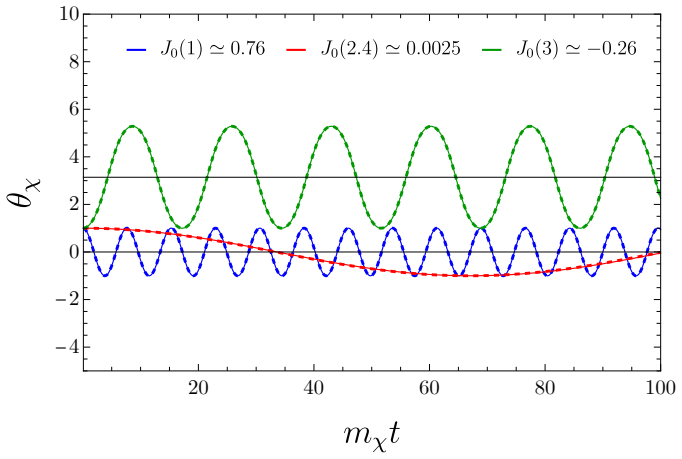
The central discovery is that the effective low-energy potential for a light axion χ, obtained by averaging over the fast oscillations of a heavy axion φ with mixing amplitude A = NΦ/fφ, is Veff(χ̄) = mχ² fχ² J0(A)(1 − cos(χ̄/fχ)). The Bessel function J0(A) controls both the height and the sign: for A ≳ 2.4, J0(A) < 0 and the stable and unstable field points interchange, so the light axion oscillates around the would-be maximum. When J0(A) crosses zero, the potential temporarily vanishes and the field can drift freely before the potential reappears. In an expanding universe the heavy axion's amplitude redshifts, so the sign flips multiple times if the mixing parameter N is large, and the fin
What carries the argument
The key object is the Bessel function J0(A) that emerges from time-averaging the cosine of a cosine, J0(A) = (mφ/2π)∫ dt cos[A cos(mφ t + α)]. It multiplies the entire effective potential, so its zeros at A ≈ 2.4, 5.5, 8.7, … turn the potential off entirely and its negative intervals flip the sign. The mass hierarchy Rm = mχ/mφ ≲ 0.01 makes the averaging valid, and the condition that the heavy-axion backreaction be negligible keeps the heavy field an external oscillator.
Load-bearing premise
The entire calculation assumes the time average over the heavy axion's oscillation is a valid description of the light axion's motion, which requires the mass ratio Rm to be small (≲0.01) and the light axion to start away from the hilltop; the paper itself shows both conditions can fail.
What would settle it
Simulate the full coupled equations with Rm = 0.4 and any initial phase α; the light axion's trajectory should visibly deviate from the time-averaged prediction (the paper's Fig. 4). For a crisp test of the sign flip itself, set Rm = 0.01, A = 3, and start θχ = 1; if the light axion does not settle around θχ = π while the heavy oscillation continues, the Bessel sign flip is wrong.
If this is right
- If J0(A) < 0 at late times, the light axion oscillates around a false vacuum; when J0(A) later becomes positive it must settle toward a true vacuum, delaying the onset of oscillations and enhancing the cold-axion abundance.
- For large initial A, the abundance is enhanced by a factor (Ain/2.4)^{2/3} with a prefactor θosc² that can be as large as π², giving a total two-to-three order-of-magnitude enhancement over standard misalignment (Fig. 9).
- The time-averaged description fails for Rm = O(0.1) and for hilltop initial conditions; in the latter case residual fast oscillations can carry the field across potential barriers (Fig. 5), which the effective potential alone would forbid.
- The QCD axion can benefit: the Kapitza-induced false minimum is CP-conserving, so the trapped-misalignment-like delay occurs without the 10^{-3} fine-tuning of an explicit CP-violating term.
- Perturbations of the light axion can grow via tachyonic instability with rate µk ∼ 2 sqrt[mχ² |J0(A)| cos θχ − k²] when Rm ≳ k/(sqrt(|J0|) mφ), potentially seeding structure or isocurvature.
Where Pith is reading between the lines
- Nested hierarchies: in a clockwork chain of many axions, each heavier level would imprint its own J0 factor on the next, so a long ladder could produce repeated sign flips and quasi-free drifting epochs; the paper notes the idea but doesn't work it out.
- The near-hilltop failure mode (Fig. 5) implies that the final vacuum number n is not determined by the averaged potential alone when initial conditions are close to a maximum; this introduces a phase-dependent, effectively stochastic element that could be a new source of axion isocurvature.
- The mechanism is not exclusive to axions: any scalar with a mixing potential that is periodic in the heavy field, plus a mass hierarchy, should exhibit the same Bessel sign flip; this could be tested in condensed-matter systems with Floquet drives or in lattice simulations of two coupled scalars.
- Since the heavy axion must dominate the energy density while the Kapitza effect acts (condition (41)), the model generically predicts a two-component dark matter sector; observations of the light axion's abundance alone would underestimate the total dark matter.
Editorial analysis
A structured set of objections, weighed in public.
Referee Report
Summary. The paper considers a two-axion system with a large mass hierarchy and a periodic mixing potential. It shows that, after time-averaging over the rapid coherent oscillations of the heavy axion φ, the light axion χ experiences an effective potential Veff = mχ² fχ² J0(A) (1 − cos(χ/fχ)), where A = NΦ/fφ is the dimensionless heavy-axion amplitude. Since J0(A) can be negative, the sign of the light-axion potential flips, exchanging stable and unstable points; for A ≳ 2.4 the origin becomes unstable. The authors verify this Kapitza-type effect against the original equation of motion and identify the regimes where the effective description fails (insufficient mass hierarchy, hilltop initial conditions). They then analyze perturbation growth via parametric and tachyonic instabilities, and apply the sign-flip mechanism to axion dark matter. A late-time sign flip, caused by the redshift decay of A, is claimed to enhance the light-axion abundance by two to three orders of magnitude, with numerical support in Fig. 9.
Significance. If correct, this is a novel and elegant mechanism in multi-axion dynamics. The central derivation is simple and parameter-free, and the paper provides direct numerical verification of the original equations of motion (Figs. 2 and 3), not just the averaged equations. The explicit mapping of the breakdown of the effective description (Sec. II.D) is a particular strength and shows the authors' careful treatment of the approximation's limits. The perturbation analysis adds value, and the proposed cosmological application is plausible, though the quantitative abundance estimate is heuristic. The paper is likely to be of broad interest to the axion and dark-matter communities.
major comments (2)
- [Sec. IV.A, Eq. (40)] The paper's main cosmological payoff is the claimed two-to-three order enhancement of the light-axion abundance. This quantitative claim relies on the heuristic θosc≃π for Ain>2.4, introduced without derivation. The numerical results in Fig. 9 show sharp spikes where the enhancement is much larger and also regions where it is smaller, indicating a strong dependence on Ain and on whether the field lands near a hilltop. To support the claim that the enhancement is generic, the authors should either justify θosc more systematically or scan over initial field values and the phase α. As written, the quantitative enhancement is an order-of-magnitude estimate rather than a robust prediction.
- [Sec. IV.A] The abundance calculation assumes a radiation-dominated universe with H=1/(2t) and a(t)∝t^{1/2}. However, the backreaction discussion leading to Eq. (42) shows that the heavy axion energy density can exceed that of the light axion by a large factor for Ain≫1; it does not ensure ρφ is subdominant to radiation at the times of interest. If ρφ dominates, the expansion history and the amplitude-redshift law A∝a^{-3/2} used in Eq. (31) would be modified, affecting the estimate of tosc and the abundance (40). The paper should either impose the additional constraint ρφ(t)<ρrad(t) for the benchmark parameters or state clearly the regime where the radiation-dominated approximation is valid.
minor comments (4)
- [Sec. IV.A/Fig. 9] Please state explicitly whether the numerical results in Fig. 9 are obtained by solving the original time-dependent equation (with the full oscillating source and Hubble expansion) or the time-averaged effective equation. This is important because the validity of the effective description across multiple sign flips is a key concern for large Ain.
- [Sec. IV.A, Eqs. (34)-(35)] The definition of tosc is ambiguous. Equation (34) uses A(tosc)≈2.4, the zero of J0, while the text says A(tosc) is smaller than the first zero and the onset is set by 3H=meff. Clarify that tosc is approximately the last sign-flip time in the limit meff≪mχ, or revise the formulas to distinguish the flip time from the oscillation-onset time.
- [Eq. (42)] The typography of Eq. (42) is difficult to follow; the placement of the denominator factors (Ain/2.4)^(-4/3) is not immediately clear. Please rewrite with explicit fractions for readability.
- [Sec. III.A] The parametric-resonance result in Fig. 6 is obtained for Rm∼O(0.1), which is outside the regime where the time-averaged description is used for the abundance calculation. It would help to state explicitly that this channel is subdominant in the benchmark regime and is included for completeness.
Circularity Check
No significant circularity: the Kapitza-type effective potential is a parameter-free time average, verified against the original equations of motion, and the cosmological abundance is computed from given inputs rather than fitted.
full rationale
The paper's central claim is the derivation of Veff from Eq. (2): substituting the heavy-axion solution ϕ=Φ cos(mϕt+α) into Vmix and averaging over one fast period gives Veff=mχ² fχ² J0(A)(1−cos(χ̄/fχ)) (Eqs. (11)–(14)). This is a mathematical identity, not a definition of χ̄ in terms of Veff, and the coefficient J0(A) is obtained by known integrals, not by fitting. The paper then validates the time-averaged description against numerical solutions of the original nonlinear equation (9) (Fig. 2) and explicitly identifies where it fails: insufficient mass hierarchy (Sec. II.D.1, Rm=0.4) and hilltop initial conditions (Sec. II.D.2, |θχ(0)|≪1). These are disclosed limitations rather than concealed circularity. The cosmological abundance (Eqs. (39)–(40)) is computed from the specified input parameters (mχ, fχ, Ain) using both an analytic estimate with an explicit ansatz θ_osc∼π and numerical integration of the original equations; the analytic estimate is labeled rough ('a crude estimate') and is compared to, not used to fit, the red dots in Fig. 9. No parameter is fitted to the target abundance, and the enhancement appears as an output. Self-citations appear for auxiliary mechanisms (clockwork, trapped/bubble misalignment) used only to motivate large Ain, but these are not invoked as proof of the sign-flip or as a uniqueness theorem, and they are accompanied by independent references. The paper contains no self-definitional step, no fitted input renamed as prediction, and no load-bearing self-citation chain.
Axiom & Free-Parameter Ledger
free parameters (1)
- θosc (oscillation amplitude of light axion at tosc) =
π (assumed for Ain > 2.4; order 1 for Ain < 2.4)
axioms (6)
- domain assumption The two-axion potential is given by Eqs. (1)-(2) with hierarchical masses mφ ≫ mχ.
- domain assumption The heavy axion φ can be treated as a homogeneous external field with negligible backreaction from χ, Eq. (4).
- domain assumption The time-averaging procedure replacing cos[A cos(mφt) + ...] with J0(A) is valid, i.e., the dynamics of χ are slow compared to φ oscillations.
- domain assumption In the expanding universe, the heavy axion amplitude decays as a^(-3/2) in a quadratic potential, Eq. (31).
- domain assumption The clockwork mechanism or trapped/bubble misalignment can provide N ≫ 1 or delayed onset, respectively, to make Ain large.
- standard math Standard Bessel-function integral identities and Floquet theory for parametric resonance.
Cite this review
Pith. "Pith review of Sign-Flipping Axion Potentials via Kapitza-Type Modulation by Heavy Axions." pith.science (2026). https://pith.science/paper/VFFPU3LM
@misc{pith2026250911032,
  author       = {Pith},
  title        = {Pith review of: Sign-Flipping Axion Potentials via Kapitza-Type Modulation by Heavy Axions},
  year         = {2026},
  howpublished = {\url{https://pith.science/paper/VFFPU3LM}},
  note         = {Machine review of arXiv:2509.11032}
}
read the original abstract
We show that the potential of a light axion can flip sign, or even nearly vanish, as a result of coherent oscillations of a heavier axion with which it mixes. This phenomenon is analogous to the Kapitza pendulum, where a high-frequency external force stabilizes an otherwise unstable configuration, but here it arises naturally from the inherent mass hierarchy and mixing among axions in the axiverse, without the need for any externally imposed modulation. We further show that a late-time sign flip of the potential can significantly enhance the abundance of the light axion, which has important cosmological and observational consequences.
Figures



Forward citations
Cited by 1 Pith paper
-
Stochastic Axion Mixing: A General Mechanism Beyond Decay Constant Constraints
Stochastic axion mixing is a broad mechanism for axion interactions in multi-axion systems that occurs naturally under distinct mass conditions and does not depend on decay constant hierarchies.
Reference graph
Works this paper leans on
-
[1]
Insufficient Mass Hierarchy First, we consider the case in which the mass hierarchy is insufficient. Fig. 4 shows the time evolution ofθ χ forR m = 0.4. In this case, the mass hierarchy between the two axions is not large enough, so the oscillation ofϕsignificantly affects the evolution of¯χ, and the use of the time-averaged equation is no longer valid. A...
-
[2]
In this case,¯χinitially evolves slowly with a tiny amplitude, similar to slow-roll behavior
Hilltop Initial Conditions Next, we consider a situation in which¯χis initially located near the hilltop of the effective potential, e.g.,|¯χ(0)| ≪fχ whenJ 0(A)<0. In this case,¯χinitially evolves slowly with a tiny amplitude, similar to slow-roll behavior. Whenθχ is sufficiently small,θχ ≪1, Eq. (9) can be approximated as ¨¯χ+R2 mm2 ϕfχ [sin (Acos (mϕt+α...
-
[3]
R. D. Peccei and H. R. Quinn, Phys. Rev. Lett.38, 1440 (1977)
1977
-
[4]
R. D. Peccei and H. R. Quinn, Phys. Rev. D16, 1791 (1977)
1977
-
[5]
Weinberg, Phys
S. Weinberg, Phys. Rev. Lett.40, 223 (1978)
1978
-
[6]
Wilczek, Phys
F. Wilczek, Phys. Rev. Lett.40, 279 (1978)
1978
-
[7]
J. E. Kim and G. Carosi, Rev. Mod. Phys.82, 557 (2010), [Erratum: Rev.Mod.Phys. 91, 049902 (2019)], arXiv:0807.3125 [hep-ph]. 25
Pith/arXiv arXiv 2010
-
[8]
P. Arias, D. Cadamuro, M. Goodsell, J. Jaeckel, J. Redondo, and A. Ringwald, JCAP06, 013 (2012), arXiv:1201.5902 [hep-ph]
Pith/arXiv arXiv 2012
-
[9]
D. J. E. Marsh, Phys. Rept.643, 1 (2016), arXiv:1510.07633 [astro-ph.CO]
Pith/arXiv arXiv 2016
-
[10]
L. Di Luzio, M. Giannotti, E. Nardi, and L. Visinelli, Phys. Rept.870, 1 (2020), arXiv:2003.01100 [hep-ph]
Pith/arXiv arXiv 2020
-
[11]
C. A. J. O’Hare, PoSCOSMICWISPers, 040 (2024), arXiv:2403.17697 [hep-ph]
Pith/arXiv arXiv 2024
-
[12]
A. Arvanitaki, S. Dimopoulos, S. Dubovsky, N. Kaloper, and J. March-Russell, Phys. Rev. D 81, 123530 (2010), arXiv:0905.4720 [hep-th]
Pith/arXiv arXiv 2010
-
[13]
T. Higaki and F. Takahashi, JHEP07, 074 (2014), arXiv:1404.6923 [hep-th]
Pith/arXiv arXiv 2014
-
[14]
T.Higaki, K.S.Jeong, N.Kitajima, andF.Takahashi,JHEP06,150(2016),arXiv:1603.02090 [hep-ph]
Pith/arXiv arXiv 2016
-
[15]
M. Farina, D. Pappadopulo, F. Rompineve, and A. Tesi, JHEP01, 095 (2017), arXiv:1611.09855 [hep-ph]
Pith/arXiv arXiv 2017
-
[16]
C. T. Hill and G. G. Ross, Nucl. Phys. B311, 253 (1988)
1988
-
[17]
N. Kitajima and F. Takahashi, JCAP01, 032 (2015), arXiv:1411.2011 [hep-ph]
Pith/arXiv arXiv 2015
-
[18]
R. Daido, N. Kitajima, and F. Takahashi, Phys. Rev. D92, 063512 (2015), arXiv:1505.07670 [hep-ph]
Pith/arXiv arXiv 2015
-
[19]
R. Daido, N. Kitajima, and F. Takahashi, Phys. Rev. D93, 075027 (2016), arXiv:1510.06675 [hep-ph]
Pith/arXiv arXiv 2016
-
[20]
S.-Y. Ho, K. Saikawa, and F. Takahashi, JCAP10, 042 (2018), arXiv:1806.09551 [hep-ph]
Pith/arXiv arXiv 2018
-
[21]
K. Murai, F. Takahashi, and W. Yin, Phys. Rev. D108, 036020 (2023), arXiv:2305.18677 [hep-ph]
Pith/arXiv arXiv 2023
-
[22]
D. Cyncynates and J. O. Thompson, Phys. Rev. D108, L091703 (2023), arXiv:2306.04678 [hep-ph]
Pith/arXiv arXiv 2023
-
[23]
Li, JCAP09, 025 (2024), arXiv:2307.09245 [hep-ph]
H.-J. Li, JCAP09, 025 (2024), arXiv:2307.09245 [hep-ph]
Pith/arXiv arXiv 2024
-
[24]
H.-J. Li, Y.-Q. Peng, W. Chao, and Y.-F. Zhou, Phys. Lett. B849, 138444 (2024), arXiv:2310.02126 [hep-ph]
Pith/arXiv arXiv 2024
- [25]
- [26]
-
[27]
K. Murai, Y. Narita, F. Takahashi, and W. Yin, JHEP04, 124 (2025), arXiv:2412.10232 [hep-ph]. 26
Pith/arXiv arXiv 2025
-
[28]
D. I. Dunsky, C. A. Manzari, P. Quílez, M. Ramos, and P. Sørensen, (2025), arXiv:2507.06287 [hep-ph]
Pith/arXiv arXiv 2025
-
[29]
K. Choi, H. Kim, and S. Yun, Phys. Rev. D90, 023545 (2014), arXiv:1404.6209 [hep-th]
Pith/arXiv arXiv 2014
-
[30]
K. Nakayama, F. Takahashi, and T. T. Yanagida, JHEP09, 014 (2014), arXiv:1406.4265 [hep-ph]
Pith/arXiv arXiv 2014
-
[31]
R. Daido, F. Takahashi, and W. Yin, JCAP05, 044 (2017), arXiv:1702.03284 [hep-ph]
Pith/arXiv arXiv 2017
-
[32]
F. Takahashi and W. Yin, JHEP10, 120 (2019), arXiv:1908.06071 [hep-ph]
Pith/arXiv arXiv 2019
-
[33]
T. Kobayashi and L. Ubaldi, JHEP08, 147 (2019), arXiv:1907.00984 [hep-ph]
Pith/arXiv arXiv 2019
-
[34]
T. Kobayashi and L. Ubaldi, JHEP09, 052 (2020), arXiv:2006.09389 [hep-ph]
Pith/arXiv arXiv 2020
-
[35]
Y. Narita, F. Takahashi, and W. Yin, JCAP12, 039 (2023), arXiv:2308.12154 [hep-ph]
Pith/arXiv arXiv 2023
-
[36]
D. Cyncynates, T. Giurgica-Tiron, O. Simon, and J. O. Thompson, Phys. Rev. D105, 055005 (2022), arXiv:2109.09755 [hep-ph]
Pith/arXiv arXiv 2022
-
[37]
T. Higaki, N. Kitajima, and F. Takahashi, JCAP12, 004 (2014), arXiv:1408.3936 [hep-ph]
Pith/arXiv arXiv 2014
-
[38]
T. Higaki, K. S. Jeong, N. Kitajima, T. Sekiguchi, and F. Takahashi, JHEP08, 044 (2016), arXiv:1606.05552 [hep-ph]
Pith/arXiv arXiv 2016
-
[39]
A. J. Long, JHEP07, 066 (2018), arXiv:1803.07086 [hep-ph]
Pith/arXiv arXiv 2018
-
[40]
M. Eto, T. Hiramatsu, I. Saito, and Y. Sakakihara, Phys. Rev. D108, 116004 (2023), arXiv:2309.04248 [hep-th]
Pith/arXiv arXiv 2023
-
[41]
J. Lee, K. Murai, F. Takahashi, and W. Yin, JCAP10, 038 (2024), arXiv:2407.09478 [hep-ph]
Pith/arXiv arXiv 2024
-
[42]
J. Lee, K. Murai, F. Takahashi, and W. Yin, JCAP04, 002 (2025), arXiv:2409.09749 [hep-ph]
Pith/arXiv arXiv 2025
-
[43]
J. Lee, K. Murai, F. Takahashi, and W. Yin, (2025), arXiv:2507.07075 [hep-ph]
arXiv 2025
- [44]
-
[45]
T. Kobayashi, R. Kurematsu, and F. Takahashi, JCAP09, 032 (2013), arXiv:1304.0922 [hep- ph]
Pith/arXiv arXiv 2013
-
[46]
I. L. Bogolyubsky and V. G. Makhankov, Pisma Zh. Eksp. Teor. Fiz.24, 15 (1976)
1976
- [47]
- [48]
-
[49]
S. Nakagawa, F. Takahashi, and M. Yamada, JCAP05, 062 (2021), arXiv:2012.13592 [hep-ph]
Pith/arXiv arXiv 2021
-
[50]
L. Di Luzio, B. Gavela, P. Quilez, and A. Ringwald, JCAP10, 001 (2021), arXiv:2102.01082 [hep-ph]. 27
Pith/arXiv arXiv 2021
-
[51]
K. S. Jeong, K. Matsukawa, S. Nakagawa, and F. Takahashi, JCAP03, 026 (2022), arXiv:2201.00681 [hep-ph]
Pith/arXiv arXiv 2022
-
[52]
L. Di Luzio and P. Sørensen, JHEP10, 239 (2024), arXiv:2408.04623 [hep-ph]
Pith/arXiv arXiv 2024
-
[53]
S. Nakagawa, F. Takahashi, M. Yamada, and W. Yin, Phys. Lett. B839, 137824 (2023), arXiv:2210.10022 [hep-ph]
Pith/arXiv arXiv 2023
-
[54]
J. Lee, K. Murai, F. Takahashi, and W. Yin, JCAP05, 122 (2024), arXiv:2402.09501 [hep-ph]
Pith/arXiv arXiv 2024
-
[55]
A. Hook and J. Huang, JHEP06, 036 (2018), arXiv:1708.08464 [hep-ph]
Pith/arXiv arXiv 2018
-
[56]
R. Balkin, J. Serra, K. Springmann, and A. Weiler, JHEP07, 221 (2020), arXiv:2003.04903 [hep-ph]
Pith/arXiv arXiv 2020
-
[57]
R. Balkin, J. Serra, K. Springmann, S. Stelzl, and A. Weiler, JHEP02, 141 (2025), arXiv:2307.14418 [hep-ph]
Pith/arXiv arXiv 2025
-
[58]
M. Kumamoto, J. Huang, C. Drischler, M. Baryakhtar, and S. Reddy, (2024), arXiv:2410.21590 [hep-ph]
Pith/arXiv arXiv 2024
-
[59]
R. T. Co, E. Gonzalez, and K. Harigaya, JHEP05, 163 (2019), arXiv:1812.11192 [hep-ph]
Pith/arXiv arXiv 2019
-
[60]
F. Takahashi and W. Yin, JHEP07, 095 (2019), arXiv:1903.00462 [hep-ph]
Pith/arXiv arXiv 2019
-
[61]
S. Nakagawa, F. Takahashi, and W. Yin, JCAP05, 004 (2020), arXiv:2002.12195 [hep-ph]
Pith/arXiv arXiv 2020
-
[62]
J. Huang, A. Madden, D. Racco, and M. Reig, JHEP10, 143 (2020), arXiv:2006.07379 [hep- ph]
Pith/arXiv arXiv 2020
-
[63]
D. Gonzalez, N. Kitajima, F. Takahashi, and W. Yin, Phys. Lett. B843, 137990 (2023), arXiv:2211.06849 [hep-ph]
Pith/arXiv arXiv 2023
-
[64]
R. T. Co, T. Gherghetta, Z. Liu, and K.-F. Lyu, JHEP09, 145 (2024), arXiv:2407.12930 [hep-ph]
Pith/arXiv arXiv 2024
-
[65]
J. Khoury, M.-X. Lin, and M. Trodden, (2025), arXiv:2503.16415 [astro-ph.CO]
arXiv 2025
-
[66]
P. L. Kapitza, Soviet Physics JETP21, 588 (1951), english translation of Zh. Eksp. Teor. Fiz. 21, 588 (1951)
1951
-
[67]
Stephenson, The London, Edinburgh, and Dublin Philosophical Magazine and Journal of Science 6,15, 233 (1908)
A. Stephenson, The London, Edinburgh, and Dublin Philosophical Magazine and Journal of Science 6,15, 233 (1908)
1908
-
[68]
M. Bukov, L. D’Alessio, and A. Polkovnikov, Advances in Physics64, 139 (2015), arXiv:1407.4803
Pith/arXiv arXiv 2015
-
[69]
K. Choi and S. H. Im, JHEP01, 149 (2016), arXiv:1511.00132 [hep-ph]
Pith/arXiv arXiv 2016
-
[70]
D. E. Kaplan and R. Rattazzi, Phys. Rev. D93, 085007 (2016), arXiv:1511.01827 [hep-ph]. 28
Pith/arXiv arXiv 2016
-
[71]
T. Higaki, K. S. Jeong, N. Kitajima, and F. Takahashi, Phys. Lett. B755, 13 (2016), arXiv:1512.05295 [hep-ph]
Pith/arXiv arXiv 2016
-
[72]
K. S. Jeong, K. Matsukawa, S. Nakagawa, and F. Takahashi, Journal of Cosmology and Astroparticle Physics2022, 026 (2022)
2022
-
[73]
A. G. Cohen and D. B. Kaplan, Phys. Lett. B199, 251 (1987)
1987
-
[74]
A. G. Cohen and D. B. Kaplan, Nucl. Phys. B308, 913 (1988)
1988
-
[75]
M. Dine, P. Huet, R. L. Singleton, Jr, and L. Susskind, Phys. Lett. B257, 351 (1991)
1991
-
[76]
A. G. Cohen, D. B. Kaplan, and A. E. Nelson, Phys. Lett. B263, 86 (1991)
1991
-
[77]
A. Dolgov and K. Freese, Phys. Rev. D51, 2693 (1995), arXiv:hep-ph/9410346
Pith/arXiv arXiv 1995
-
[78]
A. Dolgov, K. Freese, R. Rangarajan, and M. Srednicki, Phys. Rev. D56, 6155 (1997), arXiv:hep-ph/9610405
Pith/arXiv arXiv 1997
-
[79]
T. Chiba, F. Takahashi, and M. Yamaguchi, Phys. Rev. Lett.92, 011301 (2004), [Erratum: Phys.Rev.Lett. 114, 209901 (2015)], arXiv:hep-ph/0304102
Pith/arXiv arXiv 2004
-
[80]
F. Takahashi and M. Yamaguchi, Phys. Rev. D69, 083506 (2004), arXiv:hep-ph/0308173
Pith/arXiv arXiv 2004
discussion (0)
Sign in with ORCID, Apple, or X to comment. Anyone can read and Pith papers without signing in.