REVIEW 3 major objections 4 minor 11 references
Estimating Machine Translation Difficulty
T0 review · 3 major / 4 minor · reviewed 2026-08-05 · deepseek-v4-flash
Pith's one-line read The paper claims that a source-only quality model, Sentinel-src-24, is the best practical estimator of machine translation difficulty, beating heuristics, LLM judges, and costly artificial crowds.
desk verdict Solid empirical study of MT difficulty estimation, but the headline SOTA estimator ignores the model- and language-relative task the paper itself defines. read the letter →
The pith
A machine-rendered reading of the paper's core claim, the machinery that carries it, and where it could break.
The reading
What carries the argument
The mechanism that carries the argument is the definition of difficulty as expected translation quality, $d_{m,l}(x)$, paired with a Group-by-System evaluation scheme. DEC holds the translating system fixed while averaging Kendall's $\tau_b$ across models and languages, so features of the source itself—length, lexical rarity, syntactic complexity—count as genuine signals of difficulty rather than confounds to remove. The practical engine is Sentinel-src, a regression model built on XLM-RoBERTa that receives only the source sentence and is trained, in two stages, on human Direct Assessment and MQM/ESA quality scores; retraining it on expanded data through WMT23 or WMT24 yields the released Se
What would settle it
A decisive test is to build a language-conditioned variant of Sentinel-src-24 (input: source text plus target language, trained on the same data) and compare DEC with the source-only model on WMT24 language pairs known to be asymmetric, such as English-to-Chinese versus English-to-German. If the conditioned variant improves DEC, the released source-only estimator is not solving the formalized task. A second check: compute DEC for each MT model separately, as the paper begins to do, and see whether correlations stay positive for non-LLM and low-resource models; if they collapse for some model f
Extended reading notes
Core claim
The paper's central claim is that translation difficulty is not an intrinsic linguistic property but a measurable outcome: a text is difficult to the degree that its translations receive low human quality scores, and this can be predicted before any translation is produced. The task is defined as predicting $d_{m,l}(x)$—the human score for the translation of source $x$ into language $l$ by model or human translator $m$—and estimators are scored by DEC, the average Kendall $\tau_b$ between their predicted rankings and the true difficulty rankings, computed per system and per language and then averaged (Group-by-System). On the WMT24 test sets, the retrained source-only regressor Sentinel-src-
Load-bearing premise
The load-bearing premise is that one source-only difficulty score, identical for every target language and every translation model, is enough to rank how hard a text is for any contemporary machine translation system.
Editorial extensions
If this is right
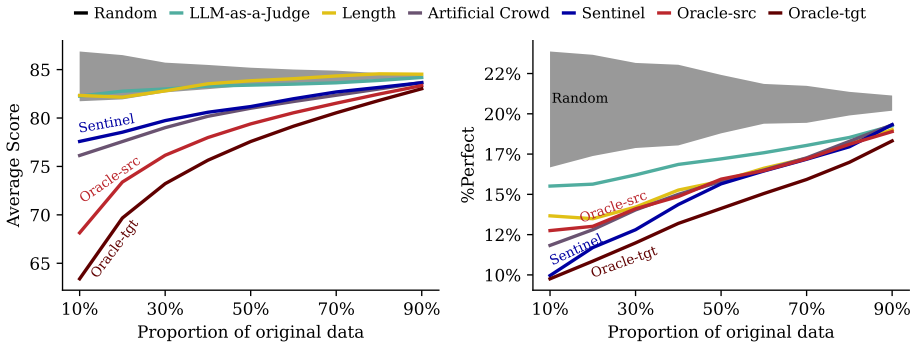
- Choosing the hardest sentences with Sentinel-src-24 turns an already hard test set into a clearly harder one: on the WMT24 ESA data, a 25% hardest subset drops the average human score from 84.4 to 79.1 and the share of perfect translations from 21% to 12%.
- Difficulty scores come from a single pass over source text, making it practical to screen large corpora for challenging segments without running any translation system or LLM judge.
- Text length is a surprisingly strong baseline—better than both LLM judges—but still well below the learned estimator, so the improvement is not just 'longer means harder'.
- Artificial Crowd is the only method that comes close to Sentinel-src-24, but it requires translating every text with four large models and scoring outputs with an XXL metric; the learned estimator delivers similar benchmark difficulty at far lower cost.
- Difficulty rankings differ between human translators and MT models, so MT-difficulty-based selection should not be used as a proxy for human translation difficulty without further validation.
Reading between the lines
- The paper's own definition is model- and language-relative, but its best estimator returns one score per source text regardless of target language or model. This suggests a testable extension: condition Sentinel-src on the target language or on a model-family descriptor; if DEC rises on asymmetric language pairs, the current estimator is solving a coarser task than the formalism.
- All estimators, including Sentinel-src-24, are strongly length-correlated (Pearson around $-0.66$; the length heuristic is $-1.00$ by construction). A length-controlled difficulty estimator would reveal how much signal remains after accounting for the most obvious proxy, and would guard against benchmarks that are hard mainly because they are long.
- The near-parity of Sentinel-src-24 and Artificial Crowd (0.182 vs 0.177 under ESA) hints at a ceiling for source-only prediction: actually translating a text with a strong system and scoring the output captures difficulty that pure source features miss. A cheap check would use a single capable translation engine plus one reference-less metric instead of the full four-model crowd.
- Because human translators and MT models rank text difficulty differently, MT-focused difficulty estimators may misallocate effort if used in human translation training, test design, or human-in-the-loop systems; pairing these scores with human translation effort data would quantify that divergence.
Editorial analysis
A structured set of objections, weighed in public.
Referee Report
Summary. The paper introduces the task of machine translation difficulty estimation, formalizing the difficulty of a source text x as the quality score d_{m,l}(x) of the translation produced by model m into target language l. It proposes Difficulty Estimation Correlation (DEC), a Group-by-System Kendall-tau metric that averages correlations over models and languages, and evaluates a broad set of estimators on the WMT24 General MT and Metrics test sets: heuristics (length, rarity, syntactic complexity), learned source-only regressors (PreCOMET variants, Sentinel-src and retrained Sentinel-src-24), LLM-as-a-Judge (GPT-4o, Command A), and artificial/true crowd methods based on XCOMET and MetricX. The authors report that Sentinel-src-24 achieves the highest DEC among non-oracle estimators, and they demonstrate its utility for selecting difficult subsets in a simulated benchmark-construction setting. They release Sentinel-src-24 and Sentinel-src-25, with the latter trained additionally on WMT24 data and used only in a qualitative analysis.
Significance. If the central claims hold, this is a useful step toward building more discriminative MT benchmarks and identifying headroom for MT systems. The evaluation is held-out with respect to Sentinel-src-24's training data, uses public WMT24 data across many language directions and multiple translators, and includes significance clustering. The authors release models and code, and they provide a thoughtful analysis of potential pitfalls of difficulty-based subsampling, including length bias, output diversity, and model-specific bias. The new DEC metric and the comparison across heuristic, learned, LLM-judge, and crowd-based families are valuable for future work on difficulty estimation. The main caveat is that the paper's formal task is model- and language-conditional, while the top estimator is a single source-only regressor; the significance of the results is therefore narrower than the formalization suggests.
major comments (3)
- [Section 3, Eq. (1), Section 5.2 footnote 5, Table 1] The task is formally defined as predicting d_{m,l}(x), the quality score of model m's translation into l (Section 3). However, Sentinel-src-24, the reported state-of-the-art estimator, is source-only: footnote 5 states that its predictions are identical for all m and l. DEC then averages Kendall tau over all (m,l) pairs, effectively measuring how well a single source-based ranking approximates the average of many heterogeneous model- and language-specific rankings. The heterogeneity is substantial: Oracle(source+target language) reaches 0.301 on ESA versus 0.224 for Oracle(source-only), and Table 2 shows cross-model Kendall tau values of only 0.151-0.221. Thus the SOTA claim in Section 5.3 holds only for an implicitly averaged, model-independent notion of difficulty, not for the task defined in Section 3. The Limitations section acknowledges the target-language issue but does not reconci
- [Section 5.1 footnote 4; Section 7; Abstract] Sentinel-src-25 is trained on WMT24 data, is explicitly excluded from the Table 1 results, and receives no quantitative evaluation anywhere in the paper. The abstract says the authors 'release two improved models,' and Section 7 describes Sentinel-src-25 as developed by 'incorporating additional data into the training pipeline of Sentinel-src-24.' Without a held-out evaluation of Sentinel-src-25 (e.g., on a different test set or via a dedicated comparison), the claim that it is an improved difficulty estimator is unsupported. Please evaluate it on a genuinely held-out set or qualify the claim to state that only Sentinel-src-24 is benchmarked and the 25 model is released without quantitative validation.
- [Section 6.1 and Limitations, 'Using the WMT 2024 test set'] The benchmark-construction utility experiment uses the same WMT24 test set both as the source pool for subset selection and as the source of human quality scores for evaluation. As the Limitations paragraph notes, WMT24 sources were human-vetted, making the distribution artificial; the supplementary crawled-corpus experiment (Appendix Figure 5) only examines source similarity, not translation difficulty or downstream utility. The practical-utility claim in the abstract is therefore demonstrated only for a vetted test-set-like distribution. I recommend either adding an evaluation on independently collected, non-vetted texts with human annotations, or explicitly conditioning the utility claim on such distributions.
minor comments (4)
- [Abstract] The abstract says 'Sentinel-src achieving the best performance,' but the reported best estimator is Sentinel-src-24. Please update for consistency.
- [Table 1] The three oracle rows are all labeled 'Oracle,' with the distinguishing information (source text only, source text + target language, or source + target language + translation) appearing only in Appendix E. The table caption should identify each oracle row explicitly.
- [Table 10] The MQM AvgScore values are negative (e.g., Random -2.5) because MQM scores are negative-scale, but the caption does not explain this. A one-sentence note would prevent confusion.
- [Table 2] The row/column organization of the correlation matrix is somewhat unclear: the column headers (IOL, GPT-4, Claude3.5, Tower70B) do not exactly match the row labels (Human, Tower70B, Claude3.5, GPT-4). Please add a clarifying statement about which entries correspond to human-model versus model-model correlations.
Circularity Check
No significant circularity: Sentinel-src-24 is trained on prior WMT data and evaluated on WMT24; the SOTA claim rests on held-out benchmark results, not on a fitted parameter renamed as a prediction.
full rationale
The paper's derivation chain is self-contained against external benchmarks. Difficulty is defined as human-assessed translation quality (Section 3), and Sentinel-src-24 is trained on WMT21-23 DA/MQM annotations (Appendix B), then evaluated on WMT24 ground-truth ESA/MQM scores via DEC (Eq. 1). Training and evaluation sets are disjoint by year, so the DEC result is not forced by construction. The main reliance on the authors' prior Sentinel-src (Perrella et al., 2024) is as an architectural starting point and baseline; the improved model's superiority is established empirically on WMT24, not by appeal to the prior publication. The Artificial Crowd estimator translates with new models and scores with XCOMET/MetricX, which is a proxy, not a fitted input to the target. The only notable mismatch—the formal task is model/language-specific d_{m,l}(x) while Sentinel-src-24 is source-only (footnote 5)—is a validity/scope issue rather than circularity: the model is not defined in terms of the evaluation labels, and the paper acknowledges the target-language limitation in the Limitations section. No prediction reduces to a fitted value by construction, and no load-bearing argument depends on an unverified self-citation.
Assumptions & free parameters
assumptions (6)
- domain assumption Translation difficulty can be proxied by the quality of translations of that text (lower quality = higher difficulty).
- domain assumption Group-by-System correlation (DEC) is the appropriate evaluation for difficulty estimators.
- standard math Kendall's tau_b is an appropriate ranking correlation for human scores in a narrow quality band.
- domain assumption WMT24 ESA/MQM human scores are a reliable gold standard for translation quality across languages.
- domain assumption Training on previous WMT editions (up to 2023) transfers to WMT24 evaluation data.
- domain assumption A single source-only difficulty score, identical across target languages and models, can serve the model-relative task d_{m,l}(x).
Cite this review
Pith. "Pith review of Estimating Machine Translation Difficulty." pith.science (2026). https://pith.science/paper/VFVTAAOW
@misc{pith2026250810175,
  author       = {Pith},
  title        = {Pith review of: Estimating Machine Translation Difficulty},
  year         = {2026},
  howpublished = {\url{https://pith.science/paper/VFVTAAOW}},
  note         = {Machine review of arXiv:2508.10175}
}
read the original abstract
Machine translation quality has steadily improved over the years, achieving near-perfect translations in recent benchmarks. These high-quality outputs make it difficult to distinguish between state-of-the-art models and to identify areas for future improvement. In this context, automatically identifying texts where machine translation systems struggle holds promise for developing more discriminative evaluations and guiding future research. In this work, we address this gap by formalizing the task of translation difficulty estimation, defining a text's difficulty based on the expected quality of its translations. We introduce a new metric to evaluate difficulty estimators and use it to assess both baselines and novel approaches. Finally, we demonstrate the practical utility of difficulty estimators by using them to construct more challenging benchmarks for machine translation. Our results show that dedicated models outperform both heuristic-based methods and LLM-as-a-judge approaches, with Sentinel-src achieving the best performance. Thus, we release two improved models for difficulty estimation, Sentinel-src-24 and Sentinel-src-25, which can be used to scan large collections of texts and select those most likely to challenge contemporary machine translation systems.
Figures


Figures from the paper (4 more)


Reference graph
Works this paper leans on
-
[3]
In Proceedings of the Eighth Conference on Machine Translation , pages 756–767
MetricX-23: The Google submission to the WMT 2023 metrics shared task. In Proceedings of the Eighth Conference on Machine Translation , pages 756–767. Association for Computational Lin- guistics. Tom Kocmi, Eleftherios Avramidis, Rachel Bawden, Ondˇrej Bojar, Anton Dvorkovich, Christian Feder- mann, Mark Fishel, Markus Freitag, Thamme Gowda, Roman Grundki...
work page 2023
-
[6]
MixEval-X: Any-to-Any Evaluations from Real-World Data Mixtures
Tangled up in BLEU: Reevaluating the eval- uation of automatic machine translation evaluation metrics. In Proceedings of the 58th Annual Meet- ing of the Association for Computational Linguistics, pages 4984–4997. Association for Computational Linguistics. Abhijit Mishra, Pushpak Bhattacharyya, and Michael Carl. 2013. Automatically predicting sentence tra...
work page Pith review arXiv 2013
-
[7]
Association for Computational Linguistics
Guardians of the machine translation meta- evaluation: Sentinel metrics fall in! In Proceedings of the 62nd Annual Meeting of the Association for Computational Linguistics (Volume 1: Long Papers), pages 16216–16244. Association for Computational Linguistics. Emmanouil Antonios Platanios, Otilia Stretcu, Graham Neubig, Barnabas Poczos, and Tom Mitchell. 20...
work page 2019
-
[9]
Finding replicable human evaluations via sta- ble ranking probability. In Proceedings of the 2024 Conference of the North American Chapter of the Association for Computational Linguistics: Human Language Technologies (Volume 1: Long Papers) , pages 4908–4919. Association for Computational Linguistics. Pedro Rodriguez, Joe Barrow, Alexander Miserlis Hoyle,...
work page 2024
-
[10]
The right tool for the job: Matching model and instance complexities. In Proceedings of the 58th Annual Meeting of the Association for Computational Linguistics , pages 6640–6651. Association for Computational Linguistics. Petru Soviany, Radu Tudor Ionescu, Paolo Rota, and Nicu Sebe. 2022. Curriculum learning: A survey. Int. J. Comput. Vision, 130(6):1526...
work page 2022
-
[2014]
Multidimensional quality metrics (MQM): A framework for declaring and describing translation quality metrics. Tradumàtica, 0(12):0455–463. Felipe Maia Polo, Lucas Weber, Leshem Choshen, Yuekai Sun, Gongjun Xu, and Mikhail Yurochkin
-
[2019]
Correlating process and product data to get an insight into translation difficulty. Perspectives. Xin Wang, Yudong Chen, and Wenwu Zhu. 2022. A survey on curriculum learning. IEEE Transac- tions on Pattern Analysis and Machine Intelligence, 44(9):4555–4576. Guillaume Wenzek, Vishrav Chaudhary, Angela Fan, Sahir Gomez, Naman Goyal, Somya Jain, Douwe Kiela,...
arXiv 2022
-
[2020]
It’s easier to translate out of English than into it: Measuring neural translation difficulty by cross- mutual information. In Proceedings of the 58th An- nual Meeting of the Association for Computational Linguistics, pages 1640–1649. Association for Com- putational Linguistics. Cohere Team. 2025. Command a: An enterprise-ready large language model. Prepr...
arXiv 2025
Show all 11 references
-
[2023]
In Pro- ceedings of the 2023 Conference on Empirical Meth- ods in Natural Language Processing, pages 12914– 12929
Ties matter: Meta-evaluating modern metrics with pairwise accuracy and tie calibration. In Pro- ceedings of the 2023 Conference on Empirical Meth- ods in Natural Language Processing, pages 12914– 12929. Association for Computational Linguistics. Shachar Don-Yehiya, Leshem Chos...
2023 arXiv
-
[2024]
In Proceedings of the 41st International Conference on Machine Learning , volume 235 of Proceedings of Machine Learning Research, pages 34303–34326
tinyBenchmarks: Evaluating LLMs with fewer examples. In Proceedings of the 41st International Conference on Machine Learning , volume 235 of Proceedings of Machine Learning Research, pages 34303–34326. PMLR. Nitika Mathur, Timothy Baldwin, and Trevor Cohn
-
[2025]
In Proceedings of the 63rd Annual Meeting of the Association for Computational Linguistics (Vol- ume 2: Short Papers), pages 790–813
Has machine translation evaluation achieved human parity? the human reference and the limits of progress. In Proceedings of the 63rd Annual Meeting of the Association for Computational Linguistics (Vol- ume 2: Short Papers), pages 790–813. Association for Computational Linguis...
2025 arXiv
Reviewed August 5, 2026 · model on record in the stance chip above.
Discussion (0). Sign in to comment.