REVIEW 3 major objections 5 minor 96 references
Quantum Formulation of Chiral Vortical Effect in Weyl Semi-metals
T0 review · 3 major / 5 minor · reviewed 2026-08-12 · deepseek-v4-flash
Pith's one-line read The chiral vortical effect is a non-equilibrium phenomenon supported on a ground-state-free Floquet spectrum, according to a fully quantum derivation for Weyl semimetals.
desk verdict A real wavefunction-level CVE calculation with a clean semiclassical limit, but the model Hamiltonian only couples rotation to orbital L; the standard rotating frame uses J, which would give no dynamics, so the central non-equilibrium claim is currently unsupported. read the letter →
The pith
A machine-rendered reading of the paper's core claim, the machinery that carries it, and where it could break.
The reading
What carries the argument
The load-bearing object is the rotating Weyl Hamiltonian $H=\bigoplus_\lambda \lambda\hbar v_F\,\mathbf{k}\cdot\boldsymbol{\sigma}-\boldsymbol{\omega}\cdot\mathbf{L}$, with $\boldsymbol{\omega}$ along $z$. It is solvable because $H$, $J_z$, $k_z$, and $k_x^2+k_y^2$ share eigenstates built from cylindrical Bessel functions: the two spinor components are $J_n(k_\perp r)e^{in\phi}$ and $J_{n+1}(k_\perp r)e^{i(n+1)\phi}$ times a plane wave in $z$, and the operators $k_x\pm ik_y$ ladder between neighboring $n$. The integer $n$ does the conceptual work: it labels a fermion's quantized distance from the rotation axis and generates the infinite Floquet fold structure that removes the ground state. The same Bessel basis produces the void states at $k_\perp=0$, where both components vanish except for $n=0,-1$, which is what makes the $k_\perp=0$ sector current-free.
What would settle it
Numerically diagonalize Eq. (1) on a finite cylinder of radius $R$ with a physical boundary and check whether the spectrum remains unbounded below; if a lowest-energy state appears, the central claim that CVE lives on a ground-state-free spectrum fails for finite samples.
Extended reading notes
Core claim
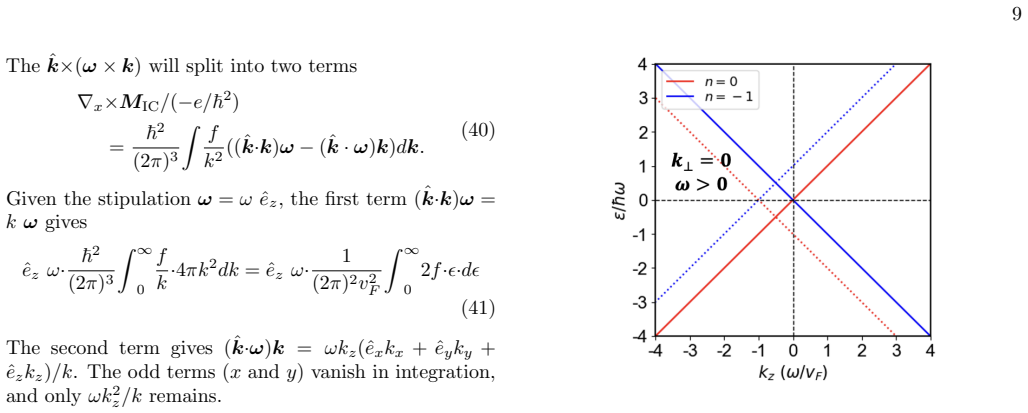
The paper's claim is that rotation enters the Weyl Hamiltonian through orbital angular momentum only, $\hat V=-\boldsymbol{\omega}\cdot\mathbf{L}$, and that the resulting spectrum is an infinite Floquet ladder $\epsilon_{\lambda,s,n}=s\hbar\sqrt{(v_F k_\perp)^2+(\lambda v_F k_z+\omega/2)^2}-(n+\tfrac{1}{2})\hbar\omega$, $n\in\mathbb{Z}$. Because the ladder has no bottom, the distribution $f_{\mathrm{CVE}}$ formed by unitary evolution from an initial state is not a Fermi-Dirac distribution even at $T=0$; it is a non-equilibrium, dynamically attainable distribution over metastable states. In the isotropic high-$\mu$, slow-rotation limit the quantum calculation reproduces the semiclassical formulas $j_{\mathrm{CVE}}=\omega/(2\pi v_F)^2\int 2f\,\epsilon\,d\epsilon$ and $\nabla\times\mathbf{M}=\tfrac{2}{3}\mathbf{j}_{\mathrm{CVE}}$, with the magnetization split into localized and itinerant parts. Beyond that regime the theory predicts deviations: void states at $k_\perp=0$ make that sector carry no current, the $\mu^2$ law fails, and charge pumped per revolution is independent of Fermi velocity.
Load-bearing premise
The entire construction rests on the model $H=\bigoplus_\lambda\lambda\hbar v_F\,\mathbf{k}\cdot\boldsymbol{\sigma}-\boldsymbol{\omega}\cdot\mathbf{L}$, in which rotation acts only on orbital angular momentum with no spin-rotation coupling and no radial boundary; if a finite sample edge regularizes the spectrum or spin also feels rotation, the ground-state-free character and the CVE distribution would change.
Editorial extensions
If this is right
- Under the three simultaneous conditions ($\omega R/v_F\ll 1$, $\mu/(\hbar v_F/R)\gg 1$, isotropy), the known semiclassical CVE coefficients follow from a strictly quantum calculation: the axial current is proportional to $\mu^2$ and $\nabla\times\mathbf{M}$ accounts for exactly $2/3$ of it.
- Outside that regime the current deviates from the semiclassical $\mu^2$ law, most sharply when $\mu/(\hbar v_F/R)\sim 1$, because the $k_\perp=0$ void states do not contribute to $j_z$.
- The CVE distribution is not a Fermi function even at zero temperature; it is a non-equilibrium state built from dynamically reachable metastable bands, so CVE is better classed with unitary evolution than with thermal relaxation.
- Rotating the system by $2\pi$ pumps charge $\Delta Q=A(9\pi \tilde n^2/16)^{1/3}$ per Weyl node, a quantity independent of $v_F$; flatter bands therefore do not suppress this pumping the way they suppress electric-field transport.
- A rotation that couples to total angular momentum ($-\omega J_z$) produces no bulk current, so the physically active rotation is the relative motion between orbital and spin degrees of freedom.
Reading between the lines
- A finite cylinder with a physical boundary could regularize the unbounded spectrum; if it does, the ground-state-free character of the CVE would be an idealization of the infinite-plane model rather than a property of real samples.
- The paper's symmetry argument suggests directly testing CVE without mechanical rotation by rotating the spin sector, which would create the same axial current; this is a concrete route the paper sketches but does not develop.
- Because anisotropic initial states produce time-dependent distributions, the CVE response coefficient should depend on how the rotating state is prepared; a measurement of $j_z$ under different preparation protocols would distinguish this quantum prediction from the semiclassical one.
- If the $v_F$-independent per-revolution pumping is observed across materials with different Fermi velocities, CVE could serve as a calibrated probe of chiral carrier density $\tilde n$ that does not require knowing $v_F$.
Editorial analysis
A structured set of objections, weighed in public.
Referee Report
Summary. The paper develops a quantum-mechanical formulation of the chiral vortical effect in Weyl semimetals. The central model is the Weyl-node Hamiltonian augmented by an orbital rotation term, H = ⊕_λ λℏv_F k·σ − ω·L (Eq. (1)). Solving this model in a Bessel-function basis yields the spectrum of Eq. (13), which is claimed to be unbounded below and therefore ground-state-free. The paper then evaluates the axial current and orbital magnetization from the exact eigenstates, reproduces the semiclassical CVE coefficient and the 2/3 magnetization contribution under stated conditions, and proposes that the semiclassical results hold only when ωR/v_F≪1, μ/(ℏv_F/R)≫1, and isotropy are simultaneously satisfied. Beyond that regime, the paper predicts void states, a non-Fermi distribution f_CVE, deviations from the μ² law, and a Fermi-velocity-independent charge pumping.
Significance. If the model of Eq. (1) is accepted, the paper provides a fully solvable microscopic quantum framework for the CVE, recovering known semiclassical results from an exact wavefunction calculation rather than from a postulated distribution. The explicit spectrum, the derivation of the 2/3 magnetization contribution, and the three validity conditions are concrete and testable. The prediction of v_F-independent charge pumping and the identification of the CVE as a non-equilibrium, ground-state-free phenomenon are striking claims that would substantially change the conceptual status of the effect. The manuscript is also transparent about its assumptions, and the algebra from Eq. (13) through the current and magnetization response is coherent. However, the physical status of the orbital-only rotation coupling and the finite-size regularization of the spectrum are not yet established, and these issues directly affect the central non-equilibrium claim.
major comments (3)
- [Sec. II.1, Eq. (1); Sec. V] The Hamiltonian couples rotation only through −ω·L and excludes the spin-rotation term. For a Dirac/Weyl fermion in a rotating frame, the standard transformation with the spin connection gives H_rot = H − ω·J = H − ω·(L + ℏσ/2); this is the Hamiltonian used in the standard chiral kinetic and vortical literature. The manuscript neither derives Eq. (1) from a lattice model nor explains why the pseudospin degree of freedom is rotationally inert. The argument in Sec. V that −ω·J_z gives j_z=0 is not a microscopic derivation: it only shows that a sudden quench of −ω·J_z leaves the H_0-diagonal density operator unchanged because [H_0,J_z]=0, but it does not analyze the rotating-frame current operator or the possibility of a rotating equilibrium state. Since the entire non-equilibrium evolution of Secs. 4.2–4.4 and the characterization of f_CVE as non-equilibrium rest on the L-only coupling, this choice needs a derivation from a microscopic model or an explicit experimental protocol that realizes orbital-only rotation.
- [Sec. II.1, Eq. (13); Sec. IV.5, Eqs. (62)–(63)] The unbounded spectrum used to conclude that the CVE state is ground-state-free is obtained in the infinite-plane limit with continuous k⊥∈[0,∞). The same paper introduces a finite radius R for the degeneracy N_k⊥≈k_F R and for the slow-rotation condition ωR/v_F≪1, but no radial boundary condition is imposed on the Bessel solutions. In a finite disk with a physical boundary, the smallest allowed radial momentum for angular momentum n scales as |n|/R, so the large-|n| energies are approximately ℏ|n|(v_F/R − sign(n)ω), which are bounded below precisely in the regime ωR/v_F≪1. Thus the claim that the spectrum is unbounded below, and the associated conclusion that f_CVE is qualitatively distinct from a Fermi distribution, is an artifact of combining the infinite-plane spectrum with the finite-size degeneracy and conditions. A controlled finite-size regularization is needed before this central claim can be assessed.
- [Appendix A, Eqs. (79)–(87); Eq. (48)] The transformation between plane-wave and Bessel-function bases is not established. The scaling argument correctly shows that the continuum inner product is divergent and that any formally convergent definition gives c_n,k⊥=0, meaning the plane-wave states are not in the Hilbert space spanned by the Bessel states in the continuum. The finite-N_k⊥ Fourier prescription of Eq. (48) is then introduced with N_k⊥>1, but no proof is given that the limit N_k⊥→∞ (together with R→∞) exists, nor that the observables computed from it, such as the current formula in Eq. (24) and the diagonal matrix element in Eq. (59), are independent of the regularization. Because this transformation is used to connect the exact H-eigenbasis calculation to the plane-wave-labeled semiclassical current, this is a load-bearing gap.
minor comments (5)
- [Sec. IV.2] The phrase “density density operator” should be corrected to “density operator”.
- [Sec. IV.3] “Water-proof derivation” should read “watertight derivation”.
- [Sec. IV.4] The sentence “For quantum, the frame transformation is specified by Eq.” is incomplete; the intended equation reference is missing.
- [Fig. 2 and Sec. II.1] The term “Floquet features” is potentially misleading because the Hamiltonian in Eq. (1) is time-independent; the n-index ladder resembles a Floquet spectrum, but the terminology should be clarified to avoid implying an explicit time-periodic Hamiltonian.
- [Sec. IV.6, Eq. (65)] The v_F-independent pumping result should state more explicitly the assumption that μ (or the carrier density) is held fixed while v_F is varied; otherwise the prefactor in Eq. (65) appears to depend on v_F through the density of states.
Circularity Check
No significant circularity; the quantum derivation is self-contained and benchmarks are external.
full rationale
The paper's central derivation is self-contained. The Hamiltonian in Eq. (1) is presented explicitly as a model choice ('We find the below (isotropic) H respects these general principles'), not as a consequence of the CVE formula or of the semiclassical current. The spectrum in Eq. (13) is obtained by solving this Hamiltonian in the Bessel-function basis, and the current in Eq. (24) is the standard quantum current operator evaluated on an initial density operator; the coefficients |a|^2 are arbitrary initial occupancies, not fitted parameters. The recovery of the semiclassical CVE formula in Eq. (31) and the magnetization ratio 2/3 in Eq. (43) are comparisons against external benchmarks (Chen-Son-Stephanov-Yee-Yin; Nanda-Hosur), and neither derivation imports those benchmark formulas as inputs. The Fermi distribution is tested, not assumed: Section 4.4 computes f(epsilon) from unitary evolution and compares it with f_F, and the three validity conditions in Sections 4.5 and 5 follow from scale analysis (omega R/v_F, mu/(hbar v_F/R), isotropy), not from fitting to the semiclassical result. Self-citations appearing in the paper (e.g., [9], [54], [55]) are background references for phase-space distributions, Floquet properties, and boundary-condition discussion; none is load-bearing for the main derivation. The choice of -omega.L instead of -omega.J is a physical modeling decision explicitly discussed in Section V; whether it is correct is a scientific question, not a circularity. No equation reduces to its own input by construction, and no parameter is fitted and then renamed as a prediction.
Assumptions & free parameters
free parameters (1)
- system radius R
assumptions (5)
- domain assumption Isotropic two-node Weyl semimetal dispersion H_λ0=λℏv_F σ·k.
- ad hoc to paper Rotation acts only through the orbital angular momentum term −ω·L, with no spin-rotation coupling.
- ad hoc to paper The plane-wave to Bessel basis transformation can be regularized with finite N_k⊥ and the continuum limit reproduces observables.
- domain assumption The initial state is a Fermi-filled set of H_0 eigenstates that evolves unitarily without relaxation.
- domain assumption Inter-band transitions are negligible for small ω (intra-band approximation).
Cite this review
Pith. "Pith review of Quantum Formulation of Chiral Vortical Effect in Weyl Semi-metals." pith.science (2026). https://pith.science/paper/VGFPEPCG
@misc{pith2026260808269,
  author       = {Pith},
  title        = {Pith review of: Quantum Formulation of Chiral Vortical Effect in Weyl Semi-metals},
  year         = {2026},
  howpublished = {\url{https://pith.science/paper/VGFPEPCG}},
  note         = {Machine review of arXiv:2608.08269}
}
abstract
The chiral vortical effect (CVE) is the generation of an axial current in a rotating Weyl fermion; its description is presently based on semiclassical frameworks. In this work, we develop a fully quantum formulation for CVE, solving the exact evolution of microscopic spinful wavefunctions, which enables a bottom-up quantitative test of semi-classical theories and postulated distributions $f_{\text{CVE}}$ in different reference frames. Notably, it shows that $f_{\text{CVE}}$ is over a ground-state-free Floquet spectrum, qualitatively distinct from a thermal equilibrium distribution (i.e., fermi form $f_F$), underscoring CVE as a non-equilibrium phenomenon, distinguished from other chiral transports. The $f_F$ only approximately holds when three conditions are simultaneously fulfilled: (1) slow rotation $\omega R/v_F\ll 1$, (2) high chemical potential $\mu/(\hbar v_F R)\gg 1$, (3) isotropic symmetry, where $R$ is the size, $v_F$ is fermi velocity. In these conditions, the theory recovers established semiclassical results, including the current-response coefficients and the magnetization contribution; otherwise, it uncovers quantum phenomena such as ``void states", deviation from the semiclassical formula $j_{\text{CVE}} \sim \mu^2$, a $v_F$-independent charge pumping. The theory is based on semimetals, providing more experimentally accessible detection than fundamental Weyl particles.
Figures


Figures from the paper (7 more)


Reference graph
Works this paper leans on
-
[1]
Thej CVE was expressed in terms of a spinless (or spin-averaged) distributionf(p,x) in the phase space{p,x}
Chiral current under rotation A key result from kinetic theory is that, for isotropic Weyl fermion, the CVE current isj CVE = ω (2π)2 R ∞ 0 2f·ϵdϵ, givenv F =ℏ= 1 [1, 21, 23–25] – the basic connotation of CVE. Thej CVE was expressed in terms of a spinless (or spin-averaged) distributionf(p,x) in the phase space{p,x}. With the microscopic quantum theory, w...
-
[2]
(13)) varies with the rotating speedω 0 of the reference frame
T ransforming reference frames under Quantum protocol It is a misconception to think thatωinϵ(Eq. (13)) varies with the rotating speedω 0 of the reference frame. It is also mistaken that the measured energy or distribu- tion necessarily vary with reference framesω 0, – a classi- cal impression that is no longer true for quantum. Here, we discuss the quant...
-
[3]
Since [H, J z] = 0, theHis in- variant, except for a phase flexibilityδin off-diagonals of H(Eq
by H→e −iJzδ/ℏHe iJzδ/ℏ, (15) whereδ= (ω ′ 0 −ω 0)t. Since [H, J z] = 0, theHis in- variant, except for a phase flexibilityδin off-diagonals of H(Eq. (12)) due toK +|n⟩=c +|n+ 1⟩→K +einδ|n⟩= c+ei(n+1)δ|n+ 1⟩. That is, rotation shiftsc +→eiδc+ (c−→e−iδc−), because|n⟩and|n+ 1⟩will mismatch the phase under rotation. Indeed, the eigenvalue (Eq. (13)) is indep...
-
[4]
correction
Observables in Quantum formulation The quantum theory is more than adding “correction” terms. It changes the paradigm (Fig. 3) by reshaping the causality. It will also supply the valid conditions of semi-classical arguments, such as 2/3 of CVEj z being contributed by∇×M[21, 24, 65], which concerns two observables: the currentjand the magnetizationM. Parad...
-
[5]
Physical phenomena typically involve scales in energy, length, etc
Quantum regimes for CVE: Two scales uncovered. Physical phenomena typically involve scales in energy, length, etc. that dictate classical-quantum crossover. Quantum formulation (defined in Sec. 2) underscores two scales, which might have been overlooked by semi- classical treatments. The first concerns the ratio of two velocities: the rotat- ing speed at ...
-
[6]
bottom-up
Magnetization contribution. Another semi-classical result to deduce is that a mag- netic contribution∇ x×Mamounts to 2/3 of the CVE current [24]. To be concrete, Eq. (20) suggests the spatial curl of M(x) of Weyl fermion will contribute in addition to the Liouville current; they together form the axial current jCVE, and∇ x×Mis termedmagnetization contribu...
-
[7]
void states
Uncover “void states” due to quantization. Quantization might qualitatively alter a classical re- sult, such as breaking classical symmetry, namelyquan- tum anomaly[6, 26, 28]. Here, quantization distinguishes k⊥ = 0 fromk ⊥ >0, unlike the uniform classicalk-space. The structure beyond semi-classical pictures will affect dynamics and transports. The casek...
-
[8]
ripple-shaped
Quantum evolution. After clarifying the Hilbert space, we solve the quan- tum evolution and examine such questions: From an initial eigenstate ofH 0, what a state does it evolve into? What a microscopic wavefunction is responsible for CVE? An initial state is characterized by a density density operator that is specified by coefficientsaassociated with H0’...
Show all 96 references
-
[9]
Semi-classical results, e.g.,j= ω (2πvF )2 R f(ϵ)2ϵ·dϵ, rely on isotropy
The role of isotropic approximation. Semi-classical results, e.g.,j= ω (2πvF )2 R f(ϵ)2ϵ·dϵ, rely on isotropy. The influence by anisotropy remains unex- plored. Here, we study roles of this approximation in quantum contexts and find that anisotropy is more than adopting an ori...
-
[10]
destination
Physical validity and meaning off(ϵ)in semi-classical protocols. Semi-classical protocols may presume one or multi- ple of the below:f(ϵ) takes forms of fermi distribution; f(ϵ) appears as equilibrium in the rotating (non-inertia) frame, etc. We test the validity with quantum ...
-
[11]
Subramanyan, S.-Z
V. Subramanyan, S.-Z. Lin, and A. Saxena, Geometric transport signatures of strained multi-Weyl semimetals, Phys. Rev. B111, 165130 (2025)
2025
-
[12]
In this section, we discuss the CVE relevance to Fermi velocityv F
V elocity-independent pumping & Flat band limit. In this section, we discuss the CVE relevance to Fermi velocityv F . We show an implicit indication by Eq. (32): whether the Weyl fermion is fast or inert, the amount of charge being pumped by rotation of 2πis invariant. In low-...
-
[13]
quantum force
Role of Berry curvature in chiral transport. In this section, we discuss the role of Berry curvature in the CVE, as it is an essential ingredient for understanding the chiral anomaly, CME, etc. [6, 26, 28, 71–73] In semi-classical frameworks, Berry curvatureΩenters as a classi...
-
[14]
Kawaguchi, K
M. Kawaguchi, K. Mameda, Susceptibilities of rotating quark matter in Fourier-Bessel basis, J. High Energy Phys.11, 170 (2025)
2025
-
[15]
Vilenkin, Parity Nonconservation and Rotating Black Holes, Phys
A. Vilenkin, Parity Nonconservation and Rotating Black Holes, Phys. Rev. Lett.41, 1575 (1978)
1978
-
[16]
Vilenkin, Quantum field theory at finite temperature in a rotating system, Phys
A. Vilenkin, Quantum field theory at finite temperature in a rotating system, Phys. Rev. D21, 2260 (1980)
1980
-
[17]
Landsteiner, Anomalous transport of Weyl fermions in Weyl semimetals, Phys
K. Landsteiner, Anomalous transport of Weyl fermions in Weyl semimetals, Phys. Rev. B89, 075124 (2014)
2014
-
[18]
V. P. Kirilin, A. V. Sadofyev, and V. I. Zakharov, Chi- ral vortical effect in superfluid, Phys. Rev. D86, 25021 (2012)
2012
-
[19]
Z. V. Khaidukov, V. P. Kirilin, and A. V. Sadofyev, Chi- ral vortical effect in Fermi liquid, Phys. Lett. B717, 447 (2012)
2012
-
[20]
Loganayagam, and P
R. Loganayagam, and P. Sur´ owka, Anomaly/transport in an Ideal Weyl gas, J. High Energy Phys.2012, 97 (2012)
2012
-
[21]
A. V. Sadofyev, V. I. Shevchenko, and V. I. Zakharov, Notes on chiral hydrodynamics within the effective the- ory approach, Phys. Rev. D83, 105025 (2011)
2011
-
[22]
K. Chen, S. Nanda, and P. Hosur, Chiral kinematic the- ory and converse vortical effects, Phys. Rev. B110, 195145 (2024)
2024
-
[23]
B. Q. Song, P. Hosur, Quantum structure of the chiral vortical effect and boundary-induced vortical pumping, arXiv:2604.01293 (2026)
2026
-
[24]
P˘ atuleanu, A
T. P˘ atuleanu, A. D. Fodor, V. E. Ambru¸ s, and C. Crucean, Dirac fermions under imaginary rotation, Phys. Rev. D111, 116004 (2025)
2025
-
[25]
M. A. Stephanov and Y. Yin, Chiral Kinetic Theory, Phys. Rev. Lett.109, 162001 (2012)
2012
-
[26]
N. P. Armitage, E. J. Mele, and A. Vishwanath, Weyl and Dirac semimetals in three-dimensional solids, Rev. Mod. Phys.90, 015001 (2018)
2018
-
[27]
P. B. Wiegmann, Vorticity-induced effects from Wess- Zumino-Witten terms, Phys. Rev. D,113, 036029 (2026)
2026
-
[28]
Ahmad, G
A. Ahmad, G. Varma K, and G. Sharma, Geometry, anomaly, topology, and transport in Weyl fermions, J. Phys.: Condens. Matter37043001 (2025)
2025
-
[29]
Xiang, J
L. Xiang, J. Jia, F. Xu, Z. Qiao, J. Wang, Intrinsic Gy- rotropic Magnetic Current from Zeeman Quantum Ge- ometry, Phys. Rev. Lett.134, 116301 (2025)
2025
-
[30]
Wang, and X.-G
S. Wang, and X.-G. Huang, Chiral magnetovortical in- stability, Phys. Rev. D109, L121302 (2024)
2024
-
[31]
Kawaguchi, S
M. Kawaguchi, S. Matsuzaki, Chiral-imbalance density wave in baryonic matters, J. Phys. G: Nucl. Part. Phys. 47045101 (2020)
2020
-
[32]
Vilenkin, Macroscopic parity-violating effects: Neu- trino fluxes from rotating black holes and in rotating thermal radiation, Phys
A. Vilenkin, Macroscopic parity-violating effects: Neu- trino fluxes from rotating black holes and in rotating thermal radiation, Phys. Rev. D20, 1807 (1979)
1979
-
[33]
Mameda, N
K. Mameda, N. Yamamoto, Quantum Metric Corrections to Liouville’s Theorem and Chiral Kinetic Theory, arXiv: 2509.15731v3 (2026)
2026 arXiv
-
[34]
Morales-Tejera, V
S. Morales-Tejera, V. E. Ambru¸ s, M. N. Chernodub, Vortical waves in a quantum fluid with vector, axial and helical charges. II. Dissipative effects, Eur. Phys. J. C85, 89 (2025)
2025
-
[35]
Shitade, K
A. Shitade, K. Mameda, and T. Hayata, Chiral vortical effect in relativistic and nonrelativistic systems, Phys. Rev. B102, 205201 (2020)
2020
-
[36]
Stone and J
M. Stone and J. Kim, Mixed anomalies: Chiral vortical effect and the Sommerfeld expansion, Phys. Rev. D98, 25012 (2018)
2018
-
[37]
D. E. Kharzeev, J. Liao, S. A. Voloshin, and G. Wang, Chiral magnetic and vortical effects in high-energy nu- clear collisions-A status report, Progress in Particle and Nuclear Physics88, 1 (2016)
2016
-
[38]
J.-Y. Chen, D. T. Son, M. A. Stephanov, H.-U. Yee, and Y. Yin, Lorentz Invariance in Chiral Kinetic The- ory, Phys. Rev. Lett.113, 182302 (2014)
2014
-
[39]
Ambru¸ s, M
Victor E. Ambru¸ s, M. N. Chernodub, Vortical effects in 21 Dirac fluids with vector, chiral and helical charges, Eur. Phys. J. C83, 111 (2023)
2023
-
[40]
D. T. Son and N. Yamamoto, Berry Curvature, Trian- gle Anomalies, and the Chiral Magnetic Effect in Fermi Liquids, Phys. Rev. Lett.109, 181602 (2012)
2012
-
[41]
Sogabe, and Y
N. Sogabe, and Y. Yin, Berry Curvature and Spin-One Color Superconductivity, Phys. Rev. Lett.134, 171903 (2025)
2025
-
[42]
Q. Yang, J. Xiao, I. Robredo, C. Felser, Monopole- like orbital-momentum locking and the induced orbital transport in topological chiral semimetals, PNAS12048 e2305541120 (2023)
2023
-
[43]
B. Q. Song, J. D. H. Smith, L. Luo, J. Wang, Geometric pumping and dephasing at topological phase transition, Phys. Rev. B105, 035101 (2022)
2022
-
[44]
Ashcroft, N
N. Ashcroft, N. Mermin, Solid state physics, 1st ed. (Cen- gage Learning, Boston, MA, 1976)
1976
-
[45]
M. C. Chang, Q. Niu, Berry phase, hyperorbits, and the Hofstadter spectrum: Semiclassical dynamics in mag- netic Bloch bands, Phys. Rev. B53, 7010 (1996)
1996
-
[46]
S. A. Parameswaran, S. A. Kivelson, R. Shankar, S. L. Sondhi, B. Z. Spivak, Microscopic Model of Quasiparti- cle Wave Packets in Superfluids, Superconductors, and Paired Hall States, Phys. Rev. Lett.109, 237004 (2012)
2012
-
[47]
Liang, S
L. Liang, S. Peotta, A. Harju, P. T¨ orm¨ a, Wave-packet dynamics of Bogoliubov quasiparticles: Quantum metric effects, Phys. Rev. B96, 064511 (2017)
2017
-
[48]
Sheng, Q
X.-L. Sheng, Q. Wang, D. H. Rischke, Lorentz-covariant kinetic theory for massive spin-1/2 particles, Phys. Rev. D106, L111901 (2022)
2022
-
[49]
Yang, S.-X
S.-Z. Yang, S.-X. Ma, and J.-H. Gao, Second-order chiral kinetic theory from the Wigner function approach, Phys. Rev. D112, 016001 (2025)
2025
-
[50]
Chadha, S
N. Chadha, S. Mukerjee, Vortical Currents and Recipro- cal Relations for Transport Coefficients in the Electron Hydrodynamic Regime, Phys. Rev. Lett.134, 196301 (2025)
2025
-
[51]
Weickgenannt, and J.-
N. Weickgenannt, and J.-. Blaizot, Chiral hydrodynamics of expanding systems, Phys. Rev. D109, 056012 (2024)
2024
-
[52]
Toshio, K
R. Toshio, K. Takasan, and N. Kawakami, Anomalous hy- drodynamic transport in interacting noncentrosymmetric metals, Phys. Rev. Research2, 032021(R) (2020)
2020
-
[53]
V. I. Arnold, Mathematical Methods of Classical Me- chanics (Springer-Verlag, New York, 1991)
1991
-
[54]
Y. Yen, J. A. Krieger, M. Yao, I. Robredo, K. Manna, Q. Yang, E. C. McFarlane, C. Shekhar, H. Borrmann, S. Stolz, R. Widmer, O. Gr¨ oning, V. N. Strocov, S. S. P. Parkin, C. Felser, M. G. Vergniory, M. Sch¨ uler, N. B. M. Schr¨ oter, Controllable orbital angular momentum monop...
2024
-
[55]
Balduini, A
F. Balduini, A. Molinari, L. Rocchino, V. Hasse, C. Felser, M. Sousa, C. Zota, H. Schmid, A. G. Grushin, and B. Gotsmann, Intrinsic negative magnetoresistance from the chiral anomaly of multifold fermions, Nature Commun.15, 6526 (2024)
2024
-
[56]
Hubener, M
H. Hubener, M. A. Sentef, U. D. Giovannini, A. F. Kem- per, and A. Rubio, Nat. Commun.8, 13940 (2017)
2017
-
[57]
Cheng, T
B. Cheng, T. Schumann, S. Stemmer, and N. P. Ar- mitage, Probing charge pumping and relaxation of the chiral anomaly in a Dirac semimetal, Sci. Adv.7, eabg0914 (2021)
2021
-
[58]
M. Z. Hasan, G. Chang, I. Belopolski, G. Bian, S.-Y. Xu, and J.-X. Yin, Weyl, Dirac and high-fold chiral fermions in topological quantum matter, Nature Rev. Mat.6, 784–803 (2021)
2021
-
[59]
A. C. Niemann, J. Gooth, S. C. Wu, S. B¨ aßler, P. Sergelius, R. H¨ uhne, B. Rellinghaus, C. Shekhar, V. S¨ uß, M. Schmidt, C. Felser, B. Yan, and K. Nielsch, Chiral magnetoresistance in the Weyl semimetal NbP, Sci. Rep. 7, 3 (2017)
2017
-
[60]
S.-Y. Xu, I. Belopolski, N. Alidoust, M. Neupane, G. Bian, C. Zhang, R. Sankar, G. Chang, Z. Yuan, C.-C. Lee, S.-M. Huang, H. Zheng, J. Ma, D. S. Sanchez, B. Wang, A. Bansil, F. Chou, P. P. Shibayev, H. Lin, S. Jia, and M. Z. Hasan, Discovery of a Weyl fermion semimetal and to...
2015
-
[61]
Huang, L
X. Huang, L. Zhao, Y. Long, P. Wang, D. Chen, Z. Yang, H. Liang, M. Xue, H. Weng, Z. Fang, X. Dai, and G. Chen, Observation of the Chiral-Anomaly-Induced Neg- ative Magnetoresistance in 3D Weyl Semimetal TaAs, Phys. Rev. X5, 031023 (2015)
2015
-
[62]
Xiong, S
J. Xiong, S. K. Kushwaha, T. Liang, J. W. Krizan, M. Hirschberger, W. Wwang, R. J. Cava, and N. P. Ong, Evidence for the chiral anomaly in the Dirac semimetal Na3Bi, Science350, 413 (2015)
2015
-
[63]
D. T. Son and N. Yamamoto, Kinetic theory with Berry curvature from quantum field theories, Phys. Rev. D87, 085016 (2013)
2013
-
[64]
M. M. Vazifeh, and M. Franz, Electromagnetic Response of Weyl Semimetals, Phys. Rev. Lett.111, 027201 (2013)
2013
-
[65]
D. T. Son, and B. Z. Spivak, Chiral anomaly and classical negative magnetoresistance of Weyl metals, Phys. Rev. B 88, 104412 (2013)
2013
-
[66]
R. K. Pathria and Paul D. Beale, Statistical Mechanics, 3rd ed. (Academic Press, Cambridge, MA, 2011)
2011
-
[67]
Ahn, G.-Y
J. Ahn, G.-Y. Guo, N. Nagaosa, Low-Frequency Di- vergence and Quantum Geometry of the Bulk Photo- voltaic Effect in Topological Semimetals. Phys. Rev. X 10, 041041 2020
2020
-
[68]
B. Q. Song, J. D. H. Smith, L. Luo, J. Wang, Quantum Liouville theorem based on Haar measure, Phys. Rev. B 109, 144301 (2024)
2024
-
[69]
Theφ(r)e inϕ is a common eigenstate ofk 2 x +k 2 y and Lz, denoted as|n, k⊥⟩(or|n⟩for short); but yet ofHor Jz
BecauseY n(0) (at the position of rotating axis) is divergent for arbitrary orders, the valid solution is only Jn(ρ). Theφ(r)e inϕ is a common eigenstate ofk 2 x +k 2 y and Lz, denoted as|n, k⊥⟩(or|n⟩for short); but yet ofHor Jz. To include them, we examine the off-diagonals o...
-
[70]
B. Q. Song, J. D. H. Smith, T. Jiang, Y. X. Yao, J. Wang, Quantum geometry embedded in unitarity of evolution: Revealing its impacts as geometric oscillation and de- phasing in spin resonance and crystal bands, Phys. Rev. B111, 144305 (2025)
2025
-
[71]
M. A. Sentef, M. Claassen, A. F. Kemper, B. Moritz, T. Oka, J. K. Freericks, and T. P. Devereaux, Nat. Commun. 6, 7047 (2015)
2015
-
[72]
K. I. Seetharam, C. E. Bardyn, N. H. Lindner, M. S. Rudner, and G. Refael, Phys. Rev. X5, 041050 (2015)
2015
-
[73]
F. L. Traversa, M. DiVentra, and F. Bonani, Phys. Rev. Lett.110, 170602 (2013)
2013
-
[74]
J. J. Sakurai, J. Napolitano, Modern Quantum Mechan- ics, 3rd ed. (Cambridge University Press, Cambridge, UK, 2020)
2020
-
[75]
Auletta, Foundations and Interpretation of Quantum Mechanics (World Scientific, Singapore, 2000)
G. Auletta, Foundations and Interpretation of Quantum Mechanics (World Scientific, Singapore, 2000)
2000
-
[76]
B. Song, J. D. H. Smith, J. Wang, Position operators in terms of converging finite-dimensional matrices and their intertwining with geometry, transport, and gauge, Quantum Reports8, 14 (2026)
2026
-
[77]
B. Q. Song, J. D. H. Smith, J. Wang, Geometric origin of supercurrents in Berry phase: Formula for computing currents from wavefunctions with correlation and particle number variation, arXiv: 2502.16258 (2025)
2025 arXiv
-
[78]
A. G. Grushin, J. W. F. Venderbos, A. Vishwanath, and R. Ilan, Inhomogeneous Weyl and Dirac semimet- als: Transport in axial magnetic fields and Fermi arc surface states from pseudo-Landau levels, Phys. Rev. X 6, 041046 (2016)
2016
-
[79]
Nanda and P
S. Nanda and P. Hosur, Vortical effects in chiral band structures, Phys. Rev. B107, 205107 (2023)
2023
-
[80]
L. Luo, B. Song, G. Gu, M. Mootz, Y. Yao, I. E. Per- akis, Q. Li, J. Wang, Symmetry instability induced by topological phase transitions, Phys. Rev. B111, 075151 (2025)
2025
-
[81]
H. Tian, X. Gao, Y. Zhang, S. Che, T. Xu, P. Cheung, K. Watanabe, T. Taniguchi, M. Randeria, F. Zhang, C. N. Lau, M. W. Bockrath, Evidence for Dirac flat band superconductivity enabled by quantum geometry, Nature 614, 440 (2023)
2023
-
[82]
slow rotation
(although the procedure is different). In short, this work demonstrates, first, a viable route to constructing a quantum Hamiltonian for the CVE and, second, that the resulting quantum model is solvable. Three conditions for semiclassical results. A the- ory gains credibility ...
-
[83]
Gluck, D
P. Gluck, D. Agmon, Classical and relativistic mechanics (World Scientific Publishing Company, Singapore, 2009)
2009
-
[84]
Bowman, Introduction to Bessel Functions (Dover Publications, Garden City, New York, 2010)
F. Bowman, Introduction to Bessel Functions (Dover Publications, Garden City, New York, 2010)
2010
-
[85]
L. K. Shi, D. Zhang, K. Chang, J. C. W. Song, Geo- metric photon-drag effect and nonlinear shift current in centrosymmetric crystals. Phys. Rev. Lett.126, 197402 (2021)
2021
-
[86]
Nakazawa, T
K. Nakazawa, T. Yamaguchi, A. Yamakage, Nonlinear charge and thermal transport properties induced by or- bital magnetic moment in chiral crystal cobalt monosili- cide, Phys. Rev. B111, 045161 (2025)
2025
-
[87]
Liang, Current response to axial gauge fields in non- centrosymmetric magnetic Weyl semimetals, Phys
L. Liang, Current response to axial gauge fields in non- centrosymmetric magnetic Weyl semimetals, Phys. Rev. B111, L201109 (2025)
2025
-
[88]
Cortijo, D
A. Cortijo, D. Kharzeev, K. Landsteiner, and M. A. H. Vozmediano, Strain-induced chiral magnetic effect in Weyl semimetals, Phys. Rev. B94, 241405(R) (2016)
2016
-
[89]
D. I. Pikulin, A. Chen, and M. Franz, Chiral anomaly from strain-induced gauge fields in Dirac and Weyl semimetals, Phys. Rev. X6, 041021 (2016)
2016
-
[90]
Thonhauser, D
T. Thonhauser, D. Ceresoli, D. Vanderbilt, and R. Resta, Orbital Magnetization in Periodic Insulators, Phys. Rev. Lett.95, 137205 (2005)
2005
-
[91]
D. Xiao, J. Shi, and Q. Niu, Berry Phase Correction to 22 Electron Density of States in Solids, Phys. Rev. Lett.95, 137204 (2005)
2005
-
[92]
B. A. Bernevig, and T. L. Hughes, Topological Insulators and Topological Superconductors (Princeton University Press, Princeton, NJ, 2013)
2013
-
[93]
D. Vanderbilt, Berry Phases in Electronic Structure The- ory: Electric Polarization, Orbital Magnetization and Topological Insulators, 1st Edition (Cambridge Univer- sity Press, Cambridge, United Kingdom, 2018)
2018
-
[94]
B. Q. Song, J. D. H. Smith, Y. X. Yao, J. Wang, Type-II pumping beyond resonance principle: From energetic to geometric rules, arXiv:2408.01282 (2024)
2024 arXiv
-
[95]
Cao, Y. et al. Correlated insulator behaviour at half- filling in magic angle graphene superlattices. Nature556, 80 (2018)
2018
-
[96]
Griffiths, Introduction to Quantum Mechanics, 2nd ed
D. Griffiths, Introduction to Quantum Mechanics, 2nd ed. (Cambridge University Press, Cambridge, UK, 2005)
2005
Reviewed August 12, 2026 · model on record in the stance chip above.
Discussion (0). Continue with ORCID to comment.