Interpreting the scattering surface in protoplanetary disks
Pith reviewed 2026-06-26 06:55 UTC · model grok-4.3
The pith
Scattering surface heights in protoplanetary disks can be used to measure the mass contained in small dust grains.
A machine-rendered reading of the paper's core claim, the machinery that carries it, and where it could break.
Core claim
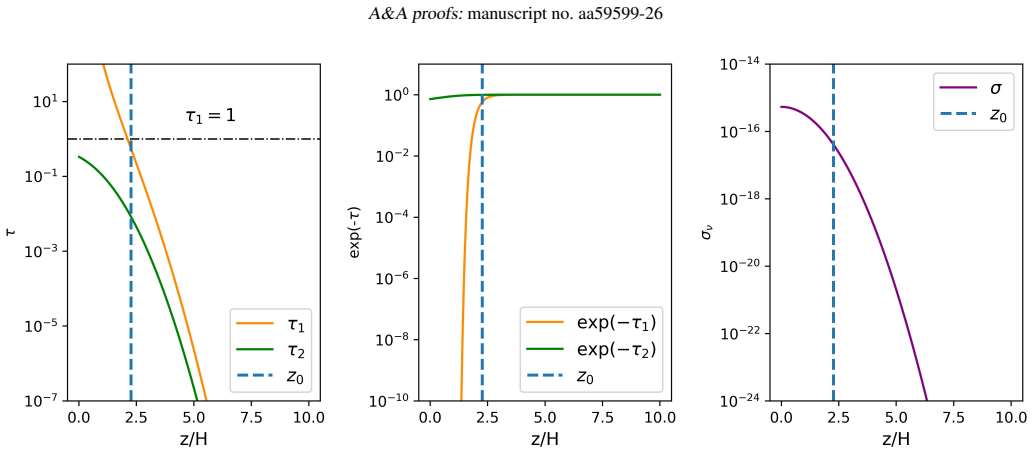
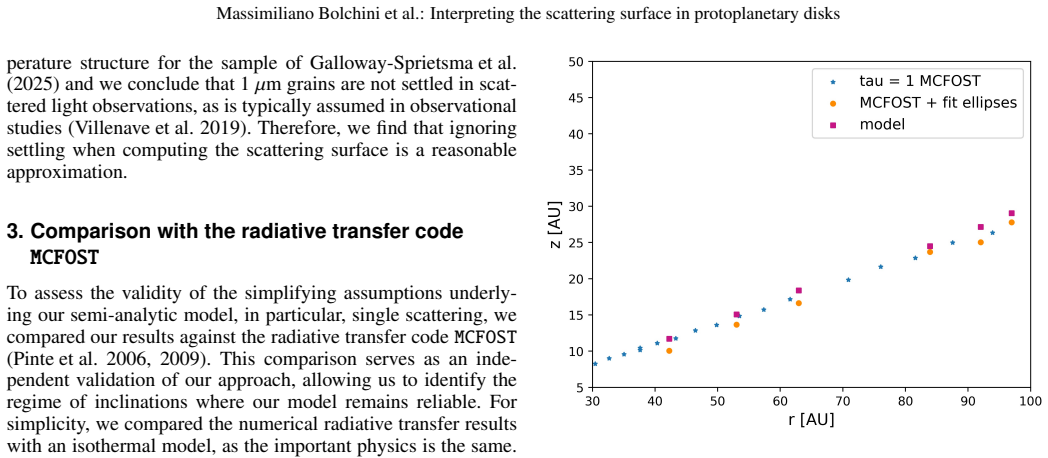
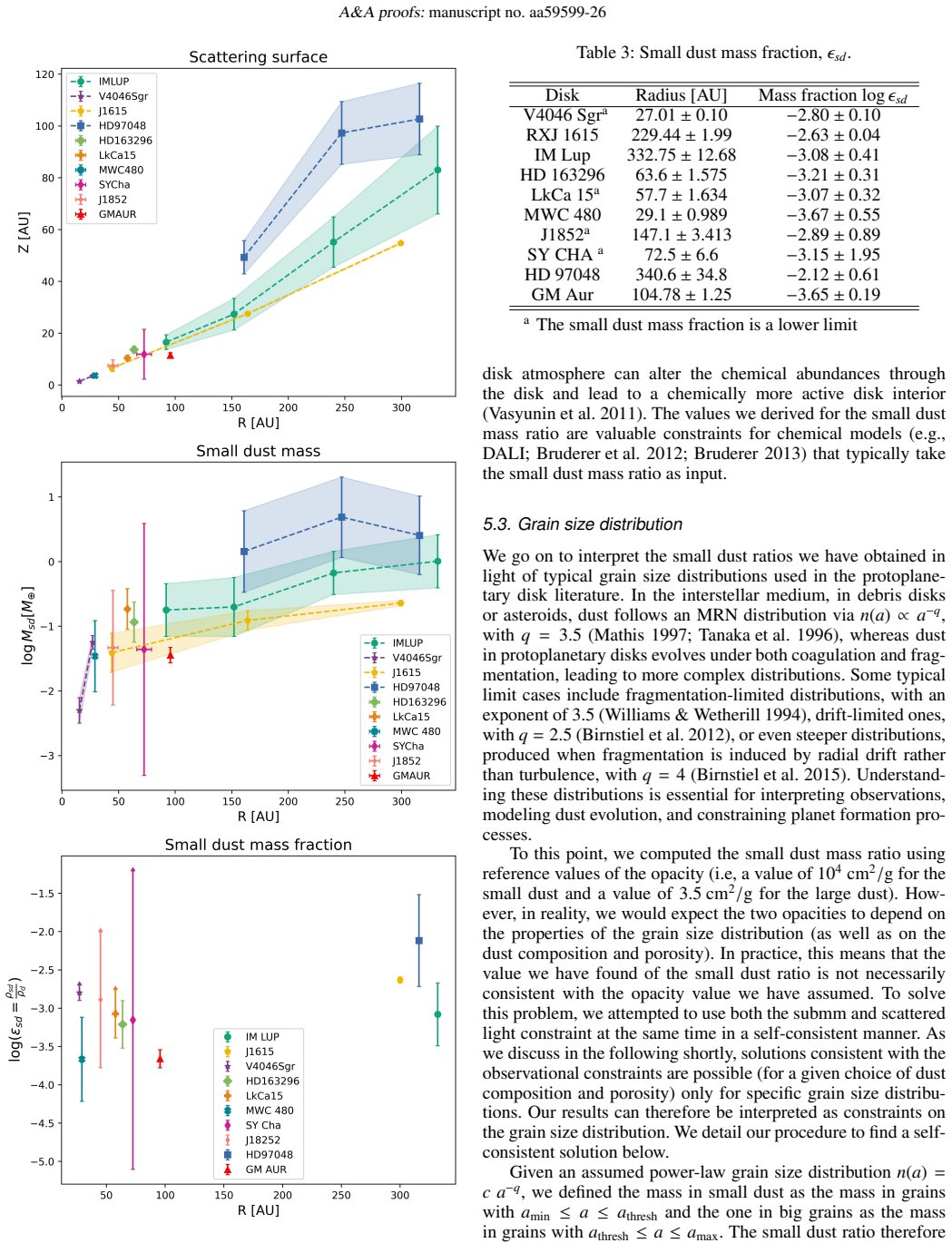
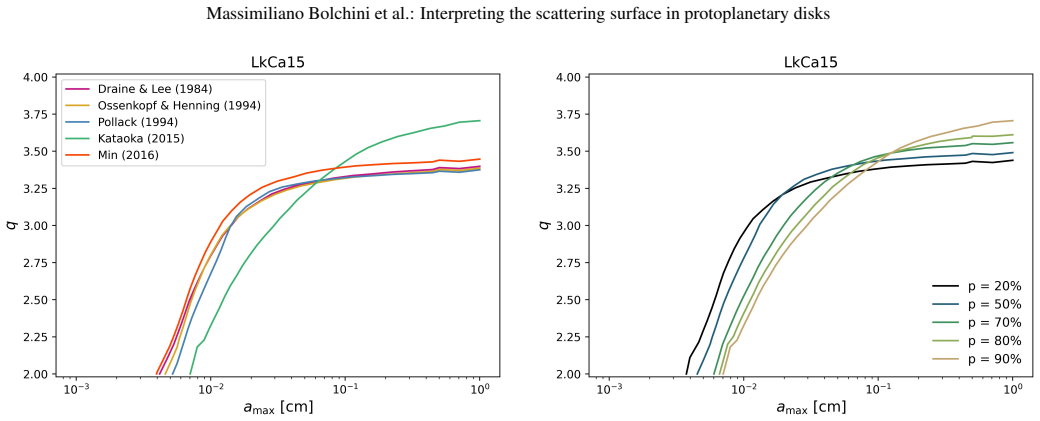
The scattering surface coincides with the layer where the line-of-sight optical depth from the star reaches order unity. A semi-analytical expression for that height, derived from radiative-transfer principles and validated with MCFOST, is applied to measured surface heights. The resulting small-dust mass fractions are of order 10^{-3}. Using standard opacity tables, these fractions are shown to be consistent with modest grain growth (a_max ≳ 0.1 mm) and grain-size distribution indices of 3 to 3.5. The thermal structure exerts the dominant influence on height; dust settling and anisotropic scattering contribute only minor corrections.
What carries the argument
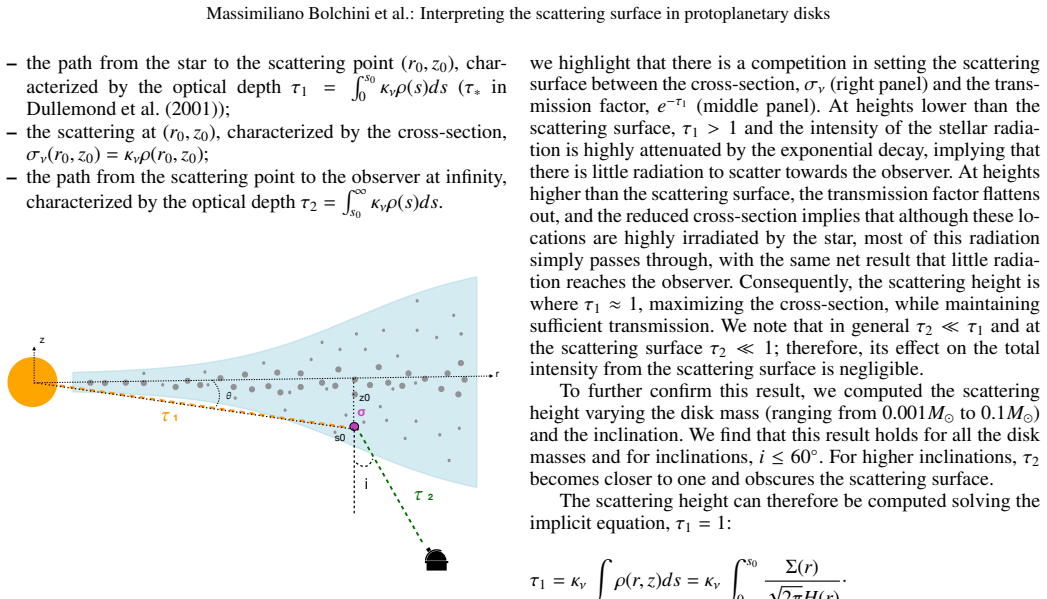
A semi-analytical expression for scattering-surface height obtained by setting the integrated optical depth along the stellar radiation path to order unity, written as a function of total small-dust mass, temperature profile, and dust opacity.
If this is right
- The thermal structure of the disk strongly controls the observed scattering height.
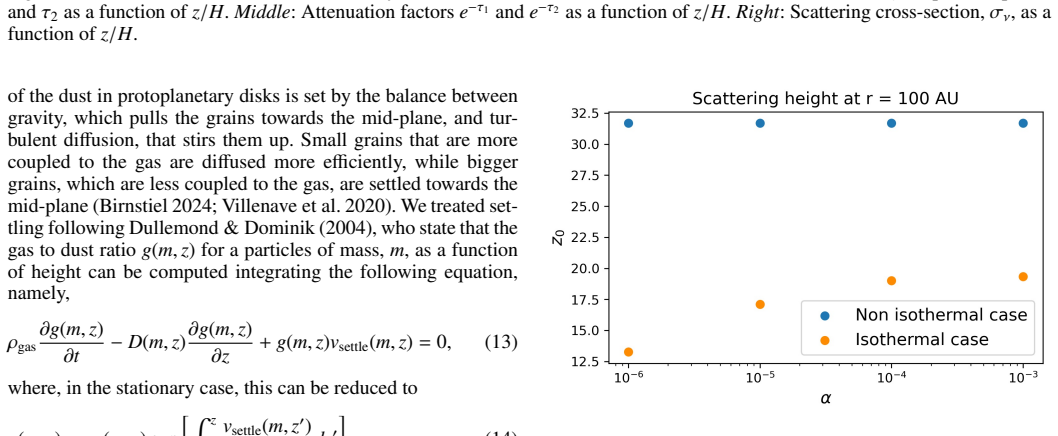
- Dust settling and anisotropic scattering produce only small changes in surface height.
- Ten observed disks return global small-dust mass fractions of order 10^{-3}.
- These fractions correspond to maximum grain sizes above 0.1 mm and size-distribution power-law indices between 3 and 3.5.
Where Pith is reading between the lines
- Repeated scattering-height measurements on the same disk over several years could track how the small-grain reservoir changes as the disk evolves.
- Pairing scattering heights with millimeter continuum maps of the same object would allow separate constraints on the small-grain and large-grain populations.
- The method implicitly assumes the disk is close to hydrostatic equilibrium; significant deviations from that equilibrium would shift the inferred masses.
Load-bearing premise
The temperature structure of the disk is known independently with enough precision that its uncertainty does not dominate the uncertainty assigned to the small-dust mass.
What would settle it
An independent determination of the small-dust mass in any one of the ten disks, obtained for example from detailed modeling of the spectral energy distribution, that differs from the scattering-height value by more than the combined model and observational uncertainties.
Figures
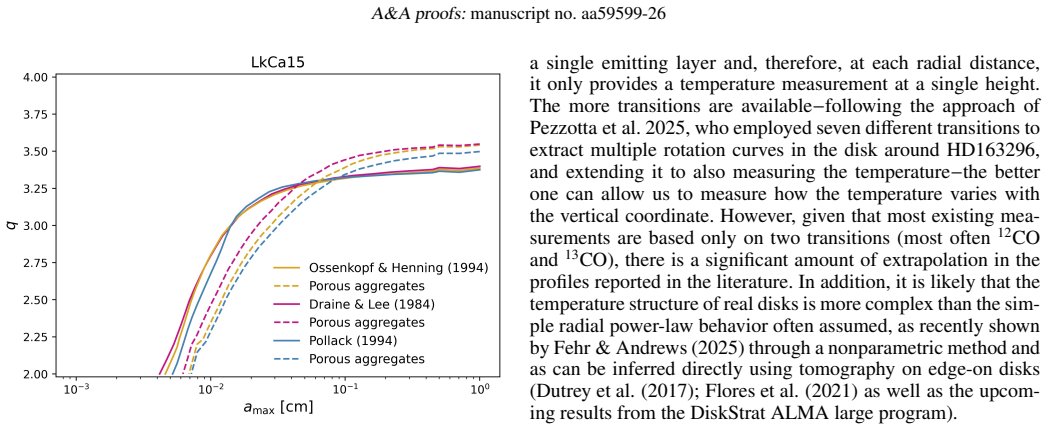
read the original abstract
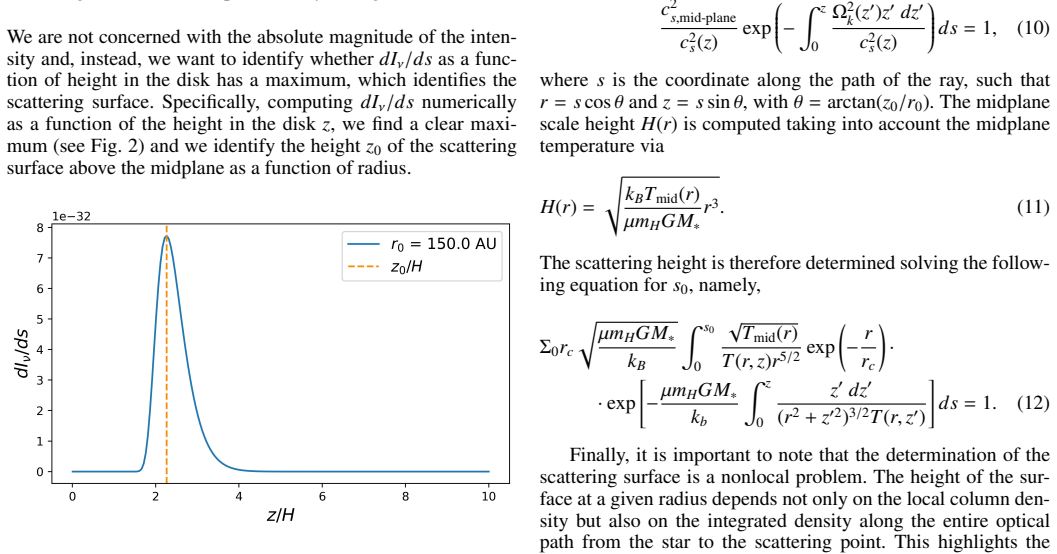
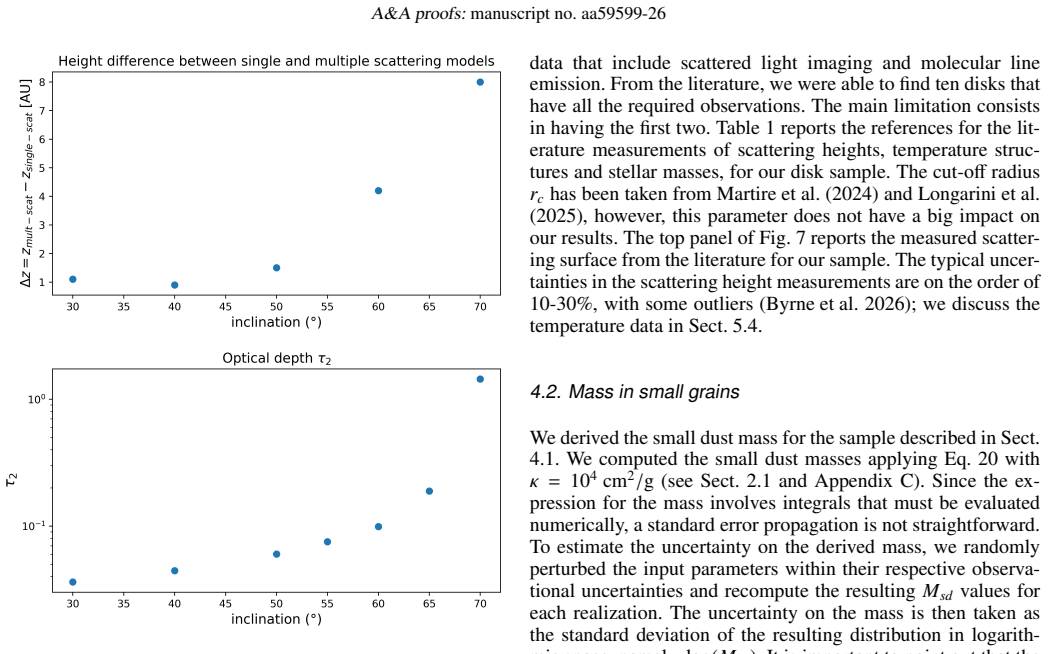
In recent years, extreme adaptive optics have enabled high-resolution, high-contrast scattered-light observations of protoplanetary disks. Interpreting these observations requires an understanding of the scattering surface, which is shaped by the distribution of small dust grains and determines how disks appear in scattered light. We aim to exploit measurements of the scattering surface height to directly constrain the masses of small dust grains in disks. Starting from radiative transfer principles, we developed a semi-analytical model of the stellar radiation path and its interaction with the disk, deriving the height of the scattering surface as a function of disk parameters such as mass, temperature, and opacity. We validated our predictions against the radiative transfer code MCFOST. Using measured scattering heights, we inferred the mass of dust in small grains and the particle size distribution for a sample of ten disks. We confirm previous results indicating that the scattering surface coincides with the region where the integrated optical depth along the stellar path is of order unity. The thermal structure of the disk significantly affects the surface height, while dust settling and anisotropic scattering have comparatively minor effects. Applying our model to observations, we measure global small-dust mass fractions of order (10^{-3}). Using dust-opacity models, we show that these values are consistent with modest grain growth ((a_{\rm max} \gtrsim 0.1,{\rm mm})) and grain-size distribution power-law indices of approximately 3--3.5, as commonly predicted by grain-growth models. Scattering-surface measurements, together with constraints on the disk thermal structure, provide a powerful method for determining the small-dust content of protoplanetary disks.
Editorial analysis
A structured set of objections, weighed in public.
Referee Report
Summary. The paper develops a semi-analytical radiative-transfer model for the height of the scattering surface in protoplanetary disks (where the line-of-sight optical depth to the star reaches order unity), validates the model against MCFOST Monte-Carlo calculations, and applies the relation to measured scattering heights in ten disks to infer global small-dust mass fractions of order 10^{-3}. These fractions are shown to be consistent with modest grain growth (a_max ≳ 0.1 mm) and size-distribution indices p ≈ 3–3.5 when standard dust-opacity models are adopted. The work emphasizes that thermal structure dominates the surface height while settling and anisotropic scattering are secondary.
Significance. If the thermal-structure uncertainty can be controlled, the approach supplies a direct, observationally accessible route to the small-grain mass reservoir that complements SED and millimeter continuum methods. The external validation against MCFOST and the application to a multi-disk sample are concrete strengths that increase the utility of scattering-surface measurements for grain-growth studies.
major comments (2)
- [Application to observations] Application to the ten-disk sample (final section): the inversion for small-dust surface density inherits the full uncertainty in the adopted T(r,z) profile, yet the manuscript provides no quantitative sensitivity analysis to plausible variations in the midplane-to-surface temperature gradient. Because the abstract itself states that thermal structure significantly affects surface height, a 20–30 % shift in the gradient maps directly into comparable or larger shifts in the reported 10^{-3} mass fractions and the derived a_max and p values; this must be demonstrated before the numerical conclusions can be considered robust.
- [Validation and inference] §3 (validation) and the inference step: while the model is validated against MCFOST for fixed parameters, the paper does not show that the same MCFOST runs recover the input small-dust mass when the thermal structure is allowed to vary within the range used for the observational sample. Without this cross-check, it remains unclear whether the semi-analytic inversion remains unbiased once realistic temperature uncertainties are folded in.
minor comments (2)
- [Dust-opacity models] Notation for the power-law index of the grain-size distribution is introduced as p but occasionally appears as q in the opacity-model discussion; a single symbol should be used consistently.
- [Figure 4] Figure captions for the MCFOST comparison panels should explicitly state the fixed values of a_max and p adopted in each run so that readers can reproduce the test cases.
Simulated Author's Rebuttal
We thank the referee for the constructive and detailed report. The comments highlight important aspects of uncertainty quantification that we will address in revision. We respond point-by-point to the major comments below.
read point-by-point responses
-
Referee: [Application to observations] Application to the ten-disk sample (final section): the inversion for small-dust surface density inherits the full uncertainty in the adopted T(r,z) profile, yet the manuscript provides no quantitative sensitivity analysis to plausible variations in the midplane-to-surface temperature gradient. Because the abstract itself states that thermal structure significantly affects surface height, a 20–30 % shift in the gradient maps directly into comparable or larger shifts in the reported 10^{-3} mass fractions and the derived a_max and p values; this must be demonstrated before the numerical conclusions can be considered robust.
Authors: We agree that the lack of a quantitative sensitivity analysis to the adopted temperature gradient is a limitation. In the revised manuscript we will add a dedicated subsection (or appendix) that perturbs the midplane-to-surface temperature gradient by ±20–30 % around the fiducial profiles used for the ten-disk sample, recomputes the inferred small-dust mass fractions, and reports the resulting ranges together with the nominal values. This will directly quantify the propagation of thermal-structure uncertainty into the reported 10^{-3} fractions and the derived grain-growth parameters. revision: yes
-
Referee: [Validation and inference] §3 (validation) and the inference step: while the model is validated against MCFOST for fixed parameters, the paper does not show that the same MCFOST runs recover the input small-dust mass when the thermal structure is allowed to vary within the range used for the observational sample. Without this cross-check, it remains unclear whether the semi-analytic inversion remains unbiased once realistic temperature uncertainties are folded in.
Authors: We acknowledge that the MCFOST validation in §3 was performed at fixed thermal structures. To close this gap we will carry out a new set of MCFOST runs in which the temperature profile is varied within the same range adopted for the observational sample, apply the semi-analytic inversion to the resulting synthetic scattering surfaces, and verify that the input small-dust masses are recovered without significant systematic bias. These additional tests and the corresponding figures will be included in the revised §3. revision: yes
Circularity Check
Derivation from first-principles radiative transfer is self-contained with external validation
full rationale
The paper derives the scattering-surface height model directly from radiative-transfer principles (optical-depth integral reaching order unity), validates the semi-analytical expressions against the independent MCFOST Monte-Carlo code, and then inverts measured heights for small-dust mass using separate opacity tables. No equation reduces to a fitted parameter renamed as a prediction, no load-bearing premise rests on self-citation, and no ansatz is smuggled via prior work by the same authors. The reported 10^{-3} mass fractions therefore follow from the external height measurements and the independently constrained thermal structure rather than from any definitional equivalence within the paper itself.
Axiom & Free-Parameter Ledger
free parameters (2)
- disk temperature structure
- dust opacity model parameters (a_max, power-law index)
axioms (2)
- domain assumption Scattering surface coincides with region where integrated optical depth along stellar path is of order unity
- domain assumption MCFOST provides an accurate numerical benchmark for the semi-analytical model
Reference graph
Works this paper leans on
-
[1]
, keywords =
Dust opacities for protostellar cores. , keywords =
-
[2]
Accretion Disks around Young Objects. II. Tests of Well-mixed Models with ISM Dust. , keywords =. doi:10.1086/308103 , archivePrefix =. astro-ph/9907330 , primaryClass =
work page internal anchor Pith review Pith/arXiv arXiv doi:10.1086/308103
-
[3]
, year = 1974, month = sep, volume =
The evolution of viscous discs and the origin of the nebular variables. , year = 1974, month = sep, volume =. doi:10.1093/mnras/168.3.603 , adsurl =
-
[4]
Measuring the Two-Dimensional Thermal Structures of Protoplanetary Disks. arXiv e-prints , keywords =. doi:10.48550/arXiv.2509.15196 , archivePrefix =. 2509.15196 , primaryClass =
-
[5]
The two-dimensional pressure structure of the HD 163296 protoplanetary disk as probed by multi-molecule kinematics. , keywords =. doi:10.1051/0004-6361/202451307 , archivePrefix =. 2501.05517 , primaryClass =
-
[6]
The efficiency of dust trapping in ringed protoplanetary discs. , keywords =. doi:10.1093/mnras/staa1170 , archivePrefix =. 2004.11394 , primaryClass =
-
[7]
Physical model and observational evidence in MAPS disks
Rotation curves in protoplanetary disks with thermal stratification. Physical model and observational evidence in MAPS disks. , keywords =. doi:10.1051/0004-6361/202348546 , archivePrefix =. 2402.12236 , primaryClass =
-
[8]
Direct mapping of the temperature and velocity gradients in discs. Imaging the vertical CO snow line around IM Lupi. , keywords =. doi:10.1051/0004-6361/201731377 , archivePrefix =. 1710.06450 , primaryClass =
work page internal anchor Pith review Pith/arXiv arXiv doi:10.1051/0004-6361/201731377
-
[9]
Molecules with ALMA at Planet-forming Scales (MAPS). IV. Emission Surfaces and Vertical Distribution of Molecules. , keywords =. doi:10.3847/1538-4365/ac1439 , archivePrefix =. 2109.06217 , primaryClass =
-
[10]
CO Line Emission Surfaces and Vertical Structure in Midinclination Protoplanetary Disks. , keywords =. doi:10.3847/1538-4357/ac6c02 , archivePrefix =. 2205.01776 , primaryClass =
-
[11]
Mapping Protoplanetary Disk Vertical Structure with CO Isotopologue Line Emission. , keywords =. doi:10.3847/1538-4357/acb3c4 , archivePrefix =. 2212.08667 , primaryClass =
-
[12]
Mapping the Vertical Gas Structure of the Planet-hosting PDS 70 Disk. , keywords =. doi:10.3847/1538-4357/ad24d2 , archivePrefix =. 2401.03018 , primaryClass =
-
[13]
exoALMA. V. Gaseous Emission Surfaces and Temperature Structures. , keywords =. doi:10.3847/2041-8213/adc437 , archivePrefix =. 2504.19902 , primaryClass =
-
[14]
Dust Growth and Evolution in Protoplanetary Disks. , keywords =. doi:10.1146/annurev-astro-071221-052705 , archivePrefix =. 2312.13287 , primaryClass =
-
[15]
, year = 1941, month = jan, volume =
Diffuse radiation in the Galaxy. , year = 1941, month = jan, volume =. doi:10.1086/144246 , adsurl =
-
[16]
The effect of dust settling on the appearance of protoplanetary disks
The effect of dust settling on the appearance of protoplanetary disks. , keywords =. doi:10.1051/0004-6361:20040284 , archivePrefix =. astro-ph/0405226 , primaryClass =
work page internal anchor Pith review Pith/arXiv arXiv doi:10.1051/0004-6361:20040284
-
[17]
Physical Review , year = 1924, month = jun, volume =
On the Resistance Experienced by Spheres in their Motion through Gases. Physical Review , year = 1924, month = jun, volume =. doi:10.1103/PhysRev.23.710 , adsurl =
-
[18]
Observations of edge-on protoplanetary disks with ALMA. I. Results from continuum data. , keywords =. doi:10.1051/0004-6361/202038087 , archivePrefix =. 2008.06518 , primaryClass =
-
[19]
Observational appearance
Black holes in binary systems. Observational appearance. , year = 1973, month = jan, volume =
1973
-
[20]
Monte Carlo radiative transfer in protoplanetary disks
Monte Carlo radiative transfer in protoplanetary disks. , keywords =. doi:10.1051/0004-6361:20053275 , archivePrefix =. astro-ph/0606550 , primaryClass =
work page internal anchor Pith review Pith/arXiv arXiv doi:10.1051/0004-6361:20053275
-
[21]
Benchmark problems for continuum radiative transfer. High optical depths, anisotropic scattering, and polarisation. , keywords =. doi:10.1051/0004-6361/200811555 , archivePrefix =. 0903.1231 , primaryClass =
work page internal anchor Pith review Pith/arXiv arXiv doi:10.1051/0004-6361/200811555
-
[22]
Optical Properties of Interstellar Graphite and Silicate Grains. , keywords =. doi:10.1086/162480 , adsurl =
-
[23]
From Stardust to Planetesimals , year = 1997, editor =
Composition and Size of Interstellar Dust. From Stardust to Planetesimals , year = 1997, editor =
1997
-
[24]
Disks around T Tauri Stars with SPHERE (DARTTS-S). I. SPHERE/IRDIS Polarimetric Imaging of Eight Prominent T Tauri Disks. , keywords =. doi:10.3847/1538-4357/aab846 , archivePrefix =. 1803.10882 , primaryClass =
work page internal anchor Pith review Pith/arXiv arXiv doi:10.3847/1538-4357/aab846
-
[25]
Observed Polarized Scattered Light Phase Functions of Planet-forming Disks. , keywords =. doi:10.3847/1538-4357/acdc97 , archivePrefix =. 2301.04617 , primaryClass =
-
[26]
Possible single-armed spiral in the protoplanetary disk around HD 34282. , keywords =. doi:10.1051/0004-6361/201936787 , archivePrefix =. 2010.12202 , primaryClass =
-
[27]
Direct detection of scattered light gaps in the transitional disk around HD 97048 with VLT/SPHERE
Direct detection of scattered light gaps in the transitional disk around HD 97048 with VLT/SPHERE. , keywords =. doi:10.1051/0004-6361/201629265 , archivePrefix =. 1609.04027 , primaryClass =
work page internal anchor Pith review Pith/arXiv arXiv doi:10.1051/0004-6361/201629265
-
[28]
Composition and Radiative Properties of Grains in Molecular Clouds and Accretion Disks. , keywords =. doi:10.1086/173677 , adsurl =
-
[29]
Multiwavelength optical properties of compact dust aggregates in protoplanetary disks
Multiwavelength optical properties of compact dust aggregates in protoplanetary disks. , keywords =. doi:10.1051/0004-6361/201526048 , archivePrefix =. 1510.05426 , primaryClass =
work page internal anchor Pith review Pith/arXiv arXiv doi:10.1051/0004-6361/201526048
-
[30]
Millimeter-wave polarization of protoplanetary disks due to dust scattering
Millimeter-wave Polarization of Protoplanetary Disks due to Dust Scattering. , keywords =. doi:10.1088/0004-637X/809/1/78 , archivePrefix =. 1504.04812 , primaryClass =
work page internal anchor Pith review Pith/arXiv arXiv doi:10.1088/0004-637x/809/1/78
-
[31]
ISO spectroscopy of circumstellar dust in the Herbig Ae systems AB Aur and HD 163296
ISO spectroscopy of circumstellar dust in the Herbig Ae systems AB Aur and HD 163296. , keywords =. doi:10.48550/arXiv.astro-ph/0002440 , archivePrefix =. astro-ph/0002440 , primaryClass =
work page internal anchor Pith review Pith/arXiv arXiv doi:10.48550/arxiv.astro-ph/0002440
-
[32]
Measuring Turbulent Motion in Planet-forming Disks with ALMA: A Detection around DM Tau and Nondetections around MWC 480 and V4046 Sgr. , keywords =. doi:10.3847/1538-4357/ab8cc5 , archivePrefix =. 2004.12176 , primaryClass =
-
[33]
Spatial segregation of dust grains in transition disks. SPHERE observations of 2MASS J16083070-3828268 and RXJ1852.3-3700. , keywords =. doi:10.1051/0004-6361/201834800 , archivePrefix =. 1902.04612 , primaryClass =
work page internal anchor Pith review Pith/arXiv arXiv doi:10.1051/0004-6361/201834800 1902
-
[34]
The full census of planet-forming disks with GTO and DESTINYS programs
The SPHERE view of the Chamaeleon I star-forming region. The full census of planet-forming disks with GTO and DESTINYS programs. , keywords =. doi:10.1051/0004-6361/202244005 , archivePrefix =. 2403.02149 , primaryClass =
-
[35]
Molecules with ALMA at Planet-forming Scales (MAPS). XVIII. Kinematic Substructures in the Disks of HD 163296 and MWC 480. , keywords =. doi:10.3847/1538-4365/ac1438 , archivePrefix =. 2109.06218 , primaryClass =
-
[36]
exoALMA. XII. Weighing and Sizing exoALMA Disks with Rotation Curve Modelling. , keywords =. doi:10.3847/2041-8213/adc431 , adsurl =
-
[37]
Molecules with ALMA at Planet-forming Scales (MAPS). XIV. Revealing Disk Substructures in Multiwavelength Continuum Emission. , keywords =. doi:10.3847/1538-4365/ac1431 , archivePrefix =. 2109.06433 , primaryClass =
-
[38]
, year = 1996, month = oct, volume =
Steady-State Size Distribution for the Self-Similar Collision Cascade. , year = 1996, month = oct, volume =. doi:10.1006/icar.1996.0170 , adsurl =
-
[39]
Size Distribution of Collisionally Evolved Asteroidal Populations: Analytical Solution for Self-Similar Collision Cascades. , keywords =. doi:10.1006/icar.1994.1010 , adsurl =
-
[40]
A simple model for the evolution of the dust population in protoplanetary disks
A simple model for the evolution of the dust population in protoplanetary disks. , keywords =. doi:10.1051/0004-6361/201118136 , archivePrefix =. 1201.5781 , primaryClass =
work page internal anchor Pith review Pith/arXiv arXiv doi:10.1051/0004-6361/201118136
-
[41]
Dust Evolution Can Produce Scattered Light Gaps in Protoplanetary Disks
Dust Evolution Can Produce Scattered Light Gaps in Protoplanetary Disks. , keywords =. doi:10.1088/2041-8205/813/1/L14 , archivePrefix =. 1510.05660 , primaryClass =
work page internal anchor Pith review Pith/arXiv arXiv doi:10.1088/2041-8205/813/1/l14 2041
-
[42]
Constraining the turbulence and the dust disk in IM Lup: Onset of planetesimal formation. , keywords =. doi:10.1051/0004-6361/202244869 , archivePrefix =. 2212.01291 , primaryClass =
-
[43]
Turbulence in protoplanetary disks: A systematic analysis of dust settling in 33 disks. , keywords =. doi:10.1051/0004-6361/202553822 , archivePrefix =. 2503.05872 , primaryClass =
-
[44]
Protoplanetary Disk Chemistry. , keywords =. doi:10.1146/annurev-astro-022823-040820 , archivePrefix =. 2309.05685 , primaryClass =
-
[45]
Impact of size-dependent grain temperature on gas-grain chemistry in protoplanetary disks: The case of low-mass star disks. , keywords =. doi:10.1051/0004-6361/202038788 , archivePrefix =. 2106.05888 , primaryClass =
-
[46]
OpTool: Command-line driven tool for creating complex dust opacities
-
[47]
ALMA reveals the anatomy of the mm-sized dust and molecular gas in the HD 97048 disk
ALMA Reveals the Anatomy of the mm-sized Dust and Molecular Gas in the HD 97048 Disk. , keywords =. doi:10.3847/0004-637X/831/2/200 , archivePrefix =. 1609.02011 , primaryClass =
work page internal anchor Pith review Pith/arXiv arXiv doi:10.3847/0004-637x/831/2/200
-
[48]
Passive irradiated circumstellar disks with an inner hole
Passive Irradiated Circumstellar Disks with an Inner Hole. , keywords =. doi:10.1086/323057 , archivePrefix =. astro-ph/0106470 , primaryClass =
work page internal anchor Pith review Pith/arXiv arXiv doi:10.1086/323057
-
[49]
exoALMA. IV. Substructures, Asymmetries, and the Faint Outer Disk in Continuum Emission. , keywords =. doi:10.3847/2041-8213/adc438 , archivePrefix =. 2504.18725 , primaryClass =
-
[50]
Dust modeling of the combined ALMA and SPHERE datasets of HD 163296. Is HD 163296 really a Meeus group II disk?. , keywords =. doi:10.1051/0004-6361/201732299 , archivePrefix =. 1802.03328 , primaryClass =
work page internal anchor Pith review Pith/arXiv arXiv doi:10.1051/0004-6361/201732299
-
[51]
Radiative transfer in very optically thick circumstellar disks
Radiative transfer in very optically thick circumstellar disks. , keywords =. doi:10.1051/0004-6361/200811470 , archivePrefix =. 0902.3092 , primaryClass =
work page internal anchor Pith review Pith/arXiv arXiv doi:10.1051/0004-6361/200811470
-
[52]
Investigating the Relative Gas and Small Dust Grain Surface Heights in Protoplanetary Disks. , keywords =. doi:10.3847/1538-4357/abf92e , archivePrefix =. 2104.07821 , primaryClass =
-
[53]
Effect of dust size and structure on scattered light images of protoplanetary discs
Effect of dust size and structure on scattered-light images of protoplanetary discs. , keywords =. doi:10.1093/mnras/stz662 , archivePrefix =. 1903.01890 , primaryClass =
work page internal anchor Pith review Pith/arXiv arXiv doi:10.1093/mnras/stz662 1903
-
[54]
Fractal Aggregates of Submicron-sized Grains in the Young Planet-forming Disk around IM Lup. , keywords =. doi:10.3847/2041-8213/acb824 , archivePrefix =. 2302.01119 , primaryClass =
-
[55]
Scattered light mapping of protoplanetary disks
Scattered light mapping of protoplanetary disks. , keywords =. doi:10.1051/0004-6361/201629098 , archivePrefix =. 1609.09505 , primaryClass =
work page internal anchor Pith review Pith/arXiv arXiv doi:10.1051/0004-6361/201629098
-
[56]
Disk Evolution Study Through Imaging of Nearby Young Stars (DESTINYS): V721 CrA and BN CrA have wide and structured disks in the polarised infrared. , keywords =. doi:10.1051/0004-6361/202556331 , archivePrefix =. 2511.01717 , primaryClass =
work page internal anchor Pith review Pith/arXiv arXiv doi:10.1051/0004-6361/202556331
-
[57]
DRAGyS A comprehensive tool for extracting scattering phase functions in protoplanetary disks: Disk ring adjusted geometry yields scattering phase function. , keywords =. doi:10.1051/0004-6361/202554058 , archivePrefix =. 2505.20070 , primaryClass =
-
[58]
Protostars and Planets VII , year = 2023, editor =
Optical and Near-infrared View of Planet-forming Disks and Protoplanets. Protostars and Planets VII , year = 2023, editor =. doi:10.48550/arXiv.2203.09991 , archivePrefix =. 2203.09991 , primaryClass =
-
[59]
Shadows and cavities in protoplanetary disks: HD163296, HD141569A, and HD150193A in polarized light
Shadows and cavities in protoplanetary disks: HD 163296, HD 141569A, and HD 150193A in polarized light. , keywords =. doi:10.1051/0004-6361/201424262 , archivePrefix =. 1406.7387 , primaryClass =
work page internal anchor Pith review Pith/arXiv arXiv doi:10.1051/0004-6361/201424262
-
[60]
Direct Imaging of Fine Structures in Giant Planet-forming Regions of the Protoplanetary Disk Around AB Aurigae. , keywords =. doi:10.1088/2041-8205/729/2/L17 , archivePrefix =. 1102.4408 , primaryClass =
work page internal anchor Pith review Pith/arXiv arXiv doi:10.1088/2041-8205/729/2/l17 2041
-
[61]
Proceedings of the Japan Academy, Series B , year = 2016, month = feb, volume =
SEEDS - Strategic explorations of exoplanets and disks with the Subaru Telescope -. Proceedings of the Japan Academy, Series B , year = 2016, month = feb, volume =. doi:10.2183/pjab.92.45 , adsurl =
-
[62]
Gemini-LIGHTS: Herbig Ae/Be and Massive T Tauri Protoplanetary Disks Imaged with Gemini Planet Imager. , keywords =. doi:10.3847/1538-3881/ac7be4 , archivePrefix =. 2206.05815 , primaryClass =
-
[63]
Disk Evolution Study Through Imaging of Nearby Young Stars (DESTINYS): Late Infall Causing Disk Misalignment and Dynamic Structures in SU Aur. , keywords =. doi:10.3847/2041-8213/abdf57 , archivePrefix =. 2102.08781 , primaryClass =
-
[64]
Multiple rings in the transition disk and companion candidates around RX J1615.3-3255. High contrast imaging with VLT/SPHERE. , keywords =. doi:10.1051/0004-6361/201629267 , archivePrefix =. 1610.04038 , primaryClass =
work page internal anchor Pith review Pith/arXiv arXiv doi:10.1051/0004-6361/201629267
-
[65]
Spectral Energy Distributions of T Tauri Stars With Passive Circumstellar Disks
Spectral Energy Distributions of T Tauri Stars with Passive Circumstellar Disks. , keywords =. doi:10.1086/304869 , archivePrefix =. astro-ph/9706042 , primaryClass =
work page internal anchor Pith review Pith/arXiv arXiv doi:10.1086/304869
-
[66]
Protostars and Planets VII , year = 2023, editor =
Planet Formation Theory in the Era of ALMA and Kepler: from Pebbles to Exoplanets. Protostars and Planets VII , year = 2023, editor =. doi:10.48550/arXiv.2203.09759 , archivePrefix =. 2203.09759 , primaryClass =
-
[67]
The Flying Saucer: Tomography of the thermal and density gas structure of an edge-on protoplanetary disk. , keywords =. doi:10.1051/0004-6361/201730645 , archivePrefix =. 1706.02608 , primaryClass =
work page internal anchor Pith review Pith/arXiv arXiv doi:10.1051/0004-6361/201730645
-
[68]
The Anatomy of an Unusual Edge-on Protoplanetary Disk. II. Gas Temperature and a Warm Outer Region. , keywords =. doi:10.3847/1538-3881/abeb1e , archivePrefix =. 2103.02666 , primaryClass =
-
[69]
Imaging the LkCa 15 system in polarimetry and total intensity without self-subtraction artefacts. , keywords =. doi:10.1051/0004-6361/202449743 , archivePrefix =. 2512.18439 , primaryClass =
-
[70]
The circumstellar disk HD$\,$169142: gas, dust and planets acting in concert?
The Circumstellar Disk HD 169142: Gas, Dust, and Planets Acting in Concert?. , keywords =. doi:10.3847/1538-4357/aa94c2 , archivePrefix =. 1710.06485 , primaryClass =
work page internal anchor Pith review Pith/arXiv arXiv doi:10.3847/1538-4357/aa94c2
-
[71]
The Disk Substructures at High Angular Resolution Project (DSHARP). I. Motivation, Sample, Calibration, and Overview. , keywords =. doi:10.3847/2041-8213/aaf741 , archivePrefix =. 1812.04040 , primaryClass =
work page internal anchor Pith review Pith/arXiv arXiv doi:10.3847/2041-8213/aaf741 2041
-
[72]
Physical and Chemical Structure of Protoplanetary Disks with Grain Growth
Physical and Chemical Structure of Protoplanetary Disks with Grain Growth. , keywords =. doi:10.1086/501114 , archivePrefix =. astro-ph/0601230 , primaryClass =
work page internal anchor Pith review Pith/arXiv arXiv doi:10.1086/501114
-
[73]
Consistent dust and gas models for protoplanetary disks. I. Disk shape, dust settling, opacities, and PAHs. , keywords =. doi:10.1051/0004-6361/201526538 , archivePrefix =. 1511.03431 , primaryClass =
work page internal anchor Pith review Pith/arXiv arXiv doi:10.1051/0004-6361/201526538
-
[74]
Impact of grain evolution on the chemical structure of protoplanetary disks
Impact of Grain Evolution on the Chemical Structure of Protoplanetary Disks. , keywords =. doi:10.1088/0004-637X/727/2/76 , archivePrefix =. 1011.4420 , primaryClass =
work page internal anchor Pith review Pith/arXiv arXiv doi:10.1088/0004-637x/727/2/76
-
[75]
The warm gas atmosphere of the HD 100546 disk seen by Herschel. Evidence of a gas-rich, carbon-poor atmosphere?. , keywords =. doi:10.1051/0004-6361/201118218 , archivePrefix =. 1201.4860 , primaryClass =
work page internal anchor Pith review Pith/arXiv arXiv doi:10.1051/0004-6361/201118218
-
[76]
Survival of molecular gas in cavities of transition disks. I. CO. , keywords =. doi:10.1051/0004-6361/201321171 , archivePrefix =. 1308.2966 , primaryClass =
work page internal anchor Pith review Pith/arXiv arXiv doi:10.1051/0004-6361/201321171
-
[77]
Determining protoplanetary disk gas masses from CO isotopologues line observations
Determining protoplanetary disk gas masses from CO isotopologues line observations. , keywords =. doi:10.1051/0004-6361/201628159 , archivePrefix =. 1605.07780 , primaryClass =
work page internal anchor Pith review Pith/arXiv arXiv doi:10.1051/0004-6361/201628159
-
[78]
Beyond diffusion: a generalized mean-field theory of turbulent dust transport in protoplanetary discs. , keywords =. doi:10.1093/mnras/stad2471 , archivePrefix =. 2306.06103 , primaryClass =
-
[79]
Particle Stirring in Turbulent Gas Disks: Including Orbital Oscillations
Particle stirring in turbulent gas disks: Including orbital oscillations. , keywords =. doi:10.1016/j.icarus.2007.07.012 , archivePrefix =. 0707.2975 , primaryClass =
work page internal anchor Pith review Pith/arXiv arXiv doi:10.1016/j.icarus.2007.07.012 2007
-
[80]
exoALMA. XV. Interpreting the Height of CO Emission Layer. , keywords =. doi:10.3847/2041-8213/adc42e , archivePrefix =. 2504.20012 , primaryClass =
discussion (0)
Sign in with ORCID, Apple, or X to comment. Anyone can read and Pith papers without signing in.