REVIEW 3 major objections 5 minor 54 references
Symmetry-Protected Ideal Type-II Weyl Phonons in CdTe
T0 review · 3 major / 5 minor · reviewed 2026-08-14 · deepseek-v4-flash
Pith's one-line read The paper identifies ideal type-II Weyl phonons in zinc-blende CdTe, pinned to high-symmetry zone-boundary lines by a twofold rotation together with time reversal.
desk verdict CdTe type-II Weyl phonons are probably real, but the symmetry proof that pins them to the zone boundary is wrong as written. read the letter →
The pith
A machine-rendered reading of the paper's core claim, the machinery that carries it, and where it could break.
The reading
What carries the argument
The central object is the $2\times 2$ $\mathbf{k}\cdot\mathbf{p}$ Hamiltonian $H(\mathbf{q}) = d_x(\mathbf{q})\sigma_x + d_y(\mathbf{q})\sigma_y + d_z(\mathbf{q})\sigma_z$ for the two crossing phonon branches. The load-bearing constraint is that the twofold rotation about $z$ combined with time reversal acts as $C_2^z T = \sigma_z K$, which imposes $d_x(q_x,q_y,q_z) = -d_x(q_x,q_y,-q_z)$; periodicity then forces the crossing onto the zone-boundary plane $q_z = 2\pi/a$, where $d_x \equiv 0$, and the other twofold rotations confine the points to the X-W axes. This symmetry machinery explains the pinning and protection of the Weyl points; Chern-number computation fixes their chirality, and the iterative Green's-function surface method produces the long arcs. The underlying physical input is the phonon branch inversion between the longitudinal acoustic and transverse optical branches.
What would settle it
Measure the CdTe phonon dispersion along X-W at the Brillouin-zone boundary with inelastic X-ray or neutron scattering: if the longitudinal acoustic and transverse optical branches show an avoided gap near 3.5 THz instead of a clean crossing, the predicted Weyl phonons are not present.
Extended reading notes
Core claim
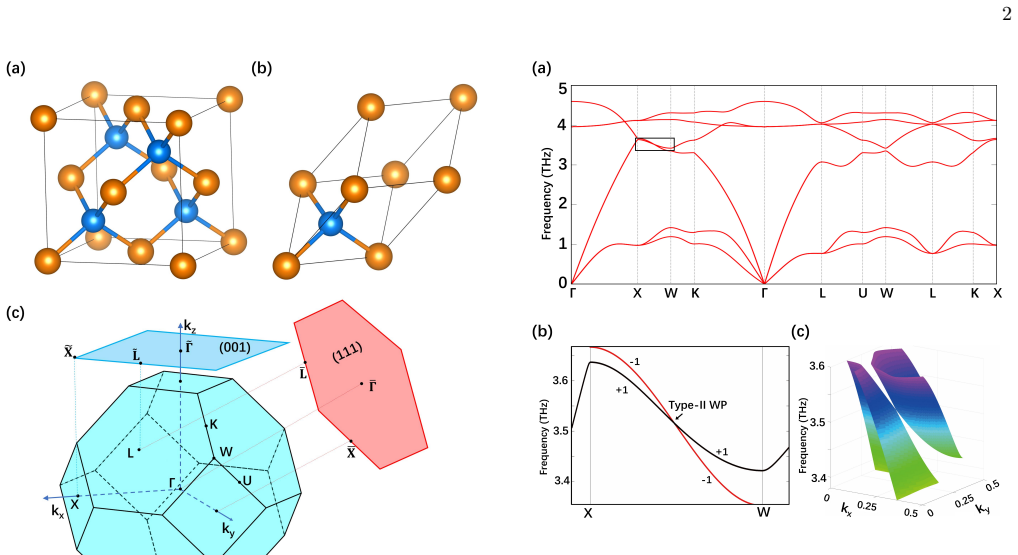
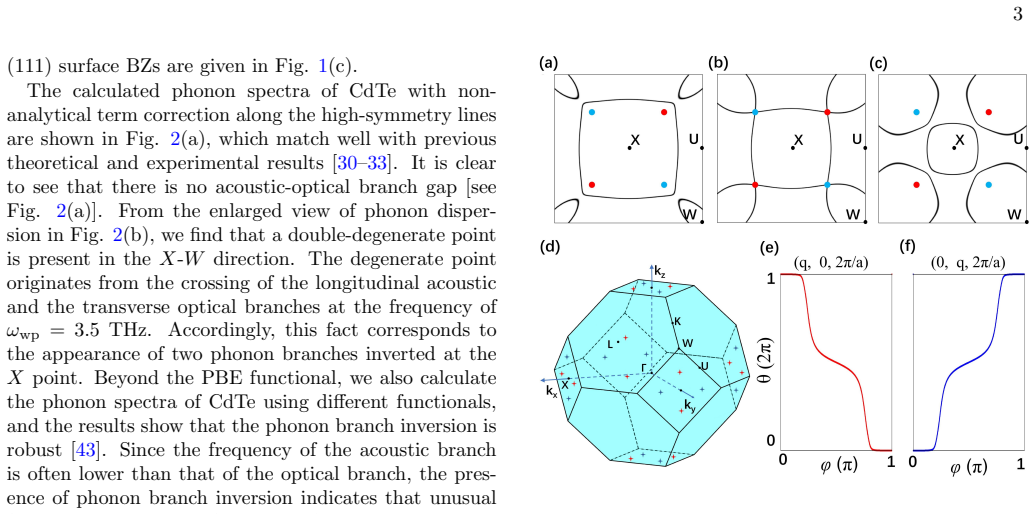
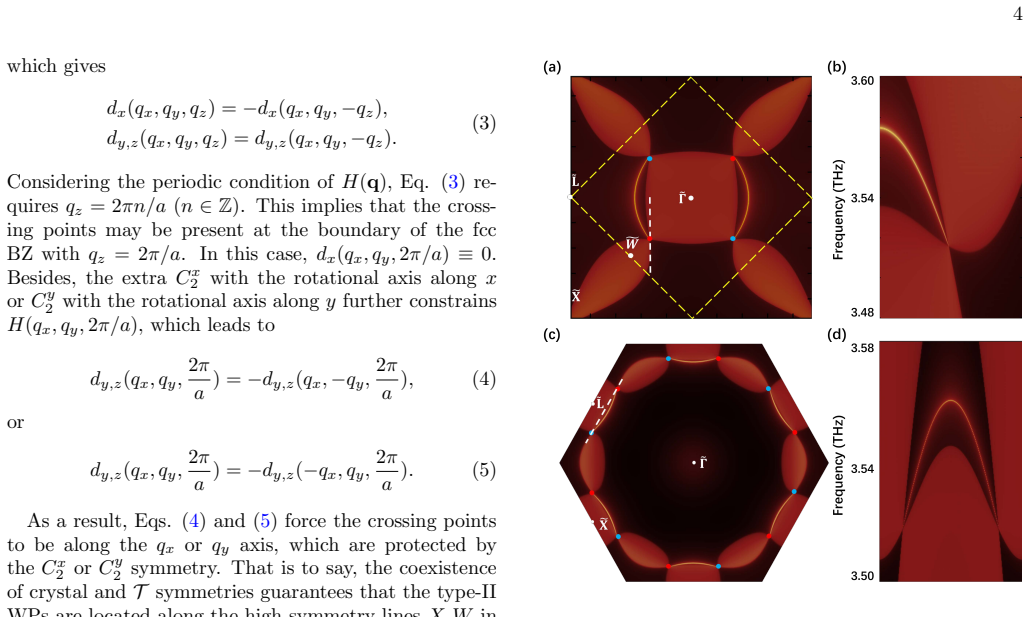
Using first-principles phonon calculations together with a symmetry-constrained $\mathbf{k}\cdot\mathbf{p}$ model, the paper predicts that CdTe hosts twelve Weyl phonon points of type II. In the computed spectrum, the longitudinal acoustic branch crosses a transverse optical branch at a double-degenerate point at $\omega_{\mathrm{wp}} = 3.5$ THz along X-W. Because the crossing branches carry opposite eigenvalues of the twofold rotation $C_2$, and because $C_2$ combined with time reversal forces the coefficient $d_x$ of the effective two-band Hamiltonian to vanish on the plane $q_z = 2\pi/a$, the Weyl points are constrained to the X-W high-symmetry lines at the boundaries of the face-centered cubic Brillouin zone; the same argument applies on the $q_x = 2\pi/a$ and $q_y = 2\pi/a$ planes. The twelve points have chirality $C = +1$ or $-1$, sit at explicitly listed momenta with $q = 0.054\,\mathrm{\AA}^{-1}$, and are well separated in momentum space. Open iso-frequency pockets at the Weyl frequency confirm the type-II character. A tight-binding surface calculation then yields long surface arcs connecting opposite-chirality projections on both (001) and (111) surfaces, which the paper argues provide a robust one-way channel for surface phonon propagation.
Load-bearing premise
The entire identification rests on the computed phonon spectrum: if the predicted crossing of the longitudinal acoustic and transverse optical branches along X-W is an artifact of the approximate density functional, the Weyl points in real CdTe would not exist.
Editorial extensions
If this is right
- The Weyl phonon points survive the absence of inversion symmetry in CdTe, because their protection comes from the coexistence of a twofold rotation and time-reversal symmetry.
- Because phonons have no spin-orbit coupling, the Weyl points are not gapped away from the high-symmetry lines: they sit exactly on the Brillouin-zone boundaries and remain symmetry-protected.
- The very long surface arcs connecting opposite-chirality Weyl points provide a one-way, backscattering-free propagation channel for elastic waves on the (001) and (111) surfaces, supporting the proposed phonon-transport and topological thermal applications.
- CdTe is already a synthesized and experimentally studied semiconductor, so the predicted crossings at about 3.5 THz and the long surface arcs are, in principle, accessible to existing phonon-probing techniques.
- The total Chern number of each acoustic or optical pocket is zero, so the bulk remains topologically trivial overall and the nontrivial physics appears through the surface arcs between Weyl points of opposite chirality.
Reading between the lines
- The same twofold-rotation-plus-time-reversal mechanism should pin type-II Weyl phonons to zone-boundary lines in other zinc-blende II-VI or III-V compounds where the longitudinal acoustic and transverse optical branches invert; a phonon-spectrum screen of such binaries could find additional candidates.
- The 'ideal' characterization assumes no other Weyl phonons elsewhere in the Brillouin zone; a systematic full-zone nodal search of the computed phonon spectrum would test that part of the claim directly.
- The 3.5 THz Weyl frequency lies in the terahertz range, so time-domain THz spectroscopy or surface-sensitive scattering might reveal dynamical signatures of the open iso-frequency pockets and the long arcs, beyond static surface-state calculations.
Signed reviews
Editorial analysis
A structured set of objections, weighed in public.
Referee Report
Summary. The manuscript reports first-principles and symmetry-based evidence for type-II Weyl phonons in zinc-blende CdTe. Using PBE DFT, finite-displacement interatomic force constants, a Wannier tight-binding model, Wilson-loop Chern-number calculations, and iterative Green's-function surface calculations, the authors identify a crossing between the longitudinal-acoustic and transverse-optical branches along the X-W lines at the fcc Brillouin-zone boundaries, with 12 Weyl points at four symmetry-related positions. They argue that the coexistence of two-fold rotational symmetry and time-reversal symmetry pins the Weyl points to the zone-boundary high-symmetry lines, and they show long surface arcs on the (001) and (111) surfaces. The abstract and introduction characterize the result as 'ideal' type-II Weyl phonons and suggest that CdTe hosts only such Weyl phonons.
Significance. If the prediction is correct, CdTe would be a readily available, experimentally well-studied material platform for type-II Weyl phonons, with the specific merit that the Weyl points are located at the Brillouin-zone boundary and are therefore symmetry-protected in the absence of spin-orbit coupling for phonons. The numerical workflow is mostly standard, and the phonon spectrum agrees with earlier theoretical and experimental work, which lends credibility to the basic identification. The Wilson-loop chirality calculation and the surface-state calculations are genuine outputs of the DFT-derived tight-binding model, not fits to the claimed surface arcs. However, the central analytic symmetry proof contains a concrete algebraic error, and the 'ideal' and 'only' claims are not supported by a full-zone nodal search. With corrections, the main prediction could stand, but the manuscript in its current form needs nontrivial revision.
major comments (3)
- [Symmetry analysis, Eqs. (3)-(5)] Equations (4) and (5), as printed, state that both d_y and d_z are odd under q_y -> -q_y (respectively q_x -> -q_x). Combined with d_x = 0 on the q_z = 2π/a plane from Eq. (3), this would make the entire q_y = 0 line a nodal line on which the 2x2 effective Hamiltonian vanishes, contradicting the isolated Weyl points shown in Fig. 2. The representation argument also indicates that C2^x T and C2^y T act diagonally in the C2^z eigenbasis because they commute with C2^z, so they can only flip the off-diagonal components d_x and d_y while leaving d_z invariant. The correct constraint is d_y(qx,qy,2π/a) = -d_y(qx,-qy,2π/a) and d_z(qx,qy,2π/a) = d_z(qx,-qy,2π/a), with the analogous statement for the q_x coordinate. With this correction, the pinning of the crossing to the q_x axis (where the off-diagonal terms vanish and the crossing requires d_z = 0) is recovered, but the proof as written is internally inconsistent and must be revised.
- [Abstract and Introduction; Fig. 3] The abstract and introduction claim that CdTe hosts 'ideal' type-II Weyl phonons and that candidates in which 'only ideal type-II Weyl phonons are present' are being explored. The manuscript presents phonon dispersions along high-symmetry lines and one constant-q plane, and the Wilson-loop calculation is performed for the identified points, but no full-Brillouin-zone search for all band degeneracies is presented. Without such a search, the 'only' claim is unsupported, and the meaning of 'ideal' is not made precise. Please either add a full-zone nodal search over a dense q mesh, or soften the claims to state specifically that the identified Weyl points are boundary-pinned type-II Weyl phonons.
- [Computational methods and Supplemental Material] The identification of the Weyl points depends entirely on the branch inversion between the longitudinal-acoustic and transverse-optical branches along X-W in the PBE phonon spectrum. The manuscript states that the inversion is robust to several exchange-correlation functionals, but the supporting results are only cited to the Supplemental Material, which was not available for this review. Because this is a load-bearing check, the Supplemental Material should be included with the revision, or the main text should summarize the dependence of q_wp and ω_wp on the functional, so that the robustness claim can be evaluated.
minor comments (5)
- [Fig. 2 caption and text] The text and caption refer to a 'titled Dirac point'; this should be 'tilted Dirac point'.
- [After Eq. (3)] The periodic-condition argument leading to d_x = 0 at q_z = 2π/a is terse; the reciprocal-lattice period along the relevant axis should be stated explicitly so that the reader can verify the conclusion.
- [Weyl point positions, Fig. 3(d)] The coordinate notation (2π/a, 0, ±q) and (0, ±q, 2π/a) is ambiguous about which plane is being described and how the 12 points are counted; one sentence defining the convention would improve clarity.
- [Surface arcs, Fig. 4] The claim that the surface arcs are 'guaranteed to be very long' should be qualified: the numerical length and visibility depend on the separation of the projected Weyl points as well as on the absence of bulk-state contamination, which is checked numerically but not guaranteed analytically.
- [Introduction] The phrase 'only ideal type-II Weyl phonons are present' is stronger than the demonstrated result; it should be reconciled with the absence of a full-zone search, as noted in the major comments.
Circularity Check
No circularity found: Weyl-point positions, chiralities, and surface arcs are outputs of DFT and derived tight-binding calculations, not inputs; the symmetry analysis constrains but does not assume the result.
full rationale
The derivation chain is self-contained. The phonon spectrum and the acoustic-optical branch inversion in CdTe are obtained from DFT-PBE lattice dynamics with non-analytical term correction; the Weyl-point frequency (ω_wp = 3.5 THz) and positions (q = 0.054 Å^-1) are read off the computed dispersion rather than fitted. The 2×2 k·p Hamiltonian in Eq. (1) is a generic expansion of the two crossing branches, and the C2/T constraints in Eqs. (3)-(5) restrict where crossings can occur but do not by construction create the crossings or fix their chirality. The chirality is computed independently with the Wilson-loop/Wannier-center method, and the surface arcs are obtained from a Wannier tight-binding Hamiltonian built from the real-space interatomic force constants, with no parameter fitted to the claimed arcs. No load-bearing result is imported from the authors' prior work; the cited packages and methods are external. Caveats that affect confidence but not circularity are that the supplemental functional-robustness checks were not available in this review and that the 'ideal' characterization would require a documented full-Brillouin-zone nodal search. Correctness concerns about the algebraic derivation of Eq. (4) are separate from whether the paper's results reduce to its inputs.
Assumptions & free parameters
free parameters (2)
- Weyl point position q_wp =
0.054 Å^{-1}
- Weyl point frequency ω_wp =
3.5 THz
assumptions (4)
- domain assumption DFT-PBE phonon dispersions approximate the true lattice dynamics of CdTe with sufficient accuracy for the topological classification.
- domain assumption The non-analytical term correction handles the polar LO-TO splitting correctly at q to 0.
- standard math Phonon time-reversal symmetry T is conserved.
- domain assumption The two crossing branches carry opposite C2 eigenvalues ±1.
Cite this review
Pith. "Pith review of Symmetry-Protected Ideal Type-II Weyl Phonons in CdTe." pith.science (2026). https://pith.science/paper/VGRUHX2S
@misc{pith2026190801951,
  author       = {Pith},
  title        = {Pith review of: Symmetry-Protected Ideal Type-II Weyl Phonons in CdTe},
  year         = {2026},
  howpublished = {\url{https://pith.science/paper/VGRUHX2S}},
  note         = {Machine review of arXiv:1908.01951}
}
read the original abstract
Nontrivial low-energy excitations of crystalline solids have insightfully strengthened understanding of elementary particles in quantum field theory. Usually, topological quasiparticles are mainly focused on fermions in topological semimetals. In this work, we alternatively show by first-principles calculations and symmetry analysis that ideal type-II Weyl phonons are present in zinc-blende cadmium telluride (CdTe), a well-known II-VI semiconductor. Importantly, these type-II Weyl phonons originate from the inversion between the longitudinal acoustic and transverse optical branches. Symmetry guarantees the type-II Weyl points to lie along the high-symmetry lines at the boundaries of Brillouin zone even with breaking the inversion symmetry, exhibiting the robustness of protected phonon features. The nontrivial phonon surface states and surface arcs projected on the semi-finite (001) and (111) surfaces are investigated. The phonon surface arcs connecting the Weyl points with opposite chirality, guaranteed to be very long, are clearly visible. This work not only offers a promising candidate for studying type-II Weyl phonons, but also provides a route to realize symmetry-protected nontrivial phonons and related applications in realistic materials.
Figures
Reference graph
Works this paper leans on
-
[1]
S. Braibant, G. Giacomelli, and M. Spurio, Particles and Fundamental Interactions: An Introduction to Par- ticle Physics , Undergraduate Lecture Notes in Physics (Springer Netherlands, 2011), ISBN 9789400724648
work page 2011
-
[2]
Fu and C
L. Fu and C. L. Kane, Phys. Rev. Lett. 100, 096407 (2008)
2008
-
[3]
Qi and S.-C
X.-L. Qi and S.-C. Zhang, Rev. Mod. Phys. 83, 1057 (2011)
2011
-
[4]
Nadj-Perge, I
S. Nadj-Perge, I. K. Drozdov, J. Li, H. Chen, S. Jeon, J. Seo, A. H. MacDonald, B. A. Bernevig, and A. Yaz- dani, Science 346, 602 (2014)
2014
-
[5]
H. Weng, C. Fang, Z. Fang, B. A. Bernevig, and X. Dai, Phys. Rev. X 5, 011029 (2015)
2015
-
[6]
Z. Wang, M. G. Vergniory, S. Kushwaha, M. Hirschberger, E. V. Chulkov, A. Ernst, N. P. Ong, R. J. Cava, and B. A. Bernevig, Phys. Rev. Lett. 117, 236401 (2016)
2016
-
[7]
A. A. Burkov, M. D. Hook, and L. Balents, Phys. Rev. B 84, 235126 (2011)
2011
-
[8]
N. P. Armitage, E. J. Mele, and A. Vishwanath, Rev. Mod. Phys. 90, 015001 (2018)
2018
Show all 54 references
-
[9]
Bansil, H
A. Bansil, H. Lin, and T. Das, Rev. Mod. Phys. 88, 021004 (2016)
2016
-
[10]
M. Z. Hasan and C. L. Kane, Rev. Mod. Phys. 82, 3045 (2010)
2010
-
[11]
Bradlyn, J
B. Bradlyn, J. Cano, Z. Wang, M. G. Vergniory, C. Felser, R. J. Cava, and B. A. Bernevig, Science 353, 6299 (2016)
2016
-
[12]
B. Q. Lv, Z.-L. Feng, Q.-N. Xu, X. Gao, J.-Z. Ma, L.-Y. Kong, P. Richard, Y.-B. Huang, V. N. Strocov, C. Fang, et al., Nature 546, 627 (2017)
2017
-
[13]
Z. Zhu, G. W. Winkler, Q. Wu, J. Li, and A. A. Soluyanov, Phys. Rev. X 6, 031003 (2016)
2016
-
[14]
A. A. Soluyanov, D. Gresch, Z. Wang, Q. Wu, and M. Troyer, Nature 527, 495 (2015)
2015
-
[15]
Z. Wang, D. Gresch, A. A. Soluyanov, W. Xie, S. Kush- waha, X. Dai, M. Troyer, R. J. Cava, and B. A. Bernevig, Phys. Rev. Lett. 117, 056805 (2016)
2016
-
[16]
Aut` es, D
G. Aut` es, D. Gresch, M. Troyer, A. A. Soluyanov, and O. V. Yazyev, Phys. Rev. Lett. 117, 066402 (2016)
2016
-
[17]
F. D. M. Haldane and S. Raghu, Phys. Rev. Lett. 100, 013904 (2008)
2008
-
[18]
L. Lu, L. Fu, J. D. Joannopoulos, and M. Soljacic, Nat. Photon. 7, 294 (2013)
2013
-
[19]
Z. Wang, Y. D. Chong, J. D. Joannopoulos, and M. Soljaˇ ci´ c, Phys. Rev. Lett.100, 013905 (2008)
2008
-
[20]
S. H. Mousavi, A. B. Khanikaev, and Z. Wang, Nat. Com- mun. 6 (2015)
2015
-
[21]
Suesstrunk and S
R. Suesstrunk and S. D. Huber, Science 349, 47 (2015)
2015
-
[22]
F. Li, X. Huang, J. Lu, J. Ma, and Z. Liu, Nat. Phys. 14, 30 (2018)
2018
-
[23]
Y. Liu, Y. Xu, and W. Duan, Nat. Sci. Rev.5, 314 (2018)
2018
-
[24]
Zhang, J
L. Zhang, J. Ren, J.-S. Wang, and B. Li, Phys. Rev. Lett. 105, 225901 (2010)
2010
-
[25]
M. Mori, A. Spencer-Smith, O. P. Sushkov, and S. Maekawa, Phys. Rev. Lett. 113, 265901 (2014)
2014
-
[26]
Y. Liu, Y. Xu, S.-C. Zhang, and W. Duan, Phys. Rev. B 96, 064106 (2017)
2017
-
[27]
J. Li, Q. Xie, S. Ullah, R. Li, H. Ma, D. Li, Y. Li, and X.-Q. Chen, Phys. Rev. B 97, 054305 (2018)
2018
-
[28]
Zhang, Z
T. Zhang, Z. Song, A. Alexandradinata, H. Weng, C. Fang, L. Lu, and Z. Fang, Phys. Rev. Lett. 120, 016401 (2018)
2018
-
[29]
Madelung, U
O. Madelung, U. R¨ ossler, and M. Schulz, eds., Cad- mium telluride (CdTe) crystal structure, modifications (Springer Berlin Heidelberg, Berlin, Heidelberg, 1999), pp. 1–7, ISBN 978-3-540-31359-5
1999
-
[30]
J. M. Rowe, R. M. Nicklow, D. L. Price, and K. Zanio, Phys. Rev. B 10, 671 (1974)
1974
-
[31]
M. H. Krisch, A. Mermet, A. San Miguel, F. Sette, C. Masciovecchio, G. Ruocco, and R. Verbeni, Phys. Rev. B 56, 8691 (1997)
1997
-
[32]
B. D. Rajput and D. A. Browne, Phys. Rev. B 53, 9052 (1996)
1996
-
[33]
Dal Corso, S
A. Dal Corso, S. Baroni, R. Resta, and S. de Gironcoli, Phys. Rev. B 47, 3588 (1993)
1993
-
[34]
Kresse and J
G. Kresse and J. Furthm¨ uller, Phys. Rev. B 54, 11169 (1996)
1996
-
[35]
Kohn and L
W. Kohn and L. J. Sham, Phys. Rev. 140, A1133 (1965)
1965
-
[36]
J. P. Perdew, K. Burke, and M. Ernzerhof, Phys. Rev. Lett. 77, 3865 (1996)
1996
-
[37]
J. P. Perdew, K. Burke, and M. Ernzerhof, Phys. Rev. Lett. 78, 1396 (1997)
1997
-
[38]
Kresse and D
G. Kresse and D. Joubert, Phys. Rev. B 59, 1758 (1999)
1999
-
[39]
D. M. Ceperley and B. J. Alder, Phys. Rev. Lett. 45, 566 (1980)
1980
-
[40]
H. J. Monkhorst and J. D. Pack, Phys. Rev. B 13, 5188 (1976)
1976
-
[41]
R. M. Pick, M. H. Cohen, and R. M. Martin, Phys. Rev. B 1, 910 (1970)
1970
-
[42]
Togo and I
A. Togo and I. Tanaka, Scr. Mater. 108, 1 (2015)
2015
-
[43]
See Supplemental Material for detailed results with dif- ferent kinds of functional, which includes Refs. [44–51]
-
[44]
J. P. Perdew and Y. Wang, Phys. Rev. B 45, 13244 (1992)
1992
-
[45]
J. P. Perdew, A. Ruzsinszky, G. I. Csonka, O. A. Vydrov, G. E. Scuseria, L. A. Constantin, X. Zhou, and K. Burke, Phys. Rev. Lett. 100, 136406 (2008)
2008
-
[46]
Armiento and A
R. Armiento and A. E. Mattsson, Phys. Rev. B 72, 085108 (2005). 6
2005
-
[47]
J. Sun, A. Ruzsinszky, and J. P. Perdew, Phys. Rev. Lett. 115, 036402 (2015)
2015
-
[48]
J. Sun, M. Marsman, G. I. Csonka, A. Ruzsinszky, P. Hao, Y.-S. Kim, G. Kresse, and J. P. Perdew, Phys. Rev. B 84, 035117 (2011)
2011
-
[49]
J. Tao, J. P. Perdew, V. N. Staroverov, and G. E. Scuse- ria, Phys. Rev. Lett. 91, 146401 (2003)
2003
-
[50]
Paier, M
J. Paier, M. Marsman, K. Hummer, G. Kresse, I. C. Gerber, and J. G. Angyan, J. Chem. Phys. 124, 154709 (2006)
2006
-
[51]
J. P. Perdew, M. Ernzerhof, and K. Burke, J. Chem. Phys. 105, 9982 (1996)
1996
-
[52]
Q. Wu, S. Zhang, H.-F. Song, M. Troyer, and A. A. Soluyanov, Comput. Phys. Commun. 224, 405 (2018)
2018
-
[53]
R. Yu, X. L. Qi, A. Bernevig, Z. Fang, and X. Dai, Phys. Rev. B 84, 075119 (2011)
2011
-
[54]
M. P. L. Sancho, J. M. L. Sancho, and J. Rubio, J. Phys. F: Metal Phys. 14, 1205 (1984)
1984
Reviewed August 14, 2026 · model on record in the stance chip above.
Discussion (0). Continue with ORCID to comment.