Proposal-Conditioned Latent Diffusion for Closed-Loop Traffic Scenario Generation
Pith reviewed 2026-06-26 05:04 UTC · model grok-4.3
The pith
A proposal-conditioned latent diffusion model generates efficient, controllable closed-loop traffic scenarios.
A machine-rendered reading of the paper's core claim, the machinery that carries it, and where it could break.
Core claim
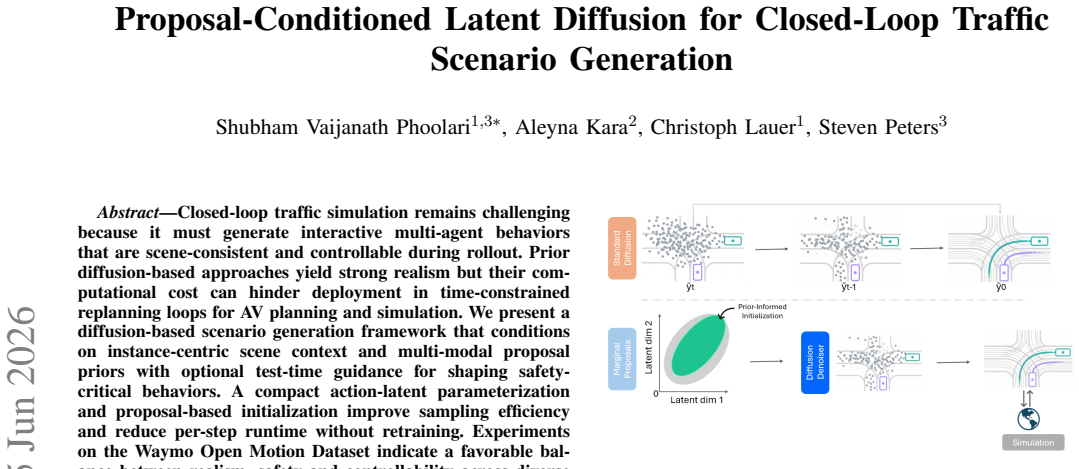
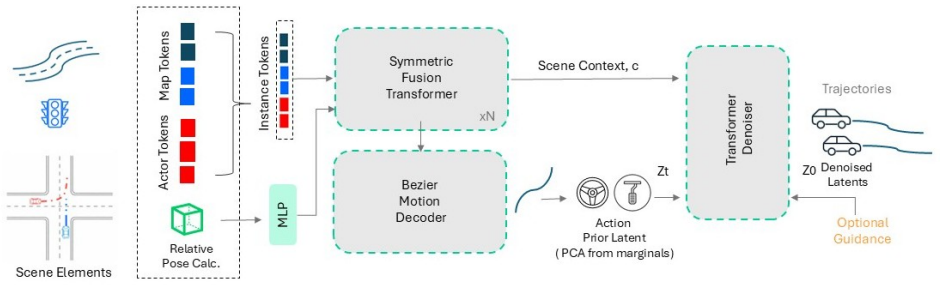
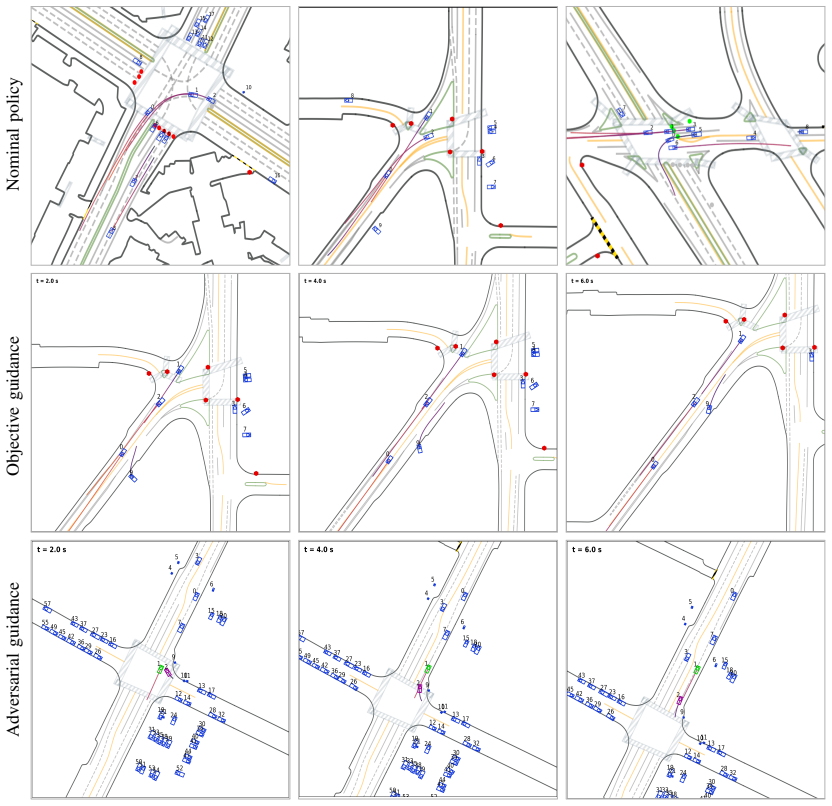
The framework conditions a latent diffusion model on instance-centric scene context and multimodal proposal priors for generating scene-consistent, controllable multi-agent behaviors in closed-loop traffic simulation. A compact action-latent representation together with proposal-based initialization reduces per-step runtime and improves sampling efficiency without retraining. Optional test-time guidance shapes safety-critical behaviors, enabling trade-offs among realism, safety, and controllability as demonstrated on the Waymo Open Motion Dataset.
What carries the argument
Proposal-conditioned latent diffusion model that uses multimodal proposal priors, a compact action-latent representation, and proposal-based initialization for efficient sampling and optional test-time guidance.
If this is right
- The method supports deployment inside time-constrained replanning loops for autonomous vehicle planning and simulation.
- It produces a favorable balance among realism, safety, and controllability across diverse interactive scenarios.
- Test-time guidance enables systematic trade-offs among competing objectives without any retraining step.
- Scene consistency and controllability remain intact throughout the full rollout length.
Where Pith is reading between the lines
- The same conditioning approach might transfer to generating scenarios for other multi-agent systems such as pedestrian crowds or drone swarms.
- The runtime reduction could support higher-frequency scenario regeneration inside live simulation environments.
- Test-time guidance could be paired with domain-specific safety metrics from existing AV test protocols to produce targeted edge cases.
Load-bearing premise
Conditioning on multimodal proposal priors together with a compact action-latent representation and proposal-based initialization will improve sampling efficiency and reduce per-step runtime without retraining while preserving scene-consistency and controllability throughout rollout.
What would settle it
An ablation on the Waymo Open Motion Dataset that removes proposal conditioning and the compact latent representation, then measures changes in per-step runtime, scene-consistency metrics, and controllability scores, would show whether the claimed efficiency gains hold without quality loss.
Figures
read the original abstract
Closed-loop traffic simulation remains challenging because it must generate interactive multi-agent behaviors that are scene-consistent and controllable throughout rollout. Prior diffusion-based approaches achieve strong realism, but their computational cost can hinder deployment in time-constrained replanning loops for autonomous vehicle planning and simulation. We present a diffusion-based scenario generation framework conditioned on instance-centric scene context and multimodal proposal priors, with optional test-time guidance for shaping safety-critical behaviors. A compact action-latent representation and proposal-based initialization improve sampling efficiency and reduce per-step runtime without retraining. Experiments on the Waymo Open Motion Dataset demonstrate a favorable balance among realism, safety, and controllability across diverse interactive scenarios, while showing that test-time guidance enables systematic trade-offs among competing objectives.
Editorial analysis
A structured set of objections, weighed in public.
Referee Report
Summary. The paper proposes a diffusion-based framework for closed-loop traffic scenario generation conditioned on instance-centric scene context and multimodal proposal priors, incorporating a compact action-latent representation, proposal-based initialization for sampling efficiency without retraining, and optional test-time guidance to shape safety-critical behaviors. Experiments on the Waymo Open Motion Dataset are presented as demonstrating a favorable balance among realism, safety, and controllability across interactive scenarios, with guidance enabling systematic objective trade-offs.
Significance. If the claimed experimental outcomes hold with appropriate metrics and long-horizon validation, the approach could offer a practical improvement over prior diffusion methods for time-constrained replanning in autonomous vehicle simulation by enhancing efficiency while preserving controllability and scene consistency.
major comments (1)
- [Abstract] Abstract: The central efficiency claim (improved sampling efficiency and reduced per-step runtime via proposal-based initialization) is load-bearing for the contribution, yet the abstract supplies no quantitative metrics, baselines, error bars, or details on evaluation horizons; this leaves open whether cumulative runtime and consistency are measured over multi-second closed-loop rollouts where initial proposals may become inconsistent, as raised by the stress-test concern.
Simulated Author's Rebuttal
We thank the referee for the constructive feedback on the abstract. We agree that quantitative support for the efficiency claims should be included and will revise the abstract accordingly. We address the comment in detail below.
read point-by-point responses
-
Referee: [Abstract] Abstract: The central efficiency claim (improved sampling efficiency and reduced per-step runtime via proposal-based initialization) is load-bearing for the contribution, yet the abstract supplies no quantitative metrics, baselines, error bars, or details on evaluation horizons; this leaves open whether cumulative runtime and consistency are measured over multi-second closed-loop rollouts where initial proposals may become inconsistent, as raised by the stress-test concern.
Authors: We agree the abstract should include quantitative metrics. In the revision we will add specific figures on sampling efficiency gains (e.g., X% fewer steps) and per-step runtime reduction versus baselines, including error bars. Our closed-loop experiments use the standard 8-second Waymo horizons; we will state this explicitly. Cumulative runtime and consistency over these horizons are reported in Section 4, and our stress-test results (Figure 7) confirm that proposal-based initialization preserves consistency without drift. We will also note cumulative runtime measurements in the abstract. revision: yes
Circularity Check
No circularity; claims rest on external dataset experiments
full rationale
The paper describes a diffusion-based framework with conditioning on scene context and multimodal proposals, plus a compact action-latent representation. All performance claims (realism/safety/controllability balance, efficiency gains, test-time guidance trade-offs) are supported by experiments on the external Waymo Open Motion Dataset rather than any self-referential definitions, fitted parameters renamed as predictions, or self-citation chains. No equations appear in the provided text that would reduce a derived quantity to its inputs by construction. This is the common case of an empirical method paper whose central results are falsifiable against held-out data.
Axiom & Free-Parameter Ledger
Reference graph
Works this paper leans on
-
[1]
The Release of Autonomous Vehicles,
W. Wachenfeld and H. Winner, “The Release of Autonomous Vehicles,” in Autonomous Driving: Technical, Legal and Social Aspects, Springer, pp. 425–449, 2016, doi:10.1007/978-3-662-48847-8 21
-
[2]
TrafficSim: Learning to Simulate Realistic Multi-Agent Behaviors,
S. Suo, S. Regalado, S. Casas, and R. Urtasun, “TrafficSim: Learning to Simulate Realistic Multi-Agent Behaviors,” in2021 IEEE/CVF Conference on Computer Vision and Pattern Recognition (CVPR). Los Alamitos, CA, USA: IEEE Computer Society, Jun. 2021, pp. 10 395–10 404
2021
-
[3]
TrafficGen: Learning to Gen- erate Diverse and Realistic Traffic Scenarios,
L. Feng, Q. Li, Z. Peng, S. Tan, and B. Zhou, “TrafficGen: Learning to Gen- erate Diverse and Realistic Traffic Scenarios,” in2023 IEEE International Conference on Robotics and Automation (ICRA), 2023, pp. 3567–3575
2023
-
[4]
Generating Useful Accident-Prone Driving Scenarios via a Learned Traffic Prior,
D. Rempe, J. Philion, L. J. Guibas, S. Fidler, and O. Litany, “Generating Useful Accident-Prone Driving Scenarios via a Learned Traffic Prior,” in 2022 IEEE/CVF Conference on Computer Vision and Pattern Recognition (CVPR), 2022, pp. 17 284–17 294
2022
-
[5]
KING: Generating Safety-Critical Driving Scenarios for Robust Imitation via Kinematics Gradients,
N. Hanselmann, K. Renz, K. Chitta, A. Bhattacharyya, and A. Geiger, “KING: Generating Safety-Critical Driving Scenarios for Robust Imitation via Kinematics Gradients,” arXiv:2204.13683, 2022
-
[6]
MotionDiffuser: Controllable Multi-Agent Motion Prediction Using Dif- fusion,
C. M. Jiang, A. Cornman, C. Park, B. Sapp, Y . Zhou, and D. Anguelov, “MotionDiffuser: Controllable Multi-Agent Motion Prediction Using Dif- fusion,” in2023 IEEE/CVF Conference on Computer Vision and Pattern Recognition (CVPR). Los Alamitos, CA, USA: IEEE Computer Society, Jun. 2023, pp. 9644–9653
2023
-
[7]
Versatile Behavior Diffusion for Generalized Traffic Agent Simulation,
Z. Huang, Z. Zhang, A. Vaidya, Y . Chen, C. Lv, and J. F. Fisac, “Versatile Behavior Diffusion for Generalized Traffic Agent Simulation,” arXiv : 2404.02524v3, Feb. 2026
-
[8]
Optimizing Diffusion Models for Joint Trajectory Prediction and Controllable Generation,
Y . Wang, C. Tang, L. Sun, S. Rossi, Y . Xie, C. Peng, T. Hannagan, S. Saba- tini, N. Poerio, M. Tomizuka, and W. Zhan, “Optimizing Diffusion Models for Joint Trajectory Prediction and Controllable Generation,” inComputer Vision – ECCV 2024, L. Leonardis, E. Ricci, S. Roth, O. Russakovsky, T. Sattler, and G. Varol, Eds., ser.Lecture Notes in Computer Scie...
2024
-
[9]
Efficient and Unbiased Safety Test for Autonomous Driving Systems,
Z. Jiang, W. Pan, J. Liu, S. Dang, Z. Yang, H. Li, and Y . Pan, “Efficient and Unbiased Safety Test for Autonomous Driving Systems,”IEEE Trans- actions on Intelligent Vehicles, vol. 8, no. 5, pp. 3336–3348, 2023
2023
-
[10]
A Multimodal Importance Sampling Approach for the Probabilistic Safety Assessment of Automated Driver Assistance Systems,
T. Most, M. Rasch, P. T. Ubben, R. Niemeier, and V . Bayer, “A Multimodal Importance Sampling Approach for the Probabilistic Safety Assessment of Automated Driver Assistance Systems,”Journal of Autonomous Vehicles and Systems, vol. 3, no. 1, p. 011001, 2024
2024
-
[11]
Trustworthy Safety Improvement for Autonomous Driving Using Reinforcement Learning,
Z. Cao, S. Xu, X. Jiao, H. Peng, and D. Yang, “Trustworthy Safety Improvement for Autonomous Driving Using Reinforcement Learning,” Transportation Research Part C: Emerging Technologies, vol. 138, p. 103656, 2022
2022
-
[12]
DeFIX: Detecting and Fixing Failure Scenarios with Reinforcement Learning in Imitation Learning Based Autonomous Driving,
R. Dagdanov, F. Eksen, H. Durmus, F. Yurdakul, and N. K. Ure, “DeFIX: Detecting and Fixing Failure Scenarios with Reinforcement Learning in Imitation Learning Based Autonomous Driving,” inProc. IEEE Int. Conf. on Intelligent Transportation Systems (ITSC), 2022, pp. 4215–4220
2022
-
[13]
CAT: Closed-Loop Adversarial Training for Safe End-to-End Driving,
L. Zhang, Z. Peng, Q. Li, and B. Zhou, “CAT: Closed-Loop Adversarial Training for Safe End-to-End Driving,” arXiv:2310.12432, 2023
-
[14]
Adversarial Safety-Critical Scenario Generation Using Naturalistic Human Driving Priors,
K. Hao, W. Cui, Y . Luo, L. Xie, Y . Bai, J. Yang, S. Yan, Y . Pan, and Z. Yang, “Adversarial Safety-Critical Scenario Generation Using Naturalistic Human Driving Priors,”IEEE Transactions on Intelligent Vehicles, vol. 9, no. 9, pp. 5392–5406, 2024
2024
-
[15]
Congested Traffic States in Empirical Observations and Microscopic Simulations,
M. Treiber, A. Hennecke, and D. Helbing, “Congested Traffic States in Empirical Observations and Microscopic Simulations,”Physical Review E, vol. 62, no. 2, pp. 1805–1824, 2000
2000
-
[16]
General Lane-Changing Model MOBIL for Car-Following Models,
A. Kesting, M. Treiber, and D. Helbing, “General Lane-Changing Model MOBIL for Car-Following Models,”Transportation Research Record, vol. 1999, no. 1, pp. 86–94, 2007
1999
-
[17]
Waymax: An Accelerated, Data-Driven Simulator for Large-Scale Autonomous Driving Research,
C. Gulinoet al., “Waymax: An Accelerated, Data-Driven Simulator for Large-Scale Autonomous Driving Research,” arXiv:2310.08710, 2023
-
[18]
Stochastic Tra- jectory Prediction via Motion Indeterminacy Diffusion,
T. Gu, G. Chen, J. Li, C. Lin, Y . Rao, J. Zhou, and J. Lu, “Stochastic Tra- jectory Prediction via Motion Indeterminacy Diffusion,” arXiv:2203.13777, 2022
-
[19]
Intention-Aware Denoising Diffusion Model for Trajectory Prediction,
C. Liu, S. He, H. Liu, and J. Chen, “Intention-Aware Denoising Diffusion Model for Trajectory Prediction,”IEEE Transactions on Intelligent Trans- portation Systems, vol. 26, no. 5, pp. 5915–5930, 2025
2025
-
[20]
Unsupervised Sampling Pro- moting for Stochastic Human Trajectory Prediction,
G. Chen, Z. Chen, S. Fan, and K. Zhang, “Unsupervised Sampling Pro- moting for Stochastic Human Trajectory Prediction,” inProceedings of the IEEE/CVF Conference on Computer Vision and Pattern Recognition (CVPR), June 2023, pp. 17 874–17 884
2023
-
[21]
Diffusion Models Beat GANs on Image Synthesis
P. Dhariwal and A. Nichol, “Diffusion Models Beat GANs on Image Synthesis,” arXiv:2105.05233, 2021
work page internal anchor Pith review Pith/arXiv arXiv 2021
-
[22]
Classifier-Free Diffusion Guidance
J. Ho and T. Salimans, “Classifier-Free Diffusion Guidance,” arXiv : 2207.12598, 2022
work page internal anchor Pith review Pith/arXiv arXiv 2022
-
[23]
Compositional Visual Generation with Composable Diffusion Models,
N. Liu, S. Li, Y . Du, A. Torralba, and J. B. Tenenbaum, “Compositional Visual Generation with Composable Diffusion Models,” arXiv:2206.01714, 2023
-
[24]
Diffusion-ES: Gradient-Free Planning with Diffusion for Autonomous and Instruction-Guided Driving,
B. Yang, H. Su, N. Gkanatsios, T.-W. Ke, A. Jain, J. Schneider, and K. Fragkiadaki, “Diffusion-ES: Gradient-Free Planning with Diffusion for Autonomous and Instruction-Guided Driving,” in2024 IEEE/CVF Con- ference on Computer Vision and Pattern Recognition (CVPR), 2024, pp. 15 342–15 353
2024
-
[25]
GameFormer: Game-theoretic Modeling and Learning of Transformer-Based Interactive Prediction and Planning for Autonomous Driving,
Z. Huang, H. Liu, and C. Lv, “GameFormer: Game-theoretic Modeling and Learning of Transformer-Based Interactive Prediction and Planning for Autonomous Driving,” in2023 IEEE/CVF International Conference on Computer Vision (ICCV), 2023, pp. 3880–3890
2023
-
[26]
SIMPL: A Simple and Efficient Multi-Agent Motion Prediction Baseline for Autonomous Driving,
L. Zhang, P. Li, S. Liu, and S. Shen, “SIMPL: A Simple and Efficient Multi-Agent Motion Prediction Baseline for Autonomous Driving,”IEEE Robotics and Automation Letters, vol. 9, no. 4, pp. 3767–3774, 2024
2024
-
[27]
Denoising Diffusion Probabilistic Models,
J. Ho, A. Jain, and P. Abbeel, “Denoising Diffusion Probabilistic Models,” inAdvances in Neural Information Processing Systems, 2020
2020
-
[28]
Denoising Diffusion Implicit Models,
J. Song, C. Meng, and S. Ermon, “Denoising Diffusion Implicit Models,” in Proc. International Conference on Learning Representations (ICLR), 2021
2021
-
[29]
Large-Scale Interac- tive Motion Forecasting for Autonomous Driving: Waymo Open Motion Dataset,
S. Ettinger, S. Cheng, B. Caine, C. Liu, H. Zhao, S. Pradhan, Y . Chai, B. Sapp, C. Qi, Y . Zhou, Z. Yang, A. Chouard, P. Sun, J. Ngiam, V . Va- sudevan, A. McCauley, J. Shlens, and D. Anguelov, “Large-Scale Interac- tive Motion Forecasting for Autonomous Driving: Waymo Open Motion Dataset,” in2021 IEEE/CVF International Conference on Computer Vision (ICC...
2021
-
[30]
The 2nd Place Solution for 2023 Waymo Open Sim Agents Challenge,
C. Qian, D. Xiu, and M. Tian, “The 2nd Place Solution for 2023 Waymo Open Sim Agents Challenge,” arXiv:2306.15914, 2023
-
[31]
Waymax: An Accelerated, Data-Driven Simulator for Large-Scale Autonomous Driving Research,
C. Gulinoet al., “Waymax: An Accelerated, Data-Driven Simulator for Large-Scale Autonomous Driving Research,” inAdvances in Neural Infor- mation Processing Systems (NeurIPS), 2023
2023
-
[32]
SAFE-SIM: Safety-Critical Closed-Loop Traffic Simulation with Diffusion-Controllable Adversaries,
W.-J. Chang, F. Pittaluga, M. Tomizuka, W. Zhan, and M. Chan- draker, “SAFE-SIM: Safety-Critical Closed-Loop Traffic Simulation with Diffusion-Controllable Adversaries,” arXiv:2401.00391, 2024
-
[33]
Guided Conditional Diffusion for Controllable Traffic Simula- tion,
Z. Zhong, D. Rempe, D. Xu, Y . Chen, S. Veer, T. Che, B. Ray, and M. Pavone, “Guided Conditional Diffusion for Controllable Traffic Simula- tion,” in2023 IEEE International Conference on Robotics and Automation (ICRA), 2023, pp. 3560–3566
2023
discussion (0)
Sign in with ORCID, Apple, or X to comment. Anyone can read and Pith papers without signing in.