REVIEW 3 major objections 4 minor 4 cited by
Identifying regions for asymptotic expansions of amplitudes: fundamentals and recent advances
T0 review · 3 major / 4 minor · reviewed 2026-08-16 · deepseek-v4-flash
Pith's one-line read A Feynman integral's asymptotic expansion can be organized by splitting its regions into facet regions, visible as lower faces of a Newton polytope, and hidden regions, which require polytope dissection; in wide-angle scattering the…
desk verdict Useful review of region identification, but the exhaustive hidden-region enumerations outrun the completeness of the search algorithm — worth a serious referee with revision. read the letter →
The pith
A machine-rendered reading of the paper's core claim, the machinery that carries it, and where it could break.
The reading
What carries the argument
The load-bearing object is the Newton polytope $\Delta(P)$ of the Lee-Pomeransky polynomial $P(x;s)=U+F$, whose points encode the exponents of each monomial together with the scaling of its kinematic coefficient, $s\cdot x^a\mapsto(a,b)$. Lower facets of this polytope—facets whose inward normal has positive last entry—give region vectors whose first entries are the $\lambda$-exponents of the parameters, so identifying facet regions reduces to finding lower facets. Hidden regions are handled by a second mechanism: Landau equations locate pinch singularities inside the integration domain, and a recursive search algorithm over $F_+$ and $F_-$ decides whether cancellations can occur; then a polytope dissection changes variables so that the pinch moves to an endpoint and the region becomes a facet of a sub-polytope. The graph-theoretic reformulation in terms of minimum spanning (2-)trees is what makes the all-loop facet theorem and the enumeration algorithms possible.
What would settle it
Search the 1081 four-loop $2\to 2$ wide-angle graphs identified as having potential pinch singularities: if any of them develops a hidden region whose momentum configuration is not a Landshoff scattering after polytope dissection, the conjecture that all hidden regions are Landshoff fails. A more basic test would be to find any Feynman integral in which the method-of-regions sum disagrees with a direct evaluation order by order in $\lambda$, which would refute the foundational assumption on which every region list in this review depends.
Extended reading notes
Core claim
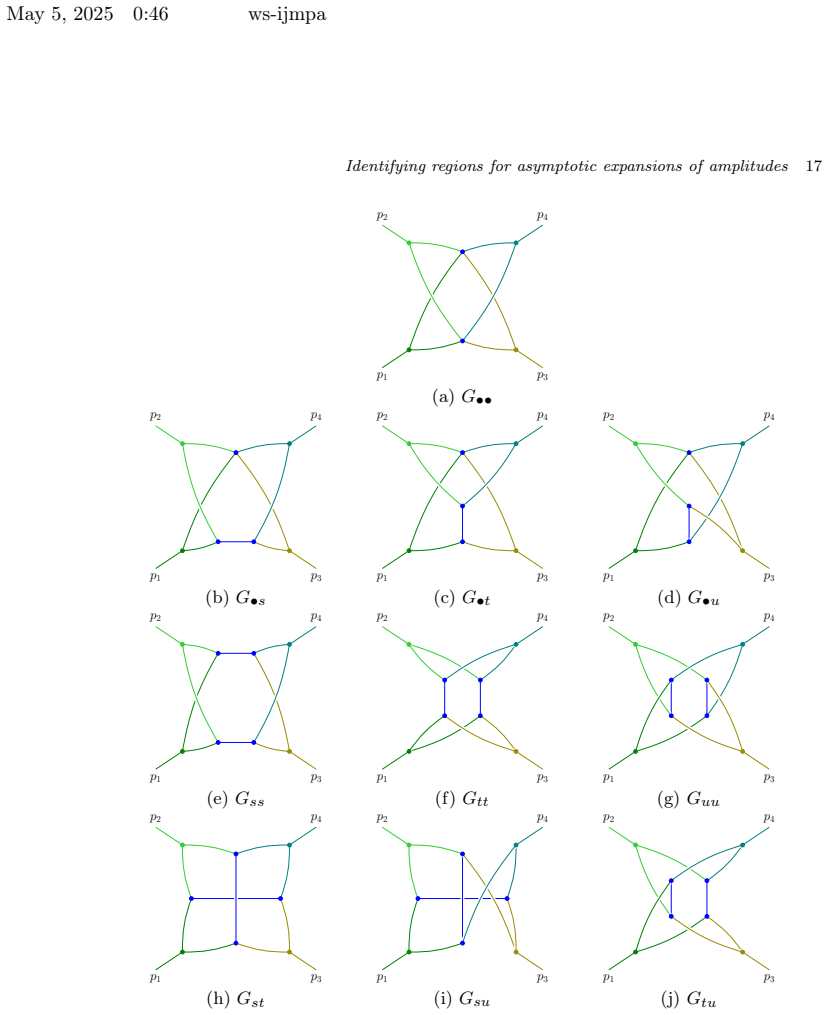
The paper's central claim is that region identification in the method of regions is a solved problem for a broad class of asymptotic expansions once regions are split into two types. Facet regions are in one-to-one correspondence with the lower facets of the Newton polytope of the Lee-Pomeransky polynomial, so their parameter scalings are monomials $x_i\sim\lambda^{v_i}$; for the on-shell expansion of wide-angle scattering, an all-loop theorem asserts the complete configuration: one connected hard subgraph, one connected jet per external lightlike momentum, and a possibly disconnected soft subgraph, with constraints that exclude scaleless integrals. Hidden regions cannot be seen on polytope facets: they arise from cancellations in the $F$ polynomial satisfying Landau equations, and the paper's strategy is to dissect the polytope into sub-polytopes in which the pinch becomes an endpoint. Applied to $2\to 2$ wide-angle scattering, this dissection yields exactly ten three-loop graphs with one hidden region each, and in every case the region is a Landshoff configuration where hard scatterings occur at distinct locations; at four loops all 1081 potential graphs contain three-loop subtopologies. The same ten graphs reappear as the hidden regions of the Regge-limit expansion, where the exchanged mode is Glauber rather than Landshoff.
Load-bearing premise
The whole region list is only as trustworthy as the method of regions itself: the identity $I=\sum I(R_i)$ with scaleless integrals set to zero has no rigorous proof or counterexample, and a failure of that identity would invalidate any region list built on it.
Editorial extensions
If this is right
- For any wide-angle on-shell expansion, no momentum mode beyond hard, collinear, and soft can appear in a facet region; alternative scalings always give scaleless integrals.
- Every hidden region of a $2\to 2$ wide-angle scattering is a Landshoff configuration; at three loops there are exactly ten such graphs, and at four loops all candidate graphs contain one of these ten.
- A region-finding algorithm can enumerate regions by graph structure alone, without building the polytope, at least for the on-shell expansion.
- In the Regge limit the same hidden-region graphs exchange a Glauber momentum, so Glauber singularities and Landshoff singularities are two faces of the same pinch mechanism.
- The soft, timelike-collinear, and heavy-to-light mass expansions each require extra jet compatibility constraints, and the mass and Regge expansions develop cascades of modes that appear every two loop orders.
Reading between the lines
- If the Landshoff conjecture holds for generic wide-angle kinematics, then the minimal loop order at which hidden regions appear should track the number of distinct lightlike directions that enter separate hard vertices; the appearance of hidden regions already at two loops in $2\to 3$ scattering is a first test of that counting.
- Because the facet/hidden split is independent of numerator and spacetime dimension, the same dissection strategy should apply verbatim to phase-space integrals, where the paper notes only initial progress has been made.
- A rigorous proof of the method of regions would presumably need to show that every possible pinch is either an endpoint (facet) or convertible to an endpoint by dissection; the classification in this review is a constructive candidate for that missing step.
- The correspondence between hidden regions and disconnected off-shell subgraphs suggests that effective-theory descriptions built only from hard, collinear, and soft fields will miss the Landshoff and Glauber configurations that appear in individual integrals, even when amplitudes summed over regions remain correct.
Signed reviews
Editorial analysis
A structured set of objections, weighed in public.
Referee Report
Summary. This paper is a review of systematic methods for identifying regions in the method-of-regions expansion of Feynman integrals. It introduces a classification of regions into facet regions (visible as lower facets of the Newton polytope of the Lee-Pomeransky polynomial) and hidden regions (interior to the polytope, arising from Landau-equation pinches). The proposed strategy for facet regions is graph-theoretic, based on minimum spanning (2-)trees, and for hidden regions it combines a recursive Landau-equation search with polytope dissections that convert hidden regions into facet regions of sub-polytopes. The framework is applied to the on-shell expansion for wide-angle scattering, where an all-loop theorem for facet regions is cited from Ref. 17 and hidden regions at three and four loops are claimed to be exhaustively enumerated (ten and 1081 graphs, respectively) with the conjecture that all hidden regions are Landshoff-scattering configurations. The soft, timelike-collinear, and heavy-to-light mass expansions are discussed, and the Regge-limit expansion for 2 to 2 forward scattering is treated, with claims of a cascade of momentum modes and hidden Glauber regions.
Significance. If the claims are correct, the paper provides a valuable unifying geometric framework for region identification, connecting Newton polytopes, Landau singularities, and graph topology, with potential applications to automating multiloop asymptotic expansions and to understanding factorization violations. The paper is clearly written, carefully distinguishes theorems from conjectures in most places, and includes instructive one-loop examples (Sudakov form factor, one-loop five-point graphs) that make the ideas concrete. The cited proofs in Refs. 16-18 provide a solid basis for the facet-region theorem and for the dissection methodology, and the paper explicitly labels its higher-loop statements (e.g., the Landshoff configuration conjecture) as conjectures. The significance is tempered, however, by the fact that the completeness of the hidden-region search algorithm is not established, and the Regge-limit results are stated without derivation or citation; as a result, the paper's central claim to provide a systematic way to identify all regions is stronger than the evidence presented.
major comments (3)
- [§2.3.2, §3.2, §5.2] The recursive search algorithm in §2.3.2 is explicitly a necessary-condition filter: the text states that the output 'represents only a necessary condition' and that cancellations might occur for unphysical (negative or complex) α_e values. Nevertheless, §3.2 uses the algorithm to make exhaustive statements—'At three-loop level, there are ten graphs with potential pinch singularities' (Fig. 7 caption: 'All the massless four-point three-loop graphs ...')—and §5.2 repeats the same enumeration for the Regge limit and further claims that 'all four-loop graphs with hidden regions can be constructed by adding one loop to one of the ten three-loop base graphs.' No completeness proof is given that the recursion detects every positive solution of the Landau equations and that every 'no pinch' output is definitive. Since false negatives would invalidate the Landshoff/Glauber picture as a complete classification of hidden regions, this is a load-bearing gap. The claims should be either backed by a proof (or a reference to one) or explicitly labeled as conjectures or partial results.
- [§5.2.1, Eqs. (23)–(24)] The facet-region structure of the Regge-limit expansion is stated without any derivation or citation. In particular, the mode list in Eq. (23) (soft, soft·collinear, (collinear)^2 modes), Eq. (24) (higher-order analogues), the assertion that new modes emerge incrementally every two-loop order, and the statement that the upper/lower jet structure with Glauber modes is a facet region (Fig. 15) are all presented as established facts, but no reference to prior work or proof sketch is given. Unlike the on-shell-expansion theorem of §3.1, which is explicitly attributed to Ref. 17, these Regge-limit results appear to be new or unpublished. The reader cannot assess their validity; please provide references, derivations, or explicit conjecture labels.
- [§2.3.2] The dissection strategy is described as producing 'a complete set of regions' after converting hidden regions to facet regions of sub-polytopes. Completeness requires that every hidden region of the original integral is captured by at least one sub-polytope and that the union of facet regions of the sub-polytopes does not introduce spurious regions. The paper refers to Ref. 18 for details, but the review's own use of this completeness to justify statements such as 'each of the ten graphs in Fig. 7 has a unique hidden region' goes beyond what is demonstrated here. Please state explicitly which parts of the dissection procedure are proven in Ref. 18 and which remain conjectural.
minor comments (4)
- [§5.1] The characterization of Glauber scaling appears reversed: for kμ ∼ (λ, λ, λ^{1/2}), the two longitudinal (lightcone) components are O(λ) and the transverse components are O(λ^{1/2}), not vice versa as stated in the text.
- [§4.1] The paragraph beginning 'The soft expansion can be seen as a generalization of the on-shell expansion' is repeated almost verbatim in two consecutive paragraphs; the duplication should be removed.
- [§3.2] The phrase 'an search algorithm' should be 'a search algorithm'.
- [§6] The sentence 'Below let me list a few representative s' contains a typo; it should read 'a few representatives'.
Circularity Check
No circularity: the paper is a review that imports prior-work theorems and labels its open claims as conjectures; no derivation reduces to its own input.
full rationale
This paper is a review article, so the load-bearing results are imported from Refs. 16-18 rather than re-derived. Importing a theorem from the author's own prior paper is not itself circular: Section 3.1 cites Ref. 17 for the on-shell-expansion region theorem, and Section 2.3.1 sketches the proof strategy (minimum-weight criterion and facet criterion), so the conclusion is not redefined into the premise. The hidden-region algorithm in Section 2.3.2 is explicitly a necessary-condition filter: the paper states that the output represents "only a necessary condition." The subsequent enumerative claims about ten three-loop and 1081 four-loop graphs therefore depend on a completeness assumption that is not proved, but that is a correctness or verification gap, not a circular reduction. The Landshoff characterization is explicitly announced as a conjecture. No fitted parameter is renamed as a prediction, no equation is defined in terms of its own output, and no alternative is excluded solely by an unverified self-citation. The heavy self-citation is notable but does not make the logic circular.
Assumptions & free parameters
assumptions (6)
- domain assumption The method of regions expansion I = Σ I(R_i) (Eq. 2) is valid for the considered integrals.
- domain assumption Regions in momentum space correspond to lower facets of the Newton polytope of the Lee-Pomeransky polynomial (Section 2.1).
- domain assumption Dimensional regularization and the convention that all scaleless integrals vanish are used (Section 1).
- standard math The Landau equations (Eq. 14) are necessary conditions for pinch singularities in parameter space (Section 2.3.2).
- ad hoc to paper The polytope dissection procedure converts hidden regions into facet regions of sub-polytopes, and the resulting region list is complete (Section 2.3.2).
- ad hoc to paper The search algorithm steps 1-3 (Section 2.3.2) identify all graphs with potential pinch singularities at a given loop order.
Cite this review
Pith. "Pith review of Identifying regions for asymptotic expansions of amplitudes: fundamentals and recent advances." pith.science (2026). https://pith.science/paper/VHQXBUBD
@misc{pith2026250501368,
  author       = {Pith},
  title        = {Pith review of: Identifying regions for asymptotic expansions of amplitudes: fundamentals and recent advances},
  year         = {2026},
  howpublished = {\url{https://pith.science/paper/VHQXBUBD}},
  note         = {Machine review of arXiv:2505.01368}
}
read the original abstract
This review paper discusses the identification of regions, a crucial first step in applying the "method-of-regions" technique. A systematic approach based on Newton polytope geometry has proven successful and efficient for many cases. However, obtaining the correct list of regions becomes increasingly subtle with higher loop numbers or specific Feynman graph topologies. This paper explores the scenarios where such subtleties arise, outlines general strategies to address them, and reviews the current understanding of region structures in various asymptotic expansions of Feynman integrals.
Figures


Figures from the paper (13 more)




Forward citations
Cited by 4 Pith papers
-
geoSCET: Soft Theorems from Power Counting
geoSCET derives geometric soft theorems for scalar field theories directly from effective-field-theory power counting and proves they are exact to all orders in perturbation theory when no potential is present.
-
Spacelike-Collinear Scattering by the Method of Regions
The kinematic factorisation-violating part of the two-loop spacelike-collinear splitting amplitude comes entirely from a single hidden region with soft and Glauber loop momenta.
-
Random Reshuffling-Based Distributed Nash Equilibrium Seeking
Random reshuffling yields distributed Nash-seeking algorithms that, under partial decision information, converge linearly to a neighborhood (constant steps) or exactly a.s./in mean square (diminishing steps), outperfo...
-
Low-energy theory of jet processes and PDF factorization
A three-loop Glauber contribution to low-energy soft-collinear matrix elements exactly cancels the collinear factorization-violating terms, so DGLAP running and PDF factorization are consistent with super-leading logarithms.
Reference graph
Works this paper leans on
-
[1]
R. N. Lee, A. V. Smirnov and V. A. Smirnov, JHEP 03, 008 (2018), arXiv:1709.07525 [hep-ph] , doi:10.1007/JHEP03(2018)008
arXiv 2018
-
[2]
R. J. Eden, P. V. Landshoff, D. I. Olive and J. C. Polkinghorn e, The analytic S-matrix (Cambridge University Press, 2002)
2002
-
[3]
G. F. Sterman, An Introduction to quantum field theory (Cambridge University Press, 1993). May 5, 2025 0:46 ws-ijmpa 30 Yao Ma
1993
-
[4]
G. F. Sterman, Partons, factorization and resummation, T ASI 95, in QCD and beyond. Proceedings, Theoretical Advanced Study Insti tute in Elementary Par- ticle Physics, TASI-95, Boulder, USA, June 4-30, 1995 , (1995), pp. 327–408, arXiv:hep-ph/9606312 [hep-ph]
arXiv 1995
-
[5]
J. C. Collins, D. E. Soper and G. F. Sterman, Adv. Ser. Direct. High Energy Phys. 5, 1 (1989), arXiv:hep-ph/0409313 [hep-ph] , doi:10.1142/9789814503266_0001
arXiv 1989
-
[6]
Collins, Foundations of perturbative QCD (Cambridge University Press, 2011)
J. Collins, Foundations of perturbative QCD (Cambridge University Press, 2011)
work page 2011
-
[7]
I. W. Stewart and C. W. Bauer, Lectures on the soft-colline ar effective theory (2013)
work page 2013
- [8]
Show all 82 references
-
[9]
Agarwal, L
N. Agarwal, L. Magnea, C. Signorile-Signorile and A. Trip athi, arXiv preprint arXiv:2112.07099 (2021)
2021 arXiv
-
[10]
Beneke and V
M. Beneke and V. A. Smirnov, Nucl. Phys. B522, 321 (1998), arXiv:hep-ph/9711391 [hep-ph] , doi:10.1016/S0550-3213(98)00138-2
1998 arXiv
-
[11]
Anastasiou, E
C. Anastasiou, E. W. N. Glover and C. Oleari, Nucl. Phys. B 572, 307 (2000), arXiv:hep-ph/9907494, doi:10.1016/S0550-3213(99)00637-9
2000 arXiv
-
[12]
Jantzen, JHEP 12, 076 (2011), arXiv:1111.2589 [hep-ph] , doi:10.1007/ JHEP12(2011)076
B. Jantzen, JHEP 12, 076 (2011), arXiv:1111.2589 [hep-ph] , doi:10.1007/ JHEP12(2011)076
2011 arXiv
-
[13]
G. B. Pivovarov and F. V. Tkachov (1986)
1986
-
[14]
V. A. Smirnov, Communications in mathematical physics 134, 109 (1990)
1990
-
[15]
V. A. Smirnov, Applied asymptotic expansions in momenta and masses (Springer, 2003)
2003
-
[16]
Gardi, F
E. Gardi, F. Herzog, S. Jones, Y. Ma and J. Schlenk, JHEP 07, 197 (2023), arXiv:2211.14845 [hep-th] , doi:10.1007/JHEP07(2023)197
2023 arXiv
-
[17]
Ma, JHEP 09, 197 (2024), arXiv:2312.14012 [hep-ph] , doi:10.1007/ JHEP09(2024)197
Y. Ma, JHEP 09, 197 (2024), arXiv:2312.14012 [hep-ph] , doi:10.1007/ JHEP09(2024)197
2024 arXiv
-
[18]
Gardi, F
E. Gardi, F. Herzog, S. Jones and Y. Ma, JHEP 08, 127 (2024), arXiv:2407.13738 [hep-th] , doi:10.1007/JHEP08(2024)127
2024 arXiv
-
[19]
R. N. Lee and A. A. Pomeransky, JHEP 11, 165 (2013), arXiv:1308.6676 [hep-ph] , doi:10.1007/JHEP11(2013)165
2013 arXiv
-
[20]
Pak and A
A. Pak and A. Smirnov, The European Physical Journal C 71, 1 (2011)
2011
-
[21]
Jantzen, A
B. Jantzen, A. V. Smirnov and V. A. Smirnov, The European Physical Journal C 72, 1 (2012)
2012
-
[22]
T. Y. Semenova, A. V. Smirnov and V. A. Smirnov, The European Physical Journal C 79, 1 (2019)
2019
-
[23]
Ananthanarayan, A
B. Ananthanarayan, A. Pal, S. Ramanan and R. Sarkar, The European Physical Jour- nal C 79, 1 (2019)
2019
-
[24]
Heinrich, S
G. Heinrich, S. Jahn, S. Jones, M. Kerner, F. Langer, V. Ma gerya, A. Poldaru, J. Schlenk and E. Villa, Computer Physics Communications 273, 108267 (2022)
2022
-
[25]
Chen, Comput
W. Chen, Comput. Phys. Commun. 312, 109607 (2025), arXiv:2408.06426 [hep-ph] , doi:10.1016/j.cpc.2025.109607
2025 arXiv
-
[26]
Landau, Nuclear Physics 13, 181 (1959)
L. Landau, Nuclear Physics 13, 181 (1959)
1959
-
[27]
Jaskiewicz, S
S. Jaskiewicz, S. Jones, R. Szafron and Y. Ulrich (12 2024 ), arXiv:2501.00587 [hep-ph]
2024 arXiv
-
[28]
J.-Y. Hou, J. Wang and D.-J. Zhang (1 2025), arXiv:2501.11824 [hep-ph]
2025 arXiv
-
[29]
Becher, P
T. Becher, P. Hager, S. Jaskiewicz, M. Neubert and D. Schw ienbacher, Phys. Rev. Lett. 134, 061901 (2025), arXiv:2408.10308 [hep-ph] , doi:10.1103/PhysRevLett. 134.061901
2025 arXiv
-
[30]
Coleman and R
S. Coleman and R. E. Norton, Nuovo Cim. 38, 438 (1965), doi:10.1007/BF02750472
1965 doi
-
[31]
S. B. Libby and G. F. Sterman, Phys. Rev. D18, 3252 (1978), doi:10.1103/PhysRevD. May 5, 2025 0:46 ws-ijmpa Identifying regions for asymptotic expansions of amplitud es 31 18.3252
1978 doi
-
[32]
G. F. Sterman, Phys. Rev. D17, 2773 (1978), doi:10.1103/PhysRevD.17.2773
1978 doi
- [33]
-
[34]
G. F. Sterman and M. E. Tejeda-Yeomans, Phys. Lett. B552, 48 (2003), arXiv:hep-ph/0210130 [hep-ph] , doi:10.1016/S0370-2693(02)03100-3
2003 arXiv
-
[35]
L. J. Dixon, L. Magnea and G. F. Sterman, JHEP 08, 022 (2008), arXiv:0805.3515 [hep-ph] , doi:10.1088/1126-6708/2008/08/022
2008 arXiv
-
[36]
Feige and M
I. Feige and M. D. Schwartz, Phys. Rev. D90, 105020 (2014), arXiv:1403.6472 [hep-ph] , doi:10.1103/PhysRevD.90.105020
2014 arXiv
-
[37]
Erdoğan and G
O. Erdoğan and G. Sterman, Phys. Rev. D91, 065033 (2015), arXiv:1411.4588 [hep-ph] , doi:10.1103/PhysRevD.91.065033
2015 arXiv
-
[38]
Ma, JHEP 05, 012 (2020), arXiv:1910.11304 [hep-ph] , doi:10.1007/ JHEP05(2020)012
Y. Ma, JHEP 05, 012 (2020), arXiv:1910.11304 [hep-ph] , doi:10.1007/ JHEP05(2020)012
2020 arXiv
-
[39]
J. M. F. Labastida and G. F. Sterman, Nucl. Phys. B254, 425 (1985), doi:10.1016/ 0550-3213(85)90226-3
1985
-
[40]
Botts and G
J. Botts and G. F. Sterman, Nucl. Phys. B 325, 62 (1989), doi:10.1016/0550-3213(89) 90372-6
1989 doi
-
[41]
Y. J. Zhu (9 2020), arXiv:2009.08919 [hep-ph]
2020
-
[42]
Catani, L
S. Catani, L. Cieri, D. Colferai and F. Coradeschi, Eur. Phys. J. C 83, 38 (2023), arXiv:2210.09397 [hep-ph] , doi:10.1140/epjc/s10052-022-11141-y
2023 arXiv
-
[43]
Czakon, F
M. Czakon, F. Eschment and T. Schellenberger, JHEP 04, 065 (2023), arXiv:2211.06465 [hep-ph] , doi:10.1007/JHEP04(2023)065
2023 arXiv
-
[44]
Catani, D
S. Catani, D. Colferai and A. Torrini, JHEP 01, 118 (2020), arXiv:1908.01616 [hep-ph] , doi:10.1007/JHEP01(2020)118
2020 arXiv
-
[45]
Del Duca, C
V. Del Duca, C. Duhr, R. Haindl and Z. Liu, JHEP 01, 040 (2023), arXiv:2206.01584 [hep-ph] , doi:10.1007/JHEP01(2023)040
2023 arXiv
-
[46]
Herzog, Y
F. Herzog, Y. Ma, B. Mistlberger and A. Suresh, JHEP 12, 023 (2023), arXiv:2309.07884 [hep-ph] , doi:10.1007/JHEP12(2023)023
2023 arXiv
-
[47]
Chen, M.-x
W. Chen, M.-x. Luo, T.-Z. Yang and H. X. Zhu, JHEP 01, 131 (2024), arXiv:2309.03832 [hep-ph] , doi:10.1007/JHEP01(2024)131
2024 arXiv
-
[48]
Chen and Z
X. Chen and Z. Liu, JHEP 02, 166 (2025), arXiv:2411.08795 [hep-ph] , doi:10.1007/ JHEP02(2025)166
2025 arXiv
-
[49]
Beneke, P
M. Beneke, P. Hager and R. Szafron, JHEP 03, 199 (2022), arXiv:2110.02969 [hep-th] , doi: 10.1007/JHEP03(2022)199
2022 arXiv
-
[50]
M. A. Ebert, B. Mistlberger and G. Vita, JHEP 09, 181 (2020), arXiv:2006.03055 [hep-ph] , doi:10.1007/JHEP09(2020)181
2020 arXiv
-
[51]
M. A. Ebert, B. Mistlberger and G. Vita, JHEP 09, 146 (2020), arXiv:2006.05329 [hep-ph] , doi:10.1007/JHEP09(2020)146
2020 arXiv
-
[52]
M. A. Ebert, B. Mistlberger and G. Vita, JHEP 09, 143 (2020), arXiv:2006.03056 [hep-ph] , doi:10.1007/JHEP09(2020)143
2020 arXiv
-
[53]
M. A. Ebert, B. Mistlberger and G. Vita, JHEP 07, 121 (2021), arXiv:2012.07853 [hep-ph] , doi:10.1007/JHEP07(2021)121
2021 arXiv
-
[54]
X. Guan, F. Herzog, Y. Ma, B. Mistlberger and A. Suresh, JHEP 01, 090 (2025), arXiv:2408.03019 [hep-ph] , doi:10.1007/JHEP01(2025)090
2025 arXiv
- [55]
-
[56]
Catani, D
S. Catani, D. de Florian and G. Rodrigo, JHEP 07, 026 (2012), arXiv:1112.4405 [hep-ph] , doi:10.1007/JHEP07(2012)026. May 5, 2025 0:46 ws-ijmpa 32 Yao Ma
2012 arXiv
-
[57]
J. R. Forshaw, M. H. Seymour and A. Siodmok, JHEP 11, 066 (2012), arXiv:1206.6363 [hep-ph] , doi:10.1007/JHEP11(2012)066
2012 arXiv
-
[58]
M. D. Schwartz, K. Yan and H. X. Zhu, Phys. Rev. D 96, 056005 (2017), arXiv:1703.08572 [hep-ph] , doi:10.1103/PhysRevD.96.056005
2017 arXiv
-
[59]
J. C. Collins and G. F. Sterman, Nucl. Phys. B185, 172 (1981), doi:10.1016/ 0550-3213(81)90370-9
1981
-
[60]
Liu and Y.-Q
X. Liu and Y.-Q. Ma, Comput. Phys. Commun. 283, 108565 (2023), arXiv:2201.11669 [hep-ph] , doi:10.1016/j.cpc.2022.108565
2023 arXiv
-
[61]
Hidding, Comput
M. Hidding, Comput. Phys. Commun. 269, 108125 (2021), arXiv:2006.05510 [hep-ph] , doi:10.1016/j.cpc.2021.108125
2021 arXiv
-
[62]
Armadillo, R
T. Armadillo, R. Bonciani, S. Devoto, N. Rana and A. Vicin i, Comput. Phys. Commun. 282, 108545 (2023), arXiv:2205.03345 [hep-ph] , doi:10.1016/j.cpc.2022.108545
2023 arXiv
-
[63]
Zhang, JHEP 09, 069 (2024), arXiv:2407.12107 [hep-ph] , doi:10.1007/ JHEP09(2024)069
H. Zhang, JHEP 09, 069 (2024), arXiv:2407.12107 [hep-ph] , doi:10.1007/ JHEP09(2024)069
2024 arXiv
-
[64]
On-shell expansion regions finder https://bitbucket.org/franz_herzog/ose
-
[65]
C. W. Bauer, S. Fleming and M. E. Luke, Phys. Rev. D63, 014006 (2000), arXiv:hep-ph/0005275 [hep-ph] , doi:10.1103/PhysRevD.63.014006
2000 arXiv
-
[66]
C. W. Bauer, D. Pirjol and I. W. Stewart, Phys. Rev. D65, 054022 (2002), arXiv:hep-ph/0109045 [hep-ph] , doi:10.1103/PhysRevD.65.054022
2002 arXiv
-
[67]
C. W. Bauer, D. Pirjol and I. W. Stewart, Phys. Rev. D66, 054005 (2002), arXiv:hep-ph/0205289 [hep-ph] , doi:10.1103/PhysRevD.66.054005
2002 arXiv
-
[68]
I. Z. Rothstein and I. W. Stewart, JHEP 08, 025 (2016), arXiv:1601.04695 [hep-ph] , doi:10.1007/JHEP08(2016)025
2016 arXiv
-
[69]
Falcioni, E
G. Falcioni, E. Gardi, N. Maher, C. Milloy and L. Vernazza , Phys. Rev. Lett. 128, 132001 (2022), arXiv:2112.11098 [hep-ph] , doi:10.1103/PhysRevLett.128.132001
2022 arXiv
-
[70]
Caola, A
F. Caola, A. Chakraborty, G. Gambuti, A. von Manteuffel an d L. Tancredi, Phys. Rev. Lett. 128, 212001 (2022), arXiv:2112.11097 [hep-ph] , doi:10.1103/PhysRevLett. 128.212001
2022 arXiv
-
[71]
V. S. Fadin, Phys. Atom. Nucl. 84, 100 (2021), doi:10.1134/S1063778820060149
2021 doi
-
[72]
V. S. Fadin, Phys. Part. Nucl. Lett. 20, 341 (2023), doi:10.1134/S1547477123030275
2023 doi
-
[73]
Moult, S
I. Moult, S. Raman, G. Ridgway and I. W. Stewart, JHEP 05, 025 (2023), arXiv:2207.02859 [hep-ph] , doi:10.1007/JHEP05(2023)025
2023 arXiv
-
[74]
Milloy, G
C. Milloy, G. Falcioni, E. Gardi, N. Maher and L. Vernazza , PoS LL2022, 044 (2022), arXiv:2207.07441 [hep-ph] , doi:10.22323/1.416.0044
2022 arXiv
-
[75]
A. Gao, I. Moult, S. Raman, G. Ridgway and I. W. Stewart (11 2024), arXiv:2411.09692 [hep-ph]
2024 arXiv
-
[76]
Abreu, G
S. Abreu, G. De Laurentis, G. Falcioni, E. Gardi, C. Millo y and L. Vernazza, JHEP 04, 161 (2025), arXiv:2412.20578 [hep-ph] , doi:10.1007/JHEP04(2025)161
2025 arXiv
-
[77]
V. A. Smirnov and F. Wunder, JHEP 08, 138 (2024), arXiv:2405.13120 [hep-ph] , doi:10.1007/JHEP08(2024)138
2024 arXiv
-
[78]
Anastasiou, R
C. Anastasiou, R. Haindl, G. Sterman, Z. Yang and M. Zeng, JHEP 04, 222 (2021), arXiv:2008.12293 [hep-ph] , doi:10.1007/JHEP04(2021)222
2021 arXiv
-
[79]
Anastasiou and G
C. Anastasiou and G. Sterman, JHEP 05, 242 (2023), arXiv:2212.12162 [hep-ph] , doi:10.1007/JHEP05(2023)242
2023 arXiv
-
[80]
Anastasiou, J
C. Anastasiou, J. Karlen, G. Sterman and A. Venkata, JHEP 11, 043 (2024), arXiv:2403.13712 [hep-ph] , doi:10.1007/JHEP11(2024)043
2024 arXiv
-
[81]
Kermanschah and M
D. Kermanschah and M. Vicini (7 2024), arXiv:2407.18051 [hep-ph]
2024
-
[82]
Haindl (2 2025), arXiv:2502.00572 [hep-ph]
R. Haindl (2 2025), arXiv:2502.00572 [hep-ph]
2025
Reviewed August 16, 2026 · model on record in the stance chip above.
Discussion (0). Continue with ORCID to comment.