ALMA High-resolution Observation of the HH46/47 Outflow/disk/envelope System
Pith reviewed 2026-06-27 18:13 UTC · model grok-4.3
The pith
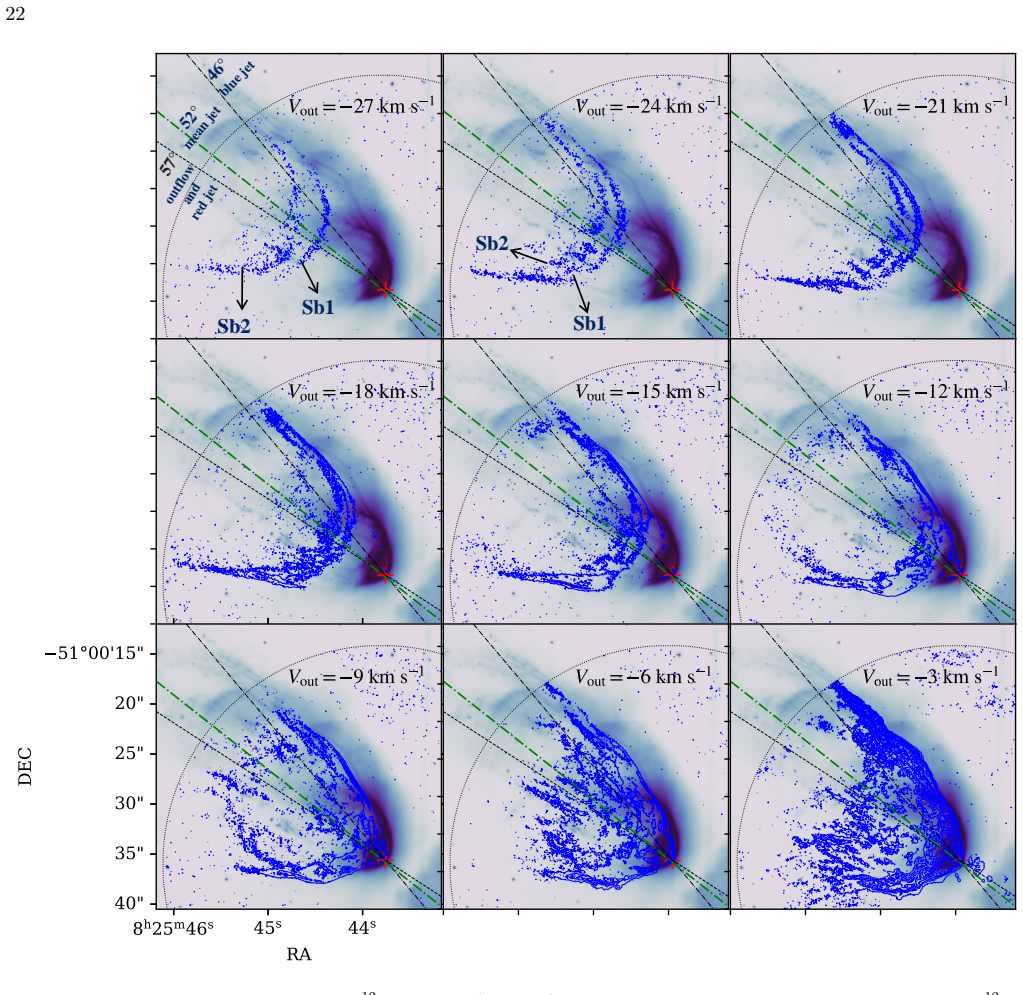
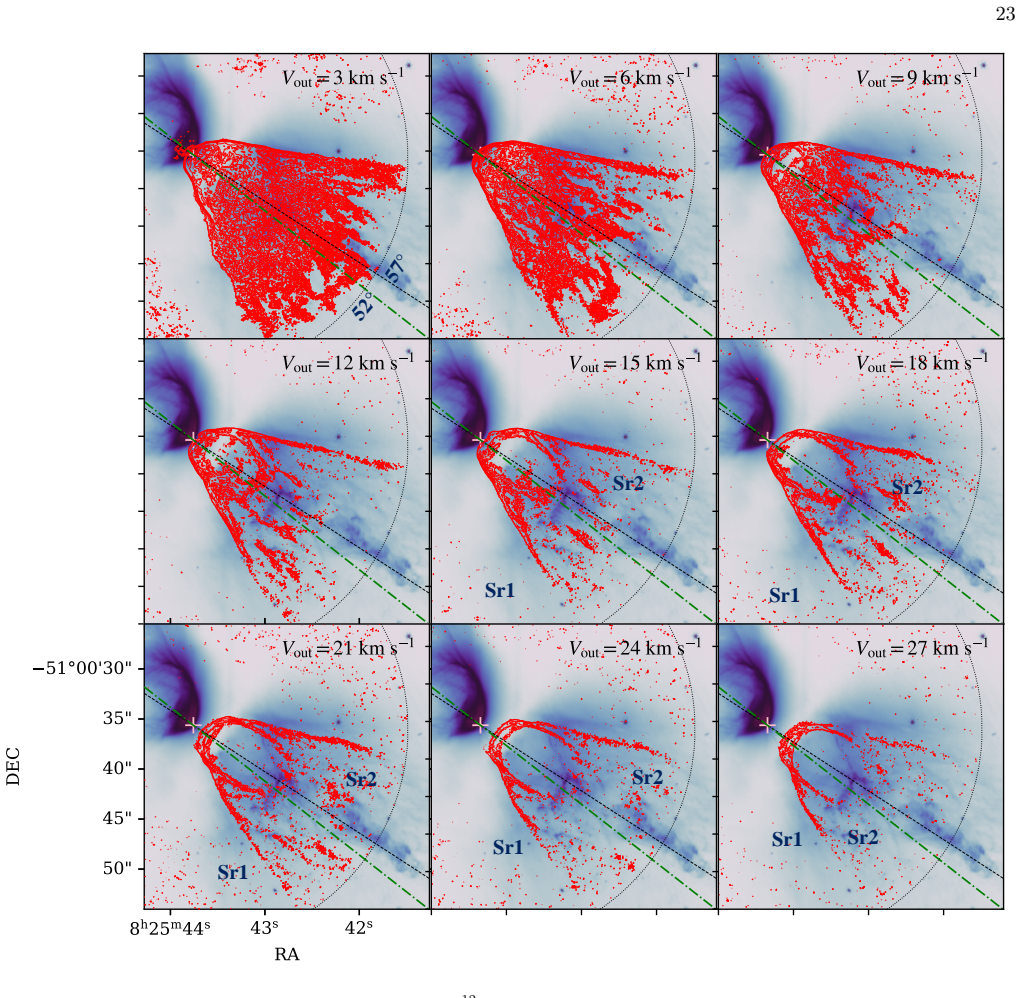
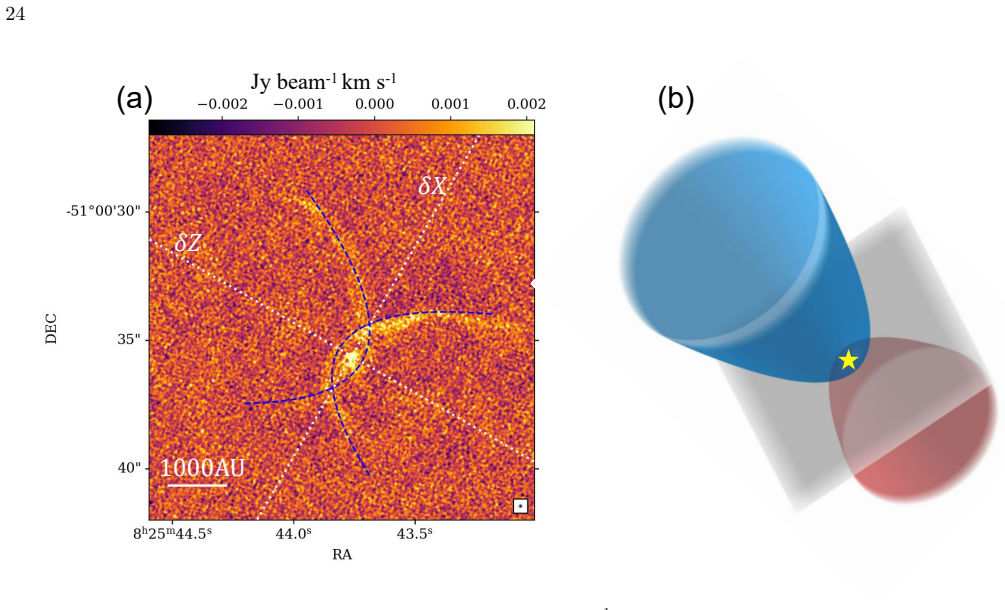
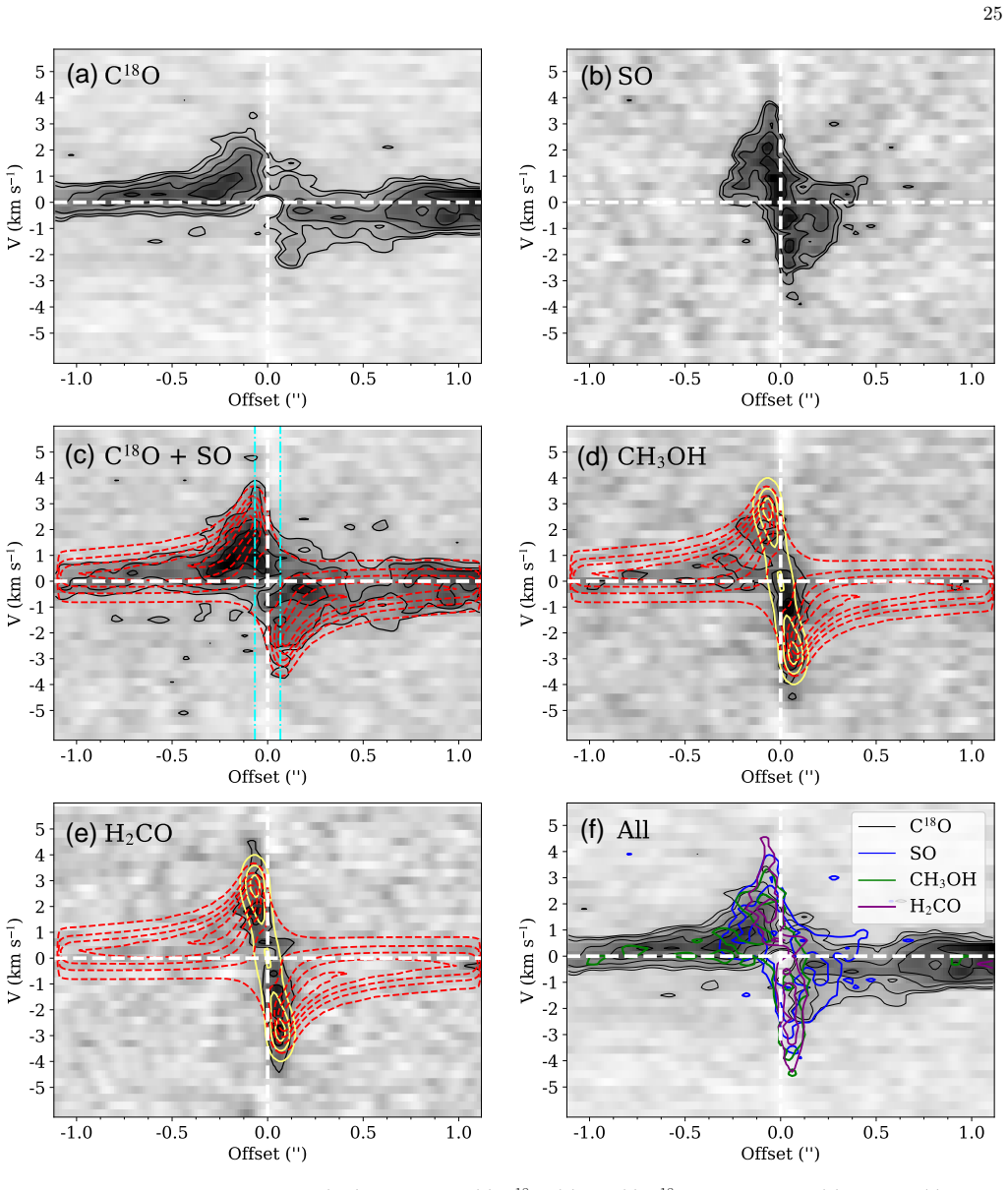
ALMA observations of HH 46/47 show a rotating infalling envelope becoming a disk at 30 au, with the outflow shell expanding radially to support entrainment over a disk wind.
A machine-rendered reading of the paper's core claim, the machinery that carries it, and where it could break.
Core claim
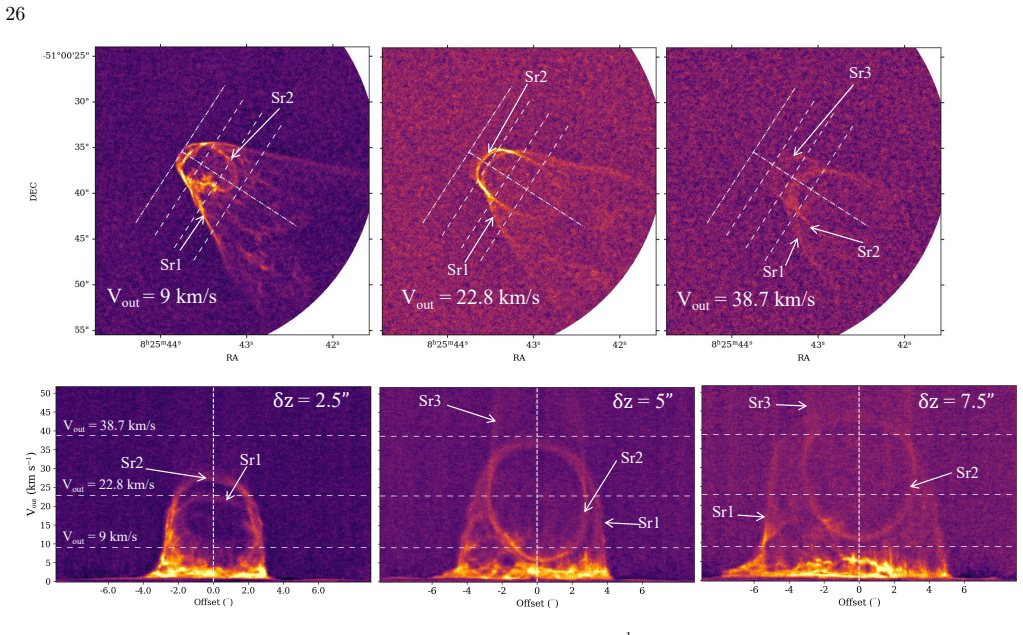
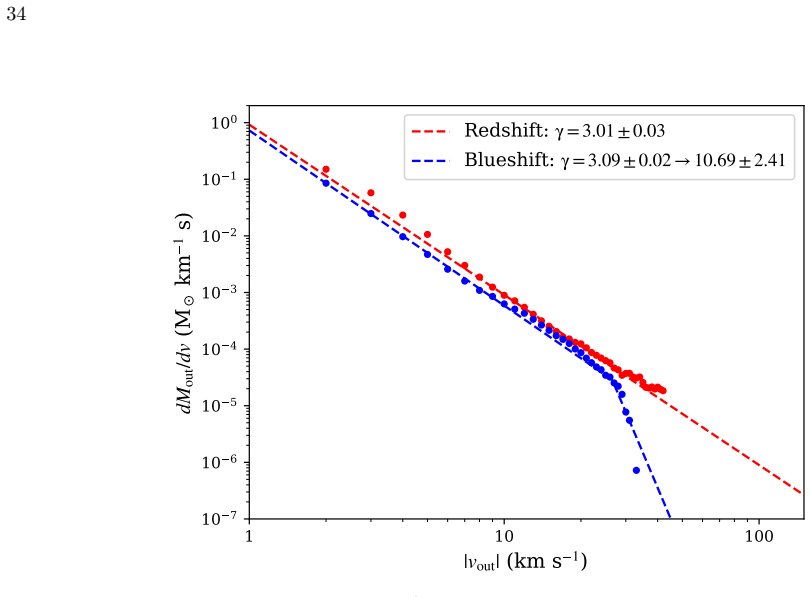
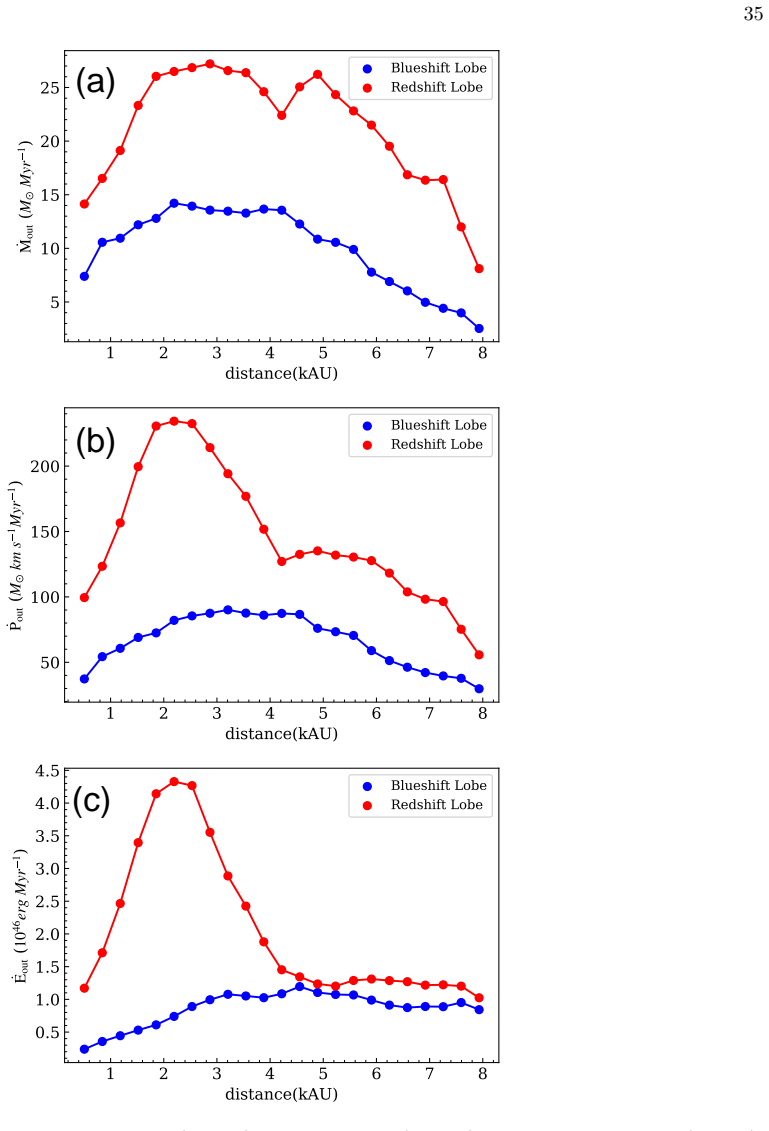
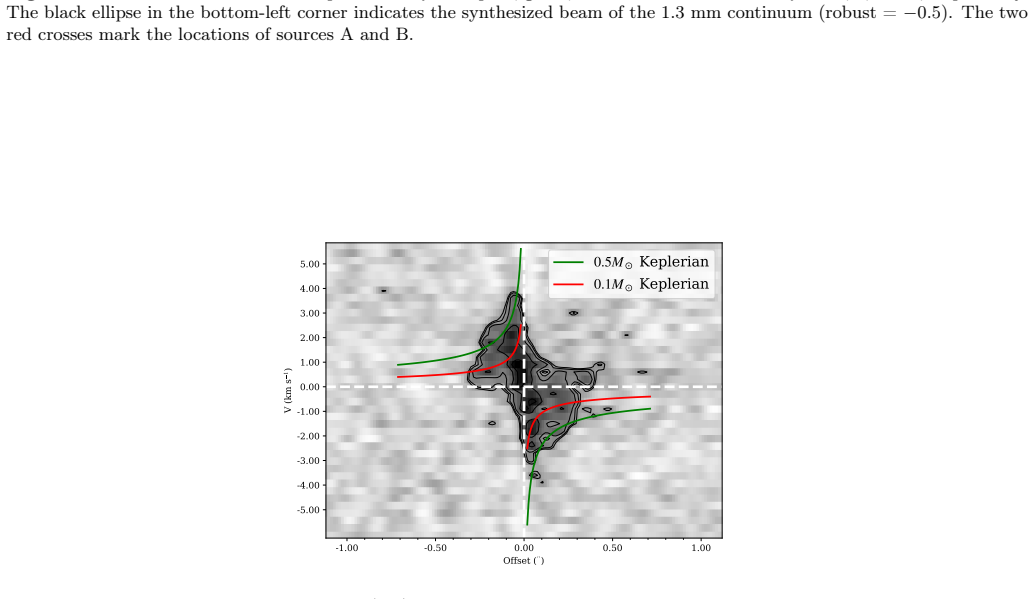
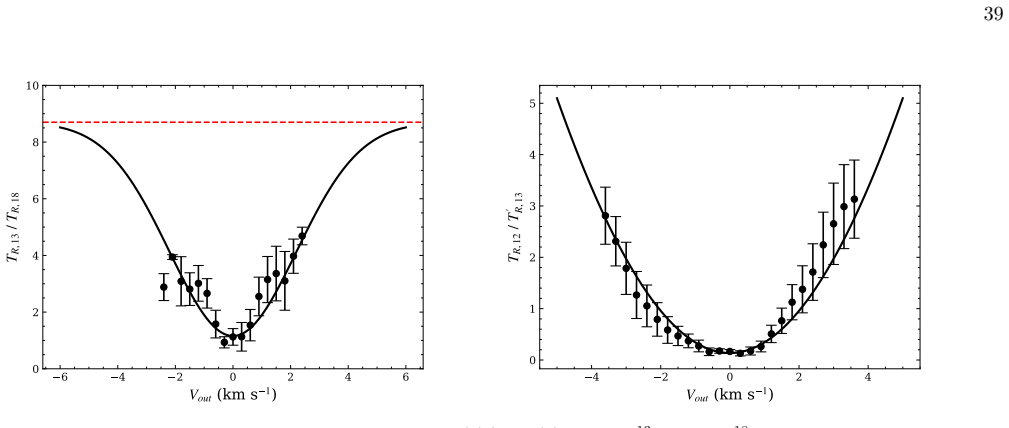
The observations are well reproduced by a rotating-infalling envelope transitioning to an inner disk at a radius of ~30 au around a 0.3 Msun protostar. The 12CO emission, together with JWST NIRCam images, reveals multiple shell structures in the outflow. Using C18O and 13CO to correct for optical depth, the spatial distributions of outflow mass, momentum, and kinetic energy are derived. A model-independent analysis of a well-defined redshifted shell yields its three-dimensional velocity field, showing that the shell expands radially rather than flowing along its surface. Although a transverse velocity gradient is detected, interpreting it as rotation implies an unphysically large magnetic le
What carries the argument
Rotating-infalling envelope model transitioning to inner disk at 30 au, combined with model-independent three-dimensional velocity field reconstruction of the redshifted outflow shell
If this is right
- The central protostar mass is 0.3 solar masses with the disk beginning at a radius of 30 au.
- Outflow mass, momentum, and kinetic energy distributions, plus their time rates, are obtained after correcting for optical depth effects.
- Multiple shell structures appear in the outflow when 12CO maps are combined with infrared imaging.
- The shell kinematics are consistent with entrainment by the jet rather than a direct disk wind.
Where Pith is reading between the lines
- The same radial-expansion test could be applied to shells in other protostellar outflows to distinguish entrainment from disk-wind origins.
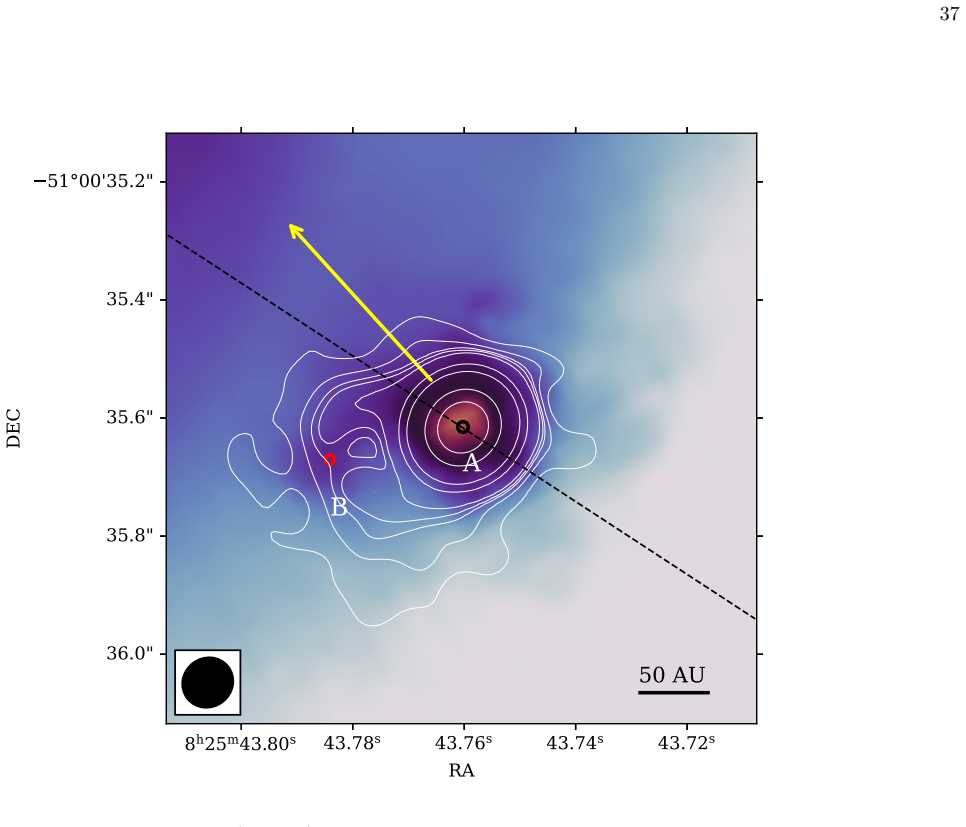
- The spur-like features and intensity minimum near the companion suggest that binary companions commonly reshape circumbinary disks through gravitational effects.
- Joint ALMA and infrared datasets can separate the radial and rotational components of outflow motion more cleanly than either alone.
Load-bearing premise
That a rotation interpretation of the observed transverse velocity gradient would require an unphysically large magnetic lever arm and therefore must be rejected.
What would settle it
A measurement showing that the shell material moves primarily along the shell surface rather than radially outward would falsify the radial-expansion claim and reopen a possible disk-wind interpretation.
Figures
read the original abstract
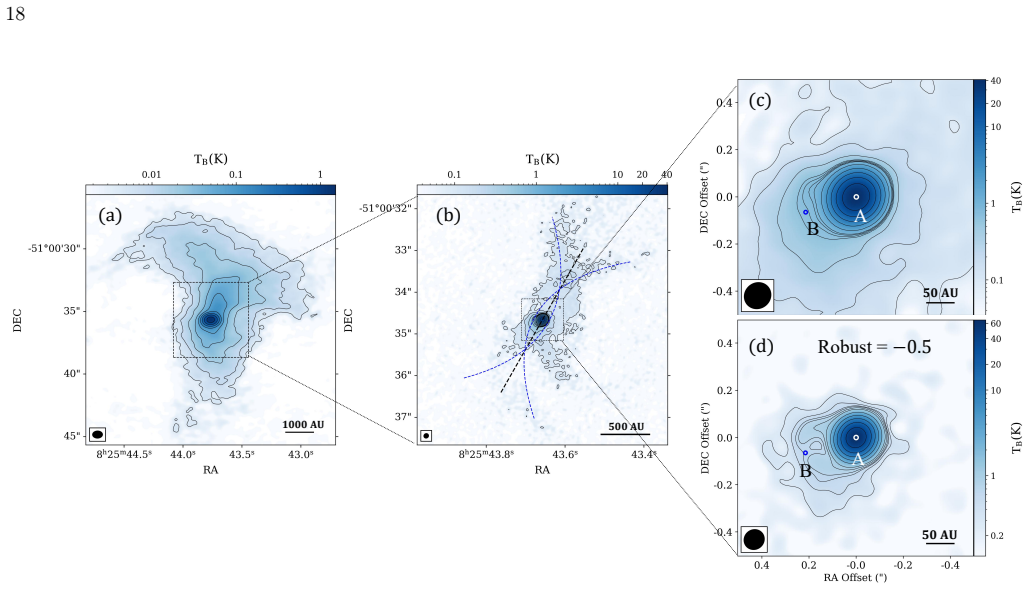
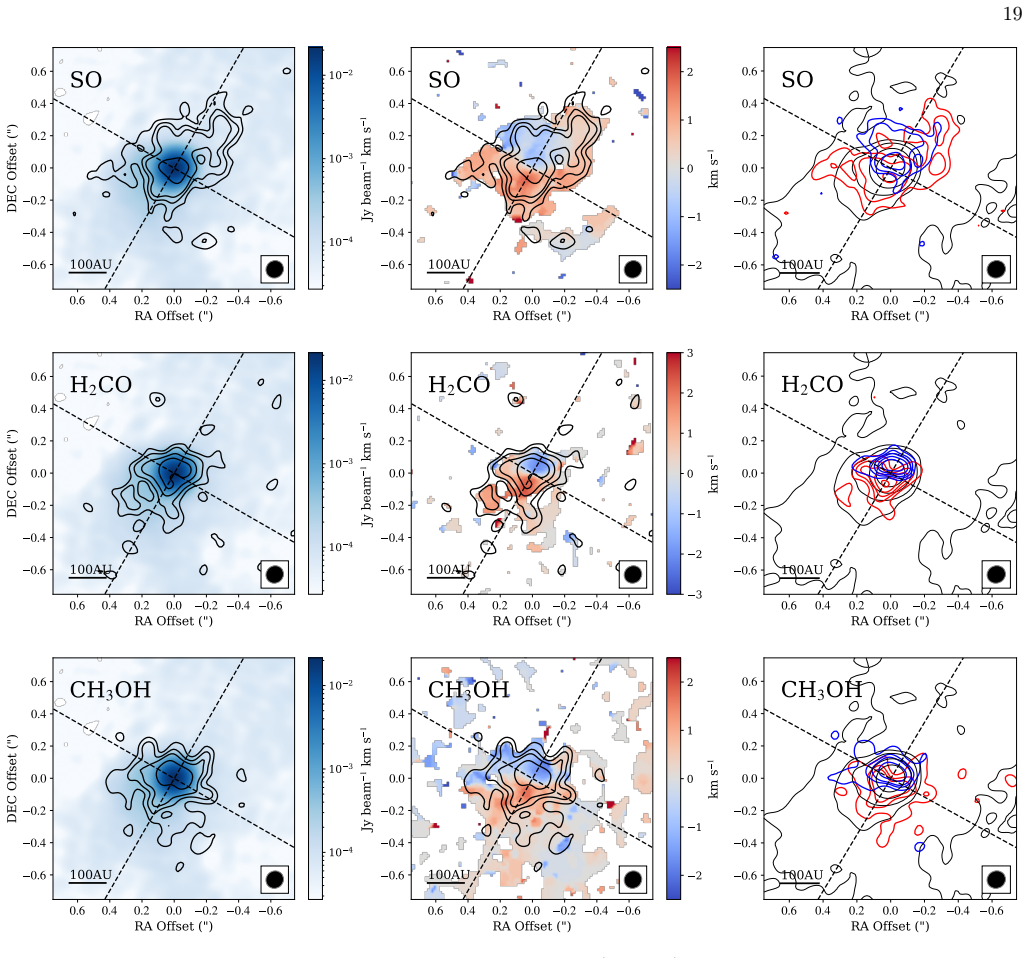
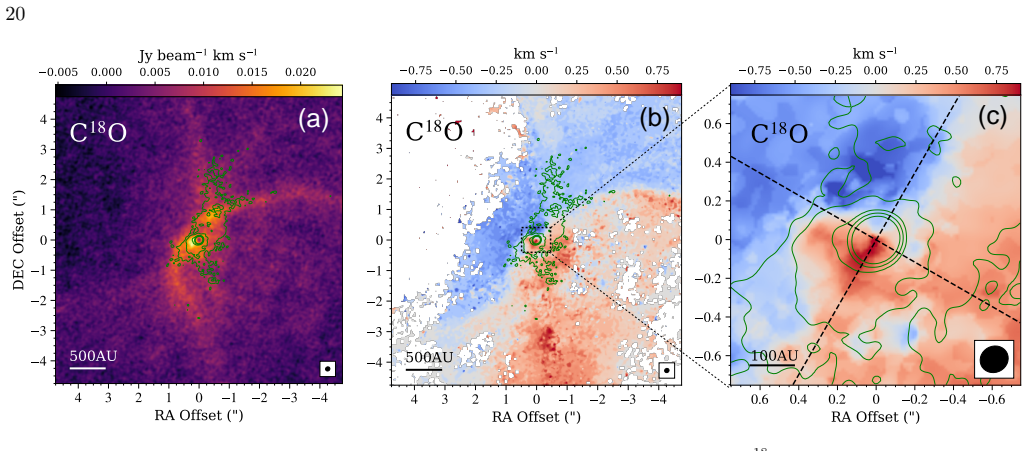
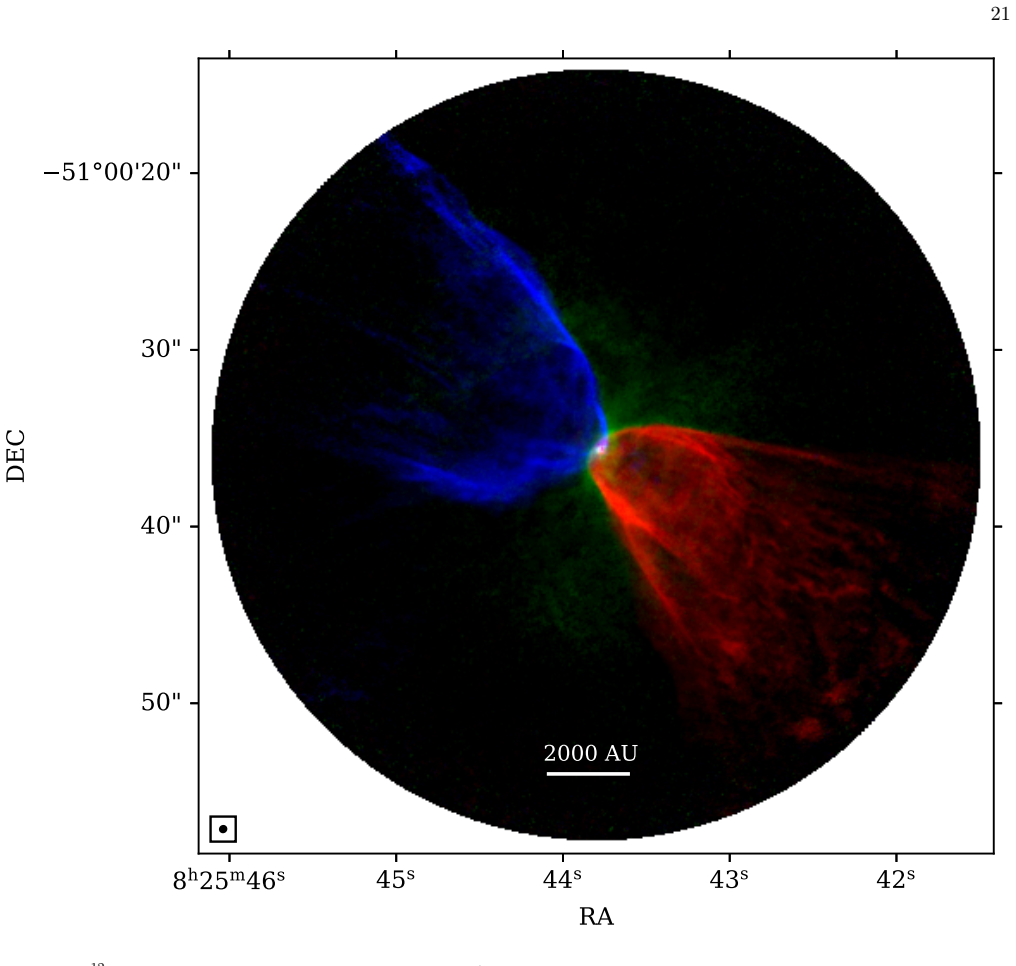
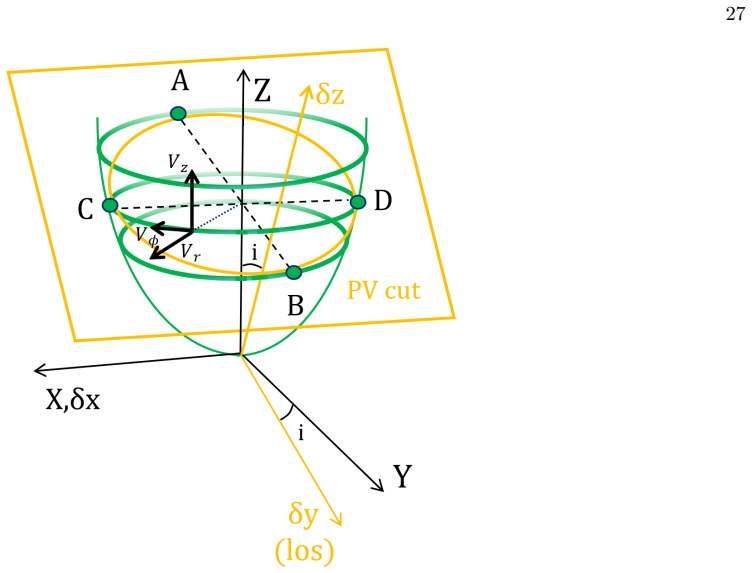
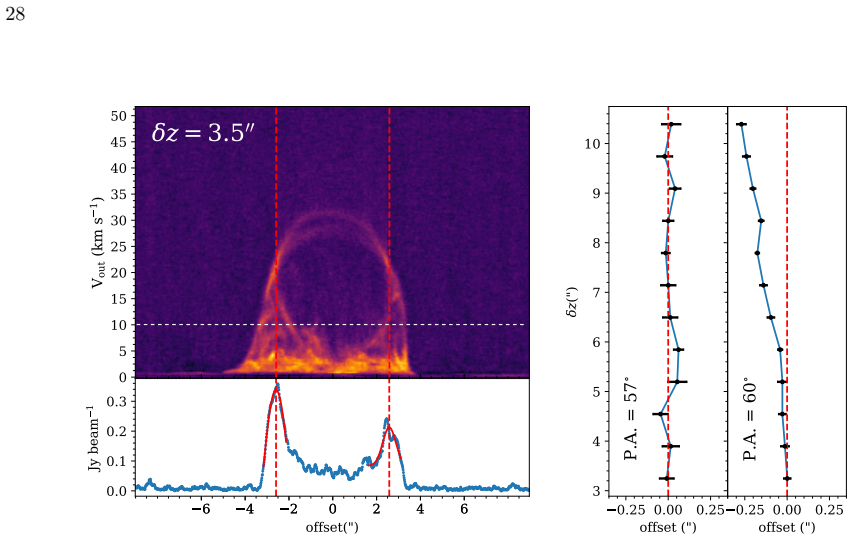
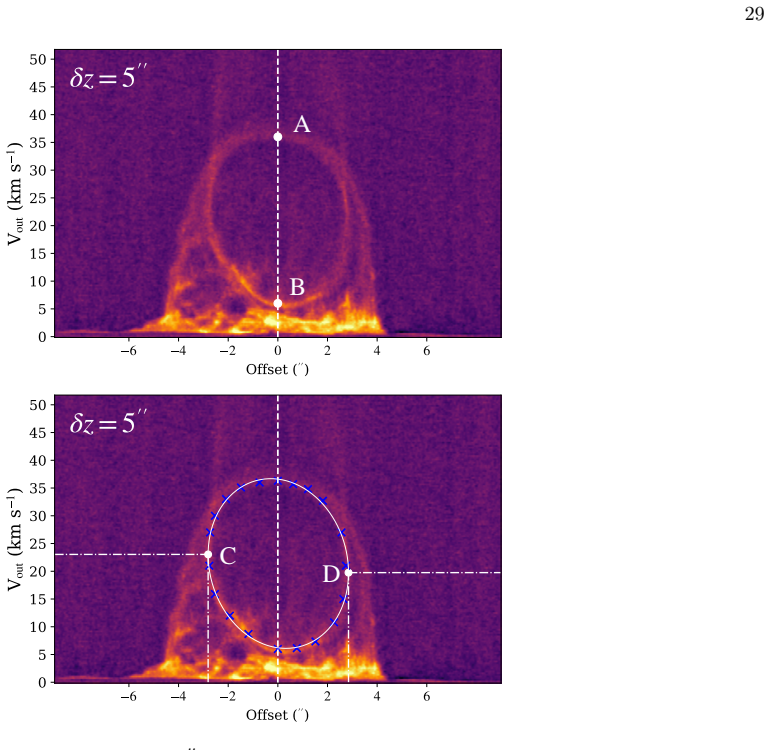
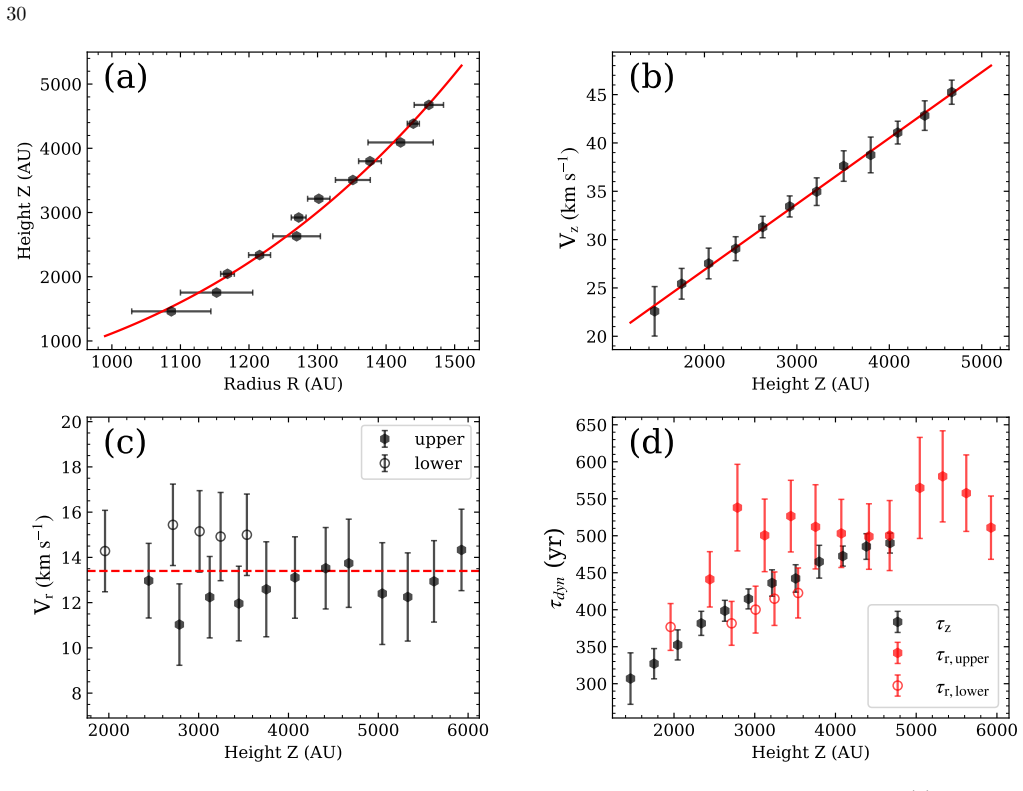
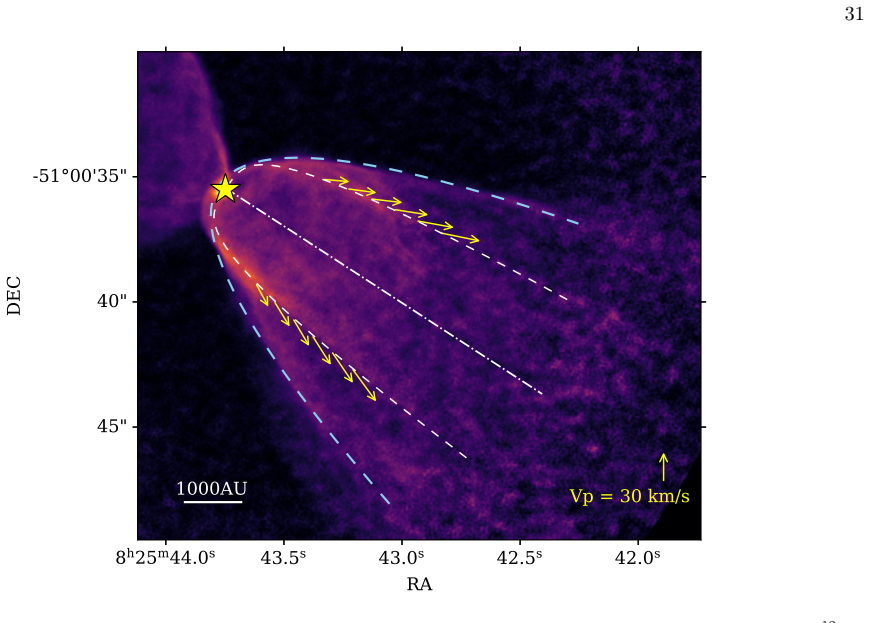
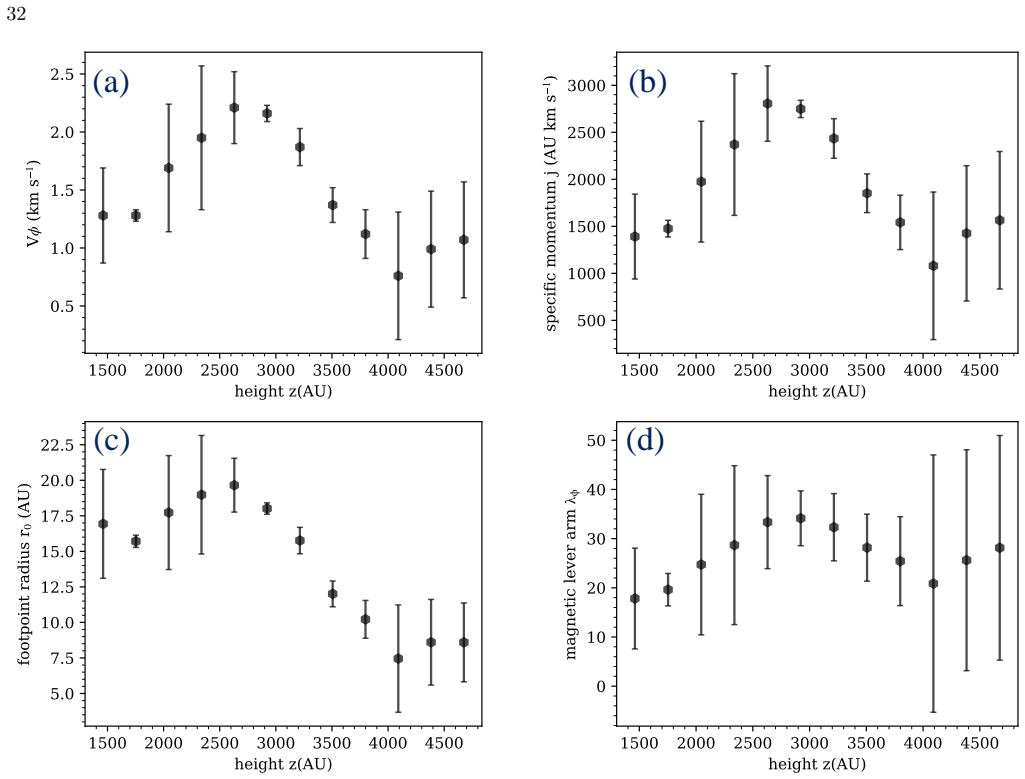
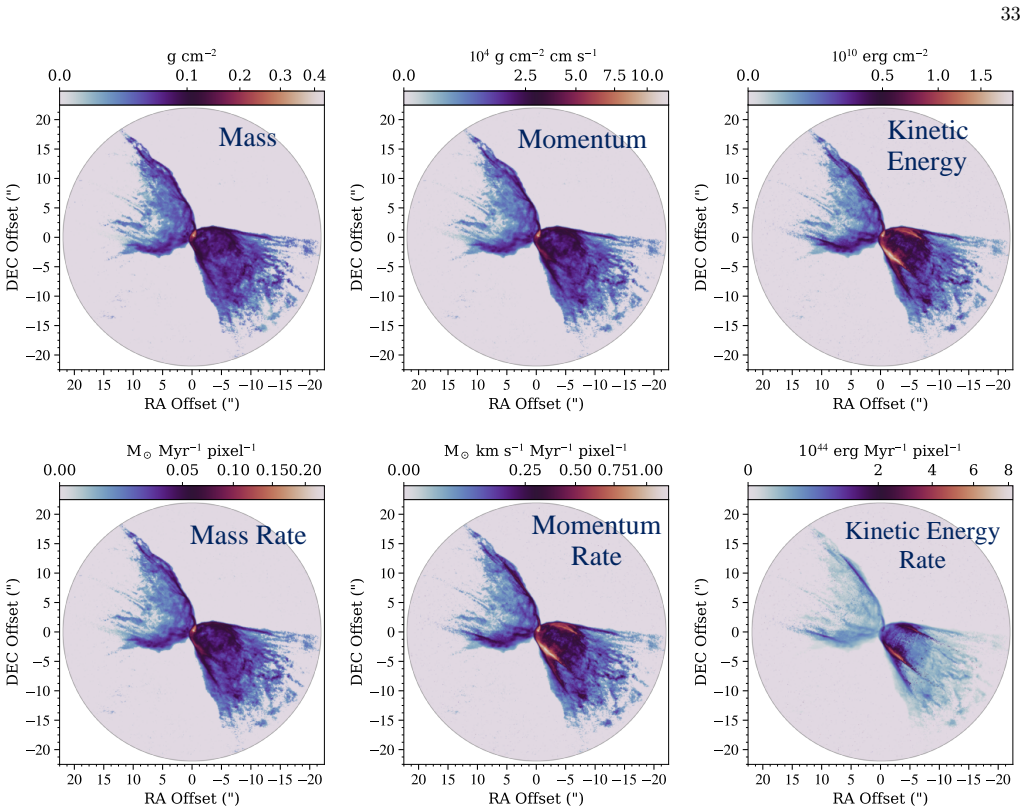
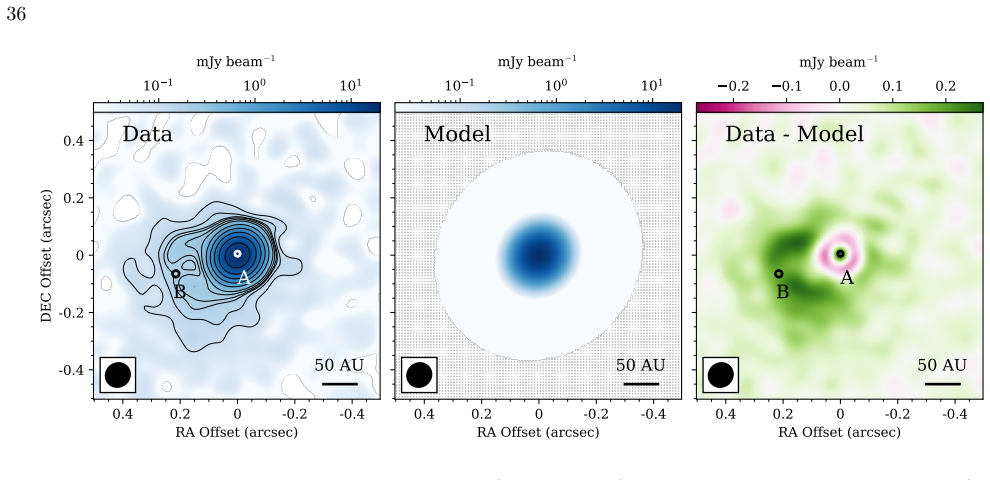
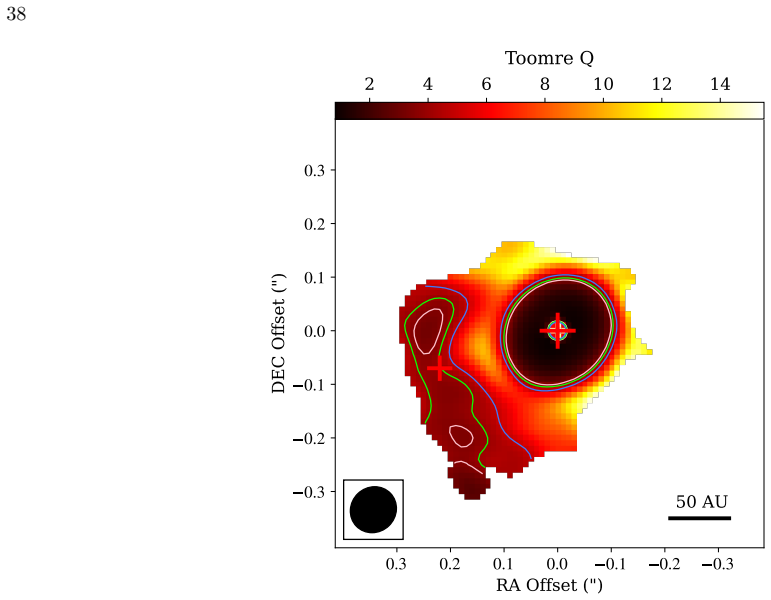
We present 0.1" (~ 50 au) resolution Atacama Large Millimeter/submillimeter Array (ALMA) observations of the HH 46/47 molecular outflow and its envelope-disk system. The 1.3 mm continuum emission reveals a compact central source surrounded by a circumbinary disk with substructures. The companion, identified in optical and infrared observations, is not detected in the millimeter continuum but coincides with a local intensity minimum. Two spur-like features extending from the primary source toward the companion are identified and are likely induced by gravitational perturbations from the companion. The envelope-disk system is traced by C18O, SO, H2CO, and CH3OH. C18O primarily traces the extended envelope, while SO probes the inner envelope, and H2CO and CH3OH trace compact, faster-rotating structures near the centrifugal barrier. The observations are well reproduced by a rotating-infalling envelope transitioning to an inner disk at a radius of ~30 au around a 0.3 Msun protostar. The 12CO emission, together with JWST NIRCam images, reveals multiple shell structures in the outflow. Using C18O and 13CO to correct for optical depth, we derive the spatial distributions of outflow mass, momentum, and kinetic energy, as well as their corresponding rates. A model-independent analysis of a well-defined redshifted shell yields its three-dimensional velocity field, showing that the shell expands radially rather than flowing along its surface. Although a transverse velocity gradient is detected, interpreting it as rotation implies an unphysically large magnetic lever arm, disfavoring a direct disk-wind origin. Instead, the shell kinematics support an entrainment scenario.
Editorial analysis
A structured set of objections, weighed in public.
Referee Report
Summary. The manuscript presents 0.1-arcsec ALMA observations of the HH 46/47 outflow/disk/envelope system at 1.3 mm. The continuum reveals a central source with a circumbinary disk showing substructures and spur-like features attributed to the companion; C18O, SO, H2CO, and CH3OH trace the envelope, inner envelope, and compact structures near the centrifugal barrier. These data are reproduced by a rotating-infalling envelope model transitioning to a disk at ~30 au around a 0.3 Msun protostar. Optical-depth-corrected 12CO maps yield outflow mass, momentum, and energy distributions. A model-independent analysis of one well-defined redshifted shell shows radial expansion with a transverse velocity gradient; the authors interpret the latter as incompatible with rotation because it would require an unphysically large magnetic lever arm, thereby favoring entrainment over a direct disk wind.
Significance. If the kinematic conclusions are robust, the work supplies spatially resolved evidence that can discriminate between disk-wind and entrainment scenarios for molecular outflows, a central question in protostellar feedback. The high-resolution continuum substructures, multi-tracer line mapping, and direct 3D velocity-field reconstruction of the shell are concrete strengths. The simple envelope+disk model that reproduces the observed line emission is also a positive feature.
major comments (2)
- [Abstract and kinematics analysis] Abstract (final sentence) and the kinematics analysis section: the claim that interpreting the detected transverse velocity gradient as rotation 'implies an unphysically large magnetic lever arm' is presented without any explicit calculation of the lever arm (r_A/r_launch) from the measured shell velocities and radii, and without numerical comparison to literature ranges for disk winds. This judgment is load-bearing for the conclusion that the data disfavor a direct disk-wind origin.
- [Outflow mass/momentum section] Outflow mass/momentum section: the optical-depth corrections applied to 12CO using C18O and 13CO are described, yet the quantitative effect of those corrections on the derived mass, momentum, and kinetic-energy distributions (and on the corresponding rates) is not shown; this choice directly affects the reliability of the reported outflow properties.
minor comments (2)
- [Continuum results] The companion is stated to coincide with a local intensity minimum in the continuum; a quantitative upper limit on its millimeter flux (or a clear statement that none is detected above the noise) would strengthen the non-detection claim.
- [Envelope-disk model] Notation for the centrifugal barrier radius and the disk transition radius should be unified across text, figures, and the model description to avoid ambiguity.
Simulated Author's Rebuttal
We thank the referee for the constructive and detailed review. The comments highlight areas where additional quantitative detail will strengthen the manuscript. We address each major comment below and will revise accordingly.
read point-by-point responses
-
Referee: [Abstract and kinematics analysis] Abstract (final sentence) and the kinematics analysis section: the claim that interpreting the detected transverse velocity gradient as rotation 'implies an unphysically large magnetic lever arm' is presented without any explicit calculation of the lever arm (r_A/r_launch) from the measured shell velocities and radii, and without numerical comparison to literature ranges for disk winds. This judgment is load-bearing for the conclusion that the data disfavor a direct disk-wind origin.
Authors: We agree that the current text presents the lever-arm conclusion without the supporting calculation. In the revised manuscript we will add an explicit computation of r_A/r_launch using the observed shell velocities and radii in the kinematics analysis section, together with a direct numerical comparison to the range of lever arms reported for disk-wind models in the literature. This addition will make the argument quantitative and transparent while preserving the model-independent nature of the shell analysis. revision: yes
-
Referee: [Outflow mass/momentum section] Outflow mass/momentum section: the optical-depth corrections applied to 12CO using C18O and 13CO are described, yet the quantitative effect of those corrections on the derived mass, momentum, and kinetic-energy distributions (and on the corresponding rates) is not shown; this choice directly affects the reliability of the reported outflow properties.
Authors: We acknowledge that the quantitative impact of the optical-depth corrections is not illustrated. In the revision we will add a direct comparison—either as supplementary panels or a table—showing the mass, momentum, and kinetic-energy distributions (and the corresponding rates) derived with and without the C18O/13CO corrections. This will allow readers to assess the magnitude of the correction and the robustness of the reported outflow properties. revision: yes
Circularity Check
No significant circularity in derivation chain
full rationale
The paper derives its key conclusions from direct ALMA observations of continuum and line emission, with explicit corrections for optical depth using C18O and 13CO to obtain mass, momentum, and energy distributions. The model-independent 3D velocity field of the redshifted shell is extracted from the data without reference to fitted parameters or prior self-citations, and the preference for entrainment over disk-wind follows from a physical-plausibility judgment on the transverse gradient rather than any equation that reduces to the paper's own inputs by construction. No self-definitional loops, fitted inputs renamed as predictions, or load-bearing self-citation chains appear in the provided text; the derivation remains self-contained against the external benchmark of the raw kinematic measurements.
Axiom & Free-Parameter Ledger
free parameters (2)
- central protostar mass =
0.3 Msun
- centrifugal barrier / disk transition radius =
~30 au
axioms (2)
- domain assumption C18O and 13CO can be used to correct 12CO for optical depth when deriving outflow mass, momentum and energy
- domain assumption A transverse velocity gradient, if interpreted as rotation, maps directly to a magnetic lever arm whose magnitude can be judged 'unphysical'
Reference graph
Works this paper leans on
-
[1]
and Mardones, Diego and Cabrit, Sylvie and Dunham, Michael M
Zhang, Yichen and Arce, Héctor G. and Mardones, Diego and Cabrit, Sylvie and Dunham, Michael M. and Garay, Guido and Noriega-Crespo, Alberto and Offner, Stella S. R. and Raga, Alejandro C. and Corder, Stuartt A. , year =. ALMA CYCLE 1 OBSERVATIONS OF THE HH46/47 MOLECULAR OUTFLOW: STRUCTURE, ENTRAINMENT, AND CORE IMPACT , volume =. , publisher =. doi:10.3...
-
[2]
and Mardones, Diego and Cabrit, Sylvie and Dunham, Michael M
Zhang, Yichen and Arce, Héctor G. and Mardones, Diego and Cabrit, Sylvie and Dunham, Michael M. and Garay, Guido and Noriega-Crespo, Alberto and Offner, Stella S. R. and Raga, Alejandro C. and Corder, Stuartt A. , year =. An Episodic Wide-angle Outflow in HH 46/47 , volume =. , publisher =. doi:10.3847/1538-4357/ab3850 , number =
-
[3]
Li, Zhi‐Yun and Shu, Frank H. , year =. Magnetized Singular Isothermal Toroids , volume =. , publisher =. doi:10.1086/178056 , number =
-
[4]
Dunham, Michael M. and Arce, Héctor G. and Mardones, Diego and Lee, Jeong-Eun and Matthews, Brenda C. and Stutz, Amelia M. and Williams, Jonathan P. , year =. MOLECULAR OUTFLOWS DRIVEN BY LOW-MASS PROTOSTARS. I. CORRECTING FOR UNDERESTIMATES WHEN MEASURING OUTFLOW MASSES AND DYNAMICAL PROPERTIES , volume =. , publisher =. doi:10.1088/0004-637x/783/1/29 , number =
-
[5]
Kong, Shuo and Arce, Héctor G. and Feddersen, Jesse R. and Carpenter, John M. and Nakamura, Fumitaka and Shimajiri, Yoshito and Isella, Andrea and Ossenkopf-Okada, Volker and Sargent, Anneila I. and Sánchez-Monge, Álvaro and Suri, S\". The CARMA-NRO Orion Survey , volume =. , publisher =. 2018 , month = may, pages =. doi:10.3847/1538-4365/aabafc , number =
-
[6]
and Li, Zhi-Yun and Dunham, Michael and Offner, Stella and Stephens, Ian W
Hsieh, Cheng-Han and Arce, Héctor G. and Li, Zhi-Yun and Dunham, Michael and Offner, Stella and Stephens, Ian W. and Stutz, Amelia and Megeath, Tom and Kong, Shuo and Plunkett, Adele and Tobin, John J. and Zhang, Yichen and Mardones, Diego and Pineda, Jaime E. and Stanke, Thomas and Carpenter, John , year =. The Evolution of Protostellar Outflow Cavities,...
-
[7]
Wilson, T. L. and Matteucci, F. , year =. Abundances in the interstellar medium , volume =. The Astronomy and Astrophysics Review , publisher =. doi:10.1007/bf00873568 , number =
-
[8]
Langer, William D. and Penzias, Arno A. , year =. (C-12)/(C-13) isotope ratio in the local interstellar medium from observations of (C-13)(O-18) in molecular clouds , volume =. doi:10.1086/172611 , journal =
-
[9]
van der Marel, N. and Kristensen, L. E. and Visser, R. and Mottram, J. C. and Yıldız, U. A. and van Dishoeck, E. F. , year =. Outflow forces of low-mass embedded objects in Ophiuchus: a quantitative comparison of analysis methods , volume =. doi:10.1051/0004-6361/201220717 , journal =
-
[10]
Offner, Stella S. R. and Chaban, Jonah , year =. Impact of Protostellar Outflows on Turbulence and Star Formation Efficiency in Magnetized Dense Cores , volume =. , publisher =. doi:10.3847/1538-4357/aa8996 , number =
-
[11]
Ohashi, Nagayoshi and Hayashi, Masahiko and Ho, Paul T. P. and Momose, Munetake , year =. Interferometric Imaging of IRAS 04368+2557 in the L1527 Molecular Cloud Core: A Dynamically Infalling Envelope with Rotation , volume =. , publisher =. doi:10.1086/303533 , number =
-
[12]
, year = 2014, month = mar, volume =
Sakai, Nami and Sakai, Takeshi and Hirota, Tomoya and Watanabe, Yoshimasa and Ceccarelli, Cecilia and Kahane, Claudine and Bottinelli, Sandrine and Caux, Emmanuel and Demyk, Karine and Vastel, Charlotte and Coutens, Audrey and Taquet, Vianney and Ohashi, Nagayoshi and Takakuwa, Shigehisa and Yen, Hsi-Wei and Aikawa, Yuri and Yamamoto, Satoshi , year =. Ch...
-
[13]
FERIA: Flat Envelope Model with Rotation and Infall under Angular Momentum Conservation , volume =
Oya, Yoko and Kibukawa, Hirofumi and Miyake, Shota and Yamamoto, Satoshi , year =. FERIA: Flat Envelope Model with Rotation and Infall under Angular Momentum Conservation , volume =. , publisher =. doi:10.1088/1538-3873/ac8839 , number =
-
[14]
Nisini, Brunella and Navarro, Maria Gabriela and Giannini, Teresa and Antoniucci, Simone and Kavanagh, Patrick, J. and Hartigan, Patrick and Bacciotti, Francesca and Caratti o Garatti, Alessio and Noriega-Crespo, Alberto and van Dishoeck, Ewine F. and Whelan, Emma T. and Arce, Hector G. and Cabrit, Sylvie and Coffey, Deirdre and Fedele, Davide and Eisl\"....
-
[15]
Bipolar Molecular Outflows from High‐Mass Protostars , volume =
Su, Yu‐Nung and Zhang, Qizhou and Lim, Jeremy , year =. Bipolar Molecular Outflows from High‐Mass Protostars , volume =. , publisher =. doi:10.1086/381880 , number =
-
[16]
Molecular Outflows in Low- and High-Mass Star Forming Regions
Molecular Outflows in Low- and High-Mass Star-forming Regions. Protostars and Planets V , year = 2007, editor =. doi:10.48550/arXiv.astro-ph/0603071 , archivePrefix =. astro-ph/0603071 , primaryClass =
work page internal anchor Pith review Pith/arXiv arXiv doi:10.48550/arxiv.astro-ph/0603071 2007
-
[17]
Surveys of clumps, cores, and condensations in Cygnus-X: SMA observations of SiO (5−4) , volume =
Yang, Kai and Qiu, Keping and Pan, Xing , year =. Surveys of clumps, cores, and condensations in Cygnus-X: SMA observations of SiO (5−4) , volume =. doi:10.1051/0004-6361/202346873 , journal =
-
[18]
Rabenanahary, M. and Cabrit, S. and Meliani, Z. and Pineau des For\^ets, G. , year =. Wide-angle protostellar outflows driven by narrow jets in stratified cores , volume =. doi:10.1051/0004-6361/202243139 , journal =
-
[19]
Li, Pak Shing and Klein, Richard I. and McKee, Christopher F. , year =. Formation of stellar clusters in magnetized, filamentary infrared dark clouds , volume =. , publisher =. doi:10.1093/mnras/stx2611 , number =
-
[20]
and Reipurth, Bo and Bally, John , year =
Hartigan, Patrick and Heathcote, Steve and Morse, Jon A. and Reipurth, Bo and Bally, John , year =. Proper Motions of the HH 47 Jet Observed with theHubble Space Telescope , volume =. , publisher =. doi:10.1086/491673 , number =
-
[21]
de Valon, A. and Dougados, C. and Cabrit, S. and Louvet, F. and Zapata, L. A. and Mardones, D. , year =. Modeling the CO outflow in DG Tauri B: Swept-up shells versus perturbed MHD disk wind , volume =. doi:10.1051/0004-6361/202141316 , journal =
-
[22]
Louvet, F. and Dougados, C. and Cabrit, S. and Mardones, D. and Ménard, F. and Tabone, B. and Pinte, C. and Dent, W. R. F. , year =. The HH30 edge-on T Tauri star: A rotating and precessing monopolar outflow scrutinized by ALMA , volume =. doi:10.1051/0004-6361/201731733 , journal =
-
[23]
The layered molecular outflow from HL Tau and its relationship with the ringed disk
ALMA chemical survey of disk-outflow sources in Taurus (ALMA-DOT): VII. The layered molecular outflow from HL Tau and its relationship with the ringed disk. , keywords =. doi:10.1051/0004-6361/202453649 , archivePrefix =. 2501.03920 , primaryClass =
-
[24]
, keywords =
Dust opacities for protostellar cores. , keywords =
-
[25]
Formation of a Keplerian Disk in the Infalling Envelope around L1527 IRS: Transformation from Infalling Motions to Kepler Motions. , keywords =. doi:10.1088/0004-637X/796/2/131 , archivePrefix =. 1410.0172 , primaryClass =
work page internal anchor Pith review Pith/arXiv arXiv doi:10.1088/0004-637x/796/2/131
-
[26]
A Rotating Feature Rich in Complex Organic Molecules in a Protostellar Core
ALMASOP. A Rotating Feature Rich in Complex Organic Molecules in a Protostellar Core. , keywords =. doi:10.3847/1538-4357/ade7fc , archivePrefix =. 2506.15140 , primaryClass =
-
[27]
Infalling-Rotating Motion and Associated Chemical Change in the Envelope of IRAS 16293-2422 Source A Studied with ALMA. , keywords =. doi:10.3847/0004-637X/824/2/88 , archivePrefix =. 1605.00340 , primaryClass =
work page internal anchor Pith review Pith/arXiv arXiv doi:10.3847/0004-637x/824/2/88
-
[28]
Multiple Shells Driven by Disk Winds: ALMA Observations in the HH 30 Outflow. , keywords =. doi:10.3847/1538-4357/ad132a , archivePrefix =. 2312.03272 , primaryClass =
-
[29]
doi:10.1016/j.molstruc.2005.01.027 , Journal =
The Cologne Database for Molecular Spectroscopy, CDMS: a useful tool for astronomers and spectroscopists. Journal of Molecular Structure , year = 2005, month = may, volume =. doi:10.1016/j.molstruc.2005.01.027 , adsurl =
-
[30]
APEX-CHAMP ^ + high-J CO observations of low-mass young stellar objects. I. The HH 46 envelope and outflow. , keywords =. doi:10.1051/0004-6361/200912013 , archivePrefix =. 0905.2878 , primaryClass =
work page internal anchor Pith review Pith/arXiv arXiv doi:10.1051/0004-6361/200912013
-
[31]
An Ordered Envelope-disk Transition in the Massive Protostellar Source G339.88-1.26
An Ordered Envelope-Disk Transition in the Massive Protostellar Source G339.88-1.26. , keywords =. doi:10.3847/1538-4357/ab0553 , archivePrefix =. 1811.04381 , primaryClass =
work page internal anchor Pith review Pith/arXiv arXiv doi:10.3847/1538-4357/ab0553
-
[32]
Massive Protostars in a Protocluster - A Multi-scale ALMA View of G35.20-0.74N. , keywords =. doi:10.3847/1538-4357/ac847f , archivePrefix =. 2207.11320 , primaryClass =
-
[33]
and Li, Zhi-Yun and Krasnopolsky, Ruben and Blandford, Roger D
Anderson, Jeffrey M. and Li, Zhi-Yun and Krasnopolsky, Ruben and Blandford, Roger D. , year =. Locating the Launching Region of T Tauri Winds: The Case of DG Tauri , volume =. , publisher =. doi:10.1086/376824 , number =
-
[34]
Hydromagnetic flows from accretion disks and the production of radio jets. , keywords =. doi:10.1093/mnras/199.4.883 , adsurl =
-
[35]
Zhang, Yichen and Higuchi, Aya E. and Sakai, Nami and Oya, Yoko and López-Sepulcre, Ana and Imai, Muneaki and Sakai, Takeshi and Watanabe, Yoshimasa and Ceccarelli, Cecilia and Lefloch, Bertrand and Yamamoto, Satoshi , year =. Rotation in the NGC 1333 IRAS 4C Outflow , volume =. , publisher =. doi:10.3847/1538-4357/aad7ba , number =
-
[36]
Hydrodynamical Simulations of Jet- and Wind-driven Protostellar Outflows
Hydrodynamic Simulations of Jet- and Wind-driven Protostellar Outflows. , keywords =. doi:10.1086/321648 , archivePrefix =. astro-ph/0104373 , primaryClass =
work page internal anchor Pith review Pith/arXiv arXiv doi:10.1086/321648
-
[37]
ALMA Observations of the HH 46/47 Molecular Outflow
ALMA Observations of the HH 46/47 Molecular Outflow. , keywords =. doi:10.1088/0004-637X/774/1/39 , archivePrefix =. 1304.0674 , primaryClass =
work page internal anchor Pith review Pith/arXiv arXiv doi:10.1088/0004-637x/774/1/39
-
[38]
Star Formation and the Nature of Bipolar Outflows. , keywords =. doi:10.1086/185970 , adsurl =
-
[39]
Shang , Hsien and Liu , Chun-Fan and Krasnopolsky, Ruben and Wang , Liang-Yao , year =. A Unified Model for Bipolar Outflows from Young Stars: Kinematic Signatures of Jets, Winds, and Their Magnetic Interplay with the Ambient Toroids , volume =. , publisher =. doi:10.3847/1538-4357/aca763 , number =
-
[40]
, keywords =
Molecular outflows entrained by jet bowshocks. , keywords =
-
[41]
and Yang, Yao-lun and Zhang, Yichen and Cox, Erin G
Zhang, Ziwei E. and Yang, Yao-lun and Zhang, Yichen and Cox, Erin G. and Zeng, Shaoshan and Murillo, Nadia M. and Ohashi, Satoshi and Sakai, Nami , year =. The Perseus ALMA Chemistry Survey (PEACHES). II. Sulfur-bearing Species and Dust Polarization Revealing Shocked Regions in Protostars in the Perseus Molecular Cloud , volume =. , publisher =. doi:10.38...
-
[42]
Hubble Space Telescope NICMOS Images of Herbig-Haro Energy Sources: [Fe II] Jets, Binarity, and Envelope Cavities. , keywords =. doi:10.1086/301510 , adsurl =
-
[43]
, year = 1977, month = feb, volume =
Evidence of star formation triggered by expansion of the Gum Nebula. , year = 1977, month = feb, volume =. doi:10.1086/182367 , adsurl =
-
[44]
Is the Cepheus E Outflow driven by a Class 0 Protostar?
Is the Cepheus E Outflow Driven by a Class 0 Protostar?. , keywords =. doi:10.1086/423136 , archivePrefix =. astro-ph/0506710 , primaryClass =
work page internal anchor Pith review Pith/arXiv arXiv doi:10.1086/423136
-
[45]
A kinematical study of the launching region of the blueshifted HH 46/47 outflow with SINFONI K-band observations. , keywords =. doi:10.1051/0004-6361/202451433 , archivePrefix =. 2407.07233 , primaryClass =
-
[46]
and Caratti o Garatti, Alessio and Antoniucci, Simone and Arce, Hector G
Navarro, Maria Gabriela and Nisini, Brunella and Giannini, Teresa and Kavanagh, Patrick J. and Caratti o Garatti, Alessio and Antoniucci, Simone and Arce, Hector G. and Bacciotti, Francesca and Cabrit, Sylvie and Coffey, Deirdre and Dougados, Catherine and Eisl\". PROJECT-J: The Shocking H 2 Outflow from HH 46 , volume =. , publisher =. 2025 , month = dec...
-
[47]
On the gravitational stability of a disk of stars. , year = 1964, month = may, volume =. doi:10.1086/147861 , adsurl =
-
[48]
A Sub-arcsecond Survey Toward Class 0 Protostars in Perseus: Searching for Signatures of Protostellar Disks. , keywords =. doi:10.1088/0004-637X/805/2/125 , archivePrefix =. 1503.05189 , primaryClass =
work page internal anchor Pith review Pith/arXiv arXiv doi:10.1088/0004-637x/805/2/125
-
[49]
Protostars and Planets VI , year = 2014, editor =
Jets and Outflows from Star to Cloud: Observations Confront Theory. Protostars and Planets VI , year = 2014, editor =. doi:10.2458/azu_uapress_9780816531240-ch020 , archivePrefix =. 1402.3553 , primaryClass =
-
[50]
Disk-Driven Rotating Bipolar Outflow in Orion Source I
Disk-driven rotating bipolar outflow in Orion Source I. Nature Astronomy , keywords =. doi:10.1038/s41550-017-0146 , archivePrefix =. 1712.04606 , primaryClass =
work page internal anchor Pith review Pith/arXiv arXiv doi:10.1038/s41550-017-0146
-
[51]
Bipolar molecular outflows driven by hydromagnetic protostellar winds
Bipolar Molecular Outflows Driven by Hydromagnetic Protostellar Winds. , keywords =. doi:10.1086/312376 , archivePrefix =. astro-ph/9909479 , primaryClass =
work page internal anchor Pith review Pith/arXiv arXiv doi:10.1086/312376
-
[52]
An infall model for the T Tauri phenomenon. , keywords =. doi:10.1086/154840 , adsurl =
-
[53]
ALMA Results of the Pseudodisk, Rotating Disk, and Jet in the Continuum and HCO ^ + in the Protostellar System HH 212. , keywords =. doi:10.1088/0004-637X/786/2/114 , archivePrefix =. 1403.5853 , primaryClass =
work page internal anchor Pith review Pith/arXiv arXiv doi:10.1088/0004-637x/786/2/114
-
[54]
Sulfur oxides tracing streamers and shocks at low-mass protostellar disk─envelope interfaces. , keywords =. doi:10.1051/0004-6361/202554186 , archivePrefix =. 2507.22870 , primaryClass =
-
[55]
CO Outflows from Young Stars: Confronting the Jet and Wind Models. , keywords =. doi:10.1086/317056 , adsurl =
-
[56]
Resolved images of a protostellar outflow launched by an extended disk wind
Resolved images of a protostellar outflow driven by an extended disk wind. , keywords =. doi:10.1038/nature20600 , archivePrefix =. 1612.05148 , primaryClass =
work page internal anchor Pith review Pith/arXiv arXiv doi:10.1038/nature20600
-
[57]
Apparent rotation signatures and application to HH212
Constraining MHD disk winds with ALMA. Apparent rotation signatures and application to HH212. , keywords =. doi:10.1051/0004-6361/201834377 , archivePrefix =. 2004.08804 , primaryClass =
-
[58]
A Rotating Protostellar Jet Launched from the Innermost Disk of HH 212
A rotating protostellar jet launched from the innermost disk of HH 212. Nature Astronomy , keywords =. doi:10.1038/s41550-017-0152 , archivePrefix =. 1706.06343 , primaryClass =
work page internal anchor Pith review Pith/arXiv arXiv doi:10.1038/s41550-017-0152
-
[59]
Star formation in molecular clouds: observation and theory. , keywords =. doi:10.1146/annurev.aa.25.090187.000323 , adsurl =
-
[60]
, year = 2023, month = oct, volume =
Outflows from the youngest stars are mostly molecular. , year = 2023, month = oct, volume =. doi:10.1038/s41586-023-06551-1 , adsurl =
-
[61]
Disk Winds, Jets, and Outflows: Theoretical and Computational Foundations
Disk Winds, Jets, and Outflows: Theoretical and Computational Foundations. Protostars and Planets V , year = 2007, editor =. doi:10.48550/arXiv.astro-ph/0603592 , archivePrefix =. astro-ph/0603592 , primaryClass =
work page internal anchor Pith review Pith/arXiv arXiv doi:10.48550/arxiv.astro-ph/0603592 2007
-
[62]
arXiv , author =:2001.09776 , journal =
ALMA reveals a large structured disk and nested rotating outflows in DG Tauri B. , keywords =. doi:10.1051/0004-6361/201936950 , archivePrefix =. 2001.09776 , primaryClass =
-
[63]
Direct evidence for magnetohydrodynamic disk winds driving rotating outflows in protostar HOPS 358. arXiv e-prints , keywords =. doi:10.48550/arXiv.2603.26120 , archivePrefix =. 2603.26120 , primaryClass =
-
[64]
Angular momentum profiles of Class 0 protostellar envelopes. , keywords =. doi:10.1051/0004-6361/201936364 , archivePrefix =. 2001.10004 , primaryClass =
-
[65]
Young Stellar Objects in the Gould Belt
Young Stellar Objects in the Gould Belt. , keywords =. doi:10.1088/0067-0049/220/1/11 , archivePrefix =. 1508.03199 , primaryClass =
work page internal anchor Pith review Pith/arXiv arXiv doi:10.1088/0067-0049/220/1/11
-
[66]
Magneto-thermal Disk Wind from Protoplanetary Disks
Magneto-thermal Disk Winds from Protoplanetary Disks. , keywords =. doi:10.3847/0004-637X/818/2/152 , archivePrefix =. 1511.06769 , primaryClass =
work page internal anchor Pith review Pith/arXiv arXiv doi:10.3847/0004-637x/818/2/152
-
[67]
Magnetically-driven jets from Keplerian accretion discs
Magnetically-driven jets from Keplerian accretion discs. , keywords =. doi:10.48550/arXiv.astro-ph/9607057 , archivePrefix =. astro-ph/9607057 , primaryClass =
work page internal anchor Pith review Pith/arXiv arXiv doi:10.48550/arxiv.astro-ph/9607057
-
[68]
A Unified Model for Bipolar Outflows from Young Stars: Kinematic and Mixing Structures in HH 30. , keywords =. doi:10.3847/1538-4357/ad2355 , archivePrefix =. 2402.02529 , primaryClass =
-
[69]
Circumstellar Dust Disks in Taurus-Auriga: The Submillimeter Perspective
Circumstellar Dust Disks in Taurus-Auriga: The Submillimeter Perspective. , keywords =. doi:10.1086/432712 , archivePrefix =. astro-ph/0506187 , primaryClass =
work page internal anchor Pith review Pith/arXiv arXiv doi:10.1086/432712
-
[70]
Precise determination of circumstellar disk lifetimes: Disk evolution in a single star-forming region. , keywords =. doi:10.1051/0004-6361/202554921 , archivePrefix =. 2512.06873 , primaryClass =
-
[71]
A Keplerian-like disk around the forming O-type star AFGL 4176
A Keplerian-like Disk around the Forming O-type Star AFGL 4176. , keywords =. doi:10.1088/2041-8205/813/1/L19 , archivePrefix =. 1509.08469 , primaryClass =
work page internal anchor Pith review Pith/arXiv arXiv doi:10.1088/2041-8205/813/1/l19 2041
-
[72]
Bowshocks driven by the pole-on molecular jet of outbursting protostar SVS 13. Nature Astronomy , keywords =. doi:10.1038/s41550-025-02716-2 , archivePrefix =. 2512.14458 , primaryClass =
-
[73]
The Launch Region of the SVS 13 Outflow and Jet
The Launch Region of the SVS 13 Outflow and Jet. , keywords =. doi:10.1088/0004-637X/794/2/169 , archivePrefix =. 1408.5940 , primaryClass =
work page internal anchor Pith review Pith/arXiv arXiv doi:10.1088/0004-637x/794/2/169
-
[74]
Systematic description of wind-driven protoplanetary discs. , keywords =. doi:10.1051/0004-6361/202040109 , archivePrefix =. 2101.10349 , primaryClass =
-
[75]
The VLA Nascent Disk and Multiplicity Survey of Perseus Protostars (VANDAM). II. Multiplicity of Protostars in the Perseus Molecular Cloud. , keywords =. doi:10.3847/0004-637X/818/1/73 , adsurl =
-
[76]
The VLA/ALMA Nascent Disk and Multiplicity (VANDAM) Survey of Orion Protostars. II. A Statistical Characterization of Class 0 and Class I Protostellar Disks. , keywords =. doi:10.3847/1538-4357/ab6f64 , adsurl =
-
[77]
The VLA/ALMA Nascent Disk And Multiplicity (VANDAM) Survey of Orion Protostars. V. A Characterization of Protostellar Multiplicity. , keywords =. doi:10.3847/1538-4357/ac36d2 , adsurl =
discussion (0)
Sign in with ORCID, Apple, or X to comment. Anyone can read and Pith papers without signing in.