REVIEW 3 major objections 5 minor 116 references
A Survey of Challenges and Opportunities in Sensing and Analytics for Cardiovascular Disorders
T0 review · 3 major / 5 minor · reviewed 2026-08-14 · deepseek-v4-flash
Pith's one-line read Remote monitoring for cardiovascular disorders has failed in trials so far, but this survey argues the failures came from thin sensing and analytics, not from the idea itself.
desk verdict A well-organized survey of cardiovascular remote monitoring, but its motivating claim that null telemonitoring trials failed for technological reasons is an unverified leap. read the letter →
The pith
A machine-rendered reading of the paper's core claim, the machinery that carries it, and where it could break.
The reading
What carries the argument
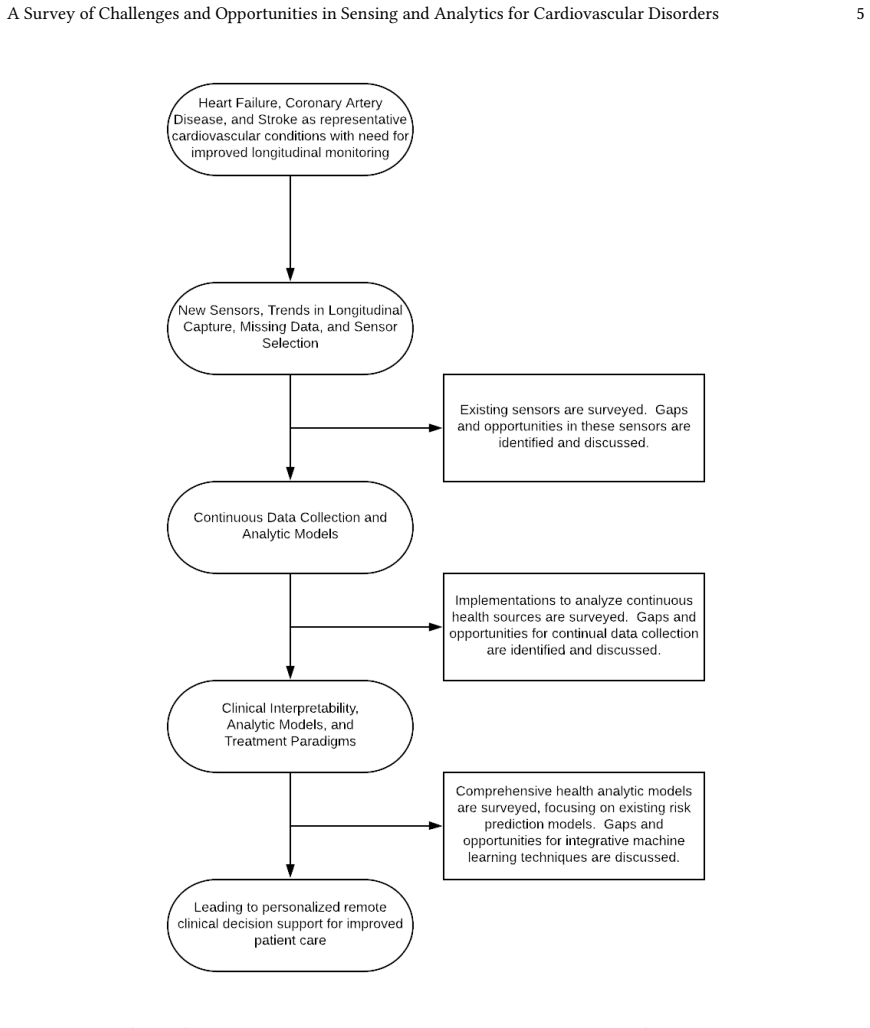
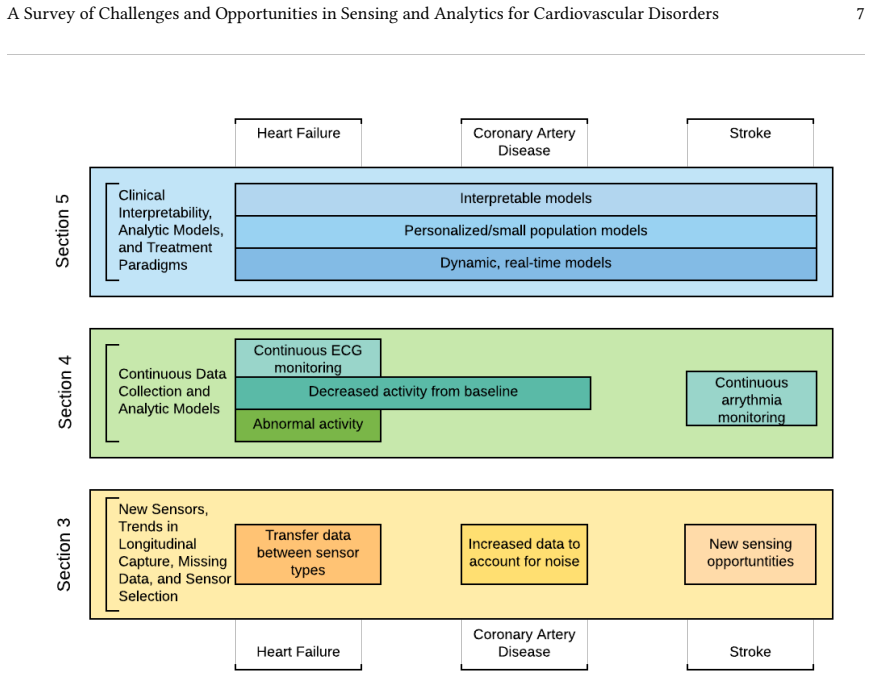
The organizing device is a three-need framework that acts as a pipeline: longitudinal sensing to continual analytics to personalized, interpretable modeling. Each sensor category, including acoustic and vital-sign capture, electrical measurements, blood-flow and cuff-less blood pressure, fluid retention and edema tracking, and physical activity and posture, is assessed against the first need; time-series and deep-learning methods are assessed against the second; and risk models such as CHA2DS2-VASc, HAS-BLED, QStroke, and the Pooled Cohort Equations are assessed against the third. The framework does the argumentative work by converting scattered sensor papers and trial null results into a single diagnosis of what is missing and where to build.
What would settle it
A randomized telemonitoring trial for heart failure that fully implements all three needs, with continuous multimodal sensing, longitudinal models that update risk, and interpretable personalized alerts, and then shows no reduction in readmissions or mortality despite high adherence and clean data would refute the survey's diagnosis. A cheaper test would re-analyze Tele-HF and Beat-HF data to determine whether patients who were fully adherent and received timely alerts still showed no benefit; if they did not, data richness was not the limiting factor.
Extended reading notes
Core claim
The central claim is stated in the abstract and repeated in the discussion: new smart health technologies for heart failure, coronary artery disease, and stroke need to satisfy three conditions at once. First, sensors must capture longitudinal trends in signs and symptoms even when measurements are infrequent, noisy, or missing, because patients will not wear every sensor all the time and context changes measurement quality. Second, analytic techniques must model data in a longitudinal, continual fashion, moving beyond anomaly detection and fixed-window classification toward tracking disease progression and updating risk over time. Third, the resulting machine learning must be personalized and interpretable, so patients and clinicians can act on predictions, update them as treatment changes, and understand the drivers of risk. The paper reads the failed Tele-HF and Beat-HF telemonitoring trials as evidence that point measurements and simple alerts are insufficient, and surveys existing acoustic, electrical, blood-flow, fluid-retention, and activity-sensing work to argue that the missing pieces are now being developed.
Load-bearing premise
The load-bearing premise is that the null results of earlier telemonitoring trials were caused by inadequate sensing and analytics, rather than by something else about remote monitoring, so that richer sensors and better models can actually reduce adverse events.
Editorial extensions
If this is right
- If the three needs are accepted, remote cardiac monitors should be evaluated on how well they track trends through missing and noisy data, not on occasional point measurements.
- Risk scores built on sparse history, such as CHA2DS2-VASc, could be enriched with temporal data such as atrial fibrillation burden, potentially sharpening decisions about anticoagulation.
- The framework implies that integrating multiple sensing modalities into a single platform, such as wrist and chest devices, is a prerequisite for longitudinal monitoring because patients will not wear many separate sensors.
- Machine learning for telemonitoring must be interpretable and personalized, since clinicians cannot act on outputs they cannot explain or adapt to a specific patient.
- The survey's reading of the Tele-HF and Beat-HF trials predicts that a telemonitoring system satisfying all three needs could reduce heart failure readmissions even though earlier simple alerts did not.
Reading between the lines
- If the three-needs framing is correct, the natural unit of clinical validation shifts from a single wearable device to an integrated sensing-plus-analytics system, and future trials should measure adherence, data quality, and alert response as mediators rather than only the final event rate.
- The framework implies a transfer-learning research program: because patients will not wear every sensor continuously, models that can estimate missing modalities from worn ones, such as inferring blood pressure from pulse arrival time or activity context, become central to longitudinal monitoring.
- The same pipeline could extend to other chronic conditions characterized by slow decompensation, such as diabetes or chronic obstructive pulmonary disease, following the paper's own analogy from human activity recognition to cardiac monitoring.
- A relatively cheap test of the survey's premise would be a retrospective simulation on Tele-HF and Beat-HF data that imputes missing daily weights and activity levels and checks whether richer longitudinal features would have produced earlier or more accurate decompensation alerts.
Signed reviews
Editorial analysis
A structured set of objections, weighed in public.
Referee Report
Summary. This manuscript is a survey of remote sensing and machine-learning analytics for cardiovascular disorders, using heart failure, coronary artery disease, stroke, and hypertension as case studies. It organizes the literature into three "primary needs": sensing that tracks longitudinal signs and symptoms despite noisy or missing data; analytics that model continuous longitudinal data for risk prediction and disease progression; and interpretable, personalized machine learning for shared clinical decision making. After reviewing acoustic, electrical, blood-flow, fluid-retention, and activity sensors, continuous-capture analytics, risk models, and interpretability methods, the paper concludes that addressing the three needs will enable improved remote clinical decision support for cardiovascular patients.
Significance. The survey's main value is organizational: it brings a broad and heterogeneous body of sensing and analytics literature under a single taxonomy and connects each technology category to specific clinical signs and symptoms. It also gives explicit credit to prior work and is generally careful to distinguish demonstrated technical performance from clinical benefit, notably for mSToPS and for edema sensors. As a survey, it makes no new empirical claims and offers no machine-checked artifacts. The conceptual contribution, the three-needs framework, is plausible and potentially useful as a research agenda, but its evidential basis is weaker than the presentation suggests: the motivating interpretation of Tele-HF and BEAT-HF is an unsupported causal counterfactual, and several trial attributions are incorrect. With revisions that sharpen the epistemic claims and correct the citations, the survey could be a useful reference for the smart-health community.
major comments (3)
- [Section 1 and Section 4.1.3] The narrative that Tele-HF and BEAT-HF failed because sensing and analytics were inadequate is a causal counterfactual that the manuscript does not establish. Both trials tested specific interventions (daily telephone self-report; automated transmission of weight, blood pressure, and heart rate with nurse telephone follow-up), and their null results are compatible with poor engagement, alert fatigue, absence of a linked treatment pathway, or limited avertability of readmissions. The survey cites no evidence that richer signals or more sophisticated analytics change clinical outcomes; mSToPS, which the survey itself describes, increased AFib diagnosis and anticoagulation but also increased healthcare utilization with unknown clinical impact. Please either reframe the three needs as a hypothesis or opportunity rather than a conclusion drawn from these trials, or cite direct evidence that data richness or analytic sophistication causally improves outcomes.
- [Section 4.1.3] The sentence beginning "Ong et al. in the Beat-HF study tried to use some machine learning techniques" misattributes the machine-learning analysis. Reference [84] is a separate secondary analysis by Pourhomayoun et al.; the Beat-HF trial report [75] did not itself evaluate machine-learning models. Please correct the attribution and distinguish the primary trial result from post-hoc analytics.
- [Section 5.1.2] The sentence "In Tele-HF, Krumholz et al. found that a self-report telemonitoring system was not able to reduce readmissions... [48]" misattributes the null trial result. The primary Tele-HF outcome is reported in Chaudhry et al. [17]; reference [48] is a secondary analysis of non-clinical predictors of readmission. Please correct the citation and keep primary and secondary analyses distinct, since the survey's motivating argument depends on accurate reporting of what these trials actually tested.
minor comments (5)
- [Section 4.1.2] "MIT-BHI arrhythmia database" should be "MIT-BIH arrhythmia database."
- [Section 3.1.2] The phrase "q-minima" would be clearer as "QRS minima" or "Q-wave minima."
- [Section 4.1.3] "degredation" should be "degradation."
- [Authors' block] The author name "BOBAK J. MORTAZA VI,Texas A&M University" appears with a missing space and comma placement issue; it should be "BOBAK J. MORTAZAVI, Texas A&M University."
- [Section 4.1.2] The mSToPS trial is described as ongoing; please clarify that the cited results are from the initial phase and that the three-year follow-up for clinical outcomes is still pending.
Circularity Check
No circularity: the paper is a survey that derives no results from its inputs; the three expressed needs are editorial framing, and author self-citations are used as supporting examples, not as load-bearing derivation.
full rationale
The paper makes no mathematical derivation, fits no parameters, and presents no predictive claim that is defined in terms of its own output. Its central content, the three primary needs in smart health for cardiovascular disorders, is asserted as an interpretive summary of the surveyed literature rather than derived from any equation or fitted quantity. The cited prior work by the authors, such as Krumholz et al. on Tele-HF and Mortazavi et al. on machine learning for heart failure readmissions, is used to describe existing studies and results; these citations provide context and examples, and the survey does not rely on any uniqueness theorem or prior self-citation to force a conclusion. The interpretive claim that null telemonitoring trials suggest a need for additional biomedical signals is a judgment about the literature, not a circular reduction: the paper does not define remote monitoring's potential in terms of its own sensing or analytics agenda, and it explicitly acknowledges that mechanistic alternatives exist by noting the mSToPS trial's increased healthcare utilization and unknown ultimate clinical impact. Accordingly, the paper is self-contained as a survey and contains no circular step that reduces a claimed result to its own inputs by definition, fitted parameter, or self-citation chain.
Assumptions & free parameters
assumptions (2)
- domain assumption Prior telemonitoring failures (Tele-HF, Beat-HF) are due to insufficient sensing and analytics, not a fundamental limit of remote monitoring.
- domain assumption Patients will accept and adhere to wearing multiple sensors longitudinally.
Cite this review
Pith. "Pith review of A Survey of Challenges and Opportunities in Sensing and Analytics for Cardiovascular Disorders." pith.science (2026). https://pith.science/paper/VJOAZ44I
@misc{pith2026190806170,
  author       = {Pith},
  title        = {Pith review of: A Survey of Challenges and Opportunities in Sensing and Analytics for Cardiovascular Disorders},
  year         = {2026},
  howpublished = {\url{https://pith.science/paper/VJOAZ44I}},
  note         = {Machine review of arXiv:1908.06170}
}
read the original abstract
Cardiovascular disorders account for nearly 1 in 3 deaths in the United States. Care for these disorders are often determined during visits to acute care facilities, such as hospitals. While the length of stay in these settings represents just a small proportion of patients' lives, they account for a disproportionately large amount of decision making. To overcome this bias towards data from acute care settings, there is a need for longitudinal monitoring in patients with cardiovascular disorders. Longitudinal monitoring can provide a more comprehensive picture of patient health, allowing for more informed decision making. This work surveys the current field of sensing technologies and machine learning analytics that exist in the field of remote monitoring for cardiovascular disorders. We highlight three primary needs in the design of new smart health technologies: 1) the need for sensing technology that can track longitudinal trends in signs and symptoms of the cardiovascular disorder despite potentially infrequent, noisy, or missing data measurements; 2) the need for new analytic techniques that model data captured in a longitudinal, continual fashion to aid in the development of new risk prediction techniques and in tracking disease progression; and 3) the need for machine learning techniques that are personalized and interpretable, allowing for advancements in shared clinical decision making. We highlight these needs based upon the current state-of-the-art in smart health technologies and analytics and discuss the ample opportunities that exist in addressing all three needs in the development of smart health technologies and analytics applied to the field of cardiovascular disorders and care.
Figures

Reference graph
Works this paper leans on
-
[84]
Mohammad Pourhomayoun, Nabil Alshurafa, Bobak Mortazavi, Hassan Ghasemzadeh, Konstantinos Sideris, Bahman Sadeghi, Michael Ong, Lorraine Evangelista, Patrick Romano, and Andrew Auerbach. 2014. Multiple model analytics for adverse event prediction in remote health monitoring systems. In 2014 IEEE Healthcare Innovation Conference (HIC) . IEEE, 106–110
work page 2014
-
[75]
Michael K Ong, Patrick S Romano, Sarah Edgington, Harriet U Aronow, Andrew D Auerbach, Jeanne T Black, Teresa De Marco, Jose J Escarce, Lorraine S Evangelista, and Barbara Hanna. 2016. Effectiveness of remote patient monitoring after discharge of hospitalized patients with heart failure: the better effectiveness after transitionâĂŞheart failure (BEAT-HF) ...
work page 2016
-
[48]
Harlan M Krumholz, Sarwat I Chaudhry, John A Spertus, Jennifer A Mattera, Beth Hodshon, and Jeph Herrin. 2016. Do non-clinical factors improve prediction of readmission risk?: results from the Tele-HF study. JACC: Heart Failure 4, 1 (2016), 12–20
2016
-
[17]
Sarwat I Chaudhry, Jennifer A Mattera, Jeptha P Curtis, John A Spertus, Jeph Herrin, Zhenqiu Lin, Christopher O Phillips, Beth V Hodshon, Lawton S Cooper, and Harlan M Krumholz. 2010. Telemonitoring in patients with heart failure. New England Journal of Medicine 363, 24 (2010), 2301–2309. https://doi.org/10.1056/NEJMoa1010029
-
[1]
Mohammadreza Abtahi, Joshua V Gyllinsky, Brandon Paesang, Scott Barlow, Matthew Constant, Nicholas Gomes, Oliver Tully, Susan E D’Andrea, and Kunal Mankodiya. 2018. MagicSox: An E-textile IoT system to quantify gait abnormalities. Smart Health 5 (2018), 4–14
2018
-
[2]
Tariq Ahmad, Michael J Pencina, Phillip J Schulte, Emily O’Brien, David J Whellan, Ileana L PiÃśa, Dalane W Kitzman, Kerry L Lee, Christopher M O’Connor, and G Michael Felker. 2014. Clinical implications of chronic heart failure phenotypes defined by cluster analysis.Journal of the American College of Cardiology 64, 17 (2014), 1765–1774. https://doi.org/1...
-
[3]
Robert Amelard, Richard L Hughson, Danielle K Greaves, Kaylen J Pfisterer, Jason Leung, David A Clausi, and Alexander Wong. 2017. Non-contact hemodynamic imaging reveals the jugular venous pulse waveform. Scientific reports 7 (2017), 40150. https://doi.org/10.1038/srep40150
-
[4]
Rasmus S Andersen, Abdolrahman Peimankar, and Sadasivan Puthusserypady. 2019. A deep learning approach for real-time detection of atrial fibrillation. Expert Systems with Applications 115 (2019), 465–473
2019
Show all 116 references
-
[5]
Stefan D Anker, Friedrich Koehler, and William T Abraham. 2011. Telemedicine and remote management of patients with heart failure. The Lancet 378, 9792 (2011), 731–739. https://doi.org/10.1016/S0140-6736(11)61229-4
2011 doi
-
[6]
Randy Ardywibowo, Guang Zhao, Zhangyang Wang, Bobak Mortazavi, Shuai Huang, and Xiaoning Qian. 2019. Adaptive Activity Monitoring with Uncertainty Quantification in Switching Gaussian Process Models. In The 22nd International Conference on Artificial Intelligence and Statistic...
2019
-
[7]
Sherif Assaad, Wolf B Kratzert, Benjamin Shelley, Malcolm B Friedman, and Albert Perrino Jr. 2018. Assessment of pulmonary edema: principles and practice. Journal of cardiothoracic and vascular anesthesia 32, 2 (2018), 901–914. https://doi.org/10.1053/j.jvca.2017.08.028
2018 doi
-
[8]
Akin Avci, Stephan Bosch, Mihai Marin-Perianu, Raluca Marin-Perianu, and Paul Havinga. 2010. Activity recognition using inertial sensing for healthcare, wellbeing and sports applications: A survey. In 23th International conference on architecture of computing systems 2010 . VDE, 1–10
2010
-
[9]
Charles F Babbs. 2012. Oscillometric measurement of systolic and diastolic blood pressures validated in a physiologic mathematical model. Biomedical engineering online 11, 1 (2012), 56. https://doi.org/10.1186/1475-925X-11-56 Manuscript submitted to ACM A Survey of Challenges ...
2012 doi
-
[10]
David W Baker, Doug Einstadter, Scott S Husak, and Randall D Cebul. 2004. Trends in postdischarge mortality and readmissions: has length of stay declined too far? Archives of internal medicine 164, 5 (2004), 538–544
2004
-
[11]
Ulas Baran Baloglu, Muhammed Talo, Ozal Yildirim, Ru San Tan, and U Rajendra Acharya. 2019. Classification of myocardial infarction with multi-lead ECG signals and deep CNN. Pattern Recognition Letters 122 (2019), 23–30
2019
-
[12]
Emelia J Benjamin, Paul Muntner, and Márcio Sommer Bittencourt. 2019. Heart disease and stroke statistics-2019 update: A report from the American Heart Association. Circulation 139, 10 (2019), e56–e528. https://doi.org/10.1161/CIR.0000000000000659
2019 doi
-
[13]
Terrell R Bennett, Claudio Savaglio, David Lu, Hunter Massey, Xianan Wang, Jian Wu, and Roozbeh Jafari. 2014. Motionsynthesis toolset (most): a toolset for human motion data synthesis and validation. In Proceedings of the 4th ACM MobiHoc workshop on Pervasive wireless healthca...
2014
-
[14]
Frank C Bennis, Carola van Pul, Jarno JL van den Bogaart, Peter Andriessen, Boris W Kramer, and Tammo Delhaas. 2019. Artifacts in pulse transit time measurements using standard patient monitoring equipment. PloS one 14, 6 (2019), e0218784
2019
-
[15]
Anshuman Bhuyan, Jung Woo Choe, Byung Chul Lee, Paul Cristman, Ömer Oralkan, and Butrus T Khuri-Yakub. 2011. Miniaturized, wearable, ultrasound probe for on-demand ultrasound screening. In 2011 IEEE International Ultrasonics Symposium . IEEE, 1060–1063
2011
-
[16]
Joseph M Bumgarner, Cameron T Lambert, Ayman A Hussein, Daniel J Cantillon, Bryan Baranowski, Kathy Wolski, Bruce D Lindsay, Oussama M Wazni, and Khaldoun G Tarakji. 2018. Smartwatch algorithm for automated detection of atrial fibrillation. Journal of the American College of C...
2018 doi
-
[18]
Chen Chen, Roozbeh Jafari, and Nasser Kehtarnavaz. 2017. A survey of depth and inertial sensor fusion for human action recognition. Multimedia Tools and Applications 76, 3 (2017), 4405–4425
2017
-
[19]
Jiaming Chen, Han Peng, and Abolfazl Razi. 2017. Remote ECG monitoring kit to predict patient-specific heart abnormalities. Journal of Systemics, Cybernetics and Informatics 15, 4 (2017), 82–89
2017
-
[20]
Robert D Conn and James H O’Keefe. 2009. Cardiac physical diagnosis in the digital age: an important but increasingly neglected skill (from stethoscopes to microchips). The American journal of cardiology 104, 4 (2009), 590–595. https://doi.org/10.1016/j.amjcard.2009.04.030
2009 doi
-
[21]
Wen-Xuan Dai, Yuan-Ting Zhang, Jing Liu, Xiao-Rong Ding, and Ni Zhao. 2016. Dual-modality arterial pulse monitoring system for continuous blood pressure measurement. In 2016 38th Annual International Conference of the IEEE Engineering in Medicine and Biology Society (EMBC) . I...
2016
-
[22]
Simon de Denus, Eileen O’Meara, Akshay S Desai, Brian Claggett, Eldrin F Lewis, Grégoire Leclair, Martin Jutras, JoÃńl Lavoie, Scott D Solomon, and Bertram Pitt. 2017. Spironolactone metabolites in TOPCATâĂŤnew insights into regional variation. New England Journal of Medicine ...
2017
-
[23]
Bruce H Dobkin and Clarisa Martinez. 2018. Wearable Sensors to Monitor, Enable Feedback, and Measure Outcomes of Activity and Practice. Current neurology and neuroscience reports 18, 12 (2018), 87. https://doi.org/10.1007/s11910-018-0896-5
2018 doi
-
[24]
Mohamed Elgendi, Prashant Bobhate, Shreepal Jain, Jennifer Rutledge, James Y Coe, Roger Zemp, Dale Schuurmans, and Ian Adatia. 2014. Time- domain analysis of heart sound intensity in children with and without pulmonary artery hypertension: a pilot study using a digital stethos...
2014
-
[25]
Bjoern Eskofier, Sunghoon Lee, Manuela Baron, André Simon, Christine Martindale, Heiko Gaßner, and Jochen Klucken. 2017. An overview of smart shoes in the internet of health things: gait and mobility assessment in health promotion and disease monitoring. Applied Sciences 7, 10...
2017
-
[26]
Ramin Fallahzadeh, Mahdi Pedram, and Hassan Ghasemzadeh. 2016. Smartsock: A wearable platform for context-aware assessment of ankle edema. In 2016 38th Annual International Conference of the IEEE Engineering in Medicine and Biology Society (EMBC) . IEEE, 6302–6306
2016
-
[27]
Ramin Fallahzadeh, Mahdi Pedram, Ramyar Saeedi, Bahman Sadeghi, Michael Ong, and Hassan Ghasemzadeh. 2015. Smart-cuff: A wearable bio-sensing platform with activity-sensitive information quality assessment for monitoring ankle edema. In 2015 IEEE International Conference on Pe...
2015
-
[28]
Ian Fox, Lynn Ang, Mamta Jaiswal, Rodica Pop-Busui, and Jenna Wiens. 2017. Contextual motifs: Increasing the utility of motifs using contextual data. In Proceedings of the 23rd ACM SIGKDD International Conference on Knowledge Discovery and Data Mining . ACM, 155–164
2017
-
[29]
Ian Fox, Lynn Ang, Mamta Jaiswal, Rodica Pop-Busui, and Jenna Wiens. 2018. Deep multi-output forecasting: Learning to accurately predict blood glucose trajectories. In Proceedings of the 24th ACM SIGKDD International Conference on Knowledge Discovery & Data Mining . ACM, 1387–1395
2018
-
[30]
Alan H Gee, Diego Garcia-Olano, Joydeep Ghosh, and David Paydarfar. 2019. Explaining Deep Classification of Time-Series Data with Learned Prototypes. arXiv preprint arXiv:1904.08935 (2019)
2019 arXiv
-
[31]
David C Goff, Donald M Lloyd-Jones, Glen Bennett, Sean Coady, Ralph B D’Agostino, Raymond Gibbons, Philip Greenland, Daniel T Lackland, Daniel Levy, and Christopher J O’Donnell. 2014. 2013 ACC/AHA guideline on the assessment of cardiovascular risk: a report of the American Col...
2014
-
[32]
SPRINT Research Group. 2015. A randomized trial of intensive versus standard blood-pressure control. New England Journal of Medicine 373, 22 (2015), 2103–2116. Manuscript submitted to ACM 28 Hurley et al
2015
-
[33]
Jette Henderson, Huan He, Bradley A Malin, Joshua C Denny, Abel N Kho, Joydeep Ghosh, and Joyce C Ho. 2018. Phenotyping through Semi-Supervised Tensor Factorization (PSST). In AMIA Annual Symposium Proceedings , Vol. 2018. American Medical Informatics Association, 564
2018
-
[34]
Katharine E Henry, David N Hager, Peter J Pronovost, and Suchi Saria. 2015. A targeted real-time early warning score (TREWScore) for septic shock. Science translational medicine 7, 299 (2015), 299ra122–299ra122. https://doi.org/10.1126/scitranslmed.aab3719
2015 doi
-
[35]
Balraj S Heran, Jenny MH Chen, Shah Ebrahim, Tiffany Moxham, Neil Oldridge, Karen Rees, David R Thompson, and Rod S Taylor. 2011. Exercise- based cardiac rehabilitation for coronary heart disease. Cochrane database of systematic reviews 7 (2011), CD001800. https://doi.org/10.1...
2011
-
[36]
Shurouq Hijazi, Alex Page, Burak Kantarci, and Tolga Soyata. 2016. Machine learning in cardiac health monitoring and decision support. Computer 49, 11 (2016), 38–48
2016
-
[37]
Julia Hippisley-Cox, Carol Coupland, and Peter Brindle. 2013. Derivation and validation of QStroke score for predicting risk of ischaemic stroke in primary care and comparison with other risk scores: a prospective open cohort study. Bmj 346 (2013), f2573. https://doi.org/10.11...
2013 doi
-
[38]
J Hodgkinson, J Mant, U Martin, B Guo, FDR Hobbs, JJ Deeks, C Heneghan, N Roberts, and RJ McManus. 2011. Relative effectiveness of clinic and home blood pressure monitoring compared with ambulatory blood pressure monitoring in diagnosis of hypertension: systematic review. Bmj ...
2011 doi
-
[39]
Enamul Hoque and John Stankovic. 2012. AALO: Activity recognition in smart homes using Active Learning in the presence of Overlapped activities. In 2012 6th International Conference on Pervasive Computing Technologies for Healthcare (PervasiveHealth) and Workshops . IEEE, 139–146
2012
-
[40]
Toan Huynh, Roozbeh Jafari, and Wan-Young Chung. 2018. An Accurate Bioimpedance measurement system for blood pressure monitoring. Sensors 18, 7 (2018), 2095
2018
-
[41]
Bassem Ibrahim, Ali Akbari, and Roozbeh Jafari. 2017. A novel method for pulse transit time estimation using wrist bio-impedance sensing based on a regression model. In 2017 IEEE Biomedical Circuits and Systems Conference (BioCAS) . IEEE, 1–4
2017
-
[42]
Omer T Inan, Abdul Q Javaid, Sean Dowling, Hazar Ashouri, Mozziyar Etemadi, James A Heller, Shuvo Roy, and Liviu Klein. 2016. Using ballistocardiography to monitor left ventricular function in heart failure patients. Journal of Cardiac Failure 22, 8 (2016), S45
2016
-
[43]
Shweta H Jambukia, Vipul K Dabhi, and Harshadkumar B Prajapati. 2015. Classification of ECG signals using machine learning techniques: A survey. In 2015 International Conference on Advances in Computer Engineering and Applications . IEEE, 714–721
2015
-
[44]
Kunal N Karmali, Philippa Davies, Fiona Taylor, Andrew Beswick, Nicole Martin, and Shah Ebrahim. 2014. Promoting patient uptake and adherence in cardiac rehabilitation. Cochrane Database of Systematic Reviews 6 (2014), CD007131. https://doi.org/10.1002/14651858.CD007131.pub3
2014 doi
-
[45]
Chang-Sei Kim, Andrew M Carek, Omer T Inan, Ramakrishna Mukkamala, and Jin-Oh Hahn. 2018. Ballistocardiogram-based approach to cuffless blood pressure monitoring: proof of concept and potential challenges. IEEE Transactions on Biomedical Engineering 65, 11 (2018), 2384–2391. h...
2018
-
[46]
Chang-Sei Kim, Stephanie L Ober, M Sean McMurtry, Barry A Finegan, Omer T Inan, Ramakrishna Mukkamala, and Jin-Oh Hahn. 2016. Ballistocardio- gram: Mechanism and potential for unobtrusive cardiovascular health monitoring.Scientific reports 6 (2016), 31297. https://doi.org/10.1...
2016 doi
-
[47]
Arthur Knapp, Violetta Cetrullo, Brett A Sillars, Nat Lenzo, Wendy A Davis, and Timothy ME Davis. 2014. Carotid artery ultrasonographic assessment in patients from the Fremantle Diabetes Study Phase II with carotid bruits detected by electronic auscultation. Diabetes technolog...
2014
-
[49]
Harlan M Krumholz, Jeph Herrin, Lauren E Miller, Elizabeth E Drye, Shari M Ling, Lein F Han, Michael T Rapp, Elizabeth H Bradley, Brahmajee K Nallamothu, and Wato Nsa. 2011. Improvements in door-to-balloon time in the United States, 2005 to 2010. Circulation 124, 9 (2011), 103...
2011 doi
-
[50]
Roberto M Lang, Luigi P Badano, Victor Mor-Avi, Jonathan Afilalo, Anderson Armstrong, Laura Ernande, Frank A Flachskampf, Elyse Foster, Steven A Goldstein, and Tatiana Kuznetsova. 2015. Recommendations for cardiac chamber quantification by echocardiography in adults: an update...
2015
-
[51]
Oscar D Lara and Miguel A Labrador. 2012. A survey on human activity recognition using wearable sensors. IEEE communications surveys & tutorials 15, 3 (2012), 1192–1209
2012
-
[52]
Shuang Leng, Ru San Tan, Kevin Tshun Chuan Chai, Chao Wang, Dhanjoo Ghista, and Liang Zhong. 2015. The electronic stethoscope. Biomedical engineering online 14, 1 (2015), 66. https://doi.org/10.1186/s12938-015-0056-y
2015 doi
-
[53]
R Levin, M Dolgin, C Fox, and R Gorlin. 1994. The Criteria Committee of the New York Heart Association: Nomenclature and Criteria for Diagnosis of Diseases of the Heart and Great Vessels. LWW Handbooks 9 (1994), 344
1994
-
[54]
Changzhi Li, Julie Cummings, Jeffrey Lam, Eric Graves, and Wenhsing Wu. 2009. Radar remote monitoring of vital signs.IEEE Microwave Magazine 10, 1 (2009), 47–56
2009
-
[55]
Qiao Li, Cadathur Rajagopalan, and Gari D Clifford. 2014. A machine learning approach to multi-level ECG signal quality classification. Computer methods and programs in biomedicine 117, 3 (2014), 435–447. https://doi.org/10.1016/j.cmpb.2014.09.002
2014 doi
-
[56]
Gregory YH Lip, Robby Nieuwlaat, Ron Pisters, Deirdre A Lane, and Harry JGM Crijns. 2010. Refining clinical risk stratification for predicting stroke and thromboembolism in atrial fibrillation using a novel risk factor-based approach: the euro heart survey on atrial fibrillati...
2010
-
[57]
Zachary C Lipton, David C Kale, and Randall Wetzel. 2016. Modeling missing data in clinical time series with rnns. arXiv preprint arXiv:1606.04130 (2016)
2016 arXiv
-
[58]
Yang Liu, Zhenjiang Li, Zhidan Liu, and Kaishun Wu. 2019. Real-time Arm Skeleton Tracking and Gesture Inference Tolerant to Missing Wearable Sensors. In Proceedings of the 17th Annual International Conference on Mobile Systems, Applications, and Services . ACM, 287–299
2019
-
[59]
T Ma and Yuan-Ting Zhang. 2006. A correlation study on the variabilities in pulse transit time, blood pressure, and heart rate recorded simultaneously from healthy subjects. In 2005 IEEE Engineering in Medicine and Biology 27th Annual Conference . IEEE, 996–999
2006
-
[60]
Ralph Maddison, Jonathan C Rawstorn, Anna Rolleston, Robyn Whittaker, Ralph Stewart, Jocelyne Benatar, Ian Warren, Yannan Jiang, and Nicholas Gant. 2014. The remote exercise monitoring trial for exercise-based cardiac rehabilitation (REMOTE-CR): a randomised controlled trial p...
2014 doi
-
[61]
Sherin M Mathews, Chandra Kambhamettu, and Kenneth E Barner. 2018. A novel application of deep learning for single-lead ECG classification. Computers in biology and medicine 99 (2018), 53–62. https://doi.org/10.1016/j.compbiomed.2018.05.013
2018 doi
-
[62]
Robert L McNamara, Yongfei Wang, Jeph Herrin, Jeptha P Curtis, Elizabeth H Bradley, David J Magid, Eric D Peterson, Martha Blaney, Paul D Frederick, and Harlan M Krumholz. 2006. Effect of door-to-balloon time on mortality in patients with ST-segment elevation myocardial infarc...
2006 doi
-
[63]
Authors/Task Force Members, A John Camm, Gregory YH Lip, Raffaele De Caterina, Irene Savelieva, Dan Atar, Stefan H Hohnloser, Gerhard Hindricks, Paulus Kirchhof, and ESC Committee for Practice Guidelines. 2012. 2012 focused update of the ESC guidelines for the management of at...
2012
-
[64]
George B Moody and Roger G Mark. 2001. The impact of the MIT-BIH arrhythmia database. IEEE Engineering in Medicine and Biology Magazine 20, 3 (2001), 45–50. https://www.ncbi.nlm.nih.gov/pubmed/11446209
2001
-
[65]
Christopher L Moore and Joshua A Copel. 2011. Point-of-care ultrasonography. New England Journal of Medicine 364, 8 (2011), 749–757. https://doi.org/10.1056/NEJMra0909487
2011 doi
-
[66]
Bobak Mortazavi, Suneil Nyamathi, Sunghoon Ivan Lee, Thomas Wilkerson, Hassan Ghasemzadeh, and Majid Sarrafzadeh. 2013. Near-realistic mobile exergames with wireless wearable sensors. IEEE Journal of Biomedical and Health Informatics 18, 2 (2013), 449–456
2013
-
[67]
Bobak Mortazavi, Mohammad Pourhomayoun, Hassan Ghasemzadeh, Roozbeh Jafari, Christian K Roberts, and Majid Sarrafzadeh. 2014. Context- aware data processing to enhance quality of measurements in wireless health systems: An application to met calculation of exergaming actions. ...
2014
-
[68]
Bobak J Mortazavi, Nicholas S Downing, Emily M Bucholz, Kumar Dharmarajan, Ajay Manhapra, Shu-Xia Li, Sahand N Negahban, and Harlan M Krumholz. 2016. Analysis of machine learning techniques for heart failure readmissions. Circulation: Cardiovascular Quality and Outcomes 9, 6 (...
2016 doi
-
[69]
Bobak Jack Mortazavi, Mohammad Pourhomayoun, Gabriel Alsheikh, Nabil Alshurafa, Sunghoon Ivan Lee, and Majid Sarrafzadeh. 2014. Determining the single best axis for exercise repetition recognition and counting on smartwatches. In 2014 11th International Conference on Wearable ...
2014
-
[70]
Brahmajee K Nallamothu, Sharon-Lise T Normand, Yongfei Wang, Timothy P Hofer, John E Brush Jr, John C Messenger, Elizabeth H Bradley, John S Rumsfeld, and Harlan M Krumholz. 2015. Relation between door-to-balloon times and mortality after primary percutaneous coronary interven...
2015
-
[71]
Viswam Nathan, Sudip Paul, Temiloluwa Prioleau, Li Niu, Bobak J Mortazavi, Stephen A Cambone, Ashok Veeraraghavan, Ashutosh Sabharwal, and Roozbeh Jafari. 2018. A Survey on Smart Homes for Aging in Place: Toward Solutions to the Specific Needs of the Elderly. IEEE Signal Proce...
2018
-
[72]
Lisa Nobel, Nancy E Mayo, James Hanley, Lyne Nadeau, and Stella S Daskalopoulou. 2014. MyRisk_Stroke calculator: a personalized stroke risk assessment tool for the general population. Journal of Clinical Neurology 10, 1 (2014), 1–9. https://doi.org/10.3988/jcn.2014.10.1.1
2014 doi
-
[73]
Eoin O’brien, Bernard Waeber, Gianfranco Parati, Jan Staessen, and Martin G Myers. 2001. Blood pressure measuring devices: recommendations of the European Society of Hypertension. Bmj 322, 7285 (2001), 531–536. https://doi.org/10.1136/bmj.322.7285.531
2001 doi
-
[74]
Michael H Olsen, Sonia Y Angell, Samira Asma, Pierre Boutouyrie, Dylan Burger, Julio A Chirinos, Albertino Damasceno, Christian Delles, Anne-Paule Gimenez-Roqueplo, and Dagmara Hering. 2016. A call to action and a lifecourse strategy to address the global burden of raised bloo...
2016 doi
-
[76]
Edward Onusko. 2003. Diagnosing secondary hypertension. American family physician 67, 1 (2003), 67–74. https://www.ncbi.nlm.nih.gov/pubmed/ 12537168
2003
-
[77]
Andreas Østvik, Erik Smistad, Svein Arne Aase, Bjørn Olav Haugen, and Lasse Lovstakken. 2019. Real-time Standard View Classification in Transthoracic Echocardiography using Convolutional Neural Networks. Ultrasound in medicine & biology 45, 2 (2019), 374–384
2019
-
[78]
Kazushige Ouchi and Miwako Doi. 2013. Smartphone-based monitoring system for activities of daily living for elderly people and their relatives etc. In Proceedings of the 2013 ACM conference on Pervasive and ubiquitous computing adjunct publication . ACM, 103–106. Manuscript su...
2013
-
[79]
Rajkumar Palaniappan, Kenneth Sundaraj, and Nizam Uddin Ahamed. 2013. Machine learning in lung sound analysis: a systematic review. Biocybernetics and Biomedical Engineering 33, 3 (2013), 129–135
2013
-
[80]
Marc A Pfeffer, Brian Claggett, Susan F Assmann, Robin Boineau, Inder S Anand, Nadine Clausell, Akshay S Desai, Rafael Diaz, Jerome L Fleg, and Ivan Gordeev. 2015. Regional variation in patients and outcomes in the Treatment of Preserved Cardiac Function Heart Failure With an ...
2015 doi
-
[81]
Ivan Pires, Nuno Garcia, Nuno Pombo, and Francisco Flórez-Revuelta. 2016. From data acquisition to data fusion: a comprehensive review and a roadmap for the identification of activities of daily living using mobile devices. Sensors 16, 2 (2016), 184
2016
-
[82]
Ron Pisters, Deirdre A Lane, Robby Nieuwlaat, Cees B De Vos, Harry JGM Crijns, and Gregory YH Lip. 2010. A novel user-friendly score (HAS-BLED) to assess 1-year risk of major bleeding in patients with atrial fibrillation: the Euro Heart Survey. Chest 138, 5 (2010), 1093–1100. ...
2010 doi
-
[83]
Bertram Pitt, Marc A Pfeffer, Susan F Assmann, Robin Boineau, Inder S Anand, Brian Claggett, Nadine Clausell, Akshay S Desai, Rafael Diaz, Jerome L Fleg, et al . 2014. Spironolactone for heart failure with preserved ejection fraction. New England Journal of Medicine 370, 15 (2...
2014
-
[85]
David M Reboussin, Norrina B Allen, Michael E Griswold, Eliseo Guallar, Yuling Hong, Daniel T Lackland, Edgar Pete R Miller, Tamar Polonsky, Angela M Thompson-Paul, and Suma Vupputuri. 2018. Systematic review for the 2017 ACC/AHA/AAPA/ABC/ACPM/AGS/APhA/ASH/ASPC/NMA/PCNA guidel...
2018
-
[86]
Marco Tulio Ribeiro, Sameer Singh, and Carlos Guestrin. 2016. Why should I trust you?: Explaining the predictions of any classifier. In Proceedings of the 22nd ACM SIGKDD international conference on knowledge discovery and data mining . ACM, 1135–1144
2016
-
[87]
Seyed Ali Rokni and Hassan Ghasemzadeh. 2016. Plug-n-learn: automatic learning of computational algorithms in human-centered internet-of- things applications. In Proceedings of the 53rd Annual Design Automation Conference . ACM, 139
2016
-
[88]
Seyed Ali Rokni and Hassan Ghasemzadeh. 2018. Autonomous training of activity recognition algorithms in mobile sensors: A transfer learning approach in context-invariant views. IEEE Transactions on Mobile Computing 17, 8 (2018), 1764–1777
2018
-
[89]
Seyed Ali Rokni, Marjan Nourollahi, and Hassan Ghasemzadeh. 2018. Personalized human activity recognition using convolutional neural networks. In Thirty-Second AAAI Conference on Artificial Intelligence
2018
-
[90]
Jennifer A Rymer and Sunil V Rao. 2019. Enhancement of Risk Prediction With Machine Learning: Rise of the Machines. JAMA network open 2, 7 (2019), e196823–e196823. https://doi.org/10.1001/jamanetworkopen.2019.6823
2019
-
[91]
Manuel Sánchez-de-la Torre, Abdelnaby Khalyfa, Alicia Sánchez-de-la Torre, Montserrat Martinez-Alonso, Miguel Ángel Martinez-GarcÃŋa, Antonia Barceló, Patricia Lloberes, Francisco Campos-Rodriguez, Francisco Capote, and Maria José Diaz-de Atauri. 2015. Precision medicine in pa...
2015
-
[92]
Sougata Sen, Vigneshwaran Subbaraju, Archan Misra, Rajesh Krishna Balan, and Youngki Lee. 2015. The case for smartwatch-based diet monitoring. In 2015 IEEE international conference on pervasive computing and communication workshops (PerCom workshops) . IEEE, 585–590
2015
-
[93]
Arijit Sinharay, Deb Ghosh, Parijat Deshpande, Shahnawaz Alam, Rohan Banerjee, and Arpan Pal. 2016. Smartphone Based Digital Stethoscope for Connected Health–A Direct Acoustic Coupling Technique. In 2016 IEEE First International Conference on Connected Health: Applications, Sy...
2016
-
[94]
Roger Solis, Arash Pakbin, Ali Akbari, Bobak J Mortazavi, and Roozbeh Jafari. 2019. A human-centered wearable sensing platform with intelligent automated data annotation capabilities. In Proceedings of the International Conference on Internet of Things Design and Implementatio...
2019
-
[95]
Huan Song, Deepta Rajan, Jayaraman J Thiagarajan, and Andreas Spanias. 2018. Attend and diagnose: Clinical time series analysis using attention models. In Thirty-Second AAAI Conference on Artificial Intelligence
2018
-
[96]
Janani C Sriram, Minho Shin, Tanzeem Choudhury, and David Kotz. 2009. Activity-aware ECG-based patient authentication for remote health monitoring. In Proceedings of the 2009 international conference on Multimodal interfaces . ACM, 297–304
2009
-
[97]
Steven R Steinhubl, Jill Waalen, Alison M Edwards, Lauren M Ariniello, Rajesh R Mehta, Gail S Ebner, Chureen Carter, Katie Baca-Motes, Elise Felicione, and Troy Sarich. 2018. Effect of a home-based wearable continuous ECG monitoring patch on detection of undiagnosed atrial fib...
2018
-
[98]
Harini Suresh, Jen J Gong, and John V Guttag. 2018. Learning tasks for multitask learning: Heterogenous patient populations in the icu. In Proceedings of the 24th ACM SIGKDD International Conference on Knowledge Discovery & Data Mining . ACM, 802–810
2018
-
[99]
Simi Susan Thomas, Viswam Nathan, Chengzhi Zong, Ebunoluwa Akinbola, Antoine Lourdes Praveen Aroul, Lijoy Philipose, Karthikeyan Soundarapandian, Xiangrong Shi, and Roozbeh Jafari. 2014. BioWatch-A wrist watch based signal acquisition system for physiological signals including...
2014
-
[100]
Zachary Trujillo, Viswam Nathan, Gerard L Coté, and Roozbeh Jafari. 2017. Design and parametric analysis of a wearable dual-photoplethysmograph based system for pulse wave velocity detection. In 2017 IEEE International Symposium on Circuits and Systems (ISCAS) . IEEE, 1–4
2017
-
[101]
Kristof Van Laerhoven, Marko Borazio, and Jan Hendrik Burdinski. 2015. Wear is your mobile? Investigating phone carrying and use habits with a wearable device. Frontiers in ICT 2 (2015), 10
2015
-
[102]
Ramachandran S Vasan, Alexa Beiser, Sudha Seshadri, Martin G Larson, William B Kannel, Ralph B D’Agostino, and Daniel Levy. 2002. Residual lifetime risk for developing hypertension in middle-aged women and men: The Framingham Heart Study. Jama 287, 8 (2002), 1003–1010. https:/...
2002 doi
-
[103]
Gabor Vinci, Stefan Lindner, Francesco Barbon, Sebastian Mann, Maximilian Hofmann, Alexander Duda, Robert Weigel, and Alexander Koelpin
-
[104]
Jindong Wang, Yiqiang Chen, Shuji Hao, Xiaohui Peng, and Lisha Hu. 2019. Deep learning for sensor-based activity recognition: A survey. Pattern Recognition Letters 119 (2019), 3–11
2019
-
[105]
Jeremiah Wasserlauf, Cindy You, Ruchi Patel, Alexander Valys, David Albert, and Rod Passman. 2019. Smartwatch Performance for the Detection and Quantification of Atrial Fibrillation. Circulation: Arrhythmia and Electrophysiology 12, 6 (2019), e006834. https://doi.org/10.1161/C...
2019 doi
-
[106]
Sören Weyer, Tobias Menden, Lennart Leicht, Steffen Leonhardt, and Tobias Wartzek. 2015. Development of a wearable multi-frequency impedance cardiography device. Journal of medical engineering & technology 39, 2 (2015), 131–137. https://doi.org/10.3109/03091902.2014.990161
2015
-
[107]
SP Wright, D Verouhis, G Gamble, K Swedberg, N Sharpe, and RN Doughty. 2003. Factors influencing the length of hospital stay of patients with heart failure. European Journal of Heart Failure 5, 2 (2003), 201–209. https://doi.org/10.1016/s1388-9842(02)00201-5
2003 doi
-
[108]
Michael Xie, Neal Jean, Marshall Burke, David Lobell, and Stefano Ermon. 2016. Transfer learning from deep features for remote sensing and poverty mapping. In Thirtieth AAAI Conference on Artificial Intelligence
2016
-
[109]
Jianchu Yao, Elizabeth MB Weaver, Brandon D Langley, Stephanie M George, and Sonya R Hardin. 2017. Monitoring peripheral edema of heart failure patients at home: Device, algorithm, and clinic study. In 2017 39th Annual International Conference of the IEEE Engineering in Medici...
2017
-
[110]
Özal Yildirim. 2018. A novel wavelet sequence based on deep bidirectional LSTM network model for ECG signal classification. Computers in biology and medicine 96 (2018), 189–202. https://doi.org/10.1016/j.compbiomed.2018.03.016
2018 doi
-
[111]
Cheuk-Man Yu, LI Wang, Elaine Chau, Raymond Hon-Wah Chan, Shun-Ling Kong, Man-Oi Tang, Jill Christensen, Robert W Stadler, and Chu-Pak Lau. 2005. Intrathoracic impedance monitoring in patients with heart failure: correlation with fluid status and feasibility of early warning p...
2005 doi
-
[112]
Özgür Yürür, Chi Harold Liu, and Wilfrido Moreno. 2015. Light-weight online unsupervised posture detection by smartphone accelerometer. IEEE Internet of Things Journal 2, 4 (2015), 329–339
2015
-
[113]
Yuan-ting Zhang, Carmen CY Poon, Chun-hung Chan, Martin WW Tsang, and Kin-fai Wu. 2006. A health-shirt using e-textile materials for the continuous and cuffless monitoring of arterial blood pressure. In 2006 3rd IEEE/EMBS International Summer School on Medical Devices and Bios...
2006
-
[114]
Zhilin Zhang. 2015. Photoplethysmography-based heart rate monitoring in physical activities via joint sparse spectrum reconstruction. IEEE transactions on biomedical engineering 62, 8 (2015), 1902–1910. https://doi.org/10.1109/TBME.2015.2406332
2015
-
[115]
Boback Ziaeian and Gregg C Fonarow. 2016. Epidemiology and aetiology of heart failure. Nature Reviews Cardiology 13, 6 (2016), 368. https: //doi.org/10.1038/nrcardio.2016.25 A NORMAL CARDIAC PHYSIOLOGY In order to better understand the opportunities discussed in this work, we ...
2016 doi
-
[2013]
IEEE Transactions on Microwave Theory and Techniques 61, 5 (2013), 2093–2100
Six-port radar sensor for remote respiration rate and heartbeat vital-sign monitoring. IEEE Transactions on Microwave Theory and Techniques 61, 5 (2013), 2093–2100
2013
Reviewed August 14, 2026 · model on record in the stance chip above.
Discussion (0). Continue with ORCID to comment.