REVIEW 2 major objections 6 minor 36 references
The Dirac Vacuum in Discrete Spacetime
T0 review · 2 major / 6 minor · reviewed 2026-08-11 · deepseek-v4-flash
Pith's one-line read Filling the negative-energy eigenstates of a discrete-time Dirac model creates a second boundary where pair creation releases energy, destabilizing the vacuum.
desk verdict A clear, honest short paper that identifies a genuine obstruction to defining a Dirac sea in discrete-time fermion walks; the instability claim is conditional on an uncomputed interaction amplitude, but the paper says so itself. read the letter →
The pith
A machine-rendered reading of the paper's core claim, the machinery that carries it, and where it could break.
The reading
What carries the argument
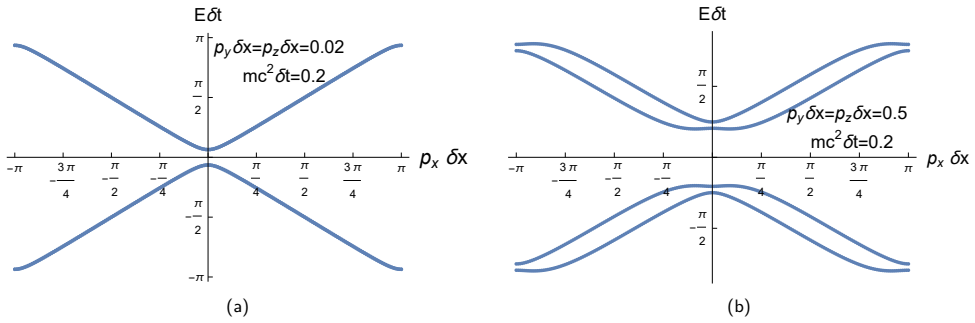
The load-bearing mechanism is modular energy: because evolution is a single unitary, the energy $E$ is read from the eigenvalues $e^{-iE\delta t}$ and is only defined modulo $2\pi/\delta t$. Filling the lower half of the energy circle creates two boundaries, and the core identity used to control them is $\cos(\tilde{E}_p\delta t)=\cos(mc^2\delta t)\cos^2(p\delta x)+\sin^2(p\delta x)\cos(mc^2\delta t+2\phi)$ with $\phi=\pi/2-\theta$. This equation shows that choosing $\theta$ so that $-\pi/2<mc^2\delta t+2\phi<\pi/2$ makes the right-hand side positive for all momenta, forcing every energy eigenvalue out of the problematic half-circle and into $(-\pi/(2\delta t),\pi/(2\delta t))$; it also reveals that the gap at $E=\pm\pi/\delta t$ vanishes when $2\theta=mc^2\delta t$. The swapped eigenstates near the boundary, $|s^+_{\pm\pi/\delta x+p}\rangle\approx|\tilde{v}_p\rangle$ and $|s^-_{\pm\pi/\delta x+p}\rangle\approx|\tilde{u}_p\rangle$, justify treating the boundary amplitude as comparable to the low-energy one, which is what makes the instability argument go through.
What would settle it
Compute the second-order transition rate for high-momentum pair creation near the $E=\pm\pi/\delta t$ boundary in an explicit interacting Dirac QCA (for example a 1+1-D QED cellular automaton): if the rate does not grow with evolution time, or if modular energy is not conserved at higher orders in a way that forbids the $2\pi/\delta t-(\epsilon_1+\epsilon_2)$ channel, the vacuum instability does not occur. A direct search for spontaneous high-momentum pairs in a quantum simulation of the Dirac QCA with weak interactions would likewise settle the claim.
Extended reading notes
Core claim
The paper claims that a Dirac sea defined by filling all negative-energy eigenstates of the Dirac quantum walk has two boundaries, not one. At $E=0$ the physics is the familiar continuum one: a sea particle must absorb positive energy to reach a positive-energy state. At $E=\pm\pi/\delta t$, however, the eigenstates' internal spin structure is swapped — the filled states look like the continuum positive-energy spinors $|\tilde{u}_p\rangle$ and the empty ones like the negative-energy spinors $|\tilde{v}_p\rangle$ — and modular energy conservation implies that a transition changing energy by $2\pi/\delta t-(\epsilon_1+\epsilon_2)$ costs an effective $-(\epsilon_1+\epsilon_2)$, meaning it releases energy. Consequently, in any interacting version of the model, pairs of high-momentum particle-antiparticle-like excitations near this boundary would be spontaneously produced and the vacuum would be unstable. The proposed remedy is a modified walk $U_{\rm mod}=e^{-imc^2\sigma_x\delta t}e^{-iP\sigma_{-\theta}\delta x}e^{-iP\sigma_{\theta}\delta x}$, which satisfies $|\tilde{E}_p|\delta t<\pi/2$ for a suitable $\theta$ (Theorem 1), so that pair creation at the boundary can never release positive energy; the cost is that every energy level becomes doubly degenerate, a fermion-doubling problem familiar from lattice field theory.
Load-bearing premise
The instability argument assumes that modular energy is genuinely conserved by an interacting QCA, which is proven only to first order in the coupling, and that the transition amplitude near the $E=\pm\pi/\delta t$ boundary is comparable to the one near $E=0$, which is argued from the swapped internal states but never computed.
Editorial extensions
If this is right
- Any interacting quantum cellular automaton that defines its vacuum by filling negative-energy eigenstates must either bend the free dispersion to open a gap at $E=\pm\pi/\delta t$, accept fermion doubling, or abandon the Dirac-sea construction.
- The discrete Fermi golden rule (Eq. 22) implies that interaction terms transferring $2\pi/\delta t$ of energy relative to the free model are unsuppressed, so stable total energy in a QCA requires such terms be negligible.
- The modified walk realizes a low-momentum Dirac approximation for any $0\le mc^2\delta t<\pi/2$ with all energy eigenstates satisfying $|\tilde{E}_p|\delta t<\pi/2$, making pair creation at the boundary energetically forbidden.
- In 3+1 dimensions the unmodified walk already contains high-momentum solutions that behave as Dirac particles near the boundary, so the same modular-energy pair-creation problem arises there, and the same bending remedy applies.
- The fermion doubling introduced by the remedy is the same type of problem handled in lattice field theory, suggesting that established doubling-suppression strategies could be adapted to this discrete-time setting.
Reading between the lines
- Inference: if confirmed by an explicit interacting calculation, the instability would also threaten the half-filled product-state vacuum used in existing QED QCA constructions, whose mass term may already be generating spurious pairs.
- Inference: the modified walk's gap theorem suggests a testable prediction — the pair-creation rate near the boundary should be suppressed in proportion to how close $\cos(\tilde{E}_p\delta t)$ is to $1$, and a second-order calculation could quantify this suppression.
- Inference: a design rule for future discrete-time QFT models follows naturally: the free unitary's eigenvalues should be confined to an arc of the unit circle shorter than $\pi$, otherwise any filled-sea vacuum will have a second, dangerous boundary.
Editorial analysis
A structured set of objections, weighed in public.
Referee Report
Summary. This paper considers the Dirac quantum walk and its second-quantized fermionic QCA in 1+1 dimensions, with energy defined through the eigenvalues of the single-step unitary, so that energy is modular with period 2π/δt. The authors propose filling all negative-energy eigenstates to define a Dirac vacuum and observe that, in addition to the usual E=0 boundary, a second boundary appears at E=±π/δt, where positive- and negative-energy spinors are interchanged and a transition from a filled state near -π/δt to an empty state near +π/δt would release energy according to modular energy conservation. They argue that this makes high-momentum pair creation energetically favourable and potentially destabilizes the vacuum in an interacting model. As a remedy, they introduce a modified walk with parameter θ and prove (Theorem 1) that for 0≤mc²δt<π/2 one can choose θ so that all energies lie in (-π/(2δt), π/(2δt)), leaving a gap at the problematic boundary, at the cost of fermion doubling. Appendices provide a modular Fermi golden rule, the fermionic QCA and circuit implementations, and a 3+1D extension.
Significance. The paper makes a useful conceptual point: modular energy in discrete-time models creates an additional boundary in the Dirac sea, a feature absent from continuum QFT and potentially relevant to both fundamental discrete-spacetime models and quantum simulation of lattice field theories. The technical results are solid: Appendix A derives a closed-form modular Fermi golden rule, and the proof of Theorem 1 is a clean trigonometric argument. A notable strength is that the proposed modified QCA is explicit, local, and accompanied by a qubit circuit, so the construction is concrete and implementable, and the single free parameter θ is a design choice rather than a fit. The main limitation is explicitly acknowledged in Section 4: the actual transition amplitude at the high-momentum boundary is not computed, so the instability of the Dirac vacuum is a well-motivated conjecture rather than a proven result. If an interacting extension is shown to have a non-negligible amplitude, the paper would identify a genuine obstruction for discrete-time formulations; even without that step, the energy-boundary phenomenon and the modified walk are valuable contributions.
major comments (2)
- [Section 2 and Fig. 2(c)] The conclusion that the Dirac vacuum is unstable rests on more than modular energy conservation. Equation (22) of Appendix A shows that the transition rate is proportional to |⟨ψ_f|H|ψ_i⟩|², but no interacting H is defined and no estimate of this matrix element near E=±π/δt is given; the spinor interchange |s⁻_p⟩≈|ũ_p⟩ and |s⁺_p⟩≈|ṽ_p⟩ at the boundary does not by itself fix the interaction vertex, momentum overlap, or selection rules. Since the authors explicitly defer an explicit interacting model to future work in Section 4, the abstract and Section 2 should state that the instability is conditional on a non-negligible transition amplitude, rather than presenting it as a definite consequence.
- [Section 3.2 and Appendix D] Theorem 1 proves a gap in the single-particle spectrum, but the statement that 'we might expect the amplitude for high-momentum particle creation to be damped' is not a corollary of that theorem. The modified walk changes both the dispersion relation and the form of the interaction needed to couple to other fields, so the matrix elements entering Eq. (22) must be re-evaluated in the modified model. The paper should either provide such an estimate or explicitly label the suppression of the transition amplitude as a conjecture.
minor comments (6)
- [Section 2, after Fig. 2(c)] The phrase 'we would expect particles in the Dirac sea close to the high energy boundary to fall up' should be softened to 'might' or 'could', since the transition rate is not computed.
- [Appendix A, Eq. (21)] The summation upper limit in the identity is written as N, while Eq. (20) uses N−1; please make the limits consistent (the result is unchanged).
- [Section 3.2] The statement that a jump requires absorption of energy 'in the range 2mc² < E < π/δt' should use 2mc² ≤ E, since the p=0 transition between -mc² and +mc² costs exactly 2mc².
- [Figure 3(a) caption] 'Not that' should read 'Note that'.
- [Section 2] 'ap ket0' is a typo and should read 'a_p|0⟩'.
- [Appendix E.2] The 3+1D analogue of Theorem 1 is presented only as an expectation; please label it as a conjecture or provide a proof.
Circularity Check
No significant circularity: the vacuum-instability argument follows from the modular-energy definition and the discrete golden rule; the uncomputed interaction amplitude is an acknowledged limitation, not a circular reduction.
full rationale
The paper's derivation chain is self-contained and does not reduce to its inputs. Energy is introduced as a convention through the unitary eigenvalues in Eq. (4), with the branch cut on the energy circle an explicit labelling choice, not a parameter fitted to the paper's conclusion. The vacuum-instability claim is then obtained by modular-energy arithmetic around the E=±π/δt boundary (Fig. 2c), using the discrete Fermi golden rule derived in Appendix A, Eq. (22), rather than by assuming the conclusion. The amplitude for high-momentum pair creation is not computed; the paper argues it from the swapped internal states near the boundary and explicitly states in Section 4 that 'it would be very interesting to calculate such effects from an explicit interacting model.' This is a genuine limitation of the argument, but it is a gap in evidence, not a circular reduction. The modified walk in Section 3 and Theorem 1 are proven from the definition of U_mod in Appendix D (Eq. (45)), with θ a freely chosen design parameter, so the remedy is not a renamed fit to the problem. Self-citations such as Ref. [10] are used only as background for the established continuum limit, which is also rederived to first order in Eqs. (5)-(7); they are not load-bearing for the instability claim. No step equates the prediction with its input by construction.
Assumptions & free parameters
free parameters (1)
- θ (modified walk rotation angle) =
chosen by hand (e.g., 3π/8 in Fig. 3b)
assumptions (2)
- domain assumption Modular energy is conserved in weakly interacting QCAs
- domain assumption The energy of a state is obtained from the phase of the free unitary eigenvalue via a fixed branch cut
Cite this review
Pith. "Pith review of The Dirac Vacuum in Discrete Spacetime." pith.science (2026). https://pith.science/paper/VJZM6VEC
@misc{pith2026241203466,
  author       = {Pith},
  title        = {Pith review of: The Dirac Vacuum in Discrete Spacetime},
  year         = {2026},
  howpublished = {\url{https://pith.science/paper/VJZM6VEC}},
  note         = {Machine review of arXiv:2412.03466}
}
read the original abstract
We consider introducing the Dirac sea in a quantum cellular automata model of fermions in discrete spacetime which approximates the Dirac equation in the continuum limit. However, if we attempt to fill up the `negative' energy states, we run into a problem. A new boundary is created between positive and negative energy states, at which pair creation seems energetically favourable. This happens because of the modular nature of energy in discrete time models. We then suggest a possible remedy by amending the model, in order to pull states away from the new boundary.
Figures


Figures from the paper (4 more)



Reference graph
Works this paper leans on
-
[21]
Twisted quantum walks, generalised dirac equation and fermion doubling
Nicolas Jolly and Giuseppe Di Molfetta. “Twisted quantum walks, generalised dirac equation and fermion doubling”. The Euro- pean Physical Journal D77, 80 (2023)
work page 2023
-
[17]
Fermion doubling in quantum cellular automata
Dogukan Bakircioglu, Pablo Arnault, and Pablo Arrighi. “Fermion doubling in quantum cellular automata” (2025). arXiv:2505.07900
arXiv 2025
-
[1]
Simulating physics with computers
Richard P. Feynman. “Simulating physics with computers”. International Journal of Theoretical Physics21, 467–488 (1982)
work page 1982
-
[2]
A review of quantum cellular automata
Terry Farrelly. “A review of quantum cellular automata”. Quantum4, 368 (2020)
work page 2020
-
[3]
Reversible quantum cellular au- tomata
Benjamin Schumacher and Reinhard F Werner. “Reversible quantum cellular au- tomata” (2004). arXiv:quant-ph/0405174
arXiv 2004
-
[4]
Light-cone lattice approach to fermionic theories in 2d: The massive thirring model
C Destri and HJ De Vega. “Light-cone lattice approach to fermionic theories in 2d: The massive thirring model”. Nuclear Physics B 290, 363–391 (1987)
work page 1987
-
[5]
Quantum cellular automata and free quantum field theory
Giacomo Mauro D’Ariano and Paolo Perinotti. “Quantum cellular automata and free quantum field theory”. Frontiers of Physics 12, 120301 (2017)
work page 2017
-
[6]
“Dirac quantum cel- Accepted in Quantum 2025-08-26, click title to verify
Alessandro Bisio, Giacomo Mauro D’Ariano, and Alessandro Tosini. “Dirac quantum cel- Accepted in Quantum 2025-08-26, click title to verify. Published under CC-BY 4.0. 13 lular automaton in one dimension: Zitter- bewegung and scattering from potential”. Physical Review A—Atomic, Molecular, and Optical Physics88, 032301 (2013)
work page 2013
Show all 36 references
-
[7]
Quantum electrodynamics from quantum cellular automata, and the tension between symmetry, locality, and positive energy
Todd A Brun and Leonard Mlodinow. “Quantum electrodynamics from quantum cellular automata, and the tension between symmetry, locality, and positive energy”. En- tropy 27, 492 (2025)
2025
-
[8]
Weyl, dirac, and maxwell equations on a lattice as unitary cellular automata
Iwo Bialynicki-Birula. “Weyl, dirac, and maxwell equations on a lattice as unitary cellular automata”. Physical Review D 49, 6920 (1994)
1994
-
[9]
Lattice boltzmann equation for quantum mechan- ics
Sauro Succi and Roberto Benzi. “Lattice boltzmann equation for quantum mechan- ics”. Physica D: Nonlinear Phenomena 69, 327–332 (1993)
1993
-
[10]
Discrete spacetime and relativistic quan- tum particles
Terence C Farrelly and Anthony J Short. “Discrete spacetime and relativistic quan- tum particles”. Physical Review A 89, 062109 (2014)
2014
-
[11]
Dis- crete spacetime, quantum walks, and rela- tivistic wave equations
Leonard Mlodinow and Todd A Brun. “Dis- crete spacetime, quantum walks, and rela- tivistic wave equations”. Physical Review A 97, 042131 (2018)
2018
-
[12]
Derivation of the dirac equation from principles of information processing
Giacomo Mauro D’Ariano and Paolo Perinotti. “Derivation of the dirac equation from principles of information processing”. Physical Review A90, 062106 (2014)
2014
-
[13]
The dirac equation as a quantum walk: higher dimensions, observational con- vergence
Pablo Arrighi, Vincent Nesme, and Marcelo Forets. “The dirac equation as a quantum walk: higher dimensions, observational con- vergence”. Journal of Physics A: Mathemat- ical and Theoretical47, 465302 (2014)
2014
-
[14]
A relativistic discrete spacetime formulation of 3+ 1 qed
Nathanaël Eon, Giuseppe Di Molfetta, Giuseppe Magnifico, and Pablo Arrighi. “A relativistic discrete spacetime formulation of 3+ 1 qed”. Quantum7, 1179 (2023)
2023
-
[15]
A quantum cellular automaton for one-dimensional qed
Pablo Arrighi, Cédric Bény, and Terry Far- relly. “A quantum cellular automaton for one-dimensional qed”. Quantum Information Processing 19, 1–28 (2020)
2020
-
[16]
Quantumfieldtheoryfromaquantumcellu- larautomatoninonespatialdimensionanda no-go theorem in higher dimensions
Leonard Mlodinow and Todd A Brun. “Quantumfieldtheoryfromaquantumcellu- larautomatoninonespatialdimensionanda no-go theorem in higher dimensions”. Phys- ical Review A102, 042211 (2020)
2020
-
[18]
Quantum walks as mass- less dirac fermions in curved space-time
Giuseppe Di Molfetta, Marc Brachet, and Fabrice Debbasch. “Quantum walks as mass- less dirac fermions in curved space-time”. Physical Review A88, 042301 (2013)
2013
-
[19]
A theory of electrons and protons
Paul Adrien Maurice Dirac. “A theory of electrons and protons”. Proceedings of the Royal Society of London. Series A, Contain- ing papers of a mathematical and physical character 126, 360–365 (1930)
1930
-
[20]
Discretetimequantumlattice systems
HolgerVogts. “Discretetimequantumlattice systems”. PhD thesis. Braunschweig, Tech- nische Universität Braunschweig. (2009). url: https://api.semanticscholar.org/ CorpusID:125606673
2009
-
[22]
An introduction to quan- tum field theory
Michael E Peskin. “An introduction to quan- tum field theory”. CRC press. (2018)
2018
-
[23]
Quantum cellular au- tomaton theory of light
Alessandro Bisio, Giacomo Mauro D’Ariano, and Paolo Perinotti. “Quantum cellular au- tomaton theory of light”. Annals of Physics 368, 177–190 (2016)
2016
-
[24]
A discrete relativis- tic spacetime formalism for 1+ 1-qed with continuum limits
Kevissen Sellapillay, Pablo Arrighi, and Giuseppe Di Molfetta. “A discrete relativis- tic spacetime formalism for 1+ 1-qed with continuum limits”. Scientific Reports 12, 2198 (2022)
2022
-
[25]
Confinement of quarks
Kenneth G Wilson. “Confinement of quarks”. Physical review D10, 2445 (1974)
1974
-
[26]
Hamil- tonian formulation of wilson’s lattice gauge theories
John Kogut and Leonard Susskind. “Hamil- tonian formulation of wilson’s lattice gauge theories”. Physical Review D11, 395 (1975)
1975
-
[27]
Strong-coupling calculations of lat- tice gauge theories:(1+ 1)-dimensional exer- cises
Tom Banks, Leonard Susskind, and John Kogut. “Strong-coupling calculations of lat- tice gauge theories:(1+ 1)-dimensional exer- cises”. Physical Review D13, 1043 (1976)
1976
-
[28]
Quantum fields on a lattice
István Montvay and Gernot Münster. “Quantum fields on a lattice”. Cambridge University Press. (1994)
1994
-
[29]
Lattice gauge theories: an introduction
Heinz J Rothe. “Lattice gauge theories: an introduction”. World Scientific Publishing Company. (2012)
2012
-
[30]
The quantum field as a quantum computer
Giacomo Mauro D’Ariano. “The quantum field as a quantum computer”. Physics Let- ters A376, 697–702 (2012)
2012
-
[31]
Physics as quan- tum information processing: quantum fields asquantumautomata
Giacomo Mauro D’Ariano. “Physics as quan- tum information processing: quantum fields asquantumautomata”. AIPConferencePro- ceedings 1424, 371–386 (2012). Accepted in Quantum 2025-08-26, click title to verify. Published under CC-BY 4.0. 14
2012
-
[32]
Causal fermions in discrete space-time
Terence C Farrelly and Anthony J Short. “Causal fermions in discrete space-time”. Physical Review A89, 012302 (2014)
2014
-
[33]
Quantum field as a quantum cellular automaton: The dirac free evolution in one dimension
Alessandro Bisio, Giacomo Mauro D’Ariano, and Alessandro Tosini. “Quantum field as a quantum cellular automaton: The dirac free evolution in one dimension”. Annals of Physics 354, 244–264 (2015)
2015
-
[34]
Quantum cellular automata and quantum fieldtheoryintwospatialdimensions
Todd A Brun and Leonard Mlodinow. “Quantum cellular automata and quantum fieldtheoryintwospatialdimensions”. Phys- ical Review A102, 062222 (2020)
2020
-
[35]
Fermionic and bosonic quantum field theo- riesfromquantumcellularautomatainthree spatial dimensions
Leonard Mlodinow and Todd A Brun. “Fermionic and bosonic quantum field theo- riesfromquantumcellularautomatainthree spatial dimensions”. Physical Review A103, 052203 (2021)
2021
-
[36]
Über das paulische äquivalenzverbot
Pascual Jordan and Eugene Paul Wigner. “Über das paulische äquivalenzverbot”. Springer. (1993). Accepted in Quantum 2025-08-26, click title to verify. Published under CC-BY 4.0. 15
1993
Reviewed August 11, 2026 · model on record in the stance chip above.
Discussion (0). Continue with ORCID to comment.