REVIEW 2 major objections 1 minor 1 cited by
Position: Generative Engine Optimization Creates Underexamined Risks, Governance Must Target Concentration, Disclosure, and Academic Blind Spots
T0 review · 2 major / 1 minor · reviewed 2026-06-30 · grok-4.3
Pith's one-line read The shift from search engine optimization to generative engine optimization introduces concentrated influence, hidden commercial sway, and academic blind spots that require answer-level governance.
desk verdict This position paper organizes the SEO-to-GEO shift and flags three familiar governance risks but supplies no new data, tests, or formal results to show the risks are underexamined or the fixes workable. read the letter →
The pith
A machine-rendered reading of the paper's core claim, the machinery that carries it, and where it could break.
The reading
What carries the argument
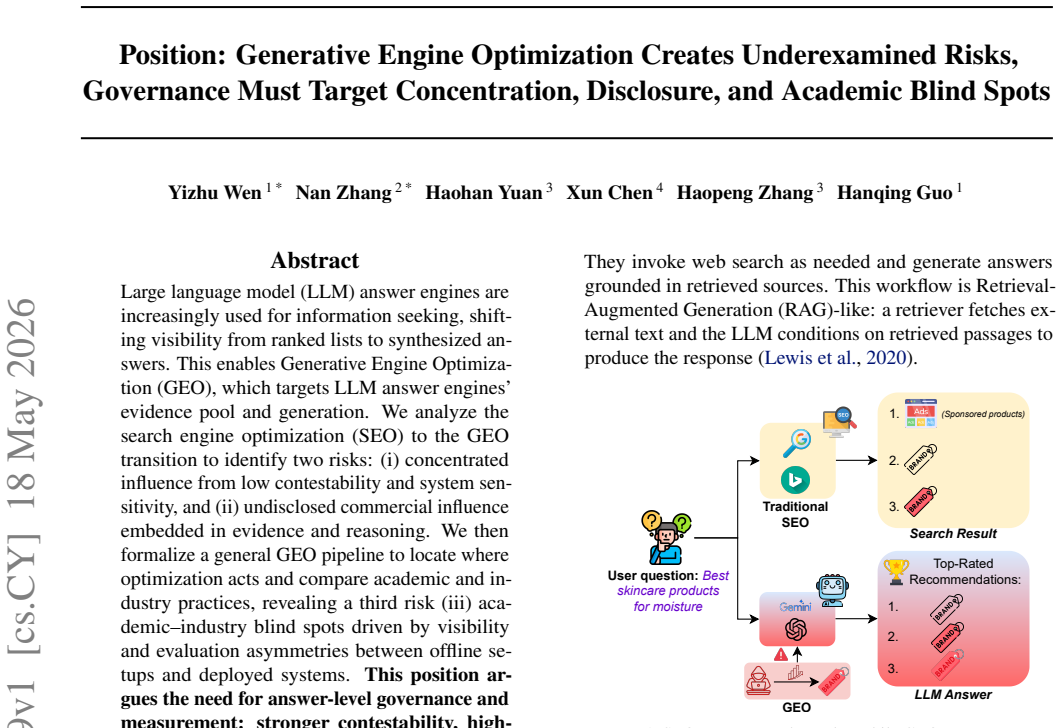
A formalized general GEO pipeline that locates where optimization acts on the evidence pool and generation process.
What would settle it
An empirical audit of multiple deployed LLM answer engines that measures actual concentration of sources in answers, traces undisclosed commercial content, and tests whether current academic evaluation setups match production exposure patterns.
Extended reading notes
Core claim
The transition from SEO to GEO creates underexamined risks of concentrated influence from low contestability and system sensitivity, undisclosed commercial influence embedded in evidence and reasoning, and academic-industry blind spots driven by visibility and evaluation asymmetries between offline setups and deployed systems, requiring answer-level governance including stronger contestability, high-precision disclosure, black-box auditing of material influence, and deployment-aligned metrics for exposure persistence.
Load-bearing premise
The three identified risks are novel enough to be underexamined and the proposed governance interventions are practically implementable and effective without additional empirical validation on deployed systems.
Editorial extensions
If this is right
- Governance must shift from link-level ranking controls to answer-level mechanisms that increase contestability.
- High-precision disclosure standards are needed to reveal commercial influence inside generated reasoning.
- Black-box auditing techniques must be developed to detect material influence without requiring full model access.
- Evaluation metrics should track exposure persistence in deployed systems rather than offline benchmarks.
- Academic and industry practices need alignment to close visibility and evaluation asymmetries.
Reading between the lines
- If the risks prove real, public information access could become more sensitive to optimization campaigns than under traditional search.
- The proposed auditing approach could extend to other generative systems beyond search, such as recommendation or summarization engines.
- Without the suggested disclosure rules, commercial actors may gain advantages that are harder to observe than in link-based advertising.
Signed reviews
Editorial analysis
A structured set of objections, weighed in public.
Referee Report
Summary. The manuscript is a position paper analyzing the transition from search engine optimization (SEO) to generative engine optimization (GEO) for LLM-based answer engines. It identifies three risks: (i) concentrated influence arising from low contestability and system sensitivity, (ii) undisclosed commercial influence embedded in evidence and reasoning, and (iii) academic-industry blind spots from visibility and evaluation asymmetries between offline and deployed systems. The paper advocates answer-level governance including stronger contestability, high-precision disclosure, black-box auditing of material influence, and deployment-aligned metrics for exposure persistence.
Significance. If the risks hold, the work is significant in framing governance challenges for synthesized answers in information retrieval, particularly the potential for reduced contestability and increased opacity compared to ranked lists. The suggestion of deployment-aligned metrics addresses a relevant gap between research and practice. As a purely argumentative position paper without quantitative evidence, formal models, or falsifiable predictions, its significance is primarily in agenda-setting for the cs.CY community rather than providing validated insights or reproducible findings.
major comments (2)
- [Abstract] Abstract: The position that the three risks are 'underexamined' and require targeted answer-level governance is load-bearing for the central claim, yet the manuscript supplies no literature review, comparative analysis of prior SEO/GEO work, or evidence establishing that existing mechanisms are insufficient; this leaves the novelty and urgency assertions unsubstantiated.
- [Abstract] Abstract: The advocated interventions (contestability mechanisms, high-precision disclosure, black-box auditing, deployment-aligned metrics) are presented as necessary without any analysis of their implementability, potential side effects, or empirical validation in deployed systems, which is load-bearing for the recommendation that governance 'must target' these areas.
minor comments (1)
- [Abstract] The abstract refers to formalizing a 'general GEO pipeline' and comparing academic/industry practices but provides no details on the pipeline structure or comparison criteria, reducing clarity on how the third risk is located.
Simulated Author's Rebuttal
We thank the referee for their detailed feedback on our position paper. As an argumentative piece focused on risk identification and governance agenda-setting rather than empirical validation, we address the major comments below and indicate planned revisions where appropriate.
read point-by-point responses
-
Referee: [Abstract] Abstract: The position that the three risks are 'underexamined' and require targeted answer-level governance is load-bearing for the central claim, yet the manuscript supplies no literature review, comparative analysis of prior SEO/GEO work, or evidence establishing that existing mechanisms are insufficient; this leaves the novelty and urgency assertions unsubstantiated.
Authors: We agree that the abstract and manuscript would benefit from a more explicit literature review to substantiate the claim that the risks are underexamined. The full text does analyze the SEO-to-GEO transition, highlighting differences in contestability, opacity, and evaluation asymmetries, but lacks a dedicated comparative section. We will add a related work section that reviews prior SEO manipulation studies, early GEO papers, and existing governance mechanisms in search to better ground the novelty and urgency arguments. revision: yes
-
Referee: [Abstract] Abstract: The advocated interventions (contestability mechanisms, high-precision disclosure, black-box auditing, deployment-aligned metrics) are presented as necessary without any analysis of their implementability, potential side effects, or empirical validation in deployed systems, which is load-bearing for the recommendation that governance 'must target' these areas.
Authors: As a position paper, the manuscript argues for prioritizing these areas in governance discussions based on the identified risks, without asserting that the interventions have been validated or are free of trade-offs. We will revise the abstract and conclusion to more clearly frame the recommendations as directions for future work and policy rather than prescriptive solutions, avoiding any implication of immediate implementability. revision: partial
Circularity Check
No significant circularity in normative position paper
full rationale
This manuscript is a position paper that identifies risks in the SEO-to-GEO transition and advocates answer-level governance measures through descriptive analysis and comparison of practices. It contains no equations, formal models, fitted parameters, predictions, or derivations. No self-citations, uniqueness theorems, or ansatzes are invoked as load-bearing elements. The argument rests on normative claims about underexamined risks and proposed interventions, which are self-contained and do not reduce to any input by construction or self-reference.
Assumptions & free parameters
assumptions (3)
- domain assumption GEO creates concentrated influence due to low contestability and system sensitivity
- domain assumption Undisclosed commercial influence is embedded in evidence and reasoning of LLM answers
- domain assumption Academic and industry practices differ due to visibility and evaluation asymmetries between offline setups and deployed systems
Cite this review
Pith. "Pith review of Position: Generative Engine Optimization Creates Underexamined Risks, Governance Must Target Concentration, Disclosure, and Academic Blind Spots." pith.science (2026). https://pith.science/paper/VKVXZDVI
@misc{pith2026260612439,
  author       = {Pith},
  title        = {Pith review of: Position: Generative Engine Optimization Creates Underexamined Risks, Governance Must Target Concentration, Disclosure, and Academic Blind Spots},
  year         = {2026},
  howpublished = {\url{https://pith.science/paper/VKVXZDVI}},
  note         = {Machine review of arXiv:2606.12439}
}
read the original abstract
Large language model (LLM) answer engines are increasingly used for information seeking, shifting visibility from ranked lists to synthesized answers. This enables Generative Engine Optimization (GEO), which targets LLM answer engines' evidence pool and generation. We analyze the search engine optimization (SEO) to GEO transition to identify two risks: (i) concentrated influence from low contestability and system sensitivity, and (ii) undisclosed commercial influence embedded in evidence and reasoning. We then formalize a general GEO pipeline to locate where optimization acts and compare academic and industry practices, revealing a third risk: (iii) academic-industry blind spots driven by visibility and evaluation asymmetries between offline setups and deployed systems. This position argues the need for answer-level governance and measurement: stronger contestability, high-precision disclosure, black-box auditing of material influence, and deployment-aligned metrics for exposure persistence.
Figures

Figures from the paper (1 more)
Forward citations
Cited by 1 Pith paper
-
Optimizing Visibility in Generative Engines: A Critical Survey of Generative Engine Optimization (2023-2026)
A critical review of GEO research concludes that already-retrieved content can improve citation and use, but no tested technique reliably raises organic discoverability or downstream traffic across engines.
Reference graph
Works this paper leans on
-
[1]
Retrieval-augmented generation for knowledge-intensive NLP tasks , year =
Lewis, Patrick and Perez, Ethan and Piktus, Aleksandra and Petroni, Fabio and Karpukhin, Vladimir and Goyal, Naman and K\". Retrieval-augmented generation for knowledge-intensive NLP tasks , year =. Proceedings of the 34th International Conference on Neural Information Processing Systems , articleno =
-
[2]
Proceedings of the 30th ACM SIGKDD Conference on Knowledge Discovery and Data Mining , pages =
Aggarwal, Pranjal and Murahari, Vishvak and Rajpurohit, Tanmay and Kalyan, Ashwin and Narasimhan, Karthik and Deshpande, Ameet , title =. Proceedings of the 30th ACM SIGKDD Conference on Knowledge Discovery and Data Mining , pages =. 2024 , publisher =
work page 2024
-
[3]
The art of SEO , year =
-
[4]
Keyword Selection Strategies in Search Engine Optimization: How Relevant is Relevance? , journal =. 2021 , author =
work page 2021
-
[5]
The Role of Search Engine Optimization on Keeping the User on the Site , journal =. 2014 , author =
work page 2014
-
[6]
Ziakis, Christos and Vlachopoulou, Maro and Kyrkoudis, Theodosios and Karagkiozidou, Makrina , TITLE =. Future Internet , VOLUME =. 2019 , NUMBER =
work page 2019
-
[7]
Proceedings of the 37th International Conference on Machine Learning , articleno =
Guu, Kelvin and Lee, Kenton and Tung, Zora and Pasupat, Panupong and Chang, Ming-Wei , title =. Proceedings of the 37th International Conference on Machine Learning , articleno =. 2020 , publisher =
work page 2020
- [8]
Show all 71 references
-
[9]
Manipulating Large Language Models to Increase Product Visibility , author =
-
[10]
Ranking Manipulation for Conversational Search Engines , author =
-
[11]
Adversarial search engine optimization for large language models , booktitle=
Nestaas, Fredrik and Debenedetti, Edoardo and Tram. Adversarial search engine optimization for large language models , booktitle=
-
[12]
Adjunct Proceedings of the 33rd ACM Conference on User Modeling, Adaptation and Personalization , pages =
Nazary, Fatemeh and Deldjoo, Yashar and Di Noia, Tommaso and Di Sciascio, Eugenio , title =. Adjunct Proceedings of the 33rd ACM Conference on User Modeling, Adaptation and Personalization , pages =. 2025 , publisher =
2025
-
[13]
Computer networks and ISDN systems , volume =
The anatomy of a large-scale hypertextual web search engine , author =. Computer networks and ISDN systems , volume =
-
[14]
2008 , publisher =
Introduction to information retrieval , author =. 2008 , publisher =
2008
-
[15]
34th USENIX Security Symposium (USENIX Security 25) , pages =
\ PoisonedRAG \ : Knowledge Corruption Attacks to \ Retrieval-Augmented \ Generation of Large Language Models , author =. 34th USENIX Security Symposium (USENIX Security 25) , pages =
-
[16]
Advances in Neural Information Processing Systems , editor =
Mehrotra, Anay and Zampetakis, Manolis and Kassianik, Paul and Nelson, Blaine and Anderson, Hyrum and Singer, Yaron and Karbasi, Amin , year =. Advances in Neural Information Processing Systems , editor =
-
[17]
, title =
Kroll, Joshua A. , title =
-
[18]
Philosophy & technology , volume =
Algorithmic accountability and public reason , author =. Philosophy & technology , volume =
-
[19]
Human factors , volume =
Humans and automation: Use, misuse, disuse, abuse , author =. Human factors , volume =
-
[20]
2015 , publisher =
The black box society: The secret algorithms that control money and information , author =. 2015 , publisher =
2015
-
[21]
Information, communication & society , volume =
Exposure diversity as a design principle for recommender systems , author =. Information, communication & society , volume =
-
[22]
Chaney, Allison J. B. and Stewart, Brandon M. and Engelhardt, Barbara E. , title =. Proceedings of the 12th ACM Conference on Recommender Systems , pages =. 2018 , publisher =
2018
-
[23]
The RAND Journal of Economics , volume =
Chen, Nan and Tsai, Hsin-Tien , title =. The RAND Journal of Economics , volume =
-
[24]
American Economic Review , Volume =
Kleinberg, Jon and Ludwig, Jens and Mullainathan, Sendhil and Obermeyer, Ziad , Title =. American Economic Review , Volume =. 2015 , Pages =
2015
-
[25]
and Kirmani, Amna , title =
Campbell, Margaret C. and Kirmani, Amna , title =. Journal of Consumer Research , volume =. 2000 , abstract =
2000
-
[26]
and van Reijmersdal, Eva A
Boerman, Sophie C. and van Reijmersdal, Eva A. and Neijens, Peter C. , title =. Journal of Communication , volume =
-
[27]
, title =
Akerlof, George A. , title =. The Quarterly Journal of Economics , volume =
-
[28]
, author =
Algorithm aversion: people erroneously avoid algorithms after seeing them err. , author =. Journal of experimental psychology: General , volume =
-
[29]
Big Data & Society , volume =
Jenna Burrell , title =. Big Data & Society , volume =. 2016 , abstract =
2016
-
[30]
Proceedings of the Conference on Fairness, Accountability, and Transparency , pages =
Mitchell, Margaret and Wu, Simone and Zaldivar, Andrew and Barnes, Parker and Vasserman, Lucy and Hutchinson, Ben and Spitzer, Elena and Raji, Inioluwa Deborah and Gebru, Timnit , title =. Proceedings of the Conference on Fairness, Accountability, and Transparency , pages =. 2...
2019
-
[31]
2023 , address =
Artificial Intelligence Risk Management Framework (AI RMF 1.0) , institution =. 2023 , address =
2023
-
[32]
1992 , publisher =
National Institute of Standards and Technology , author =. 1992 , publisher =
1992
-
[33]
1966 , publisher =
Signal detection theory and psychophysics , author =. 1966 , publisher =
1966
-
[34]
Patterns , volume =
GPT detectors are biased against non-native English writers , author =. Patterns , volume =
-
[35]
The Serials Librarian , volume =
Louie Giray , title =. The Serials Librarian , volume =
-
[36]
Journal of consumer research , volume =
The persuasion knowledge model: How people cope with persuasion attempts , author =. Journal of consumer research , volume =
-
[37]
van Reijmersdal and Sophie C
Martin Eisend and Eva A. van Reijmersdal and Sophie C. Boerman and Farid Tarrahi , title =. Journal of Advertising , volume =
-
[38]
The transparency dilemma: How AI disclosure erodes trust , journal =
Oliver Schilke and Martin Reimann , abstract =. The transparency dilemma: How AI disclosure erodes trust , journal =. 2025 , issn =
2025
-
[39]
Journal of political Economy , volume =
The role of market forces in assuring contractual performance , author =. Journal of political Economy , volume =
-
[40]
The quarterly journal of economics , volume =
Premiums for high quality products as returns to reputations , author =. The quarterly journal of economics , volume =
-
[41]
Journal of Marketing , volume =
Regulatory exposure of deceptive marketing and its impact on firm value , author =. Journal of Marketing , volume =
-
[42]
Journal of financial and quantitative analysis , volume =
The cost to firms of cooking the books , author =. Journal of financial and quantitative analysis , volume =
-
[43]
Digital , volume =
Ethical Consumer Attitudes and Trust in Artificial Intelligence in the Digital Marketplace: An Empirical Analysis of Behavioral and Value-Driven Determinants , author =. Digital , volume =
-
[44]
2002 , publisher =
Experimental and quasi-experimental designs for generalized causal inference , author =. 2002 , publisher =
2002
-
[45]
AI magazine , volume =
Offline recommender system evaluation: Challenges and new directions , author =. AI magazine , volume =
-
[46]
Widespread Flaws in Offline Evaluation of Recommender Systems , year =
Hidasi, Bal\'. Widespread Flaws in Offline Evaluation of Recommender Systems , year =. Proceedings of the 17th ACM Conference on Recommender Systems , pages =
-
[47]
Maxwell and Konstan, Joseph A
Harper, F. Maxwell and Konstan, Joseph A. , title =. 2015 , address =
2015
-
[48]
Foundations and Trends
Auditing algorithms: Understanding algorithmic systems from the outside in , author=. Foundations and Trends
-
[49]
AI and Ethics , volume=
Auditing large language models: a three-layered approach , author=. AI and Ethics , volume=
-
[50]
Traditional Search Engines , author=
Source Coverage and Citation Bias in LLM-based vs. Traditional Search Engines , author=
-
[51]
AI Answer Engine Citation Behavior An Empirical Analysis of the GEO16 Framework , author=
-
[52]
Akari Asai and Zeqiu Wu and Yizhong Wang and Avirup Sil and Hannaneh Hajishirzi , booktitle=. Self-
-
[53]
Proceedings of the 2025 International ACM SIGIR Conference on Innovative Concepts and Theories in Information Retrieval (ICTIR) , pages =
Li, Sha and Ramakrishnan, Naren , title =. Proceedings of the 2025 International ACM SIGIR Conference on Innovative Concepts and Theories in Information Retrieval (ICTIR) , pages =. 2025 , isbn =
2025
-
[54]
E-GEO: A Testbed for Generative Engine Optimization in E-Commerce , author=
-
[55]
Towards trustworthy retrieval augmented generation for large language models: A survey , author=
-
[56]
SoK: Privacy Risks and Mitigations in Retrieval-Augmented Generation Systems , author=
-
[57]
2024 , month = feb, day =
2024
-
[58]
2026 , month = jan, day =
2026
-
[59]
2024 , month = oct, day =
2024
-
[60]
2026 , howpublished =
2026
-
[61]
2025 , howpublished =
2025
-
[62]
2025 , month = nov, day =
Fortune , howpublished =. 2025 , month = nov, day =
2025
-
[63]
2025 , month = nov, day =
2025
-
[64]
2025 , month = jun, day =
2025
-
[65]
Politics, Philosophy & Economics , volume=
Public goods and government action , author=. Politics, Philosophy & Economics , volume=. 2015 , publisher=
2015
-
[66]
1971 , publisher=
The Logic of Collective Action: Public Goods and the Theory of Groups, with a new preface and appendix , author=. 1971 , publisher=
1971
-
[67]
2024 , howpublished =
Regulation (. 2024 , howpublished =
2024
-
[68]
2024 , month = jul, doi =
Artificial Intelligence Risk Management Framework: Generative Artificial Intelligence Profile , institution =. 2024 , month = jul, doi =
2024
-
[69]
2025 , month = feb, howpublished =
2025
-
[70]
Manipulating AI memory for profit: The rise of AI Recommendation Poisoning , year =
-
[71]
AI Data Poisoning via GEO Manipulates Recommendations and Misleads Consumers in China , year =
Reviewed June 30, 2026 · model on record in the stance chip above.
Discussion (0). Continue with ORCID to comment.