The pole truth: an analytical graviton propagator from Asymptotic Safety
Pith reviewed 2026-06-26 23:26 UTC · model grok-4.3
The pith
An analytical graviton propagator from Asymptotic Safety contains only the poles of General Relativity.
A machine-rendered reading of the paper's core claim, the machinery that carries it, and where it could break.
Core claim
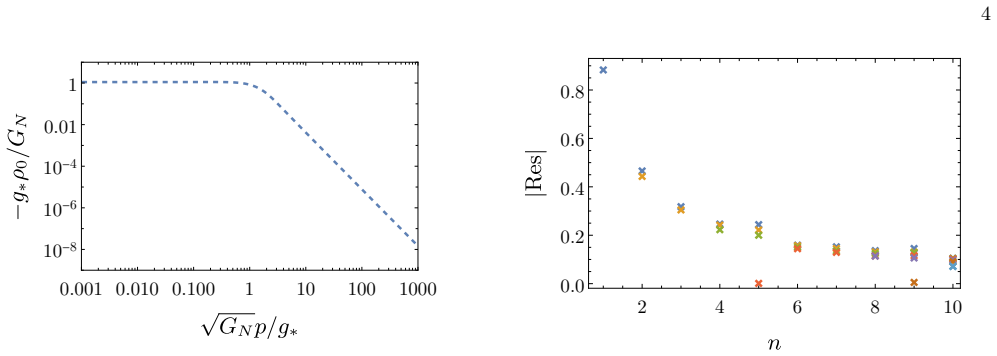
We derive an analytical approximation for the graviton propagator from Asymptotic Safety. We find neither extra poles nor indications of unitarity or causality violations in the spin-two sector. Our results strengthen the case that Asymptotic Safety does not introduce new degrees of freedom, and thus propagates the same field content as General Relativity. We also identify the underlying mechanism: the residues of spurious poles in finite-order derivative expansions approach zero as the order is increased.
What carries the argument
The analytical approximation of the graviton propagator from the Asymptotic Safety renormalization group fixed point, with the mechanism that spurious pole residues vanish at higher derivative orders.
If this is right
- The spin-two sector of the theory matches that of General Relativity.
- Asymptotic Safety introduces no new degrees of freedom.
- There are no indications of unitarity violations.
- There are no indications of causality violations.
Where Pith is reading between the lines
- If the residue trend holds non-perturbatively, the exact propagator would match the pole structure of General Relativity exactly.
- This result could be tested by comparing with other truncations or functional methods in quantum gravity.
- Similar mechanisms might apply to other correlation functions in Asymptotic Safety.
Load-bearing premise
The observed trend of spurious pole residues approaching zero continues to hold in the exact non-perturbative theory.
What would settle it
A non-perturbative computation or higher-order truncation revealing a finite residue at an extra pole would disprove the absence of new poles.
Figures
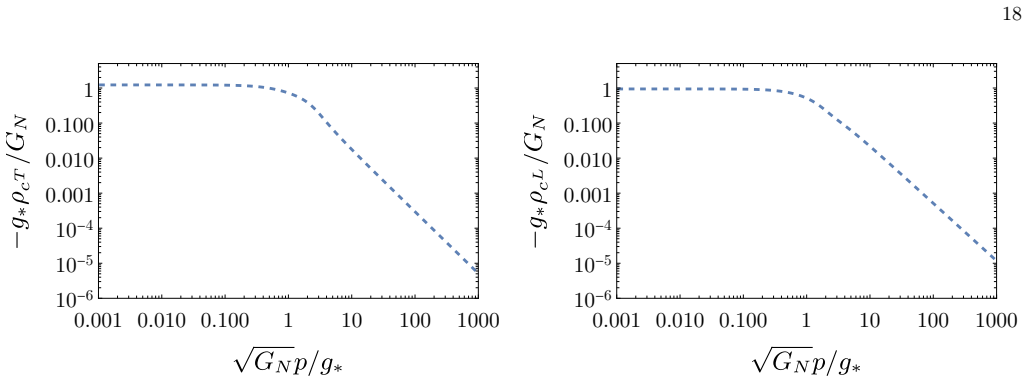
read the original abstract
We derive an analytical approximation for the graviton propagator from Asymptotic Safety. We find neither extra poles nor indications of unitarity or causality violations in the spin-two sector. Our results strengthen the case that Asymptotic Safety does not introduce new degrees of freedom, and thus propagates the same field content as General Relativity. We also identify the underlying mechanism: the residues of spurious poles in finite-order derivative expansions approach zero as the order is increased.
Editorial analysis
A structured set of objections, weighed in public.
Referee Report
Summary. The manuscript derives an analytical approximation to the graviton propagator within the Asymptotic Safety framework. It reports the absence of extra poles (beyond the GR graviton pole) and no indications of unitarity or causality violations in the spin-two sector. The central claim is that these results strengthen the case that Asymptotic Safety propagates the same field content as General Relativity, with the underlying mechanism identified as the residues of spurious poles in finite-order derivative expansions approaching zero as the truncation order is increased.
Significance. If the observed trend persists beyond finite truncations, the work would provide concrete support for the absence of new degrees of freedom in Asymptotic Safety, addressing a key consistency question for the approach. The provision of an analytical form for the propagator is a useful technical contribution that could facilitate further studies.
major comments (1)
- [Discussion of the residue trend and non-perturbative implications] The central claim that Asymptotic Safety does not introduce new degrees of freedom (and thus propagates the same field content as GR) is supported only by the observed trend of spurious-pole residues approaching zero in finite-order derivative expansions. No closed-form resummation, non-truncation identity, or independent functional equation is supplied to establish that the residues remain identically zero (rather than parametrically small) in the exact non-perturbative limit. This extrapolation is load-bearing for the strongest claims in the abstract and conclusion.
minor comments (1)
- [Abstract] Clarify in the abstract and introduction whether the analytical approximation is presented as evidence for the exact theory or strictly as a finite-order result whose trend is suggestive.
Simulated Author's Rebuttal
We thank the referee for the careful reading and for highlighting the distinction between finite-order trends and a non-perturbative proof. We address the single major comment below.
read point-by-point responses
-
Referee: The central claim that Asymptotic Safety does not introduce new degrees of freedom (and thus propagates the same field content as GR) is supported only by the observed trend of spurious-pole residues approaching zero in finite-order derivative expansions. No closed-form resummation, non-truncation identity, or independent functional equation is supplied to establish that the residues remain identically zero (rather than parametrically small) in the exact non-perturbative limit. This extrapolation is load-bearing for the strongest claims in the abstract and conclusion.
Authors: We agree that the manuscript supplies no closed-form resummation or exact functional identity establishing that the residues are identically zero beyond the computed orders. The central claim therefore rests on the systematic trend observed in the sequence of finite truncations. In the revised version we moderate the abstract and conclusion to state that the results 'provide evidence, within the derivative expansion, that the residues of spurious poles approach zero with increasing order' rather than claiming that the work 'strengthens the case' for the exact theory. A new paragraph is added explicitly noting the absence of a non-perturbative proof and the consequent limitation on the strength of the conclusion. revision: yes
Circularity Check
No circularity; derivation self-contained via truncation computations
full rationale
The paper computes residues of spurious poles within successive finite-order derivative expansions of the effective action in the Asymptotic Safety framework and observes a numerical trend toward zero. This observation is used to support the claim for the exact propagator, but the steps do not reduce by construction to a self-definition, a fitted parameter renamed as prediction, or a load-bearing self-citation chain. The central result follows from the explicit truncation calculations rather than from re-labeling inputs or importing uniqueness via prior author work. No enumerated circularity pattern is exhibited.
Axiom & Free-Parameter Ledger
Reference graph
Works this paper leans on
-
[1]
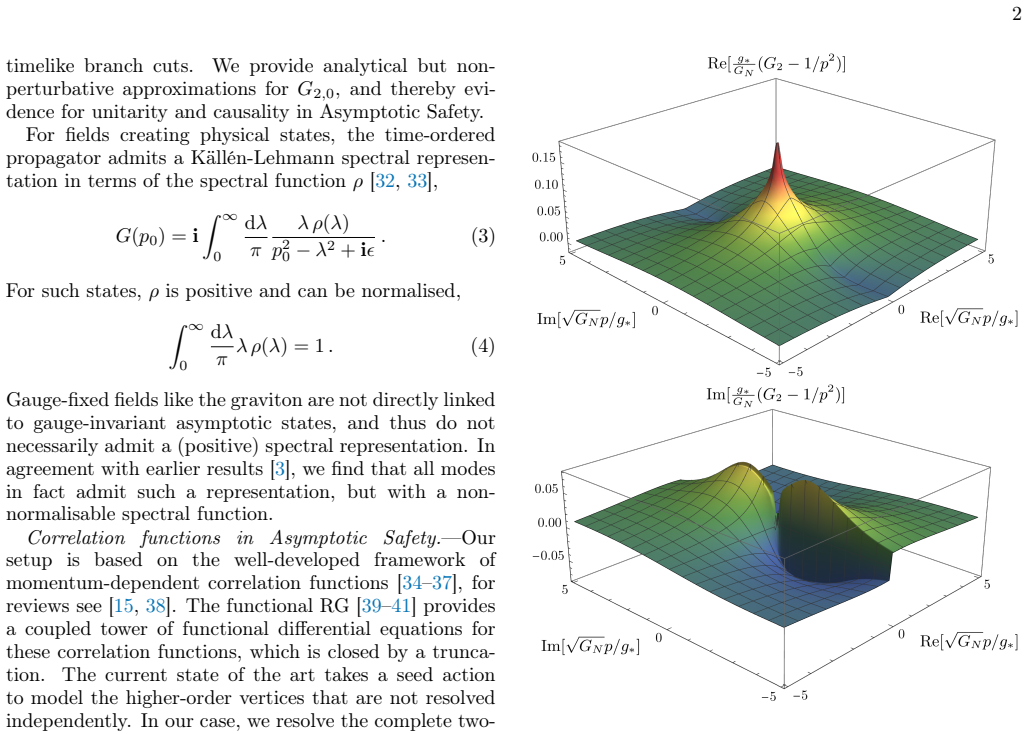
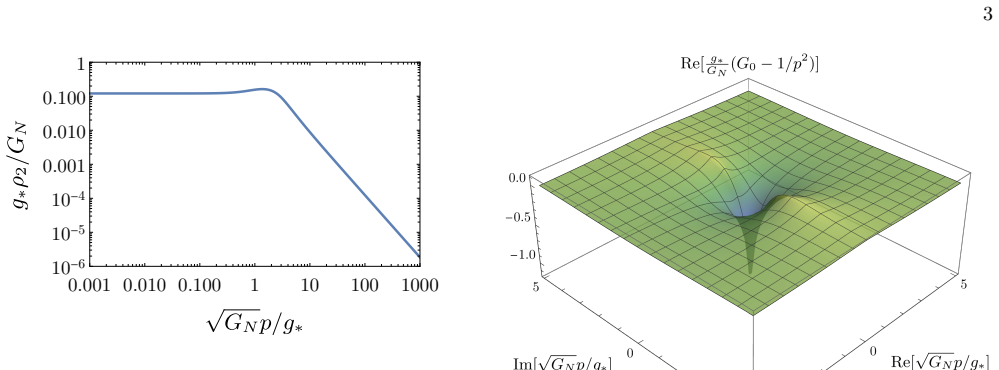
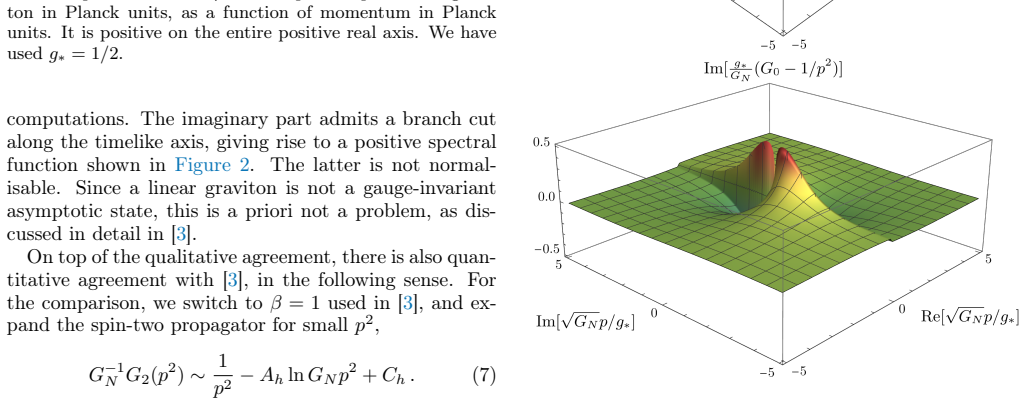
The qualitative picture confirms previous numerical results obtained from Euclidean [3] and Lorentzian [4, 5] 3 0.001 0.010 0.100 1 10 100 1000 10-6 10-5 10-4 0.001 0.010 0.100 1 FIG. 2. Spectral functionρ2 of the spin-two part of the gravi- ton in Planck units, as a function of momentum in Planck units. It is positive on the entire positive real axis. We...
- [2]
-
[3]
L. Buoninfante, B. Knorr, K. S. Kumar, A. Plata- nia,et al., SciPost Phys. Comm. Rep. , 11 (2025), arXiv:2412.08696 [hep-th]
arXiv 2025
-
[4]
A.Bonanno, T.Denz, J.M.Pawlowski, andM.Reichert, SciPost Phys.12, 001 (2022), arXiv:2102.02217 [hep-th]
arXiv 2022
- [5]
-
[6]
Self- consistent graviton spectral function in Lorentzian quan- tum gravity,
J. M. Pawlowski, M. Reichert, and J. Wessely, “Self- consistent graviton spectral function in Lorentzian quan- tum gravity,” (2025), arXiv Preprint, arXiv:2507.22169 [hep-th]
arXiv 2025
-
[7]
Percacci,An Introduction to Covariant Quantum Gravity and Asymptotic Safety,100YearsofGeneralRel- ativity, Vol
R. Percacci,An Introduction to Covariant Quantum Gravity and Asymptotic Safety,100YearsofGeneralRel- ativity, Vol. 3 (World Scientific, 2017)
2017
-
[8]
Reuter and F
M. Reuter and F. Saueressig,Quantum Gravity and the Functional Renormalization Group: The Road towards Asymptotic Safety(Cambridge University Press, 2019)
2019
-
[9]
Form Factors in Asymptotically Safe Quantum Gravity,
B. Knorr, C. Ripken, and F. Saueressig, “Form Factors in Asymptotically Safe Quantum Gravity,” inHandbook of Quantum Gravity(Springer Nature Singapore, Singa- pore, 2023) pp. 1–49, arXiv:2210.16072 [hep-th]
arXiv 2023
-
[10]
Asymptotic safety of gravity with matter,
A. Eichhorn and M. Schiffer, “Asymptotic safety of gravity with matter,” inHandbook of Quantum Gravity (Springer Nature Singapore, Singapore, 2023) pp. 1–87, arXiv:2212.07456 [hep-th]
arXiv 2023
-
[11]
The Functional f(R) Approximation,
T. R. Morris and D. Stulga, “The Functional f(R) Approximation,” inHandbook of Quantum Gravity (Springer Nature Singapore, Singapore, 2023) pp. 1–33, arXiv:2210.11356 [hep-th]
arXiv 2023
-
[12]
Perturbative Approaches to Nonperturbative Quantum Gravity,
R. Martini, G. P. Vacca, and O. Zanusso, “Perturbative Approaches to Nonperturbative Quantum Gravity,” in Handbook of Quantum Gravity(Springer Nature Singa- pore, Singapore, 2023) pp. 1–46, arXiv:2210.13910 [hep- th]
arXiv 2023
-
[13]
Quantum Gravity and Scale Symme- try in Cosmology,
C. Wetterich, “Quantum Gravity and Scale Symme- try in Cosmology,” inHandbook of Quantum Gravity (Springer Nature Singapore, Singapore, 2023) pp. 1–68, arXiv:2211.03596 [gr-qc]
arXiv 2023
-
[14]
Black Holes in Asymptotically Safe Grav- ity,
A. Platania, “Black Holes in Asymptotically Safe Grav- ity,” inHandbook of Quantum Gravity(Springer Nature Singapore, Singapore, 2023) pp. 1–65, arXiv:2302.04272 [gr-qc]
arXiv 2023
-
[15]
The Functional Renormalization Group in Quantum Gravity,
F. Saueressig, “The Functional Renormalization Group in Quantum Gravity,” inHandbook of Quantum Gravity (Springer Nature Singapore, Singapore, 2023) pp. 1–44, arXiv:2302.14152 [hep-th]
arXiv 2023
-
[16]
Quantum Gravity from Dynamical Metric Fluctuations,
J. M. Pawlowski and M. Reichert, “Quantum Gravity from Dynamical Metric Fluctuations,” inHandbook of Quantum Gravity(Springer Nature Singapore, Singa- pore, 2023) pp. 1–70, arXiv:2309.10785 [hep-th]
arXiv 2023
-
[17]
Asymptotic Safety and Cosmology,
A. Bonanno, “Asymptotic Safety and Cosmology,” in Handbook of Quantum Gravity(Springer Nature Singa- pore, Singapore, 2023) pp. 1–27
2023
-
[18]
A. Bonanno, A. Eichhorn, H. Gies, J. M. Pawlowski, R. Percacci, M. Reuter, F. Saueressig, and G. P. Vacca, Front. in Phys.8, 269 (2020), arXiv:2004.06810 [gr-qc]
arXiv 2020
-
[19]
Asymptotically Safe Gravitational Form Factors from the Proper-Time Flow Equation,
E. M. Glaviano, “Asymptotically Safe Gravitational Form Factors from the Proper-Time Flow Equation,” (2026), arXiv Preprint, arXiv:2605.29159 [hep-th]
Pith/arXiv arXiv 2026
-
[20]
The Graviton Propagator in Asymp- totically Safe Gravity with Non-Local Form Factors,
E. M. Glaviano, “The Graviton Propagator in Asymp- totically Safe Gravity with Non-Local Form Factors,” (2026), arXiv Preprint, arXiv:2606.13098 [hep-th]
Pith/arXiv arXiv 2026
-
[21]
A. Platania and C. Wetterich, Phys. Lett. B811, 135911 (2020), arXiv:2009.06637 [hep-th]
arXiv 2020
-
[22]
Platania, JHEP09, 167 (2022), arXiv:2206.04072 [hep-th]
A. Platania, JHEP09, 167 (2022), arXiv:2206.04072 [hep-th]
arXiv 2022
-
[23]
Asymptotically (un)safe scattering ampli- tudes from scratch: a deep dive into the IR jungle,
B. Knorr, “Asymptotically (un)safe scattering ampli- tudes from scratch: a deep dive into the IR jungle,” (2026), arXiv Preprint, arXiv:2602.21285 [hep-th]
arXiv 2026
-
[24]
T.Draper, B.Knorr, C.Ripken, andF.Saueressig,Phys. 6 Rev. Lett.125, 181301 (2020), arXiv:2007.00733 [hep- th]
arXiv 2020
- [25]
-
[26]
Cartographing gravity-mediated scattering ampli- tudes: scalars and photons,
B. Knorr, S. Pirlo, C. Ripken, and F. Saueres- sig, “Cartographing gravity-mediated scattering ampli- tudes: scalars and photons,” (2022), arXiv Preprint, arXiv:2205.01738 [hep-th]
arXiv 2022
-
[27]
Á. Pastor-Gutiérrez, J. M. Pawlowski, M. Reichert, and G. Ruisi, Phys. Rev. D111, 106005 (2025), arXiv:2412.13800 [hep-ph]
arXiv 2025
-
[28]
Mat- ter Spectral Functions from Quantum Gravity,
V. Kher, B. King, D. F. Litim, and M. Reichert, “Mat- ter Spectral Functions from Quantum Gravity,” (2025), arXiv Preprint, arXiv:2507.17862 [hep-th]
arXiv 2025
-
[29]
To- wards Two-to-Two Scattering of Scalars in Asymptoti- cally Safe Quantum Gravity,
A. P. Chiesa, J. M. Pawlowski, and M. Reichert, “To- wards Two-to-Two Scattering of Scalars in Asymptoti- cally Safe Quantum Gravity,” (2026), arXiv Preprint, arXiv:2603.10168 [hep-th]
arXiv 2026
-
[30]
J. M. Pawlowski and J. Tränkle, Phys. Rev. D110, 086011 (2024), arXiv:2309.17043 [hep-th]
arXiv 2024
- [31]
- [32]
-
[33]
Källén, Helv
G. Källén, Helv. Phys. Acta25, 417 (1952)
1952
-
[34]
Lehmann, Nuovo Cim.11, 342 (1954)
H. Lehmann, Nuovo Cim.11, 342 (1954)
1954
-
[35]
N. Christiansen, D. F. Litim, J. M. Pawlowski, and A. Rodigast, Phys. Lett. B728, 114 (2014), arXiv:1209.4038 [hep-th]
Pith/arXiv arXiv 2014
-
[36]
N. Christiansen, B. Knorr, J. M. Pawlowski, and A. Rodigast, Phys. Rev. D93, 044036 (2016), arXiv:1403.1232 [hep-th]
Pith/arXiv arXiv 2016
-
[37]
N. Christiansen, B. Knorr, J. Meibohm, J. M. Pawlowski, and M. Reichert, Phys. Rev. D92, 121501 (2015), arXiv:1506.07016 [hep-th]
Pith/arXiv arXiv 2015
-
[38]
T. Denz, J. M. Pawlowski, and M. Reichert, Eur. Phys. J. C78, 336 (2018), arXiv:1612.07315 [hep-th]
Pith/arXiv arXiv 2018
-
[39]
J. M. Pawlowski and M. Reichert, Front. in Phys.8, 551848 (2021), arXiv:2007.10353 [hep-th]
arXiv 2021
-
[40]
C. Wetterich, Phys. Lett. B301, 90 (1993), arXiv:1710.05815 [hep-th]
Pith/arXiv arXiv 1993
- [41]
- [42]
-
[43]
A. Bonanno and M. Reuter, Phys. Rev. D62, 043008 (2000), arXiv:hep-th/0002196
Pith/arXiv arXiv 2000
-
[44]
H. Gies, B. Knorr, and S. Lippoldt, Phys. Rev. D92, 084020 (2015), arXiv:1507.08859 [hep-th]
Pith/arXiv arXiv 2015
-
[45]
A. K. Cyrol, J. M. Pawlowski, A. Rothkopf, and N. Wink, SciPost Phys.5, 065 (2018), arXiv:1804.00945 [hep-ph]
Pith/arXiv arXiv 2018
-
[46]
K. S. Stelle, Phys. Rev. D16, 953 (1977)
1977
-
[47]
K. S. Stelle, Gen. Rel. Grav.9, 353 (1978)
1978
-
[48]
J. Braunet al., SciPost Phys. Core6, 061 (2023), arXiv:2206.10232 [hep-th]
arXiv 2023
- [49]
-
[50]
J. Horak, J. Papavassiliou, J. M. Pawlowski, and N. Wink, Phys. Rev. D104(2021), 10.1103/Phys- RevD.104.074017, arXiv:2103.16175 [hep-th]
-
[51]
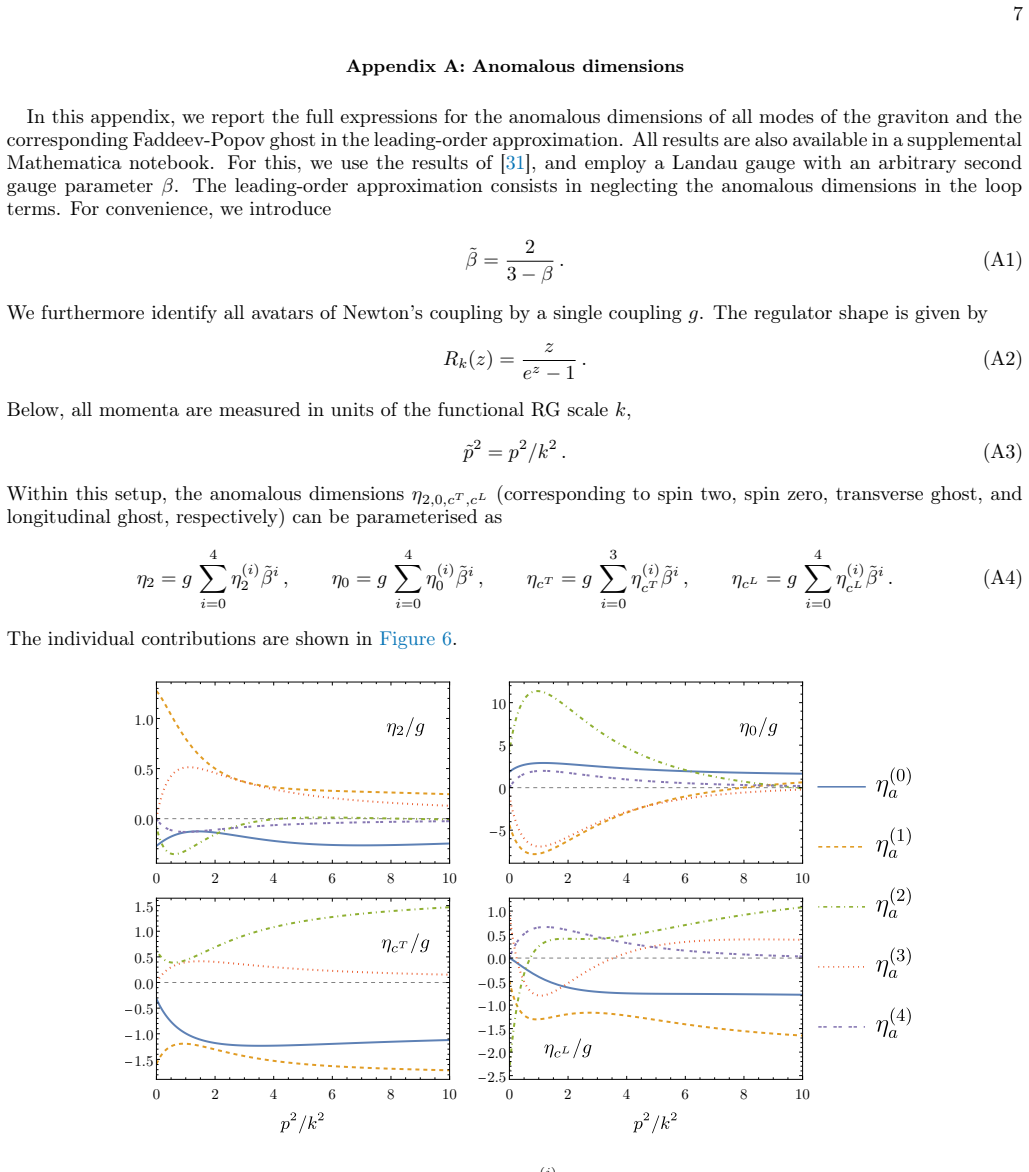
L. Bosma, B. Knorr, and F. Saueressig, Phys. Rev. Lett. 123, 101301 (2019), arXiv:1904.04845 [hep-th]. 7 Appendix A: Anomalous dimensions In this appendix, we report the full expressions for the anomalous dimensions of all modes of the graviton and the correspondingFaddeev-Popovghostintheleading-orderapproximation. Allresultsarealsoavailableinasupplementa...
arXiv 2019
discussion (0)
Sign in with ORCID, Apple, or X to comment. Anyone can read and Pith papers without signing in.