Non-linear Dynamical Stability of Magnetic Polytropes
Pith reviewed 2026-06-28 18:41 UTC · model grok-4.3
The pith
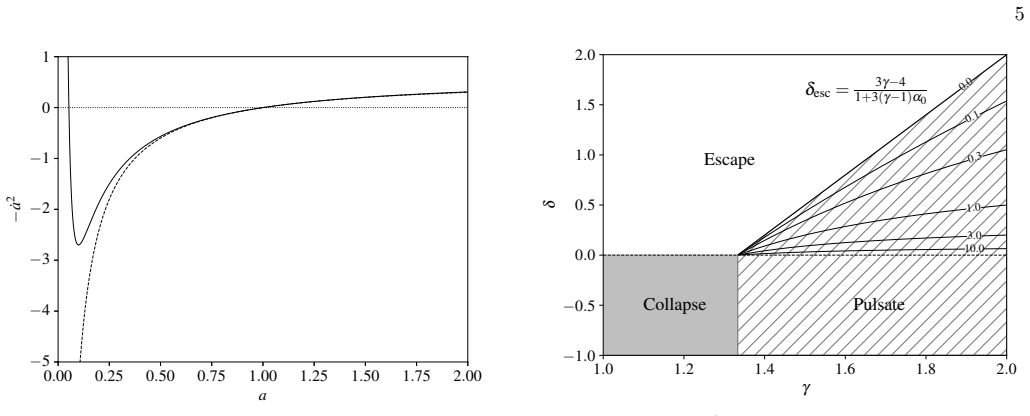
Magnetic polytropes with harmonic enthalpy become unbound above the overpressure threshold δ > (3γ−4)/(1+3(γ−1)α₀).
A machine-rendered reading of the paper's core claim, the machinery that carries it, and where it could break.
Core claim
A harmonic-enthalpy homologous flow becomes unbound when an overpressure satisfies δ = ΔP₀/P_eq > (3γ−4)/(1+3(γ−1)α₀); for a fully-ionized n=3 polytrope with 2/3 of its magnetic energy in the radial component the threshold is δ ≳ 0.15 μ^{-1} (300 M_⊙/M)^{1/2}.
What carries the argument
Mean-field radial Lorentz force equal to −(1/3) dP_B/dr for an isotropic magnetic field, combined with the harmonic-enthalpy profile that reduces the homologous-flow equations to a single ordinary differential equation.
If this is right
- Lane-Emden-like solutions exist only for γ = 4/3 and exhibit either collapse or escape.
- Radiation pressure lowers the overpressure needed to unbind the configuration.
- Solutions with negligible surface fields require at least half the magnetic energy to reside in the radial component.
- The derived threshold supplies a possible mechanism for mass loss in evolved high-mass stars.
Where Pith is reading between the lines
- The 1/3 factor in the magnetic force term could be tested by comparing the mean-field model against full MHD runs at fixed total magnetic energy.
- Relaxing the central isotropy requirement might allow new families of stable or unstable equilibria not captured by the present reduction.
- The homologous-flow restriction suggests examining whether non-homologous modes raise or lower the unbinding threshold in more realistic geometries.
Load-bearing premise
The replacement of the full Lorentz force by an isotropic average radial component −(1/3) dP_B/dr together with the assumptions of strictly homologous radial flow and the Cowling approximation.
What would settle it
A three-dimensional MHD simulation of an n=3 polytrope with imposed radial magnetic component that tracks whether the star unbinds at the predicted δ or remains bound.
Figures
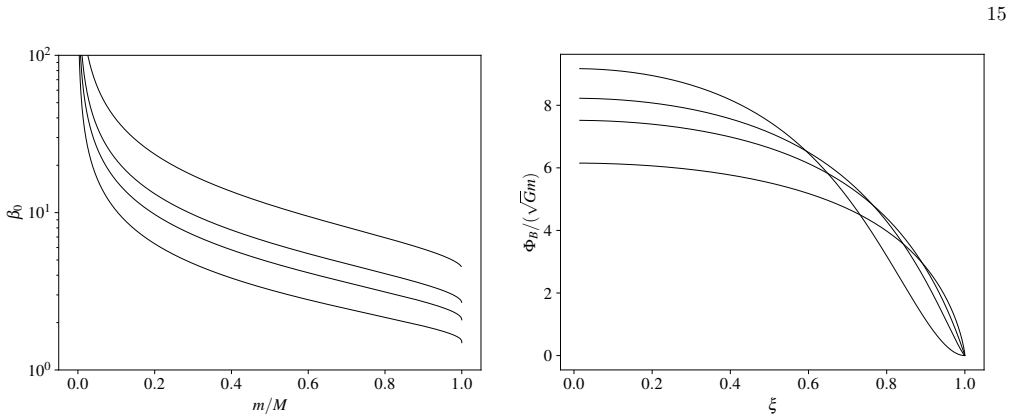
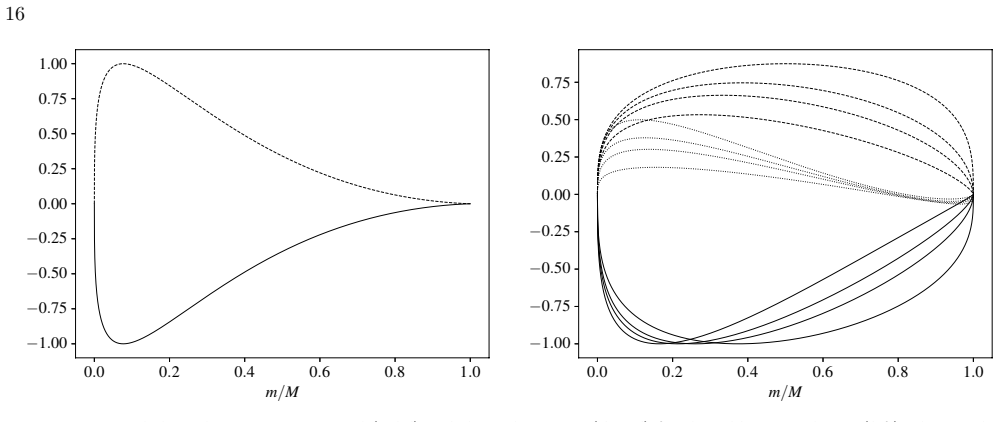
read the original abstract
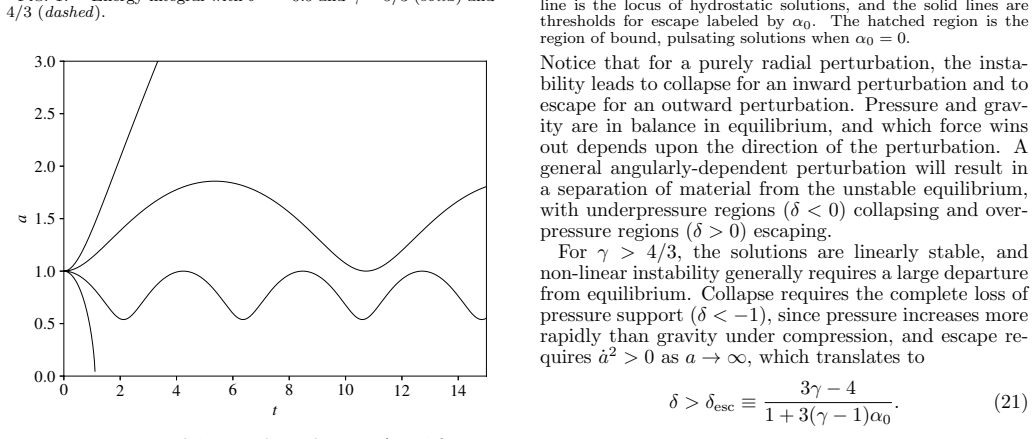
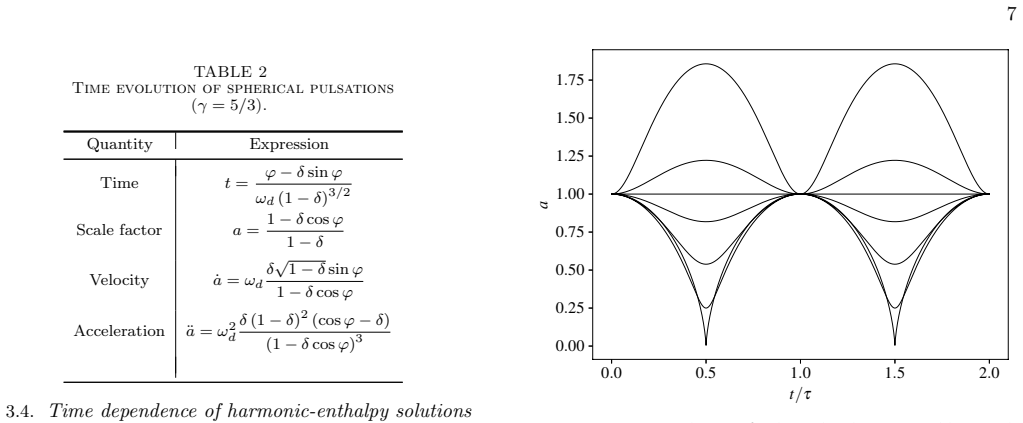
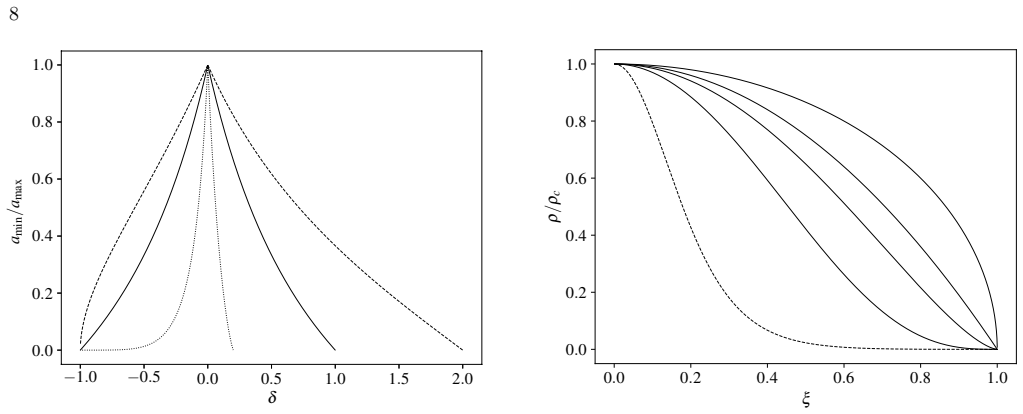
This work analyzes the non-linear dynamical stability of ideal-gas polytropes under homologous flow. A non-constant density profile requires the inclusion of magnetic fields, which is done by introducing a mean-field model that treats the spherically-averaged radial Lorentz force self-consistently and has the following properties: 1) The only essential simplifications are the Cowling approximation and a dominant radial flow. 2) The average radial Lorentz force due to an isotropic field is $-\frac13 dP_B/dr$, not $-dP_B/dr$ as is typically assumed. 3) A central peak in the magnetic field requires isotropy there; all other configurations are zero at the origin due to magnetic tension. 4) Solutions with negligible surface fields require $\gtrsim1/2$ of the magnetic energy to be in the radial component. 5) Solutions that resemble Lane-Emden solutions are restricted to $\gamma = 4/3$, where $\gamma$ is the material adiabatic index, and exhibit either collapse or escape. 6) Solutions for general $\gamma$ have a harmonic enthalpy profile and allow for non-linear radial pulsations. 7) A harmonic-enthalpy homologous flow becomes unbound when an overpressure satisfies $\delta = \Delta P_0/P_{\rm eq} > \frac{3\gamma - 4}{1 + 3(\gamma-1)\alpha_0}$, where $P$ is the total pressure, $P_{\rm eq}$ is its equilibrium value, $\alpha$ is the ratio of radiation to material pressure, and a zero subscript denotes minimum volume. This indicates that radiation pressure can unbind a linearly-stable polytrope in the presence of small but finite radial perturbations. The condition to unbind a fully-ionized $n = 3$ polytrope with $2/3$ of its magnetic energy in the radial component is $\delta \gtrsim 0.15\mu^{-1}\left(300M_\odot/M\right)^{1/2}$, where $\mu$ is the mean molecular weight. This non-linear dynamical instability threshold may have some relevance for mass loss in and dispersal of evolved high-mass stars.
Editorial analysis
A structured set of objections, weighed in public.
Referee Report
Summary. The manuscript develops a mean-field model for the non-linear dynamical stability of magnetic polytropes under homologous radial flow and the Cowling approximation. It replaces the full Lorentz force with an isotropic average radial component −(1/3)dP_B/dr, derives harmonic-enthalpy solutions for general γ, and obtains an unbinding threshold δ = ΔP₀/P_eq > (3γ−4)/(1+3(γ−1)α₀). For a fully-ionized n=3 polytrope with 2/3 of its magnetic energy in the radial component the threshold evaluates to δ ≳ 0.15 μ^{-1} (300 M_⊙/M)^{1/2}, which the authors suggest may be relevant to mass loss in evolved high-mass stars.
Significance. If the mean-field averaging and homologous-flow assumptions hold, the work supplies an explicit, parameter-dependent analytical criterion for non-linear unbinding of linearly stable polytropes, isolating the role of radiation pressure (via α₀) in enabling escape under finite radial perturbations. This is a clear strength relative to purely numerical approaches. However, the absence of any comparison to full MHD or non-homologous solutions limits the result’s immediate applicability to stellar models.
major comments (3)
- [Abstract point 2] Abstract point 2: the replacement of the radial Lorentz force by the isotropic average −(1/3)dP_B/dr is load-bearing for the entire derivation of the harmonic-enthalpy profile and the δ threshold; the manuscript provides no demonstration that this averaging remains self-consistent inside the perturbed Euler equation once magnetic tension or non-radial components appear at finite amplitude.
- [Abstract points 1 and 6] Abstract points 1 and 6: the reduction to a harmonic enthalpy profile and the explicit δ threshold both presuppose strictly homologous radial flow under the Cowling approximation; no error estimate, scaling argument, or comparison to non-homologous cases is supplied, so the robustness of the unbinding condition cannot be assessed.
- [Abstract point 7] Abstract point 7: the quoted n=3 threshold δ ≳ 0.15 μ^{-1} (300 M_⊙/M)^{1/2} inherits its numerical prefactor from the internal choice of a 2/3 radial magnetic-energy fraction and from α₀; both quantities are free parameters fixed inside the same mean-field construction, rendering the threshold circular with respect to the model assumptions.
minor comments (1)
- [Abstract] The abstract introduces δ, P_eq and α₀ without a one-sentence definition; a parenthetical clarification would improve readability for readers outside the immediate sub-field.
Simulated Author's Rebuttal
We thank the referee for the careful review and constructive feedback on our mean-field analysis of magnetic polytropes. We address each major comment below, clarifying the scope of the model assumptions while agreeing where additional caveats are warranted.
read point-by-point responses
-
Referee: [Abstract point 2] Abstract point 2: the replacement of the radial Lorentz force by the isotropic average −(1/3)dP_B/dr is load-bearing for the entire derivation of the harmonic-enthalpy profile and the δ threshold; the manuscript provides no demonstration that this averaging remains self-consistent inside the perturbed Euler equation once magnetic tension or non-radial components appear at finite amplitude.
Authors: We agree that the isotropic averaging −(1/3)dP_B/dr is a foundational assumption of the mean-field construction and is not re-derived from the full Lorentz force at finite amplitude. The manuscript explicitly lists this averaging, together with the Cowling approximation and dominant radial flow, as the essential simplifications. Within these assumptions the perturbed Euler equation closes analytically, but we acknowledge that magnetic tension or non-radial motions at large amplitude could violate the averaging. We will add an explicit statement of this limitation in the discussion section and note that full 3D MHD validation lies beyond the present analytical scope. revision: yes
-
Referee: [Abstract points 1 and 6] Abstract points 1 and 6: the reduction to a harmonic enthalpy profile and the explicit δ threshold both presuppose strictly homologous radial flow under the Cowling approximation; no error estimate, scaling argument, or comparison to non-homologous cases is supplied, so the robustness of the unbinding condition cannot be assessed.
Authors: The harmonic-enthalpy solutions and the resulting δ threshold are derived exactly under the stated assumptions of homologous radial flow and the Cowling approximation. These assumptions allow the reduction to a single ordinary differential equation whose solutions are analytic. We do not supply error estimates or non-homologous comparisons because the work is an analytical mean-field study; such tests would require time-dependent numerical simulations. We will insert a short paragraph in the conclusions outlining the expected domain of validity and recommending future non-homologous MHD comparisons. revision: yes
-
Referee: [Abstract point 7] Abstract point 7: the quoted n=3 threshold δ ≳ 0.15 μ^{-1} (300 M_⊙/M)^{1/2} inherits its numerical prefactor from the internal choice of a 2/3 radial magnetic-energy fraction and from α₀; both quantities are free parameters fixed inside the same mean-field construction, rendering the threshold circular with respect to the model assumptions.
Authors: The 2/3 radial-energy fraction is not chosen independently; it is selected as a representative value satisfying the model requirement (derived in the manuscript) that solutions with negligible surface fields must carry ≳1/2 of the magnetic energy in the radial component. α₀ is the physical central radiation-to-gas pressure ratio for a given stellar model. The quoted numerical prefactor therefore follows directly from substituting these model-consistent values into the general δ expression; it is a prediction of the mean-field framework rather than a circular re-statement of the assumptions. We will add a clarifying sentence in the relevant paragraph to make this dependence explicit. revision: no
Circularity Check
Derivation is self-contained under explicit mean-field assumptions; no reduction to inputs by construction
full rationale
The paper starts from stated simplifications (Cowling approximation, dominant radial homologous flow, and the isotropic mean-field Lorentz force −(1/3)dP_B/dr) and derives the harmonic-enthalpy profile and the explicit δ threshold formula directly from the resulting Euler equation. The n=3 numerical example simply substitutes chosen values for the radial magnetic-energy fraction and α₀ into that formula. No parameter is fitted to data and then relabeled a prediction, no self-citation supplies a load-bearing uniqueness theorem, and the central result does not reduce to its own inputs by definition. The model is therefore self-contained against its own premises.
Axiom & Free-Parameter Ledger
free parameters (2)
- radial magnetic energy fraction
- α₀ (central radiation-to-material pressure ratio)
axioms (3)
- domain assumption Cowling approximation (gravity perturbation neglected)
- domain assumption Dominant radial flow (no non-radial motions)
- domain assumption Isotropic magnetic field at the center
invented entities (1)
-
mean-field radial Lorentz force = −(1/3) dP_B/dr
no independent evidence
Reference graph
Works this paper leans on
-
[1]
Multidimensional simulations of pair-instability supernovae. , keywords =. doi:10.1051/0004-6361/201321312 , adsurl =
-
[2]
, year = 1964, month = aug, volume =
The Dynamical Instability of Gaseous Masses Approaching the Schwarzschild Limit in General Relativity. , year = 1964, month = aug, volume =. doi:10.1086/147938 , adsurl =
-
[3]
Nonlinear Dynamical Stability of Newtonian Rotating White Dwarfs and Supermassive Stars
Nonlinear Dynamical Stability of Newtonian Rotating and Non-rotating White Dwarfs and Rotating Supermassive Stars. Communications in Mathematical Physics , keywords =. doi:10.1007/s00220-008-0569-3 , archivePrefix =. 0710.3150 , primaryClass =
work page internal anchor Pith review Pith/arXiv arXiv doi:10.1007/s00220-008-0569-3
-
[4]
Non-linear stability of gaseous stars
Non-Linear Stability of Gaseous Stars. Archive for Rational Mechanics and Analysis , keywords =. doi:10.1007/s00205-003-0260-y , archivePrefix =. math-ph/0210045 , primaryClass =
work page internal anchor Pith review Pith/arXiv arXiv doi:10.1007/s00205-003-0260-y
-
[5]
On the Eddington limit and WR Stars
On the Eddington limit and Wolf-Rayet stars. , keywords =. doi:10.1051/0004-6361/201118328 , archivePrefix =. 1201.5013 , primaryClass =
work page internal anchor Pith review Pith/arXiv arXiv doi:10.1051/0004-6361/201118328
-
[6]
, year = 1962, month = jan, volume =
On the Equilibrium and Oscillations of Magnetic Fluid Spheres. , year = 1962, month = jan, volume =. doi:10.1086/147260 , adsurl =
-
[7]
A Coscaling Grid for Athena++. , keywords =. doi:10.3847/1538-4365/ac2511 , archivePrefix =. 2109.03899 , primaryClass =
-
[8]
Axisymmetric magnetic fields in stars: relative strengths of poloidal and toroidal components. , keywords =. doi:10.1111/j.1365-2966.2008.14034.x , archivePrefix =. 0810.1049 , primaryClass =
-
[9]
Physics of Fluids , keywords =
Convective instability in the presence of a nonuniform horizontal magnetic field. Physics of Fluids , keywords =. doi:10.1063/1.861158 , adsurl =
-
[10]
, year = 1966, month = sep, volume =
The Dynamical State of the Interstellar Gas and Field. , year = 1966, month = sep, volume =. doi:10.1086/148828 , adsurl =
-
[11]
Physics of Fluids , year = 1961, month = apr, volume =
Convective Instability Induced by Gravity in a Plasma with a Frozen-In Magnetic Field. Physics of Fluids , year = 1961, month = apr, volume =. doi:10.1063/1.1706342 , adsurl =
-
[12]
Annual Review of Fluid Mechanics , keywords =
Magnetic fields in the solar convection zone: magnetoconvection and magnetic buoyancy. Annual Review of Fluid Mechanics , keywords =. doi:10.1146/annurev.fl.20.010188.001155 , adsurl =
-
[13]
Instability by magnetic buoyancy. , keywords =. doi:10.1007/BF00150129 , adsurl =
-
[14]
Theoretical limits on magnetic field strengths in low-mass stars
Theoretical Limits on Magnetic Field Strengths in Low-mass Stars. , keywords =. doi:10.3847/0004-637X/818/2/189 , archivePrefix =. 1512.05692 , primaryClass =
work page internal anchor Pith review Pith/arXiv arXiv doi:10.3847/0004-637x/818/2/189
-
[15]
Strongly magnetized cold electron degenerate gas: Mass-radius relation of the magnetized white dwarf
Strongly magnetized cold degenerate electron gas: Mass-radius relation of the magnetized white dwarf. , keywords =. doi:10.1103/PhysRevD.86.042001 , archivePrefix =. 1204.1262 , primaryClass =
work page internal anchor Pith review Pith/arXiv arXiv doi:10.1103/physrevd.86.042001
-
[16]
Mass-radius relation for magnetized white dwarfs from SDSS. , keywords =. doi:10.1093/mnras/stae829 , archivePrefix =. 2403.13888 , primaryClass =
-
[17]
Suppression of luminosity and mass-radius relation of highly magnetized white dwarfs. , keywords =. doi:10.1093/mnras/staa1575 , archivePrefix =. 2006.02449 , primaryClass =
-
[18]
Quantizing magnetic field and quark-hadron phase transition in a neutron star
Quantizing Magnetic Field and Quark-Hadron Phase Transition in a Neutron Star. , keywords =. doi:10.1103/PhysRevLett.79.2176 , archivePrefix =. astro-ph/9703066 , primaryClass =
work page internal anchor Pith review Pith/arXiv arXiv doi:10.1103/physrevlett.79.2176
-
[19]
Maximum mass of stable magnetized highly super-Chandrasekhar white dwarfs: stable solutions with varying magnetic fields. , keywords =. doi:10.1088/1475-7516/2014/06/050 , archivePrefix =. 1404.7627 , primaryClass =
work page internal anchor Pith review Pith/arXiv arXiv doi:10.1088/1475-7516/2014/06/050 2014
-
[20]
Evolution of random initial magnetic fields in stably stratified and barotropic stars. , keywords =. doi:10.1093/mnras/stac102 , archivePrefix =. 2111.10673 , primaryClass =
-
[21]
Stability of axially symmetric magnetic fields in stars. , keywords =. doi:10.1093/mnras/stac2704 , archivePrefix =. 2209.01042 , primaryClass =
-
[22]
2010, MNRAS, 401, 2343, doi: 10.1111/j.1365-2966.2009.15859.x
Structure of magnetic fields in non-convective stars. , keywords =. doi:10.1111/j.1365-2966.2009.15876.x , archivePrefix =. 0903.1109 , primaryClass =
-
[23]
Stability of magnetic fields in non-barotropic stars: an analytic treatment
Stability of magnetic fields in non-barotropic stars: an analytic treatment. , keywords =. doi:10.1093/mnras/stt913 , archivePrefix =. 1302.0273 , primaryClass =
work page internal anchor Pith review Pith/arXiv arXiv doi:10.1093/mnras/stt913
-
[24]
Relaxed equilibrium configurations to model fossil fields . I. A first family. , keywords =. doi:10.1051/0004-6361/200913496 , adsurl =
-
[25]
On the Stability of Non Force-Free Magnetic Equilibria in Stars
On the Stability of Non-force-free Magnetic Equilibria in Stars. , keywords =. doi:10.1088/2041-8205/724/1/L34 , archivePrefix =. 1009.5384 , primaryClass =
work page internal anchor Pith review Pith/arXiv arXiv doi:10.1088/2041-8205/724/1/l34 2041
-
[26]
On non-axisymmetric magnetic equilibria in stars. , keywords =. doi:10.1111/j.1365-2966.2008.13218.x , archivePrefix =. 0803.1661 , primaryClass =
-
[27]
Asteroseismic signatures of evolving internal stellar magnetic fields
Asteroseismic Signatures of Evolving Internal Stellar Magnetic Fields. , keywords =. doi:10.3847/0004-637X/824/1/14 , archivePrefix =. 1602.03056 , primaryClass =
work page internal anchor Pith review Pith/arXiv arXiv doi:10.3847/0004-637x/824/1/14
-
[28]
Asteroseismology Can Reveal Strong Internal Magnetic Fields in Red Giant Stars
Asteroseismology can reveal strong internal magnetic fields in red giant stars. Science , keywords =. doi:10.1126/science.aac6933 , archivePrefix =. 1510.06960 , primaryClass =
work page internal anchor Pith review Pith/arXiv arXiv doi:10.1126/science.aac6933
-
[29]
A Method for Incorporating the Effects of Large-Scale Magnetic Fields in the Study of Stellar Structure and Variability. , keywords =. doi:10.1086/192245 , adsurl =
-
[30]
Are Magnetically Active Low-Mass M Dwarfs Completely Convective?. , keywords =. doi:10.1086/322336 , adsurl =
-
[31]
Magnetic modeling of inflated low-mass stars using interior fields no larger than ~10 kilogauss
Magnetic Modeling of Inflated Low-mass Stars Using Interior Fields No Larger than 10 kG. , keywords =. doi:10.3847/1538-4357/aa9611 , archivePrefix =. 1708.06994 , primaryClass =
work page internal anchor Pith review Pith/arXiv arXiv doi:10.3847/1538-4357/aa9611
-
[32]
Self-consistent Magnetic Stellar Evolution Models of the Detached, Solar-type Eclipsing Binary EF Aquarii. , keywords =. doi:10.1088/0004-637X/761/1/30 , archivePrefix =. 1210.6177 , primaryClass =
work page internal anchor Pith review Pith/arXiv arXiv doi:10.1088/0004-637x/761/1/30
-
[33]
Magnetic Inhibition of Convection and the Fundamental Properties of Low-mass Stars. II. Fully Convective Main-sequence Stars. , keywords =. doi:10.1088/0004-637X/789/1/53 , archivePrefix =. 1405.1767 , primaryClass =
work page internal anchor Pith review Pith/arXiv arXiv doi:10.1088/0004-637x/789/1/53
-
[34]
Magnetic Inhibition of Convection and the Fundamental Properties of Low-mass Stars. I. Stars with a Radiative Core. , keywords =. doi:10.1088/0004-637X/779/2/183 , archivePrefix =. 1309.0033 , primaryClass =
work page internal anchor Pith review Pith/arXiv arXiv doi:10.1088/0004-637x/779/2/183
-
[35]
Simulations of Solar and Stellar Dynamos and Their Theoretical Interpretation. , keywords =. doi:10.1007/s11214-023-01005-6 , archivePrefix =. 2305.16790 , primaryClass =
-
[36]
, year = 2014, month = aug, volume =
Solar Dynamo Theory. , year = 2014, month = aug, volume =. doi:10.1146/annurev-astro-081913-040012 , adsurl =
-
[37]
The adiabatic stability of stars containing magnetic fields. II. Poloidal fields. , year = 1973, month = mar, volume =. doi:10.1093/mnras/163.1.77 , adsurl =
-
[38]
, year = 1973, month = feb, volume =
Pinch instabilities in magnetic stars. , year = 1973, month = feb, volume =. doi:10.1093/mnras/162.4.339 , adsurl =
-
[39]
The stability of toroidal fields in stars
The stability of toroidal fields in stars. , keywords =. doi:10.1051/0004-6361:20041282 , archivePrefix =. astro-ph/0512182 , primaryClass =
work page internal anchor Pith review Pith/arXiv arXiv doi:10.1051/0004-6361:20041282
-
[40]
, year = 1973, month = jan, volume =
The adiabatic stability of stars containing magnetic fields-I.Toroidal fields. , year = 1973, month = jan, volume =. doi:10.1093/mnras/161.4.365 , adsurl =
-
[41]
3D stellar evolution: hydrodynamic simulations of a complete burning phase in a massive star. , keywords =. doi:10.1093/mnras/stad1572 , archivePrefix =. 2305.13912 , primaryClass =
-
[42]
Stellar evolution models with overshooting based on 3-equation non-local theories. I. Physical basis and the computation of the dissipation rate. , keywords =. doi:10.1051/0004-6361/202243125 , archivePrefix =. 2207.12296 , primaryClass =
-
[43]
Compressible Hydrodynamic Mean-Field Equations in Spherical Geometry and their Application to Turbulent Stellar Convection Data. arXiv e-prints , keywords =. doi:10.48550/arXiv.1401.5176 , archivePrefix =. 1401.5176 , primaryClass =
work page internal anchor Pith review Pith/arXiv arXiv doi:10.48550/arxiv.1401.5176
-
[44]
Stable magnetic fields in stellar interiors
Stable magnetic fields in stellar interiors. , keywords =. doi:10.1051/0004-6361:20041980 , archivePrefix =. astro-ph/0510316 , primaryClass =
work page internal anchor Pith review Pith/arXiv arXiv doi:10.1051/0004-6361:20041980
-
[45]
Instability of Magnetic Equilibria in Barotropic Stars
Instability of magnetic equilibria in barotropic stars. , keywords =. doi:10.1093/mnras/stu2514 , archivePrefix =. 1411.7252 , primaryClass =
work page internal anchor Pith review Pith/arXiv arXiv doi:10.1093/mnras/stu2514
-
[46]
Magnetic fields in non-convective regions of stars
Magnetic fields in non-convective regions of stars. Royal Society Open Science , keywords =. doi:10.1098/rsos.160271 , archivePrefix =. 1510.03198 , primaryClass =
work page internal anchor Pith review Pith/arXiv arXiv doi:10.1098/rsos.160271
-
[47]
Search for Stable Magnetohydrodynamic Equilibria in Barotropic Stars
Search for Stable Magnetohydrodynamic Equilibria in Barotropic Stars. Magnetic Fields throughout Stellar Evolution , year = 2014, editor =. doi:10.1017/S1743921314002701 , archivePrefix =. 1310.2595 , primaryClass =
work page internal anchor Pith review Pith/arXiv arXiv doi:10.1017/s1743921314002701 2014
-
[48]
Evolution of the magnetic field in magnetars
Evolution of the magnetic field in magnetars. , keywords =. doi:10.1051/0004-6361:20041981 , archivePrefix =. astro-ph/0510287 , primaryClass =
work page internal anchor Pith review Pith/arXiv arXiv doi:10.1051/0004-6361:20041981
-
[49]
A fossil origin for the magnetic fields of A-stars and white dwarfs
A fossil origin for the magnetic field in A stars and white dwarfs. , keywords =. doi:10.1038/nature02934 , archivePrefix =. astro-ph/0502043 , primaryClass =
work page internal anchor Pith review Pith/arXiv arXiv doi:10.1038/nature02934
-
[50]
(PSA-2), Volume 2
Theory of Stellar Pulsation. (PSA-2), Volume 2
-
[51]
Reports on Progress in Physics , keywords =
Pulsating stars. Reports on Progress in Physics , keywords =. doi:10.1088/0034-4885/37/5/001 , adsurl =
-
[52]
On the Photon Diffusion Time Scale for the Sun. , keywords =. doi:10.1086/172103 , adsurl =
-
[53]
On the Virial Theorem for Turbulent Molecular Clouds. , keywords =. doi:10.1086/171946 , adsurl =
-
[54]
Virial Theorem Analysis of the Structure and Stability of Magnetized Clouds. , keywords =. doi:10.1086/168226 , adsurl =
-
[55]
, year = 1966, month = jan, volume =
Gravitational collapse in the presence of a magnetic field. , year = 1966, month = jan, volume =. doi:10.1093/mnras/132.2.359 , adsurl =
-
[56]
Gravitational stability of a cylindrical plasma with an azimuthal and an axial magnetic field
Gravitational Stability of a Cylindrical Plasma with an Azimuthal and an Axial Magnetic Field. , keywords =. doi:10.1088/0004-637X/756/2/105 , archivePrefix =. 1201.0509 , primaryClass =
work page internal anchor Pith review Pith/arXiv arXiv doi:10.1088/0004-637x/756/2/105
-
[57]
doi:10.1093/mnras/136.1.101 , adsurl =
Lynden-Bell, D. , title = ". Monthly Notices of the Royal Astronomical Society , volume =. 1967 , month =. doi:10.1093/mnras/136.1.101 , url =
-
[58]
Self-Generated Plasma Rotation in a Z-Pinch Implosion with Preembedded Axial Magnetic Field , author =. Phys. Rev. Lett. , volume =. 2022 , month =. doi:10.1103/PhysRevLett.128.015001 , url =
-
[59]
Synchrotron Emission on FIRE: Equipartition Estimators of Magnetic Fields in Simulated Galaxies with Spectrally-Resolved Cosmic Rays. arXiv e-prints , keywords =. doi:10.48550/arXiv.2309.04526 , archivePrefix =. 2309.04526 , primaryClass =
-
[60]
An Empirical Relation Between The Large-Scale Magnetic Field And The Dynamical Mass In Galaxies
An Empirical Relation between the Large-scale Magnetic Field and the Dynamical Mass in Galaxies. , keywords =. doi:10.3847/2041-8205/818/1/L10 , archivePrefix =. 1512.08145 , primaryClass =
work page internal anchor Pith review Pith/arXiv arXiv doi:10.3847/2041-8205/818/1/l10 2041
-
[61]
Reconciling the magnetic field in central disc galaxies with the dynamical mass using the cosmological simulations. , keywords =. doi:10.1093/mnras/stad2279 , archivePrefix =. 2307.01431 , primaryClass =
-
[62]
Influence of Magnetic Fields on the Gas Rotation in the Galaxy NGC 6946. , keywords =. doi:10.3847/1538-4357/acb99b , archivePrefix =. 2205.09069 , primaryClass =
-
[63]
FORGE'd in FIRE: Resolving the End of Star Formation and Structure of AGN Accretion Disks from Cosmological Initial Conditions. arXiv e-prints , keywords =. doi:10.48550/arXiv.2309.13115 , archivePrefix =. 2309.13115 , primaryClass =
-
[64]
FORGE'd in FIRE II: The Formation of Magnetically-Dominated Quasar Accretion Disks from Cosmological Initial Conditions. arXiv e-prints , keywords =. doi:10.48550/arXiv.2310.04506 , archivePrefix =. 2310.04506 , primaryClass =
-
[65]
Born this way: thin disc, thick disc, and isotropic spheroid formation in FIRE-2 Milky Way-mass galaxy simulations. , keywords =. doi:10.1093/mnras/stad1806 , archivePrefix =. 2210.03845 , primaryClass =
-
[66]
Magnetic fields on FIRE: Comparing B-fields in the multiphase ISM and CGM of simulated L _ * galaxies to observations. , keywords =. doi:10.1093/mnras/stac2448 , archivePrefix =. 2206.04764 , primaryClass =
-
[67]
Polarized thermal emission from dust in a galaxy at redshift 2.6. , keywords =. doi:10.1038/s41586-023-06346-4 , archivePrefix =. 2309.02034 , primaryClass =
-
[68]
, year = 1973, month = jun, volume =
The Internal Magnetic Fields of White Dwarfs. , year = 1973, month = jun, volume =. doi:10.1086/152192 , adsurl =
-
[69]
The Internal Constitution of the Stars
-
[70]
Computing in Science and Engineering , keywords =
Matplotlib: A 2D Graphics Environment. Computing in Science and Engineering , keywords =. doi:10.1109/MCSE.2007.55 , adsurl =
-
[71]
SciPy 1.0--Fundamental Algorithms for Scientific Computing in Python
SciPy 1.0: fundamental algorithms for scientific computing in Python. Nature Methods , keywords =. doi:10.1038/s41592-019-0686-2 , archivePrefix =. 1907.10121 , primaryClass =
work page internal anchor Pith review Pith/arXiv arXiv doi:10.1038/s41592-019-0686-2 1907
-
[72]
Array programming with NumPy. , keywords =. doi:10.1038/s41586-020-2649-2 , archivePrefix =. 2006.10256 , primaryClass =
work page internal anchor Pith review Pith/arXiv arXiv doi:10.1038/s41586-020-2649-2 2006
-
[73]
An introduction to the study of stellar structure
-
[74]
Magnetic diffusion and ionization fractions in dense molecular clouds: the role of charged grains. , keywords =. doi:10.1086/157333 , adsurl =
-
[75]
, year = 1969, month = jan, volume =
Numerical calculations of the dynamics of collapsing proto-star. , year = 1969, month = jan, volume =. doi:10.1093/mnras/145.3.271 , adsurl =
-
[76]
Magnetic Fields in Stellar Bodies. I. Magnetic Fields in Polytropes. , year = 1965, month = mar, volume =. doi:10.1093/mnras/131.1.105 , adsurl =
-
[77]
Keplerian rotation of our Galaxy?
Keplerian rotation of our Galaxy?. arXiv e-prints , keywords =. doi:10.48550/arXiv.1503.01947 , archivePrefix =. 1503.01947 , primaryClass =
work page internal anchor Pith review Pith/arXiv arXiv doi:10.48550/arxiv.1503.01947
-
[78]
Studies of luminous stars in nearby galaxies. III. Comments on the evolution of the most massive stars in the Milky Way and the Large Magellanic Cloud. , keywords =. doi:10.1086/157301 , adsurl =
-
[79]
Note on the collapse of magnetic interstellar clouds. , keywords =. doi:10.1086/154835 , adsurl =
-
[80]
Problems in the astrophysics of accretion onto compact celestial bodies. arXiv e-prints , keywords =. doi:10.48550/arXiv.2311.16013 , archivePrefix =. 2311.16013 , primaryClass =
discussion (0)
Sign in with ORCID, Apple, or X to comment. Anyone can read and Pith papers without signing in.