LEGS: Laplacian-Enhanced Gaussian Splatting with a Nonlinear Weighted Loss
Pith reviewed 2026-06-27 20:27 UTC · model grok-4.3
The pith
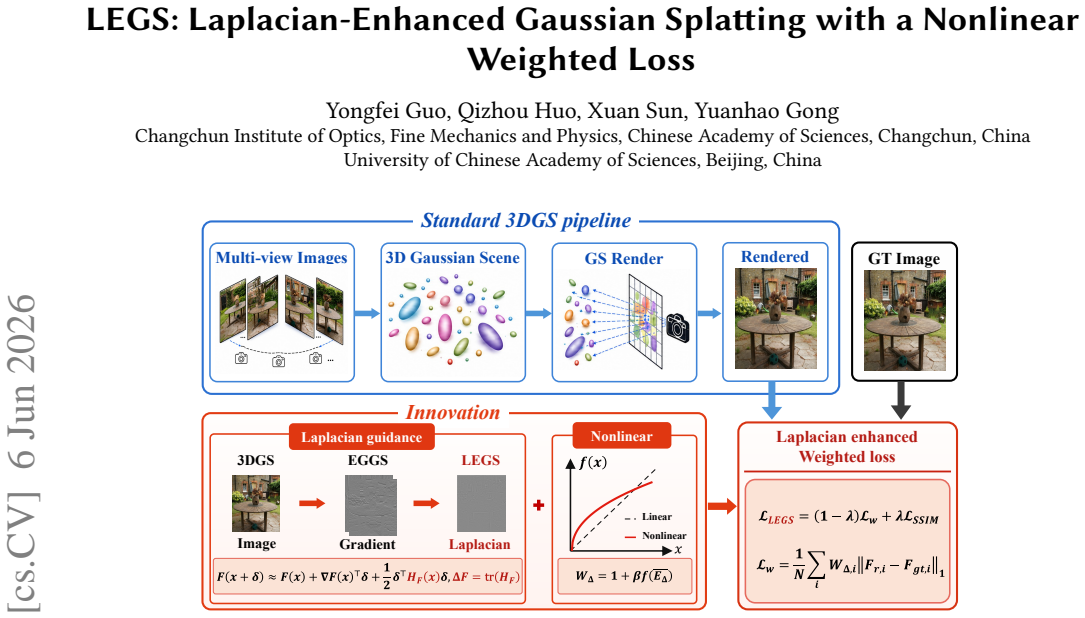
LEGS improves 3D Gaussian Splatting by using second-order Laplacian responses and nonlinear weighting to recover sharper structures than gradient-based losses.
A machine-rendered reading of the paper's core claim, the machinery that carries it, and where it could break.
Core claim
LEGS replaces first-order gradient guidance with second-order Laplacian structural guidance and maps the normalized Laplacian response into pixel-wise weights through nonlinear response-to-weight functions. The proposed loss improves structure-aware Gaussian optimization while keeping the original 3DGS rendering pipeline unchanged.
What carries the argument
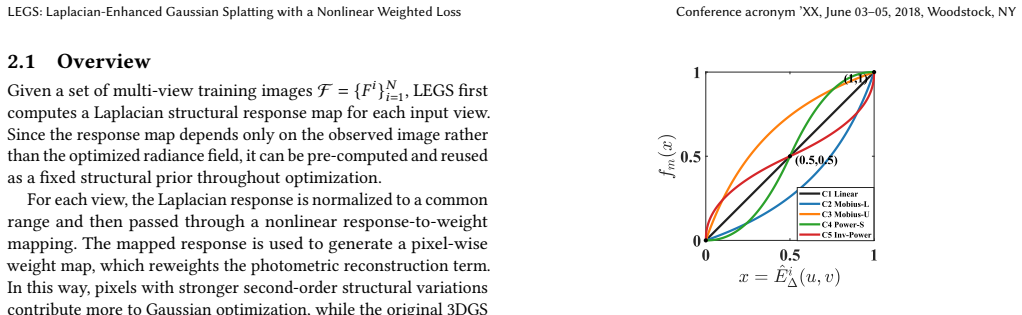
Nonlinear mapping of normalized second-order Laplacian responses to pixel-wise loss weights that guide Gaussian optimization.
If this is right
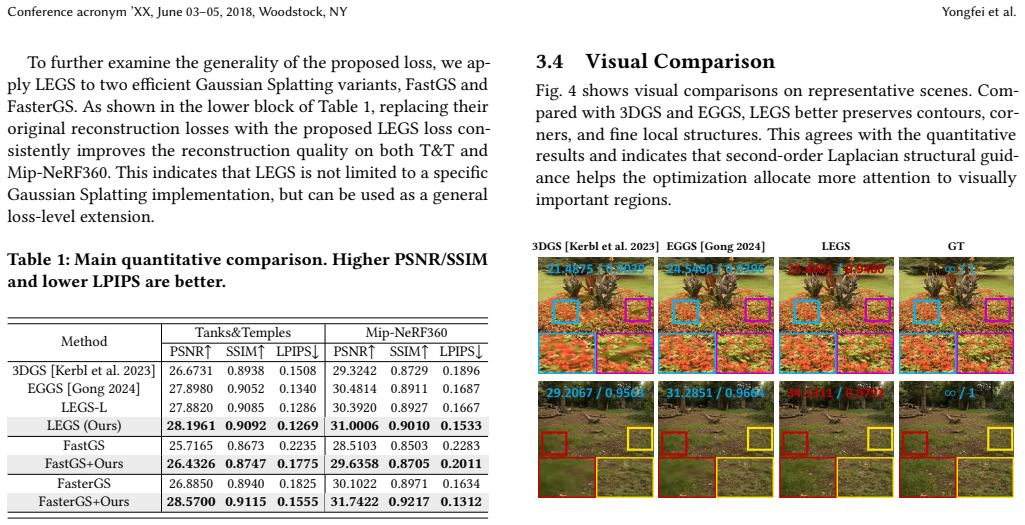
- PSNR rises by up to 1.68 dB relative to standard 3DGS on Tanks&Temples and Mip-NeRF360.
- PSNR rises by up to 0.52 dB relative to EGGS on the same full datasets.
- The identical second-order nonlinear weighting lifts FastGS and FasterGS by up to 1.69 dB.
- The modification functions as a drop-in loss extension that leaves any Gaussian Splatting renderer unchanged.
Where Pith is reading between the lines
- The same loss pattern could be tested on other explicit scene representations that already use gradient-based regularizers.
- Nonlinear second-order weighting may improve detail recovery in related real-time tasks such as dynamic scene reconstruction.
- Because the change is only in the loss, it can be combined with future speed-ups without redesigning the renderer.
Load-bearing premise
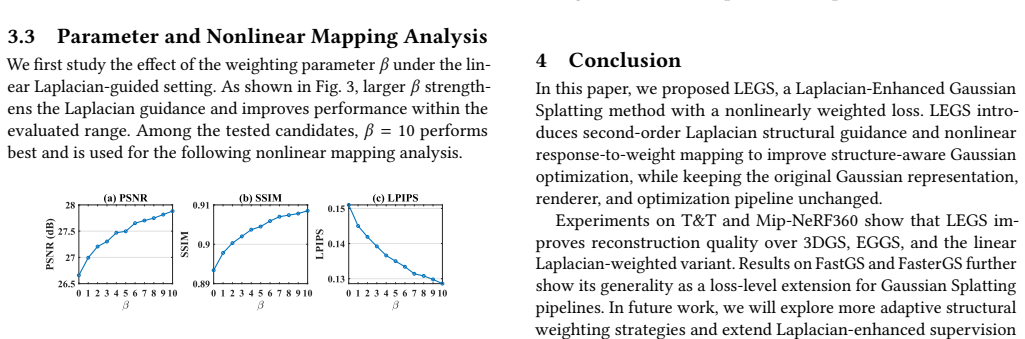
Second-order Laplacian responses supply meaningfully better structural guidance than first-order gradients once they are passed through nonlinear functions.
What would settle it
An ablation on the same Tanks&Temples and Mip-NeRF360 scenes in which swapping Laplacian responses for gradients or nonlinear weights for linear weights produces no PSNR gain.
Figures
read the original abstract
3D Gaussian Splatting (3DGS) has become an efficient explicit representation for radiance field reconstruction and real-time novel view synthesis. However, its standard photometric loss treats flat and structure-rich regions similarly, which may limit the recovery of sharp contours and fine details. Edge-Guided Gaussian Splatting (EGGS) improves structure awareness through edge-guided weighting, but mainly relies on first-order gradient responses and linear weighting. In this paper, we propose LEGS, a Laplacian-Enhanced Gaussian Splatting method with a nonlinearly weighted loss. LEGS replaces first-order gradient guidance with second-order Laplacian structural guidance and maps the normalized Laplacian response into pixel-wise weights through nonlinear response-to-weight functions. The proposed loss improves structure-aware Gaussian optimization while keeping the original 3DGS rendering pipeline unchanged. Experiments on the full Tanks\&Temples and Mip-NeRF360 datasets show that LEGS improves peak signal-to-noise ratio (PSNR) by up to 1.68 dB over 3DGS and up to 0.52 dB over EGGS. Incorporating the proposed second-order nonlinear weighting strategy into FastGS and FasterGS further improves PSNR by up to 1.69 dB, demonstrating its effectiveness as a general loss-level extension for Gaussian Splatting pipelines with potential applications in AR/VR, immersive visualization, and real-time 3D content generation.
Editorial analysis
A structured set of objections, weighed in public.
Referee Report
Summary. The manuscript proposes LEGS, a loss-level modification to 3D Gaussian Splatting that substitutes first-order gradient guidance with second-order Laplacian structural responses and applies nonlinear response-to-weight mappings to the photometric loss. The rendering pipeline remains unchanged. Experiments on the full Tanks&Temples and Mip-NeRF360 datasets are reported to yield PSNR gains of up to 1.68 dB over 3DGS and 0.52 dB over EGGS; the same weighting is also applied to FastGS and FasterGS with similar reported maxima.
Significance. If the gains prove robust and attributable to the second-order nonlinear term rather than implementation details, the method would supply a lightweight, pipeline-agnostic extension that improves structural fidelity in explicit radiance-field methods without increasing rendering cost.
major comments (3)
- [Abstract / Experiments] Abstract and Experiments: the PSNR improvements are stated exclusively as 'up to' single-scene maxima with no accompanying mean delta, standard deviation across scenes, or fraction of scenes showing positive gain; this directly weakens the claim that LEGS 'improves' the pipelines on the full datasets.
- [Abstract] Abstract: no description is given of the exact nonlinear response-to-weight functions, their functional form, or any fitted parameters, nor are ablation studies or controls isolating the second-order Laplacian term versus other implementation differences versus EGGS.
- [Abstract] Abstract: the premise that second-order Laplacian responses supply meaningfully superior structural guidance is asserted by contrast with EGGS but is not supported by any direct comparison, sensitivity analysis, or per-region error breakdown that would confirm the ordering of contributions.
minor comments (1)
- [Abstract] The abstract states that the original 3DGS rendering pipeline is kept unchanged, but no explicit statement confirms that all other training hyper-parameters (learning rates, densification schedule, etc.) are identical to the baselines.
Simulated Author's Rebuttal
We thank the referee for the constructive feedback. We address each major comment below, indicating planned revisions to improve clarity and completeness of the results and method description.
read point-by-point responses
-
Referee: [Abstract / Experiments] Abstract and Experiments: the PSNR improvements are stated exclusively as 'up to' single-scene maxima with no accompanying mean delta, standard deviation across scenes, or fraction of scenes showing positive gain; this directly weakens the claim that LEGS 'improves' the pipelines on the full datasets.
Authors: We agree that exclusive use of maximum gains limits interpretability. In the revised manuscript we will report mean PSNR deltas, standard deviations, and the fraction of scenes with positive gains for LEGS versus 3DGS and EGGS on the complete Tanks&Temples and Mip-NeRF360 datasets, as well as for the FastGS and FasterGS extensions. These aggregate statistics will be added to both the abstract and the experimental tables. revision: yes
-
Referee: [Abstract] Abstract: no description is given of the exact nonlinear response-to-weight functions, their functional form, or any fitted parameters, nor are ablation studies or controls isolating the second-order Laplacian term versus other implementation differences versus EGGS.
Authors: Section 3.2 already specifies the nonlinear mappings (exponential and power-law forms with their parameters). To address the abstract-level concern we will insert a concise statement of the functional form. We will also add ablation tables that isolate the Laplacian term from the nonlinear weighting and from EGGS-specific implementation choices. revision: partial
-
Referee: [Abstract] Abstract: the premise that second-order Laplacian responses supply meaningfully superior structural guidance is asserted by contrast with EGGS but is not supported by any direct comparison, sensitivity analysis, or per-region error breakdown that would confirm the ordering of contributions.
Authors: We will add a new experimental subsection containing (i) a direct first-order versus second-order guidance comparison, (ii) sensitivity sweeps on the Laplacian scale, and (iii) per-region error maps separating edge and textureless areas. These results will quantify the incremental benefit of the second-order term. revision: yes
Circularity Check
No circularity in the proposed Laplacian-enhanced loss
full rationale
The paper proposes an independent modification to the photometric loss in 3DGS by substituting first-order gradients with second-order Laplacian responses and applying nonlinear response-to-weight mappings. This change is described as a direct replacement that leaves the rendering pipeline unchanged, with reported PSNR gains measured on external benchmark datasets (Tanks&Temples, Mip-NeRF360). No equations, fitted parameters, or self-citations are shown that would reduce the weighting scheme or the claimed improvements to quantities defined by the same inputs or prior author work. The derivation chain consists of a design choice followed by empirical validation and is therefore self-contained.
Axiom & Free-Parameter Ledger
Reference graph
Works this paper leans on
-
[1]
The Computational Geometry Algorithms Library , author =
-
[2]
Menelaos Karavelas , subtitle =
-
[3]
The Computational Geometry Algorithms Library , subtitle =
Menelaos Karavelas , editor =. The Computational Geometry Algorithms Library , subtitle =
-
[4]
The Parmap library , author =
-
[5]
Christopher Anderson and Sophia Drossopoulou , title =
-
[6]
and Tancik, Matthew and Barron, Jonathan T
Mildenhall, Ben and Srinivasan, Pratul P. and Tancik, Matthew and Barron, Jonathan T. and Ramamoorthi, Ravi and Ng, Ren , title =. 2021 , issue_date =. doi:10.1145/3503250 , journal =
-
[7]
and Mildenhall, Ben and Verbin, Dor and Srinivasan, Pratul P
Barron, Jonathan T. and Mildenhall, Ben and Verbin, Dor and Srinivasan, Pratul P. and Hedman, Peter , booktitle=. Mip-NeRF 360: Unbounded Anti-Aliased Neural Radiance Fields , year=
-
[8]
Graph.41, 4, Article 62 (July 2022), 16 pages
Thomas M\"uller and Alex Evans and Christoph Schied and Alexander Keller , title =. ACM Trans. Graph. , issue_date =. 2022 , pages =. doi:10.1145/3528223.3530127 , publisher =
-
[9]
2022 , booktitle=
Plenoxels: Radiance Fields without Neural Networks , author=. 2022 , booktitle=
2022
-
[10]
3D Gaussian Splatting: Survey, Technologies, Challenges, and Opportunities , year=
Bao, Yanqi and Ding, Tianyu and Huo, Jing and Liu, Yaoli and Li, Yuxin and Li, Wenbin and Gao, Yang and Luo, Jiebo , journal=. 3D Gaussian Splatting: Survey, Technologies, Challenges, and Opportunities , year=
-
[11]
Chen, Guikun and Wang, Wenguan , title =. ACM Comput. Surv. , month = apr, keywords =. 2026 , publisher =. doi:10.1145/3807511 , note =
-
[12]
3D Gaussian Splatting for Real-Time Radiance Field Rendering , journal =
Kerbl, Bernhard and Kopanas, Georgios and Leimk. 3D Gaussian Splatting for Real-Time Radiance Field Rendering , journal =. 2023 , url =
2023
-
[13]
Proceedings of the IEEE/CVF Conference on Computer Vision and Pattern Recognition (CVPR) , month =
Yu, Zehao and Chen, Anpei and Huang, Binbin and Sattler, Torsten and Geiger, Andreas , title =. Proceedings of the IEEE/CVF Conference on Computer Vision and Pattern Recognition (CVPR) , month =. 2024 , pages =
2024
-
[14]
Proceedings of the IEEE/CVF Conference on Computer Vision and Pattern Recognition , pages=
Scaffold-gs: Structured 3d gaussians for view-adaptive rendering , author=. Proceedings of the IEEE/CVF Conference on Computer Vision and Pattern Recognition , pages=
-
[15]
2023 , eprint=
LightGaussian: Unbounded 3D Gaussian Compression with 15x Reduction and 200+ FPS , author=. 2023 , eprint=
2023
-
[16]
2026 , eprint=
3DGEER: 3D Gaussian Rendering Made Exact and Efficient for Generic Cameras , author=. 2026 , eprint=
2026
-
[17]
arXiv preprint arXiv:2508.09239 , year=
Gradient-Direction-Aware Density Control for 3D Gaussian Splatting , author=. arXiv preprint arXiv:2508.09239 , year=
-
[18]
Gong, Yuanhao , title =. 2024 , isbn =. doi:10.1145/3665318.3677148 , articleno =
-
[19]
Proceedings of the Winter Conference on Applications of Computer Vision (WACV) , month =
Chelani, Kunal and Benbihi, Assia and Sattler, Torsten and Kahl, Fredrik , title =. Proceedings of the Winter Conference on Applications of Computer Vision (WACV) , month =. 2025 , pages =
2025
-
[20]
Side Window Filtering , year=
Yin, Hui and Gong, Yuanhao and Qiu, Guoping , booktitle=. Side Window Filtering , year=
-
[21]
Yin, Hui and Gong, Yuanhao and Qiu, Guoping , title =. 2019 , issue_date =. doi:10.1016/j.sigpro.2019.07.026 , journal =
-
[22]
Quarter Laplacian Filter For Edge Aware Image Processing , year=
Gong, Yuanhao and Tang, Wenming and Zhou, Lebin and Yu, Lantao and Qiu, Guoping , booktitle=. Quarter Laplacian Filter For Edge Aware Image Processing , year=
-
[23]
Sub-window Box Filter , year=
Gong, Yuanhao and Liu, Bozhi and Hou, Xianxu and Qiu, Guoping , booktitle=. Sub-window Box Filter , year=
-
[24]
OSBF: One-Sided Box Filter for Edge-preserving Image Processing , year=
Gong, Yuanhao , journal=. OSBF: One-Sided Box Filter for Edge-preserving Image Processing , year=
-
[25]
FPGA Accelerated One-Sided Box Filter for Edge-Preserving Image Processing , year=
Guo, Yongfei and Niu, Xudong and Zhang, Chizhi and Gong, Yuanhao , booktitle=. FPGA Accelerated One-Sided Box Filter for Edge-Preserving Image Processing , year=
-
[26]
arXiv preprint arXiv:2511.04283 , year=
FastGS: Training 3D Gaussian Splatting in 100 Seconds , author=. arXiv preprint arXiv:2511.04283 , year=
-
[27]
2026 , eprint=
Faster-GS: Analyzing and Improving Gaussian Splatting Optimization , author=. 2026 , eprint=
2026
-
[28]
2022 , eprint=
Mip-NeRF 360: Unbounded Anti-Aliased Neural Radiance Fields , author=. 2022 , eprint=
2022
-
[29]
arXiv:2512.21185 [cs.CV] https: //arxiv.org/abs/2512.21185 Heewoo Jun and Alex Nichol
Knapitsch, Arno and Park, Jaesik and Zhou, Qian-Yi and Koltun, Vladlen , title =. ACM Trans. Graph. , month = jul, articleno =. 2017 , issue_date =. doi:10.1145/3072959.3073599 , abstract =
-
[30]
Mean Curvature Is a Good Regularization for Image Processing , year=
Gong, Yuanhao , journal=. Mean Curvature Is a Good Regularization for Image Processing , year=
-
[31]
Computing Curvature, Mean Curvature and Weighted Mean Curvature , year=
Gong, Yuanhao , booktitle=. Computing Curvature, Mean Curvature and Weighted Mean Curvature , year=
-
[32]
Computing Gaussian Curvature in Real-Time for 4K Video Processing , year=
Gong, Yuanhao and Chen, Yong , journal=. Computing Gaussian Curvature in Real-Time for 4K Video Processing , year=
-
[33]
Molecular Surface Estimation by Geometric Coupled Distance Functions , year=
Gong, Yuanhao and Chen, Yong , journal=. Molecular Surface Estimation by Geometric Coupled Distance Functions , year=
-
[34]
Weighted mean curvature , journal =
Yuanhao Gong and Orcun Goksel , keywords =. Weighted mean curvature , journal =. 2019 , issn =. doi:https://doi.org/10.1016/j.sigpro.2019.06.020 , url =
-
[35]
, booktitle=
Gong, Yuanhao and Paul, Gregory and Sbalzarini, Ivo F. , booktitle=. Coupled signed-distance functions for implicit surface reconstruction , year=
-
[36]
, booktitle=
Gong, Yuanhao and Sbalzarini, Ivo F. , booktitle=. Local weighted Gaussian curvature for image processing , year=
-
[37]
, journal=
Gong, Yuanhao and Sbalzarini, Ivo F. , journal=. Curvature Filters Efficiently Reduce Certain Variational Energies , year=
-
[38]
Soft Tissue Removal in X-Ray Images by Half Window Dark Channel Prior , year=
Gong, Yuanhao and Yin, Hui and Liu, Jingxin and Liu, Bozhi and Qiu, Guoping , booktitle=. Soft Tissue Removal in X-Ray Images by Half Window Dark Channel Prior , year=
-
[39]
Hui Yin and Yuanhao Gong and Guoping Qiu , keywords =. Fast and efficient implementation of image filtering using a side window convolutional neural network , journal =. 2020 , issn =. doi:https://doi.org/10.1016/j.sigpro.2020.107717 , url =
-
[40]
, journal=
Yu, Lantao and Liu, Dehong and Mansour, Hassan and Boufounos, Petros T. , journal=. Fast and High-Quality Blind Multi-Spectral Image Pansharpening , year=
-
[41]
Motion saliency based multi-stream multiplier ResNets for action recognition , journal =
Ming Zong and Ruili Wang and Xiubo Chen and Zhe Chen and Yuanhao Gong , keywords =. Motion saliency based multi-stream multiplier ResNets for action recognition , journal =. 2021 , issn =. doi:https://doi.org/10.1016/j.imavis.2021.104108 , url =
-
[42]
Symmetry Detection for Multi-object Using Local Polar Coordinate , booktitle=
Gong, Yuanhao and Wang, Qicong and Yang, Chenhui and Gao, Yahui and Li, Cuihua , editor=. Symmetry Detection for Multi-object Using Local Polar Coordinate , booktitle=. 2009 , publisher=
2009
-
[43]
Proceedings of the AAAI Conference on Artificial Intelligence , author=
Opt3DGS: Optimizing 3D Gaussian Splatting with Adaptive Exploration and Curvature-Aware Exploitation , volume=. Proceedings of the AAAI Conference on Artificial Intelligence , author=. 2026 , month=. doi:10.1609/aaai.v40i7.37438 , abstractNote=
-
[44]
Guoying Pang and Kefeng Li and Guangyuan Zhang and Yufei Peng and Xiaotong Li and Jiayi Yu and Zhenfang Zhu and Peng Wang and Zhenfei Wang and Chen Fu , keywords =. StruGS: Structurally consistent 3D Gaussian Splatting with targeted optimization strategies , journal =. 2025 , issn =. doi:https://doi.org/10.1016/j.cag.2025.104440 , url =
-
[45]
2025 , eprint=
Improving Densification in 3D Gaussian Splatting for High-Fidelity Rendering , author=. 2025 , eprint=
2025
discussion (0)
Sign in with ORCID, Apple, or X to comment. Anyone can read and Pith papers without signing in.