REVIEW 3 minor 26 references
Hybrid Gaussian-exponential extrapolation reduces bias in zero-noise estimates for periodic quantum circuits
Reviewed by Pith at T0; open to challenge. T0 means a machine referee read the full paper against a public rubric. the ladder, T0–T4 →
T0 review · grok-4.3
2026-06-29 07:25 UTC pith:VMBU2I2H
load-bearing objection The paper derives a CLT for the noise amplification factor in periodic circuits under Pauli-diagonal errors and shows the resulting hybrid model cuts bias in simulations compared to standard extrapolations.
Hybrid Gaussian-exponential zero-noise extrapolation for periodic circuits
The pith
A machine-rendered reading of the paper's core claim, the machinery that carries it, and where it could break.
Core claim
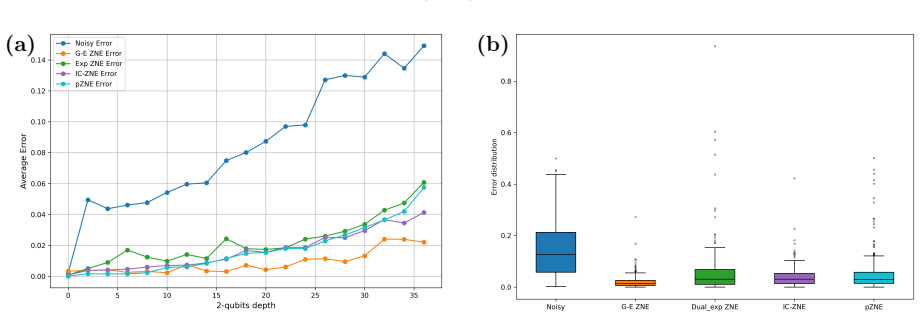
By constructing and analyzing an approximate Markov process for the transfer of Pauli operators under Pauli diagonal errors, the authors prove a central limit theorem that the noise amplification factor weakly approaches a log-normal distribution. This distribution result directly motivates augmenting the standard exponential extrapolation model with Gaussian variance corrections. The hybrid Gaussian-exponential model applies directly to arbitrary periodic circuits and requires no prior noise characterization. Numerical tests on Trotterized Ising dynamics, random circuits, and Grover search show measurable reductions in bias relative to previous extrapolation variants for moderate to large c
What carries the argument
The hybrid Gaussian-exponential zero-noise extrapolation model, obtained by adding Gaussian variance corrections to the exponential scaling on the basis of the proved log-normal central limit theorem for the noise amplification factor.
Load-bearing premise
The errors are Pauli diagonal, allowing an approximate Markov process on Pauli operator transfer whose amplification factor converges weakly to log-normal.
What would settle it
Apply both the hybrid model and the pure exponential model to a known periodic circuit under controlled Pauli diagonal noise and compare each extrapolated zero-noise value against the exact noise-free result; absence of consistent bias reduction in the hybrid case would falsify the claim.
If this is right
- The hybrid model works on any periodic circuit without separate noise characterization.
- It produces lower bias than standard exponential extrapolation once circuit depth is moderate to large.
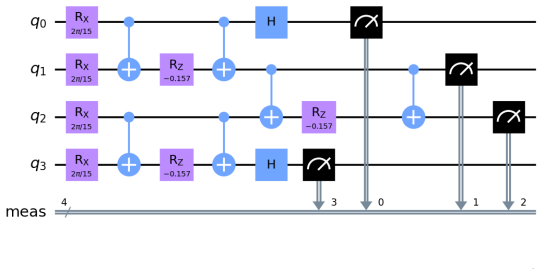
- It is demonstrated on Trotterized Ising dynamics, random circuits, and Grover search using noise simulators.
- It supplies a practical error-mitigation tool usable on near-term quantum hardware.
Where Pith is reading between the lines
- The same log-normal argument might apply to other structured but non-periodic circuits if a comparable Markov process can be identified.
- Pairing the hybrid extrapolation with additional mitigation layers could produce compounded error reductions.
- Direct tests on physical quantum processors would reveal how far the Pauli-diagonal Markov assumption survives real-device noise.
- The log-normal scaling result may supply a template for modeling noise accumulation in other quantum simulation settings.
Editorial analysis
A structured set of objections, weighed in public.
Referee Report
Summary. The manuscript introduces a hybrid Gaussian-exponential zero-noise extrapolation scheme for periodic quantum circuits. Under Pauli-diagonal errors, it constructs an approximate Markov process on Pauli operators and proves a central limit theorem establishing that the noise amplification factor converges weakly to a log-normal distribution. This motivates augmenting the standard exponential extrapolation model with Gaussian variance corrections. The resulting parameter-free method is tested via Qiskit simulations on Trotterized Ising dynamics, random periodic circuits, and Grover search, where it yields measurable bias reductions relative to prior variants for moderate-to-large depths.
Significance. If the CLT and associated bias reductions hold, the work supplies a theoretically motivated, parameter-free improvement to zero-noise extrapolation that targets the periodic circuit structures common in quantum algorithms. The combination of an explicit Markov-process derivation, a stated central limit theorem, and direct numerical comparisons across multiple algorithms constitutes a substantive contribution to NISQ error mitigation.
minor comments (3)
- The precise statement of the central limit theorem (including the mode of weak convergence and the explicit conditions on the Markov approximation) should appear in a dedicated theorem environment rather than being summarized in the abstract and introduction.
- Section 5: the simulation protocols should specify the exact Pauli-diagonal noise strengths and circuit depths used in each benchmark so that the reported bias reductions can be reproduced independently.
- Figure captions for the bias plots should explicitly identify which curves correspond to the hybrid model versus the pure exponential and linear baselines.
Simulated Author's Rebuttal
We thank the referee for the positive summary, significance assessment, and recommendation of minor revision. No specific major comments were provided in the report.
Circularity Check
No significant circularity; derivation self-contained via independent CLT proof
full rationale
The paper constructs an approximate Markov process on Pauli operators under Pauli-diagonal errors, proves a central limit theorem establishing that the noise amplification factor approaches a log-normal distribution, and uses this theorem to motivate the hybrid Gaussian-exponential model. The model is then applied directly to periodic circuits without external noise parameters or fitted inputs from the target observables. Numerical validation on Trotterized Ising, random circuits, and Grover search follows from the model but does not feed back into its construction. No self-citation chains, self-definitional steps, or renamings of known results appear in the load-bearing derivation.
Axiom & Free-Parameter Ledger
axioms (1)
- domain assumption Errors are Pauli diagonal
read the original abstract
Zero-noise extrapolation provides a practical means of suppressing gate errors in current noisy intermediate-scale quantum hardware. The accuracy of the zero-noise estimate depends sensitively on the fidelity of the assumed noise model to the actual error scaling. This work introduces a hybrid Gaussian-exponential extrapolation scheme tailored for quantum circuits with periodic structure, which are ubiquitous in quantum algorithms. Under Pauli diagonal errors, by constructing and analyzing an approximate Markov process for the transfer of Pauli operators, we prove a central limit theorem: the noise amplification factor weakly approaches a log-normal distribution, which motivates augmenting the standard exponential model with Gaussian variance corrections. The resulting model requires no prior noise characterization and applies directly to arbitrary periodic circuits. Performance is assessed on Trotterized Ising dynamics, random circuits, and Grover search algorithm using Qiskit noise simulators. For moderate to large circuit depths, the hybrid model yields measurable reductions in bias relative to previous extrapolation variants, indicating its utility for error mitigation on near-term quantum hardware.
Figures




Reference graph
Works this paper leans on
-
[1]
Quantum Computing in the NISQ era and beyond.Quantum, 2:79, August 2018
John Preskill. Quantum Computing in the NISQ era and beyond.Quantum, 2:79, August 2018
2018
-
[2]
Emanuel Knill, Raymond Laflamme, and Wojciech H. Zurek. Resilient quantum computa- tion: error models and thresholds.Proceedings of the Royal Society of London. Series A: Mathematical, Physical and Engineering Sciences, 454(1969):365–384, January 1998
1969
-
[3]
Fault-tolerant quantum computation with constant error rate.SIAM Journal on Computing, 38(4):1207–1282, 2008
Dorit Aharonov and Michael Ben-Or. Fault-tolerant quantum computation with constant error rate.SIAM Journal on Computing, 38(4):1207–1282, 2008
2008
-
[4]
A.Yu. Kitaev. Fault-tolerant quantum computation by anyons.Annals of Physics, 303(1):2–30, January 2003
2003
-
[5]
Gambetta
Kristan Temme, Sergey Bravyi, and Jay M. Gambetta. Error mitigation for short-depth quantum circuits.Phys. Rev. Lett., 119:180509, Nov 2017
2017
-
[6]
Benjamin
Ying Li and Simon C. Benjamin. Efficient variational quantum simulator incorporating active error minimization.Phys. Rev. X, 7:021050, Jun 2017
2017
-
[7]
Benjamin, and Ying Li
Suguru Endo, Simon C. Benjamin, and Ying Li. Practical quantum error mitigation for near-future applications.Phys. Rev. X, 8:031027, Jul 2018
2018
-
[8]
Wallman and Joseph Emerson
Joel J. Wallman and Joseph Emerson. Noise tailoring for scalable quantum computation via randomized compiling.Phys. Rev. A, 94:052325, Nov 2016
2016
-
[9]
McClean, Zhang Jiang, Nicholas C
Jarrod R. McClean, Zhang Jiang, Nicholas C. Rubin, Ryan Babbush, and Hartmut Neven. Decoding quantum errors with subspace expansions.Nature Commun., 11(1):636, 2020
2020
-
[10]
Benjamin, and Ying Li
Armands Strikis, Dayue Qin, Yanzhu Chen, Simon C. Benjamin, and Ying Li. Learning- based quantum error mitigation.PRX Quantum, 2:040330, Nov 2021
2021
-
[11]
Wang, Iskandar Sitdikov, Ciro Salcedo, Alireza Seif, and Zlatko K
Haoran Liao, Derek S. Wang, Iskandar Sitdikov, Ciro Salcedo, Alireza Seif, and Zlatko K. Minev. Machine learning for practical quantum error mitigation.Nature Machine Intelli- gence, 6(12):1478–1486, November 2024
2024
-
[12]
Tudor Giurgica-Tiron, Yousef Hindy, Ryan LaRose, Andrea Mari, and William J. Zeng. Digital zero noise extrapolation for quantum error mitigation. In2020 IEEE International Conference on Quantum Computing and Engineering (QCE), page 306–316. IEEE, October 2020. 21
2020
-
[13]
Koenig, Finn Reinecke, Walter Hahn, and Thomas Wellens
Kathrin F. Koenig, Finn Reinecke, Walter Hahn, and Thomas Wellens. Inverted-circuit zero-noise extrapolation for quantum-gate error mitigation.Phys. Rev. A, 110:042625, Oct 2024
2024
-
[14]
Purity- assisted zero-noise extrapolation for quantum error mitigation.Advanced Quantum Tech- nologies, 7(12), September 2024
Tian-Ren Jin, Yun-Hao Shi, Zheng-An Wang, Tian-Ming Li, Kai Xu, and Heng Fan. Purity- assisted zero-noise extrapolation for quantum error mitigation.Advanced Quantum Tech- nologies, 7(12), September 2024
2024
-
[15]
Nielsen and Isaac L
Michael A. Nielsen and Isaac L. Chuang.Quantum Computation and Quantum Information: 10th Anniversary Edition. Cambridge University Press, 2010
2010
-
[16]
Multi-exponential error extrapolation and combining error mitigation tech- niques for nisq applications.npj Quantum Information, 7(1), May 2021
Zhenyu Cai. Multi-exponential error extrapolation and combining error mitigation tech- niques for nisq applications.npj Quantum Information, 7(1), May 2021
2021
-
[17]
Dual-state purification for practical quantum error mitigation
Mingxia Huo and Ying Li. Dual-state purification for practical quantum error mitigation. Physical Review A, 105(2), February 2022
2022
-
[18]
Cambridge University Press, 2018
John Watrous.The Theory of Quantum Information. Cambridge University Press, 2018
2018
-
[19]
Direct analysis of zero-noise extrapolation: Polyno- mial methods, error bounds, and simultaneous physical-algorithmic error mitigation.Quan- tum, 9:1909, November 2025
Pegah Mohammadipour and Xiantao Li. Direct analysis of zero-noise extrapolation: Polyno- mial methods, error bounds, and simultaneous physical-algorithmic error mitigation.Quan- tum, 9:1909, November 2025
1909
-
[20]
Improving zero-noise extrapolation via physically bounded models, 2026
Andriy Miranskyy, Adam Sorrenti, Jasmine Thind, and Claude Gravel. Improving zero-noise extrapolation via physically bounded models, 2026
2026
-
[21]
Folding-free zero-noise extrapolation by layout-induced noise diversity, 2026
Debarthi Pal and Yogesh Simmhan. Folding-free zero-noise extrapolation by layout-induced noise diversity, 2026
2026
-
[22]
Weakly approaching sequences of random distributions.Jour- nal of Applied Probability, 37, 09 2000
Yuri Belyaev and Sara Luna. Weakly approaching sequences of random distributions.Jour- nal of Applied Probability, 37, 09 2000
2000
-
[23]
A general central limit theorem for strong mixing sequences.Statistics & Probability Letters, 94:236–238, 2014
Magnus Ekström. A general central limit theorem for strong mixing sequences.Statistics & Probability Letters, 94:236–238, 2014
2014
-
[24]
Horn and Charles R
Roger A. Horn and Charles R. Johnson.Matrix Analysis. Cambridge University Press, 1985
1985
-
[25]
de Jong, and Christian W
Benjamin Nachman, Miroslav Urbanek, Wibe A. de Jong, and Christian W. Bauer. Unfold- ing quantum computer readout noise.npj Quantum Inf., 6:84, 2020
2020
-
[26]
Huggins, Sam McArdle, Thomas E
William J. Huggins, Sam McArdle, Thomas E. O’Brien, Joonho Lee, Nicholas C. Rubin, Ser- gio Boixo, K. Birgitta Whaley, Ryan Babbush, and Jarrod R. McClean. Virtual distillation for quantum error mitigation.Physical Review X, 11(4), November 2021. A DEVICE PROPERTIES Fig. 8 shows the architecture and CNOT error rates of the FakeQuito and FakeLima simulator...
2021
discussion (0)
Sign in with ORCID, Apple, or X to comment. Anyone can read and Pith papers without signing in.