Spin-Induced Fractal Time-Crystal-Like Dynamics and Non-Markovian Memory in the Bateman Dual Oscillator
Pith reviewed 2026-07-01 01:07 UTC · model grok-4.3
The pith
Spin-induced noncommutativity produces discrete scaling covariance for self-similar evolution and non-Markovian memory in the closed Bateman dual oscillator.
A machine-rendered reading of the paper's core claim, the machinery that carries it, and where it could break.
Core claim
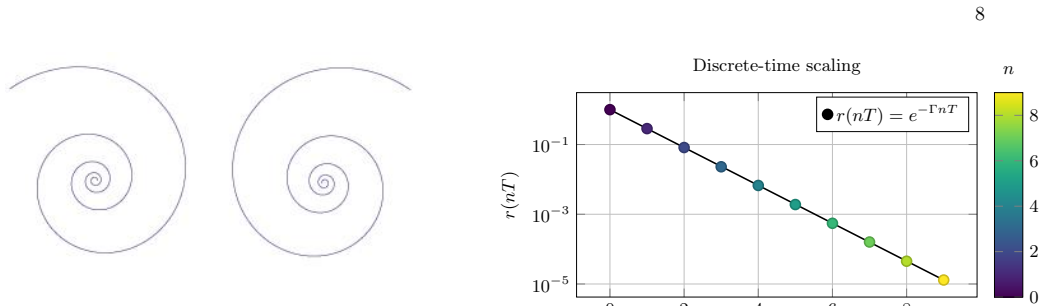
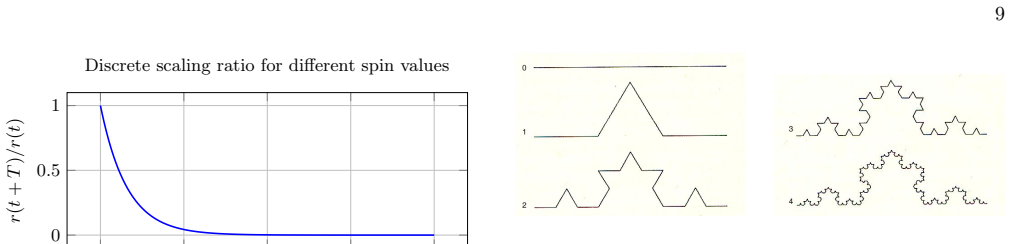
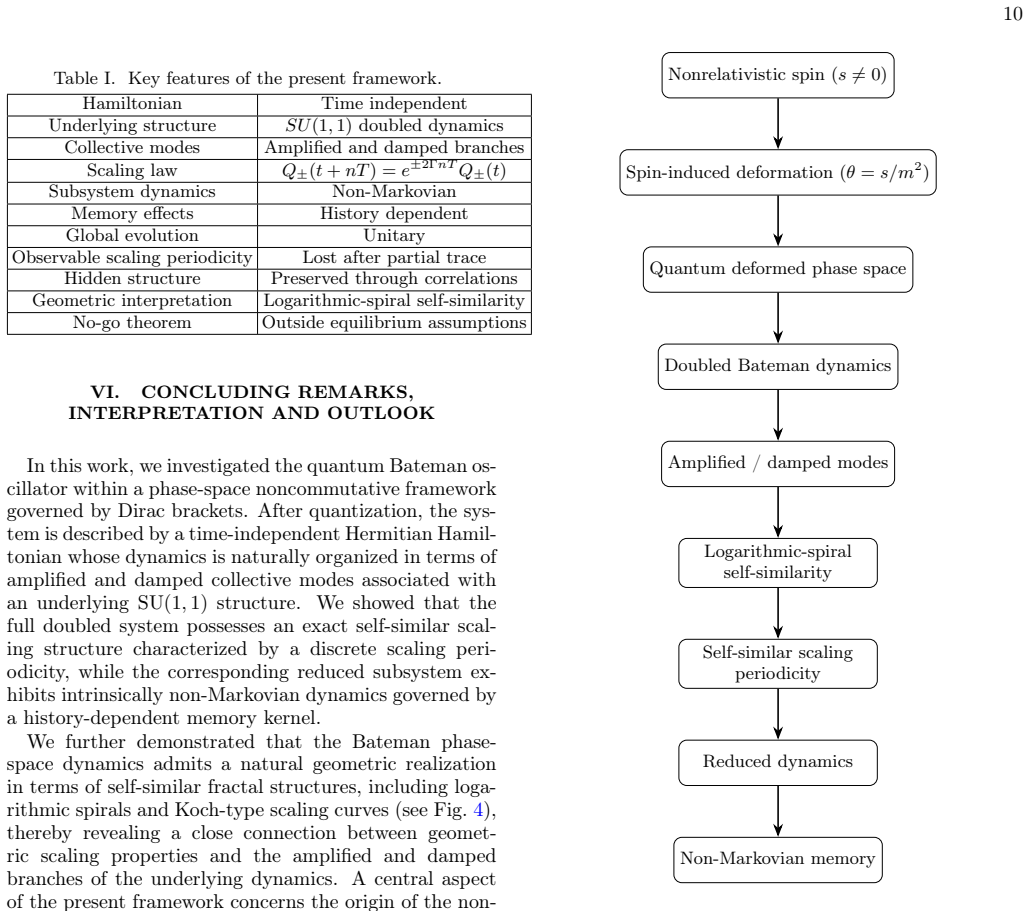
The amplified and damped modes satisfy an exact discrete scaling covariance, leading to self-similar temporal evolution without external driving. Upon tracing over one oscillator sector, the reduced dynamics becomes intrinsically non-Markovian and is governed by a history-dependent memory kernel. The same scaling structure admits a geometric representation in terms of logarithmic-spiral trajectories associated with the amplified and damped branches. The mechanism relies on nonequilibrium reduced dynamics rather than equilibrium expectation values of local observables, placing it outside the assumptions of conventional no-go theorems for equilibrium time crystals. Spin serves as the common ph
What carries the argument
The exact discrete scaling covariance satisfied by the amplified and damped collective modes under the SU(1,1) structure of the doubled quantum dynamics.
If this is right
- The mechanism identifies spin as the common physical origin of the amplified and damped dynamics, self-similar scaling, logarithmic-spiral structures, and non-Markovian memory.
- The results lie outside the assumptions underlying conventional no-go theorems for equilibrium time crystals because they rely on nonequilibrium reduced dynamics.
- The scaling structure suggests a natural extension of the mechanism to relativistic anyonic systems.
Where Pith is reading between the lines
- Similar self-similar dynamics might appear in other quantum systems where spin induces spatial noncommutativity.
- The logarithmic-spiral trajectories could offer a geometric test for the scaling covariance in numerical simulations of the reduced dynamics.
- Connections to memory effects in open quantum systems could be explored by comparing the history-dependent kernel to standard non-Markovian master equations.
Load-bearing premise
The nonrelativistic (2 + 1)-dimensional phase-space noncommutative framework generated by spin-induced spatial deformation produces the Bateman dual oscillator dynamics and the claimed scaling covariance without external driving or additional couplings.
What would settle it
Measurement of self-similar scaling in the time evolution of expectation values or the explicit form of a history-dependent memory kernel in the reduced density matrix of a spin-deformed quantum oscillator system.
Figures
read the original abstract
Can a closed quantum system generate time-crystal-like nonequilibrium behavior, self-similar scaling structures, and non-Markovian memory without external driving or coupling to a macroscopic environment? We address this question within the quantum Bateman oscillator formulated in a nonrelativistic (2 + 1)-dimensional phase-space noncommutative framework generated by spin-induced spatial deformation. The resulting doubled quantum dynamics is governed by a time-independent Hermitian Hamiltonian and exhibits an underlying SU(1, 1) structure with amplified and damped collective modes. We show that these modes satisfy an exact discrete scaling covariance, leading to self-similar temporal evolution without external driving. Upon tracing over one oscillator sector, the reduced dynamics becomes intrinsically non-Markovian and is governed by a history-dependent memory kernel. The same scaling structure admits a geometric representation in terms of logarithmic-spiral trajectories associated with the amplified and damped branches of the Bateman system. Because the mechanism relies on nonequilibrium reduced dynamics rather than equilibrium expectation values of local observables, it lies outside the assumptions underlying conventional no-go theorems for equilibrium time crystals. Our results identify spin as the common physical origin of the amplified and damped Bateman dynamics, self-similar scaling periodicity, logarithmic-spiral structures, and non-Markovian memory, also suggesting a natural extension of the mechanism to relativistic anyonic systems.
Editorial analysis
A structured set of objections, weighed in public.
Referee Report
Summary. The manuscript claims that a spin-induced noncommutative phase-space structure in (2+1) dimensions generates the quantum Bateman dual oscillator with a time-independent Hermitian Hamiltonian exhibiting SU(1,1) structure. The amplified and damped modes satisfy exact discrete scaling covariance, leading to self-similar evolution and, upon partial trace, non-Markovian dynamics with a history-dependent memory kernel. This is presented as occurring without external driving, and the mechanism is suggested to extend to relativistic anyonic systems, bypassing conventional no-go theorems for time crystals.
Significance. If the central mapping from the noncommutative framework to the exact scaling covariance holds without additional assumptions or time-dependent terms, the result would offer a novel origin for fractal time-crystal-like behavior and non-Markovian memory rooted in spin degrees of freedom. It provides a concrete example of nonequilibrium reduced dynamics in a closed system. The geometric interpretation in logarithmic spirals is an interesting addition. The strength depends on the rigor of the derivation of the Hamiltonian and scaling relations.
major comments (2)
- [Model construction / Hamiltonian definition] The assertion that the nonrelativistic (2+1)D noncommutative framework generated by spin-induced spatial deformation automatically produces the time-independent Hermitian Bateman Hamiltonian with exact discrete scaling covariance (without external driving or additional couplings) is load-bearing for the central claim but requires explicit verification; the abstract states the mapping as given but supplies no derivations or commutation relations showing how the deformation parameter yields the SU(1,1) generators and discrete scaling factor.
- [Reduced dynamics / partial trace section] The claim that the reduced dynamics after tracing over one oscillator sector is intrinsically non-Markovian and governed by a history-dependent memory kernel due to the scaling covariance needs explicit derivation of the kernel; it is unclear whether this follows rigorously from the stated Hamiltonian or reverts to a standard open-system construction if the scaling relation involves any implicit parameter tuning.
minor comments (2)
- [Abstract] The abstract is information-dense; separating the Hamiltonian construction, scaling covariance, and memory kernel claims into distinct sentences would improve clarity.
- [Notation throughout] Ensure all symbols (e.g., scaling factor, deformation parameter) are defined at first use and used consistently in equations and text.
Simulated Author's Rebuttal
We thank the referee for the careful reading of the manuscript and for the constructive recommendation of major revision. The comments correctly identify the need for more explicit derivations of the central mappings, which we will supply in the revised version. Our point-by-point responses follow.
read point-by-point responses
-
Referee: [Model construction / Hamiltonian definition] The assertion that the nonrelativistic (2+1)D noncommutative framework generated by spin-induced spatial deformation automatically produces the time-independent Hermitian Bateman Hamiltonian with exact discrete scaling covariance (without external driving or additional couplings) is load-bearing for the central claim but requires explicit verification; the abstract states the mapping as given but supplies no derivations or commutation relations showing how the deformation parameter yields the SU(1,1) generators and discrete scaling factor.
Authors: We agree that the derivation of the mapping must be made fully explicit. The manuscript states the resulting time-independent Hermitian Hamiltonian and its SU(1,1) structure but does not expand the intermediate commutation relations that connect the spin-induced noncommutativity parameter to these features. In the revision we will insert a dedicated subsection that starts from the deformed phase-space algebra, derives the generators, and shows that the discrete scaling covariance emerges directly without external driving or auxiliary couplings. This addition will not alter the physical claims but will render the construction self-contained. revision: yes
-
Referee: [Reduced dynamics / partial trace section] The claim that the reduced dynamics after tracing over one oscillator sector is intrinsically non-Markovian and governed by a history-dependent memory kernel due to the scaling covariance needs explicit derivation of the kernel; it is unclear whether this follows rigorously from the stated Hamiltonian or reverts to a standard open-system construction if the scaling relation involves any implicit parameter tuning.
Authors: We concur that an explicit derivation of the memory kernel is required. The scaling covariance of the amplified and damped modes implies that the partial trace produces a non-local-in-time equation whose kernel is fixed by the discrete scaling factor. In the revised manuscript we will compute the reduced dynamics explicitly, obtain the integro-differential form, and display the memory kernel without introducing parameter tuning. The derivation will demonstrate that the non-Markovian character is a direct consequence of the closed-system scaling structure rather than a phenomenological open-system ansatz. revision: yes
Circularity Check
Derivation self-contained; no circular reductions identified
full rationale
The paper constructs the Bateman dual oscillator from the assumed nonrelativistic (2+1)D noncommutative phase-space framework due to spin-induced deformation, then derives the SU(1,1) structure, discrete scaling covariance, self-similar evolution, and non-Markovian memory kernel upon partial trace as direct consequences of that framework and the time-independent Hermitian Hamiltonian. No equations reduce a claimed prediction to a fitted input by construction, no load-bearing uniqueness theorem is imported via self-citation, and no ansatz is smuggled. The abstract and skeptic summary present the mapping as following from the model without external tuning, qualifying as the normal self-contained case.
Axiom & Free-Parameter Ledger
axioms (1)
- domain assumption Spin induces a spatial deformation that generates a noncommutative (2+1)-dimensional phase-space framework for the Bateman oscillator
Reference graph
Works this paper leans on
-
[1]
Shapere and F
A. Shapere and F. Wilczek, Phys. Rev. Lett.109, 160402 (2012)
2012
-
[2]
F. Wilczek, Phys. Rev. Lett.109, 160401 (2012), arXiv:1202.2539 [cond-mat.other]
work page internal anchor Pith review Pith/arXiv arXiv 2012
-
[3]
Nandi, A
P. Nandi, A. Ghose-Choudhury, and P. Guha, Int. J. Geom. Meth. Mod. Phys.21, 2450213 (2024)
2024
-
[4]
Absence of Quantum Time Crystals
H. Watanabe and M. Oshikawa, Phys. Rev. Lett.114, 251603 (2015), arXiv:1410.2143 [cond-mat.stat-mech]
work page internal anchor Pith review Pith/arXiv arXiv 2015
-
[5]
Impossibility of Spontaneously Rotating Time-Crystals: A No-Go Theorem
P. Bruno, Phys. Rev. Lett.111, 070402 (2013), arXiv:1306.6275 [cond-mat.stat-mech]
work page internal anchor Pith review Pith/arXiv arXiv 2013
-
[6]
D. V. Else, B. Bauer, and C. Nayak, Phys. Rev. Lett. 117, 090402 (2016), arXiv:1603.08001 [cond-mat.stat- mech]
work page internal anchor Pith review Pith/arXiv arXiv 2016
-
[7]
On the phase structure of driven quantum systems
V. Khemani, A. Lazarides, R. Moessner, and S. L. Sondhi, Phys. Rev. Lett.116, 250401 (2016), arXiv:1508.03344 [cond-mat.dis-nn]
work page internal anchor Pith review Pith/arXiv arXiv 2016
-
[8]
N. Y. Yao, A. C. Potter, I.-D. Potirniche, and A. Vishwanath, Phys. Rev. Lett.118, 030401 (2017), arXiv:1608.02589 [cond-mat.dis-nn]
work page internal anchor Pith review Pith/arXiv arXiv 2017
-
[9]
Zhanget al., Nature543, 217 (2017)
J. Zhanget al., Nature543, 217 (2017)
2017
-
[10]
Choiet al., Nature543, 221 (2017)
S. Choiet al., Nature543, 221 (2017)
2017
-
[11]
Matus and K
P. Matus and K. Sacha, Phys. Rev. A99, 033626 (2019)
2019
- [12]
- [13]
-
[14]
Banerjee, B
R. Banerjee, B. Dutta Roy, and S. Samanta, Phys. Rev. D74, 045015 (2006)
2006
- [15]
-
[16]
Bateman, Physical Review38, 815 (1931)
H. Bateman, Physical Review38, 815 (1931)
1931
-
[17]
S. K. Pal, P. Nandi, and B. Chakraborty, Phys. Rev. A 97, 062110 (2018)
2018
-
[18]
A Novel Approach to Noncommutativity in Planar Quantum Mechanics
R. Banerjee, Mod. Phys. Lett. A17, 631 (2002), arXiv:hep-th/0106280
work page internal anchor Pith review Pith/arXiv arXiv 2002
-
[19]
Breuer and F
H.-P. Breuer and F. Petruccione,The Theory of Open Quantum Systems(Oxford University Press, 2007)
2007
-
[20]
Doplicher, K
S. Doplicher, K. Fredenhagen, and J. E. Roberts, Phys. Lett. B331, 39 (1994)
1994
-
[21]
M. B. Fröb, W. C. C. Lima, A. Much, and K. Pa- padopoulos, Phys. Rev. D108, 086003 (2023)
2023
-
[22]
P. Nandi, T. Bhattacharyya, A. S. Majumdar, G. Plea- sance, and F. Petruccione, Phys. Rev. Res.8, 023130 (2026), arXiv:2503.13061 [hep-th]. 16
work page internal anchor Pith review Pith/arXiv arXiv 2026
- [23]
- [24]
-
[25]
D. Bak, K. Lee, and J.-H. Park, Phys. Rev. Lett.87, 030402 (2001)
2001
-
[26]
Path integral action and Chern-Simons quantum mechanics in noncommutative plane
S. Gangopadhyay and F. G. Scholtz, J. Phys. A47, 235301 (2014), arXiv:1402.6156 [hep-th]
work page internal anchor Pith review Pith/arXiv arXiv 2014
-
[27]
J. Bellissard, A. van Elst, and H. Schulz-Baldes, Journal of Mathematical Physics35, 5373 (1994), arXiv:cond- mat/9411052
-
[28]
Finite Noncommutative Chern-Simons with a Wilson Line and the Quantum Hall Effect
B. Morariu and A. P. Polychronakos, JHEP07, 006 (2001), arXiv:hep-th/0106072
work page internal anchor Pith review Pith/arXiv arXiv 2001
-
[29]
Quantum Hall Physics = Noncommutative Field Theory
S. Hellerman and M. Van Raamsdonk, JHEP10, 039 (2001), arXiv:hep-th/0103179
work page internal anchor Pith review Pith/arXiv arXiv 2001
-
[30]
N. Manoj, Phys. Rev. B112, 134521 (2025), arXiv:2502.03528 [cond-mat.str-el]
-
[31]
Y.-H. Du, S. Moroz, D. X. Nguyen, and D. T. Son, Phys. Rev. Res.6, L012040 (2024)
2024
-
[32]
2D or not 2D: a "holographic dictionary" for Lowest Landau Levels
G. Mandal, A. Mohan, and R. Suroshe, (2025), arXiv:2511.01630 [hep-th]
work page internal anchor Pith review Pith/arXiv arXiv 2025
- [33]
-
[34]
A Canonical Approach to the Quantization of the Damped Harmonic Oscillator
R. Banerjee and P. Mukherjee, J. Phys. A35, 5591 (2002), arXiv:quant-ph/0108055
work page internal anchor Pith review Pith/arXiv arXiv 2002
-
[35]
Celeghini, M
E. Celeghini, M. Rasetti, and G. Vitiello, Annals Phys. 215, 156 (1992)
1992
-
[36]
Feshbach and Y
H. Feshbach and Y. Tikochinsky, Annals of Physics38, 44 (1977)
1977
-
[37]
Sivasubramanian, Y
S. Sivasubramanian, Y. N. Srivastava, G. Vitiello, and A. Widom, Phys. Lett. A311, 97 (2003)
2003
-
[38]
E.RussellandO.K.Pashaev,Oscillatory Models in Gen- eral Relativity(Walter de Gruyter, Berlin, 2018)
2018
-
[39]
Vitiello, Phys
G. Vitiello, Phys. Lett. A376, 2527 (2012)
2012
-
[40]
’t Hooft, Class
G. ’t Hooft, Class. Quantum Grav.16, 3263 (1999)
1999
-
[41]
M. Blasone, P. Jizba, and G. Vitiello, Phys. Lett. A287, 205 (2001), arXiv:hep-th/0007138
work page internal anchor Pith review Pith/arXiv arXiv 2001
-
[42]
Chern-Simons States and Topologically Massive Gauge Theories
M. Asorey, F. Falceto, and S. Carlip, Phys. Lett. B312, 477 (1993), arXiv:hep-th/9304081
work page internal anchor Pith review Pith/arXiv arXiv 1993
-
[43]
Dissipation and Topologically Massive Gauge Theories in Pseudoeuclidean Plane
M. Blasone, E. Graziano, O. K. Pashaev, and G. Vitiello, Annals Phys.252, 115 (1996), arXiv:hep-th/9603092
work page internal anchor Pith review Pith/arXiv arXiv 1996
-
[44]
C. A. Rodriguez-Rosario and E. C. G. Sudarshan, (2008), arXiv:0803.1183 [quant-ph]
work page internal anchor Pith review Pith/arXiv arXiv 2008
-
[45]
Is Exact Markovianity Fundamental Once Time Is Relational?
P. Nandi and F. Petruccione, (2026), arXiv:2606.08595 [quant-ph]
work page internal anchor Pith review Pith/arXiv arXiv 2026
-
[46]
Cabot, G
A. Cabot, G. L. Giorgi, and R. Zambrini, PRX Quantum 5, 030325 (2024)
2024
-
[47]
J. M. Lévy-Leblond, inGroup Theory and Applications, edited by E. Loebl (Academic Press, New York, 1972)
1972
-
[48]
Bose, Communications in Mathematical Physics169, 385 (1995)
S. Bose, Communications in Mathematical Physics169, 385 (1995)
1995
-
[49]
A Chern-Simons approach to Galilean quantum gravity in 2+1 dimensions
G. Papageorgiou and B. J. Schroers, JHEP11, 009 (2009), arXiv:0907.2880 [hep-th]
work page internal anchor Pith review Pith/arXiv arXiv 2009
-
[50]
Anyon spin and the exotic central extension of the planar Galilei group
R. Jackiw and V. P. Nair, Phys. Lett. B480, 237 (2000), arXiv:hep-th/0003130
work page internal anchor Pith review Pith/arXiv arXiv 2000
-
[51]
Marsot, P.-M
L. Marsot, P.-M. Zhang, and P. A. Horvathy, Phys. Rev. D106, L121503 (2022)
2022
-
[52]
R. M. Santilli,Foundations of Theoretical Mechanics I: The Inverse Problem in Newtonian Mechanics(Springer- Verlag, New York, 1984) pp. 119–137
1984
-
[53]
P. A. M. Dirac, Canadian Journal of Mathematics2, 129 (1950)
1950
-
[54]
P. A. M. Dirac, Physical Review114, 924 (1959)
1959
-
[55]
P.A.M.Dirac,Lectures on Quantum Mechanics(Yeshiva University, New York, 1964)
1964
-
[56]
C.-h. Chou, V. P. Nair, and A. P. Polychronakos, Phys. Lett. B304, 105 (1993), arXiv:hep-th/9301037
work page internal anchor Pith review Pith/arXiv arXiv 1993
-
[57]
Zhang, D
W.-M. Zhang, D. H. Feng, and R. Gilmore, Rev. Mod. Phys.62, 867 (1990)
1990
-
[58]
A. J. Niemi, Phys. Rev. Lett.135, 230201 (2025)
2025
-
[59]
Perelomov,Generalized Coherent States and Their Applications(Springer-Verlag, Berlin, 1986)
A. Perelomov,Generalized Coherent States and Their Applications(Springer-Verlag, Berlin, 1986)
1986
-
[60]
C. C. Gerry and P. L. Knight,Introductory Quantum Optics(Cambridge University Press, Cambridge, 2005)
2005
-
[61]
Umezawa, H
H. Umezawa, H. Matsumoto, and M. Tachiki,Thermo Field Dynamics and Condensed States(North-Holland Publ. Co., Amsterdam, 1982)
1982
-
[62]
H. O. Peitgen, H. Jürgens, and D. Saupe,Chaos and fractals. New Frontiers of Science(Springer-Verlag, Berlin, 1986)
1986
-
[63]
A.A.Andronov, A.A.Vitt, andS.E.Khaikin,Theory of oscillators(Dover Publications, INC„ New York, 1966)
1966
-
[64]
Time crystal platform: from quasi-crystal structures in time to systems with exotic interactions
K. Giergiel, A. Miroszewski, and K. Sacha, Phys. Rev. Lett.120, 140401 (2018), arXiv:1710.10087 [cond- mat.quant-gas]
work page internal anchor Pith review Pith/arXiv arXiv 2018
-
[65]
Celeghini, S
E. Celeghini, S. De Martino, S. De Siena, M. Rasetti, and G. Vitiello, Annals. Phys.241, 50 (1995)
1995
-
[66]
Giergiel, A
K. Giergiel, A. Kosior, P. Hannaford, and K. Sacha, Phys. Rev. A98, 013613 (2018)
2018
-
[67]
Celeghini, S
E. Celeghini, S. De Martino, S. De Siena, A. Iorio, M. Rasetti, and G. Vitiello, Phys. Lett. A244, 455 (1998)
1998
-
[68]
A.IorioandG.Vitiello,Mod.Phys.Lett.B8,269(1994)
1994
-
[69]
Giachetti, A
G. Giachetti, A. Solfanelli, L. Correale, and N. Defenu, Phys. Rev. B108, L140102 (2023)
2023
-
[70]
Blatt and C
R. Blatt and C. F. Roos, Nature Physics8, 277 (2012)
2012
-
[71]
Clarke and F
J. Clarke and F. K. Wilhelm, Nature453, 1031 (2008)
2008
-
[72]
M. H. Devoret and R. J. Schoelkopf, Science339, 1169 (2013)
2013
- [73]
-
[74]
Zarei, N
M. Zarei, N. Bartolo, D. Bertacca, S. Matarrese, and A. Ricciardone, Phys. Rev. D104, 083508 (2021)
2021
- [75]
-
[76]
A. Maity and V. V. Sreedhar, Phys. Rev. A111, 022202 (2025), arXiv:2405.02566 [quant-ph]
discussion (0)
Sign in with ORCID, Apple, or X to comment. Anyone can read and Pith papers without signing in.