REVIEW 3 major objections 6 minor 39 references
IA-T2I: Internet-Augmented Text-to-Image Generation
T0 review · 3 major / 6 minor · reviewed 2026-08-07 · deepseek-v4-flash
Pith's one-line read IA-T2I claims that wrapping a text-to-image model in a web-search, image-selection, and self-reflection loop lifts correct generation on uncertain-knowledge prompts from 19.1% to 48.3% for GPT-4o.
desk verdict A genuinely useful internet-augmented T2I framework and benchmark whose central claim survives the best-of-K worry, but whose evaluation needs independent annotators, statistics, and a corrected headline. read the letter →
The pith
A machine-rendered reading of the paper's core claim, the machinery that carries it, and where it could break.
The reading
What carries the argument
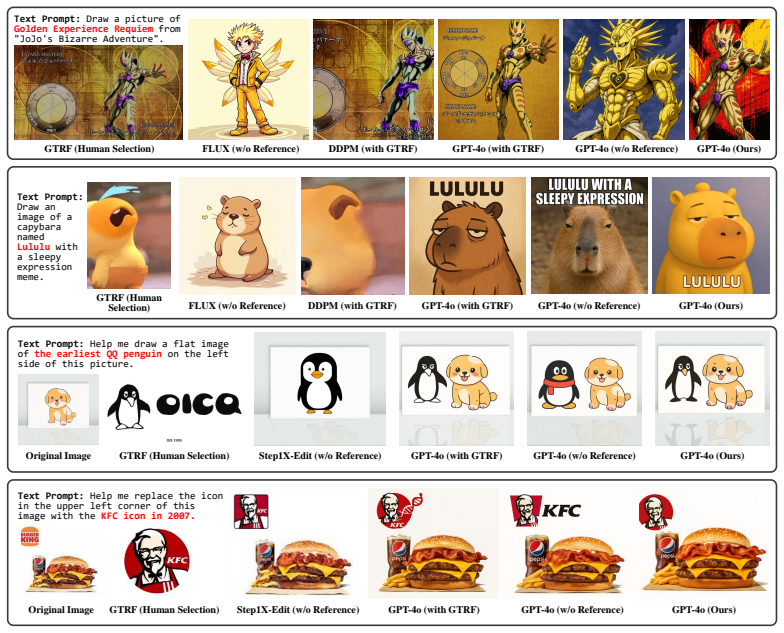
The load-bearing mechanism is a retrieval–selection–reflection loop. Its four parts are: an active-retrieval classifier that reads the prompt (and optionally the first raw output) and answers 'Y' or 'N' to whether external knowledge is needed; a query generator that converts the prompt into search queries in English, Chinese, and Japanese; a hierarchical image selector that embeds search results with CLIP image features, clusters them by cosine similarity via k-means, keeps one image per cluster, and asks a vision-language model to re-rank those candidates into a single top-1 reference; and a self-reflection scorer that uses GPT-4o to score the generated image on prompt fidelity, reference helpfulness, reference use, and improvement over the previous round, iterating until the total reaches 8. The loop is what turns an uncertain prompt into a generation that is grounded in a concrete visual reference.
What would settle it
Run the full pipeline on a fresh set of 100 prompts about recently released products or events, and have independent human raters judge both the top-ranked web reference and the final generated image; if the human-rated usefulness of the top-1 reference is far below the reported 48.3% accuracy, or if accuracy on these prompts is close to the raw model's, the framework's gain is an artifact of its curated dataset rather than a general solution to uncertain knowledge.
Extended reading notes
Core claim
The central discovery is that uncertain-knowledge failure in text-to-image generation can be treated as a retrieval problem rather than a generation problem. The paper demonstrates that supplying a single reference image recovered from the web—filtered through diversity clustering, re-ranked by a vision-language model, and checked by a self-reflection judge—closes most of the accuracy gap between an unaugmented model and a model given a ground-truth reference. In the paper's experiments, GPT-4o wrapped in this loop improves from 19.1% to 48.3% correct on the generation task and from 32.7% to 57.6% on the editing task; Gemini improves from 11.1% to 45.5% and from 6.7% to 10.3%. The authors state that web-selected references make GPT-4o and Gemini behave comparably to when they are given ground-truth references, and that each component of the pipeline contributes to the gain.
Load-bearing premise
The framework assumes that for every uncertain prompt, an internet image search returns at least one image showing the correct visual details, that the vision-language re-ranker can put that image first, and that the GPT-4o judge used to accept or reject the output makes few enough errors to preserve the measured gain.
Editorial extensions
If this is right
- With the IA-T2I wrapper, GPT-4o's human-evaluated correct-image rate on uncertain-knowledge prompts rises from 19.1% to 48.3% on text-to-image and from 32.7% to 57.6% on text-conditioned editing.
- The same wrapper lifts Gemini's rate from 11.1% to 45.5% on text-to-image, so the effect is not specific to one model.
- Web-selected references bring both commercial models close to the accuracy they reach with hand-picked ground-truth references, implying that the selection module is doing the heavy lifting.
- The active-retrieval module decides correctly in up to 95.8% of T2I and 91.7% of TI2I cases, so the framework does not force a web lookup on every prompt.
- Ablations show that removing diversity selection, re-ranking, or self-reflection lowers accuracy, so the three stages are complementary rather than redundant.
Reading between the lines
- A natural extension not tested in the paper is a stress test on fast-moving prompts for which the web index is current but the training data is old; the 'unknown' category is exactly this, but only 30 T2I samples support it.
- Because the same GPT-4o model both generates and judges the output, its blind spots are shared by the acceptance criterion; an independent judge model would reveal whether the self-reflection loop inflates the reported gain.
- The paper retrieves only images; pairing image retrieval with caption or text retrieval might help when the visual subject is obscure but well-described in text, a combination the paper does not explore.
- Although the framework is training-free, its cost is several API calls per prompt; a smaller, open-model benchmark would show whether the accuracy gain survives outside the GPT-4o ecosystem.
Editorial analysis
A structured set of objections, weighed in public.
Referee Report
Summary. The paper proposes IA-T2I, a training-free framework that augments text-to-image and text-conditioned image-editing models with reference images retrieved from the internet. The framework consists of an active retrieval gate that decides whether external knowledge is needed, a query generator that extracts search queries in three languages, a diversity-based candidate selection followed by an LVLM re-ranker, and a self-reflection mechanism that repeatedly generates and evaluates outputs until a GPT-4o judge accepts them. The authors introduce the Img-Ref-T2I dataset of 240 samples (120 T2I, 120 TI2I) spanning three types of uncertain knowledge, and they report human and automated preference evaluations showing large improvements over raw baselines, e.g., T2I accuracy rising from 19.1% for GPT-4o to 48.3% with IA-T2I.
Significance. If the reported gains are confirmed, the framework is a practical plug-and-play enhancement for commercial T2I models, and the Img-Ref-T2I dataset is a useful resource for evaluating knowledge-uncertain prompts. The paper makes its prompts and dataset available, which supports reproducibility. However, the central empirical claim currently rests on an uncontrolled comparison in which the raw baseline is a single generation while the proposed method can make multiple attempts, and on human evaluations performed by the paper's own authors. The claimed comparability with ground-truth reference images is also not supported by the table. These issues prevent the current results from establishing that internet retrieval, rather than multi-attempt selection, is responsible for the reported improvement.
major comments (3)
- [§3.6, Table 1, Table 2, Table 3] The paper compares a single-generation Raw baseline (19.1% on T2I) against IA-T2I, whose self-reflection loop (Section 3.6) can generate repeatedly until acceptance. The number of self-reflection rounds is never reported, and no best-of-K control is given for the Raw baseline. Under the reported per-sample accuracy of 19.1%, three independent raw attempts with uniform random selection would succeed at 1-(1-0.191)^3 ≈ 47.1%, almost exactly the reported 48.3%. The headline improvement may therefore be attributable to the opportunity to retry rather than to the retrieved reference images. Please report the distribution of rounds, add a Raw+best-of-K baseline with a matched attempt budget, and include a self-reflection-without-retrieval control.
- [§5.2, §5.3] The human evaluation is conducted by the paper's co-authors, as stated in Section 5.2, and no inter-annotator agreement, significance tests, or error bars are reported. The automated GPT-4o preference evaluation, which is claimed to match human preference, uses the same model that serves as the generator backend, query generator, re-ranker, and self-reflection judge. This creates a risk of circularity: the judge may systematically prefer outputs that satisfy its own scoring criteria, so the automated metric is not independent evidence. Please provide external evaluator results, or at minimum a detailed blinded protocol with external annotators and agreement statistics, and validate the automated preference metric against such external judgments.
- [§5.2, observation (3), Table 1] The statement that 'Gemini and GPT-4o achieve performance comparable to that with GT reference images' is not supported by Table 1. For T2I, GPT-4o with IA-T2I reaches 48.3% while GPT-4o with the ground-truth reference reaches 65.4%, a gap of 17.1 percentage points; for Gemini the gap is 11.1 points (45.5 vs 56.6). These are substantial gaps, not comparability. Please revise the claim or provide statistical support for a formal equivalence/comparability statement.
minor comments (6)
- [§4] The dataset composition is ambiguous: the text says there are 120 samples per task, with 30 samples per uncertainty category, and then adds 30 samples without uncertain knowledge. Please clarify whether the no-uncertainty samples are part of the 120 or additional, and specify which subset is used for the generation accuracy numbers in Table 1.
- [§5.2] The normalization description for the human evaluation is unclear: after saying each record is evaluated by three annotators, the text says scores are divided by the number of samples. Please state explicitly whether the denominator is the number of samples or the number of sample-annotator pairs.
- [§5.3] The label 'Ours' in Figure 3 denotes the GPT-4o automated preference evaluation, but it is easily confused with the proposed framework's output. Please rename it (e.g., 'Auto') for clarity.
- [§5.5, Table 4] The active retrieval prompt (prompt3 for T2I) was selected after evaluating on the same Img-Ref-T2I test set, so the reported 95.8% accuracy is optimistically biased. A held-out validation set or cross-validation should be used to report the module's accuracy.
- [§5.6, Figure 5] The number of clusters N in the diversity selection is a free parameter and appears to be tuned on the same test set (the optimum is found at C(10)). Please state how N is chosen and whether this choice is fixed before evaluation.
- [Throughout] There are several typos and unclear phrases: 'Appedix' in Section 5.3, 'we fed them into search engine' in Section 3, and 'inverse-based T2I model' for DDPM in Section 5.1 (likely 'inversion-based'). Please proofread.
Circularity Check
Automated preference evaluation is defined by closeness to the injected reference image, so Ours-vs-Raw is won by construction; the self-reflection loop's unreported retry budget can reproduce much of the headline gain without retrieval.
-
self definitional
[Appendix A, Figure 7, 'Prompt for GPT-4o Preference Evaluation' (used in Section 5.3)]
"However, this reference image is a necessary element in answering this image question. You need to evaluate the quality of the next two images based on the text question and the reference image. ... If the second image is closer to the reference image, you output 0. If the third image is closer to the reference image, you output 1. Your final output is only allowed to be 0 or 1."
The automated preference evaluator is instructed to decide by proximity to the reference image. IA-T2I's generation is conditioned on that same reference image (Section 3.5), and the self-reflection loop additionally requires a 'reference relationship' between output and reference; the Raw baseline receives no reference at all. Hence the Ours-vs-Raw automated preference outcome is fixed by the evaluation definition, not measured. This does not by itself invalidate the independent human preference test, so the circularity is partial.
-
other
[Section 3.6; Tables 1 and 2]
"A self-reflection mechanism is employed to evaluate the accuracy and usability of the output image I_i^o generated in the current round. If the result is deemed unsatisfactory, a new round is initiated to reselect reference images and attempt generation again. ... When the total score is greater than or equal to 8, I_i^o is accepted as the final output image."
Ours is thus an accept-after-N-rounds procedure with a GPT-4o judge, while Table 1's Raw baseline is a single generation (19.1% on T2I). The paper never reports the number of self-reflection rounds or a best-of-K control. If the judge accepted roughly one output in three, independent raw samples would already give 1-(1-0.191)^3 = 47.1%, essentially the reported 48.3%; so the retry loop, not internet retrieval, can account for part of the headline gain. This is a missing control that prevents causal attribution and makes part of the reported improvement depend on the output-selection definition rather than on the retrieved reference image.
full rationale
The paper's central human-evaluation claim is not a formal derivation, so this is not a fully circular paper. The 30% human-preference improvement is scored by co-authors (Section 5.2: 'We ask evaluators (co-authors of this paper)') rather than by the method's own judge, and no load-bearing uniqueness theorem or self-citation chain is invoked. However, two supporting pieces of the evidence chain are self-referential. First, the GPT-4o preference evaluator (labeled 'Ours' in Figure 3) is prompted to prefer the image 'closer to the reference image'; only IA-T2I receives a reference image, so its victory in the automated comparison is encoded in the prompt. Second, the self-reflection mechanism defines the final output as the first image scored >=8 by GPT-4o, with an unreported number of rounds; the Raw baseline is single-shot, and the best-of-K effect (1-(1-0.191)^3 ≈ 47.1%) is close to the reported 48.3%. The ablation does show 40.8% without self-reflection, so retrieval contributes, but the retry budget is never separated from the self-reflection gain. These issues make the supporting automated evidence partially circular and the headline attribution under-controlled, while the core claim retains an independent (if author-run) human-evaluation grounding, hence score 5 rather than 6-8.
Assumptions & free parameters
free parameters (3)
- Number of clusters in diversity selection (N) =
Not stated explicitly; Figure 5 suggests C(10)
- Self-reflection acceptance threshold =
8 (total score)
- Active retrieval prompt choice =
prompt3 for T2I, prompt6 for TI2I
assumptions (5)
- standard math CLIP features and k-means clustering group images by visual similarity
- domain assumption For each uncertain prompt, at least one helpful reference image is returned by the search engine
- domain assumption LVLM re-ranking and self-reflection judgments are reliable without external verification
- domain assumption Human evaluation by co-authors is an unbiased measure of image quality
- ad hoc to paper The three uncertainty categories produce a representative benchmark
Cite this review
Pith. "Pith review of IA-T2I: Internet-Augmented Text-to-Image Generation." pith.science (2026). https://pith.science/paper/VMITCLD4
@misc{pith2026250515779,
  author       = {Pith},
  title        = {Pith review of: IA-T2I: Internet-Augmented Text-to-Image Generation},
  year         = {2026},
  howpublished = {\url{https://pith.science/paper/VMITCLD4}},
  note         = {Machine review of arXiv:2505.15779}
}
read the original abstract
Current text-to-image (T2I) generation models achieve promising results, but they fail on the scenarios where the knowledge implied in the text prompt is uncertain. For example, a T2I model released in February would struggle to generate a suitable poster for a movie premiering in April, because the character designs and styles are uncertain to the model. To solve this problem, we propose an Internet-Augmented text-to-image generation (IA-T2I) framework to compel T2I models clear about such uncertain knowledge by providing them with reference images. Specifically, an active retrieval module is designed to determine whether a reference image is needed based on the given text prompt; a hierarchical image selection module is introduced to find the most suitable image returned by an image search engine to enhance the T2I model; a self-reflection mechanism is presented to continuously evaluate and refine the generated image to ensure faithful alignment with the text prompt. To evaluate the proposed framework's performance, we collect a dataset named Img-Ref-T2I, where text prompts include three types of uncertain knowledge: (1) known but rare. (2) unknown. (3) ambiguous. Moreover, we carefully craft a complex prompt to guide GPT-4o in making preference evaluation, which has been shown to have an evaluation accuracy similar to that of human preference evaluation. Experimental results demonstrate the effectiveness of our framework, outperforming GPT-4o by about 30% in human evaluation.
Figures


Figures from the paper (4 more)



Reference graph
Works this paper leans on
-
[1]
High-resolution image synthesis with latent diffusion models, 2021
Robin Rombach, Andreas Blattmann, Dominik Lorenz, Patrick Esser, and Björn Ommer. High-resolution image synthesis with latent diffusion models, 2021
2021
-
[2]
Adding conditional control to text-to-image diffusion models
Lvmin Zhang, Anyi Rao, and Maneesh Agrawala. Adding conditional control to text-to-image diffusion models. InProceedings of the IEEE/CVF international conference on computer vision, pages 3836–3847, 2023
2023
-
[3]
Flux.https://github.com/black-forest-labs/flux, 2024
Black Forest Labs. Flux.https://github.com/black-forest-labs/flux, 2024
2024
-
[4]
Gpt-4o system card.arXiv preprint arXiv:2410.21276, 2024
Aaron Hurst, Adam Lerer, Adam P Goucher, Adam Perelman, Aditya Ramesh, Aidan Clark, AJ Ostrow, Akila Welihinda, Alan Hayes, Alec Radford, et al. Gpt-4o system card.arXiv preprint arXiv:2410.21276, 2024
arXiv 2024
-
[5]
Generative adversarial networks.Communications of the ACM, 63(11):139– 144, 2020
Ian Goodfellow, Jean Pouget-Abadie, Mehdi Mirza, Bing Xu, David Warde-Farley, Sherjil Ozair, Aaron Courville, and Yoshua Bengio. Generative adversarial networks.Communications of the ACM, 63(11):139– 144, 2020
2020
-
[6]
Attngan: Fine-grained text to image generation with attentional generative adversarial networks
Tao Xu, Pengchuan Zhang, Qiuyuan Huang, Han Zhang, Zhe Gan, Xiaolei Huang, and Xiaodong He. Attngan: Fine-grained text to image generation with attentional generative adversarial networks. In Proceedings of the IEEE conference on computer vision and pattern recognition, pages 1316–1324, 2018
2018
-
[7]
Denoising diffusion implicit models.arXiv preprint arXiv:2010.02502, 2020
Jiaming Song, Chenlin Meng, and Stefano Ermon. Denoising diffusion implicit models.arXiv preprint arXiv:2010.02502, 2020
arXiv 2010
-
[8]
Visual autoregressive modeling: Scalable image generation via next-scale prediction.Advances in neural information processing systems, 37:84839–84865, 2024
Keyu Tian, Yi Jiang, Zehuan Yuan, Bingyue Peng, and Liwei Wang. Visual autoregressive modeling: Scalable image generation via next-scale prediction.Advances in neural information processing systems, 37:84839–84865, 2024
2024
Show all 39 references
-
[9]
Autore- gressive model beats diffusion: Llama for scalable image generation.arXiv preprint arXiv:2406.06525, 2024
Peize Sun, Yi Jiang, Shoufa Chen, Shilong Zhang, Bingyue Peng, Ping Luo, and Zehuan Yuan. Autore- gressive model beats diffusion: Llama for scalable image generation.arXiv preprint arXiv:2406.06525, 2024
2024 arXiv
-
[10]
Controlnet++: Improving conditional controls with efficient consistency feedback: Project page: liming-ai
Ming Li, Taojiannan Yang, Huafeng Kuang, Jie Wu, Zhaoning Wang, Xuefeng Xiao, and Chen Chen. Controlnet++: Improving conditional controls with efficient consistency feedback: Project page: liming-ai. github. io/controlnet_plus_plus. InEuropean Conference on Computer Vision, pa...
2024
-
[11]
Lumina-mgpt: Illuminate flexible photorealistic text-to-image generation with multimodal generative pretraining.arXiv preprint arXiv:2408.02657, 2024
Dongyang Liu, Shitian Zhao, Le Zhuo, Weifeng Lin, Yu Qiao, Hongsheng Li, and Peng Gao. Lumina-mgpt: Illuminate flexible photorealistic text-to-image generation with multimodal generative pretraining.arXiv preprint arXiv:2408.02657, 2024
2024 arXiv
-
[12]
Show-o: One single transformer to unify multimodal understanding and generation.arXiv preprint arXiv:2408.12528, 2024
Jinheng Xie, Weijia Mao, Zechen Bai, David Junhao Zhang, Weihao Wang, Kevin Qinghong Lin, Yuchao Gu, Zhijie Chen, Zhenheng Yang, and Mike Zheng Shou. Show-o: One single transformer to unify multimodal understanding and generation.arXiv preprint arXiv:2408.12528, 2024
2024 arXiv
-
[13]
Chameleon: Mixed-modal early-fusion foundation models.arXiv preprint arXiv:2405.09818, 2024
Chameleon Team. Chameleon: Mixed-modal early-fusion foundation models.arXiv preprint arXiv:2405.09818, 2024
2024 arXiv
-
[14]
Next-gpt: Any-to-any multimodal llm
Shengqiong Wu, Hao Fei, Leigang Qu, Wei Ji, and Tat-Seng Chua. Next-gpt: Any-to-any multimodal llm. InForty-first International Conference on Machine Learning, 2024
2024
-
[15]
Seed-x: Multimodal models with unified multi-granularity comprehension and generation.arXiv preprint arXiv:2404.14396, 2024
Yuying Ge, Sijie Zhao, Jinguo Zhu, Yixiao Ge, Kun Yi, Lin Song, Chen Li, Xiaohan Ding, and Ying Shan. Seed-x: Multimodal models with unified multi-granularity comprehension and generation.arXiv preprint arXiv:2404.14396, 2024
2024 arXiv
-
[16]
Armor v0
Jianwen Sun, Yukang Feng, Chuanhao Li, Fanrui Zhang, Zizhen Li, Jiaxin Ai, Sizhuo Zhou, Yu Dai, Shenglin Zhang, and Kaipeng Zhang. Armor v0. 1: Empowering autoregressive multimodal understanding model with interleaved multimodal generation via asymmetric synergy.arXiv preprint...
2025 arXiv
-
[17]
Chatdit: A training-free baseline for task-agnostic free-form chatting with diffusion transformers.arXiv preprint arXiv:2412.12571, 2024
Lianghua Huang, Wei Wang, Zhi-Fan Wu, Yupeng Shi, Chen Liang, Tong Shen, Han Zhang, Huanzhang Dou, Yu Liu, and Jingren Zhou. Chatdit: A training-free baseline for task-agnostic free-form chatting with diffusion transformers.arXiv preprint arXiv:2412.12571, 2024
2024 arXiv
-
[18]
Images speak in images: A generalist painter for in-context visual learning
Xinlong Wang, Wen Wang, Yue Cao, Chunhua Shen, and Tiejun Huang. Images speak in images: A generalist painter for in-context visual learning. InProceedings of the IEEE/CVF Conference on Computer Vision and Pattern Recognition, pages 6830–6839, 2023. 10
2023
-
[19]
Seggpt: Towards segmenting everything in context
Xinlong Wang, Xiaosong Zhang, Yue Cao, Wen Wang, Chunhua Shen, and Tiejun Huang. Seggpt: Towards segmenting everything in context. InProceedings of the IEEE/CVF International Conference on Computer Vision, pages 1130–1140, 2023
2023
-
[20]
In-context learning unlocked for diffusion models.Advances in Neural Information Processing Systems, 36:8542–8562, 2023
Zhendong Wang, Yifan Jiang, Yadong Lu, Pengcheng He, Weizhu Chen, Zhangyang Wang, Mingyuan Zhou, et al. In-context learning unlocked for diffusion models.Advances in Neural Information Processing Systems, 36:8542–8562, 2023
2023
-
[21]
Generative multimodal models are in-context learners
Quan Sun, Yufeng Cui, Xiaosong Zhang, Fan Zhang, Qiying Yu, Yueze Wang, Yongming Rao, Jingjing Liu, Tiejun Huang, and Xinlong Wang. Generative multimodal models are in-context learners. InProceedings of the IEEE/CVF Conference on Computer Vision and Pattern Recognition, pages ...
2024
-
[22]
Context diffusion: In-context aware image generation
Ivona Najdenkoska, Animesh Sinha, Abhimanyu Dubey, Dhruv Mahajan, Vignesh Ramanathan, and Filip Radenovic. Context diffusion: In-context aware image generation. InEuropean Conference on Computer Vision, pages 375–391. Springer, 2024
2024
-
[23]
In-context lora for diffusion transformers.arXiv preprint arXiv:2410.23775, 2024
Lianghua Huang, Wei Wang, Zhi-Fan Wu, Yupeng Shi, Huanzhang Dou, Chen Liang, Yutong Feng, Yu Liu, and Jingren Zhou. In-context lora for diffusion transformers.arXiv preprint arXiv:2410.23775, 2024
2024 arXiv
-
[24]
Retrieval-augmented diffusion models.Advances in Neural Information Processing Systems, 35:15309–15324, 2022
Andreas Blattmann, Robin Rombach, Kaan Oktay, Jonas Müller, and Björn Ommer. Retrieval-augmented diffusion models.Advances in Neural Information Processing Systems, 35:15309–15324, 2022
2022
-
[25]
Knn-diffusion: Image generation via large-scale retrieval.arXiv preprint arXiv:2204.02849, 2022
Shelly Sheynin, Oron Ashual, Adam Polyak, Uriel Singer, Oran Gafni, Eliya Nachmani, and Yaniv Taigman. Knn-diffusion: Image generation via large-scale retrieval.arXiv preprint arXiv:2204.02849, 2022
2022 arXiv
-
[26]
Re-imagen: Retrieval-augmented text-to-image generator.arXiv preprint arXiv:2209.14491, 2022
Wenhu Chen, Hexiang Hu, Chitwan Saharia, and William W Cohen. Re-imagen: Retrieval-augmented text-to-image generator.arXiv preprint arXiv:2209.14491, 2022
2022 arXiv
-
[27]
Fin- erag: Fine-grained retrieval-augmented text-to-image generation
Huaying Yuan, Ziliang Zhao, Shuting Wang, Shitao Xiao, Minheng Ni, Zheng Liu, and Zhicheng Dou. Fin- erag: Fine-grained retrieval-augmented text-to-image generation. InProceedings of the 31st International Conference on Computational Linguistics, pages 11196–11205, 2025
2025
-
[28]
Realrag: Retrieval-augmented realistic image generation via self-reflective contrastive learning.arXiv preprint arXiv:2502.00848, 2025
Yuanhuiyi Lyu, Xu Zheng, Lutao Jiang, Yibo Yan, Xin Zou, Huiyu Zhou, Linfeng Zhang, and Xuming Hu. Realrag: Retrieval-augmented realistic image generation via self-reflective contrastive learning.arXiv preprint arXiv:2502.00848, 2025
2025
-
[29]
Internet-augmented dialogue generation.arXiv preprint arXiv:2107.07566, 2021
Mojtaba Komeili, Kurt Shuster, and Jason Weston. Internet-augmented dialogue generation.arXiv preprint arXiv:2107.07566, 2021
2021 arXiv
-
[30]
Internet-augmented language models through few-shot prompting for open-domain question answering.arXiv preprint arXiv:2203.05115, 2022
Angeliki Lazaridou, Elena Gribovskaya, Wojciech Stokowiec, and Nikolai Grigorev. Internet-augmented language models through few-shot prompting for open-domain question answering.arXiv preprint arXiv:2203.05115, 2022
2022 arXiv
-
[31]
Chatplug: Open-domain generative dialogue system with internet- augmented instruction tuning for digital human.arXiv preprint arXiv:2304.07849, 2023
Junfeng Tian, Hehong Chen, Guohai Xu, Ming Yan, Xing Gao, Jianhai Zhang, Chenliang Li, Jiayi Liu, Wenshen Xu, Haiyang Xu, et al. Chatplug: Open-domain generative dialogue system with internet- augmented instruction tuning for digital human.arXiv preprint arXiv:2304.07849, 2023
2023 arXiv
-
[32]
Searchlvlms: A plug-and-play framework for augmenting large vision-language models by searching up-to-date internet knowledge
Chuanhao Li, Zhen Li, Chenchen Jing, Shuo Liu, Wenqi Shao, Yuwei Wu, Ping Luo, Yu Qiao, and Kaipeng Zhang. Searchlvlms: A plug-and-play framework for augmenting large vision-language models by searching up-to-date internet knowledge. InThe Thirty-eighth Annual Conference on Ne...
2024
-
[33]
Mmsearch: Benchmarking the potential of large models as multi-modal search engines.arXiv preprint arXiv:2409.12959, 2024
Dongzhi Jiang, Renrui Zhang, Ziyu Guo, Yanmin Wu, Jiayi Lei, Pengshuo Qiu, Pan Lu, Zehui Chen, Chaoyou Fu, Guanglu Song, et al. Mmsearch: Benchmarking the potential of large models as multi-modal search engines.arXiv preprint arXiv:2409.12959, 2024
2024 arXiv
-
[34]
Shuai Bai, Keqin Chen, Xuejing Liu, Jialin Wang, Wenbin Ge, Sibo Song, Kai Dang, Peng Wang, Shijie Wang, Jun Tang, et al. Qwen2. 5-vl technical report.arXiv preprint arXiv:2502.13923, 2025
2025 arXiv
-
[35]
Learning transferable visual models from natural language supervision
Alec Radford, Jong Wook Kim, Chris Hallacy, Aditya Ramesh, Gabriel Goh, Sandhini Agarwal, Girish Sastry, Amanda Askell, Pamela Mishkin, Jack Clark, et al. Learning transferable visual models from natural language supervision. InProceedings of the International Conference on Ma...
2021
-
[36]
Prentice-Hall, Inc., 1988
Anil K Jain and Richard C Dubes.Algorithms for clustering data. Prentice-Hall, Inc., 1988
1988
-
[37]
An edit friendly ddpm noise space: Inversion and manipulations
Inbar Huberman-Spiegelglas, Vladimir Kulikov, and Tomer Michaeli. An edit friendly ddpm noise space: Inversion and manipulations. InProceedings of the IEEE/CVF Conference on Computer Vision and Pattern Recognition, pages 12469–12478, 2024. 11
2024
-
[38]
Step1x-edit: A practical framework for general image editing.arXiv preprint arXiv:2504.17761, 2025
Shiyu Liu, Yucheng Han, Peng Xing, Fukun Yin, Rui Wang, Wei Cheng, Jiaqi Liao, Yingming Wang, Honghao Fu, Chunrui Han, Guopeng Li, Yuang Peng, Quan Sun, Jingwei Wu, Yan Cai, Zheng Ge, Ranchen Ming, Lei Xia, Xianfang Zeng, Yibo Zhu, Binxing Jiao, Xiangyu Zhang, Gang Yu, and Dax...
2025 arXiv
-
[39]
True", otherwise you output
Google Gemini2. Experiment with gemini 2.0 flash native image generation. 2025. A Prompts In this section, we provide the prompts of this paper, as shown in the Figure 7. Prompt for Query Generator: Here is a problem of drawing a picture:{question}. This problem is usually a r...
2025
Reviewed August 7, 2026 · model on record in the stance chip above.
Discussion (0). Sign in to comment.