REVIEW 4 major objections 5 minor 10 cited by
ACTIVE-o3: Empowering MLLMs with Active Perception via Pure Reinforcement Learning
T0 review · 4 major / 5 minor · reviewed 2026-08-07 · deepseek-v4-flash
Pith's one-line read ACTIVE-O3 uses GRPO reinforcement learning to teach a multimodal language model where to zoom in an image, improving small-object detection and interactive segmentation under a fixed sensing budget.
desk verdict A useful framework and benchmark for MLLM active perception, but the central claim that RL learns 'where to look' is not yet supported by the experiments. read the letter →
The pith
A machine-rendered reading of the paper's core claim, the machinery that carries it, and where it could break.
The reading
What carries the argument
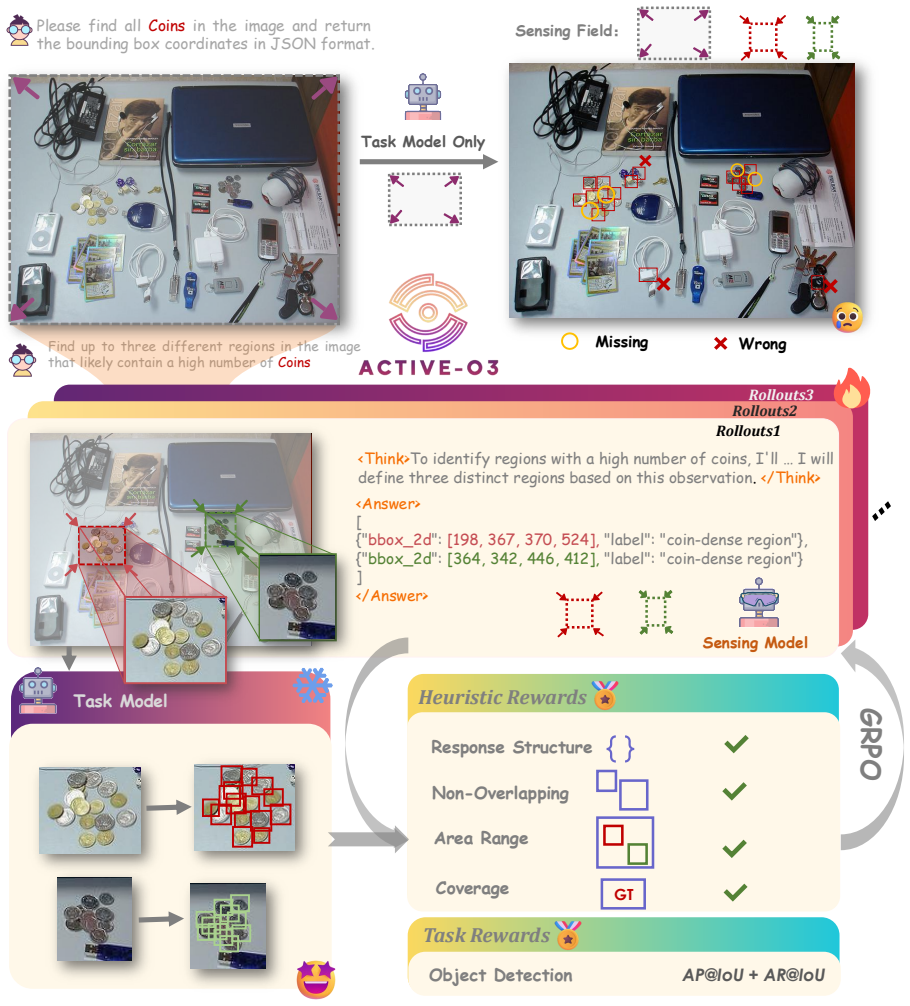
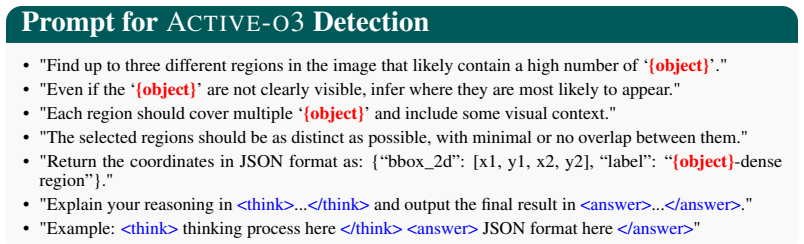
The load-bearing mechanism is the modular sensing–action decomposition combined with Group Relative Policy Optimization (GRPO), a policy-gradient update that estimates advantages from the mean and standard deviation of rewards within a group of sampled responses and therefore needs no critic model. The sensing policy $M_O$ is the same multimodal language model prompted to output up to three bounding boxes; each crop is resized and passed to the task model $M_A$, and the reward is a weighted sum of task-aware terms ($AP+AR$ for detection, $mIoU$ after SAM-based interactive segmentation) and heuristic terms (JSON validity, non-overlap threshold $\tau=0.3$, area ratio between 0.01 and 0.5, and coverage of ground-truth masks or boxes). Under the fixed-budget objective $\max_{M_O} \mathbb{E}\left[\sum_{k=1}^K R(M_A(o_k), \mathcal{I})\right]$, the reward signal is what transfers downstream utility back to region selection.
What would settle it
Train ACTIVE-O3 under the same rewards and data but with a fixed or random crop policy instead of the learned sensing policy, and compare downstream $AP$/$AR$ and $mIoU$; if that control matches or beats ACTIVE-O3, the claim that region selection is learned would be refuted.
Extended reading notes
Core claim
The central claim is that MLLM-based active perception can be formalized as a two-stage policy—a sensing policy $M_O$ proposing up to $K$ rectangular regions from a low-resolution global view, and a task model $M_A$ operating on the crops—and that GRPO, with a dual-form reward, can learn the sensing policy directly from downstream task feedback. The paper demonstrates the claim by training Qwen2.5-VL-7B-Instruct this way and reporting consistent improvements: on LVIS small and dense grounding, $AP_s$ and $AR_s$ rise by +1.0/+2.8 and +2.7/+3.5 over Qwen2.5-VL-CoT; on SODA-A and SODA-D, $AP_s$ improves by +8.5 and +13.0; and on ThinObjects interactive segmentation, $mIoU$ at zoom budget 3 rises from 0.796 to 0.863 while the chain-of-thought baseline falls to 0.561. The paper further claims the learned sensing policy is reusable: paired with Grounding DINO it improves that detector, and it transfers zero-shot to fine-grained VQA without being trained on reasoning or question-answering data.
Load-bearing premise
The load-bearing premise is that the task model can be treated as fixed while only the sensing policy is learned; in the implementation both roles are played by the same Qwen2.5-VL-7B model updated by GRPO, so gains could in principle come from improving the shared model on detection and segmentation rather than from learning where to look.
Editorial extensions
If this is right
- A model trained only on object-level rewards learns to emit spatial proposals, suggesting region-selection skill can emerge without region annotations.
- With a fixed sensing budget of three regions, ACTIVE-O3 consistently beats the chain-of-thought prompting baseline on $AP_s$/$AR_s$ for small and dense objects and on $mIoU$ for interactive segmentation.
- The same sensing policy can be paired at test time with a different, stronger task model such as Grounding DINO, improving its results and supporting the modularity of the design.
- The policy transfers zero-shot to fine-grained VQA such as V*, so detection-oriented active perception training appears to generalize to other tasks that require zooming.
Reading between the lines
- A testable extension would be a control in which crops come from a fixed or random policy under identical rewards; if that control matched ACTIVE-O3, the gains would come from the shared backbone improving on detection and segmentation rather than from learned region selection.
- The modular formulation suggests a direct path to embodied active perception: replace the crop action with camera-viewpoint control and keep the same reward structure, which the static-image experiments here do not test.
- Measuring accuracy against the number of crops used, rather than only against a fixed budget, would connect this work to compute-adaptive inference, where the model spends resolution only where the task demands.
Signed reviews
Editorial analysis
A structured set of objections, weighed in public.
Referee Report
Summary. The paper formalizes MLLM-based active perception as a two-module policy—a sensing model M_O that proposes regions and a task model M_A that executes on crops—and proposes ACTIVE-O3, a GRPO-based reinforcement learning framework with a dual-form reward (heuristic plus task-aware). Experiments are reported on LVIS small/dense grounding, SODA-A/SODA-D small-object detection, and ThinObjects interactive segmentation, with qualitative zero-shot examples on the V* benchmark. The central claim is that ACTIVE-O3 learns efficient, stable region-selection strategies without explicit region-selection supervision, substantially improving active perception over Qwen2.5-VL-CoT under a fixed sensing budget.
Significance. If the attribution of gains to the learned sensing policy were established, ACTIVE-O3 would be a practical contribution to MLLM-based active vision, leveraging pure RL without separate critic or SFT. The paper provides a clean task definition, a modular formulation, a released codebase, and a multi-domain benchmark, which are strengths. However, the current experiments do not exclude an alternative explanation—that improvements come from fine-tuning the shared task/sensing backbone on detection and segmentation rewards—and the claimed absence of explicit region-selection supervision is contradicted by a ground-truth-based coverage reward. The significance of the specific active-perception claim is therefore not yet supported.
major comments (4)
- [Section 4.2, Eq. (2), Appendix E.2, Remark D.2] The formal objective in Eq. (1) assumes M_A is fixed and optimizes only M_O, but the implementation instantiates both M_A and M_O with the same Qwen2.5-VL-7B-Instruct model and updates it with the GRPO objective in Eq. (2). As a result, the gains in Tables 1 and 2 could come from improving the shared backbone on detection rewards rather than from learning where to look. The decoupling experiment ACTIVE-O3+GDINO in Table 1 replaces M_A with Grounding DINO at test time, but it is not compared against GDINO using CoT-proposed regions, so it does not isolate the sensing policy. Please add a control that trains with fixed or random crops under the same reward, or freezes M_A during RL training.
- [Abstract and Section 1] The abstract promises that ACTIVE-O3 'can also serve as a proxy task for leveraging perception data, further improving performance on benchmarks such as RealWorldQA and MME,' but the manuscript contains no evaluation on RealWorldQA or MME. Either add the missing results or remove this claim from the abstract, since it is presently unsupported.
- [Appendix B.4 and Section 1] The abstract and Section 1 claim that ACTIVE-O3 learns region selection 'without explicit region-selection supervision,' but the coverage-based reward R_coverage in Appendix B.4 directly uses ground-truth masks and bounding boxes with thresholds θ and δ. This is explicit supervision of the selected regions, and the ablation in Table 4 shows that the combined reward includes this component. Please revise the claim or provide an ablation without R_coverage to show that the method works without it.
- [Appendix E.3 and Table 2] The SODA evaluation lowers the IoU threshold to 0.1 for detection metrics, which is non-standard and likely inflates the AP/AR values reported in Table 2. The paper should also report results under the standard COCO IoU range (0.5:0.95) or provide a systematic justification for the threshold and a sensitivity analysis, so that the advertised gains are comparable with prior work.
minor comments (5)
- [Figure 6] The word 'signicade' appears to be a typo; the intended word is likely 'sign' or 'barricade.'
- [Section 4] The notation M_A and M_O is used before the mapping to 'task model' and 'sensing model' is stated; a sentence clarifying the correspondence immediately after Eq. (1) would improve readability.
- [Section 1 and Appendix D.4] The paper repeatedly refers to 'GPT-o3' without a citation; if this is a real model, a reference is needed, and if it is a hypothetical or renamed model, the text should say so.
- [Appendix G.1] The claim of zero-shot transfer to the V* benchmark is supported only by qualitative examples in Figures 1, 10–12; a quantitative table on V* would make the claim verifiable.
- [Table 3] The row label 'LVIS + SODA-A + D' is ambiguous; it should be written as 'LVIS + SODA-A + SODA-D' for clarity.
Circularity Check
Coverage reward computed from GT boxes/masks contradicts the 'no explicit region-selection supervision' claim, and the shared-weight implementation breaks the fixed-MA assumption that would isolate the sensing policy.
-
self definitional
[Abstract; Appendix B.4 (Coverage-Based Reward) and B.5 (Overall Heuristic Reward)]
"Coverage-Based Reward. When ground truth masks or boxes are available, we assess how well the predicted regions align with task-relevant areas. This can include: (i) the proportion of ground-truth mask pixels covered by a region, (ii) the percentage of ground-truth boxes matched by at least one proposal."
The abstract's central claim is that ACTIVE-O3 'autonomously learns efficient and stable region selection strategies without explicit region-selection supervision.' But R_heuristic (B.5) includes λ4 R_coverage, and R_coverage is defined directly from GT masks/boxes: a proposal is rewarded for covering GT pixels or matching GT boxes. The sensing policy is therefore optimized against region-level GT, so the claimed absence of explicit region-selection supervision is contradicted by the paper's own reward construction. The 'autonomous' region-selection result is not derived; it is built into the reward by definition.
-
other
[Section 3 Eq. (1); Section 4; Appendix E.2; Remark D.2]
"In the 2D setting, we assume a fixed task model MA and focus on learning a sensing policy MO that selects K informative regions from a static image I based on an initial observation oinit and instruction I."
Eq. (1) optimizes only MO with MA fixed, but Appendix E.2 states 'We use Qwen2.5-VL-7B-Instruct as the shared policy backbone πθ,' and Section 4 instantiates both MA and MO as parses of the same π. Thus the 'fixed' task model is co-trained during GRPO. Observed LVIS/SODA gains may come from improving the shared model on detection rewards rather than from learning where to look, and the ACTIVE-O3+GDINO decoupling is not compared against GDINO with CoT-proposed regions. This is an attribution confound rather than an equation-level identity, but it prevents the central sensing-policy claim from being established by the stated optimization.
full rationale
The paper contains no load-bearing self-citation or imported uniqueness theorem, and the held-out LVIS/SODA evaluations provide independent evidence that the training recipe improves downstream detection. However, two load-bearing steps in the claimed chain do not hold as stated. First, the 'without explicit region-selection supervision' contribution is contradicted by the GT-based coverage reward in Appendix B.4; the learned region proposals are rewarded for matching GT boxes/masks, so this part of the claim reduces to the reward definition. Second, the formal objective assumes MA is fixed while the implementation shares and updates one MLLM for both MA and MO, so the measured gains are not cleanly attributable to the sensing policy. These issues make the central narrative partially circular/overclaimed, but they do not collapse the empirical comparisons, so a moderate score is appropriate.
Assumptions & free parameters
free parameters (6)
- Heuristic reward weights lambda_1..lambda_4 =
all set to 1
- Non-overlap IoU threshold tau =
0.3
- Area ratio bounds =
0.01 to 0.5 of image area
- Coverage and matching thresholds theta, delta =
not specified
- SODA evaluation IoU threshold =
0.1
- Number of proposed regions K =
3
assumptions (6)
- standard math GRPO with clipped importance ratios and KL regularization is a valid optimizer for the MLLM policy (Eq. 2).
- domain assumption The task model M_A can be treated as fixed while only the sensing policy M_O is optimized.
- domain assumption Rewards computed from ground-truth boxes and masks are a valid training signal for the sensing policy.
- domain assumption Static 2D crop selection with up to three boxes is a representative proxy for active perception.
- ad hoc to paper GPT-o3 uses a zoom-in search strategy and is inefficient and inaccurate.
- domain assumption Training on 1,000 images from each target-domain SODA split supports claims of domain generalization.
invented entities (1)
-
Oracle task model for interactive segmentation
Cite this review
Pith. "Pith review of ACTIVE-o3: Empowering MLLMs with Active Perception via Pure Reinforcement Learning." pith.science (2026). https://pith.science/paper/VNAKPWUD
@misc{pith2026250521457,
  author       = {Pith},
  title        = {Pith review of: ACTIVE-o3: Empowering MLLMs with Active Perception via Pure Reinforcement Learning},
  year         = {2026},
  howpublished = {\url{https://pith.science/paper/VNAKPWUD}},
  note         = {Machine review of arXiv:2505.21457}
}
read the original abstract
Active vision, also known as active perception, refers to actively selecting where and how to look in order to gather task-relevant information. It is a critical component of efficient perception and decision-making in humans and advanced embodied agents. With the rise of Multimodal Large Language Models (MLLMs) as central planners in robotic systems, the lack of methods for equipping MLLMs with active perception has become a key gap. We first provide a systematic definition of MLLM-based active perception tasks and show that GPT-o3's zoom-in strategy can be viewed as a special case, though it suffers from low efficiency and inaccurate region selection. To address these issues, we propose ACTIVE-o3, a reinforcement learning framework built on GRPO that equips MLLMs with active perception capabilities. Leveraging a modular sensing-action design and a dual-form reward, ACTIVE-o3 autonomously learns efficient and stable region selection strategies without explicit region-selection supervision. We further establish a comprehensive benchmark covering both open-world tasks, including small- and dense-object grounding, and domain-specific scenarios, including remote sensing, autonomous driving, and interactive segmentation. Experimental results demonstrate that ACTIVE-o3 significantly enhances active perception capabilities compared to baselines. Moreover, we show that our framework not only preserves the model's general understanding ability but can also serve as a proxy task for leveraging perception data, further improving performance on benchmarks such as RealWorldQA and MME.
Figures


Figures from the paper (13 more)




Forward citations
Cited by 10 Pith papers
-
Where to Look: Can Foundation Models Reach a Target Viewpoint Through Active Exploration?
Introduces the TVR active viewpoint-matching task and TVRBench indoor simulation benchmark, where foundation models start at low single-digit success rates but reach 51.4% after visual-action SFT and multi-turn GRPO p...
-
Eliciting Complex Spatial Reasoning in MLLMs through Wide-Baseline Matching
Authors create ReasonMatch-Bench and DCRL training to boost MLLM performance on wide-baseline matching, reporting gains over baselines while preserving general capabilities.
-
PInVerify: An Offline Embodied Benchmark for Active Instance Verification
PInVerify is a new offline embodied benchmark for active instance verification that supplies multi-view captures and 6-sector navigation topology, with MLLM baselines reaching 85.6% after fine-tuning but showing no re...
-
Diversity Over Frequency: Rethinking Tool Use in Visual Chain-of-Thought Agents
Visual CoT agents exhibit tool-use collapse where tool usage declines but task accuracy rises, and adding entropy regularization for rollout diversity produces the strongest performance.
-
InSight-doc: Agentic Visual Perception for Long-Document Understanding
InSight-doc trains an 8B vision-language model to zoom into document sub-regions on demand, improving long-document VQA accuracy by up to 16.4 points while cutting latency by 41-68%.
-
BVS: Bayesian Visual Search with Multimodal Large Language Model for Fine-grained Perception
BVS combines early-stop attention rollout priors with a scale-aware non-stationary kernel and GP-UCB to locate tiny objects in UHR images more accurately and with fewer MLLM queries than prior visual-search methods.
-
EAGLE-360: Embodied Active Global-to-Local Exploration in 360$^\circ$
EAGLE-360 introduces a global-to-local exploration framework for 360° visual search, adapting RoPE Rolling, creating a new VQA dataset, and using SFT+GRPO training to claim SOTA performance with 8x accuracy gain.
-
Learning Active Perception via Self-Evolving Preference Optimization for GUI Grounding
LASER uses self-evolving preference optimization to teach GUI models to crop and zoom before clicking, reaching 55.7% on ScreenSpot-Pro with a 7B model.
-
From Structure to Synergy: A Survey of Vision-Language Perception Paradigm Evolution in Multimodal Large Language Models
The survey formalizes MLLM perception as a unified vision-language capability and traces its evolution via a new five-stage taxonomy while outlining future challenges.
-
Latent Visual States for Efficient Multimodal Reasoning
EVA generates adaptive Latent_slot tokens as internal visual thoughts, trained end-to-end with text tokens via D-GSPO on the EVA-230K dataset, claiming performance gains and better inference efficiency.
Reference graph
Works this paper leans on
-
[1]
Active vision.International journal of computer vision, 1:333–356, 1988
John Aloimonos, Isaac Weiss, and Amit Bandyopadhyay. Active vision.International journal of computer vision, 1:333–356, 1988. 1, 3
work page 1988
-
[2]
Animate vision.Artificial intelligence, 48(1):57–86, 1991
Dana H Ballard. Animate vision.Artificial intelligence, 48(1):57–86, 1991. 1, 3
work page 1991
-
[3]
Peter Whaite and Frank P Ferrie. Autonomous exploration: Driven by uncertainty.IEEE Transactions on Pattern Analysis and Machine Intelligence, 19(3):193–205, 1997. 1, 3
work page 1997
-
[4]
Active vision for dexterous grasping of novel objects
Ermano Arruda, Jeremy Wyatt, and Marek Kopicki. Active vision for dexterous grasping of novel objects. In2016 IEEE/RSJ International Conference on Intelligent Robots and Systems (IROS), pages 2881–2888. IEEE, 2016. 1, 4
work page 2016
-
[5]
Neural modular control for embodied question answering
Abhishek Das, Georgia Gkioxari, Stefan Lee, Devi Parikh, and Dhruv Batra. Neural modular control for embodied question answering. InConference on robot learning, pages 53–62. PMLR, 2018. 1, 4
work page 2018
-
[6]
Learning to explore using active neural slam.arXiv preprint arXiv:2004.05155, 2020
Devendra Singh Chaplot, Dhiraj Gandhi, Saurabh Gupta, Abhinav Gupta, and Ruslan Salakhut- dinov. Learning to explore using active neural slam.arXiv preprint arXiv:2004.05155, 2020. 1, 3, 4
arXiv 2004
-
[7]
Gpt-4 technical report.arXiv preprint arXiv:2303.08774, 2023
Josh Achiam, Steven Adler, Sandhini Agarwal, Lama Ahmad, Ilge Akkaya, Florencia Leoni Aleman, Diogo Almeida, Janko Altenschmidt, Sam Altman, Shyamal Anadkat, et al. Gpt-4 technical report.arXiv preprint arXiv:2303.08774, 2023. 2, 3
arXiv 2023
-
[8]
Openai o1 system card.arXiv preprint arXiv:2412.16720, 2024
Aaron Jaech, Adam Kalai, Adam Lerer, Adam Richardson, Ahmed El-Kishky, Aiden Low, Alec Helyar, Aleksander Madry, Alex Beutel, Alex Carney, et al. Openai o1 system card.arXiv preprint arXiv:2412.16720, 2024. 2
arXiv 2024
Show all 44 references
-
[9]
Deepseek-v3 technical report.arXiv preprint arXiv:2412.19437, 2024
Aixin Liu, Bei Feng, Bing Xue, Bingxuan Wang, Bochao Wu, Chengda Lu, Chenggang Zhao, Chengqi Deng, Chenyu Zhang, Chong Ruan, et al. Deepseek-v3 technical report.arXiv preprint arXiv:2412.19437, 2024. 2, 3
2024 arXiv
-
[10]
Shuai Bai, Keqin Chen, Xuejing Liu, Jialin Wang, Wenbin Ge, Sibo Song, Kai Dang, Peng Wang, Shijie Wang, Jun Tang, et al. Qwen2. 5-vl technical report.arXiv preprint arXiv:2502.13923,
-
[11]
Sofar: Language-grounded orientation bridges spatial reasoning and object manipulation.arXiv preprint arXiv:2502.13143, 2025
Zekun Qi, Wenyao Zhang, Yufei Ding, Runpei Dong, Xinqiang Yu, Jingwen Li, Lingyun Xu, Baoyu Li, Xialin He, Guofan Fan, et al. Sofar: Language-grounded orientation bridges spatial reasoning and object manipulation.arXiv preprint arXiv:2502.13143, 2025. 2
2025
-
[12]
Magma: A foundation model for multimodal ai agents
Jianwei Yang, Reuben Tan, Qianhui Wu, Ruijie Zheng, Baolin Peng, Yongyuan Liang, Yu Gu, Mu Cai, Seonghyeon Ye, Joel Jang, et al. Magma: A foundation model for multimodal ai agents. arXiv preprint arXiv:2502.13130, 2025. 2
2025 arXiv
-
[13]
Gemini robotics: Bringing ai into the physical world.arXiv preprint arXiv:2503.20020, 2025
Gemini Robotics Team, Saminda Abeyruwan, Joshua Ainslie, Jean-Baptiste Alayrac, Montser- rat Gonzalez Arenas, Travis Armstrong, Ashwin Balakrishna, Robert Baruch, Maria Bauza, Michiel Blokzijl, et al. Gemini robotics: Bringing ai into the physical world.arXiv preprint arXiv:25...
2025 arXiv
-
[14]
Openvla: An open-source vision-language-action model.arXiv preprint arXiv:2406.09246, 2024
Moo Jin Kim, Karl Pertsch, Siddharth Karamcheti, Ted Xiao, Ashwin Balakrishna, Suraj Nair, Rafael Rafailov, Ethan Foster, Grace Lam, Pannag Sanketi, et al. Openvla: An open-source vision-language-action model.arXiv preprint arXiv:2406.09246, 2024. 2, 4
2024 arXiv
-
[15]
pi0: A vision-language-action flow model for general robot control.arXiv preprint arXiv:2410.24164, 2024
Kevin Black, Noah Brown, Danny Driess, Adnan Esmail, Michael Equi, Chelsea Finn, Niccolo Fusai, Lachy Groom, Karol Hausman, Brian Ichter, et al. pi0: A vision-language-action flow model for general robot control.arXiv preprint arXiv:2410.24164, 2024. 2, 4
-
[16]
\pi_0.5: A vision- language-action model with open-world generalization.arXiv preprint arXiv:2504.16054, 2025
Physical Intelligence, Kevin Black, Noah Brown, James Darpinian, Karan Dhabalia, Danny Driess, Adnan Esmail, Michael Equi, Chelsea Finn, Niccolo Fusai, et al. \pi_0.5: A vision- language-action model with open-world generalization.arXiv preprint arXiv:2504.16054, 2025. 2
2025 arXiv
-
[17]
Deepseek-r1: Incentivizing reasoning capability in llms via reinforcement learning.arXiv preprint arXiv:2501.12948, 2025
Daya Guo, Dejian Yang, Haowei Zhang, Junxiao Song, Ruoyu Zhang, Runxin Xu, Qihao Zhu, Shirong Ma, Peiyi Wang, Xiao Bi, et al. Deepseek-r1: Incentivizing reasoning capability in llms via reinforcement learning.arXiv preprint arXiv:2501.12948, 2025. 3
2025 arXiv
-
[18]
V?: Guided visual search as a core mechanism in multimodal llms
Penghao Wu and Saining Xie. V?: Guided visual search as a core mechanism in multimodal llms. InProceedings of the IEEE/CVF Conference on Computer Vision and Pattern Recognition, pages 13084–13094, 2024. 3, 17 25
2024
-
[19]
Llama 2: Open foundation and fine-tuned chat models.arXiv preprint arXiv:2307.09288, 2023
Hugo Touvron, Louis Martin, Kevin Stone, Peter Albert, Amjad Almahairi, Yasmine Babaei, Nikolay Bashlykov, Soumya Batra, Prajjwal Bhargava, Shruti Bhosale, et al. Llama 2: Open foundation and fine-tuned chat models.arXiv preprint arXiv:2307.09288, 2023. 3
2023 arXiv
-
[20]
Qwen technical report.arXiv preprint arXiv:2309.16609, 2023
Jinze Bai, Shuai Bai, Yunfei Chu, Zeyu Cui, Kai Dang, Xiaodong Deng, Yang Fan, Wenbin Ge, Yu Han, Fei Huang, et al. Qwen technical report.arXiv preprint arXiv:2309.16609, 2023. 3
2023 arXiv
-
[21]
Deepseek llm: Scaling open-source language models with longtermism.arXiv preprint arXiv:2401.02954, 2024
Xiao Bi, Deli Chen, Guanting Chen, Shanhuang Chen, Damai Dai, Chengqi Deng, Honghui Ding, Kai Dong, Qiushi Du, Zhe Fu, et al. Deepseek llm: Scaling open-source language models with longtermism.arXiv preprint arXiv:2401.02954, 2024. 3
2024 arXiv
-
[22]
Visual instruction tuning.Advances in neural information processing systems, 36:34892–34916, 2023
Haotian Liu, Chunyuan Li, Qingyang Wu, and Yong Jae Lee. Visual instruction tuning.Advances in neural information processing systems, 36:34892–34916, 2023. 3
2023
-
[23]
Internvl: Scaling up vision foundation models and aligning for generic visual-linguistic tasks
Zhe Chen, Jiannan Wu, Wenhai Wang, Weijie Su, Guo Chen, Sen Xing, Muyan Zhong, Qinglong Zhang, Xizhou Zhu, Lewei Lu, et al. Internvl: Scaling up vision foundation models and aligning for generic visual-linguistic tasks. InProceedings of the IEEE/CVF conference on computer visi...
2024
-
[24]
Deepseek-vl: towards real-world vision-language under- standing.arXiv preprint arXiv:2403.05525, 2024
Haoyu Lu, Wen Liu, Bo Zhang, Bingxuan Wang, Kai Dong, Bo Liu, Jingxiang Sun, Tongzheng Ren, Zhuoshu Li, Hao Yang, et al. Deepseek-vl: towards real-world vision-language under- standing.arXiv preprint arXiv:2403.05525, 2024. 3
2024 arXiv
-
[25]
Deepseek-vl2: Mixture-of-experts vision- language models for advanced multimodal understanding.arXiv preprint arXiv:2412.10302,
Zhiyu Wu, Xiaokang Chen, Zizheng Pan, Xingchao Liu, Wen Liu, Damai Dai, Huazuo Gao, Yiyang Ma, Chengyue Wu, Bingxuan Wang, et al. Deepseek-vl2: Mixture-of-experts vision- language models for advanced multimodal understanding.arXiv preprint arXiv:2412.10302,
-
[26]
Long Ouyang, Jeff Wu, Xu Jiang, Diogo Almeida, Carroll L. Wainwright, Pamela Mishkin, Chong Zhang, Sandhini Agarwal, Katarina Slama, Alex Ray, John Schulman, Jacob Hilton, Fraser Kelton, Luke Miller, Maddie Simens, Amanda Askell, Peter Welinder, Paul Christiano, Jan Leike, and...
2022
-
[27]
Deepseekmath: Pushing the limits of mathematical reasoning in open language models.arXiv preprint arXiv:2402.03300, 2024
Zhihong Shao, Peiyi Wang, Qihao Zhu, Runxin Xu, Junxiao Song, Xiao Bi, Haowei Zhang, Mingchuan Zhang, YK Li, Y Wu, et al. Deepseekmath: Pushing the limits of mathematical reasoning in open language models.arXiv preprint arXiv:2402.03300, 2024. 3
2024 arXiv
-
[28]
R1-omni: Explainable omni-multimodal emotion recognition with reinforcement learning, 2025
Jiaxing Zhao, Xihan Wei, and Liefeng Bo. R1-omni: Explainable omni-multimodal emotion recognition with reinforcement learning, 2025. 3
2025
-
[29]
Video-r1: Reinforcing video reasoning in mllms, 2025
Kaituo Feng, Kaixiong Gong, Bohao Li, Zonghao Guo, Yibing Wang, Tianshuo Peng, Junfei Wu, Xiaoying Zhang, Benyou Wang, and Xiangyu Yue. Video-r1: Reinforcing video reasoning in mllms, 2025. 3
2025
-
[30]
Visual-rft: Visual reinforcement fine-tuning.arXiv preprint arXiv:2503.01785,
Ziyu Liu, Zeyi Sun, Yuhang Zang, Xiaoyi Dong, Yuhang Cao, Haodong Duan, Dahua Lin, and Jiaqi Wang. Visual-rft: Visual reinforcement fine-tuning.arXiv preprint arXiv:2503.01785,
-
[31]
Vision-r1: Incentivizing reasoning capability in multimodal large language models.arXiv preprint arXiv:2503.06749, 2025
Wenxuan Huang, Bohan Jia, Zijie Zhai, Shaosheng Cao, Zheyu Ye, Fei Zhao, Zhe Xu, Yao Hu, and Shaohui Lin. Vision-r1: Incentivizing reasoning capability in multimodal large language models.arXiv preprint arXiv:2503.06749, 2025. 3
2025 arXiv
-
[32]
Vlm-r1: A stable and generalizable r1-style large vision-language model.arXiv preprint arXiv:2504.07615, 2025
Haozhan Shen, Peng Liu, Jingcheng Li, Chunxin Fang, Yibo Ma, Jiajia Liao, Qiaoli Shen, Zilun Zhang, Kangjia Zhao, Qianqian Zhang, et al. Vlm-r1: A stable and generalizable r1-style large vision-language model.arXiv preprint arXiv:2504.07615, 2025. 3
2025 arXiv
-
[33]
Iqa: Visual question answering in interactive environments
Daniel Gordon, Aniruddha Kembhavi, Mohammad Rastegari, Joseph Redmon, Dieter Fox, and Ali Farhadi. Iqa: Visual question answering in interactive environments. InProceedings of the IEEE conference on computer vision and pattern recognition, pages 4089–4098, 2018. 3
2018
-
[34]
Object goal navigation using goal-oriented semantic exploration.Advances in Neural Information Processing Systems, 33:4247–4258, 2020
Devendra Singh Chaplot, Dhiraj Prakashchand Gandhi, Abhinav Gupta, and Russ R Salakhut- dinov. Object goal navigation using goal-oriented semantic exploration.Advances in Neural Information Processing Systems, 33:4247–4258, 2020. 3
2020
-
[35]
Learning to look around: Intelligently exploring unseen environments for unknown tasks
Dinesh Jayaraman and Kristen Grauman. Learning to look around: Intelligently exploring unseen environments for unknown tasks. InProceedings of the IEEE conference on computer vision and pattern recognition, pages 1238–1247, 2018. 3, 4 26
2018
-
[36]
Target-driven visual navigation in indoor scenes using deep reinforcement learning
Yuke Zhu, Roozbeh Mottaghi, Eric Kolve, Joseph J Lim, Abhinav Gupta, Li Fei-Fei, and Ali Farhadi. Target-driven visual navigation in indoor scenes using deep reinforcement learning. In2017 IEEE international conference on robotics and automation (ICRA), pages 3357–3364. IEEE, 2017. 3
2017
-
[37]
Objectnav revisited: On evaluation of embodied agents navigating to objects.arXiv preprint arXiv:2006.13171, 2020
Dhruv Batra, Aaron Gokaslan, Aniruddha Kembhavi, Oleksandr Maksymets, Roozbeh Mottaghi, Manolis Savva, Alexander Toshev, and Erik Wijmans. Objectnav revisited: On evaluation of embodied agents navigating to objects.arXiv preprint arXiv:2006.13171, 2020. 3
2006 arXiv
-
[38]
Sofar: Language-grounded orientation bridges spatial reasoning and object manipulation, 2025
Zekun Qi, Wenyao Zhang, Yufei Ding, Runpei Dong, Xinqiang Yu, Jingwen Li, Lingyun Xu, Baoyu Li, Xialin He, Guofan Fan, Jiazhao Zhang, Jiawei He, Jiayuan Gu, Xin Jin, Kaisheng Ma, Zhizheng Zhang, He Wang, and Li Yi. Sofar: Language-grounded orientation bridges spatial reasoning...
2025
-
[39]
Grounding dino: Marrying dino with grounded pre-training for open-set object detection
Shilong Liu, Zhaoyang Zeng, Tianhe Ren, Feng Li, Hao Zhang, Jie Yang, Qing Jiang, Chunyuan Li, Jianwei Yang, Hang Su, et al. Grounding dino: Marrying dino with grounded pre-training for open-set object detection. InEuropean Conference on Computer Vision, pages 38–55. Springer,
-
[40]
Grounded sam: Assembling open-world models for diverse visual tasks.arXiv preprint arXiv:2401.14159, 2024
Tianhe Ren, Shilong Liu, Ailing Zeng, Jing Lin, Kunchang Li, He Cao, Jiayu Chen, Xinyu Huang, Yukang Chen, Feng Yan, et al. Grounded sam: Assembling open-world models for diverse visual tasks.arXiv preprint arXiv:2401.14159, 2024. 9
2024 arXiv
-
[41]
Lvis: A dataset for large vocabulary instance segmentation
Agrim Gupta, Piotr Dollar, and Ross Girshick. Lvis: A dataset for large vocabulary instance segmentation. InProceedings of the IEEE/CVF conference on computer vision and pattern recognition, pages 5356–5364, 2019. 9, 16
2019
-
[42]
Towards large-scale small object detection: Survey and benchmarks.IEEE Transactions on Pattern Analysis and Machine Intelligence, 45(11):13467–13488, 2023
Gong Cheng, Xiang Yuan, Xiwen Yao, Kebing Yan, Qinghua Zeng, Xingxing Xie, and Junwei Han. Towards large-scale small object detection: Survey and benchmarks.IEEE Transactions on Pattern Analysis and Machine Intelligence, 45(11):13467–13488, 2023. 10, 16
2023
-
[43]
Sam 2: Segment anything in images and videos.arXiv preprint arXiv:2408.00714, 2024
Nikhila Ravi, Valentin Gabeur, Yuan-Ting Hu, Ronghang Hu, Chaitanya Ryali, Tengyu Ma, Haitham Khedr, Roman Rädle, Chloe Rolland, Laura Gustafson, et al. Sam 2: Segment anything in images and videos.arXiv preprint arXiv:2408.00714, 2024. 13
2024 arXiv
-
[44]
Deep interactive thin object selection
Jun Hao Liew, Scott Cohen, Brian Price, Long Mai, and Jiashi Feng. Deep interactive thin object selection. InProceedings of the IEEE/CVF Winter Conference on Applications of Computer Vision, pages 305–314, 2021. 16 27
2021
Reviewed August 7, 2026 · model on record in the stance chip above.
Discussion (0). Continue with ORCID to comment.